
What Drove Timing of NYTimes Publishing Risen-Apuzzo Disclosure of McHale Jundallah Contacts?

Saturday night, the New York Times published a blockbuster article by James Risen and Matt Apuzzo that was then carried on the front page of Sunday’s print edition. The article described the jaw-dropping revelation that somehow, a lowly Port Authority detective wound up as the primary contact for Jundallah, a Sunni extremist group on the Iran-Pakistan border that attacks Iran (and sometimes Pakistan) with an aim to unify the region that is home to the Baloch people. Further, it appears that through Thomas McHale’s contacts (and McHale’s membership in a Joint Terrorism Task Force), information on Jundallah attacks filtered into the CIA and FBI prior to their being carried out in Iran.

Iran has long accused the US and Israel of having associations with Jundallah, even going so far as to state that the CIA and/or Mossad equip them and help them to plan their attacks. With negotiations between the P5+1 group of countries and Iran now in the home stretch toward a November 24 deadline, Saturday’s disclosure could hardly have come at a worse time. In fact, John Kerry was in Oman, meeting with Iranian Foreign Minister Mohammad Zarif and Catherine Ashton from the EU over the weekend. Despite this disclosure coming out, Sunday’s negotiating session turned into two sessions and a further session was even added on Monday. Upbeat news is still flowing from that meeting, so on first blush the disclosure Saturday didn’t completely disrupt the talks.

My first thought on seeing the article was that it fit perfectly with the previous front page effort by the Times at disrupting the talks. David Sanger “mistakenly” claimed that a new wrinkle in the negotiations would allow Russia to take over enrichment for Iran. This would almost certainly give hardliners the room they need to kill the deal, since maintaining enrichment capacity is a redline issue for Iran.

The reality is that what is under discussion is that Iran would continue its enrichment activities, but ship low enriched uranium to Russia where it would be converted into fuel rods. Evidence that this pathway is making progress can be seen in this morning’s announcement that Iran and Russia have signed an agreement for Russia to build two more nuclear power plants in Iran. It seems that a new wrinkle on the arrangement might allow Russia to prepare the fuel rods inside Iran:

Russia, which is involved in those talks, will also cooperate with Teheran on developing more nuclear power units in Iran, and consider producing nuclear fuel components there, according to a memorandum signed by the heads of the state atomic bodies, Sergey Kirienko of Russia’s Rosatom and Ali Akbar Salehi of Iran’s Atomic Energy Organization (AEOI).

Just as hinting falsely that Iran was negotiating away its enrichment technology was a move by the Times that could have disastrous effects on the ongoing negotiations, I felt that providing this strange story on McHale would give ammunition to those in Iran who see the CIA behind Jundallah. However,there is another possibility. In a Twitter discussion with Arif Rafiq on the disclosure, Rafiq suggested that “the US is coming clean about something that has concerned Iranians for years. Could be a plus”. He later allowed that hardliners could see it as a smoking gun. A further interesting speculation from Laura Rozen on Twitter suggested that perhaps the US played both sides of Jundallah:

So let’s consider these nicer possibilities for a moment. Maybe we did give Rigi to the Iranians. Maybe we are admitting Jundallah contacts now as a way of making sure it ends. But if that is the case, Risen and Apuzzo are a very strange source for how this news came out. An admission of this sort is what I would expect to be routed through David Ignatius, Eli Lake or Josh Rogin. Risen would be especially difficult to see as cooperating with specific timing on a disclosure. Recall that the Times spiked his disclosure of Bush’s illegal wiretaps until after the 2004 elections and then only published when the book was about to drop. To believe that Risen is now somehow cooperating with the government is a huge stretch, but he does still appear to be at risk of being subpoenaed in the ongoing DOJ actions in response to the wiretapping disclosure.

Many issues surrounding US support for Jundallah (and MEK) are still quite unresolved in my view. Recall that we had the whole “false flag” controversy back in January of 2012, where it was “disclosed” that Mossad ran Jundallah while posing as CIA. Not too long after that, Sy Hersh disclosed that the US has trained operatives for the MEK (no mention of Jundallah at all in the article) for covert actions against Iran. What particularly raised my hackles in that report was that the training was held at the same site in Nevada where I suspect that the materials used in the 2001 anthrax attacks was produced.

Over at Moon of Alabama, b seems to feel that the US was indeed behind the running of Jundallah. For that to be the case, we are pretty much forced to believe that Risen and Apuzzo have been either duped or coerced. I find so much of what has come out to be conflicting that I doubt we’ll ever completely sort this out. I have no doubts that JSOC and CIA stand ready to see Iran’s enemies prosper, especially as we saw in the MEK training in Nevada. When it comes to involvement in actual operations, I just don’t know. But the possibility that we helped at some times and then handed over Rigi possibly to make up for it sounds so like what our rudderless intelligence services would do that I’m leaning that direction.
Share this entry

Suicide Bomber Strikes Near Pakistan-India Flag-Lowering Border Site

The video above shows the elaborate ceremony that takes place daily at the Wagah border crossing just outside the Pakistani city of Lahore. On Sunday evening, a suicide bomber who was stopped at a checkpoint just outside the ceremonial site detonated his vest as Pakistanis were returning from the flag-lowering. The death toll now stands near 60 and over 100 were injured. Because thousands attend this ceremony every day, the crowds are quite dense as they leave the site. From the New York Times:

Spectators viewing the ceremony have to pass through two security checkpoints before entering the site.

Pakistani officials said the suicide bomber detonated the explosives in front of a line of shops 500 to 600 yards from the main site, at a time when security was lax after the flag-lowering ceremony had concluded.

Attendance was high on Sunday because it was a holiday, and many visitors had come from other towns and cities

At least two militant groups have claimed responsibility:

The Jamaat-ul-Ahrar splinter group of the proscribed Tehreek-i-Taliban Pakistan (TTP) claimed responsibility for the Wagah border attack as its spokesman Ehsanullah Ehsan, speaking to Dawn on telephone from Afghanistan, said it was carried out by one of their men.

When asked if it was more than one suicide bomber, he said one man carried out the attack.

“We will continue such attacks in the future,” Ehsan said.

“Some other groups have claimed responsibility of this attack, but these claims are baseless. We will soon release the video of this attack,” he said.

“This attack is revenge for the killing of innocent people in North Waziristan,” the banned militant group’s spokesman said.

Earlier Jundullah, another outlawed group which was behind a suicide bombing that killed at least 78 Christians at a church in Peshawar last September, had also claimed responsibility for the Wagah border attack.

The spokesman of the splinter group of the TTP Ahmed Marwat via telephone said that the attack is a reaction to military operation Zarb-i-Azb and Waziristan operation.

Jundullah and the much larger Pakistani Taliban are among loosely aligned militant groups that frequently share personnel, tactics and agendas. Claims for specific incidents are often hard to verify.

Note that this Jundallah group is not the same one that carries out attacks on the Iran-Pakistan border.

Reuters reports that intelligence agencies for Pakistan and India had warning that an attack was coming and increased security measures prevented the bomber getting to the actual site of the flag-lowering:

“It appears the bomber wanted to target ground zero where Pakistan and India border officials stand together to perform the flag ceremony but he could not enter due to tight security on the last gate,” a Pakistani intelligence official told Reuters.

“Had he managed to reach the place, there would have been the worst scenario at both sides.”

If successful, such an attack would likely have severely tested ties between India and Pakistan, already frayed after weeks of shelling further along the border killed 17 people in October.

Unrest is not very common in Lahore. It was, however, the scene of the Raymond Davis fiasco. I’ve long been of the opinion that Davis served as a recruiter both in the US and in Pakistan, so it would be irresponsible not to wonder whether any of his recruits had a hand in Sunday’s event.

Share this entry

After Acid Attacks on Women, Rouhani Speaks Out Against “Discord” “Under the Flag of Islam”

In the historic  city of Isfahan in Iran yesterday, several thousand protesters gathered in front of the judiciary building and shouted slogans against assailants who have thrown acid on a number of women in recent weeks. Even though a spokesman for the Iranian judiciary announced Monday that four attackers had been arrested and that the harshest possible punishment will be handed out, the protesters appeared to feel that not enough is being done.

The Guardian describes the situation that led to the protests:

Assailants riding on motorbikes, in a similar sequence of events, have thrown acid in the face of at least eight women who were driving in the street with their windows pulled down. Local media say the number of victims could be higher. The attacks have so far claimed one life, an opposition website said.

Many Iranians believe that victims were targeted because they were women wearing clothes that could be deemed inappropriate in the eyes of hardliners – a claim vehemently denied by the authorities.

Isfahani citizens, horrified by the scale of vicious assaults, gathered in front of the city’s justice department on Wednesday, calling on the authorities to put an end to the crimes which has highlighted the striking challenges women face in Iran, where hijab is obligatory.

A number of protesters in Isfahan chanted slogans that described the attackers as Iran’s own version of Isis, the extremist group that has committed many atrocities in Iraq and Syria.

A number of videos of the protest appear to exist. Interestingly, they appear to be from Iranian opposition groups. One of the groups also put up some photos from the protest.

Somehow, I suspect that these opposition groups will be very unhappy with Thomas Erdbrink’s coverage of the protest, though. Erdbrink notes that the protest appears to have been organized through social media, which may be a hint that he thinks the opposition groups helped to organize it. The opposition groups would go along with Erdbrink’s coverage of a proposed new law at the heart of the controversy:

The acid attacks have prompted a heightened resistance to the new law, which Parliament passed on Sunday. The law is aimed at protecting citizens who feel compelled to correct those who, in their view, do not adhere to Iran’s strict social laws. The details of the law, which would officially empower the government and private citizens to give verbal or written statements on social mores, have yet to be completed.

While strict rules on dress, alcohol, sexual relations and much more are not new, the law is aimed at defining crimes against propriety or decency, which in the past would often be corrected informally. In Iran, where most people live in cities and many are highly educated, conservatives are trying to avert changes in attitudes by enforcing traditions.

But Erdbrink points out that Hassan Rouhani spoke out very forcefully against the law, providing a stark contrast to the image the opposition paints of him going along with harsh punishment meted out by conservatives:

President Hassan Rouhani strongly criticized the new law on Wednesday, saying that he feared it would divide society because, as many observers have pointed out, in reality it offers the country’s small but influential faction of hard-liners more power.

“The sacred call to virtue is not the right of a select group of people, a handful taking the moral high ground and acting as guardians,” Mr. Rouhani said during a trip to the provincial city of Zanjan. “It is upon all Muslims to exhort love, respect for others and human dignity.”

“May such a day never come that some lead our society down the path to insecurity, sow discord and cause divisions, all under the flag of Islam,” he said, his voice shaking with emotion.

What a powerful statement. Imagine if Barack Obama said “May such a day never come that some lead our society down the path to insecurity, sow discord and cause divisions, all under the flag of Christianity”. And imagine if he said it with a voice shaking with emotion.

Sadly, both Iran and the United States have already reached that point where religious conservatives have caused insecurity, sown discord and caused divisions. And that is what makes Rouhani’s statement so dangerously courageous and prevents Obama from ever contemplating doing the same.

Share this entry

Border Incidents Escalate Again: Iran Kills Pakistani Soldier

Back on Thursday, I noted that Iran claimed the right to enter Pakistani territory to chase terrorists that it blames for a series of border incidents that have killed a number of Iranian border guards. Iran wasted no time following up on that threat, as on Thursday night Iranian shelling killed one Pakistani soldier. Iran followed that up with border guards entering Pakistani territory on Friday to interrogate a number of villagers. It appears that Iran confiscated a vehicle and other items during the incursion. Diplomatic posturing ensued.

Interestingly, Pakistan claims that the Frontier Corpsman who was killed by Iran was in the process of chasing “miscreants” when the soldiers came under fire:

“The FC personnel were chasing miscreants when they came under attack by Iranian forces. It was a targeted attack on Pakistani forces,” the spokesperson added. One FC vehicle was completely destroyed due to intense firing by Iranian forces.
Iranian border guards continued firing for six hours. However, Pakistani forces did not retaliate to the offensive of the neighbouring country.

The big question is whether Iran feels that Pakistan’s Frontiers Corps is aiding the groups that cross into Iran or whether the Pakistani forces came under fire in this case through a mistake when they were chasing the same “miscreants” Iran presumably wished to target.

There was a small amount of additional cross-border shelling on Saturday that appeared to have no effect.

For their part, Iran does not seem to have addressed the events Thursday night through Saturday, although they did put out a statement today praising their strong security in the border region and comparing the terrorist attacks to “mosquito bites”. Iran blamed trans-regional enemies (the Americans and Zionists) as well as unnamed regional enemies for the attacks.

In an analysis of the flare-ups in Dawn, we see mention of the Jaish al-Adl group, Iranian concerns about development of the port at Gwadar and the tension caused by the border putting an artificial barrier through the heart of the regional home of the Baloch people.

But returning to the point above, it is hard to reconcile the statement from Pakistan that the Frontier Corpsmen who came under fire by Iran while chasing “miscreants” were intentionally targeted. While Iran sees Sunni extremists at the heart of their cross-border attack problems, there would seem to be significant overlap between those groups and the Baloch militants that the Frontiers Corps has long been subject to criticism for human rights abuses while trying to quash said militancy.

If Pakistan is indeed serving as a “regional enemy” of Iran in this case and supporting or providing refuge to some of the groups involved in the attacks on Iranian border posts, then Iran would seem to be justified in attacking the FC personnel. The fact that the FC did not return fire would seem to fit that scenario and serve as a tacit admission that they had been caught doing wrong.  However, if the FC were chasing a group that intended a cross-border attack, then Iran would be the ones responsible for needless escalation.


Share this entry

Iran Threatens to Chase Terrorists in Pakistan (Just Like US!)

As I noted in discussing the first reports of the explosion at Parchin, early September saw a larger than usual incident along the Iran-Pakistan border, with a force of over 70 militants and a truck packed with over 1000 pounds of explosives attacking an Iranian border station. Thomas Erdbrink then noted last week that two separate incidents along the border resulted in the deaths of “a senior officer” and “three police officers” in two separate incidents in the same region.

Iran is quite upset by these events and no less than the second in command of the IRGC is speaking out today, warning Pakistan that if they can’t control the terrorists in the border region, then Iran will have no alternative but to chase them, even in Pakistani territory:

Iran will step in to contain terrorists if Pakistan refuses to take measures in order to secure its borders to keep terrorists from slipping into the Islamic Republic, a senior Iranian military commander says.

“We believe that every country should respect its commitments vis-à-vis its own internal security as well as that of neighboring countries. Border security is a common and pressing need for neighboring countries. We are, in principle, against intervening in the affairs of any country, but if they fail to abide by their obligations we will have [no choice but] to act,” the second-in-command of the Islamic Revolution Guards Corps (IRGC), Brigadier General Hossein Salami, said on Thursday.

“Terrorists, wherever they may be, even on the soil of neighboring countries, we will find them, and if they do not give up acts of terrorism, we will deal with them without reservation,” the senior commander added.

Gosh, maybe the US should go to the UN or the ICC to complain about such a blatant violation of Pakistani sovereignty if such an attack takes place. Just as soon as the US stops violating Pakistani sovereignty with drones, that is.

The article goes on to quote Salami that Iran has very good intelligence on the terrorist groups in the border region and then notes that “Iranian security forces have apprehended a number of perpetrators behind the recent killings” regarding the incidents described in the Erdbrink report.

Gosh, with intelligence that good on the border zone terrorists, maybe Iran will start using drones in Pakistan, too. I can only imagine the chaos that would sow among the chattering classes inside the Beltway.

Share this entry

The Timing of CIA’s Discovery Its Paramilitary Ops Fail

Mark Mazzetti reports that in 2012 and 2013, CIA did a study that one of its favorite means of covert intervention — arming rebels — pretty much doesn’t work.

An internal C.I.A. study has found that it rarely works.

The still-classified review, one of several C.I.A. studies commissioned in 2012 and 2013 in the midst of the Obama administration’s protracted debate about whether to wade into the Syrian civil war, concluded that many past attempts by the agency to arm foreign forces covertly had a minimal impact on the long-term outcome of a conflict. They were even less effective, the report found, when the militias fought without any direct American support on the ground.

The findings of the study, described in recent weeks by current and former American government officials, were presented in the White House Situation Room and led to deep skepticism among some senior Obama administration officials about the wisdom of arming and training members of a fractured Syrian opposition.

But in April 2013, President Obama authorized the C.I.A. to begin a program to arm the rebels at a base in Jordan, and more recently the administration decided to expand the training mission with a larger parallel Pentagon program in Saudi Arabia to train “vetted” rebels to battle fighters of the Islamic State, with the aim of training approximately 5,000 rebel troops per year.

The only “success” CIA could find was the mujahadeen ousting the Russians in Afghanistan.

Goodie.

I’m particularly interested in the timing of all this.

Mazzetti says there were multiple studies done in 2012 — at which point David Petraeus was CIA Director, and was pushing to arm rebels in Syria — and 2013 — by which point John Brennan had replaced Petraeus.

So the timing looks something like this:

2012: CIA starts doing studies on how crappy their covert ops have been

2012: Hillary and Petraus both push Obama to arm Syrians

2012: Benghazi attack targets CIA officers ostensibly working to reclaim weapons used to oust Qaddafi but reportedly to send them on to Syria

2012: Petraeus ousted for reasons that probably aren’t primarily that he fucked his biographer

2013: John Brennan nominated to serve as CIA Director. As part of his confirmation process, the follow exchange takes place (Bark Mikulski asked a similar question in the hearing itself).

Question 7: What role do you see for the CIA in paramilitary-style intelligence activities or covert action?

The CIA, a successor to the Office of Strategic Services, has a long history of carrying out paramilitary-style intelligence activities and must continue to be able to provide the President with this option should he want to employ it to accomplish critical national security objectives.

[snip]

Question 8: What are you views on what some have described as the increased “militarization” of the CIA mission following the September 11, 2001 attacks?

In my view, the CIA is the nation’s premier “intelligence” agency, and needs to remain so. While CIA needs to maintain a paramilitary capability to be able to carry out covert action as directed by the President, the CIA should not be used, in my view, to carry out traditional military activities.

April 2013: Obama signs finding authorizing an op CIA knew wouldn’t work

June 2013: Covert op begins, per Chuck Hagel confirmation of it in August

As Mazzetti explains, the amazing discovery that CIA’s covert ops are often useless was one reason Obama delayed so long before he authorized one anyway (and his close confidante Brennan implemented it).

But I think two other things are likely (in addition to Assad’s alleged use of chemical weapons in both April and August 2013). One, it wasn’t so much Obama was opposed to such an op; he was just opposed to the way Petraeus (who oversaw the latter part of the Libya op) and Hillary implemented it. (Note, Mazzetti specifically notes both Hillary and Leon Panetta’s claims they warned Obama to respond earlier in Syria, so Mazzetti’s piece may be a response to that.) And just as likely, the Saudi-tied rising strength in ISIL forced our hand, requiring us to be able to offer a legitimate competitor to their paid terrorists.

Particularly given the mujadadeen “success” apparently cited in the CIA study, I find that rather ominous.

Share this entry

Why the Bargain Reward for Ibrahim al-Asiri?

For 5 years, Ibrahim al-Asiri has been the chief boogeyman in US efforts to scare Americans about terrorism from AQAP (and to justify huge outlays for dumb machines TSA can use). Almost yearly, the CIA leaks to ABC News that Asiri has mastered yet another new scary feat, such as surgically implanting bombs in someone’s stomach cavity. More recently, the story has been that Asiri trained some of the western terror recruits in Syria (never mind McClatchy’s report the real threat stems from a French defector).

Which is why I’m surprised that the Rewards for Justice announcement including him yesterday only offered $5 million for his capture (as compared to Nasir al-Wuhayshi — though admittedly Wuhayshi is actually the leader of AQAP, contrary to what the press implies).

Just as interesting is the description the Rewards for Justice announcement and an earlier terrorist designation uses for Asiri. Both make absolutely no mention of the UndieBomb 1.0, toner cartridge, or UndieBomb 2.0 plots in which Asiri has always been claimed to be a central figure.

Instead, State mentions only Asiri’s alleged attempt to kill our chief Saudi intelligence partner, Mohammed bin Nayef, with a bomb hidden in his brother’s rectum. Or maybe underwear. Details, as they always are with Asiri, are fuzzy.

The Secretary of State has designated al-Qa’ida in the Arabian Peninsula (AQAP) operative and bomb maker Ibrahim Hassan Tali al-Asiri under E.O. 13224, which targets terrorists and their supporters. This action will help stem the flow of finances to al-Asiri by blocking all property subject to U.S. jurisdiction in which al-Asiri has an interest and prohibiting all transactions by U.S. persons with al-Asiri. AQAP has previously been designated by the United States under Executive Order 13224 and as a Foreign Terrorist Organization.

Al-Asiri is an AQAP operative and serves as the terrorist organization’s primary bomb maker. Before joining AQAP, al-Asiri was part of an al-Qa’ida affiliated terrorist cell in Saudi Arabia and was involved in planned bombings of oil facilities in the Kingdom.

Al-Asiri gained particular notoriety for the recruitment of his younger brother as a suicide bomber in a failed assassination attempt of Saudi Prince Muhammed bin Nayif. Although the assassination attempt failed, the brutality, novelty and sophistication of the plot is illustrative of the threat posed by al-Asiri. Al-Asiri is credited with designing the remotely detonated device, which contained one pound of explosives concealed inside his brother’s body.

Al-Asiri is currently wanted by the Government of Saudi Arabia. In addition, Interpol has published an Orange Notice warning the public about the threat posed by him.

Remember, even by the time Asiri was designated as a terrorist in 2011, US prosecutors were well on their way to prosecuting Umar Farouk Abdulmutallab in his attempt to take down a Detroit-bound jet; Abdulmutallab was charged with conspiracy, and FBI allegedly found Asiri’s fingerprint on the bomb. Plus, they had Abdulmutallab’s confession implicating Asiri.

And yet … not a mention of these things in State’s descriptions of Asiri.

Share this entry

Moussaoui Wants to Testify Against the Saudi Banks

Zacarias Moussaoui sent a letter to the judge presiding over a lawsuit against Jordanian Arab Bank, offering to testify against that bank and several Saudi banks that he says supported 9/11.

I want to testify against financial institutions such as Arab Bank, Saudi American Bank, the National Commercial Bank of Saudi Arabia for their support and financing of Usama bin Laden and Al Qaeda from the time of the Eastern Africa embassy bombing, U.S.S. Cole bombing and 9/11.

As Alison Frankel — who broke this story — noted, Moussaoui’s testimony would be inappropriate in the case in question, which found that Arab Bank funded Hamas.

But that’s not the most interesting part of her report (and Moussaoui’s letter). He claims the lawyers for the 9/11 victims have tried to meet with him in the SuperMax at Florence, CO, and also claims he sent a letter to the judge presiding over that case, where his testimony would be on point.

Moussaoui said that plaintiffs’ lawyers representing victims of the Sept. 11 attacks have requested permission to meet with him but that prison officials have denied the request. Moussaoui also claimed that he has previously offered to testify about al Qaeda financing in letters to the judge overseeing the Sept. 11 victims’ consolidated litigation, U.S. District Judge George Daniels of Manhattan, but that he does not know if the prison has mailed them. The docket in that case does not show any communications from Moussaoui, who was once named as a defendant by Sept. 11 victims.

The implication is that the Special Administrative Measures to which Moussaoui is subject may be preventing his letters from getting out or plaintiffs lawyers from being able to meet with him.

I’m not convinced Moussaoui would really have known about the financing of the 9/11 attack; from reports, al Qaeda kept the operation much better compartmented than that, and Khalid Sheikh Mohammed reportedly had real questions about the competence of Moussaoui (which is why he got others for the mission). Plus, Moussaoui’s been in solitary so long, it’s unclear how cogent he can be (though his letter sounds more cogent than some of what he sent during his own trial).

Still, I am curious whether the government has been using the SAMs imposed on Moussaoui as yet another way to bury larger Saudi complicity in the attacks.

Share this entry

Blast at Parchin Kills at Least Two; Timing Stinks

Detailed information is not yet available, but by all accounts there was a very large explosion east of Tehran Sunday night, around 11:15 local time. Many believe that the explosion took place at Parchin, the military site that has been at the center of controversy raised by those who accuse Iran of carrying out work there to develop an explosive trigger for a nuclear bomb. Some of the most detailed information comes from Thomas Erdbrink of the New York Times:

A mysterious explosion at or near an important military complex rocked the Iranian capital on Sunday, lighting up the skies over the city.

Iranian official sources denied the explosion had taken place at the complex, the expansive Parchin military site east of the city, where international monitors suspect Iran once tested triggers for potential nuclear weapons. But the enormous orange flash that illuminated Tehran around 11:15 p.m. local time clearly came from that direction, several witnesses said.

Officials at Iran’s Defense Industries Organization, though also denying that the explosion took place at Parchin, confirmed that two people were missing after “an ordinary fire” caused by “chemical reactions of flammable material” at an unspecified production unit, according to the semiofficial Iranian Students’ News Agency. There was no word on the location of the fire.

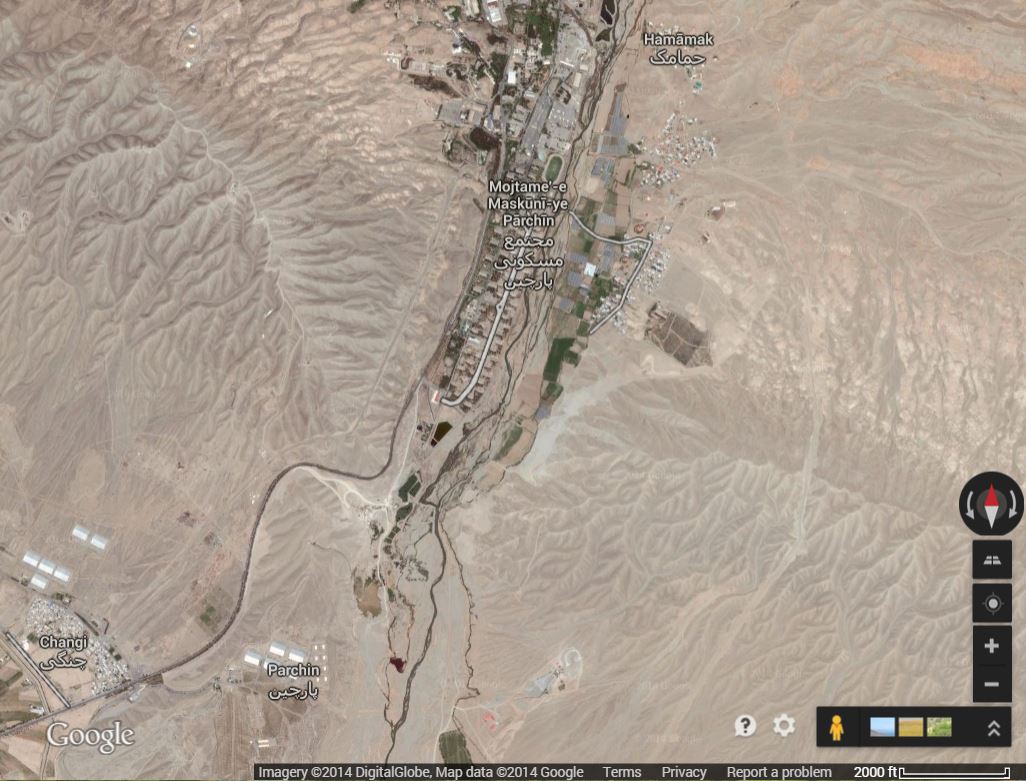
Witnesses in the east of Tehran said that windows had been shattered in the vicinity of the military complex and that all trees in a hundred-yard radius of two villages, Changi and Hammamak, had been burned. The villages are on the outskirts of the military site.

The map below shows the area in question:

Google Map of Parchin showing outlying villages of Changi and Hammamak.

Google Map of Parchin showing outlying villages of Changi and Hammamak.

As seen on the map, Changi is very close to Parchin, but Hammamak is on the other side of Parchin and the two villages are over three miles from one another. A blast fireball that scorched trees over three miles apart must have been quite spectacular.

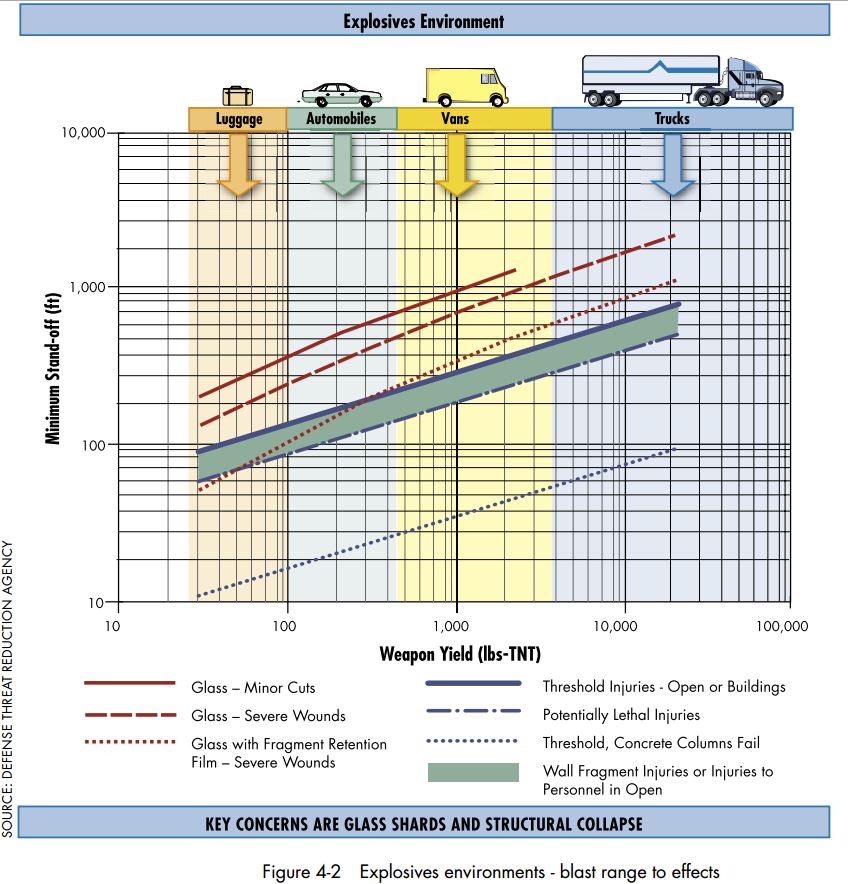
Many factors go into calculating the strength of blasts, including the type of explosive and what type of containment might have been present. However, FEMA provides (pdf) this rough guideline (via DTRA) of the radius over which various types of damage might be expected to occur as a function of the amount of explosive material used:
Blast radius

Because it relates to assessing damage from terrorist bombs, the FEMA figure breaks the amounts of explosives down into the amounts that can be carried by cars, vans and large trucks. The Times story doesn’t report on how far away from the complex windows were shattered, but the effect of burned trees in villages over three miles from one another suggests that such damage would reach quite a ways. At the very least, it would appear that the blast had the equivalent of more than 10,000 pounds of TNT, and perhaps significantly more than that.

A report from BBC does give a blast radius for window breakage: Read more

Share this entry

One Reason We’re Losing the War against Terrorism

Last Wednesday, Oregon District judge Garr King sentenced Mohamed Osman Mohamud to 30 years in prison for pressing a button FBI undercover officers had led him to believe would bomb Portland’s Christmas tree-lighting ceremony. Mohamud’s attorneys argued that in the almost-four years since his arrest Mohamud has shown a great deal of remorse. Prosecutors suggested that by contesting his conviction by claiming he was entrapped, Mohamud showed no remorse.

So 5 years after Mohamud’s father called the FBI, asking them to help divert his son from his interest in Islamic extremism, the government put Mohamud away for the better part of the rest of his life. Even assuming Mohamud only serves two-thirds of his sentence and pretending inflation doesn’t exist, taxpayers will pay $678,600 to incarcerate Mohamud, on top of the money spent on his 4-year prosecution and the at-least 18 months of informants and undercover officers pursuing the then-teenager.

Meanwhile, as the prosecution of a young man whose father reached out for help and whom the FBI prevented from spending a summer working in Alaska draws to a close, the Administration has been rolling out — for at least the third time (2010, 2011, 2014) — an effort to “counter violent extremism.” While the government has always been squishy about what gets included in “violent extremism,” in practice it has always been an effort to work with Muslim and only Muslim communities to … well, it’s not clear what the point is, whether it’s just a renewed effort to get communities to narc out their own, or whether it’s an effort to provide alternatives to an ideology that has proven attractive to young men in such communities.

The roll-out isn’t going very well.

At a hearing in OH, DHS Secretary Jeh Johnson got an earful from community leaders asking why they should trust the government.

But when Homeland Security Secretary Jeh Johnson showed up recently at the Noor Islamic Cultural Center here to offer a sympathetic ear and federal assistance, he faced a litany of grievances from a group of mostly Muslim leaders and advocates.

They complained of humiliating border inspections by brusque federal agents, F.B.I. sting operations that wrongly targeted Muslim citizens as terrorists and a foreign policy that leaves President Bashar al-Assad of Syria in place as a magnet for extremists.

“Our relationship has to be built on trust, but the U.S. government hasn’t given us very many reasons to build up that trust,” said Omar Saqr, 25, the cultural center’s youth coordinator.

And Linda Sarsour — whose organization serving Arab immigrations was targeted by NYPD’s spying program — asks how they can trust a government that spies on them.

Muslim advocates say there is deep suspicion that, despite all the meetings and the talk of outreach, the government’s main goal is to recruit informants to root out suspected terrorists.

“I don’t know how we can have a partnership with the same government that spies on you,” said Linda Sarsour, advocacy director for the National Network for Arab American Communities.

Perhaps most telling, however, in one of NYT’s several attempts describing what CVE is, it describes spying, not community.

Among its efforts, the Department of Homeland Security provides training to help state and local law enforcement officials in identifying and countering the threat, including indicators of violent extremism and “lone wolf” attacks.

The department awarded the International Association of Chiefs of Police a $700,000 grant last year to develop training on how to prevent, respond to and recover from acts of terrorism.

DHS is going to give a police organization as much to train to spy as it’ll take to incarcerate Mohamud.

Ultimately, no matter how efficient your spying-and-sting-industry, you’re still spending around $1 million to catch and warehouse men because you’re losing an ideological battle. And the spying and stings, and the obvious bias of it, surely sets the US back in its ideological battle.

If the US can’t imagine a better response when a father calls for help but to spend 18 months catching his son a sting, we can roll out CVE programs every other month and we’re not going to earn trust among the communities we need to.

Share this entry