Posts

Donald Trump Will Piss Away the Western Order Investing in Jared Kushner’s Imagined Business Savvy

It is just over nine years to the day since Jared Kushner naively asked Russian Ambassador Sergei Kislyak to use Russian secure facilities to communicate in such a way that US spies wouldn’t find them.

Kushner went forward with the meeting that Kislyak had requested on November 16. It took place at Trump Tower on November 30, 2016.1139 At Kushner’s invitation, Flynn also attended; Bannon was invited but did not attend.1140 During the meeting, which lasted approximately 30 minutes, Kushner expressed a desire on the part of the incoming Administration to start afresh with U.S.-Russian relations.1141 Kushner also asked Kislyak to identify the best person (whether Kislyak or someone else) with whom to direct future discussions—someone who had contact with Putin and the ability to speak for him.1142

The three men also discussed U.S. policy toward Syria, and Kislyak floated the idea of having Russian generals brief the Transition Team on the topic using a secure communications line.1143 After Flynn explained that there was no secure line in the Transition Team offices, Kushner asked Kislyak if they could communicate using secure facilities at the Russian Embassy.1144 Kislyak quickly rejected that idea.1145

Shortly after Kushner indicated his enthusiasm for back-channel discussions that US spies couldn’t find, Sergei Kislyak threw Sergey Gorkov at him — someone who would dangle financial goodies that would require overturning sanctions to collect, someone functionally analogous to Kirill Dmitriev.

The accounts from Kushner and Gorkov differ as to whether the meeting was diplomatic or business in nature. Kushner told the Office that the meeting was diplomatic, with Gorkov expressing disappointment with U.S.-Russia relations under President Obama and hopes for improved relations with the incoming Administration.1157 According to Kushner, although Gorkov told Kushner a little bit about his bank and made some statements about the Russian economy, the two did not discuss Kushner’s companies or private business dealings of any kind.1158 (At the time of the meeting, Kushner Companies had a debt obligation coming due on the building it owned at 666 Fifth Avenue, and there had been public reporting both about efforts to secure lending on the property and possible conflicts of interest for Kushner arising out of his company’s borrowing from foreign lenders.1159)

In contrast, in a 2017 public statement, VEB suggested Gorkov met with Kushner in Kushner’s capacity as CEO of Kushner Companies for the purpose of discussing business, rather than as part of a diplomatic effort. In particular, VEB characterized Gorkov’s meeting with Kushner as part of a series of “roadshow meetings” with “representatives of major US banks and business circles,” which included “negotiations” and discussion of the “most promising business lines and sectors.”1160

It’s all there in the Mueller Report, plain as day: From the very start Jared Kushner planned to use his role in Trump’s White House for his own benefit. It was in the background of his dealings with Mohammed bin Salman, who has domesticated him since. It was the plan for Russia, too, until Mike Flynn’s shitty OpSec scuttled the plan.

Even in the first iteration of this fraud, Jared was hiding what he was doing from the Secretary of State — at that point Rex Tillerson.

And then Kirill Dmitriev picked right up where he left off eight years earlier, finding the weak venal levers for Trump and, ultimately, Jared. The plan didn’t succeed in February. It came closer but didn’t succeed in August. In November, once Dmitriev finally got Kushner on board, it seems to be succeeding.

It’s all worth revisiting again given this important (but nauseating) report from WSJ– one they themselves suggest is the follow-up to their report, Make Money Not War: Trump’s Real Plan for Peace in Ukraine.

The way the Russians succeeded in getting Trump to sell out Ukraine and the West (and I promise you, Trump has no fucking clue the ramifications of this and probably doesn’t give a fuck anyway) was by taking the $300 billion seized by Europe as punishment for their invasion of Ukraine — money Europeans were hoping to use to arm Ukraine — and instead used it to bribe Trump, effectively.

The Trump administration in recent weeks has handed its European counterparts a series of documents, each a single page, laying out its vision for the reconstruction of Ukraine and the return of Russia to the global economy.

The proposals have sparked an intense battle at the negotiating table between America and its traditional allies in Europe. The outcome stands to profoundly alter the economic map of the continent.

The U.S. blueprint has been spelled out in appendices to current peace proposals that aren’t public but were described to The Wall Street Journal by U.S. and European officials. The documents detail plans for U.S. financial firms and other businesses to tap roughly $200 billion of frozen Russian assets for projects in Ukraine—including a massive new data center to be powered by a nuclear plant currently occupied by Russian troops.

Another appendix offers America’s broad-strokes vision for bringing Russia’s economy in from the cold, with U.S. companies investing in strategic sectors from rare-earth extraction to drilling for oil in the Arctic, and helping to restore Russian energy flows to Western Europe and the rest of the world.

[snip]

If the U.S. vision prevails, it would override Europe’s own plans to shore up Ukraine’s wartime government and further cement Russia’s economic isolation. The result is what several officials described as a frenzied race to move ahead before the U.S. imposes its own arrangements.

U.S. officials involved in the negotiations say Europe’s approach would quickly deplete the frozen funds. Washington, on the other hand, would tap Wall Street executives and private-equity billionaires to invest the money and expand the amount available to invest. One official involved in the talks said the pot could grow to $800 billion under American management. “Our sensibility is that we really understand financial growth,” the official said.

On Wednesday, Ukrainian President Volodymyr Zelensky said he had held productive conversations with the investment firm BlackRock’s chief executive, Larry Fink.

The U.S. negotiating team sees shared economic activity and energy interdependence as the cornerstone of its business-for-peace philosophy: Ukrainian data centers would draw power from the currently Russian-occupied Zaporizhzhia nuclear plant, Europe’s largest, for example.

Some European officials who have seen the documents said they weren’t sure whether to take some of the U.S. proposals seriously. One official compared them to President Trump’s vision of building a Riviera-style development in Gaza. Another, referring to the proposed U.S.-Russia energy deals, said it was an economic version of the 1945 conference where World War II victors divvied up Europe. “It’s like Yalta,” he said.

Just as pitching Trump on a Riviera where millions of Gazans once lived, Bibi Netanyahu solicited Trump’s assistance in genocide, so has Dmitriev convinced Trump to sell out the Western order by turning the nuclear plant they stole into fuel for a data center.

As Judd Legum lays out, this is all happening via a guy, Jared, effectively serving as an agent of the Saudis.

Kushner is engaged in activities that can only be conducted by government officials. The Logan Act bars private citizens from engaging in negotiations with foreign governments without authorization. Kushner is acting in an authorized capacity, under Trump’s direction, and that creates a host of legal issues.

As a de facto SGE with substantial authority, the Foreign Emoluments Clause of the Constitution prohibits Kushner from accepting “any present, Emolument, Office, or Title, of any kind whatever, from any King, Prince, or foreign State.”

Since leaving the White House in 2021, Kushner has raised at least $4.8 billion for Affinity Partners, his private equity firm. Nearly 99% of Affinity Partners’ funding comes from foreign sources. The largest investment, $2 billion, came from the Public Investment Fund of Saudi Arabia (PIF).

The Saudi government pays Kushner 1.25% of its investment, or $25 million annually. Other investors, including the governments of Qatar and the United Arab Emirates (UAE), pay annual fees of up to 2%. As of September 2024, Affinity Partners had collected $157 million in fees, mainly from Middle Eastern governments.

Kushner is continuing to collect these fees as he serves in a top foreign policy role for the Trump administration. This is precisely the kind of behavior the Foreign Emoluments Clause was designed to prevent.

See also Legum’s assessment of Jared’s role in Paramount’s effort to buy Warner using foreign (and Jared’s) money.

Horse trading away a half century alliance is bad enough.

But remember: These people are horrible businessmen. There’s no sign that Jared has any competence to judge these deals on the merits. He’s not a competent businessman, he’s a captured one.

And Trump was vastly more successful as a businessman when reality TV show producers controlled the plot than he every was IRL.

Throw enough goodies at my son-in-law and I will betray Europe, Donald Trump seems to be saying.

And that’s all it took.

Share this entry

The Dim Philby Leaks

Bloomberg obtained and posted the content of two phone calls showing Steve Witkoff — whom Michael Weiss has dubbed “Dim Philby” — working for Russia’s interests, not US interests. Bloomberg published two transcripts:

  • A 5-minute October 14 call between Witkoff and Yuri Ushakov, Putin’s top foreign policy advisor, in which Witkoff tells Ushakov how to pitch Trump on capitulation
  • A short October 29 call between Ushakov and Kirill Dmitriev, in which Dmitriev described “informally pass[ing …] along [Russia’s maximal “piece” plan], making it clear that it’s all informal. And let them do like their own

The transcripts show that Witkoff is a sycophant serving Putin’s interest and that the transcript that Americans have been claiming was their own plan was, as everyone smart insisted, in fact Russia’s plan.

The fall-out of this is yet to be seen. Thus far, Marco Rubio’s efforts to salvage things seems to have bought time.

When Bloomberg posted the transcripts they said they had reached out for comment from the White House. That reference is gone, but now Trump and his flunkies claim these transcripts make Witkoff look strong, rather than culpable. So maybe Trump will just try to barrel through the transcript release and still capitulate to Russia.

I want to consider the logistics of this leak, which could arise from wiretapping (or simply recording) what happened on Ushakov’s phone, which is common to both transcripts. It could have come from any of three entities:

  • The Russians, who would have ready access to Ushakov’s phone and no concern about preserving that access
  • Some European intelligence service, which would be endangering a tremendously valuable compromise by releasing this, but might stave off diplomatic catastrophe
  • American leakers, possibly at the CIA (which, like Marco Rubio, was excluded from these negotiations)

Bloomberg’s story has no byline, which would make it harder for the FBI or anyone else to determine who leaked these materials.

Now consider the effect of the leak. The transcripts make it clear the claims sold to Axios and WSJ — that Jared Kushner wrote this plan — were false. Dmitriev succeeded, as he told Ushakov he would do, in getting the White House to pass off the Russian plan as their own.

If the US forces through this deal, the leak of this transcript makes Russia’s complete dominance evident.

Or, if the deal fails because Rubio succeeded in making the deal more acceptable to Ukraine and Europe, this leak may undercut Dmitriev’s role in the entire process (indeed, the leak could be an attempt to scapegoat him for a failed plan to get maximal capitulation).

But unless the US understands where the transcripts came from, it makes Witkoff vulnerable. The only obviously targeted phone is Ushakov’s. But if they got both sides of this conversation, what else did they got?

We don’t know the answers but it’s worth remembering something about 2016 to 2017.

Like Witkoff, Mike Flynn used absolutely abysmal operational security when working a back channel to undermine sanctions on Russia. Ultimately, US spies discovered what he had done, after trying to figure out why Putin did nothing in response to US sanctions. But the Russian Embassy pretty clearly knew the phone lines Flynn was calling into were wiretapped. Russia knew that would be exposed, and likely knew that one of several things would happen: they’d have blackmail on Trump because he dealt with Russia before becoming President or, the discovery of Flynn’s actions could destabilize the Trump administration as the investigation into his Russia ties in fact did do.

The same could be said for these transcripts.

Share this entry

Russia Russia Russia

In a piece describing how, after Trump attempted to publicly humiliate Volodymyr Zelenskyy, talks on normalizing relations with Russia (negotiated by Kirill Dmitriev, of Mueller Report fame) will accelerate…

There is also renewed optimism in Moscow that, with President Zelensky at odds with President Trump and his team, difficult negotiations to end the war in Ukraine will now take a back seat to a raft of potentially lucrative US-Russia economic deals already being tabled behind closed doors.

[snip]

Already the Kremlin’s key economic envoy to the talks, Kirill Dmitriev, has told CNN that cooperation with the US could “include energy” deals of some kind, but no details have been announced.

Separately, the Financial Times is reporting that there have been efforts to involve US investors in the restarting Russia’s Nord Stream 2 gas pipeline to Europe, which Germany halted at the beginning of Russia’s invasion of Ukraine.

Dmitriev has called for the Trump administration and Russia to start “building a better future for humanity,” and to “focus on investment, economic growth, AI breakthroughs,” and long-term joint scientific projects like “Mars exploration,” even posting a highly produced computer graphic, on Elon Musk’s X social media platform, showing an imagined joint US-Russia-Saudi mission to Mars, on board what appears to be a Space X rocket.

CNN described literal “bewilder[ment]” about why Trump would sell out America’s allies.

[W]hy the US president would choose the Kremlin over America’s traditional partners remains the subject of intense speculation.

Much of it, like the frequent suggestion that Trump is somehow a Kremlin agent, or beholden to Putin, is without evidence.

Perhaps the right-wing US ideological fantasy that Russia is a natural US ally in a future confrontation with China, and can be broken away from its most important backer, is motivating Washington’s dramatic geopolitical shift.

But for many bewildered observers, both explanations for Trump’s extraordinary pivot to the Kremlin seem equally misplaced. [my emphasis]

CNN asserted there’s no evidence to back the claim that Trump is “beholden to Putin” in spite of the fact that Russia helped Trump win in 2016, after which Dmitriev reached out and discussed a bunch of investments as a way to improve relations. CNN asserted there’s no evidence to back the claim that Trump is “beholden to Putin” in spite of the fact that Russia attempted to help Trump win in 2020 at least by sending disinformation framing Joe Biden and his kid via Russian agent Andrii Derkach to Trump’s personal lawyer. CNN asserted there’s no evidence to back the claim that Trump is “beholden to Putin” in spite of the fact that Derkach made similar efforts in 2024, and a bunch of Russian malign influence efforts (possibly including bomb threats that forced the evacuation of Democratic precincts) similarly aimed to help Trump and others who would “oppose aid to Ukraine.”

CNN asserted there’s no evidence to back the claim that Trump is “beholden to Putin” in spite of the fact that a key Putin advisor, Nikolay Patrushev, said this in November:

In his future policies, including those on the Russian track US President-elect Donald Trump will rely on the commitments to the forces that brought him to power, rather than on election pledges, Russian presidential aide Nikolay Patrushev told the daily Kommersant in an interview.

“The election campaign is over,” Patrushev noted. “To achieve success in the election, Donald Trump relied on certain forces to which he has corresponding obligations. As a responsible person, he will be obliged to fulfill them.”

He agreed that Trump, when he was still a candidate, “made many statements critical of the destructive foreign and domestic policies pursued by the current administration.”

“But very often election pledges in the United States can iverge [sic] from subsequent actions,” he recalled.

As people puzzle through this bewilderment, as people puzzle through why Trump appointed people who undermined the Russian investigation to lead the FBI, the boilerplate about what Robert Mueller discovered about Russia’s 2016 efforts to help Trump remains wildly inadequate, as in this recent version in a story on Don Bongino’s propaganda about the investigation.

Mueller’s inquiry found repeated contacts between Russia-linked entities and Trump campaign advisers, but didn’t establish a conspiracy between the two.

Mueller didn’t establish a conspiracy between Trump and Russia. But such boilerplate always leaves out that his key aides lied about the true nature of those contacts, which is a big reason why we wouldn’t know if there had been one.

In the Mueller investigation, Trump’s campaign manager, foreign policy advisor, National Security Adviser, personal lawyer, and rat-fucker were all adjudged to have lied about the true nature of Trump’s ties to Russia from the first campaign.

Let’s unpack that even further.

  • Trump’s personal lawyer, Michael Cohen, confessed to lying to hide the direct contact he had during the campaign with Dmitry Peskov’s office in pursuit of an impossibly lucrative Trump Tower deal, a deal that would have required lifting sanctions to complete. Cohen confessed to lying to cover up his conversations with Trump about that impossibly lucrative Trump Tower deal. His confession meant that when Trump disclaimed pursuing business deals with Russia — in the same July 27, 2016 press conference where he asked Russia to hack Hillary some more and said he might bless Russia’s seizure of Crimea — Trump lied to cover up that dangle for an impossibly lucrative Trump Tower deal.
  • Trump’s foreign policy advisor, George Papadopoulos (who was overtly involved in Derkach’s efforts last year), confessed to lying about the timing and circumstances of learning that Russia had thousands of Hillary’s emails and planned to release them to hurt her campaign. He lied about the other Russians that Joseph Mifsud introduced to Papadopoulos. After he pled guilty, Papadopoulos remembered and then unremembered telling his boss on the campaign, Sam Clovis, about the emails. He also claimed to forget what his own notes describing a proposed meeting in September 2016 with Putin’s team pertained to (notes that also mentioned Egypt and involved Walid Phares, whom investigators suspected of having a role in any $10 million payment Egypt made to Trump).
  • A jury found Trump’s rat-fucker, Roger Stone, guilty of lying to cover up the nature and source of his advance notice of the Russian hack-and-leak campaign. Over the course of the investigation, the FBI found evidence Stone knew of several of the Russian personas before they went public. There’s good reason to believe that Stone got advance knowledge, in mid-August 2016, of the substance of select emails from the later John Podesta leak. When prosecutors indicted Stone, they were very keen to obtain a notebook containing notes he took of all his conversations with Trump during the 2016 campaign. Stone stayed out of jail by repeatedly claiming prosecutors offered leniency to get knowledge of those contacts.
  • Don Jr. refused to testify before a grand jury, an appearance that presumably would have included questions about his understanding of the June 9 meeting at which Aras Agalarov offered dirt on Hillary in exchange for sanctions relief.
  • Amy Berman Jackson ruled that Trump’s campaign manager, Paul Manafort, reneged on his plea agreement, in part, by lying about his August 2, 2016 meeting with Konstantin Kilimnik, at which three topics were discussed: The campaign’s strategy to win swing states, how Manafort could get paid millions, and a plan to carve up Ukraine. In 2021, Treasury stated as fact that Kilimnik. was a “known Russian Intelligence Services agent” who had “provided the Russian Intelligence Services with sensitive information on polling and campaign strategy” during 2016. The report went on to explain that, “Kilimnik sought to promote the narrative that Ukraine, not Russia, had interfered in the 2016 U.S. presidential election,” a narrative Trump keeps pushing.
  • Trump’s National Security Adviser, Mike Flynn, confessed, twice, to lying about his efforts to undercut Barack Obama’s policy, including efforts to sanction Russia in response to the 2016 attack. There’s a good deal of evidence — including Flynn’s assurances to Sergey Kislyak that the “Boss is aware” — that Trump was involved in those efforts.

All of the people who lied to cover up the true nature of Trump’s Russian contacts in 2016, save Michael Cohen, were pardoned.

So was one other person — someone else who probably lied about the nature of Trump’s Russian contacts in 2017.

In the section describing his declination decisions, Mueller explained that there were three other people who probably lied, but whom he wasn’t charging.

We also considered three other individuals interviewed–[redacted]–but do not address them here because they are involved in aspects of ongoing investigations or active prosecutions to which their statements to this Office may be relevant.

The report itself and the 302s of Steve Bannon’s testimony, which evolved over the course of four interviews to more closely approximate the evidence, suggests Bannon could be one of those three (after all, Bannon, Trump’s other campaign manager, was a key witness at the Stone trial).

Not least because the report describes a pretty big discrepancy between Bannon’s testimony and Erik Prince’s regarding conversations the latter had with Kirill Dmitriev, now starring in negotiations about Russia. And both men played dumb about where the texts they exchanged in that period disappeared to.

Prince said that he met Bannon at Bannon’s home after returning to the United States in mid-January and briefed him about several topics, including his meeting with Dmitriev.1086 Prince told the Office that he explained to Bannon that Dmitriev was the head of a Russian sovereign wealth fund and was interested in improving relations between the United States and Russia.1087 Prince had on his cellphone a screenshot of Dmitriev’s Wikipedia page dated January 16, 2017, and Prince told the Office that he likely showed that image to Bannon.1088 Prince also believed he provided Bannon with Dmitriev’s contact information.1089 According to Prince, Bannon instructed Prince not to follow up with Dmitriev, and Prince had the impression that the issue was not a priority for Bannon.1090 Prince related that Bannon did not appear angry, just relatively uninterested.1091

Bannon, by contrast, told the Office that he never discussed with Prince anything regarding Dmitriev, RDIF, or any meetings with Russian individuals or people associated with Putin.1092 Bannon also stated that had Prince mentioned such a meeting, Bannon would have remembered it, and Bannon would have objected to such a meeting having taken place.1093

The conflicting accounts provided by Bannon and Prince could not be independently clarified by reviewing their communications, because neither one was able to produce any of the messages they exchanged in the time period surrounding the Seychelles meeting. Prince’s phone contained no text messages prior to March 2017, though provider records indicate that he and Bannon exchanged dozens of messages.1094 Prince denied deleting any messages but claimed he did not know why there were no messages on his device before March 2017.1095 Bannon’s devices similarly contained no messages in the relevant time period, and Bannon also stated he did not know why messages did not appear on his device.1096 Bannon told the Office that, during both the months before and after the Seychelles meeting, he regularly used his personal Blackberry and personal email for work-related communications (including those with Prince), and he took no steps to preserve these work communications.1097

The lies Trump’s top aides told to hide aspects of the 2016 Russian effort — his campaign manager, foreign policy advisor, National Security Adviser, personal lawyer, and rat-fucker — along with gaps left by both Jr and Bannon’s testimony (note, Bannon’s testimony  also conflicts with Mike Flynn’s regarding whether he was privy to Flynn’s effort to undermine sanctions) trace out clear outlines of a quid pro quo: a serial agreement to reward Russia by acceding to carve up Ukraine and an agreement to lift sanctions, in exchange for help getting elected.

And here we are, eight years later, utterly bewildered why Trump might be in such a rush to deliver up Ukraine to Russia and lift sanctions to pursue business deals, precisely the quo outlined by the lies told years ago.

Really? How is anyone bewildered about this?

On November 11, one of Putin’s closest allies complained about how, “election pledges in the United States can [d]iverge from subsequent actions.” Patrushev warned that, this time, Trump will “be obliged to fulfill” his “corresponding obligations.”

And what we are seeing in real time, in plain sight, protected by an Attorney General who has promised to investigate neither the campaign assistance nor the bribery, is Trump picking up precisely where things left off in 2017.

Starting with the very same offers Dmitriev was offering eight years ago.

Update: I have taken out a reference to sanctions with regards to Kirill Dmitriev.

Share this entry

“Problem:” SDNY Charges Elena Branson as Unregistered Agent of Russia

Back in 2013, the Senior Vice President of the Russian American Chamber of Commerce (Sergei Millian’s organization) sent Elena Branson language from FARA with the subject line, “Problem.”

a. On or about January 30, 2013, BRANSON received an email from an individual using an email address ending in “mail.ru.” Based on my review of publicly available information, I have learned that this individual was a Senior Vice President of the Russian American Chamber of Commerce in the USA. This email had the subject line “Problem.” and the text of the email included, among other things, a portion of the FARA Unit’s website with background on FARA. In response, BRANSON wrote, in part, “I am interested in the number of the law, its text in English[.]” The sender then responded with “Lena, read …” and copied into the email background on FARA and portions of the statute.

Branson, who the prior year had founded the Russian Center of New York and subsequently became the Chair of Russian Community Council of the USA (KSORS), apparently didn’t think it was an urgent problem. It wasn’t until 2019 that she appears to have considered — but then, after asking Russian Ambassador Anatoly Antonov for guidance, decided not to — register under FARA.

b. On or about December 10, 2019, BRANSON received an email indicating that BRANSON had requested a new FARA “eFile” account.21 That day, a member of the FARA Unit emailed the Branson RCNY Account with an eFile account number and temporary password to log in to the FARA eFile system. Later that day, a user logged in to the FARA eFile system using that account number and temporary password, and entered the registration name “Russian Center, Inc.” and the RCNY Office as the address. The user did not submit a FARA registration for the account. A user then accessed the account again on or about December 11, 2019, but, again, the individual did not submit a FARA registration. The internet protocol addresses connected to both log-ins of this account resolve to the same zip code as the RCNY Office.

c. On or about December 26, 2019, BRANSON emailed the Embassy Email Account. In the cover email, BRANSON wrote, in part, “[A] letter is in the attachment. Respectfully, Elena.” In the attached letter, BRANSON wrote, in part, that she had been asked questions from “compatriots” about “whether it is necessary to register their public organizations as a foreign agent.” BRANSON further wrote “[t]hese questions began to arise after the arrest of Maria Butina in Washington in July 2018 on charges of working as a foreign agent in the United States without registration.” BRANSON concluded the letter by asking the Embassy to advise such Russian compatriot groups, writing, “I am asking you to provide legal advice regarding registration as a foreign agent . . . for public organizations of Russian compatriots in the United States.” The letter was addressed to Ambassador-1.

Branson’s failure to register lies at the core of a 6-count complaint unveiled by SDNY yesterday, charging Branson in several conspiracies, under both FARA and 18 USC 951, as well as for visa fraud.

Branson won’t be arrested off this complaint. She’s long gone.

A month after the FBI interviewed her and searched her office in September 2020, she fled the country. Not long after Biden was inaugurated, Branson sold her NYC apartment.

During this investigation, the FBI has, among other things, executed judicially authorized search warrants for (i) approximately eight of BRANSON’s electronic accounts (the “Branson Accounts”3); (ii) the RCNY office (which was also BRANSON’s residence) in Manhattan, New York (the “RCNY Office”); and (iii) BRANSON’s person, for all electronics and other materials in her possession at the time of the search. From the RCNY Office and the search of BRANSON’s person, the FBI recovered a total of approximately 34 electronic devices (the “Branson Electronics”), including approximately 11 cellular phones. The FBI also conducted a voluntary interview of BRANSON on the same day as the search of the RCNY Office (the “Branson Interview”) and has interviewed other individuals living in the United States in connection with the investigation.

The searches of the RCNY Office (the “RCNY Search”) and BRANSON’s person, as well as the Branson Interview, took place on or about September 29, 2020. BRANSON flew to Moscow, Russia, on or about October 20, 2020, and BRANSON does not appear to have returned to the United States since that date. In or about March 2021, BRANSON sold the RCNY Office, which had been her residence in New York City. During in or about October and November 2020, BRANSON’s then boyfriend 9 (“Boyfriend-1”) wired approximately $197,000 to two of BRANSON’s bank accounts at Russian banks.4 On or about October 15, 2021, RT, formerly known as Russia Today, a Russian state-controlled television station, published an interview conducted by Maria Butina5 of BRANSON. During this interview, BRANSON told Butina, in substance and in part, that BRANSON left the United States for Moscow approximately one month after the Branson Interview because BRANSON was “scared” and thought the “probability was very high” that she would be arrested if she stayed in the United States.6

3 The Branson Accounts include four email accounts and four social media accounts, including BRANSON’s Facebook account (the “Branson Facebook Account”).

So Branson will only be arrested if she decides to flee Putin’s increasingly totalitarian regime.

Unlike the prosecution of Jack Hanick, then, whose indictment may have been timed to tolling statutes of limitation last November and in which the US is working on getting him extradited from the UK, this complaint seems to be more about messaging in the wake of the Russian invasion of Ukraine.

As a messaging vehicle, it shows how Russia has committed to the “consolidation” of Russian diaspora, cultivating a Russian identity that can be used to mobilize political pressure (and, in Ukraine and the Baltics, justifications for imperialism).

In or about November 2015, Lavrov published an article titled “Russian World: Steering Towards Consolidation.” In this article, Lavrov wrote, in part, “The provision of support to the Russian world is an unconditional foreign-policy priority for Russia, as formalized by Russia’s Foreign Policy Concept. . . . Over the years, we have managed to elevate our work in this area to an entirely new level and to create effective cooperation mechanisms in close contact with representatives of foreign communities.”

Some of Branson’s activities are mundane cultural exchanges paid for by Russian government entities. Some sprinkle the names of likely spies or handlers in the description.

Perhaps most interesting, the complaint provides an interesting addition to this passage from the Mueller Report.

Later [on November 9, 2016, the day after Trump’s victory, Kirill] Dmitriev flew to New York, where Peskov was separately traveling to attend the chess tournament. 1020 Dmitriev invited Nader to the opening of the tournament and noted that, if there was “a chance to see anyone key from Trump camp,” he “would love to start building for the future.” 1021 Dmitriev also asked Nader to invite Kushner to the event so that he (Dmitriev) could meet him. 1022 Nader did not pass along Dmitriev’s invitation to anyone connected with the incoming Administration. 1023 Although one World Chess Federation official recalled hearing from an attendee that President-Elect Trump had stopped by the tournament, the investigation did not establish that Trump or any Campaign or Transition Team official attended the event. 1024 And the President’s written answers denied that he had. 1025

The complaint describes how Branson had been instructed to arrange a meeting with Trump or Ivanka in March 2016, around the same time Russia was hacking John Podesta, though the complaint is remarkably coy about whether Branson ever sent her draft letter to Trump Organization (and if so, whether it was among the documents showing direct ties to Russia that Trump Organization withheld from Mueller’s inquiry and SSCI).

In or about March 2016, BRANSON exchanged a series of emails with Minister-2. During these messages, in part, Minister-2 asked BRANSON to organize a meeting with CC-2 and the now-former President of the United States, who was then a candidate for the Republican presidential nomination, or his daughter, in New York. On or about March 23, 2016, BRANSON received an email from Minister-2 with the subject line “additional meetings of [CC-2].” The email stated, in part, that the author was requesting BRANSON’s assistance in organizing meetings for CC-2 with “the management” of certain specified U.S. companies. On or about March 16, 2016, BRANSON sent an individual, who was then-chair of KSORS, a draft letter addressed to the now-former President, inviting him to the Russia Forum New York in April 2016 and suggesting that if his “busy schedule will not permit your attending our forum, perhaps you can suggest one of your children . . . who have followed in your footsteps.” The draft invitation included BRANSON’s name and contact information in the signature block. There is no indication that the now-former President or his children attended the referenced meeting.

Branson’s complaint describes what would be a second attempt to get Trump to attend the Chess Championship, in addition to Kirill’s attempt to extend an invite through George Nader. Branson sent her invite to an unnamed Trump Advisor.

BRANSON also attempted to arrange meetings for Russian officials at the 2016 World Chess Championship, which was held in Manhattan, New York:

1. On or about November 9, 2016, CC-6 emailed BRANSON with the subject line “Chess business.” CC-6 wrote to BRANSON, in part, “as discussed we will try to get Kirsan online after tomorrow’s official press-conference is over around noon at Fulton Street Market Building, South Street Seaport NY[.]”20 On or about that same day, BRANSON responded to CC-6 and wrote “[CC-6], good evening! I can bring the ipad for a Skype session. I will contact the media. Need them at noon?”

2. On or about November 10, 2016, BRANSON emailed an advisor to the now-former President of the United States (“Advisor-1”), expressing congratulations for their victory in the presidential election and attaching an invitation to the World Chess Championship addressed to the then-President- elect. The invitation was signed by “President of the International Chess Federation (FIDE-FIDE).” There is no indication that the now-former President attended the referenced event.

3. On or about November 11, 2016, BRANSON was photographed at the World Chess Championship with CC-6 and a second individual who I recognize, based on my review of publicly available photographs, to be the current Press Secretary for Russian President Vladimir Putin.

20 Based on my training and experience, including my review of publicly available material, I have learned that Kirsan Ilyumzhinov is the former President of the Republic of Kalmykia in the Russian Federation and the former president of FIDE, the International Chess Federation. I have further learned that, on or about November 25, 2015, the United States Department of the Treasury designated Ilyumzhinov as a Specially Designated National for his involvement with the Government of Syria and related entities.

Here, the complaint reiterates the Mueller conclusion: there’s no evidence Trump attended the event. But it does raise questions about the completeness of the response Trump offered to Mueller’s questions, pertaining to whether Trump was asked to attend.

Were you asked to attend the World Chess Championship gala on November 10, 2016? If yes, who asked you to attend, when were you asked, and what were you told about about [sic] why your presence was requested? 1. Did you attend any part of the event? If yes, describe any interactions you had with any Russians or representatives of the Russian government at the event.

Were you asked to attend the World Chess Championship gala on November 10, 2016? If yes, who asked you to attend, when were you asked, and what were you told about about [sic] why your presence was requested? 1. Did you attend any part of the event? If yes, describe any interactions you had with any Russians or representatives of the Russian government at the event.

Response to Question V, Part (a)

I do not remember having been asked to attend the World Chess Championship gala, and I did not attend the event. During the course of preparing to respond to these questions, I have become aware of documents indicating that in March of 2016, the president of the World Chess Federation invited the Trump Organization to host, at Trump Tower, the 2016 World Chess Championship Match to be held in New York in November 2016. I have also become aware that in November 2016, there were press inquiries to my staff regarding whether I had plans to attend the tournament, which was not being held at Trump Tower. I understand these documents have already been provided to you.

Trump describes a March 2016 discussion about hosting the event and November press inquiries about whether he would attend it. But there’s no mention of a November 2016 invitation asking him to attend.

Yet the Branson complaint suggests there would have been an invitation to Trump, signed by the sanctioned Kirsan Ilyumzhinov, sent through an unnamed advisor. His response reflects only earlier (in March) communications about the chess championship, not anything sent on November 10 bearing Ilyumzhinov’s signature.

This is a signaling complaint, one that likely won’t lead to anyone’s arrest. But it should raise more questions about Donald Trump’s candor with Mueller back in 2018.

And we should expect more of the same. On Twitter, Brandon Van Grack, who would have been involved in Branson’s investigation when he ran the National Security Division’s FARA office and likely knows what else might be in the pipeline, suggested there’s probably more of the same to come.

Share this entry

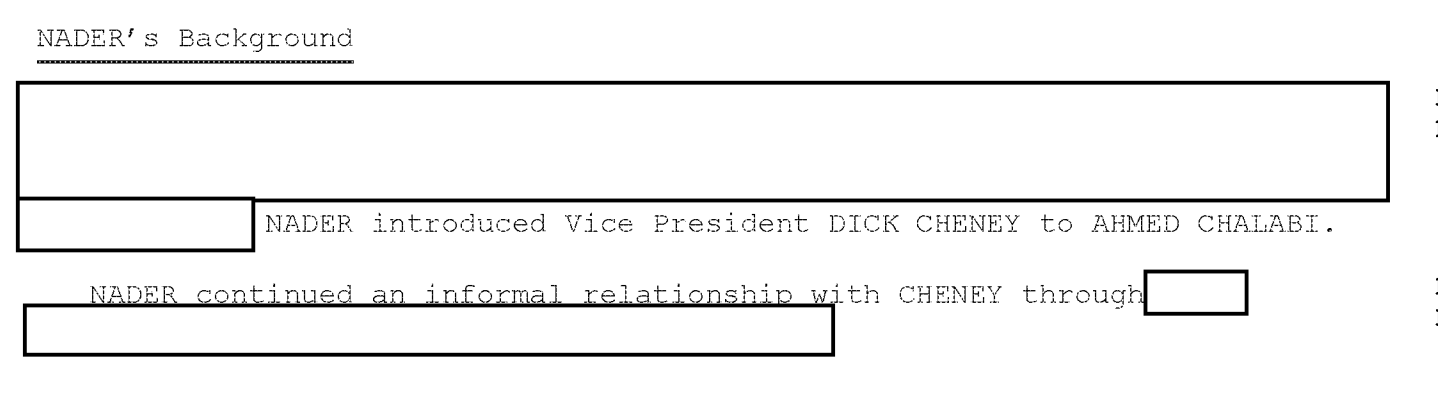
Child Rapist George Nader Introduced Dick Cheney and Ahmad Chalabi

Last night, BuzzFeed released the second-to-last dump of 302s in their Mueller FOIA. There’s a ton that’s interesting in it (and I’m just skimming much of it). But — as I said to Jason Leopold — this George Nader interview, by itself, made the FOIA dump worth the price of admission.

There’s a ton of details about how he brokered meetings between Erik Prince and Kirill Dmitriev and lots of significantly redacted discussions of meetings with Don Jr. There’s great theater where, several times, Nader denied something, including meeting “any” Russian government officials at a trip to the St. Petersburg Economic Forum in June 2016, only to have Mueller’s team show him a picture (in the case of Putin) or a text (in the case of his denials that he had met Steve Bannon) that forced him to immediately backtrack off his claims. Nader describes how he — a convicted pedophile during this entire period — could get along with all sides: Clinton and Trump, Iran and Saudi Arabia. Everyone’s favorite child rapist.

But by far the craziest part of this amazing interview — the thing that has my brain reeling this afternoon — has nothing to do with Russia.

In describing his background, you see, Nader claimed that he’s the one who introduced Ahmad Chalabi to Dick Cheney.

For those who don’t remember, Chalabi had a significant role in drumming up the Iraq War (here’s what I wrote after he died in 2015, and here’s a piece I wrote about him 10 years earlier, in advance of my book on such things). So by introducing Chalabi to Cheney, Nader played some role — how big, it’s unclear — in perhaps the single greatest American foreign policy debacle of all time.

And now he’s rotting away in prison for trafficking a boy.

Share this entry

Erik Prince Was Like a “Kid at Christmas” When He Met the Sanctioned Russian Bearing Normalized Business Relations

DOJ released the latest bunch of Mueller 302s in response to the BuzzFeed FOIA last night. They include the 302 from an Erik Prince interview on April 4, 2018.

There are, as is the norm for DOJ’s politicized treatment of this FOIA, redactions of embarrassing stuff and unredacted descriptions that later testimony would prove to be a lie. Much of that hides Prince’s relationship with Roger Stone, including his funding of Stone’s racist voter suppression efforts in 2016.

But with regards to Prince’s meeting with Kirill Dmitriev in the Seychelles in January 2017, the 302 is crazy. It makes it clear that Prince walked into the meeting hoping to make a buck and denied to the FBI knowing that making a buck from Dmitriev would require lifting sanctions on Russia.

Prince describes knowing George Nader back to 2006, when he was working for the Vice President of Iraq — Prince called Nader a “courtesan.” Prince provided details about the meeting, during the election, when Nader set up a meeting with Joel Zamel, offering social media products. The meeting was specifically tied to overturning Obama’s Iran deal, and Prince is the one who decided to bring Don Jr rather than Steve Bannon.

Early in the interview, Prince described his mercenary business with the Emirates, explaining that he focused on “‘peripheral’ areas where the Department of Defense does not have a significant presence, such as Yemen, Somalia, and Libya.” As part of his description of his relationship with Mike Flynn, whom he first met in June 2016, Prince describes “another time” meeting with Flynn in an Irish bar to talk “about how to put out fires in peripheral areas,” the same phrase he used to describe the places his mercenaries work.

Prince described knowing nothing about the December 15, 2016 meeting between Flynn, Kushner, Bannon, and Mohammed bin Zayed in NYC. But then the FBI showed him texts showing that he and Nader met right around the meeting, and Nader said he could not wait to “Follow up on our excited mission,” which Prince understood as a reference to using his mercenaries in Yemen. Prince also confirmed that texts from December 20 pertaining to “big real hunting” in the “neighboring country” also pertained to his plan to use mercenaries in Yemen. Prince’s description of the meeting he had with MbZ in the Seychelles immediately preceding his meeting with a back channel to Russia also invoked, “peripheral countries where the UAE had troops, like Somalia, Libya and Yemen.”

Over and over, this 302 makes it clear that MbZ was dangling more mercenary contracts for Prince, and he was eager to get them.

In precisely that period in December when Nader was floating business deals in “peripheral countries,” per a question Prince was asked, Nader sent him a picture of himself with Vladimir Putin, which Prince offered some lame excuse for.

Prince does not know why Nader sent Prince an image of Nader and Putin together, other than the fact that Nader always likes to show off his connections.

It’s in that context that Prince and Nader ended up planning and then  meeting in New York at least twice on January 3 and 4, 2017, possibly bracketing at least one meeting Prince had with Bannon at Trump Tower.

In the same way Prince had no explanation for the Putin image, Prince had no explanation for why Nader sent him information on Kirill Dmitriev on January 3 and 4. Nor did he have any recollection of calling … someone, whose name is redacted (earlier, the interview established that Prince had Trump’s direct phone line). Later, however, after his meeting in the Seychelles with Dmitriev, Prince recalls sharing the very same bio with Bannon, though it may have been a separate screen cap of the same bio.

But the context of his meeting with Dmitriev, set up by someone Prince called a courtesan, is that Prince badly wanted more business with MbZ, and that’s how he was lured to a meeting with a sanctioned Russian after getting sent a picture of Putin.

Prince was like a kid at Christmas about his meeting with MBZ, he could only focus on the presents under the tree. Prince had previously conducted significant business with the UAE and he hoped to gain business for the future.

Before Prince had the meeting with Dmitriev, MbZ first asked Prince — the self-described kid at Christmas eager for presents from MbZ — whether he could deliver the Trump Administration.

In Prince’s mind, Prince was not there on behalf of the upcoming Trump administration. Prince did not play up his relationship with Bannon or anyone else close to Trump. MBZ asked though whether Prince thought that the Trump administration would support the ideas that they were discussing. In response, Prince cited Trump’s campaign promises and what Prince had heard from Trump’s Strategic Policy Advisor, Bannon, on the issues.

Only then, after giving MbZ — the guy from whom Prince wanted Christmas presents in the form of more contracts for mercenary work  — the answers he wanted, did Prince meet with Dmitriev, the back channel from Russia. Here’s how savvy man of the world and self-described kid at Christmas seeking presents Erik Prince addressed sanctions.

Dmitriev also talked about the two countries resuming normal trade relations, but Prince does not recall Dmitriev specifically mentioning sanctions.

Then there’s this interesting bit where Prince presumes to speak for what Dmitriev, whom he claims he met for mere minutes over beer, was thinking.

Dmitriev knew Prince had been a loud advocate for Trump but Prince does not recall Dmitriev speaking as if Prince was a contact to the Trump people.

[snip]

Dmitriev insinuated to Prince that he wanted Prince to pass along the message of better relations to people in the U.S. Dmitriev emphasized wanting to get past the past. Prince does not recall any discussion of potential Russian interference in the 2016 Presidential election. [my emphasis]

There’s a paragraph in the 302, right after Prince offers yet more ridiculous explanations for why he would have gotten Dmitriev’s bio before meeting if the meeting weren’t pre-arranged that should explain whether Prince knew, having read Dmitriev’s bio, he understood that his bank was under sanctions. But it is redacted for privacy reasons.

In spite of all the evidence that he couldn’t explain of advance warning that this was a back channel meeting with Russia, Erik Prince by his own description was an easy mark. A child, hoping to open Christmas presents he would only get in context with this back channel meeting.

They dangled more contracts before the mercenary and he took a meeting with a sanctioned Russian, then reported back to Steve Bannon.

Share this entry

Driving Carter Page: What the 302 Says

One of the seventeen Woods violations the DOJ IG Report cites in its list of errors in the Carter Page report involves a chauffeured car.

It involves a June 1, 2017 interview with Yuval Weber, who is the son of Shlomo Weber, the academic who invited Page to speak before the New Economic School. The IG Report seems to raise doubts about the more important allegation here — that Page was rumored to have met with Igor Sechin (which would match a claim made in the Steele dossier).

A June 2017 interview by the FBI of an individual closely tied to the President of the New Economic School in Moscow who stated that Carter Page was selected to give a commencement speech in July 2016 because he was candidate Trump’s “Russia-guy.” This individual also told the FBI that while in Russia in July 2016, Carter Page was picked up in a chauffeured car and it was rumored he met with Igor Sechin. However, the FD-302 documenting this interview, which was included in the Woods File for Renewal Application No. 3, does not contain any reference to a chauffeured car picking up Carter Page. We were unable to locate any document or information in the Woods File that supported this assertion. 371

This week’s release of Mueller 302s includes the 302 from this interview. It shows that, amid a broad discussion of the way that Russia tries to cultivate Americans (including using invitations such as the one offered to Mike Flynn), Weber described,

SA [redacted] later asked why would NES want a speaker [redacted] Weber said that it was because he was Trump’s Russia-guy. The university typically had heads of state and Nobel Laureates as commencement speakers; in fact, Weber claimed they could have any Nobel Laureate they wanted for the speech.

[redacted]

In July, when Page had traveled to give the commencement speech at NES, Weber recalled that it was rumored in Moscow that Page met with Igor Sechin. Weber said that Moscow is filled with gossip and people in Moscow were interested in Page being there. It was known that a campaign official was there.

Page may have briefly met with Arkady Dvorkovich at the commencement speech, considering Dvorkovich was on the board at NES. But Weber was not aware of any special meeting.

[redacted] was not with Page 100% of the time, he met him for dinner, attended the first public presentation, but missed the commencement speech. They had a few other interactions. Page was very busy on this trip.

The 302 notes the follow-up call (but, as the IG Report correctly notes, does not mention the chauffeured car):

On 6/06/2017, SA [redacted] and SA [redacted] conducted a brief telephone follow-up interview of Weber. Weber provided the following information:

SA [redacted] asked a question specifying Weber’s previous statement that it was rumored in Moscow in July of 2016 that Page had met with Igor Sechin, as stated above, Weber said “I think so.” Weber described that Page mentioned in July that he previously met with the Prime Minister of India Narendra Modi. Weber was surprised that Page would meet a head of state, but it made him less surprised about the rumor of Page meeting Sechin.

Weber also told the agents that if they wanted to chase the rumor that Moscow had started monitoring Trump when oligarchs started “moving” money into NY real estate, they should,

…speak to any billionaire who purchased real estate from Trump, including [redacted] and Kirill Dimitriev.

Dmitriev, of course, is the Russian who successfully reached out to the Trump Transition via Erik Prince and Rick Gerson.

Ultimately, this was still just a rumor, and the FBI accurately noted it as such in the FISA application. The detail about a chauffeured car — which in this day and age could be an Uber! — seems unnecessary to the application, but also did make it into the application in violation of Woods procedures.

Still, as always, the real problems with Page’s applications were not the Woods procedure violations; they involved the more substantive exculpatory information that didn’t make it into the application.

Share this entry

The Recruitment of Jared Kushner

The other day, DOJ provided its sixth installment of Mueller 302s in response to BuzzFeed and CNN’s FOIAs. The batch includes files that have previously been referred to other agencies, such as multiple pages from Steve Bannon’s February 14, 2018 interview that were sent to DOD, which has determined they must be protected under b5 (deliberative) and one b4 (trade secrets) exemption.

A whole set of previously referred interview reports pertain to Russian outreach to Jared Kushner. These reports include:

In addition, the 302 of Richard Burt and some other people from Center for National Interest — Simes’ think tank — were released.

As a reminder, CNI served as the host for Trump’s first foreign policy speech on April 27, 2016. There were allegations that CNI provided feedback on the speech and questions about whom Sergey Kislyak spoke with at the speech. Simes continued to advise Kushner on policy pertaining to Russia throughout the campaign. When Kushner wanted to vet an email from Vladimir Putin immediately after the election, he reached out to Simes for Kislyak’s contact information. Then, a series of meetings arranged via Kislyak during the Transition, during one of which Kushner asked for a back channel, resulted in a meeting with the head of sanctioned bank, Vnesheconombank, Sergei Gorkov.

Parallel to the Kislyak-led effort, Russia made three other attempts to establish a back channel during the Transition. One, via Robert Foresman reaching out to Mike Flynn, one via CNI Board Member and Alfa Bank board member Richard Burt through Simes, and a third — the most successful — in which Kirill Dmitriev reached out first via George Nader and then through Kushner’s college buddy Rick Gerson.

None of these newly released interview reports have exemption markings akin to the ones on Bannon’s reprocessed pages describing which agency they had been referred to (which may suggest they were reviewed by CIA), but they seem to pertain to the cultivation of the President’s son-in-law.

To be very clear: while Dmitriev, using Gerson, succeeded in setting the agenda for the first phone call between Putin and Trump, the Mueller Report found no evidence that Russia succeeded in using CNI has a back channel.

The investigation did not identify evidence that the Campaign passed or received any messages to or from the Russian government through CNI or Simes.

That said, all of this remains appears to remain under active investigation. Between Simes’ first and second interviews, over 200 redactions cite a b7A exemption for an ongoing investigation; many of those also cite b3, which may indicate classified information. 25 redactions in Burt’s interview cite b7A and there are a number of b3 exemptions. Four paragraphs in what may be a continuation of the Simes discussion in Kushner’s interview include b7A redactions. There are also b7A redactions (some also marked b3) in the interview reports of fellow CNI employees, Jacob Heilbrunn and Paul Saunders.

And while the available reports suggest Kushner was just an easy mark in all of this (as he likely is for all the foreign countries he negotiates with — there’s nothing unique about Russia here), there are a few details about how this got written up in the Mueller Report worth noting. For example, the Mueller Report describes Kushner reaching out to Simes because they had so little support from experienced foreign policy people.

Kushner told the Office that the event came at a time when the Trump Campaign was having trouble securing support from experienced foreign policy professionals and that, as a result, he decided to seek Simes’s assistance during the March 14 event.

The underlying 302 report describes Kushner “admitt[ing] to ‘pursuing’ SIMES.”

A paragraph in the Mueller Report describing Kushner’s periodic contact with Simes during the campaign depicts Kushner as the passive recipient of Simes’ attention.

Between the April 2016 speech at the Mayflower Hotel and the presidential election, Jared Kushner had periodic contacts with Simes.648 Those contacts consisted of both in-person meetings and phone conversations, which concerned how to address issues relating to Russia in the Campaign and how to move forward with the advisory group of foreign policy experts that Simes had proposed.649 Simes recalled that he, not Kushner, initiated all conversations about Russia, and that Kushner never asked him to set up back-channel conversations with Russians.650 According to Simes, after the Mayflower speech in late April, Simes raised the issue of Russian contacts with Kushner, advised that it was bad optics for the Campaign to develop hidden Russian contacts, and told Kushner both that the Campaign should not highlight Russia as an issue and should handle any contacts with Russians with care.651 Kushner generally provided a similar account of his interactions with Simes.652

648 Simes 3/8/18 302, at 27.

649 Simes 3/8/18 302, at 27.

650 Simes 3/8/18 302, at 27.

651 Simes 3/8/18 302, at 27. During this period of time, the Campaign received a request for a high-level Campaign official to meet with an officer at a Russian state-owned bank “to discuss an offer [that officer] claims to be canying from President Putin to meet with” candidate Trump. NOSC00005653 (5/17/16 Email, Dearborn to Kushner (8: 12 a.m.)). Copying Manafort and Gates, Kushner responded, “Pass on this. A lot of people come claiming to carry messages. Very few are able to verify. For now I think we decline such meetings. Most likely these people go back home and claim they have special access to gain importance for themselves. Be careful.” NOSC00005653 (5/17/16 Email, Kushner to Dearborn).

652 Kushner 4/11 /18 302, at 11-13.

But the unredacted details in Kushner’s 302 are of interest. They describe Simes sending Kushner a “memo on what Mr. Trump may want to say about Russia.” And in his interview, Kushner described never receiving information from Simes that could be “operationalized” (this passage appears before a description of Simes floating dirt on Clinton).

Similarly, the Mueller Report does not include something that appears in Kushner’s 302 describing the President’s son-in-law asking for a back channel, that Kushner asked to be connected with people “who can make decisions.” Days later, of course, Kislyak started to set up the meeting with Sergei Gorkov.

The Report notes that these meetings took place in either Kushner’s office or that of Colony Capital (Tom Barrack’s office). But the passage from Kushner’s 302 which the Report cites for the location of the Gorkov meeting (page 19) remains redacted.

The one-on-one meeting took place the next day, December 13, 2016, at the Colony Capital building in Manhattan, where Kushner had previously scheduled meetings. 1152

1152 Kushner 4/11/18 302, at 19; NOSC00000130-135 (12/12/16 Email, Kushner to Berkowitz).

And there’s a detail made public since the Mueller Report that suggests Kushner may not have been entirely candid in his interview: in testimony before Congress last year, Rex Tillerson disputed a key detail from Kushner’s testimony — that he had passed along a document from Dmitriev shared via Rick Gerson. There’s no record Mueller interviewed Tillerson.

To be fair, DOJ has released two details not included in the Mueller Report, which by the standards of this FOIA release is generous. Yet Jared also happens to be a top Trump advisor — the beneficiary of absurd levels of nepotism — involved in every aspect of foreign policy. He could not obtain security clearance on his own. And the details of these FOIA releases suggest that’s because it’s not yet clear what happened with Russian efforts to cultivate him during the election.

Given how the Mueller Report leaves out key details of Kushner’s vulnerability to such cultivation, DOJ should be forced to release more of this 302.

Share this entry

Mueller’s 302s: The Apparent Referral of Rick Gerson’s 302s May Be as Interesting as Kushner’s

Last week, CNN explained why, even though DOJ had promised to release a certain set of FBI interview reports (302s) in the CNN/BuzzFeed FOIA for the underlying materials from the Mueller Report, Jared Kushner’s April 2018 interview report has not yet been released: An intelligence agency is reviewing the memo.

The Justice Department did not hand over the FBI’s summary of Jared Kushner’s interviews with special counsel Robert Mueller last week — despite a judge’s order to do so — because “a member of the intelligence community” needs to ensure the material has been properly redacted, a department attorney said Wednesday.

DOJ lawyer Courtney Enlow informed CNN as part of an ongoing lawsuit that Kushner’s memo, also known as a “302, will be released with the appropriate redactions” after the intelligence agency has finished its review.

Earlier this month, DOJ gave the plaintiffs in this FOIA suit a table that may provide useful background to it. Vast swaths of virtually all of these 302s have been withheld under a b5 exemption, which is broadly known as the deliberative privilege exemption. This table (“b5 table”) purports to explain which 302s have been withheld under which form of b5 exemption:

  • AWP: Attorney Work Product, basically a specious claim that because attorneys were present at an interview, the report produced by non-attorney FBI agents gets covered as a result
  • DPP: Deliberative Process Privilege, which is supposed to mean that the redacted material involves government officials trying to decide what to do about a policy or, in this case, prosecutorial decisions
  • PCP: Presidential Communications Privilege, meaning the redacted material includes discussions directly involving the President

The litigation over these b5 Exemptions was always going to be heated, given that DOJ is using them to hide details of what the President and his flunkies did in 2016. All the more so now that DOJ has adopted a broader invocation of b5 exemptions than they did earlier in this lawsuit, when they were limited to just discussions of law and charging decisions.

Still, the b5 table is useful in other ways.

Mary McCord interview purportedly includes Presidential Communications

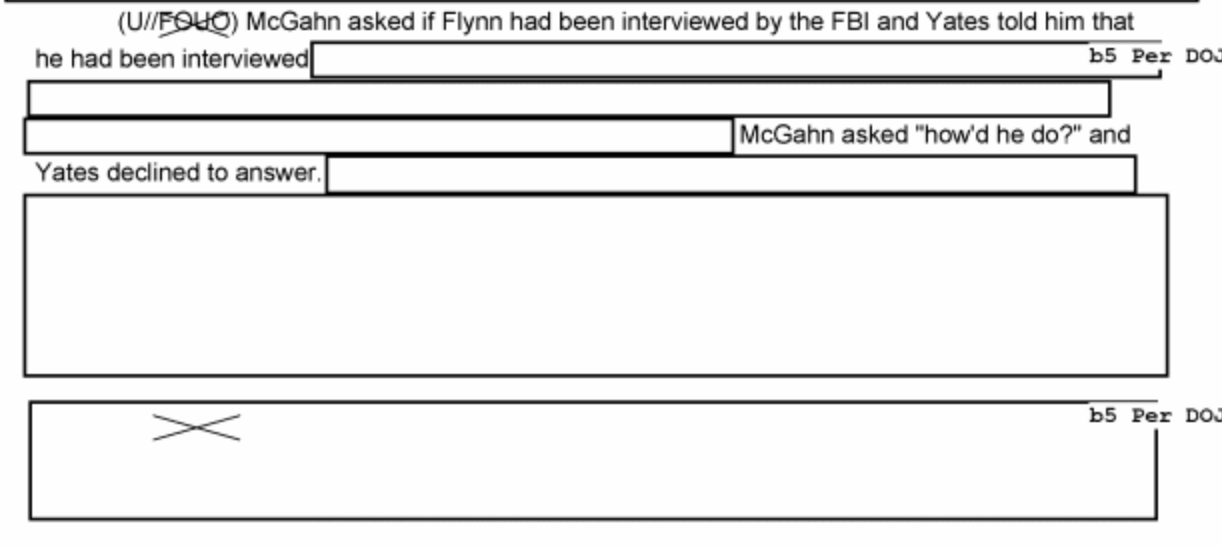
For example, it shows that the government redacted parts of Acting NSD Director Mary McCord‘s interview report, which focused closely on her interactions with the White House Counsel about Mike Flynn’s lies to the FBI, as a Presidential Communication.

This claim  is probably fairly sketchy. She is not known, herself, to have spoken directly to Trump. And while much of her interview was withheld under b1 and b3 (at least partly on classification grounds pertaining to the FISA on which Flynn was captured, but also grand jury information with respect to the investigation into Mike Flynn) and b7E (law enforcement methods), the parts that were withheld under b5 appear to be her speaking to Don McGahn, including bringing information to him, rather than the reverse.

Crazier still, we’ve all been pretending that Flynn lied about his calls with Sergey Kislyak of his own accord; the Mueller Report remained pointedly non-committal on whether Flynn undercut Obama’s sanctions on Trump’s orders or not. Protecting these conversations as a Presidential Communication seems tacit admission that Don McGahn’s interactions with McCord were significantly about Trump, not Flynn.

Chris Ruddy’s interview unsurprisingly includes Presidential Communications

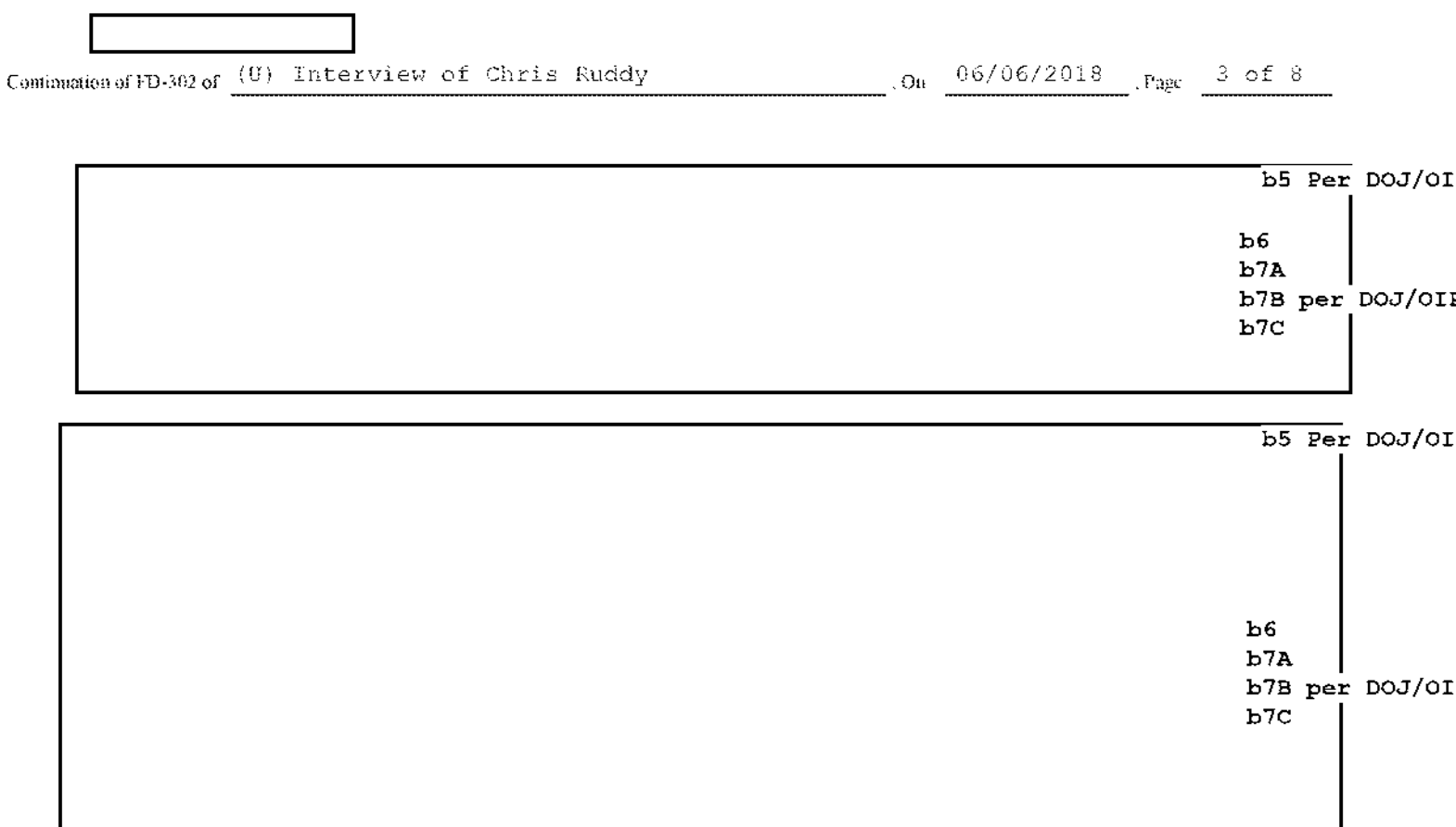
It is thoroughly unsurprising that DOJ is withholding parts of Chris Ruddy’s interview as Presidential Communications. After all, during the period about which the unredacted parts of the interview show he was interviewed (summer 2017), Ruddy served as Trump’s rational brain, so it would be unsurprising if Ruddy told Mueller’s team certain things he said to Trump.

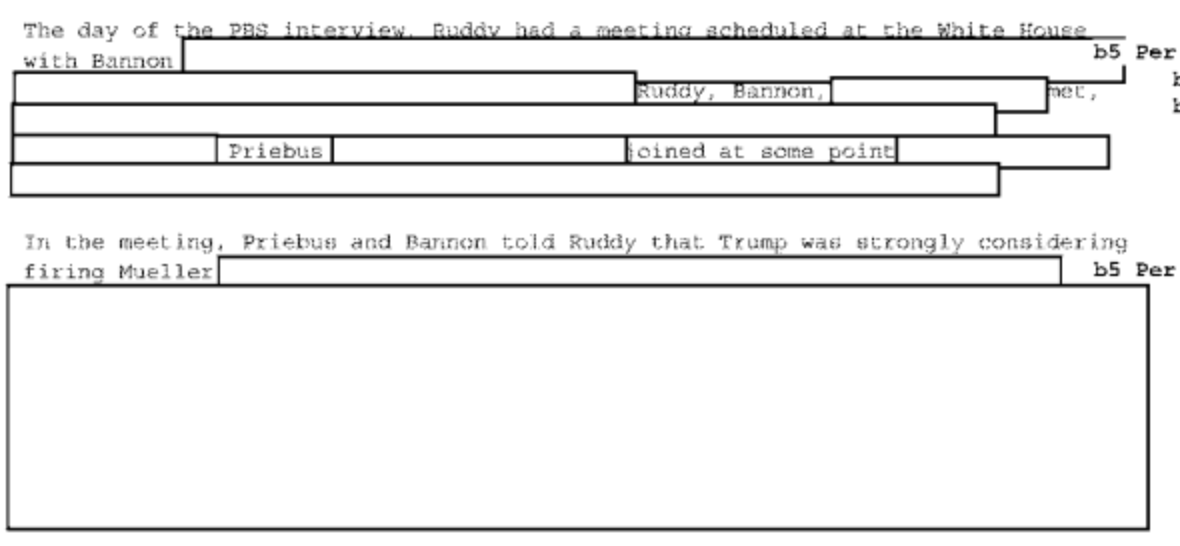
Though even there, there are passages that seem like may be an improper assertion of Presidential Communications, such as what appears to be a meeting at the White House with Reince Priebus and Steve Bannon — neither of whom is the President — asking for his help to go make a public statement mind-melding him into not firing Mueller.

As the Mueller Report passages sourced to this interview make clear, this is a PR request, not a presidential communication.

On Monday, June 12, 2017, Christopher Ruddy, the chief executive of Newsmax Media and a longtime friend of the President’s, met at the White House with Priebus and Bannon.547 Ruddy recalled that they told him the President was strongly considering firing the Special Counsel and that he would do so precipitously, without vetting the decision through Administration officials.548 Ruddy asked Priebus if Ruddy could talk publicly about the discussion they had about the Special Counsel, and Priebus said he could.549 Priebus told Ruddy he hoped another blow up like the one that followed the termination of Comey did not happen.550 Later that day, Ruddy stated in a televised interview that the President was “considering perhaps terminating the Special Counsel” based on purported conflicts of interest.551 Ruddy later told another news outlet that “Trump is definitely considering” terminating the Special Counsel and “it’s not something that’s being dismissed.”552 Ruddy’s comments led to extensive coverage in the media that the President was considering firing the Special Counsel.553

White House officials were unhappy with that press coverage and Ruddy heard from friends that the President was upset with him.554

Still, the fact that DOJ maintains that some of this interview involves Presidential Communications is interesting because of the point I made in this post: Passages currently redacted for an ongoing criminal proceeding suggest Ruddy’s other communications, possibly with Manafort or his lawyer, are part of an ongoing criminal proceeding.

I’m interested in Ruddys’ 302 because four paragraphs that show a b7ABC redaction, which mostly has been used to hide stuff pertaining to Roger Stone.

I doubt this redaction pertains to Stone, though, at least not exclusively.

As I noted last June when Amy Berman Jackson liberated the Sean Hannity texts with Manafort, she withheld another set of communications (probably showing Kevin Downing reached out to the media, as he had done with Hannity, which is why they were submitted as part of Manafort’s sentencing). She withheld the other texts because of an ongoing proceeding.

At the time, I suggested that the other proceeding might pertain to Chris Ruddy because:

  • Ruddy was a key source for a key Howard Fineman story in the same time frame as Kevin Downing had reached out to Hannity
  • Prosecutors probably obtained all of Manafort’s WhatsApp texts after learning he had been witness tampering using that account
  • Ruddy testified to Mueller the day after they had extracted the Manafort-Hannity texts, suggesting he was a likely candidate to be the other person whose texts showed ongoing communication with the media

DOJ may be withholding discrete paragraphs in Ruddy’s interview both because they are a Presidential Communication and because they are part of an ongoing investigation. Which seems like something CNN and BuzzFeed might want to clarify.

Hiding the most damning Sater and Bannon and (possibly) KT McFarland interviews?

Then there are three interviews DOJ claims to have turned over for which the interviewee’s name has been withheld.

One of those, for an interview on August 15, 2017, happened on a day when Mueller’s team conducted five interviews (or, given the 1-page length of three of them, more likely phone calls setting up interviews). One of those is of Andrej Krickovic, a Carter Page associate who is not listed on the master list of interviews but whose name was identified in his 302. But the interview in question is being withheld under a Presidential Communications exemption, so surely is not Krickovic. There’s a 6-page interview from that date reflected in the DOJ list of all interviews (“Mueller interview list”) that is likely the one in question. And given that the earliest released interview of KT McFarland, dated September 14, 2017, describes her being “acquainted with the interviewing agents from a previous interview,” given reports that her first most egregious lies about Flynn’s calls to Kislyak came during the summer (before it was clear that Mueller’s team was going to obtain a warrant to get Transition emails from GSA), and given the September 302 reflects her attempt to clear up several existing untruths, I’m guessing that’s hers.

There’s more evidence regarding the subjects of two other 302s from which the names have purportedly been withheld. The b5 table includes a December 15, 2017 interview being withheld exclusively as Attorney Work Product. It seems likely that this is the December 15, 2017 Felix Sater interview reflected in the Mueller interview list. Immediately before the September 19, 2017 Sater interview are 7 pages that were entirely withheld (1394 through 1400) under b3 (grand jury or classification), b6 and b7C (collectively, privacy), b7E (law enforcement sources and methods), b7F (likely risk of death), and b5. Sater is one of — if not the only — person whose interviews have been protected under b7F (which makes sense, given that he was a high level informant for years).  Plus, there’s reason to believe that Sater’s story evolved after he was interviewed by HPSCI on December 14, 2017, and DOJ seems especially interested in hiding how some of these stories changed over time. In other words, DOJ seems to be hiding the entirety of a Sater interview the existence of which they already acknowledged under a whole slew of exemptions, including Attorney Work Privilege. That would be particularly egregious, given that Mueller relied on that interview to support the following details about Trump Tower:

Given the size of the Trump Moscow project, Sater and Cohen believed the project required approval (whether express or implicit) from the Russian national government, including from the Presidential Administration of Russia.330 Sater stated that he therefore began to contact the Presidential Administration through another Russian business contact.331

[snip]

The day after this exchange, Sater tied Cohen’s travel to Russia to the St. Petersburg International Economic Forum (“Forum”), an annual event attended by prominent Russian politicians and businessmen. Sater told the Office that he was informed by a business associate that Peskov wanted to invite Cohen to the Forum.367

In a follow-up, I’ll explain why DOJ’s attempt to withhold this interview by hiding the existence of it even though they’ve already acknowledged it is fairly damning.

In addition, the b5 table lists a January 18, 2019 interview withheld under Presidential Communication and Deliberative Process Privilege, but not Attorney Work Product (which might suggest it was an interview FBI agents conducted with no prosecutor present). While there was stuff pending in the Jerome Corsi investigation at the time (which might explain the lack of lawyers but probably not a Presidential Communication Privilege), the only interview on that date included in the Mueller interview list involves Steve Bannon. That’s interesting because while his proffer agreement (signed by Andrew Goldstein, so seemingly reflecting Goldstein’s presence at the interview of that date) shows in the batch of 302s in which this withheld one is supposed to have appeared, his interview of that date (which is 4 pages long) does not appear. There’s not an obvious set of withheld pages that might be that interview (there are 6-page withholdings that might include it). But Bannon’s January 18, 2019 was, given some comments at the Stone trial, particularly damning and conflicts with the one (of three) Bannon 302 that has been made public. Just one sentence of the Mueller Report — pertaining to the campaign’s discussions about upcoming WikiLeaks releases but still redacted for Stone’s trial — relies on this Bannon interview, but since it does, the interview itself should not be entirely redacted. (That said, the entirety of Bannon’s 16-page October 26, 2018 302 has also been hidden in plain sight in these releases.)

There is, admittedly, varying degrees of certainty about these hypotheses. But if they are correct, it would suggest that DOJ is systematically withholding 302s that would show significant changes in testimony among people who were not charged for lying in the earlier ones. Of particularly note, they may be hiding one each that BuzzFeed (which had the lead in reporting the Felix Sater story) and CNN (which was one of the few outlets that reported how KT McFarland had to clean up her testimony) have an institutional stake in.

Rick Gerson disappeared into the same Agency review as Jared Kushner?

Finally, the b5 table reveals DOJ has “released” the two interviews from Rick Gerson, even though we’ve seen no hint of them.

You might be forgiven for forgetting who Rick Gerson is — Steven Bannon even claimed to have in his first, least forthcoming interview. He’s a hedgie who is close to Jared Kushner who actually had a key role in setting US-Russian policy from the start of the Trump Administration. George Nader introduced him to the CEO of the Russian Direct Investment Fund, Kirill Dmitriev, after which Gerson (who had no official role in the Transition or Administration so presumably had no security clearance) and Dmitriev put together a reconciliation plan between Russian and the US.

In addition, the UAE national security advisor introduced Dmitriev to a hedge fund manager and friend of Jared Kushner, Rick Gerson, in late November 2016. In December 2016 and January 2017, Dmitriev and Gerson worked on a proposal for reconciliation between the United States and Russia, which Dmitriev implied he cleared through Putin. Gerson provided that proposal to Kushner before the inauguration, and Kushner later gave copies to Bannon and Secretary of State Rex Tillerson.

Gerson’s two interviews are cited 17 times in the Mueller Report and cover topics including:

  • Gerson’s ties to Jared and non-existent role on the campaign
  • Gerson’s role setting up meetings with Tony Blair and Mohammed bin Zayed
  • How Nader introduced him to Dmitriev
  • How Dmitriev pitched Gerson on a potential joint venture
  • How Gerson, having been promised a business deal, then worked to figure out from Jared and Mike Flynn who was running “reconciliation” on the Transition
  • What Dmitriev claimed his relationship to Putin was
  • How Gerson, “on his own initiative and as a private citizen,” worked with Dmitriev during December 2016 to craft this “reconciliation” plan
  • How Gerson got that plan into Kushner’s hands and it formed a key part of the discussion between Trump and Putin on their January 28, 2017 call
  • How Dmitriev seemed to lose interest in doing business with Gerson once he had finished using him

A key part of this discussion relies on both Gerson’s interviews and the Kushner one that is being reviewed by an Agency.

On January 16, 2017, Dmitriev consolidated the ideas for U.S.-Russia reconciliation that he and Gerson had been discussing into a two-page document that listed five main points: (1) jointly fighting terrorism; (2) jointly engaging in anti-weapons of mass destruction efforts; (3) developing “win-win” economic and investment initiatives; (4) maintaining an honest, open, and continual dialogue regarding issues of disagreement; and (5) ensuring proper communication and trust by “key people” from each country. 1111 On January 18, 2017, Gerson gave a copy of the document to Kushner. 1112 Kushner had not heard of Dmitriev at that time. 1113 Gerson explained that Dmitriev was the head of RDIF, and Gerson may have alluded to Dmitriev’s being well connected. 1114 Kushner placed the document in a file and said he would get it to the right people. 1115 Kushner ultimately gave one copy of the document to Bannon and another to Rex Tillerson; according to Kushner, neither of them followed up with Kushner about it. 1116 On January 19, 2017, Dmitriev sent Nader a copy of the two-page document, telling him that this was “a view from our side that I discussed in my meeting on the islands and with you and with our friends. Please share with them – we believe this is a good foundation to start from.” 1117

1111 1/16/17 Text Messages; Dmitriev & Gerson.

1112 Gerson 6/5/18 302, at 3; Gerson 6/15/18 302, at 2.

1113 Gerson 6/5/18 302, at 3.

1114 Gerson 6/5/18 302, at 3; Gerson 6/15/18.302, at 1-2; Kushner 4/11/ 18 302, at 22.

1115 Gerson 6/5/18 302, at 3.

1116 Kushner 4/11/18 302, at 32.

1117 1/19/17 Text Message, Dmitriev to Nader (11: 11 :56 a.m.).

There are roughly 62 pages referred to another agency in the January 2 release (which is understood to include Kushner’s April 11, 2018 interview) is an 11-page series (1216-1226), which might be Gerson’s two interviews. That suggests we can’t even get the 302s that show how Putin’s selected envoy to the US managed to plan out the first phone call between Putin and Trump with a hedgie who went to college with Kushner with not formal ties to the Transition or Administration and no security clearance because they’re so sensitive — more sensitive than KT McFarland’s discussion of Transition national security discussions, for example — that some Agency like the CIA has to give us permission first.

Share this entry

Amid Description of Kushner’s Shadow Foreign Policy, Tillerson Counters a Jared Claim to Mueller about Kirill Dmitriev’s Plan

When the FBI interviewed Mike Flynn on January 24, 2017, he offered a lame excuse for why he and other Transition officials (notably including Jared Kushner) were hiding their meetings with foreign leaders.

FLYNN explained that other meetings between the TRUMP team and various foreign countries took place prior to the inauguration, and were sensitive inasmuch as many other countries did not want the then-current administration to know about them.

In reality, the Trump Transition had provided Obama’s team reassurances they would not try to undermine Obama’s policies, but were doing so secretly.

But it wasn’t just the Obama Administration that Kushner was hiding his actions from. In a May interview with the House Foreign Relations Committee, Rex Tillerson revealed this continued to happen. He provided an example where he caught Mexico’s Foreign Minister meeting with Jared “and I don’t remember who else was at the table” without his knowledge.

Q And we’ve had concerning reports lately that Mr. Kushner has traveled to the Middle East with virtually no assistance or input of his ability from the embassy. Was that something that you experienced? You know, obviously you said that there was this exchange about a broader framework that he had worked on to develop and inform the Saudi-U.S. relationship.

Did you ever experience anything of the nature of this trip I just mentioned where diplomatic engagement occurred, whether or not it was related to that framework, but it was outside the scope of your knowledge or didn’t involve preparation by the State Department?

A Yes.

Q Could you say a little more about that?

A In Saudi Arabia particularly?

Q Or other examples that I think are similar in nature.

A Yeah. There were — on occasion the President’s senior adviser would make trips abroad and usually, you know, kind of was in charge of his own agenda.

Sr. Democratic Counsel. And just to clarify, you mean Mr. Kushner?

Mr. Tillerson. Yes. Yeah. Yes. And typically not a lot of coordination with the embassy.

Sr. Democratic Staff. Did you ever raise this phenomenon with Mr. Kushner or —

Mr. Tillerson. I did.

BY SR. DEMOCRATIC COUNSEL: Q What were those conversations like?

A He said he would try to do better.

Q Did he?

A Not much changed.

Q How did that impact your job?

A Well, I think — you know, I alluded earlier to the fact that it’s always challenging if everyone isn’t kind of working from the same playbook. And certainly there — and let me be clear — there are occasions, and it’s certainly the President’s prerogative, to have individuals undertake special assignments in a very compartmentalized way. Not using — I’m trying not to use the word “compartmentalize” relative to —

Q Not a term of art.

A Right. But in a way that, for whatever reasons, they prefer to have it carried out by an individual that way, and it’s the President’s prerogative to do that. But it — yeah, it presents special challenges to everyone if others who are trying to effect foreign policy with a country and move the agenda forward are not fully aware of other conversations that are going on that might be causing your counterparty in that country to take certain actions or behave a certain way and you’re not clear as to why, why did they do that.

Q Did you ever find yourself in one of those situations where Mr. Kushner had had a meeting or had a conversation that you weren’t aware of and it caught you off guard?

A Yes.

Q Could you be specific about that?

A Well, I’ll give you just one example and then maybe we can —

Q Yes, sir.

A — leave it at the one example. But Mexico was a situation that that occurred on a number of occasions. And I mention this one because I think it was — some of the elements of it were reported publicly that the Foreign Secretary of Mexico was engaged with Mr. Kushner on a fairly — unbeknownst to me — a fairly comprehensive plan of action.

And the Foreign Secretary came to town — unbeknownst to me — and I happened to be having a business dinner at a restaurant in town. And the owner of the restaurant, proprietor of the restaurant came around and said: Oh, Mr. Secretary, you might be interested to know the Foreign Secretary of Mexico is seated at a table near the back and in case you want to go by and say hello to him. Very innocent on his part.

And so I did. I walked back. And Mr. Kushner, and I don’t remember who else was at the table, and the Foreign Secretary were at the table having dinner. And I could see the color go out of the face of the Foreign Secretary of Mexico as I very — I smiled big, and I said: Welcome to Washington. And I said: I don’t want to interrupt what y’all are doing. I said: Give me a call next time you’re coming to town. And I left it at that.

As it turned out later, the Foreign Secretary was operating on the assumption that everything he was talking to Mr. Kushner about had been run through the State Department and that I was fully on board with it. And he was rather shocked to find out that when he started telling me all these things that were news to me, I told him this is the first time I’m hearing of it. And I don’t know that any of those things were discussing ultimately happened because there was a change of government in Mexico as well.

Earlier in the interview, staffers told Tillerson (for the first time!) that Kushner and Steve Bannon got advance notice of the Gulf blockade of Qatar, which pissed Tillerson off.

Q A couple of weeks later on May 20th, 2017, you were in Riyadh with the President in advance of the Middle East summit. And you again gave public remarks with the Saudi Foreign Minister. This is the night before the President’s speech. Did he say anything to you or did anyone else say anything to you on that same topic, regional tensions, something might be changing?

A No.

Q So that same night as we understand it, so on or about May 20th, 2017, there was apparently a private dinner that was hosted between Steve Bannon, Jared Kushner, and the rulers of Saudi Arabia and UAE, respectively. Were you aware of that dinner?

A No.

Q We understand that as part of that dinner the leaders of Saudi and UAE did lay out for Mr. Kushner and Mr. Bannon their plans for the blockade. That wasn’t something that you had heard previously?

A No.

Q And to clarify, sir, not prior to when I just said it? A Correct.

Q Okay. What’s your reaction to a meeting of that sort having taken place without your knowledge?

A You mean now?

Q Yes. A Today?

Q Well —

A It makes me angry.

Q Why is that?

A Because I didn’t have a say. The State Department’s views were never expressed.

In any case, the revelation that Jared continued to conduct shadow foreign policy even after his father-in-law took over — and the fact that his so-called “peace” “process” in Palestine has been shown instead to be a hedge fund driven excuse to turn apartheid into a profit center (See these threads on just how bad it is: one, two, three) — I’d like to point to a more subtle detail in Tillerson’s interview. He claims that — contrary to what Jared told Mueller — the President’s son-in-law did not share a plan from Kirill Dmitriev with him.

Either during the transition or early in your tenure as Secretary, did anyone ever pass you a plan or sort of a roadmap regarding policy changes in the US Russia relationship?

A Not that I can recall.

Q And as you’ll note, sir, I believe one of those was mentioned in the Mueller report and it was stated that that had gone from a Mr. Kirill Dmitriev to Mr. Kushner who I believe was said that that was passed to you. Do you have any recollection of that?

A I don’t recall ever receiving any such report as described in the Mueller report or any other.

Q Okay. And no other sort of here’s what we should do on Russia proposals from anyone else?

A No.

Q Nothing from the Trump family, the organization?

A No.

As you’ll recall, Kirill Dmitriev, whom Putin tasked to reach out to the new Administration, got to Jared via one of his hedgie friends, Rick Gerson and via George Nader. Between the three of them, they had a role in setting the agenda for the January 28 phone call between Putin and Trump (Tillerson, who was not confirmed yet, did not sit in on that meeting).  That plan included “win-win investment initiatives.” According to the Mueller Report, Jared claimed he had given that report to Bannon (who was in the meeting) and Tillerson, but neither followed up on it.

Dmitriev told Gerson that he had been tasked by Putin to develop and execute a reconciliation plan between the United States and Russia. He noted in a text message to Gerson that if Russia was “approached with respect and willingness to understand our position, we can have Major Breakthroughs quickly.”1105 Gerson and Dmitriev exchanged ideas in December 2016 about what such a reconciliation plan would include. 1106 Gerson told the Office that the Transition Team had not asked him to engage in these discussions with Dmitriev, and that he did so on his own initiative and as a private citizen.1107

[snip]

On January 16, 2017, Dmitriev consolidated the ideas for U.S.-Russia reconciliation that he and Gerson had been discussing into a two-page document that listed five main points: (1) jointly fighting terrorism; (2) jointly engaging in anti-weapons of mass destruction efforts; (3) developing “win-win” economic and investment initiatives; (4) maintaining an honest, open, and continual dialogue regarding issues of disagreement; and (5) ensuring proper communication and trust by “key people” from each country. 1111 On January 18, 2017, Gerson gave a copy of the document to Kushner. 1112 Kushner had not heard of Dmitriev at that time. 1113 Gerson explained that Dmitriev was the head of RDIF, and Gerson may have alluded to Dmitriev’s being well connected. 1114 Kushner placed the document in a file and said he would get it to the right people. 1115 Kushner ultimately gave one copy of the document to Bannon and another to Rex Tillerson; according to Kushner, neither of them followed up with Kushner about it. 1116 On January 19, 2017, Dmitriev sent Nader a copy of the two-page document, telling him that this was “a view from our side that I discussed in my meeting on the islands and with you and with our friends. Please share with them – we believe this is a good foundation to start from.” 1117

Gerson informed Dmitriev that he had given the document to Kushner soon after delivering it. 1118 On January 26, 2017, Dmitriev wrote to Gerson that his “boss”-an apparent reference to Putin-was asking if there had been any feedback on the proposal. 1119 Dmitriev said, ” [w]e do not want to rush things and move at a comfortable speed. At the same time, my boss asked me to try to have the key US meetings in the next two weeks if possible.”1120 He informed Gerson that Putin and President Trump would speak by phone that Saturday, and noted that that information was “very confidential.”1121

The same day, Dmitriev wrote to Nader that he had seen his “boss” again yesterday who had “emphasized that this is a great priority for us and that we need to build this communication channel to avoid bureaucracy.” 1122 On January 28, 2017, Dmitriev texted Nader that he wanted “to see if I can confirm to my boss that your friends may use some of the ideas from the 2 pager I sent you in the telephone call that will happen at 12 EST,”1123 an apparent reference to the call scheduled between President Trump and Putin. Nader replied, “Definitely paper was so submitted to Team by Rick and me. They took it seriously!”1124 After the call between President Trump and Putin occurred, Dmitriev wrote to Nader that “the call went very well. My boss wants me to continue making some public statements that us [sic] Russia cooperation is good and important.” 1125 Gerson also wrote to Dmitriev to say that the call had gone well, and Dmitriev replied that the document they had drafted together “played an important role.” 1126

1116 Kushner 4/11/18 302, at 32.

The claim that Kushner handed over the document is sourced solely to him (Steve Bannon did testify after Kushner made this claim; it’s not clear if Tillerson ever did).

It may or may not be a big deal that Tillerson doesn’t agree with Kushner’s claim. Tillerson claims to have forgotten a lot about what happened while he was at State, so it’s possible he just forgot. But given that Kushner repeatedly kept Tillerson out of the loop, it’s certainly possible that he did so with this plan, as well.

Which would raise interesting questions if he actually made up his claim that he had kept Tillerson in the loop on this plan.

Share this entry