Posts

“It Certainly Sounds Creepy:” John Durham Adopts the “Coffee Boy” Defense

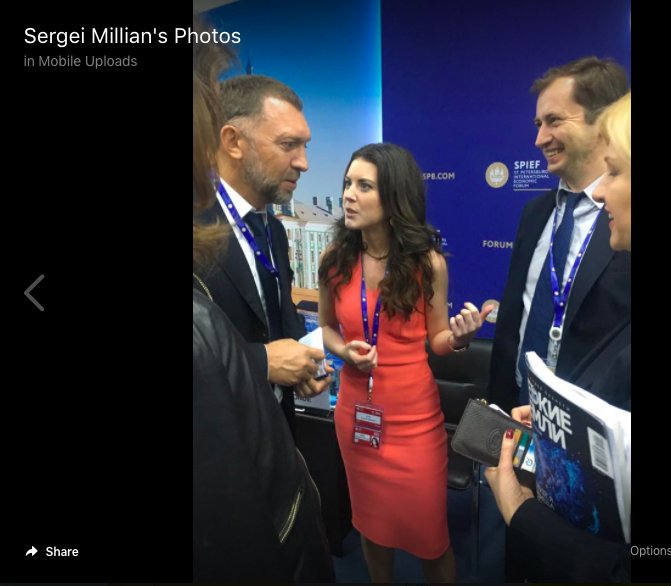
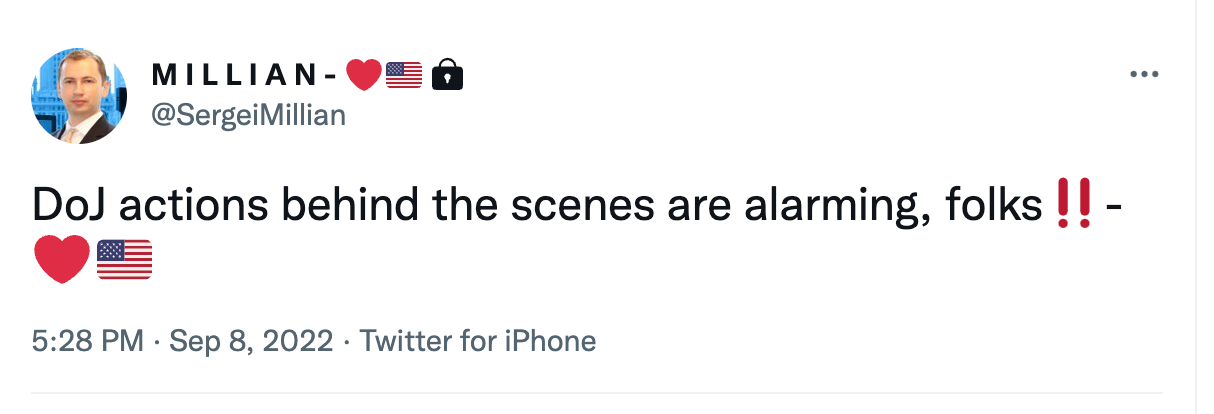
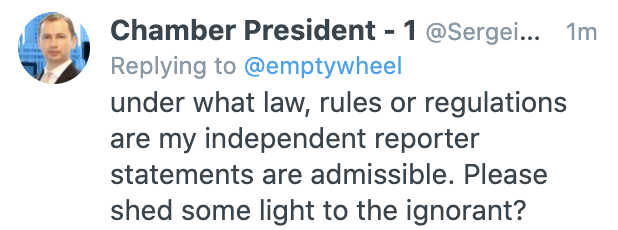
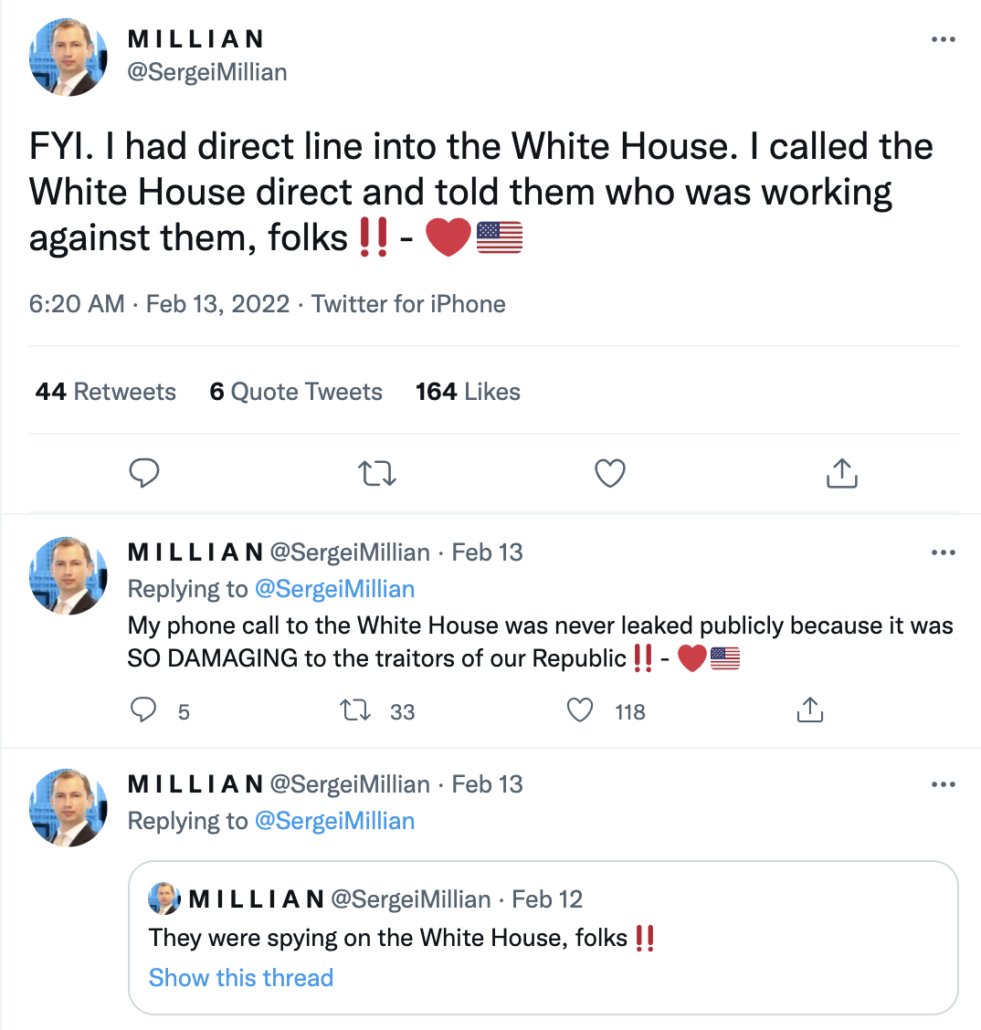
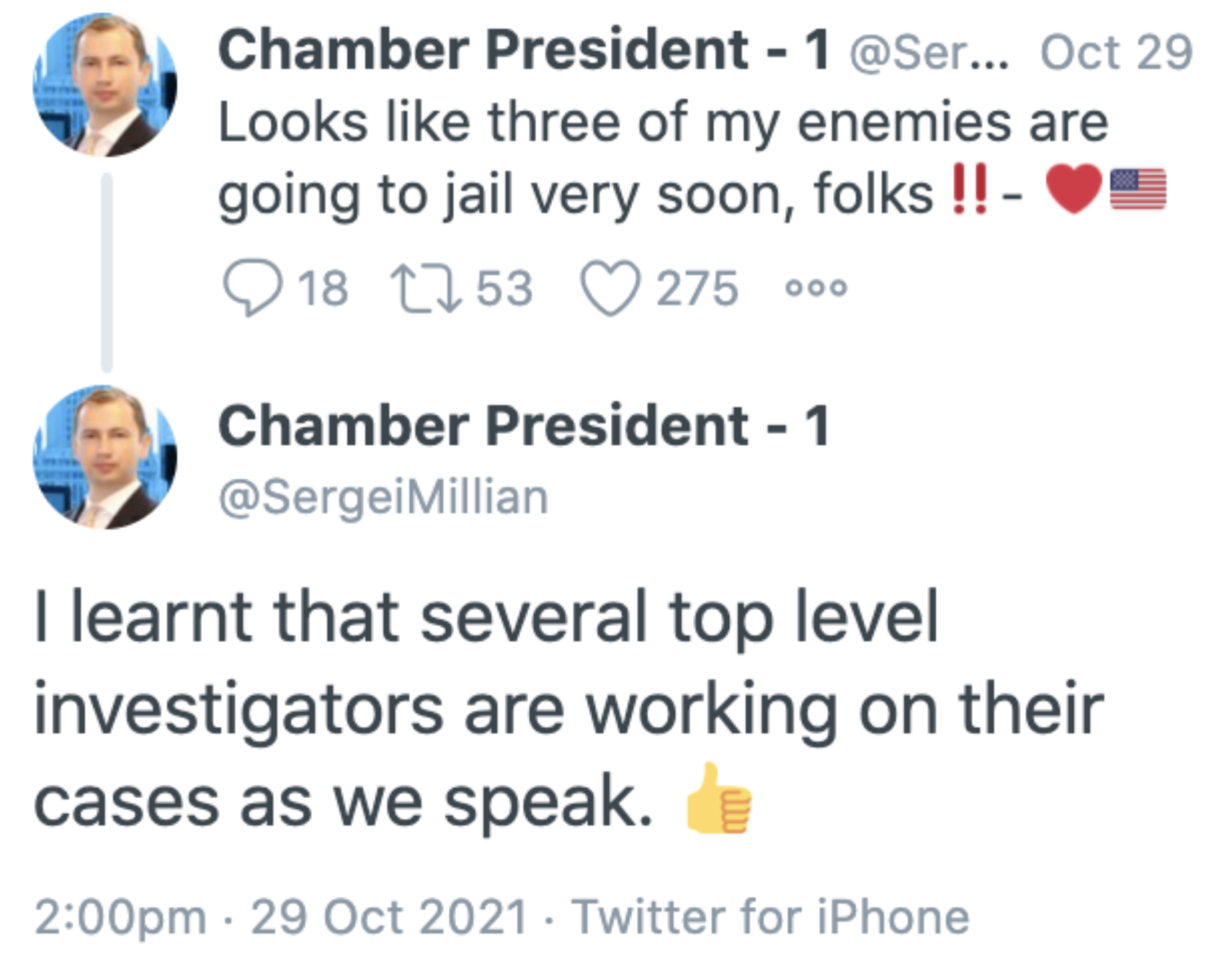
At one point during his redirect of FBI Supervisory Analyst Brian Auten yesterday, John Durham was so desperate to insinuate that the Crossfire Hurricane/Mueller team was incompetent, that he even argued that they didn’t investigate Sergei Millian thoroughly enough.

Durham was trying to suggest that Auten should have discovered and pulled the call records for a 212 number, in addition to the 404 prefix number around which Durham has built his entire case.

Q. Right. Do you recall whether or not the FBI ever did — in Crossfire Hurricane ever run that number down to see what the records might show?

A. The 212 number?

Q. Correct.

A. It’s possible. I don’t have a recollection of that while I sit here now.

Q. If you had done that, if the investigators had done that, is that something you think you would recall?

A. Not necessarily.

Q. There’s some probability that if you had actually run the numbers to the ground, you would remember that?

A. No. But, I mean, for a number trace, that may have been one of the analysts that I had under me. If we did it, again, I don’t know whether it was run or not.

Durham was trying to suggest that the FBI should have found a second phone number used by Sergei Millian that — it appears from Durham’s own exhibit list — Durham either didn’t know about or wanted to keep hidden. In the process, he implied that Mueller didn’t investigate Millian, whom Durham still believes was a victim in all this, aggressively enough.

I predicted, on multiple occasions, that Durham would be destroying his purported victims in a claimed effort to avenge them.

He should have listened to me.

Because thus far, Durham’s vengeance for Trump and his flunkies has done more to air details of the criminal investigations into everyone Durham claims to be defending than it has served to present proof of Danchenko’s guilt.

Close to the beginning of his cross-examination yesterday, Danchenko attorney Danny Onorato got Auten to lay out that three of the original subjects of the Crossfire Hurricane investigation — everyone but Carter Page — were convicted.

Q Now, you also understand that when Crossfire Hurricane opened — I think you testified yesterday that there were four people who the government was looking at, correct?

A Correct.

Q Papadopoulus?

A Correct.

Q Paul Manafort, the former campaign manager?

A Correct.

Q Carter Page?

A Correct.

Q And the fourth?

A Michael Flynn.

Q And are you aware that — I think Mr. Durham asked you — whether Mr. Page was ever charged or convicted of a crime?

A Yes, he did. He asked me that.

Q And what did you tell him?

A No.

Q What about the other three people?

A Well, Mr. Manafort, yes.

Q Was he convicted?

A Yes.

Q Next person?

A Michael Flynn.

Q Convicted?

A Yes.

Q Okay. Next?

A George Papadopoulos.

Q Okay. And?

A Yes.

Q So three of those four were convicted of crimes?

A Correct.

Q Based on the Crossfire Hurricane investigation?

A As it went over to the special counsel’s office, yes.

Q Okay.

Even before rehearsing the results of the Mueller investigation, Onorato had Auten describe that the Australian tip that predicated the entire investigation pertained to George Papdopoulos.

Okay. Now, given your background with respect to, you know, analytics and, you know, your work history, is it fair to say that you were assigned to the Crossfire Hurricane investigation?

A Yes.

Q Now, a quick summary would be to say that Crossfire Hurricane started because someone who was represented to be a high-level Trump campaign official and advisor, Mr. Papadopoulos, allegedly indicated that the Russians would help leak damaging information to the Clintons and Obamas, right?

A They had received a suggestion that they could be helped that way, yes.

Q Again, that person was George Papadopoulos, right?

A That is correct.

Q Okay. And the FBI opened an investigation on July 31, 2016?

A Yes.

Q That was before you had any information regarding the Steele dossier, right?

A That is correct.

Q That was before you even — so you would agree with me that the opening of that investigation had nothing to do with the Steele information; it had nothing to do with the initiation of Crossfire Hurricane?

A Correct.

Q You would agree that the goal of Crossfire Hurricane was to determine whether or not there was truth to the allegation that a friendly foreign government had provided the U.S. with respect to Russia and collusion between the Trump administration?

A That is correct. [my emphasis]

Onorato was laying the foundation — as I also predicted — to show proof that Durham’s entire basis for claiming that Millian could not have called Danchenko in July 2016 was easily disproven with basic details of Millian’s cultivation of Papadopoulos in the very same time period. This wasn’t about the fact that Papadopoulos admitted he had lied to cover up his ties with Russian-linked figures.

But it seems to have made Durham nervous that the jury would notice he had.

Perhaps because of this, Durham several times made really defensive comments about George Papadopoulos.

Durham spent part of his redirect of Auten attacking his claim that Papadopoulos was a “high level advisor to the Trump Campaign” (which arose from Onorato’s accurate description of the tip from Australia, as I noted in bold above), delivering the “Coffee Boy” defense Trump once used with great flourish to the “ladies and gentlemen of the jury.”

Q. Okay. Now, there were a number of questions that defense counsel asked you that you — well, there were a number of questions that counsel asked you that I want to probe a little bit more deeply. Mr. Onorato asked you or made reference to George Papadopoulos and said — and said — incorporated in his question, that George Papadopoulos was a high level advisor to the Trump Campaign, and you said yes. Well, tell the ladies and gentlemen of the jury with respect to George Papadopoulos, how old was George Papadopoulos in the 2016 election?

A. I want to say Papadopoulos was in his 30s.

Q. How about 28? Does that refresh your recollection?

A. It could be around 28.

Q. And was he such a high level advisor that he still had on his resume that he was in a student UN panel?

A. No, that was on his resume.

Q. Right. So this person that you agreed to was a high level advisor to Trump, the Trump Campaign, was a 28-year old who still had on his resume that he was a UN — a student UN person? [my emphasis]

When Auten tried to remind Durham that Trump himself had pitched Papadopoulos as a key foreign policy advisor, Durham interrupted.

A. I would say that part of my articulation of that deals with the fact that Mr. Papadopoulos was part of the small group of advisors that were named, I believe, in March of 2016

Q. Right.

A. For the president — for the former president.

Q. With respect to high level advisor, you don’t have any idea whether Papadopoulos even, you know, had occasion to talk to Trump, do you?

A. Well, he was at the meeting that — that was announced —

Q. He was at one meeting —

MR. ONORATO: Can the witness finish his question — his answer?

MR. DURHAM: Sure.

Remember that Durham and Bill Barr went on a junket to Italy together to chase Papadopoulos’ conspiracy theories without ever interviewing Papadopoulos first (which he still has not done, three years later). And now he’s telling us Papadopoulos was just a low level coffee boy?

After attempting to debunk that people — like the former President, the former Attorney General, and he himself treated Papadopoulos as if he had credibility — Durham then tried to get Auten to agree that Mueller was more worried that Papadopoulos was an asset of Israel’s than Russia’s. When Auten tried to clarify that, no, Mueller investigated Papadopoulos for both, Durham interrupted again.

Q. And, in fact, with respect to Mr. Papadopoulos, isn’t it, in fact, true that, as to Papadopoulos, what the FBI thought it was more — of more interest in Papadopoulos was his relationship to Middle Eastern countries, not to Russia?

A. Actually, I would argue that it was a combination of both. I think —

Q. And I — I’m sorry.

THE COURT: Go ahead. Finish your answer.

THE WITNESS: I think I’ve asserted in testimony that it was a both and.

Before this, Durham twice went on at great length suggesting that Millian couldn’t be a spy recruiting George Papadopoulos — even though Papadopoulos himself described Millian as “a very shady kind of person” — because they were discussing real estate and energy, not “collusion” with Russia. He did this first in a morning hearing before the jury came in.

The defendant has provided what he has premarked as Defendant’s Exhibit 480, 4-8-0, which is an email, a LinkedIn message from Millian to George Papadopoulos. Unless the defendant is going to somehow explain to the jury what Millian and Papadopoulos were communicating about at this period of time, then the Court should not permit it. Papadopoulos and Millian, as I think the defense knows from the discovery in this case, were exchanging any number of emails or Facebook exchanges or LinkedIn all about real estate, potential real estate transactions.

And so what the defense would be asking the jury to do is to draw some adverse inference that there was something going on between Millian and Papadopoulos that they really don’t know about, but it certainly sounds creepy. Well, in fact, if you look at what the communications were, as I say, between Papadopoulos and Millian, they are all about real estate, potential real estate investments.

[snip]

MR. DURHAM: 486 is from Millian to Papadopoulos. Again, you know, its irrelevant to these proceedings, but for the same reason, in the government’s view, it would be inadmissible unless we want to get into evidence relating to what Papadopoulos and Millian were doing at or about the time these email exchanges were occurring. [my emphasis]

He did it again in the middle of Onorato’s cross in the guise of voir dire before admitting the communications between Millian and Papadopoulos.

Q. And do you remember what Papadopoulos and Millian were involved in that generated these numbers?

A. I don’t recall exactly what they were involved in, but it was —

Q. But was it pretty much they were involved in real estate or investment discussions over a long period of time?

A. That, I don’t recall exactly.

Q. Well, how about generally? Do you generally refer — recall that Papadopoulos and Millian were involved in discussions about real estate projects and the like?

A. In January of…

Q. Well, this whole period that’s reflected in Defendant’s Exhibit 403.

A. Yeah, again, I don’t know if I — I don’t know if I can speak to that at this point.

Q. Well, you — you were the analyst — that supervisory analyst, correct?

A. Yes.

Q. Did you recall, sir, what it was that Mr. Millian was involved in, the kind of investments?

A. Yes, he was involved in investments and the like.

Q. Right.

A. But I don’t know if I can speak to, at this point, these phone records being tied to any real estate deals or anything of that sort.

Q. Right. So all of these records have shown there was contact between the two of them, correct?

A. Correct.

Q. And did you know that Millian was involved in the energy sector as well?

A. Yes, correct.

Q. And did you know that Papadopoulos was talking about getting involved in the energy sector in the Middle East?

A. Yes, I did know that.

Q. Does that refresh any recollection as to whether or not the contact between Millian and Papadopoulos had to do with energy and other investments?

A. Again, I am familiar with both of those things. I don’t know if that is what this document was actually written for.

Q. Okay. And there’s nothing in this document that tells you what it is about, correct?

A. No. Gmail talks about — there are a couple of references on — it’s not — it’s Bates Number — last Bates number is 105262.

Q. Uh-huh.

A. And there are two paragraphs that talk about another individual involved with energy.

Q. Right. This is all about business, correct?

A. Again, I don’t know if all of this is about business. I know that there are paragraphs in here involving energy.

Q. Okay. So one can tell from this is that they were involved in exchanges of emails or the like, correct?

A. Correct.

Q. And it appears it has to do with energy, correct?

A. It might , yes. Again, there are a lot of — there are a lot of communications on here.

Q. Yes.

A. So I would not be able to state with any substance that these are all involving energy issues.

Q. You can’t say that because the document doesn’t tell the jury what it’s about, other than that it, at least it has partially to do with energy?

A. Correct.

Q. Between Millian and Papadopoulos, correct?

A. That’s what it appears, correct.

Q. So it would be unreasonable to conclude anything or draw any conclusions from this other than Papadopoulos and Millian were involved in investments in the energy sector, right?

A. I don’t know if I can say that it follows necessarily from this, that all of these things deal with that.

Q. That wasn’t my question, though.

A. Okay.

Q. My question was: It would be unreasonable to conclude from this document anything other than they were at least involved in talking about — the energy sector, correct?

A. I would say that from this document there may —

Q. Uh-huh.

A. — there are likely communications within this list of communications dealing with energy, though I cannot say, analytically speaking, that all of these deal with energy

Q. Fair enough. You know that Millian was involved in the energy sector and real estate?

A. I do recall that.

Q. And Papadopoulos is involved in the energy sector and real estate?

A. I recall that.

Q. And so this document doesn’t have anything to do, from looking at it on its particulars, anything to do with Russia and Russia collusion and the like, correct?

A. So the only thing that this has is — it has a list of — most of it is a list of communications between the two parties, dates, times.

Q. Okay. [my emphasis]

When he finally got the witness back and the exhibits admitted, Onorato mocked the way Durham had wasted all his time.

Q. Okay. And I’m glad that Mr. Durham took five minutes of my examination with you to talk about something I didn’t want to ask you about, okay? I don’t care if they were talking about going to the beech or vacation. It’s not relevant to —

He then noted that he really didn’t give a fuck what they were talking about. This was about metadata. Onorato was introducing it to show that the investigation into both Millian and Papadopoulos revealed that there were communications between the two men — communications not relying on the single cell phone that Durham bothered to obtain the call records for. Danchenko’s lawyer was showing that, during the same period when, Durham is arguing, Millian could not have arranged a meeting in New York with Danchenko because he was in Asia and the single phone the records of which Durham bothered to pull had been turned off temporarily, Millian had been arranging a meeting in New York with Papadopoulos.

Q. So the import of that document is that you were investigating Mr. Papadopoulos after Crossfire Hurricane, right?

A. In Crossfire Hurricane, yes.

Q. Right. But you got —

A. And special counsel.

Q. Right. And then Mr. Millian was also being investigated, right?

A. Correct.

Q. And so, the import of that is that there’s communication between Papadopoulos and Millian, and the FBI was documenting that because it was important, right?

A. Correct.

Q. Okay. It doesn’t — I don’t care about the contents of what they were discussing, just the fact that there was this relationship that you needed to explore, right?

Again, the primary purpose of introducing Papadopoulos was to show that the entire metadata-based argument that Durham will make about the impossibility of a call between Millian and Danchenko simply ignored publicly-known metadata from the very same period, metadata that the FBI believed was important.

Onorato was not trying to and does not need to prove that Millian was recruiting Papadopoulos as a Russian asset.

But the mere act of introducing these communications flipped the table, and Durham started making a desperate defense of two of the claimed victims he was championing.

Durham’s observation that all those communications “certainly sound[] creepy” was made outside the presence of the jurors. But in his bid to claim Papadopoulos was just a Coffee Boy, Durham himself introduced the possibility that two men he is attempting to claim were unfairly investigated really were engaged in “Russia collusion.”

Share this entry

John Durham’s Re-Virgined Birth of the Carter Page and Sergei Millian Investigations

The Igor Danchenko trial kicked off yesterday to contentious start, with prosecutor Michael Keilty accusing Danchenko of lying while making some, um, expansive claims about the public record, and Danchenko attorney Danny Onorato accusing Keilty of lying about the extent of the immunity Danchenko was granted for his January 2017 interviews, after which Judge Anthony Trenga admonished Onorato for overstating the extent to which Keilty overstated Danchenko’s immunization.

And then John Durham — in the flesh!! — after naming some more FBI employees so the former President could include them in another frivolous lawsuit, settled in for some rather painful direct examination of Supervisory Analyst Brian Auten.

Most of it–because it focused on events that preceded the first FBI interviews of Danchenko (and because during his interview he could not have known how much of his reports or in what form were used in the Carter Page FISA)–was irrelevant to the charges against Danchenko.

The country wasn’t served by any of this.

But along the way, we learned that Sergei Millian was once a source for the FBI, and that the investigation into Millian was closed without charges. By the end of the day yesterday, prosecutors hadn’t been permitted to raise details of the investigation into Danchenko.

About two key details, however, Durham deliberately obscured the record.

First, as the Durham team did during the Michael Sussmann trial, Durham made a big deal about the fact that Crossfire Hurricane investigation was opened as a full investigation from the start.

Q. And the FBI opened that up to say full investigation?

A. That is correct.

Q. From day one?

He did this without mentioning the hack-and-leak by a hostile intelligence service targeting Hillary Clinton, making it sound, instead, as if Australia shared the George Papadopoulos tip out of the blue, rather than in response to the seeming corroboration of the tip by the WikiLeaks publication.

John Durham never tires of minimizing Russian attacks on democracy, it seems.

As his team did during the Sussmann trial, Durham made a big deal about the fact that only at a Full Investigation could DOJ get a FISA warrant targeting Page (Durham also incorrectly suggested the primary goal of a FISA warrant is to find criminal information).

Q. Explain to the jurors, then, what tools, investigative tools, the FBI had available at that time as a result of opening a full investigation as opposed to some lesser level of —

A. With a full investigation, you are able to use the Foreign Intelligence Surveillance Act, or FISA.

Q. And are court authorized FISAs, essentially, the most powerful tool that the FBI has available and —

A. I would say one of.

The problem with this entire premise — and the problem with his attack on the Horowitz Report is that there was already an investigation into Carter Page. What FBI did, with Carter Page, was take an existing counterintelligence investigation arising out of Page’s fondness for being recruited by Russian intelligence officers, and open it as part of an UNSUB (see this post for an explanation of what that means) tied to apparent advance knowledge of an attack on democracy.

Similarly, with Millian, Durham tried to get Auten to suggest that the first investigative focus the FBI developed on Millian in 2016 was from Steele.

Q. Let me ask you this: With respect to your meeting with Mr. Steele in early October of 2016, do you recall whether or not the name Sergei Millian came up?

A. Yes.

Q. And how did that come up?

A. Sergei Millian’s name came up as —

MR. ONORATO: Your Honor, I’m going to object.

THE COURT: Overruled. Go ahead.

BY MR. DURHAM: Q. With respect to Sergei Millian, whatever you learned from Mr. Steele in October of 2016, what, if anything, did you and your colleagues do regarding Sergei Millian?

A. Out of what we learned from Steele or from — or what came up before —

Q. With respect to Sergei Millian, whatever you learned from Mr. Steele in October of 2016, what, if anything, did you and your colleagues do regarding Sergei Millian?

A. Out of what we learned from Steele or from — or what came up before —

Q. Based on what you knew. Let’s not worry about hearsay from Steele.

A. No, no. I mean —

Q. What did you learn?

A. Millian’s name came up in the course and scope of the investigation prior to us talking to Mr. Steele.

Q. Okay. So — and this just calls for a yes or no. Did you have a — in your meetings with Steele, did Sergei Millian’s name come up?

A. Yes.

As the DOJ IG Report revealed, by that point, Millian was already a focus of other FBI agents.

According to a document circulated among Crossfire Hurricane team members and supervisors in early October 2016, Person 1 had historical contact with persons and entities suspected of being linked to RIS. The document described reporting [redacted] that Person 1 “was rumored to be a former KGB/SVR officer.”

Again, Durham tried to create a virgin rebirth to create original harm from the dossier where it did not exist.

Unsurprisingly, Durham also didn’t elicit from Auten that Steele had called Millian a “boaster” and said he “may engage in embellishment” in that meeting, or that as described in that meeting, Steele had claimed that the Carter Page information came from his research during the period when Oleg Deripaska, not Hillary, was paying for his research.

I assume Danchenko’s team will lay all this out in cross-examination today.

It’s just rather pathetic that, in his first outing, Durham is still obscuring the public record to create harm against Trump rather than an attack against the US by Russia.

Share this entry

Igor Danchenko Would Have Been a Crucial Witness to Understanding the Disinformation in the Dossier

Igor Danchenko claims that a Supervisory Special Agent involved in the Russian investigation described his cooperation with the FBI as a confidential source as one of the upsides of that investigation.

As one supervisory special agent has agreed, “one of the upshots [of the Crossfire Hurricane Investigation] has been a relationship with [Mr. Danchenko] which has provided the FBI insights into individuals and to areas that it otherwise was lacking [ ] because of the difficulty with which the FBI has in recruiting people from that part of the world.” The agent further agreed that the FBI’s relationship with Mr. Danchenko was “one thing that in terms of usefulness really did result from this [investigation].”

Danchenko cited it as part of his successful effort to limit how much detail about the 2010 counterintelligence into him John Durham could present at trial, which starts today.

It’s an odd statement, insofar as he doesn’t cite the source (I was wondering if it comes from a pre-trial interview of a witness he plans to call, the precise details of which he’s withholding until the trial). Plus, there are FBI agents who seemed happy to have participated in the investigation, notwithstanding the way Trump found a way to ruin the career of virtually every FBI person involved in it (besides the two guys who botched the Alfa Bank investigation). This person, with the reference to “usefulness,” sounds like one of the skeptics.

Imagine if one of the FBI agents the frothers have been celebrating as a Mueller skeptic for years had good things to say about the (hopefully last) target in Durham’s witch hunt?

Whoever it is, the frothers’ continued obsession with Danchenko’s role as an FBI source — now joined by Chuck Grassley and Ron Johnson — and their certainty there was impropriety about it is a testament to how deep within a bubble they all are, in which Trump matters but US security does not.

Start with what we know or can infer about his vetting. First, he was brought on as a source in March 2017, before the FBI stopped including FISA material among the databases it used to vet potential informants. So they likely checked collections of communications from known Russian spies before they formalized the relationship, including those they knew he had contact with years earlier. If that’s right, they knew a lot about what ties he had with Russians.

Then, at least if we can believe Danchenko, every time there was a discrepancy between what he said and others said, they were resolved in his favor.

To the contrary, not only did investigators and government officials repeatedly represent that Mr. Danchenko had been honest and forthcoming in his interviews, but also resolved discrepancies between his recollection of events and that of others in Mr. Danchenko’s favor.

Frothers blew over the implications of this just like they blew over Danchenko’s reference, in this same filing that, “The government had unfettered access to Mr. Danchenko for approximately four years following his first interview in January 2017” (a presumed allusion to his relationship with the FBI).

This statement about “discrepancies” between Danchenko’s versions and those of others would have to include the interview with Christopher Steele that Durham attempted (unsuccessfully) to introduce as evidence.

On September 18 and 19, 2017, FBI personnel from the Robert Mueller Special Counsel team interviewed Christopher Steele. Steele informed the FBI personnel, in part, that the defendant had collected election-related material in the United States for Orbis. As part of that undertaking, the defendant informed Steele that he met in person with Sergei Millian on two or three occasions – in New York and once in Charleston, South Carolina. The defendant subsequently informed the FBI that he had not in fact met with Millian on any occasion. On November 2, 2017, the defendant further stated to the FBI that Steele incorrectly believed the defendant had met in-person with Millian, and that he (the defendant) did not correct Steele in that misimpression.

Danchenko makes this even more explicitly clear later.

[W]hile the facts alleged in the indictment may show that [Steele] provided the FBI with an inaccurate statement about a meeting between Mr. Danchenko and [Millian] in New York, the facts also clearly show that Mr. Danchenko corrected the record for the FBI by unequivocally stating, on multiple occasions, that he had never met with [Millian] in New York and did not know whether he ever spoke on the phone with [Millian].

Most Republicans claim that Steele’s dossier was garbage. Danchenko maintains he had no role in writing it and Durham doesn’t seem to have any evidence to the contrary. Everything in Danchenko’s prosecution (and the entire DOJ IG Report on Carter Page) is consistent with the FBI believing Danchenko over Steele. And yet the frothers are sure that one of the first guys to raise questions about Steele (Bruce Ohr was actually the first, though he never gets credit for that) is suspect.

If Danchenko’s claim (made after reviewing discovery) is true — something I expect we’ll learn more about during the trial — Mueller, at least, came away from a series of interviews in fall 2017 crediting Danchenko’s claims about the construction of the Steele dossier over Steele’s own. I think the record is somewhat more equivocal than that. For example, Danchenko’s claim that he, “did not view his/her contacts as a network of sources, but rather as friends with whom he/she has conversations about current events and government relations,” is not credible; he knew he was getting paid for this information. But Danchenko showed proof of some of his other claims (for example, in texts with his friend Olga Galkina), and I assume whatever vetting FBI did — including the FISA 702 collection targeting Galkina — held up as well.

If you think Steele fucked over Trump, that should matter to you.

But Danchenko (and that anonymous FBI agent) make it clear Steele was not the only person who Danchenko helped the FBI to understand. Danchenko describes that the investigation into the dossier ended in November 2017.

The investigation into the Reports was ultimately completed by Special Counsel Robert S. Mueller, III, in or about November 2017

But he remained an approved source until October 2020. A Danchenko filing describes being interviewed “dozens of times,” of which roughly eight are included in the scope of the indictment against him (three in January, and one each in March, May, June, October, and November 2017), which therefore must be the only ones that pertain to the dossier. Durham’s project, with his conspiracy theory driven prosecution, is to claim that Danchenko lied at least once in every interview about the dossier.

That Danchenko was interviewed some 16 more times is news: it would suggest Danchenko’s was asked to explain more than just Steele’s reporting methods. It’s not even clear Durham would have reviewed all that reporting before he charged Danchenko; he’s not known to have investigated past the beginnings of the Mueller investigation, and Durham only produced a December 2017 draft opening memo for an investigation into Charles Dolan in the last month.

[W]hen agents drafted a December 2017 communication in support of opening an investigation into Dolan, they included the information Mr. Danchenko provided them as support for opening the investigation. 3

3 The December communication is highly exculpatory with regard to the essential element of materiality and it is not clear why it was only produced 30 days from the start of trial. It was produced as Jencks material (also late by the terms of the Court’s Order requiring all Jencks to be produced by September 1) but is obviously Brady evidence. 

Durham certainly didn’t bother learning all of Rodney Joffe’s contributions to the FBI before he made wild insinuations about him and got him discontinued as an FBI source, so it’s possible he did not for Danchenko either.

And that’s interesting given what is in the public record about related events.

Try to look at the Russian investigation not as an attempt to sink Trump (much of what we know about matters Danchenko may have cooperated on comes from before the investigation was predicated on Trump), and not as the precursor to the prosecutions we know happened. Try to consider the Russian investigation as an investigation in the wake of a hostile attack from a foreign power. And consider what the DOJ IG Report on Carter Page — a document most frothers treat with near biblical reverence and ignorance, the declassified footnotes to the report, the Bruce Ohr 302s, and details revealed in the Danchenko filings disclose about where the investigation into the dossier and related topics developed between December 2016 and September 2000.

In the period when Danchenko was brought on as an informant (and before the time Steele was interviewed) the FBI learned that Steele had problematic ties with Oleg Deripaska and his (and Danchenko’s) source network had been compromised by Russian spooks.

  • December 2016: As much as Steele was trying to push the dossier to the FBI, he was also trying to push Oleg Deripaska’s complaints that Manafort had stolen money from him
  • January 12, 2017: Another intelligence service relayed an inaccuracy about the Michael Cohen claims in the Steele Report, claims Danchenko sourced to his friend Galkina, who had gotten close to Dmitry Peskov via Dolan
  • January 24, 2017: Danchenko didn’t know that Deripaska was the one who paid Steele to investigate Manafort in spring 2016
  • February 14, 2017: Steele was working for certain attorneys, including the attorney for Oleg Deripaska
  • February 27, 2017: An individual with ties to Trump and Russia said the pee tape was the product of Russia infiltrating a source into the Steele network
  • March 2017: The Crossfire Hurricane considers the full import of the open counterintelligence investigation on Millian
  • June 2017: Someone affiliated with Oleg Deripaska learned of Steele’s project by early July 2016 — so before all but the first report
  • Early June 2017: Russian spooks became aware of Steele’s election investigation in early 2016 [this date is probably wrong but still an indication that Russia learned about the project from the start]
  • Early June 2017: FBI targeted Olga Galkina under Section 702 (and discovered her ties to Chuck Dolan and both their ties to Dmitry Peskov)
  • December 2017: FBI at least considered opening an investigation into Dolan
  • February 2018: The reason Manafort shared campaign information in August 2016 was in an effort to get “whole” with Deripaska; Kilimnik shared a clever plot to defeat Hillary
  • April 2018: Treasury sanctions Deripaska, among others
  • May 2018: More on how Kilimnik’s August meeting pertained to a plan to beat Hillary
  • September 2000: Deripaska’s US associate, Olga Shriki, appears before grand jury

By 2019, the IG Report makes clear, there were abundant reasons to suspect that Deripaska had played a key role in injecting disinformation into the dossier. In the earlier days of the investigation, key people on the Crossfire Hurricane team didn’t know of Steele’s ties to Deripaska, something that, “could have indicated that Steele was being used in a Russian ‘controlled operation’ to influence perceptions (i.e., a disinformation campaign).” Until the way Deripaska was working both sides — increasing Manafort’s legal jeopardy while using his desperation to get his cooperation with the election operation — became clear, Deripaska’s ties to the dossier didn’t make sense, as Bill Priestap explained.

[I]f that’s the theory [that Russian Oligarch 1 ran a disinformation campaign through [Steele] to the FBI], then I’m struggling with what the goal was. So, because, obviously, what [Steele] reported was not helpful, you could argue, to then [candidate] Trump. And if you guys recall, nobody thought then candidate Trump was going to win the election. Why the Russians, and [Russian Oligarch 1] is supposed to be close, very close to the Kremlin, why the Russians would try to denigrate an opponent that the intel community later said they were in favor of who didn’t really have a chance at winning, I’m struggling, with, when you know the Russians, and this I know from my Intelligence Community work: they favored Trump, they’re trying to denigrate Clinton, and they wanted to sow chaos. I don’t know why you’d run a disinformation campaign to denigrate Trump on the side.

But as the Manafort side of the equation became clear, it all made more sense. And the implication is that by 2019, that’s what the FBI understood to have happened.

Chuck Grassley was the first person to start raising public questions about Deripaska’s role in the dossier. Similarly, he was among the first to raise concerns about disinformation and the dossier.

The more likely explanation for Danchenko’s CHS status is one he and other Republicans should welcome: that the FBI investigated how the dossier was used as disinformation. Danchenko was fed a lot of shit, from people (like Galkina) he trusted implicitly; that shit happened to be tailored to sow maximal dissension in US politics. And then Steele, unbeknownst to Danchenko, packaged it up inside exaggerations.

If it bothers you that the dossier was larded with disinformation — and it should bother people on both sides of the aisle — then you should welcome FBI’s effort to understand how that happened. And one crucial step in that process is to understand how the network behind it tied right back to the Russians who played central roles in the 2016 attack on US democracy. Danchenko would have been a key guide to that information.

Share this entry

Anthony Trenga Smothers the Frothers’ Hopes for a Pee Tape Trial … But Not the Damage Done by Credulous Press

Judge Anthony Trenga has issued his order on John Durham’s omnibus motion in limine in the Igor Danchenko case which was — as the equivalent motion was in the Michael Sussmann case — a last desperate bid to turn a false statements trial into a conspiracy theory.

On all the most substantive issues, including whether Durham will be able to fly a German Ritz Hotel staffer in to testify about the pee tape, which is not charged, Trenga ruled against Durham.

His rulings include:

  • That the pee tape allegations are not intrinsic to the charged crimes and the confusing and prejudicial nature of the claims would outweigh any probative value of the story
  • Unless Durham can prove that Danchenko gave Steele the information on Millian that ties him to the pee tape, prosecutors can’t introduce utterly equivocal answers Danchenko gave to the FBI that a pee tape source could be Millian
  • Durham can introduce evidence that Danchenko told Charles Dolan he worked for Steele (though the communications in question show primarily that Dolan knew it), but he can’t introduce evidence showing that Danchenko told others he worked for Steele
  • The only reason to introduce an email to a business associate would be as impermissible evidence of bad character; it is not sufficiently related to the charges against Danchenko to be admitted under 404(b)
  • An email Sergei Millian sent on July 26, 2016 can be admitted (I’ve shown that it reflects Millian coming back from Asia earlier than he otherwise would have), but two emails from 2020 are inadmissible hearsay because by then, “Millian certainly possessed motive and opportunity to misrepresent his thoughts”
  • Durham cannot introduce the details of the 2009 counterintelligence investigation into Danchenko because to introduce those details would require hearsay, and the details themselves would not be all that useful to proving the case against Danchenko but would be very prejudicial
  • Trenga will rule on evidence pertaining to the reliability or credibility of Durham’s witnesses at trial

Both the issues on which Trenga ruled for Durham — Dolan’s knowledge that Danchenko worked for Steele and Millian’s July 2016 email — may actually hurt Durham’s case. On all the other issues, every bit of Durham’s effort to spin a conspiracy theory, Trenga has ruled for Danchenko.

And aside from noting, twice, that Millian had “opportunity and motive to fabricate and/or misrepresent his thoughts,” there’s another sign that Trenga gets what Durham’s ruse is.

His reasoning for excluding the pee tape lays out all the flimsy threads Durham spun in an effort to present his conspiracy theory.

Through [German Ritz employee] Kuhlen, for example, the government seeks to prove that Danchenko completely fabricated his sources to Steele on the Ritz-Carlton allegations and then lied about it to the FBI to keep Dolan off the FBI’s radar. But that justification faces several obstacles. First, Dolan’s role in these uncharged false statements is unclear. The government does not allege that Dolan was a source for Danchenko’s Ritz-Carlton reporting, and therefore this evidence seemingly is not being used to prove the falsity of Danchenko’s statement in Count I. While Dolan, in June 2016, received a tour of the presidential suite and had lunch with the hotel’s general manager and staff, the government does not appear to intend to present evidence that Dolan told Danchenko about those events, including meeting or speaking with Kuhlen.2 Thus, the link between Danchenko’s allegedly false statement about the Ritz and Dolan is a highly attenuated one. Perhaps recognizing this, the government instead proffers that this evidence goes to proving the materiality of Danchenko’s Count I statement, not its falsity. But the proffered evidence relating to the RitzCarlton allegations bears little probative value in terms of materiality. The government contends that had Danchenko told the FBI that Dolan was a source it is more likely that it would have interviewed Dolan, in part, because of his proximity to Danchenko in June 2016. But that fact can be established separate and apart from trying to prove Danchenko lied about his Ritz-Carlton sourcing. The government can sufficiently establish at trial that Danchenko engaged in fact gathering for the Steele Reports in Moscow in June 2016, that Dolan was present in Moscow during that same time, and that the two met in Moscow, without getting into the purported false statements or the underlying details, which have an attenuated connection to the charged false statement. Additionally, and perhaps more importantly, proving up an uncharged false statement does not bear on the materiality of the charged false statement.

Second, the government fails to reference any evidence that Danchenko told Steele either that he met with Kuhlen or, more generally, a western member of the hotel staff. The government does not, by all indications, intend to call Steele as a witness; and in terms of what Danchenko told Steele, the jury will be left solely with the hearsay description in the Report itself, which Steele, not Danchenko, prepared. Why Steele characterized the sources for the Ritz-Carlton allegations as he did in the Report or, indeed, whether the listed sources, in fact, came from Danchenko are subject to a significant degree of speculation. As such, the reference in the Report to those sources does not provide strong evidence that Danchenko informed Steele that he met with a western member of the hotel staff. Moreover, when asked by the FBI about “Source E” in his May 18, 2017 interview, Danchenko completely equivocated. See [Doc. No. 84], at 11 (“Danchenko: . . . I don’t think it’s just uh, I don’t think [UI] one of the um, hotel managers. Agent 1: You think source E is? Danchenko: [ ] Somebody I met. . . . And I don’t know who, who [Steele’s] referring to.”). The government seeks to prove that Danchenko never met with Kuhlen; and while that may be true, that evidence does not, given the circumstances, have much probative value concerning whether Danchenko lied to the FBI about his sourcing of the Ritz-Carlton allegations.

2 The government’s position on the probative value of this evidence, aside from materiality, is unclear. The government at one point, characterizes Dolan as a “fact witness” because of his tour of the presidential suite and time at the Ritz-Carlton in general, but does not draw a clear line between Dolan’s experiences and Danchenko’s reporting to Steele. [Doc. No. 78], at 10. The Indictment strongly implies, however, that Danchenko used information learned from Dolan during the June 2016 Moscow planning trip in his reporting to Steele. [Indictment], ¶¶ 30-34.

Judge Trenga won’t let this stuff in not just because the Rules of Evidence say you can’t rely on the emails of an unreliable witness written four politicized years after the fact without making him show up and risk prison himself to substantiate his claims.

He ruled against this stuff because Durham has not claimed to have any evidence to justify a number of wild leaps of logic he made to spin this conspiracy theory in the first place: Durham has not claimed to have (reliable) evidence about what Dolan told Danchenko over 6 years ago (indeed, Dolan apparently, “will testify that he has no recollection of seeing the defendant at the Ritz Carlton in June 2016”). Durham does not claim to know what Danchenko really told Steele about the pee tape, and he does not claim to know to what degree Steele exaggerated what Danchenko told him or if he otherwise reported it unfaithfully. The evidence Durham does have — that Danchenko made equivocal statements in response to a speculative cue and told the FBI his reporting stopped well short of what Steele claimed it did — doesn’t say what Durham claims it does.

Trenga won’t let Durham present his pee tape conspiracy theories in part because it is the pee tape, with six years of rabid focus by all parties behind it. But more importantly, he won’t let Durham present his pee tape conspiracies because Durham’s pee tape conspiracies were never any more substantive than Christoper Steele’s pee tape report drafted back in 2016.

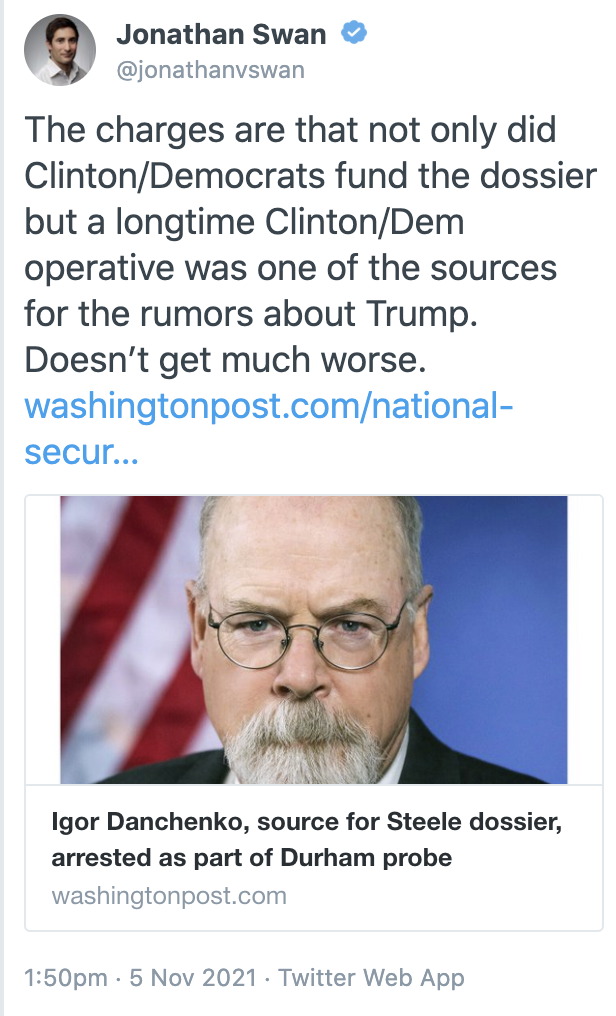
That didn’t stop any number of media figures — Devlin Barrett, Jonathan Swan, Barry Meier, Rachel Weiner, and Marshall Cohen, among others — who regurgitated the evidentiary flimsiness of Durham’s conspiracy theories and printed them as fact.

You might be under the impression that John Durham has charged Igor Danchenko with multiple counts of lying regarding the role of Charles Dolan in the sourcing of the dossier. You might similarly be under the impression that, in the indictment, Durham alleges that Dolan was the source for the pee tape.

You’d be forgiven for believing those things. After all, the WaPo reported charges, plural, showed that “some of the material” in the Steele dossier came from Dolan.

The indictment also suggests Danchenko may have lied to Steele and others about where he was getting his information. Some of the material came from a Democratic Party operative with long-standing ties to Democratic presidential nominee Hillary Clinton, according to the charges, rather than well-connected Russians with insight into the Kremlin.

The allegations cast new uncertainty on some past reporting on the dossier by news organizations, including The Washington Post.

Relying on that report, Jonathan Swan described charges, plural, that Dolan was, “one of the sources for the rumors about Trump.”

And Barry Meier, who so badly misunderstood the import of Oleg Deripaska in his book on private intelligence, also claimed there were charges, plural, relating to Dolan and insinuated that Durham had alleged the pee tape came from him.

In Durham’s indictment, however, Danchenko comes across more like the type of paid informant often found in the world of private spying — one who tells their employer what they want to hear.

According to those charges, he supposedly fed Steele some information that did not come from Kremlin-linked sources, as the dossier claims, but was gossip he picked up from an American public-relations executive with Democratic Party ties who did business in Moscow. In 2016, the indictment states, the manager of the Ritz-Carlton in Moscow gave that executive a tour of the the hotel’s presidential suite, and soon afterward, Danchenko took a selfie of himself and the executive at the hotel.

Reporting on Danchenko’s arraignment, WaPo went off at more length, not only failing to distinguish an uncharged accusation as such (one likely source of the belief that Durham charged multiple counts pertaining to Dolan), but stating as fact that Danchenko made up an entire conversation — one Danchenko has consistently attributed to a named Russian source — regarding the pee tape.

He is also accused of lying about revealing to sources that he was working for Steele.

Durham says Danchenko made up a conversation he claimed was the source of one of the dossier’s most salacious claims, that Trump paid prostitutes at a Moscow hotel room to urinate on a bed in which President Barack Obama had once slept. The dossier also suggested Russian intelligence agencies had secretly recorded that event as potential blackmail material. Trump has denied any such encounter.

The indictment suggests that story came from Dolan, who in June 2016 toured a suite at a hotel in Moscow that was once occupied by Trump.

Judge Trenga’s ruling will spoil the frothers’ hopes for a trial about the pee tape.

But the frothers aren’t the problem: The problem is how many actual journalists bought this sleight of hand and now remain silent about the baseless claims they perpetuated last year.

Update: Meanwhile, Danchenko has moved to:

Share this entry

FBI Approved Igor Danchenko as a Source before It Stopped Doing Back-Door FISA Searches to Vet Informants

Last Thursday, Judge Anthony Trenga denied Igor Danchenko’s motion to dismiss, while making it clear the government’s case was really shoddy.

Judge Anthony J. Trenga ruled that Danchenko’s case must be weighed by a jury, clearing the way for his trial next month. But it was “an extremely close call,” Trenga said from the bench.

(This AP piece has more detail but it also makes really obvious errors.) While there’s no ruling on the docket, Trenga must have approved any remaining CIPA issues.

The frothers, of course, remain obsessed with the news that the FBI formally made Danchenko a confidential human source in 2017. Most prominently, for example, Chuck Grassley and Ron Johnson wrote a pissy letter to Merrick Garland and Christopher Wray demanding information about why he was made an informant by October 22.

In December 2016, the FBI’s Crossfire Hurricane team identified Danchenko as Steele’s primary sub-source and, according to the FBI, “became familiar with the 2009 investigation.”[8] The FBI, even in light of the extensive derogatory information attached to Danchenko, proceeded to pay him as a confidential human source three months later from March 2017 to October 2020 as part of Crossfire Hurricane. Therefore, while we were investigating the Justice Department’s and FBI’s misconduct with respect to Crossfire Hurricane, you maintained him on the government’s payroll.

This extraordinary fact pattern requires additional information from the Justice Department and FBI relating to why Danchenko was placed on the payroll and paid by the taxpayer to assist in the federal government’s flawed investigation into President Trump.

I hope to finish a post explaining why all the frothers are painfully stupid in their response to this news before Danchenko’s trial starts next week.

I’m not surprised that Grassley and Johnson are just as clueless on this point as the rest of the frothers.

But I am somewhat surprised that Grassley, the Ranking Member of the Senate Judiciary Committee, doesn’t know something about how FBI vetted informants until 2018, after they formalized Danchenko as one: They queried the person against all the FBI’s databases, including their FISA databases.

For example, we were told disputes occurred related to queries conducted for vetting purposes.52 Specifically, according to the FBI, it was concerned that as a result of the change to the query standard it could no longer perform vetting queries on raw FISA information before developing a confidential human source (CHS). FBI officials told us that it was important for agents to be able to query all of its databases, including FISA data, to determine whether the FBI has any derogatory or nefarious information about a potential CHS. However, because of the implementation of the 2018 standard, the FBI is no longer able to conduct these queries because they would violate the standard (unless the FBI has a basis to believe the subject has criminal intent or is a threat to national security). According to the FBI, because its goal is to uncover any derogatory information about a potential CHS prior to establishing a relationship, many agents continue to believe that it is irresponsible to engage in a CHS relationship without conducting a complete query of the FBI’s records as “smoking gun” information on a potential CHS could exist only in FISA systems. Nevertheless, these FBI officials told us that they recognize that they have been unsuccessful when presenting these arguments to NSD and the FISC and, as noted below, they follow NSD’s latest revision of query standard guidance.

Particularly given the past investigation into Danchenko and concerns about his past ties to Russian spooks, it is highly likely the FBI would have done such a back door search with Danchenko. They would have done it for precisely the concern Grassley and Johnson raised: to chase down some of the derogatory information on Danchenko from the earlier investigation. They would have done it to see the content of conversations he had with anyone of particular interest. Indeed, for a variety of reasons, the FBI likely could have done a backdoor search on Danchenko even after the querying standard changed in 2018.

The FBI likely made Danchenko a CHS not only for very good reasons, but for reasons that the frothers, if endless saturation inside a disinformation bubble hadn’t rotted their brains, might even approve of.

And before they did so, they likely did some very thorough vetting of him first.

Share this entry

DOJ Inspector General Report on the Tensions Created by Parallel Construction

Before you read this report on tensions between FBI Office of General Counsel’s National Security and Cyber Law Branch (NSCLB)  and DOJ’s National Security Division (NSD), remember the following things:

  • In significant part because of jurisdictional limitations, DOJ Inspector General blamed FBI for everything that went wrong with the Carter Page FISA applications, and in the wake of that report, Bill Barr, Trump, and his allies in Congress used it to damage the career every single person at FBI who had been involved with the Russian investigation (except for the two guys who made multiple mistakes in dismissing the Alfa Bank allegations).
  • John Durham then used that damage to attempt to coerce testimony, sometimes false, from FBI figures in his never-ending witch-hunt.
  • For the same jurisdictional limitations, any abuse John Durham engages in or Andrew DeFilippis engaged in can only be reviewed by DOJ’s feckless Office of Professional Responsibility, not by DOJ IG.
  • After that report, DOJ IG developed proof that Carter Page was not special; by some measures, his FISA application was better than those of people who hadn’t been fired by a future President for precisely the same foreign ties that the FISA was meant to assess.
  • The NSD then dismissed those findings from DOJ IG, largely by adopting a standard different from the one that had been adopted with Carter Page (it’s unclear whether DOJ IG is still trying to resolve these discrepancies or not).
  • None of the stuff that happened thus far addresses the substantive problems with the Page applications.

The report talks about the “historically strained” relationship between these two sets of lawyers, without laying out the role that the Carter Page review — and the Trump DOJ’s use of DOJ IG to punish his enemies generally — did to make things worse.

That tension plays out in the report. For example, Horowitz only provides recommendations to NSCLB and FBI’s OGC, not NSD. In each case, FBI is directed to coordinate with NSD, without the counterpart recommendation. The tension is particularly critical to something that DOJ IG cannot, therefore, recommend: That NSD have access to FBI case files, which would allow them to play a more proactive role in the vetting of FISA applications. It would also make NSD share in accountability for any problems that arise (as they should have with Page), though, and unsurprisingly NSD doesn’t want that.

NSCLB attorneys expressed their concern that although NSD attorneys assist agents in drafting the FISA applications submitted to the FISC, they do not share accountability when compliance incidents are reported to the FISC. Although NSCLB officials acknowledged the oversight role that NSD has related to FISA, they emphasized the need for FISA to be a team effort and not an adversarial relationship and stated their belief that the number of compliance incidents would be reduced if NSD would review the FISA-related documents housed in the FBI’s IT systems. However, according to NSCLB attorneys, NSD has expressed disinterest in ensuring FISA compliance on the front end and has said that it is the agent’s responsibility to identify in the first instance, anything that is necessary to be reported to the FISC. We were also told by NSCLB attorneys that NSD has said that it is concerned that an appearance of NSD attorneys having knowledge of the underlying documents would imply that they have full knowledge of all of the supporting documents, which would not be practicably feasible for them to have.

A senior NSD official that we spoke with told us that NSD has limited resources, and it does not have direct access to FBI systems.

NSD wants none of this accountability and DOJ IG can’t make them.

For all the tensions, though, it’s a fascinating report, as useful for providing both historical and bureaucratic background on this process as anything else. Much of this tension arises out of DOJ’s admitted parallel construction — using alternative sources for certain facts to protect sources and methods. There’s even a paragraph that describes NSCLB’s role as such (though not by name).

For instance, we were told that NSD relies on NSCLB to review documents such as search warrants and criminal complaint affidavits for law enforcement or other sensitivity concerns before they are filed with the court by prosecutors. When this process is not followed, it can become particularly problematic if NSCLB later finds that sensitive information was contained in the court filing. For example, if the FBI used a sensitive platform to obtain information, prosecutors may decide that a description of the platform is needed to support the search warrant or complaint. In such instances, NSCLB may ask prosecutors to anonymize that information. However, if NSCLB does not review the case agent’s draft affidavit in support of a search warrant or complaint before the agent provides it to the prosecutor, sensitive information may be exposed. Also, senior NSCLB officials told us that including an NSCLB attorney early in this process can provide an effective means of ensuring prosecutors have information necessary to support their case. Specifically, NSCLB can help identify which information may be difficult to use from a classification and sensitivity perspective and provide suggestions to obtain the information from an independent source without implicating sensitive techniques.

The report claims the particular roles of each side are not well-defined. I’m not convinced that’s the case, though. As described, NSCLB protects national security and the secrets that go along with that (including secret intelligence techniques). And NSD fulfills the needs of prosecutions as well as “protect[ing] FISA as a tool so the FBI can continue to use it.”

In one telling explanation,

NSCLB senior officials highlighted the fact that criminal prosecution is not necessarily the FBI’s aim in every national security investigation and that the FBI sometimes appropriately pursues investigations with the aim of disrupting threats or collecting intelligence.20

These are tensions, but they are not necessarily bad tensions. And it doesn’t seem like this report considers how this compares to the relationship between a prosecutor and a case agent where there are none of the national security (and classification) concerns.

In any case, the report attributes that tension for two radically different understandings about the standards involved in two FISA concepts, including one — material facts that must be disclosed to the FISA Court — that was at the core of the Carter Page case.

In the case of materiality, the FBI seems to be playing dumb (perhaps to avoid opening a whole historical can of worms given the aftermath of the Page IG Report).

The 2009 Accuracy Memorandum defined material facts as, “those facts that are relevant to the outcome of the probable cause determination.” The FBI had interpreted this standard as facts that are outcome determinative, or facts that would invalidate the legal determination. However, NSD had applied a broader standard than the FBI, with NSD’s interpretation of material facts being facts that are capable of influencing the requested legal determination. An NSD senior official told us that the FBI’s viewpoint was based on the FBI’s involvement in the criminal law enforcement arena where the threshold for materiality in a criminal search warrant is outcome determinative. This official also stated that most material errors reported to the FISC do not invalidate the legal determination, and that the FISC still expects for these types of errors to be reported to them.

Senior NSD officials stated NSD had applied the same standard for at least 15 years and NSCLB had known of NSD’s application of the standard because it was reflected in previous Rule 13 notices filed with the FISC. For example, in the OIG’s report on the FBI’s Crossfire Hurricane Investigation, NSD supervisors stated that “NSD will consider a fact or omission material if the information is capable of influencing the court’s probable cause determination, but NSD will err on the side of disclosure and advise the court of information that NSD believes the court would want to know.”41 Similarly, in a FISC filing on January 10, 2020, NSD referred to this statement in the OIG report while describing its oversight and reporting practices when errors or omissions are identified.42 However, senior NSCLB officials told us that NSCLB was first made aware of NSD’s interpretation of the materiality standard in the OIG’s Crossfire Hurricane Investigation report and NSD’s subsequent January 2020 FISC filing.43

In the case of the claimed differing understand of  querying techniques under 702 (in which, by my read, both sides were pretending this hasn’t dramatically changed as FISC became aware of how 702 collection was really used), NSD seems to engage in the knowing bullshit.

In contrast, NSD told us that the query standard has been the same since 2008. A senior NSD official stated that the FBI had a fundamental misunderstanding of the standard and that compliance incidents were not identified sooner because NSD can only review a limited sample of the FBI’s queries and NSD improved upon its ability to identify non-compliant queries over time.

I knew the standard the FBI was using. It is not credible that I knew what it was and NSD did not.

In both cases, this claimed disagreement seems to be an effort to avoid applying the standards adopted post-Page to the FISA approach (and not just on individualized orders) applied before then.

The report confirms something that had been obvious from heavily redacted sections of the last several 702 reauthorizations: FBI had been using 702 collection (and FISA collection generally) to vet potential confidential human sources.

For example, we were told disputes occurred related to queries conducted for vetting purposes.52 Specifically, according to the FBI, it was concerned that as a result of the change to the query standard it could no longer perform vetting queries on raw FISA information before developing a confidential human source (CHS). FBI officials told us that it was important for agents to be able to query all of its databases, including FISA data, to determine whether the FBI has any derogatory or nefarious information about a potential CHS. However, because of the implementation of the 2018 standard, the FBI is no longer able to conduct these queries because they would violate the standard (unless the FBI has a basis to believe the subject has criminal intent or is a threat to national security). According to the FBI, because its goal is to uncover any derogatory information about a potential CHS prior to establishing a relationship, many agents continue to believe that it is irresponsible to engage in a CHS relationship without conducting a complete query of the FBI’s records as “smoking gun” information on a potential CHS could exist only in FISA systems. Nevertheless, these FBI officials told us that they recognize that they have been unsuccessful when presenting these arguments to NSD and the FISC and, as noted below, they follow NSD’s latest revision of query standard guidance.

Using back door searches to vet informants is an approved use on the NSA and, probably, CIA side. In the FBI context, my understanding is that informants understand they’re exchanging Fourth Amendment protections as part of their relationship with the FBI. Perhaps if the FBI had simply made this public, it could have been an approved use. Instead, we’re playing all these games about the application.

The report describes — but doesn’t really address — how the tension between NSCLB and NSD undermined National Security Reviews which,

examine (1) whether sufficient predication exists for FBI preliminary and full investigations, (2) whether a sufficient authorized purpose exists for assessments, (3) whether tools utilized during or prior to the assessment are permitted, and (4) all aspects of National Security Letters issued by the FBI.

There was a huge backlog of these until NSD hurriedly closed a bunch of them in 2020, which is the kind of thing that when Bush did them with FISA tools in 2008 was itself a symptom. So, too, may be some policy memos that happened in Lisa Monaco’s first days and John Demers’ last ones.

The section I found to be most interesting (and one that DOJ IG could not or chose not to address in recommendations) pertains to the tension over declassification of material for prosecutions.

According to the FBI’s Declassification of Classified National Security Information Policy Guide, NSCLB must participate in the approval of discretionary declassification decisions concerning FBI classified information. NSCLB assists in ensuring that the declassification of either FISA derived material or other FBI classified information is: (1) necessary to protect threats against national security; (2) will not include classified materials obtained from foreign governments; (3) will not include classified materials obtained from other U.S. agencies (unless authorized by the originating agency); (4) will not reveal any sensitive or special techniques; and (5) will not adversely impact other FBI investigations.

[snip]

Despite the FBI’s limited support role, NSD and DOJ staff we spoke with told us that they believe NSCLB has involved itself inappropriately in discovery matters. For example, an NSD senior official told us that NSCLB has attempted to second guess discovery decisions made by prosecutors. This NSD official believed that NSCLB’s role is not to participate in the determination of how the prosecutors choose to protect a piece of classified information, but instead to identify information that is classified, its level of classification, and how a declaration from the owner of that information would explain to a court why the information presents a national security concern. According to this official, NSCLB may rightfully conclude the information is too sensitive to provide in discovery and, as a result, prosecutors may have to dismiss that case. However, we were told that discovery issues do not generally reach that point. We also were told by some AUSAs that they have had to remind NSCLB attorneys that AUSAs have the discovery obligations to courts and will make discoverability determinations.

An official from one USAO told us that, while it is understood that satisfying discovery obligations is the responsibility of the prosecutor, the FBI’s interest in protecting its equities may justify challenging a prosecutor’s discovery decisions. The official explained that such back and forth may be necessary to reach a balance between the needs of discovery and the protection of sensitive information; however, when the FBI’s role in the process extends into making assessments of what is discoverable it can slow the process down and necessitate the prosecutor asserting authority over discovery decisions.

[snip]

By contrast, senior NSCLB officials noted that several factors outside of NSCLB’s control can cause the declassification process to take a considerable amount of time. According to these officials, the FBI addresses the risk of disclosing information that could cause significant harm to the American public by using a thorough, deliberate process which can be impacted by the volume of information, the sensitivities involved, and the resources available to conduct a review. In defending NSCLB’s role in the discovery process, a senior NSCLB official expressed the view that AUSAs tend to err on the side of making material discoverable, even when it involves national security information, and do not appreciate how the disclosure of information may affect other FBI or USIC operations. This official told us that NSD often prefers to declassify all information that could be relevant, necessary, or discoverable to ease the prosecution of the case or the discovery process. .

This is, in my opinion, the description of what lawyers for an intelligence agency would do. That seems to be the role NSCLB is playing, for better or worse. In light of the cases described out of which the more specific tensions arise, I find the complaint that NSCLB is delaying discovery rather telling. If prosecutors choose to make a case that NSCLB believes would have been better handled via disruption, for example, or are entirely frivolous, such tensions are bound to surface. That said, if FBI’s General Counsel’s Office has been coopted people trying to protect sources and methods, NSD lawyers are going to look like the only ones guarding due process (though I’m sure they would with CIA’s lawyers, too).

There’s a lot of worthwhile observations in this report. But it’s hard to shake the conclusion that the most important takeaway is that DOJ cannot continue to have such asymmetry in the oversight that FBI and DOJ experience.

Share this entry

On the Belated Education of John Durham

In a filing on September 2 in the Igor Danchenko case, John Durham confirmed that Danchenko had been a paid FBI source from March 2017 through October 2020.

In March 2017, the FBI signed the defendant up as a paid confidential human source of the FBI. The FBI terminated its source relationship with the defendant in October 2020.

I had heard this — though not with the sourcing such that I could publish. Apparently it was news to the frothers, who’ve been wailing about it ever since. Here’s Margot at the Federalist Faceplant, Jonathan Turley, and Chuck Ross at his new digs at the outlet that first hired Christopher Steele. Here’s the former President during an obsequious Hugh Hewitt interview.

Danchenko’s status was implicit in a lot of what is public. Even absent the frothers doing any kind of journalism, or even critical thinking, what did they think this reference in Danchenko’s motion to dismiss meant?

The government had unfettered access to Mr. Danchenko for approximately four years following his first interview in January 2017, and not once did any agent ever raise concerns about the now purportedly contradictory post-call emails.

As I hope to show in a follow-up, it actually makes a lot of sense.

Meanwhile, in Danchenko’s response to that filing, he revealed that information he provided to the FBI was used in a memorandum supporting the opening of an investigation into Charles Dolan, one of Durham’s star witnesses against Danchenko. (Note, this reference stops short of saying that the FBI did open an investigation into Dolan, just that someone proposed doing so.)

[T]he Special Counsel ignores, and conceals from this Court, that Mr. Danchenko was interviewed dozens of times and during the course of those interviews, particularly when asked specific questions about Dolan (which was not often), Mr. Danchenko (1) told the FBI about the Moscow trips with Dolan, (2) told the FBI that Steele knew of Dolan, (3) told the FBI that not only was Dolan doing work with Olga Galkina but that Mr. Danchenko himself had introduced them, and (4) told the FBI that Dolan had connections and relationships with high-level Kremlin officials, including President Putin’s personal spokesperson, Dmitry Peskov. Indeed, when agents drafted a December 2017 communication in support of opening an investigation into Dolan, they included the information Mr. Danchenko provided them as support for opening the investigation. 3 [emphasis original]

This may not be the last surprise investigation we hear about. Back in the original filing on September 2, Durham argued he should be able to talk about the 2008 allegation that led to a counterintelligence investigation into Danchenko, in part, because (Durham predicted bitterly) Danchenko will likely raise investigations into others, plural, who will “feature prominently at trial.”

[T]he Government expects the defense to introduce evidence of FBI investigations into other individuals who the Government anticipates will feature prominently at trial. Thus, the introduction of the defendant’s prior counterintelligence investigation – should the defense open the door – does not give rise to unfair prejudice that substantially outweighs its probative value.

Effectively, Durham is arguing that if Danchenko points out that Durham’s witnesses should not be considered reliable based on suspicions they were working for Russia’s interests, then he should be able to point out that Danchenko was once similarly suspected as well. Durham also wants to point out that Dolan twice asserted that Danchenko might be a Russian spook, but also allegedly always knew of his role at Orbis — assertions that, in tandem, could actually hurt Durham’s case, given the subsequent disclosure that Dolan was investigated himself. Durham may not understand that, yet.

One of these people whose investigation Danchenko will raise at trial is undoubtedly Sergei Millian, whose cultivation of George Papadopoulos in exactly the same time period Danchenko claims to have believed he spoke to Millian was one of a number of things the FBI investigated starting in 2016.

Danchenko’s response to Durham’s demand that he be allowed to raise the 11-year old counterintelligence investigation into Danchenko (besides providing a somewhat different timeline) was basically to say, “Bring it!” He intends to raise that counterintelligence investigation himself, he claims. Note: Durham doesn’t note, but it is clear from the January interviews of Danchenko, that FBI interviewers probed Danchenko about that prior investigation in their very first interviews in 2017.

As noted, I hope to return to all this dizzying spy-versus-spy shit in a follow-up. By then we’re likely to have several more disclosures, plus some details about the known investigation into Millian.

This all shows there was not a shred of prosecutorial discretion exercised before charging Danchenko. Even if Danchenko had done grievous harm to the US, no sane prosecutor would have charged this case with such easily impeached witnesses. Even Durham now seems to understand his materiality claims are flimsy. And yet, to prove a five year old false statements allegation, he has forced the government to declassify a whole range of sensitive material, including this detail about Dolan.

And that process apparently continues to be a struggle for Durham (as I predicted it would be).

Consider the timeline implied by Danchenko’s footnote about the Dolan revelation. Danchenko claims that he only just learned about the Dolan investigation opening memo.

3 The December communication is highly exculpatory with regard to the essential element of materiality and it is not clear why it was only produced 30 days from the start of trial. It was produced as Jencks material (also late by the terms of the Court’s Order requiring all Jencks to be produced by September 1) but is obviously Brady evidence. The defendant understands that the CIPA procedures may have slowed the production of certain categories of discovery but given the Indictment’s allegations about the materiality of Mr. Danchenko’s failure to attribute public information to Dolan, the production of this specific document should have been a priority for declassification.

When Danchenko says that Counterintelligence Information Procedures Act may have slowed the production of this, he’s suggesting (charitably) that someone at DOJ took a long time to release this information to Durham and that Durham had no control over that process. That’s another thing I predicted in this post about how CIPA would affect this case: “it can end up postponing the time when the defendant actually gets the evidence he will use at trial. So it generally sucks for defendants.”

The trial starts on October 11. This footnote suggests that Danchenko only received this information 30 days before trial, so around September 11, in the week before he filed this. Whenever it was disclosed, if he received it after the September 1 deadline, that would make it too late for the September 2 deadline for Danchenko’s own motion to dismiss. It would put it after Durham’s September 2 filing — the one bitching about how much of the trial Danchenko will use to focus on the investigations into witnesses, plural, against him — which means the plural reference may not have incorporated Dolan. Danchenko would have learned about this over a month after his own deadline to lay out what classified information he intended to use at trial, and at least a week after the August 30 CIPA conference, at which the two sides debated about what classified information Danchenko should be allowed to use at trial.

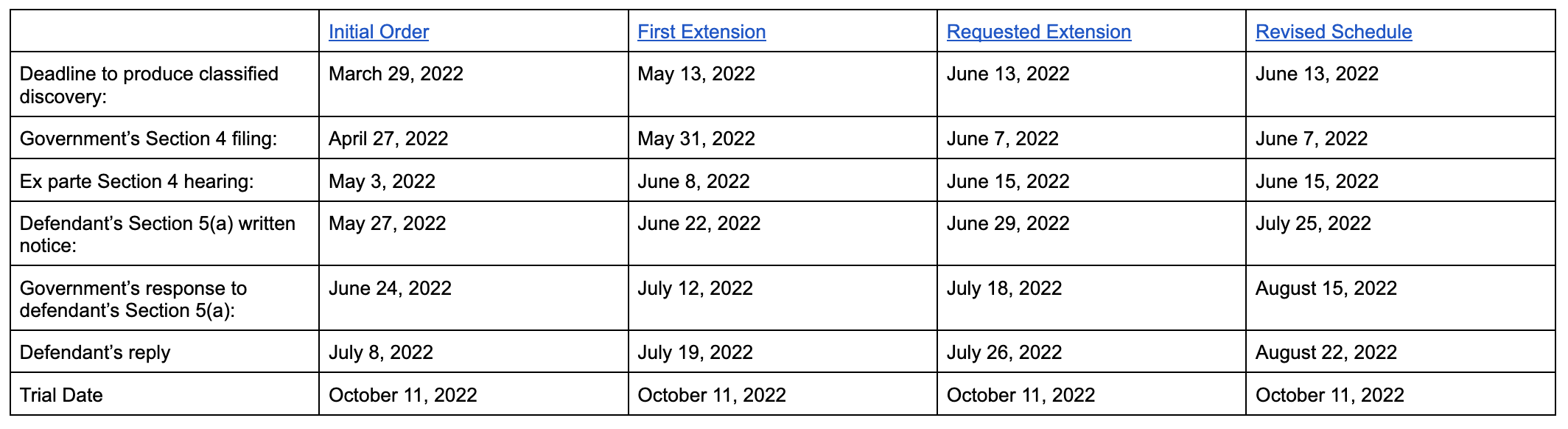
It also comes after a series of delays in Durham’s classified discovery. In May, I described what was publicly billed as the last one.

It’s that record that makes me so interested in Durham’s second bid to extend deadlines for classified discovery in the Igor Danchenko case.

After Danchenko argued he couldn’t be ready for an April 18 trial date, Durham proposed a March 29 deadline for prosecutors to meet classified discovery; that means Durham originally imagined he’d be done with classified discovery over six weeks ago. A week before that deadline, Durham asked for a six week delay — to what would have been Friday. Danchenko consented to the change and Judge Anthony Trenga granted it. Then on Monday, Durham asked for another extension, this time for another month.

When Durham asked for the first delay, he boasted they had provided Danchenko 60,000 unclassified documents and promised “a large volume” of classified discovery that week (that is, before the original deadline).

To date, the government has produced over 60,000 documents in unclassified discovery. A portion of these documents were originally marked “classified” and the government has worked with the appropriate declassification authorities to produce the documents in an unclassified format.

[snip]

Nevertheless, the government will produce a large volume of classified discovery this week

This more recent filing boasts of having provided just one thousand more unclassified documents and a mere 5,000 classified documents — for a case implicating two known FISA orders and several past and current counterintelligence investigations.

To date, the Government has produced to the defense over 5,000 documents in classified discovery and nearly 61,000 documents in unclassified discovery. The Government believes that the 5,000 classified documents produced to date represent the bulk of the classified discovery in this matter.

Danchenko waited six weeks and got almost nothing new.

But then on August 16, Durham filed a supplemental CIPA filing, suggesting there were more substitutions of classified information he wanted Judge Anthony Trenga to approve (a supplemental filing is not, by itself, unusual).

The point is, for months, Durham kept saying he’d have all the secrets delivered to Danchenko by his new deadline in June, promise, and then he dropped this bombshell on Danchenko just weeks before trial.

In the August 29 hearing on all this, Judge Trenga deferred most CIPA decisions until after Danchenko files a new CIPA filing on September 22 — so if any of this remains classified, Danchenko still has a chance, with just days notice, to argue he needs it at trial. They’ll fight about these issues again on September 29.

But given Durham’s performance in the Sussmann case, it’s not entirely clear these missed classified deadlines are DOJ’s fault. After all, Durham never even asked DOJ IG for relevant discovery in Sussmann’s (and therefore, we should assume, this) case until after Sussmann was charged. He didn’t investigate Rodney Joffe’s true relationship with the FBI and other agencies until Sussmann asked him to. He didn’t ask Jim Baker for his own iCloud content until early this year, after belatedly rediscovering Baker phones he had been told about years ago.

It’s not just his belated request for information from DOJ IG that we know to have affected this case too. Durham also has never interviewed George Papadopoulos — not before he went on a junket to Italy chasing Papadopoulos’ conspiracy theories, and not since. Thus, Durham never tested whether Millian’s cultivation of Papadopoulos undermines his evidence against Danchenko — and it does, obviously and materially.

Because of Durham’s obvious failures to take the most basic investigative steps before charging wild conspiracy theories, there are several possible explanations why he’s only providing Danchenko news of this Dolan memo a month before trial:

  1. Someone tried to hide this from Danchenko and ultimately was overridden. If that’s the explanation, it makes Andrew DeFilippis’ August departure from the team and, according to the NYT, DOJ, all the more interesting.
  2. DOJ delayed the time until they let Durham disclose this because of some sensitivity about the investigation. Recall that Dolan has ties to Putin spox Dmitri Peskov, who was sanctioned earlier this year, followed by his family.
  3. Durham didn’t know.

The last possibility — that Durham had no fucking clue that one of his star witnesses had been (at least considered) for investigation — is entirely plausible. It’s entirely consistent with what we saw in the Sussmann case, though worse even than that case in terms of timing.

Durham came into this investigation treating the conspiracy theories of Papadopoulos and Trump as credible. He seems to have believed, all along, that Sergei Millian was a genuinely aggrieved victim and not someone playing him, for at least a year, for a fool. He seems to have decided that he knew better than FBI’s experts about who had credibility about Russia and who didn’t. Along the way he forced the FBI to cut its ties with Joffe and — given the October 2020 cut-off of Danchenko’s ties to the FBI, probably Danchenko as well. He did all this with a lead prosecutor who believed it was problematic for DARPA to investigate the Guccifer 2.0 persona used by the GRU.

Durham walked into this investigation believing and parroting, without first testing, Trump’s claims that the Russian investigation was abusive. Based on those beliefs, he chased all manner of conspiracy theory in an attempt to allege pre-meditation and malice on the part of Hillary and everyone else involved with the dossier. His Sussmann prosecution ended in humiliating failure. This prosecution, win or lose, may do worse for Durham’s project: it may reveal unknown details about Russian efforts to tamper in 2016, efforts that harmed both Republicans and Democrats alike.

The Durham prosecutions have been shitshows and undoubtedly a disaster for those targeted. It’s not yet clear what will happen with the Danchenko trial (or even whether it will go to trial; given that CIPA issues still have to be resolved, there’s still a chance Durham will have to dismiss it rather than going to trial). Durham will still write a report that may try to resuscitate his conspiracy theories that were disproven in the Sussmann trial.

But thus far, the actual record of the Durham investigation shows that when actually bound by the rules of evidence, when actually obligated to dig through DOJ’s coffers to discover what DOJ learned as it tried to understand Russia’s intervention in 2016, reality looks nothing like the conspiracy theories Durham has chased for three years.

John Durham’s education process has been a painful process for all personally involved (except maybe Sergei Millian, gleefully dicking around from afar). But along the way he’s debunking many of the conspiracy theories he was hired to sustain.

Update: Chuck Ross is outraged that I suggested his boss had paid for Steele (and lying that I said Paul Singer paid for the dossier, which I pointedly did not say). It is true that the payment for Fusion GPS’ Trump project had shifted to Perkins Coie before Steele first sent Danchenko to Russia.

It’s also true that, based on length of project, Ross’ current boss paid for much of Nellie Ohr’s work on Trump’s ties to Russia, which includes some of Fusion’s early work on Paul Manafort and Felix Sater, and possibly early work on Millian (she continued to work on Millian until she left Fusion).

And since Chuck is so upset, I should point out that his former co-columnist, Oleg Deripaska, also reportedly paid for Steele’s work (in that case, research on Paul Manafort), though also through the cut-out of a law firm.

Share this entry

Durham Admits He Has No Real Evidence on Four Millian Counts against Igor Danchenko

In the middle of a motion in limine arguing, in part, that the Durham prosecutors should be able to introduce two sets of emails from Sergei Millian to one of the journalists who gave Igor Danchenko Millian’s contact information, John Durham admits that those emails are the most probative evidence he’s got that Millian never met or spoke with Danchenko.

Fourth, whether the statements are the most probative evidence on the point. Millian’s emails written contemporaneous to the events at issue are undoubtedly the most probative evidence to support the fact that Millian had never met or spoken with the defendant.

Mind you, whether Millian ever spoke to Danchenko or not is irrelevant to whether Danchenko believed that he had.

But Durham appears not to understand that.

If you don’t mind, I think I’ll punctuate this post with stupid Millian Tweets — like some Greek chorus — while I take breaks to wrap my brain around how Durham got his ass so badly handed to him by Sergei Millian.

Durham appears not to understand that if Danchenko got a phone call from someone else in July 2016, but believed at the time that the call was from Millian, then his four charged statements that he believed the call was from Millian would still be entirely true — an argument I made last year and one Danchenko made in his Motion to Dismiss (Danchenko’s MTD was filed after the government motion, but submitted unsealed from the start).

[T]he indictment does not allege that Mr. Danchenko did not receive an anonymous phone call in or about late July 2016. Instead, the indictment alleges only that Mr. Danchenko “never received such a phone call or information from any person he believed to be Chamber President-1[.]” The alleged false statement is that Danchenko did not truly believe that the anonymous caller was Chamber President-1. The indictment also alleges that Mr. Danchenko “never made any arrangements to meet Chamber President-1.” However, Mr. Danchenko never stated that he made such arrangements. Rather, he told the FBI that he arranged to meet the anonymous caller, but the anonymous caller never showed up for the meeting.

But Durham believes his job is to prove that Millian never spoke with Danchenko, and so spent a third of his filing making humiliating admissions about how weak his case is.

One of the dire problems Durham has with his Millian case is that … as I predicted … he has no witness.

As I noted last year, when he originally charged Danchenko, he relied on Millian’s Twitter feed, not an interview with Millian, to substantiate Millian’s claim that he never spoke with Danchenko. Here’s how Sergei responded last year when I pointed out that his testimony, under oath, would be necessary to convict Danchenko.


Turns out I wasn’t nuts. All of the sources against Danchenko were willing to testify under oath, it appears, but Millian. Well, and Christopher Steele, too, but that’s for another post.

To Durham’s … um … credit, he did at some point (he tellingly hides the date) get Millian to participate in a “virtual interview” (which may or may not be the same as a “video interview”?). In that interview, Millian claimed that rather than fleeing the US because of the criminal investigation into him and Mueller’s interest in interviewing him, he fled the country because of the Steele dossier.

The Government has conducted a virtual interview of Millian. Based on representations from counsel, the Government believes that Millian was located in Dubai at the time of the interview. During the interview, Millian stated, in sum and substance, that he has never met with or spoken with the defendant, Millian informed investigators that he left the United States in March 2017 and he has not returned. Millian stated, in sum, that he left the United States due to threats on his and his family’s personal safety because of his alleged role in the Steele Reports. On multiple occasions, the Government has inquired about Millian’s availability to testify at the defendant’s trial. Millian has repeatedly informed the Government that he has concerns for his and his family’s safety (who reside abroad) should he testify. Millian also informed the Government that he does not trust the FBI and fears being arrested if he returns to the United States. The Government has repeatedly informed Millian that it will work to ensure his security during his time in the United States, as it does with all witnesses. The Government has also been in contact with Millian’s counsel about the possibility of his testimony at trial. Nonetheless, despite its best efforts, the Government’s attempts to secure Millian’s voluntary testimony have been unsuccessful. Moreover, counsel for Millian would not accept service of a trial subpoena and advised that he does not know Millian’s address in order to effect service abroad.

Durham was unable to subpoena Millian to require him to testify under oath to his claim that he never spoke with Danchenko, because Sergei’s lawyer doesn’t know where he lives, not even to bill him. I guess he bills him “virtually,” just like the interviews.

But don’t worry. Durham promises he has other evidence that Sergei could not have called Danchenko in July 2016.

That evidence is that Millian was traveling in Asia during the period between July 21 and July 26, 2016, when such a call to Danchenko would have taken place.

Millian was traveling in Asia at the time the defendant sent this email and did not return to New York until late on the night of July 27, 2016. Notably, Millian had suspended his cellular phone service effective July 14, 2016 (prior to his travel) and his service was reconnected effective August 8, 2016. The defendant did travel to New York from July 26, 2016 through July 28, 2016 with his young daughter and spent much of his time sight-seeing, including a trip to the Bronx Zoo on July 28, 2016. The defendant would later claim to the FBI that it was during this trip to New York that the defendant attempted to meet Sergei Millian (after having received the alleged anonymous phone call from a person he purportedly believed to be Millian). [my emphasis]

The implication, says the Special Counsel who flew to Italy to get the multiple phones of Joseph Mifsud but who never walked across DOJ to get the multiple phones of his key witness Jim Baker, is that Millian could not have called Danchenko because the only possible SIM card he would have used while traveling in Asia, which generally used the GSM standard, would be the phone he used in the US, where CDMA was still widely used.

Millian couldn’t have called Danchenko during the period, Durham says, because his US-based phone was shut down while he was traveling in Asia.

That would be a shocking claim to make about any fairly sophisticated traveler in 2016, much less one who made the effort to shut off his location tracker cell coverage while he traveled overseas and for twelve days after he returned.

It’s an especially remarkable claim to make about someone that — DOJ has proof! — was arranging in-person meetings in NYC in precisely the same period, via text messages sent during the period when Millian’s US phone service was shut down.

Papadopoulos first connected with Millian via Linkedln on July 15, 2016, shortly after Papadopoulos had attended the TAG Summit with Clovis.500 Millian, an American citizen who is a native of Belarus, introduced himself “as president of [the] New York-based Russian American Chamber of Commerce,” and claimed that through that position he had ” insider knowledge and direct access to the top hierarchy in Russian politics.”501 Papadopoulos asked Timofeev whether he had heard of Millian.502 Although Timofeev said no,503 Papadopoulos met Millian in New York City.504 The meetings took place on July 30 and August 1, 2016.505 Afterwards, Millian invited Papadopoulos to attend-and potentially speak at-two international energy conferences, including one that was to be held in Moscow in September 2016.506 Papadopoulos ultimately did not attend either conference.

500 7/15/16 Linkedln Message, Millian to Papadopoulos.

501 7 /15/16 Linkedln Message, Millian to Papadopoulos.

502 7/22/16 Facebook Message, Papadopoulos to Timofeev (7:40:23 p.m.); 7/26/16 Facebook Message, Papadopoulos to Timofeev (3:08:57 p.m.).

503 7/23/16 Facebook Message, Timofeev to Papadopoulos (4:31:37 a.m.); 7/26/16 Facebook Message, Timofeev to Papadopoulos (3:37: 16 p.m.).

504 7/16/16 Text Messages, Papadopoulos & Millian (7:55:43 p.m.).

505 7/30/16 Text Messages, Papadopoulos & Millian (5:38 & 6:05 p.m.); 7/31/16 Text Messages, Millian & Papadopoulos (3:48 & 4:18 p.m.); 8/ 1/16 Text Message, Millian to Papadopoulos (8:19 p.m.).

506 8/2/16 Text Messages, Millian & Papadopoulos (3 :04 & 3 :05 p.m.); 8/3/16 Facebook Messages, Papadopoulos & Millian (4:07:37 a.m. & 1:11:58 p.m.).

Anyway, that’s the background to why, Durham says, the best evidence he’s got that Millian never called Danchenko are some emails.

One of those emails is inconsistent with Durham’s story, which says that Millian returned late on July 27, which was a Wednesday. On July 26, Millian sent this to one of the RIA Novosti journalists, Dimitry Zlodorev:

Dimitry, on Friday I’m returning from Asia. An email came from Igor. Who is that? What sort of person?

Durham says one of his best pieces of evidence that Millian didn’t call Danchenko is an email that had him returning two days later than he actually returned. Something led Millian to come back early, at least according to Durham’s record.

Early enough to be in NYC when Danchenko was there.

Durham also wants to introduce some emails Millian sent Zlodorev in 2020, three years after Danchenko’s alleged lie and four years into a manufactured outrage over the Steele dossier. One of those emails suggests that Millian believed Steele blamed Danchenko for problems with the dossier, which is probably true, but Durham thinks it helps him anyway.

I’ve been informed that Bogdanovsky travelled to New York with Danchenko at the end of July 2016; Danchenko, supposedly to meet with me (but the meeting didn’t take place). Can you inquire with Bogdanovsky whether he remembers something from that trip and whether they touched upon my name in conversation, as well as for what reason Danchenko was travelling to NY? Steele, it seems, made Danchenko the fall guy, but Danchenko himself made several statements that were difficult to understand, for example, about the call with me. Did he tell Bogdanovsky that he communicated with me by phone and on what topic? Thank you! This will clarify a lot for me personally. It’s a convoluted story! [my emphasis]

That’s how desperate he is for evidence to prove his four Millian charges.

Now, as Durham did when he tried to introduce totally unrelated emails in the Michael Sussmann case, Durham says he’s not introducing these (as what he calls “the most probative evidence” that Millian didn’t call Danchenko) for the truth.

He’s just asking questions — but not, apparently, why Millian said he was coming back Friday when he ended up coming back on Wednesday instead, early enough to be in NY when Danchenko was there.

As an initial matter, all three emails to Zlodorev are admissible non-hearsay because each email consists of a series of questions, i.e., (1) “Who is that? What sort of person?” (July 26, 2016), (2) “Do you remember such a person? Igor Danchenko?” (July 19, 2020), and (3) (a) “Can you inquire with Bogdanovsky whether he remembers something from that trip and whether they touched upon my name in conversation, as well as for what reason Danchenko was travelling to NY? (b) “Did he tell Bogdanovsky that he communicated with me by phone and on what topic?” (July 20, 2020). See Sinclair, F. App’x at 253. To the extent the remaining sentences in those emails are statements, they are not being offered to prove the truth of the matter asserted. Indeed, with respect to the July 26, 2016 email, the Government is not seeking to prove that (1) Millian was returning from Asia on Friday or (2) that an email came from the defendant.

And if his just asking questions ploy doesn’t work, then he’ll raise the point that he charged this indictment without ever talking to Sergei Millian first!!!

First, the unavailability of the declarant. A declarant is “unavailable” at a hearing or trial when he “is absent from the hearing and the proponent of a statement has not been able, by process or other reasonable means, to procure the declarant’s attendance or testimony. Fed. R. Evid. 804(a)(5)(B). “Courts have consistently held that hearsay exceptions premised on the unavailability of a witness require the proponent of a statement to show a good faith, genuine, and bona fide effort to procure a witness’s attendance.” United States v. Wrenn, 170 F. Supp. 2d 604, 607 (E.D. Va. 2001) (citing Barber v. Page., 390 U.S. 719,724 (1968)). Courts considering whether a prosecutor, as the proponent of a statement, “has made such a good faith effort have focused on the reasonableness of the prosecutor’s efforts.” Id. \ Ohio v. Roberts, 448 U.S. 56, 74 (1980) (“The lengths to which the prosecutor must go to produce a witness … is a question of reasonableness. The ultimate question is whether the witness is unavailable despite good-faith efforts undertaken prior to trial to locate and present the witness.”). In the case of a U.S. national residing in a foreign country, 28 U.S.C. § 1783 allows for the service of a subpoena on a U.S. national residing abroad. Here, the Government has made substantial and repeated efforts to secure Millian’s voluntary testimony. When those efforts failed, the Government attempted to serve a subpoena on Millian’s counsel who advised that he was not authorized to accept service on behalf of Mr. Millian. The Government, not being aware of Millian’s exact location or address, asked counsel to provide Millian’s address so that service of a subpoena could be effectuated pursuant to 28 U.S.C. § 1783. Counsel stated that he does not know Millian’s address. In any event, even if the Government had been able to locate Millian, it appears unlikely that Millian would comply with the subpoena and travel to the United States to testify. Indeed, as discussed above, Millian has shown a reluctance to travel to the United States for fear of his personal safety and his family’s safety. Accordingly, the Government has demonstrated good faith efforts to secure Millian’s appearance at trial.

What’s interesting is that Durham not only claims that Millian had no motive to lie to Zlodorev in 2016, but he asserts that “the existence of the Steele Reports were not public.”

The Government is not aware of any evidence that Millian was aware of who the defendant was in July of 2016. Millian also had no motive to lie about his knowledge of the defendant in July 2016. Indeed, at that time of the July 2016 email the existence of the Steele Reports were not public. Further, Millian had no apparent motive to lie to Zlodorev, an individual he appears to consider a friend.

They were to this guy.

According to the IG Report that Durham had never read before charging Sussmann, an Oleg Deripaska associate likely knew of the dossier by early July 2016, weeks after Millian met with one of the key architects of the 2016 operation in St. Petersburg and weeks before Danchenko emailed Millian and then Millian grilled Zlodorev about who Danchenko was.

Oleg Deripaska had a motive to lie about the dossier — and he appears to have been lying, to both sides.

Similarly, Durham claims that Millian had no motive to lie in 2020 when he grilled Zlodorev again about the circumstances of his meeting with Danchenko.

The July 2020 emails between Millian and Zlodorev also bear circumstantial guarantees of trustworthiness. Again, in July 2020, Millian had no motive to lie to Zlodorev.

Which is really nutty, because the Twitter account that Durham relied on to charge this thing claimed that — years earlier and therefore presumably well before 2020 — he had personally called the White House and told them the identities of the people behind the dossier.

He would have called from Asia or some other undisclosed location, though, so in Durham’s mind such a call would not exist.

And that’s how it came about that we’re a month away from trial, and John Durham is begging Anthony Trenga to admit emails from 2020 as his best evidence in four charges against Danchenko because he decided to rely on a Twitter account rather than securing witnesses in his case first.


For months and years, John Durham has treated Sergei Millian — a man who fled the country to avoid a counterintelligence investigation and questions from Mueller, but whom Durham claims fled the country because of the dossier — as an aggrieved victim. And in the same filing admitting that he has no solid evidence to prove that he is a victim, Durham also talked about how important it is to consider whether you’re getting played by Russian disinformation.

Such evidence is admissible because in any investigation of potential collusion between the Russian Government and a political campaign, it is appropriate and necessary for the FBI to consider whether information it receives via foreign nationals may be a product of Russian intelligence efforts or disinformation.

“SCO Durham, think of your legacy please❗❗”

Update: Replaced “in real time” based on Just Some Guy’s observations.

Earlier emptywheel coverage of the Danchenko case

The Igor Danchenko Indictment: Structure

John Durham May Have Made Igor Danchenko “Aggrieved” Under FISA

“Yes and No:” John Durham Confuses Networking with Intelligence Collection

Daisy-Chain: The FBI Appears to Have Asked Danchenko Whether Dolan Was a Source for Steele, Not Danchenko

Source 6A: John Durham’s Twitter Charges

John Durham: Destroying the Purported Victims to Save Them

John Durham’s Cut-and-Paste Failures — and Other Indices of Unreliability

Aleksej Gubarev Drops Lawsuit after DOJ Confirms Steele Dossier Report Naming Gubarev’s Company Came from His Employee

In Story Purporting to “Reckon” with Steele’s Baseless Insinuations, CNN Spreads Durham’s Unsubstantiated Insinuations

On CIPA and Sequestration: Durham’s Discovery Deadends

The Disinformation that Got Told: Michael Cohen Was, in Fact, Hiding Secret Communications with the Kremlin

John Durham’s Igor Danchenko Case May Be More Problematic than His Michael Sussmann Case

“Desperate at Best:” Igor Danchenko Starts Dismantling John Durham’s Case against Him

Share this entry

“Desperate at Best:” Igor Danchenko Starts Dismantling John Durham’s Case against Him

Since he was charged on November 3 last year, Igor Danchenko and his legal team have been virtually silent, mostly watching as John Durham’s team repeatedly failed to meet classified discovery dates.

But as we draw closer to the October 11 trial date, there has been more activity.

On August 1, there was a hilariously short status conference, all of four minutes, where Durham himself showed up. On August 21, Andrew DeFilippis — the most abusive of Durham’s prosecutors — dropped off the docket. Last week, Durham’s team asked for and got permission to file their motions in limine under seal — perhaps in an effort to avoid the inflammatory claims they made during the Michael Sussmann trial. Even the Classified Information Procedures Act (CIPA) conference, at which the two sides argued over how much classified information Danchenko needs at trial and whether the government can substitute information to make it less sensitive, seems to have ended inconclusively. Afterwards, Judge Anthony Trenga deferred decision until September 29, in part because the two sides are seemingly still trying to work things out amicably.

Before the hearing, the parties had successfully resolved all issues as to many of the listed documents and during that hearing, the parties agreed to engage in further discussions and efforts with respect to the remaining documents at issue, including Defendant’s willingness to withdraw his notice as to certain listed documents and the Government’s willingness to review the classified nature of certain listed documents and provide summaries with respect to other listed documents, following which Defendant will advise the Court concerning what further interest, if any, he has in using the listed documents at trial in light of the totality of the information provided to him by the Government.

In short, it has lacked all the pre-trial drama of the Sussmann case (perhaps because DeFilippis so badly overstepped, and still lost, in the Sussmann case).

But things may about to get interesting.

In a motion to dismiss the indictment filed Friday, Danchenko calls one of the government’s arguments (pertaining to the four Sergei Millian-related charges) “desperate at best.” The bases Danchenko challenges the indictment against him largely map some of the problems I laid out here: The questions FBI asked are not ones about the topics Durham has charged and Danchenko’s answers — he convincingly argues — were true.

For nearly a year, from January 2017 through November 2017, Mr. Danchenko sat through numerous voluntary FBI interviews and provided hours of truthful information to the government. Four years later, Special Counsel John Durham returned an indictment that alleges Mr. Danchenko knowingly made false statements about two matters when he: (1) acknowledged to the FBI that he talked with PR Executive-1 about issues “related” to the content of the Company Reports but stated that he did not talk about “specific” allegations contained in one of the reports; and (2) made four consistent statements to the FBI about his equivocal “belief” that an anonymous man who called him may have been Chamber President-1. These equivocal and ambiguous answers were prompted by fundamentally ambiguous questions, are literally true, and are immaterial as a matter of law.

Further, the government’s attempt here to stretch § 1001(a)(2) to a defendant’s equivocal and speculative statements about his subjective belief appears to be a first. And it would be a first for good reason. In order to meet its burden of proof in a case predicated on a subjective belief the government would need to prove not whether something did or did not happen but that the defendant did not truly subjectively believe what he said happened or did not happen. That would be a heavy burden in any case and it is an insurmountable one here.

Danchenko also argues (as Sussmann did) his claimed lies could not be material, in this case because Durham’s materiality claim is based in the influence of the Steele dossier, which (as Danchenko notes) he didn’t even know about, much less write.

Significantly, the indictment does not allege that Mr. Danchenko’s allegedly false statements themselves were material, but instead alleges only that the Company Reports, and the information contained in those reports, some of which allegedly came from Mr. Danchenko, were material.

In my series of posts on Danchenko’s case, I even missed some problems with the indictment. I had noted, for example, that Durham entirely misrepresented the question Danchenko was asked about Chuck Dolan on which Durham built one of the false statement charges. Durham claimed the FBI asked Danchenko if Dolan was a source for Danchenko. As I noted and as Danchenko does in this MTD, the question was actually whether Dolan was another sub-source directly for Christopher Steele.

But Danchenko notes two more problems with the charge.

First, he was asked whether Dolan and he “spoken” about the matters in the dossier; and to prove they did, Durham provides an email. 

Count One alleges that Mr. Danchenko made a false statement when “he denied to agents of the FBI that he had spoken with PR Executive-1 about any [specific] material contained in the Company Reports, when in truth and in fact, and as the defendant well knew, PR Executive-1 was the source for an allegation contained in a Company Report dated August 22, 2016 and was otherwise involved in the events and information described in the reports.”

[snip]

For “proof” of the alleged false statement under this charge, the indictment relies on an email exchange between PR Executive-1 and Mr. Danchenko on or about August 19-20, 2016.

More problematic still, in context, the question was about whether Danchenko and Dolan had spoken about allegations that remained in the dossier after Steele wrote them up, a conversation that (because neither had seen Steele’s reports in real time) could only have taken place after January 11, when BuzzFeed published the dossier.

Next, when asked whether Mr. Danchenko and PR Executive-1 ever “talked . . . about anything that showed up in the dossier [Company Reports],” Mr. Danchenko responded, “No. We talked about, you know, related issues perhaps but no, no, no, nothing specific.” Indictment at 18 (emphasis added). The most reasonable reading of this question is whether Mr. Danchenko and PR Executive-1 talked about the Company Reports themselves after they were published. Mr. Danchenko’s answer to this question was literally true because he never talked to PR Executive-1 about the specific allegations contained in the Company Reports themselves, but they did talk about issues “related” to the allegations later published in those reports. Moreover, the specific question posed to Mr. Danchenko was whether Mr. Danchenko and PR Executive-1 “talked” about anything in the dossier. That part of the question was not ambiguous and, importantly, FBI Agent1 never asked whether Mr. Danchenko and PR Executive-1 had ever exchanged emails about information that showed up in the dossier. For that reason alone, evidence that PR Executive-1 allegedly emailed Mr. Danchenko about information contained in the Reports does not make Mr. Danchenko’s answer false

In arguing that his comments about Dolan weren’t material, Danchenko later confirms something I suspected: the FBI wasn’t much interested in the dossier report at the heart of Durham’s purported smoking gun evidence.

[T]he government apparently never even asked Mr. Danchenko about the specific information regarding Campaign Manager-1 that was contained in the relevant Company Report.

Remember: Durham tried to make this exchange stand in for the pee tape report (it worked with the press, too!!). But he didn’t actually charge anything pertaining to the pee tape.

Danchenko similarly notes that the government never asked Danchenko about something else Durham treated as a smoking gun: Emails from after the time, in July 2016, when Danchenko failed to meet someone he believed to be Sergei Millian, one of which Danchenko turned over himself in his first meeting with the FBI.

Danchenko was never asked about that email because it did nothing to clarify whether Chamber President-1 had been the anonymous caller and because it was, in truth and in fact, ultimately immaterial to the FBI’s investigation.

And with regards the Millian questions, Danchenko notes that Durham doesn’t even argue his responses were material. He instead argues the dossier was (though I think Durham will rebut this one).

As an initial matter, the indictment itself fails to even allege that Mr. Danchenko’s statements to the FBI were material. Instead, the indictment argues that the Company Reports created by U.K. Person-1 prior to Mr. Danchenko’s statements to the FBI were material:

(1) the FBI’s investigation of the Trump Campaign relied in large part on the Company Reports to obtain FISA warrants on Advisor-1, (2) the FBI ultimately devoted substantial resources attempting to investigate and corroborate the allegations contained in the Company Reports, including the reliability of Danchenko’s sub-sources; and (3) the Company Reports, as well as information collected for the Reports by Danchenko, played a role in the FBI’s investigative decisions and in sworn representations that the FBI made to the Foreign Intelligence Surveillance Court throughout the relevant time period. Indictment at 4.

The materiality of the Company Reports, if any, is irrelevant to the materiality of the statements that Mr. Danchenko later made to the FBI and cannot provide a basis for a false statement charge against Mr. Danchenko. 7

He notes, as I did, that his answers in interviews after the first two Carter Page applications could not have been material to those applications.

Motions to dismiss rarely work, and this one is unlikely to either (though I think Danchenko’s argument with respect to the Dolan charge is particularly strong).

But if Durham adheres to the same sloppiness they did in the Sussmann case, the MTD may be useful to Danchenko for other reasons, besides framing the case for Judge Trenga. MTDs are supposed to rely entirely on what is charged in the indictment. But in addition to the observations that Danchenko was asked neither about the Dolan email Durham has made central to the indictment nor Danchenko’s own emails after the failed July 2016 meeting in NYC, Danchenko’s argument is also premised on there not being further evidence to substantiate what appears on the face of the indictment. For example, if Durham had testimony from Dolan about conversations with Danchenko about the pee tape, Danchenko might not have argued as he has. And Danchenko explicitly states that the indictment does not claim a July 2016 phone call Danchenko believed to be from Millian did not happen — a weakness in the indictment I raised several times.

Notably, the indictment does not allege that Mr. Danchenko did not receive an anonymous phone call in or about late July 2016. Instead, the indictment alleges only that Mr. Danchenko “never received such a phone call or information from any person he believed to be Chamber President-1[.]” The alleged false statement is that Danchenko did not truly believe that the anonymous caller was Chamber President-1. The indictment also alleges that Mr. Danchenko “never made any arrangements to meet Chamber President-1.” However, Mr. Danchenko never stated that he made such arrangements. Rather, he told the FBI that he arranged to meet the anonymous caller, but the anonymous caller never showed up for the meeting.

Nine months into discovery, Danchenko would know for a fact if Durham had conclusive proof that he didn’t get a call. He’d probably know the substance of Dolan’s testimony against him.

But in response to an attack on the shoddiness of this indictment, Durham may well — as he did with Sussmann — talk about what they would prove at trial, not what was in the indictment. If Durham has proof the call didn’t happen or thinks he can argue it, he may well reveal it in response. In the Sussmann case, anyway, Durham didn’t have the goods.

And along the way, Danchenko has nodded to where this will go if the indictment is not dismissed. Most notably, Danchenko asserts, as fact, that the FBI investigation into Millian long preceded his interviews.

Indeed, the FBI was already investigating Chamber President-1’s potential involvement with Russian interference efforts long before it had ever interviewed or even identified Mr. Danchenko.

The scope and results of the investigation into Millian is presumably one of the classified details that Danchenko has argued (correctly) he needs at trial, and if he has, then Trenga will be quite familiar with the substance of the evidence. If Danchenko does make an argument about the folly of relying on Millian as a key witness, then Danchenko’s trial may be even more of an indictment of the Durham investigation than Sussmann’s was.

In fact, early in this motion, Danchenko makes the contrast I keep making: between Mueller’s substantive results and Durham’s failure thus far to undermine that substance with shoddy false statements indictments.

Between January and November 2017, Mr. Danchenko not only answered every question to the best of his ability, even when asked to speculate, but also provided emails and contact information for other potential sources of information in the Reports. The investigation into the Reports was ultimately completed by Special Counsel Robert S. Mueller, III, in or about November 2017 and the Special Counsel’s office closed its entire investigation into possible Trump/Russia collusion in March 2019. Approximately thirty-four individuals were charged by Mueller’s office, including several for providing false statements to investigators. Mr. Danchenko was not among them. To the contrary, not only did investigators and government officials repeatedly represent that Mr. Danchenko had been honest and forthcoming in his interviews, but also resolved discrepancies between his recollection of events and that of others in Mr. Danchenko’s favor.

In or about April 2019, and just one month after Mueller had concluded his investigation, then President Trump’s Attorney General, William Barr, tapped John Durham, the U.S. Attorney for the District of Connecticut, to review the origins of the Russia investigation and efforts by law enforcement to investigate the Trump campaign. Just prior to the end of former President Trump’s term, Barr appointed Mr. Durham Special Counsel to carry out his investigation. Through the instant indictment, the Durham Special Counsel’s Office now claims to have uncovered false statements made by Mr. Danchenko that the previous special counsel did not, despite relying substantially on the same evidence, the same statements, and the same agents involved in the Mueller investigation.

While he doesn’t say it explicitly, in several places Danchenko makes clear that both Mueller and Michael Horowitz will affirm that, for years, Danchenko was consistently viewed as candid and his candid views were material to both those investigations.

And because Durham is now claiming otherwise, based off issues that weren’t even of interest to investigators, Durham risks putting himself on trial in October.

Share this entry

Junkets In Lieu of Investigation: John Durham Charged Igor Danchenko without Ever Interviewing George Papdopoulos about Sergei Millian

Recently, Roger Stone invited George Papadopoulos onto his show to talk about how, even though Michael Sussmann was acquitted, it’s still proof of a grand conspiracy involving Hillary Clinton.

Stone invited Papadopulos to talk about how Durham and Billy Barr chased Papadopoulos’ conspiracy theories to Italy, which both the Rat-Fucker and the Coffee Boy seemed to take as proof that those conspiracies were true, even though Barr has publicly stated there was no there there.

The biggest news from Mr. Durham’s probe is what he has ruled out. Mr. Barr was initially suspicious that agents had been spying on the Trump campaign before the official July 2016 start date of Crossfire Hurricane, and that the Central Intelligence Agency or foreign intelligence had played a role. But even prior to naming Mr. Durham special counsel, Mr. Barr had come to the conclusion that he didn’t “see any sign of improper CIA activity” or “foreign government activity before July 2016,” he says. “The CIA stayed in its lane.”

Seemingly in hopes of finding details that Durham was ignoring, Stone asked Papadopoulos whether Durham had ever spoken to the Coffee Boy. Papadopoulos babbled for some time about his House testimony, then Stone followed up to get him to state that, no, Durham had never spoken to him.

Never.

Stone: You make a very good point. The fact that the Attorney General was on the trip means that he knows the origins of the Russian collusion fraud far earlier than other people realize. George, have you specifically met with either John Durham or representatives of his office to tell them what you know?

Papadopoulos: So, that’s a good question. In 2018, I was one of five witnesses who was invited by–under oath, behind closed doors–in front of the House Oversight Committee. And the other four witnesses, besides myself, were Rod Rosenstein, Sally Yates, uh, Jim Comey, and Loretta Lynch. Now, back in 2018, and there’s a Washington Post article, I think it’s called “Papadopoulos and Rosenstein about to testify behind closed doors,” back in 2018, people were scratching their heads, why on earth is George Papadopoulos one of four, one of five witnesses who is going to testify to both John Ratcliffe and Mark Meadows. Back then, obviously, before Mark Meadows was Chief of Staff at the White House and Ratcliffe was the head of DNI, they were Congressmen. They were in charge of the House Oversight Committee. During that testimony back then, both of those individuals who later served in senior White House, uh, Administrative capacities were asking me questions about wiretaps. They were asking me if I was being monitored while I was in Europe. They were asking me whether my lawyers were ever given so-called exculpatory information about any of, about Joseph Mifsud, any of these other type of operatives, both domestic and foreign. And I basically let them know, under oath, that I’m telling you. How I met him, what my background was, why I believe there was this target on my back, why I think it followed me all the way from the beginning, all the way until the summer of 2017, where they were, the FBI was trying to set me up while I was in Israel with this other bizarre exchange that I had, that I talk about in my book. So that testimony, I believe, was used with the Durham team, to help get this entire thing started, that’s how Durham and Barr flew to both to Rome, to talk to Italian intelligence services — not the FBI — to learn about Mifsud, and I believe — that’s why NBC has also been quoted as saying that Western intelligence officials have gone on the record and stated that it’s Papadopoulos’ breadcrumbs, if you want to call it that, that have led to Durham’s real conspiracy case that he’s trying to uh–

Stone: So, but to go to my direct question, have you had any direct contact with Durham or his office, or your attorneys?

Papadopoulos: No, I haven’t. No no no, no I haven’t. But my understanding is that that testimony, 2018, was used by the Durham, that’s my understanding.

This is fairly shocking — and damning news.

Papadopoulos’ testimony was not only not under oath (though committee staffers admonished the sworn liar not to do it to them), but it was a shitshow.

I’ve cataloged all the ways it was a shitshow below. But the fact that Billy Barr and Johnny D jumped on a plane together for their junket to Rome based off such a shitshow matters for two reasons.

First, it shows that they did no vetting of the conspiracy theories the Coffee Boy repeated in the hearing — which as I show below were really just rewarmed conspiracy theories parroted by John Solomon and Chuck Ross — before hopping on a plane for their junket. Importantly, one of those conspiracy theories was spread by Joseph Mifsud attorney Stephen Roh, who himself is suspected of sketchy ties to Russia.

The other reason it matters is because Durham’s Igor Danchenko prosecution treats Danchenko, whom the FBI found credible in 2017 and afterwards, as less credible than Sergei Millian. But George Papadopoulos, whose testimony Durham considered sufficiently credible to hop on a flight to Rome for, described Millian — in the context of details about his offer to hire him so long as he also worked in the Administration — as “a very shady kind of person.”

Q I guess there’s just one follow-up, because you said some kind of consultancy work for some — someone that Sergei Millian knew in Russia. What would have been the nature of that work? Like, what topic would the work have been on?

A My current understanding — and this is what I think it is, because this is a very shady kind of person — was that it was a former minister of some sort who had money and wanted to do PR work. But then, of course, we met in Chicago, and I felt that, you know, he was — I don’t know. I just felt that when he proposed this deal to me face-to-face that he might have been wearing some sort of wire. And he was acting very bizarre. And I don’t know what that was. Maybe I’m a paranoid person. But there were certain other events regarding Sergei Millian that made — that make me believe that he might have actually been working with the FBI.

Durham shouldn’t be able to have it both ways. If Papadopoulos’ testimony was deemed sufficiently credible, without any more vetting, to justify a taxpayer-paid trip to Rome, then his judgment that Millian is a “very shady person” the likes of whom might lie about a call with Igor Danchenko, then Durham should not rely on Millian’s unsworn Twitter ramblings for four charges against Danchenko.

In short, the fact that Durham hasn’t interviewed Papadopoulos at all, either before or after the junket, is yet more proof that Durham is hesitant to test any of his conspiracy theories with actual investigative work.


Catalog of Coffee Boy Testimony Shitshowery

One key piece of proof that Papadopoulos’ testimony before the Oversight Committee was a shitshow designed to elicit conspiracy theories about Mueller’s investigation rather than useful information is that the committee didn’t ask him for any emails or other records in advance — emails that Papadopoulos had earlier withheld from SSCI, with which request he only partly complied in 2019. Papadopoulos told the committee on at least 18 occasions he had emails or other records that would allow him to answer their questions — about when he joined the campaign, his communications with Olga Polanskaya, Joseph Mifsud, and Ivan Timofeev, his communications with Steve Bannon, Stephen Miller, Mike Flynn, KT McFarland, and Walid Phares, his communications with Sergei Millian, his meetings with Stefan Halper, his interactions with suspect Israelis — accurately, but that he couldn’t without those records. [Note the last several of these are out of order because I just kept finding more examples.]

1. Mr. Breitenbach. Is there any paperwork that you might have indicating when you actually began on the Trump campaign?

Mr. Papadopoulos. I believe we might have, we might have those emails.

Ms. Polisi. We have emails. We don’t have any official documentation.

Mr. Papadopoulos. I mean, if the emails would suffice, I think we have emails suggesting that I would be joining the campaign on this day, or Sam Clovis was telling me you’re on board, good job, or something like that.

[snip]

2. And I remember I even — where I’m going at is I don’t think I was talking to the same person [Olga Polanskaya]. That’s what I’m trying to say.

Q When you say talking?

A I mean writing back and forth.

Q By email? By text?

A Email. Email. And I remember there was even a point I messaged this person on Skype. And I said, are you the same person that I met a couple months ago or so? You know, it was just very odd. I think I, you know, I wrote that to her on Skype. Nevertheless, I think we could provide these emails of my interactions with this individual and Joseph Mifsud. What it seems was going on was that Mifsud was using her as some sort of Russian face or person.

[snip]

3. I could get into the details about what was going on with [Ivan Timofeev] or however —

Q Sure. A So I saw him as potentially the person that could, you know, introduce not only me, but the campaign to the people in the Russian Ministry of Foreign Affairs and then act as the key point man for this potential Trump-Putin submit. We exchanged emails. We could provide those emails to you.

[snip]

4. Q Did you arrange for anyone else to travel to Russia? Let’s just keep it specifically —

A Yeah.

Q — based on your contacts with Mifsud at this point.

A Yes. I reached out directly to Paul Manafort, you know, and Corey Lewandowski and the top — the heads of the campaign, and openly told them I’m trying to arrange this. I mean, they were fully aware of what I was doing. This is all in emails. I’m not sure if you have those emails. I’m happy to provide them to you. That I’m trying to set up this meeting. Are we interested or are we not interested.

[snip]

5. Mr. Meadows. Are you indicating that there are some things that were reported that are not accurate?

Mr. Papadopoulos. That’s a kind way to say it. Okay. Let’s go back to April. I can’t remember exact dates in April, but April, and maybe we can send emails and when could corroborate certain things. I’m in talks with an Israeli diplomat named Christian Cantor, who was introduced to me through, I guess a friend at the Israeli embassy in D.C. named Dore Shapiro, who was an economic counselor. And you have to remember I was very connected to Israel and what was going on. So that was my network.

[snip]

6. Q So how often was that, would you say? Like how often would you be sending an email? I mean, I know it’s a rough estimate, but —

A It depends on the timing. I mean, there was a point where it was very frequent, and then I took a pause, then started up again. I can’t give a number. I really can’t. But there’s a lot of emails, and those are all documented.

Q Okay. So when the transition started, you said that you became introduced to Michael Flynn and K.T. McFarland.

A Over email.

Q Over email.

[snip]

7. Q And what was that project that you were discussing with Sergei Millian?

A Well, this — I never properly understood exactly what we were talking about. I believe I was asking him for a contract. And I have to go back, and I could share notes later on, but I — just giving off my current memory, that he wanted to do some sort of PR or consultancy for a friend of his or somebody that he knew in Russia. And I believe the terms of the agreement would have been $30,000 a month and some sort of office space and in New York. But then I felt that he wasn’t who he seemed to be and that he was working on behalf of somebody else when he was proposing this to me. And — I mean, we could get into that.

[snip]

8. Q With regard to Olga, you mentioned that she discussed sanctions with you in your correspondence. Does that ring a bell?

A I believe she did over email.

Q And what was the position on sanctions that she expressed over email?

A I can’t remember exactly, but we are happy to share them with — we have those emails in case you don’t. And are more than happy to share them with you.

[snip]

9. Q Did [Timofeev] correspond with you about any geopolitical issues in email?

A We certainly exchanged some emails. I can’t remember exactly what’s in those emails, but I’m more than happy to provide them to the committee.

[snip]

10 and 11. Q I’d also like to ask you about some of the communications that you referenced earlier with Trump campaign officials. You said earlier that you provided notes on President Trump’s — then candidate Trump’s big foreign policy speech to Stephen Miller?

A Yes.

Q What was the substance of those comments?

A I can’t remember but I’m more than happy to share them, because it is all in an email form.

Q And you said that you communicated with Steve Bannon by email as well. Is that right?

A Yes.

Q Would you be —

A Email and a couple of phone calls. What was that?

Q Would you be willing to share those emails with Steve Bannon with us as well?

A I’m more than happy to share whatever emails I have with the campaign with the committee.

[snip]

12. Q You mentioned a number of emails where both of you would have been copied. Did you and Mr. Phares have any direct communication just the two of you?

A We met face to face at the TAG Summit. And then we obviously met at the March 31st meeting. And I can’t remember if we met another time in person or not. But we certainly were in correspondence for months over email.

Q Did you discuss your efforts to set up the Putin-Trump meeting with Mr. Phares?

A I’m not sure he was copied on those particular emails, but I could send whatever emails I have with him to the committee. It’s fine with me.

[snip]

13. Q Did you reach out to anyone on the Trump campaign that day?

A That particular day? Like, I think, Steve Bannon, you know, just to say we did it or something like that. I can’t — like I said, I could provide all these emails, I just don’t know. I really can’t remember exactly what I did on that specific day.

[snip]

14. A Sergei Millian reached out to me out of the blue on LinkedIn around sometime in late July 2016. I can’t remember exactly how he presented himself, but he basically stated that he’s an American of Belarusian origin who worked for Trump or his organization, and he could be helpful in understanding the U.S.-Russia relationship, and he might be a good person to get to know. So I thought this was probably one of Trump’s people and he’s reaching out to me. That’s a good sign. I have the message somewhere. I could always present it to the committee here. And then we met shortly after that in New York.

[snip]

Mr. Meadows. Do you know when in July of 2016, what the date was?

Mr. Papadopoulos. I’m not 100 percent sure, but I think it was around July 22nd. Mr. Meadows. And do you recall the date that you actually met with him?

Mr. Papadopoulos. I’m not even 100 percent sure of exactly the day in July. I could always go back in my records and provide that.

Mr. Meadows. That would be helpful. Those dates would be helpful, but when did you meet with him, in July or in August?

[snip]

15. You explained previously that Mr. — that Professor Mifsud had a connection to and introduced you to Ivan Timofeev. Is that right? A Via email, yes.

Q And did he explain at the time what the purpose of that introduction was?

A I assume he did. I just can’t remember exactly the language, the specific language of the introduction. But I have those emails and am more than happy to share that — those interactions with the committee.

[snip]

16. A I — as I’ve stated, I never met Timofeev in my life face-to-face, so I’m just trying to go back in my memory to see if he actually copied any Russian nationals on an email. I don’t recall that. But as I stated, I’m more than happy to share all communication I have with this person.

Q Great. Thank you.

A Yes.

Q Do you recall him introducing you to any other people in the emails or when you spoke to him by phone?

A I — I don’t recall. But they — but the emails should be in our possession, and we’re more than happy to provide them.

[snip]

17. Q Real quick, just following up on Congressman Ratcliffe’s questions in terms of timing with your conversation with Mr. Halper. You had mentioned it was sometime between September 13th through the 15th. But then you said that you had left London by flight, I suppose. So you might have a record on the day that you left?

A Yes.

Q And you think you met with him the day before you left.

A Yes.

Q Is that something you could provide to us?

A I believe so, yes. It shouldn’t be too hard.

[snip]

18. Mr. Meadows. So I want to follow up on one item from the previous hour, where you had talked about Mr. Tawil. I guess you had not heard from him about the $10,000. And then all of a sudden, you get an email, I assume an email out of the blue saying he wants his $10,000 back. Is that correct?

Mr. Papadopoulos. My memory of the past year, and any interactions I had with this individual — I’m more than happy to share his emails with the committee — was that he would reach out to me indirectly through contacts of mine, and ask how was George doing, what’s his news, even though I was all over the global media at that time. And I don’t remember him ever asking for his money back, even though I had offered to give him his money back, shortly after I left him in — wherever I left him. And going back into my records, I just looked at my email, and we can provide this to you, I think 2 days after I was sentenced, I think — so, September 9th of last month, he sends me an email and he says, not only am I thinking about suing you, but I want my money, and let’s act like we never met. Something along those lines.

Without these emails, the testimony was guaranteed to be useless with respect to 2016, but it gave Papadopoulos the opportunity to engage in wild conspiracy theorizing. The Coffee Boy didn’t much remember the events of 2016, but he did remember what he read in the Daily Caller, the Hill, and the NYT in the weeks before his testimony, which is what he spent much of his testimony telling Congress about.

A You know, I don’t want to espouse conspiracy theories because, you know, it’s horrifying to really think that they might be true, but just yesterday, there was a report in the Daily Caller from [Joseph Mifsud’s] own lawyer that he was working with the FBI when he approached me. And when he was working me, I guess — I don’t know if that’s a fact, and I’m not saying it’s a fact — I’m just relaying what the Daily Caller reported yesterday, with Chuck Ross, and it stated in a categorical fashion that Stephan Roh, who is Joseph Mifsud’s, I believe his President’s counsel, or PR person, said that Mifsud was never a Russian agent.

In fact, he’s a tremendous friend of western intelligence, which makes sense considering I met him at a western spying school in Rome. And all his interactions — this is just me trying to repeat the report, these are not my words — and when he met with me, he was working as some sort of asset of the FBI. I don’t know if that’s true or not. I’m just reporting what my current understanding is of this individual based on reports from journalists.

[snip]

But I guess the overwhelming evidence, from what I’ve read, just in reports, nothing classified, of course, because I’m not privy to anything like that, and considering his own lawyer is saying it, Stephan Roh, that Mifsud is a western intelligence source. And, I guess, according to reports yesterday, he was working with the FBI. I don’t know if that’s true or not. I’m just here to, you know, maybe, you know, let you — direct you in certain directions of what I’ve read and maybe, in case you haven’t read it.

[snip]

Mr. Meadows. Are you aware of any potential exculpatory evidence that would exist that you just have not seen or your counsel have not seen?

Mr. Papadopoulos. I read John Solomon’s report, like I think probably everyone in this room did from The Hill a couple days ago, about Stefan Halper, which is another person. But in regarding Downer, no, I haven’t seen anything like that.

[snip]

Q Were you — are you aware of any other transcripts or recordings or exculpatory materials as Mr. Meadows referenced?

A This is what I currently understand. I read the John Solomon report about the Stefan Halper, I guess, tapes or recordings of some nature. And so — my old lawyer or — all I — my understanding is that they had a — that they gave me, my old lawyers, a passing reference to something about — I said about treason, and I am — no, about the exculpatory.

[snip]

A My current memory makes me believe that he was stating it as a fact, and I took it as well.

Q And did you believe him at the time?

A At the time, yeah.

Q And so —

A But at the time, also, I thought he was validating rumors. So that was really my impression of him. I mean, you have to understand this is a person who sold himself as the key to Moscow but then really couldn’t deliver on any one of real substance except Putin’s fake niece and the think tank analyst, and then now he’s drooping this information on me. It was very confusing. You can understand how confusing this process was over the month.

Q Do you not believe him now, given what you’ve learned, or do you — you know, do you continue to believe that he was given information that the Russians had Hillary Clinton’s emails?

A I’m not a conspiracy theorist. Everything I’ve ever tweeted or — probably, if that’s what you’re referring to, it’s just backed by things I’ve read in the media. And it’s not my job to dig into this person, because I really don’t care about this person. And legally, I’m not even allowed to talk to him directly or indirectly. So all I can do is read reports, read what his lawyer is saying, and take it with a grain of salt and just share that information with you that his lawyer, yesterday, said that he was working with the FBI. Was he? Is his lawyer a crazy person who’s slandering his client, or was he really working with the FBI and this was some sort of operation? I don’t have the answer to that, and I’m not sitting here telling you I do have the answer to that.

[snip]

Mr. Papadopoulos. Just who I am, my background in the energy business, because everyone was curious about my background in the energy business in Israel. And that’s another thing we’ll get to about what I think why I had a FISA on me, but I don’t know. She then apparently — I don’t remember it, I’m just reading The New York Times. She starts asking me about hacking. I don’t remember her actually asking me that, I just read it in The New York Times. Nevertheless, she introduces me the next time to Stefan Halper.

Mr. Meadows. She asked you about hacking?

Mr. Papadopoulos. I don’t remember it. I just — I think I read that particular —

Mr. Meadows. You’ve read that?

Mr. Papadopoulos. Yes, that’s what I — I think I read it in The New York Times.

[snip]

Mr. Meadows. You say a transcript exists. A transcript exists of that conversation?

Mr. Papadopoulos. That’s I guess what John Solomon reported a couple days ago.

Mr. Meadows. So are you aware of a transcript existing? I mean — Mr. Papadopoulos. I wasn’t aware of a transcript existing personally.

Mr. Meadows. So you have no personal knowledge of it?

Mr. Papadopoulos. I had no personal knowledge, no.

Mr. Meadows. But you think that he could have been recording you is what you’re suggesting?

Mr. Papadopoulos. Yes.

Having used the stories of Stephen Roh and John Solomon — key players in Russian influence operations — to float conspiracy theories about the Coffee Boy being set up, both Mark Meadows and John Ratcliffe then cued Papadopoulos to attack the Mueller investigation.

For example, Meadows suggested that the FBI had not read Papadopoulos his Miranda rights and had improperly searched his bags.

Mr. Meadows. They told you — I guess, they gave your Miranda rights?

Mr. Papadopoulos. I don’t remember that. I don’t remember that. I’m sure there might be the video or a transcript of what was going on. You have to understand, I had just come off a trans-Atlantic flight.

In fact, when Papadopoulos told agents he was still represented by an attorney, they told him they would ask no further questions, read his rights and marked the Miranda form as waived. But even after being warned not to say anything without his lawyer present, he kept offering unsolicited comments. And in spite of Meadows’ insinuations, while in FBI custody Papadopoulos thanked the FBI agents for treating him well.

Meadows also found it deeply suspicious that the FBI would ask Papadopoulos to wear a wire to record Joseph Mifsud.

Mr. Meadows. Now, this is the same agent that said that he knew that you had said something. Is that the same person?

Mr. Papadopoulos. Same guy.

Mr. Meadows. And so, he was the one that said you had definitely — I want to make sure that we’re accurate with this. If you’ll — because the name keeps coming back. When you said you didn’t know what you had said to Mr. Downer, it’s the same agent that said, Oh, yes, you said it. Is that correct?

Mr. Papadopoulos. That’s how I remember it, yes.

Mr. Meadows. Okay. So go ahead.

Mr. Papadopoulos. So I told him, I’m not interested in wearing a wire.

Mr. Meadows. So on your second meeting with the FBI, they asked you to wear a wire?

Mr. Papadopoulos. Against Mifsud.

Mr. Meadows. Against Mifsud, who they believed at that time was doing what?

Mr. Papadopoulos. Well, I guess —

Mr. Meadows. Why did they want you to wear a wire for Mifsud?

The reason Meadows is so bothered that the FBI tried to investigate a suspected Russian agent is that he wanted proof that that Papadopoulos himself was taped. He was looking for something specific: transcripts.

Mr. Meadows. So as we look at this, I think getting our head around all of this is just — it’s hard to believe that it happened in the United States of America. And I think that that’s the trouble that I have with it. And I’ve seen nothing in the classified setting. I want to — for the record, I purposely have not gone into a classified setting to see things so that I can try to put this piece of the puzzle together. It is my belief that you were taped at some point or another by one of these officials, whether it be Mifsud or whether it be Downer or whether it be Halper. I don’t know which one of them did it, but I believe that certainly it is my strong belief that you were taped. Has anyone in the Department of Justice indicated to you that they may have a tape of a private conversation that you had with anyone of those three individuals?

The goal of Meadows and John Ratcliffe — probably the entire point of the hearing, which took place in the wake of a John Solomon article reporting on the topic — was to suggest that George Papadopoulos was deprived of exculpatory evidence, transcripts from his interactions with Halper, before he pled guilty and that he wouldn’t have pled guilty had he received it. Coached by Meadows and influenced by things he read at the Daily Beast, Papadopoulos says maybe the whole thing was a set-up.

Mr. Meadows. I guess if they had that, wouldn’t, before you pleaded guilty, wouldn’t that be something that they should have provided to you or let you know that there was exculpatory evidence out there?

Mr. Papadopoulos. Absolutely. And that would have changed my calculus 100 percent.

Mr. Meadows. Okay. So you, perhaps, would not have pleaded guilty if you knew that there was this tape of a private conversation with one of the three individuals that I just mentioned?

Mr. Papadopoulos. That’s correct. I guess, my thought process at the time —

Mr. Meadows. Because it could potentially have been a setup.

Mr. Papadopoulos. Absolutely could have been. And just going back in my memory, I guess the logic behind my guilty plea was that I thought I was really in the middle of a real Russia conspiracy, that this was all real, and that I had to plead out or face life in prison, the way they were making it seem. And after this conversation and after much information that’s come out, it’s clear that my — I was completely off on my calculus?

Here’s how former US Attorney Ratcliffe quizzes Papadopoulos about whether he was asked about his conversations with a confidential informant.

Mr. Ratcliffe. Again, to be real clear, the special counsel investigating collusion, potential collusion, or links between the Trump campaign and the Russian Government never asked you, the person around which this investigation was opened and centered, about any communications you had with an individual where you expressed that there was no collusion between the Trump campaign and the Russian Government?

Mr. Papadopoulos. That’s what I remember, yes.

Mr. Ratcliffe. The reason I’m asking these questions, Mr. Papadopoulos, is your credibility is at issue, and will be at issue, because you have pled guilty to an 18 U.S.C. 1001 charge of lying to the FBI. And so there will be those that will call into question the truthfulness of your testimony. If you’ve lied to the FBI before, how do we know that you’re telling us the truth? But if there is a transcript of a conversation that you had where you expressed that you had no knowledge about collusion, that might corroborate your testimony. It might also raise obligations, obligations to you as a defendant, to your lawyers as defense counsel, and to various judges as arbiters of material facts.

Here’s how Meadows asked the same question.

Mr. Meadows. Both. I mean, obviously if the special prosecutor is trying to get to the truth and you’re having substantial conversations with Stefan Halper and they don’t ask any questions about it, I find that curious. Do you find that curious?

Mr. Papadopoulos. Now I do.

There are a few problems with Meadows and Ratcliffe’s story. First, Papadopoulos made clear that his lawyers did get the substance of the transcript in question, where Papadopoulos likened what Roger Stone did to treason.

Mr. Meadows. About recordings or transcripts of Mr. Halper?

Mr. Papadopoulos. I never saw anything, but my lawyers, to be clear, they had made a passing remark about something that I said about treason —

Worse still, when Meadows asked Papdopoulos about his conversation with Halper, the Coffee Boy tried to claim his purported disavowal of “collusion” was made to someone he never imagined could be investigating him.

Mr. Meadows. So when you pushed back with Stefan Halpern [sic], and you said, Listen, this is, you know, I’m not going to do that and colluding with the Russians would not be something that I would do. It would be against the law — I don’t want to put words in your mouth — you had no knowledge of being under an investigation at that particular time, is that correct?

Mr. Papadopoulos. So, that’s absolutely correct, and if I had even a scintilla of proof or belief that Stefan Halper was an FBI agent, there’s no way I would have be going and talking to him — I just wouldn’t, I don’t think I would. I don’t think anybody would be running into some sort of operation against themselves.

That’s false. According to the DOJ IG Report, he told another informant he thought Halper would tell the CIA what he said.

Papadopoulos said he believed Source 2 was going to go

and tell the CIA or something if I’d have told him something else. I assume that’s why he was asking. And I told him, absolutely not …. it’s illegal, you know, to do that.. .. [my emphasis]

That is, Papadopoulos admitted to a second FBI informant that he said what he had to Halper precisely because he believed Halper might share what he said with the IC.

Which is among the reasons the FBI believed his answer was a rehearsed cover story in real time.

Now, Papadopoulos’ claim that he never imagined Halper might tell the FBI what he said when in fact he said the nearly the opposite in real time is not the only false claim he made to Congress before Billy Barr and Johnny D went on their junket chasing his conspiracy theories.

This answer, for example, is mostly word salad. But it hides that Papadopoulos continued to pursue a meeting with Russia until September 2016, months after he reached out to Paul Manafort. The word salad obscures a topic — his later effort to set up a meeting with Russian — that Papaodpoulos refused to explain to Mueller.

And to the best of my understanding, that’s when, you know, I really stopped engaging about this Trump-Putin potential meeting.

[snip]

Q Were there other interactions with Mifsud about, I think I read about possibly setting up a trip to Russia about campaign officials? Is there other things you worked on with him aside from the Putin summit? A Yeah, I think what we were trying to do is bring — I was trying to bring the campaign, I think Sam Clovis and Walid Phares and I, we were talking about potentially going to Europe and meeting officials together. And I was trying to see who Mifsud potentially knew in the U.K., or in other parts of Europe that could facilitate that meeting. Of course, we never did it. I think Sam Clovis ended up telling me I can’t make it, I’m too busy, but if you and Walid want to go to this, whatever you’re trying to put together, go ahead. That’s what I remember.

Q And did that trip ever happen?

A I never traveled with Walid Phares, no.

Q Did you arrange for anyone else?

A What was that?

Q Did you arrange for anyone else to travel to Russia? Let’s just keep it specifically —

A Yeah.

Q — based on your contacts with Mifsud at this point.

A Yes. I reached out directly to Paul Manafort, you know, and Corey Lewandowski and the top — the heads of the campaign, and openly told them I’m trying to arrange this. I mean, they were fully aware of what I was doing. This is all in emails. I’m not sure if you have those emails. I’m happy to provide them to you. That I’m trying to set up this meeting. Are we interested or are we not interested. So Corey Lewandowski was informed, Paul Manafort was informed, Sam Clovis was informed about what I was doing and what my progress, I guess, if you want to call it that, was.

“It is a lot of risk,” the notes that Papadopoulos refused to explain appear to have said about a September meeting with Russia, originally scheduled for the same dates as he met Halper.

And when Democratic staffers tried to get back to the gist of the issue — away from the transcripts capturing coached answers Papadopoulos told because he thought the answer might get back to the CIA and to the charged conduct — Papadopoulos’ lawyer refused to let him answer.

Q Is it your position here today that you did not lie to the FBI during your first interview?

Ms. Polisi. I’m just going to advise my client not to answer that.

In several such interactions, the Democratic staffers identified material discrepancies between what Papadopoulos said to a Committee of Congress and what he had sworn to in his guilty plea.

So Mr. Papadopoulos, why did you lie to the FBI and claim that your interactions with Professor Misfud occurred before you became a foreign policy adviser to the Trump campaign?

Ms. Polisi. I’m going to object to this line of questioning.

Ms. Shen. What’s the objection based upon?

Ms. Polisi. We are here on a voluntary basis. We have answered all of your questions thus far. It is my advice to him that he not talk specifically about the offense conduct.

[snip]

Q Can you please turn to page 4. Mr. Papadopoulos, I believe earlier in this round, we were asking about your interviews with the FBI, and I believe that you said that you had brought up to the FBI the — the professor and your conversation with him. Is that correct?

A That is what I remember.

Q So if you could take a look at footnote 2 on this page, page 4, in the second paragraph, it reads, “To the contrary, the defendant identified the professor only after being prompted by a series of specific questions about when the defendant first learned about Russia’s disclosure of information related to the campaign, and whether defendant had ever, quote, ‘received any information or anything like that from a Russian government official’ unquote. In response, while denying he received any information from a Russian Government official that further identified the professor by name, while also falsely claiming he interacted with the professor ‘before I was with Trump though.'” Mr. Papadopoulos, what you just said earlier today during this interview doesn’t seem to jive with the information in this footnote. Can you explain the discrepancy?

Ms. Polisi. I’m still going to object to this line of questioning. I disagree with your characterization of his previous testimony. What’s written is written, you read it into the record.

Ms. Shen. Well, he just agreed with my characterization.

Ms. Polisi. No, he did not. He did not. He did not agree with your characterization.

Ms. Shen. I asked him if what we talked about earlier was correct — on the record.

Ms. Polisi. That is correct.

Ms. Shen. And then I read the paragraph from his sentencing memorandum, and you are not allowing him to respond to that.

Ms. Polisi. Correct, I’m not allowing him to respond to that.

I guess it makes sense that Durham would not interview Papadopoulos after this performance. It’s not actually clear whether he could tell the truth, and if he did, the truth — that the Coffee Boy was still pursuing a risky back channel to Russia even after the investigation into him was opened — would utterly destroy the objective of the Durham investigation.

So in the same way that Durham never subpoenaed Jim Baker before basing an entire indictment on his testimony, Durham never spoke to Papadopoulos, who would testify that in the same weeks when — Durham claims — Danchenko believed he had a sketchy call with Millian, Papadopoulos started having similar calls with the “very shady person” that Durham has made the centerpiece of his case against Danchenko.

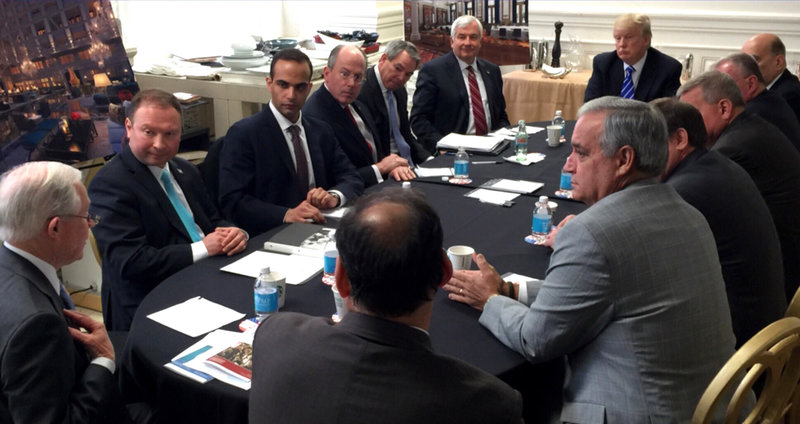
Share this entry