Posts

MattyDickPics Taibbi Doesn’t Like When Charlie Savage Takes Away His Russian Spy Toys

I want to talk about one paragraph that appears in this screed from Matty “Dick Pics” Taibbi, written after Matty declared the Durham classified annex is proof he’s been right for years, responding to Charlie Savage’s explainer on the import of the discovery that the emails — from which Russian spies purportedly wrote a report claiming Hillary was going to politicize Trump’s ties with Russia — were manufactured. The rest of the rant boils down to “NYT wah wah wah NYT NYT” and is of course riddled with errors.

But this short paragraph is a piece of work, even for MattyDickPics.

Matty dismisses the import that the emails behind the report that he and the right wing have chased for years were “assembled by Russian spies.” He claims this is just about a “pair” of emails, but that dodges what was really there:

  • Two drafts of an email purportedly dated July 25, both incorporating a Russian idiom in an email presented as the original English
  • An email between two Russian spooks, which Durham describes to be dated July 26, talking about ginning up a conspiracy theory about the Deep State
  • Another email purportedly dated July 27 containing the imagined smoking gun that Clinton approved this alleged plan; the email was attached to an email between spooks that seems to reference their plan to gin up a conspiracy theory
  • The report itself, the date of which Durham has always hidden and we still don’t know (but it is either dated July 27, incorporating that email purportedly dated July 27, or it precedes the date of the main piece of evidence supporting the claim in the report)

It’s enough, for Matty, that the emails were “likely pulled by Russians from other real American victims of hacking.” Nevermind that only one other email reflecting the language of the email has been found, and that other email was largely unrelated to Hillary Clinton and, oh, also pertained to Russian rat-fucking and language play. It’s enough for Matty that these Russian spies cut-and-pasted from something else they stole to justify treating the claims based on that purported email as “true.”

You see, Matty wants to separate those emails (admittedly Savage refers to them as a pair, just like Matty, but it matters that there are two drafts of the July 25 one) from the larger cache — the existence of emails in English using a Russian idiom dated around the same time as some Russian spies decided to gin up a conspiracy theory, this conspiracy theory, the one Matty has monetized for years.

To dismiss the fact that conspiracy theory he has monetized for years is based on a report based on manufactured emails incorporating a Russian idiom in English, Matty says it doesn’t matter, first, because there are numerous other American “victims,” scare quotes. The sheer breadth of Russian hacking stands in for accuracy for Matty, and he’s happy to dismiss the plight of the victims if he has to.

He also claims that the larger SVR collection “has been described in multiple other reports as real.” Matty is conflating — as other Russian propagandists have — “real” for “accurate.” Here’s what those other reports have said:

  • 2018 DOJ IG Classified Annex: At best, the reports based on stolen emails (in this case the January and March 2016 allegations about Loretta Lynch pressuring the FBI), involve multiple levels of hearsay and invitation to exaggeration. But the FBI believed parts of the emails were “objectively false.”
  • 2020 John Ratcliffe email: Ratcliffe’s initial disclosure of this report explains, “The IC does not know the accuracy of this allegation or the extent to which the Russian intelligence analysis may reflect exaggeration or fabrication.”
  • 2020 HPSCI Report: The right wing report incorporated a great number of SVR reports, without any discussion of whether the things they claimed about Hillary Clinton — such as that she has Type 2 diabetes — match known reality. More importantly, to sustain their claim that these are “real,” they ignore the part of one of the Lynch reports stating that Jim Comey would draw out the Clinton email investigation to help Republicans, which is what actually happened, and so if true would mean Trump didn’t win without help. We know with certainty that the authors of that report cherry-picked what was available to serve their needs. (Indeed, we know they ignored the email between Russian spooks about ginning up a conspiracy theory.)

So, no, Matty. While other reports describe these documents as authentically obtained from SVR, those other reports either dodge the question, raise real questions about accuracy, or declare several “objectively false.”

Nothing in this performance from Matty — his utter disinterest in provenance, a disdain for “victims” of Russian aggression, and a conflation of “authentic” for “true” — is new.

It’s just a really condensed example of his grift, written in response to the exposure that his nine-year grift was always built on a deliberate conspiracy theory ginned up by Russian spies exploiting people just like him.

Share this entry

Days After the FBI Announced an Investigation, Russian Spies Deliberately “Put More Oil into the Fire”

I really don’t think enough people are getting the pee-your-pants humor — at least if you’re Russian and want to destroy the United States — at the core of the classified annex from the Durham Report.

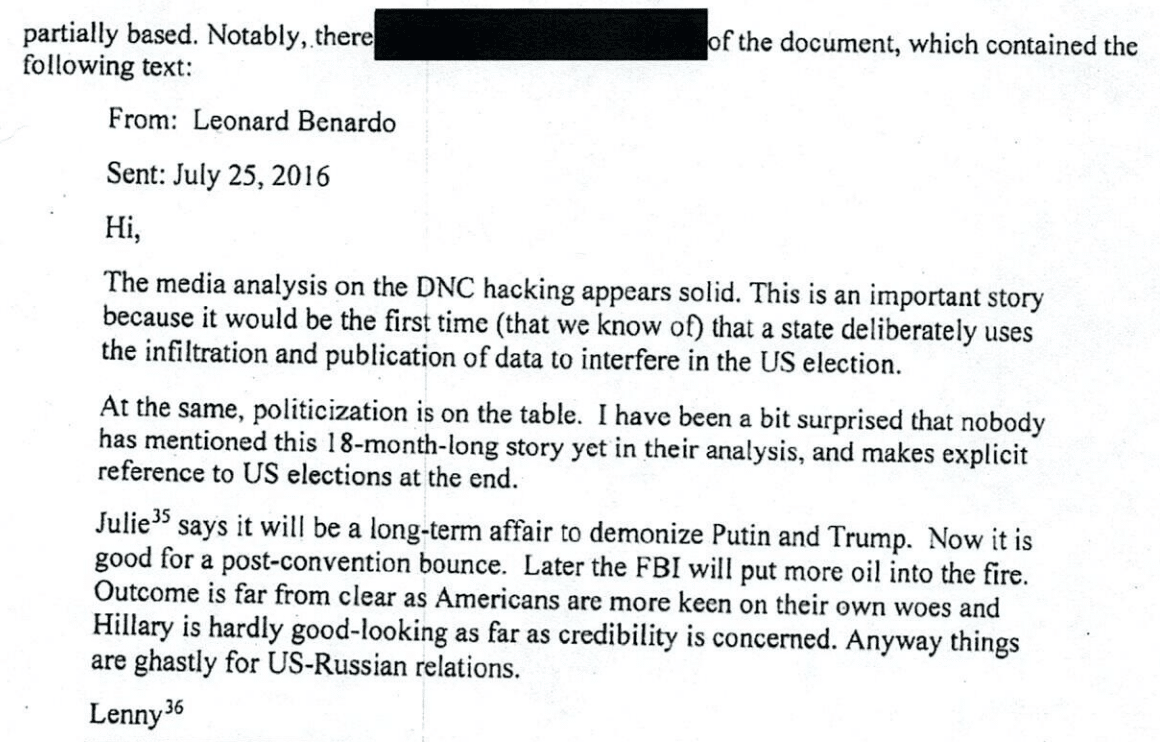
Durham describes that, in a May 21, 2021 interview with Leonard Benardo, Durham showed the Open Society Foundation Executive an email purportedly stolen from him in 2016 and asked him if he wrote it. Benardo told Durham, “he would not have used certain terms, such as ‘oil into the fire.'”

Durham, you see, was pretty aroused by the term, “put more oil into the fire,” because he was chasing a conspiracy theory that Hillary framed Donald Trump by paying for a dossier that — unbeknownst to her — was likely riddled with Russian disinformation, thanks to Oleg Deripaska, and also — unbeknownst to her — got shared with the FBI, and because – unbeknownst to her — Michael Sussmann brought allegations about a DNS anomaly to the FBI (one that the guy I went to the FBI about had a role in inflaming just weeks later). So that phrase, “put more oil into the fire,” looked like paydirt. It seemed to confirm the exact same conspiracy theory Durham was chasing: that Hillary intended to frame Trump at the FBI (even though the FBI had already announced their investigation).

Durham doesn’t quote what Benardo said directly. It may well have been more colorful than that he wouldn’t have used that term. Benardo has lived in Moscow and other parts of the former Soviet Union, and so he surely recognizes the phrase not only is not one most Americans would use — they would say, “pour fuel on the fire” or “add fuel to the fire.” They definitely wouldn’t use “oil.”

But he would recognize it as a Russian idiom.

And to be clear, while Chuck Grassley and Tulsi Gabbard are redacting most details about the provenance of these documents, the introduction says, “the above-referenced [SVR] memorandum included the English text of a document … the document contained a purported email from Benardo” on which, a redacted passage from Durham suggests, the SVR report “was partially based.”

That appears to confirm that this text appeared in the intelligence report that Durham chased like a toddler for four years in English. That is, it’s not a problem of translation — English to Russian back into English. A document that Durham spent years trying to verify as authentic uses a Russian idiom to describe the chaos that might ensue as a result of the FBI investigation that was publicly confirmed the very date of the email, July 25, 2016.

And this is one reason why the timing of these documents matters, which Grassley and Gabbard aggressively obscure. This is as close as we can establish:

  • July 25: Thomas Rid story
  • July 25, 11 to 11:35AM: Smith texts other people trying to figure out if there was any investigation of the hack, and then discovering the FBI has just announced such an investigation (as I noted here, Durham doesn’t disclose anywhere in his report that during the Michael Sussmann prosecution, Sussmann forced him to obtain these emails that show FBI releasing a statement without consulting with the Dems, the victims of the hack, which goes a long way to debunking his conspiracy theory).
  • July 25, undisclosed time: Maurer responds to the Rid story
  • July 25, undisclosed time, but the date could be made up: Two drafts of purported Benardo emails
  • July 26: Email between two Russian spooks suggesting “doing something about a task from someone”
  • July 27: Email between two Russian spooks about illuminating Hillary’s attempts to vilify Trump and Putin that links to a purported July 27 Benardo email which among other things reports that Hillary has “approved Julia’s idea”
  • July 26 to July 28: A draft Russian spy memorandum claiming that on July 26, Hillary Clinton approved a plan to smear Donald Trump, citing July 25 emails purportedly from Benardo
  • July 27: Email from Smith soliciting signers for a letter condemning Trump’s attack on NATO

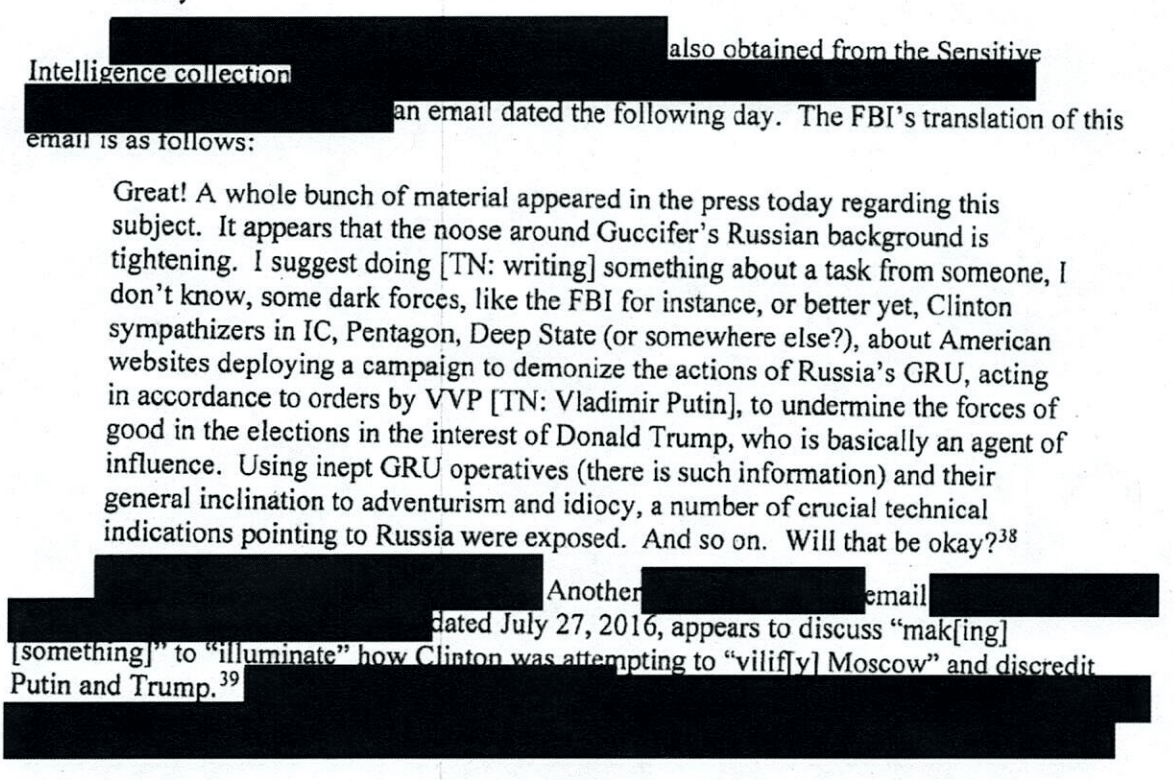
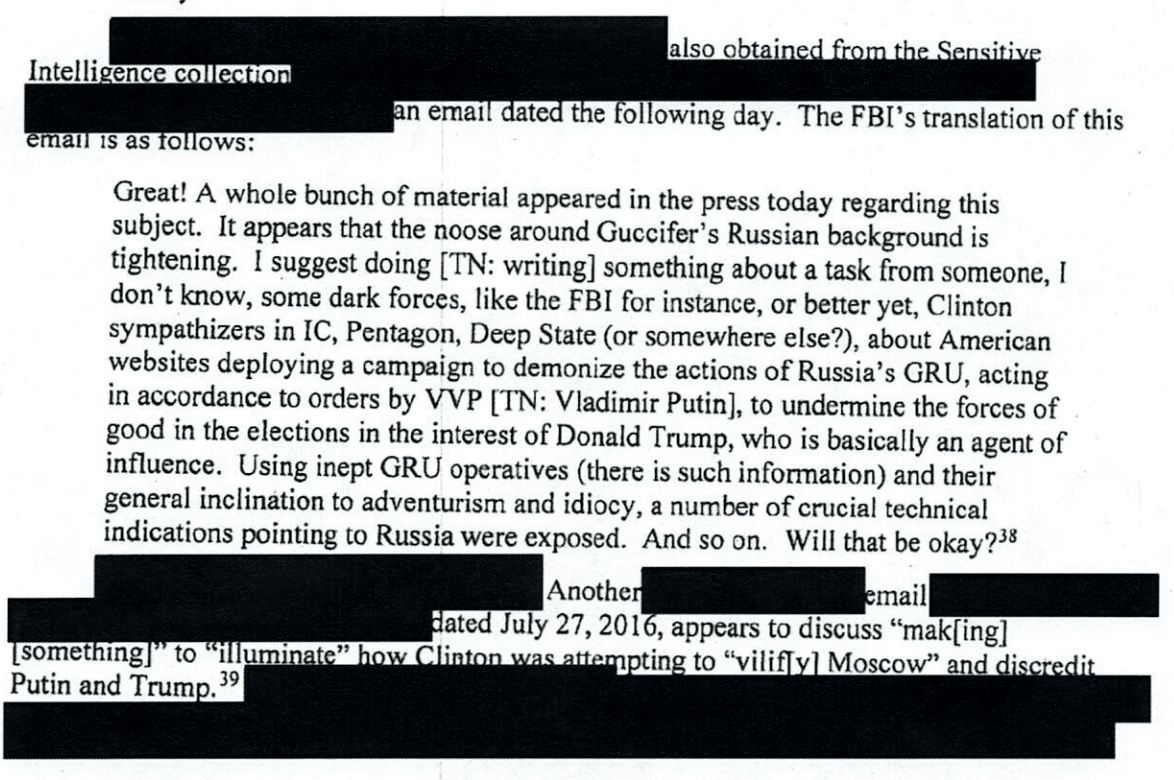
Importantly, Durham describes that this email between two Russian spooks was “dated the following day” from the email with the Russian idiom in the English text, so July 26.

This email between two Russian spooks says, let’s do something “about a task from someone, I don’t know, some dark forces, like the FBI, or better yet, Clinton sympathizers in IC, Pentagon, Deep State (or somewhere else?), about American websites deploying a campaign to demonize the actions of Russia’s GRU.” This email between two Russian spooks effectively says, “Let’s do something about a campaign to demonize Trump.”

That’s why the date of the report — the one Durham never disclosed in his entire unclassified report and which he either didn’t disclose here or Grassley and Gabbard are covering up — matters.

Because even if you believed the emails from Benardo were real, the one with the Russian idiom dated July 25 and one dated July 27 — the very same day Trump would ask Russia to hack Hillary some more and Russian hackers would almost immediately comply, the same day Trump lied about chasing business interests in Russia, a lie Putin’s top people had proof was a lie, the same day Trump said he might recognize Crimea (in the days immediately following, Roger Stone attempted to script pro-Russian tweets from Trump) — even if you believed those emails were true, you’d have to notice that a key part of the SVR report, the detail that Hillary had, past tense, approved “a campaign to demonize the actions of Russia’s GRU” only appears in the July 27 email, not the July 25 one.

And that email, also in “English,” was attached to a follow-up email discussing the plan to “‘illuminate’ how Clinton was attempting to ‘villif[y] Moscow.'”

That all seems to suggest that the intelligence report itself — the one claiming to confirm that Hillary had approved a campaign to demonize Russia? — appeared the day after two Russian spooks said, “wouldn’t it be cool, now that we know the FBI is looking, to claim that Hillary was seeking to frame Trump?” Let’s pour fuel on the fire, as it were.

Durham ultimately concluded that these emails were “composites” of other emails — though he only identifies one, an email about an article from one of America’s foremost intelligence disinformation scholars, Thomas Rid, who is nowhere near as high up on Putin’s list of adversaries as Benardo surely is, but certainly someone it’d be hilarious to mock.

Durham doesn’t bother to discuss what Rid said, but much of what Rid did say conflicts with what the purported intelligence report does. Perhaps more importantly, Rid discussed how one of the early Guccifer documents included the signature of Felix Dzerzhinsky: “one dumped document was modified using Russian language settings, by a user named ‘Феликс Эдмундович,’ a code name referring to the founder of the Soviet Secret Police.” Likewise, it might have been worth mentioning that in the article whence this “composite” email came, Rid commented on the shitty English of Guccifer 2.0. “Guccifer 2.0’s English initially was also weak, but in subsequent posts the quality improved sharply.”

Had Durham actually looked these things: the apparent timing — including the coincidence with Donald Trump’s overtly pro-Russian statements, to say nothing of his lies about Russian business ties — had Durham actually considered all of this, that “English” phrase, “put more oil into the fire,” in shitty English, he might have gotten the joke.

Because honestly, it is fucking hilarious. Well-played, Russian spy dudes. Well-fucking-played.

But instead of seeing how he had been made a laughingstock — and really, the entire US intelligence community, especially the FBI that these conspiracy theories have serially destroyed — Durham instead doubled down, indicting two more men he hoped would fulfill his conspiracy theories, first destroying US DNS capabilities targeting Russia and then chasing Sergei Millian’s uncorroborated tweets, for years.

Nine years into this influence operation, that phrase, “put more oil into the fire,” a phrase that someone at the FBI should have recognized as a Russian idiom at least five years ago, is still ripping the country to pieces.

And somewhere, some Russian spies are peeing their pants in laughter.

Share this entry

FBI Thwarted an Investigation into How Russians Injected Disinformation in the Steele Dossier

Judging from the chronology of his interview transcripts, John Durham first started chasing his conspiracy theories about Hillary Clinton by September 17, 2019 (a detail I’ll return to). This list shows all the interviews cited in both Durham’s unclassified report and the annex; the italicized ones appear only in his classified annex (meaning they likely focus on the SVR intelligence at the core of that material).

In early September, Bill Barr’s office was micromanaging what Durham should investigate, including feeding him a binder of material. On September 16, he met with a partisan Cyber Agent named Nate Batty; he’s the guy who bolloxed the investigation of the Alfa Bank allegations, knowing that they came from Democrats. Then, on September 17, he met with “HQ Analyst-3” and she explained the nature of the SVR collection.

That September 17 interview is the only one exclusively listed in the annex. But it’s not the only interview Durham did with her. Between the unclassified report and the annex, Durham cited five interviews with this analyst, starting a month earlier, on August 14, 2019. In that interview, she described checking the SVR materials for information on the people prosecuted by Robert Mueller, a question he returned to twice more, in December 2019 and February 2020.

Where this analyst played the most significant role in his report, though, was in finding — in “significant intelligence information that first became available for the FBI to review in 2018” (perhaps not coincidentally after the DOJ IG investigation into the SVR material raised concerns about whether it had been sufficiently consulted during the Hillary email investigation) — “that as a result of [Russia’s access to sensitive U.S. government information”], Steele’s subsources could have been compromised by the Russians at a point in time prior to the date of the first Steele dossier report.”

It’s possible this analyst is Brittany Herzog, who testified about Steele’s subsources at the Igor Danchenko trial, though she left the FBI in 2019 to start grad school.

The bulk of what Durham included from this analyst pertained to how, in fall 2018, after she found evidence that Steele’s subsources had been identified before the first report in 2016, senior officials at FBI told her to stop documenting her work. She escalated the problem, ultimately to David Bowdich. Durham doesn’t discuss what happened then, even though his investigation continued past the time Bowdich departed.

We’ve never heard the results of that — except, perhaps, in questions by DOJ IG why the FBI didn’t unpack the possibility that Oleg Deripaska had injected disinformation in the dossier.

Which is why Durham’s own disinformation problem (well, one of them) is so interesting.

Having interviewed Analyst-3 about what was in the SVR files, he cited the DOJ IG report (by way of the SSCI Report) to affirm that Oleg Deripaska knew of the Steele project by July 2016. But then in a totally separate section, he casually asserted (citing NYT) that Steele worked for Deripaska (something he could, and should, have cited to Bruce Ohr’s 302s).

The FBI would have multiple reasons not to want to chase the disinformation in the Steele dossier, first in 2018, and then — after Mueller had established that Manafort was trying to get debt forgiven by him when he shared how the campaign planned to win and then discussed how to carve up Ukraine, another reason when Bowdich got that briefing. Over and over again, however, people serving Trump’s disinformation purposes never seem to want to pull the threads of Deripaska’s relationship with Steele and the possibility that Russia was sending disinformation coming and going.

Incidentally, Analyst-3 was not among the people who backed Durham’s theory that the Leonard Benardo emails were authentic.

Cited testimony

August 14, 2019: SVR didn’t have anything regarding regarding any Trump election campaign conspiracy with the Russians, nor did she see anything in FBI holdings regarding Carter Page, Michael Flynn, George Papadopoulos, or Paul Manafort, though there was material on Manafort that was not connected to the election or the presidential campaign.

September 17, 2019: Timing of SVR hacks. Victims targeted. 

December 10, 2019: Timing of SVR hacks. Victims targeted. The three things obtained: emails about hacking, analysis of hacked documents, and the stolen emails hacked. Hypothesis that the reference to “special services” in the SVR report was a reference to Christopher Steele. Details of the SVR report. Probable description of the compromise of Carnegie Endowment for International Peace. SVR didn’t have anything regarding regarding any Trump election campaign conspiracy with the Russians, nor did she see anything in FBI holdings regarding Carter Page, Michael Flynn, George Papadopoulos, or Paul Manafort.

February 19, 2020: The review team initially briefed Counterintelligence and Cyber executive management about their findings on the compromise of Steele’s sources during a conference call. Following the call, while driving home, Headquarters Analyst-3 was called by Acting Section Chief-2. Acting Section Chief-2 told Headquarters Analyst-3 that they appreciated the team’s work, but no more memorandums were to be written. A meeting was then held with Assistant Director Priestap and others. During that meeting, the review team was told to be careful about what they were writing down because issues relating to Steele were under intense scrutiny. SVR didn’t have anything regarding regarding any Trump election campaign conspiracy with the Russians, nor did she see anything in FBI holdings regarding Carter Page, Michael Flynn, George Papadopoulos, or Paul Manafort.

December 2, 2021: Moreover, significant intelligence information that first became available for the FBI to review in 2018 showed that the Russians had access to sensitive U.S. government information years earlier that would have allowed them to identify Steele’s subsources. Indeed, an experienced FBI analyst assessed that as a result of their access to the information, Steele’s subsources could have been compromised by the Russians at a point in time prior to the date of the first Steele dossier report. Two weeks later, the Deputy Assistant Director for Counterintelligence, Dina Corsi, met with the review team and directed them not to document any recommendations, context, or analysis in the memorandum they were preparing. The instructions, which Headquarters Analyst-3 described as “highly unusual,” concerned the team because analysis is what analysts do. Headquarters Analyst-3 was so concerned about the failure to fully exploit the materials involving Steele subsource information (and the possible need to bring information already exploited to the attention of the FISC) that she raised her concerns about the FBI’s lack of action in an email to her supervisor in the hope of having the issues explored further. See FBI-0009265 (Email from Headquarters Analyst-3 to FBI employees dated 10/17/2018). Although the team did not fully adhere to that instruction because of the need to provide context to the team’s findings, they did tone down their conclusions in the final memorandum. Headquarters Analyst-3 recalled that a separate briefing on the review was eventually provided by the team in the Deputy Director’s conference room, although Headquarters Analyst-3 could not recall if Deputy Director David Bowdich attended the briefing. Headquarters Analyst-3 did know that Bowdich was aware of the review itself. [T]here is reason to believe that even earlier in time [Russia] had access to other highly sensitive information from which the identities of Steele’s sources could have been compromised.

Share this entry

How John Durham and Chuck Grassley Covered Up Getting Ass-Handed by Russia

The most important passage of the classified annex of the Durham Report is this one — though you won’t hear it from the frothy mob, in significant part because Chuck Grassley and Tulsi Gabbard are hiding what these documents are. Durham describes that it is “dated the following day” just after discussing an email dated July 25, so July 26.

Go ahead and read it once. But before I explain why it is so important, first let me illustrate how Chuck Grassley and Tulsi Gabbard are obscuring the provenance of these documents.

As I explained here, these documents were stolen from Russian foreign intelligence (SVR) by another country’s intelligence service (understood to be the Dutch). The documents themselves generally consist of two different kinds of documents:

  • Emails and other raw intelligence that SVR stole from victims, including US think tanks, State Department, and the Executive Office of the President
  • Discussions among SVR — mostly intelligence analysis — about the files they stole

Sometimes the victim files the Russians stole would be attached to the reports, sometimes they would be incorporated into the reports. Sometimes the Russians would translate the English-language documents they stole, other times they would not. So the game of telephone that most of these documents entail looks like this:

  • SVR steals documents
  • SVR translates documents
  • SVR analyzes documents
  • Dutch intelligence steals documents from SVR
  • Dutch intelligence shares documents with CIA and/or FBI
  • CIA and/or FBI translate the Russian bits
  • CIA and/or FBI analyze what they found
  • CIA sends what they think they found to FBI

But that’s not all. For the key documents in this collection, they report the speech of one or another Hillary Clinton associate, which means the game of telephone looks like this:

  • Debbie Wasserman Schultz or Julianne Smith talk with Think Tank guys (primarily Open Society’s Leonard Benardo, but also OSF’s Jeffrey Goldstein, as well as unidentified people at Atlantic Council and Carnegie Endowment)
  • Think tank guys write what they learned from DWS or Julianne Smith
  • SVR steals documents from Think Tank guys
  • SVR translates documents from English to Russian
  • SVR analyzes documents
  • Dutch intelligence steals documents from SVR
  • Dutch intelligence shares documents with CIA and/or FBI
  • CIA and/or FBI translate the Russian bits to English
  • CIA and/or FBI analyze what they found
  • CIA sends what they think they found to FBI

Best as I can tell, that path is the one involved in the documents Durham claims are the most important in his appendix, the ones that claim to report what Smith said about a Hillary Clinton plan to smear Donald Trump.

Here’s what FBI lawyer Tricia Anderson wrote about the problems with this game of telephone in a memo:

  • The reports likely reflected multiple levels of hearsay given that they were based on purported communications between Wasserman Schultz and potential donors, not any underlying communications between Lynch and Clinton campaign staff;
  • Wasserman Schultz’ communications may have contained exaggerations designed to reassure potential donors who were concerned by news about the FBI investigation;
  • The [Russians] who drafted the reports may have injected opinion, editorialization, or exaggeration into the reports; and
  • Translation errors may have contributed to the potential for unreliability

Durham provided just a summary of this assessment, but a fair one (in part because he’s more focused on later documents that don’t involve DWS but do involve all those levels of reported speech).

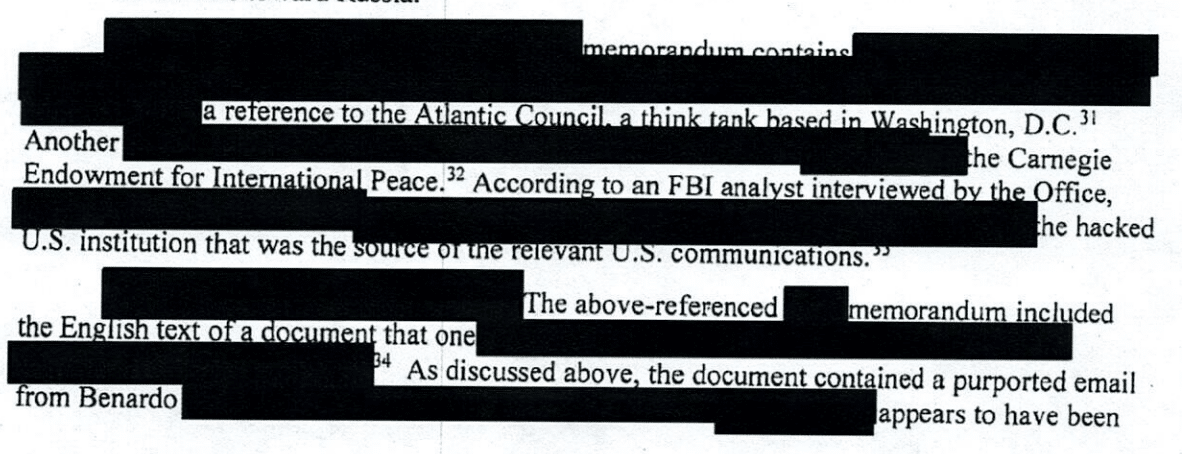
Here’s how the purported smoking gun was introduced (note, if Durham provided the date, it is redacted, but it reports something that happened on July 26, so it can be no later than then but could be July 27).


There was additional analysis about the provenance following the text.

There are a number of things conveyed in these redactions:

  • The classification marks
  • That CIA received these documents
  • The dates the Dutch passed them on
  • Presumably (though given Durham’s practice elsewhere in his report, not definitely) the date of the underlying memo
  • A description of the people at SVR they were obtained from
  • The import of all the other think tanks
  • The nature of the incorporated messages purported to be from Benardo

I don’t contest some of those redactions. But the amount of redaction, and lack of context elsewhere, obscure what the purported smoking gun is: a draft SVR report that in some way incorporates language attributed to Leonard Benardo. We have no clue whether it is dated July 26, 27, or 28 (by which date CIA had a copy). The section that most frothers are quoting (just like the section of other SVR reports released in recent weeks) is not an email itself, it is a Russian discussion about purported emails.

Durham follows the actual SVR report with the text attributed to Benardo; the description of how this text is incorporated in the document is redacted.

He follows it with another similar (raw) email attributed to Benardo (which should make evident whom Benardo sent the email to, or at what time, but Durham didn’t share that).

John Durham does not mention, at all, that the language of those first two purported Benardo emails — the ones with a date of July 25 — in no way supports the claim made in the SVR Report, that on,

26 July 2016, Clinton approved of a plan of her policy advisor, Julianna Smith … to smear Donald Trump. by magnifying the scandal tied to the intrusion by the Russian special services in the pre-election process to benefit the Republican nominee.

As envisioned by Smith, raising the theme of “Putin’s support for Trump” to the level of the Olympics scandal would divert the constituents’ attention from the investigation of Clinton’s compromised electronic correspondence.

He does note in a footnote that the SVR report got Julianne’s first name wrong, Juliana. He simply asserts that the “Julie” referred to in the purported Benardo emails is Julianne; he doesn’t note that in the purported follow-up Benardo email the name used is “Julia,” not the kind of thing a colleague would normally do. Durham interviewed Benardo, who specifically said he didn’t know who “Julie” (or “Julia”) was.

The only corroboration at all that the language in the Benardo email was real, was evidence it was not: an email sent by someone else, a Carnegie Endowment cyber guy named Tim Maurer, discussing this article on attribution from Thomas Rid. Durham says less about the Rid article than another cited in this correspondence, which is telling, because Rid discussed the Democrats’ decision, back in June, to go public with the hack.

This was big. Democratic political operatives suspected that not one but two teams of Putin’s spies were trying to help Trump and harm Clinton. The Trump campaign, after all, was getting friendly with Russia. The Democrats decided to go public.

Rid also discussed the Guccifer persona at length, which is important for reasons I’ll explain in a follow-up.

As noted, ultimately Durham concludes that the emails themselves — documents that are supposed to be raw collection — are instead “composites,” including from a totally different guy, Maurer.

The Office’s best assessment is that the July 25th and July 27th emails that purport to be from Benardo were ultimately a composite of several emails that were obtained through Russian intelligence hacking of the U.S.-based Think Tanks, including the Open Society Foundations, the Carnegie Endowment, and others. Indeed, as discussed above, language from Tim Maurer’s email of July 25th is identical to language contained in Benardo’s purported email of the same date.

Durham is hedging wildly here. I think the NYT overstates when it says, “Mr. Durham concluded that the email from July 27, 2016, and a related one dated two days earlier were probably manufactured.” That would be the conclusion sane normal people would draw, that if emails purporting to be from Benardo were actually cut-and-pasted language from Maurer, but Durham doesn’t make that conclusion (perhaps because he continued to chase this conspiracy theory for another two years after he interviewed all these people, indicting two more men only to discover his theories about them, too, were made up). Indeed, in an almost entirely redacted (and therefore useless) passage, Durham claims that in what must be July 2017, the CIA still maintained that the report and at least some of the purported emails were not fabrications. He also cites interviews he did with people who thought the Benardo emails were authentic.

But yeah, if the emails themselves are “composites,” it means they’re made up, not even attributing the author correctly. In fact, if they’re composites, we have no reason to believe the emails dated July 25 weren’t in fact “composited” on July 26 or 27.

Now’s a good time to mention that Durham is obscuring the sequence of the documents here (not least by withholding the metadata of the real email he obtains, but also thanks to the redactions from Grassley and Tulsi). The sequence looks something like this, but we can’t be sure:

  • July 25: Thomas Rid story
  • July 25, 11 to 11:35AM: Smith texts other people trying to figure out if there was any investigation of the hack (as I noted here, Durham doesn’t disclose anywhere in his report that during the Michael Sussmann prosecution, Sussmann forced him to obtain these emails that show FBI releasing a statement without consulting with the Dems, the victims of the hack.
  • July 25, undisclosed time: Maurer responds to the Rid story
  • July 25, undisclosed time, but the date could be made up: Two drafts of purported Benardo emails
  • July 26: Email between two Russian spooks suggesting “doing something about a task from someone”
  • Unknown date: A draft Russian spy memorandum claiming that on July 26, Hillary Clinton approved a plan to smear Donald Trump, citing July 25 emails purportedly from Benardo
  • July 27: Email between two Russian spooks about illuminating Hillary’s attempts to vilify Trump and Putin that links to a purported Benardo email, in what Durham describes as English but is … probably not written by a native English speaker
  • July 27: Email from Smith soliciting signers for a letter condemning Trump’s attack on NATO

Narratively, Durham puts the draft report, incorporating a July 25 email attributed to Benardo, then citing another July 25 email attributed to Benardo, and describing Hillary approving a plan on July 26, before the email between two Russian spooks, which by description is dated July 26. But I’ve been staring at it for an hour (and reviewing Durham’s unclassified report and now realizing he never provides the date there, either) and for the life of me, I’m not sure if we know whether the two spooks email precedes the draft intelligence report or not (note, too, that it starts, “Great!” by responding to something, suggesting there’s an even earlier one Durham suppressed). If my read that it is dated July 26 is correct, it would have been written on the same day as the purported approval by Hillary, of a plan to smear Donald Trump. But the only email attributed to Benardo reflecting Hillary’s approval is written July 27, meaning it’s more likely it was written on July 27.

So we don’t know. I am still searching but I believe Durham never revealed the date of that memo. But based on what we can see, SVR didn’t “have” an email reflecting Hillary approving this plan until July 27, the day after (at least by Durham’s description) two Russian spooks discussed telling stories about the Deep State.

If that’s right, Russian spooks were discussing “making” such a report before they “found” an email in stilted English that Durham couldn’t match describing Hillary approving this plan.

Based on interviews (italicized here) that appear only in this annex, John Durham first started chasing this conspiracy theory no later than September 2019 (the day after meeting with Nate Batty, the politicized FBI Agent who killed the Alfa Bank investigation). After interviews done by July 2021, Durham should have come to the conclusion he states here: that the purported emails were “compiled” from emails of entirely different people. And yet all the while, the IC was in possession of documents showing one Russian spook suggesting that another one, “do something about a task from someone, I don’t know, some dark forces, like the FBI for instance, or better yet, Clinton sympathizers in IC, Pentagon, Deep State.”

Durham tried to bury all that, that he created precisely the chaos the Russian spooks were trying to manufacture, in this classified annex and — if you believe Kash Patel — burn the proof.

The Russians told you what they were up to.

And yet you fell for it anyway.

Update: Fixed spelling of Benardo’s last name.

Share this entry

BREAKING: Right Wingers Believe Jim Comey Threw the 2016 Election to Trump and Jim Jordan Must Go to Jail

The Epstein distraction files continue, with a purported whistleblower report (which Tulsi Gabbard now seems to claim was the entire source of her past discredited propaganda) and the Classified Annex to the Durham Appendix.

I’ll return to the substance of the Durham Appendix.

The Tl;dr is that Durham made false claims in the appendix contradicted in the unclassified version, and ignored totally basic details about the 2016 election as well as evidence in his own possession to sustain his Clinton Conspiracy Theory, which I addressed at length here.

But the short version of the story is that in addition to the two SVR documents involving Loretta Lynch I described here, Durham reviewed two more SVR documents. So in sum total, this scandal is about:

  • A January 2016 intelligence memo purporting to describe what Debbie Wasserman-Schultz said about the Clinton email investigation and also stating that Jim Comey intended to keep the scandal running “to jeopardize the chance of the DP to win the presidential race.”
  • A March 2016 intelligence memo claiming that the Hillary’s political director, Amanda Renteria, regularly receives updates from Loretta Lynch and that Hillary was reviewing Trump’s ties with Russian oligarchs (including Aras Agalarov), “with support from special services.”
  • A July 2016 “draft memo” relaying that the Soros Foundation had evidence that on July 26, Hillary approved a plan from her policy advisor, Juliane Smith, “to smear Donald Trump by magnifying the scandal tied to the intrusion by the Russian special services in the pre-election process to benefit the Republican candidate.” This was, in part, an effort to get the White House to be more confrontational with Russia. (There’s a reference to “PC” that Durham takes to be “Political Convention” and not “Principals Committee”). It claimed (remember, this purports to be what Smith said) that the FBI lacked irrefutable evidence of Russia’s involvement in the scandal. The July 2016 memo then says that the campaign Hillary purportedly approved on July 26 was launched in June 2016, and also claimed that Hillary lacked direct evidence (which they of course did have). The appendix cites five more somethings of emails (the report redacts the description) purportedly from Leonard Bernardo, dated July 25 to July 27, that say “the FBI will put more oil into the fire,” most of which are in Russian.

Durham obtained records from many of the think tanks involved and he “was unable to locate in the records from the Think Tanks any exact versions of the Bernardo emails obtained” from their source. Instead, he found some real emails, “contain language and references with the exact same verbiage to the materials.” One was a discussion about Thomas Rid’s analysis of the DNC hack. Another was an email Smith actually sent soliciting bipartisan experts to condemn Trump’s attacks on NATO. As noted in my earlier post, Durham focused on Smith’s efforts to get a public statement about the actual hack released, which had no tie to Trump (as also noted, Durham omits a great deal of context to make that look damning).

None of the people involved in the purported emails said they sent them. None of Hillary’s staffers said there was a plan. Durham ultimately concludes that the emails on which he predicated a five year investigation were merely “a composite of several emails that were obtained through Russian intelligence hacking.” The rest of his opinion is stupid for the reasons I laid out in my earlier post, but will return to.

From that, the right wing is treating the things in the Russian intelligence reports as true. And treating the desire to make political hay of an election year hack as a criminal conspiracy.

Curiously, though, none of them are treating as true that Jim Comey would draw out the investigation into Hillary until the end of the election to help Trump win, even though that is what happened.

And none of them are accusing Jim Jordan (or anyone else) of trying to make political hay about the Iran hack of Donald Trump last year — the exact equivalent of the worst insinuations about what Smith did.

Today, House Judiciary Committee Chairman Jim Jordan (R-OH) sent a letter to Federal Bureau of Investigation (FBI) Director Christopher Wray requesting an unclassified briefing on the Iranian hack of President Trump’s campaign. According to reporting, Iran emailed the illegally obtained information to at least three advisers on the Democratic presidential campaign and emailed stolen information, including at least three major media outlets—Politico, the Washington Post, and the New York Times.

The Committee is requesting the briefing to address questions including:

  • What material did Iran obtain from President Trump’s campaign?
  • To whom at the Biden for President or the Harris for President campaigns did the hackers send information and materials?
  • On what date did the FBI learn there had been a hack and exfiltration of nonpublic information from President Trump’s campaign?
  • On what date(s) did Iran provide the stolen documents to the Biden for President campaign or the Harris for President campaign?
  • On what date did the FBI first inform President Trump’s campaign it had been hacked?
  • Did the FBI use any Foreign Intelligence Surveillance Act authorities to surveil President Trump’s campaign?
Excerpts of the letter to Director Wray

“On September 18, 2024, the Federal Bureau of Investigation (FBI), the Office of the Director of National Intelligence, and the Cybersecurity and Infrastructure Security Agency announced that in ‘late June and early July,’ the Islamic Republic of Iran attempted to interfere with the upcoming presidential election by ‘sen[ding] unsolicited emails to individuals then associated with the Biden-Harris campaign that contained an excerpt taken from stolen, non-public material from former President Trump’s campaign . . . .’  Since then, Iran has continued ‘to send stolen, non-public material’ from President Trump’s campaign to the media.  Iran’s actions raise serious concerns about foreign election interference targeting President Trump’s campaign to support President Biden’s and Vice President Harris’s campaigns. We write to request information about this serious matter.

Look, if you really believe that these documents represent the transparent truth, then you believe that Jim Comey threw the election to Donald Trump and Jim Jordan must go to prison.

But if you’re ignoring those bits (as well as John Durham’s silence that the DOJ IG report quoted FBI as saying some of the SVR memos were “objectively false”), then you’re simply chasing conspiracy theories to drown out the Epstein scandal.

Pick. Either send Jim Jordan to prison or shut your yap.

Share this entry

Tulsi Gabbard Accuses Kash Patel of Covering Up for the Obama Deep State

Suspected Russian asset Tulsi Gabbard has released a report of screen caps out of context and one 114-page collection of documents purportedly showing what she claims is a conspiracy against Donald Trump.

It serves its purpose — because a broad swath of very stupid people are currently frothing madly about it on Xitter.

What Tulsi purports to show is that the FBI didn’t back expansive claims of Russian involvement in election interference in September and October 2016, refused to participate in a assessment in December, only for Obama to order a new assessment, after which — Tulsi claims — the assessment changed to reflect more confidence in Putin’s involvement.

In general, Tulsi accomplishes the circus trick of getting stupid people to buy her narrative by conflating whether spooks thought Russia hacked the US voting tabulation infrastructure with Intelligence Community confidence that Russia was involved in the hack of the DNC and DCCC and then involved in the dissemination of files stolen from it.

So:

Voting infrastructure

Hack and leak

Not the same things

Tulsi assumes her rubes won’t notice she’s doing that and — lo and behold!! — she’s right!!

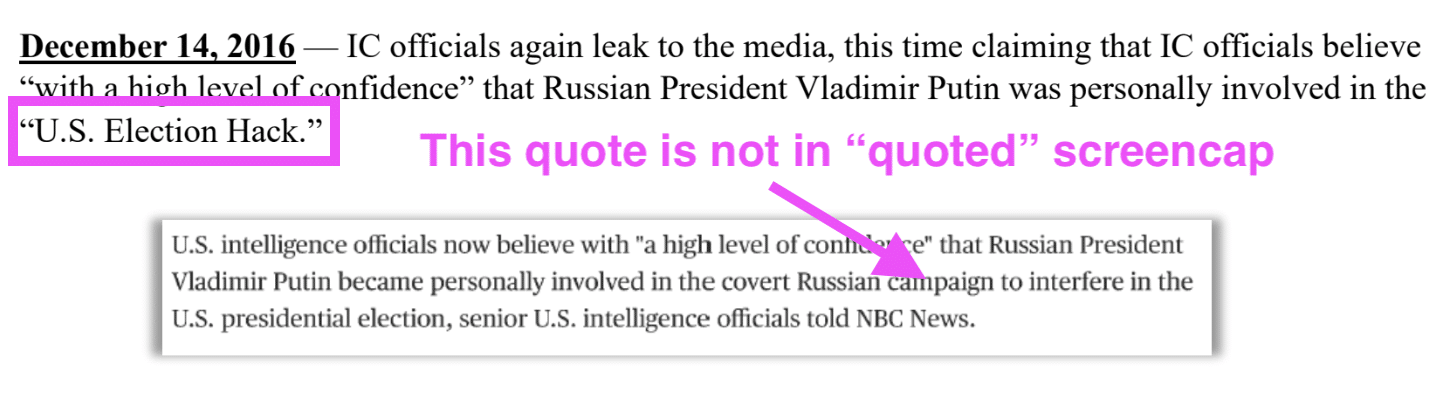
As one example of how transparently shoddy Tulsi’s “work” is, note how she misquotes a story (which she attributes to spooks but which might come from Congress) talking about the larger Russian intelligence operation in 2016, claiming it pertains exclusively to the “U.S. Election Hack.”

Tulsi doesn’t link the underlying story, for good reason, because reading the story gives away her game.

While it does use the word “hack” in the title, it includes two details that undermine Tulsi’s information operation.

U.S. Officials: Putin Personally Involved in U.S. Election Hack

New intelligence shows that Putin became personally involved in the computer breach, two senior U.S. officials say.

Two senior officials with direct access to the information say new intelligence shows that Putin personally directed how hacked material from Democrats was leaked and otherwise used. The intelligence came from diplomatic sources and spies working for U.S. allies, the officials said.

[snip]

The latest intelligence said to show Putin’s involvement goes much further than the information the U.S. was relying on in October, when all 17 intelligence agencies signed onto a statement attributing the Democratic National Committee hack to Russia.

Most importantly, the story describes that the Intelligence Community got new information. Wow! An explanation for why the assessment changed in December 2016!!!! All readily available if you just check Tulsi’s sources!!

Just as importantly, nothing in the article addresses tampering with the voting infrastructure, the topic of almost all the other screen caps in Tulsi’s propaganda, in her effort to conflate the voting infrastructure, the hack and leak, and the larger information operation.

There are a slew of other problems with Tulsi’s book report. It ignores:

  • The Russian investigation into Trump didn’t arise out of this intelligence. It arose out of Mike Flynn’s efforts to undermine the Obama sanctions on Russia in response, and Trump’s efforts to undermine the investigation of Flynn.
  • The Russian investigation discovered abundant new evidence, including proof that Trump’s campaign learned of Russia’s operation in advance. Trump’s Coffee Boy, Campaign Manager, National Security Advisor, personal lawyer, and rat-fucker were all eventually adjudged to have lied to cover up aspects of Trump’s involvement in the Russian investigation. And through their confessions, we learned that Russia dangled an impossibly lucrative real estate deal, told a Trump campaign official and his rat-fucker about their operation, got campaign data and strategy — possibly in exchange for millions of dollars and involvement in a plan to carve of Ukraine — and then undermined Obama’s foreign policy to help Russia.
  • After all these 2016 assessments, the NSA later developed evidence — according to the document Reality Winner leaked — that showed Russia did attempt to and had some success in hacking voting infrastructure.

Which is to say, Tulsi’s entire little book report is unrelated to the Russian investigation into Trump and her claims about hacking the election infrastructure were eventually revised.

But her report is not without interest.

If her story is true — if there is a shred of truth to her claims that Obama tried to alter the intelligence in 2016 — then evidence to that fact was available in 2020, when Kash Patel was reviewing precisely the same intelligence while serving as Ric Grenell’s handler, and that evidence was available from 2019 through 2023, when John Durham reviewed it all and determined that the spooks did nothing wrong.

In other words, if Tulsi’s allegations are true, it means Kash Patel and John Durham are part of the Deep State plot against Donald Trump!!!!

It means Trump’s hand-picked FBI Director was part of a sustained effort to cover-up Obama’s devious intervention in 2016.

If Tulsi’s allegations have any merit, then Pam Bondi must fire Kash Patel and include him, right along with all the nefarious actors Tulsi targets, because Kash covered this up when he could have helped Trump win the 2020 election.

Update: Corrected how long the primary document collection is.

Links

A Dossier Steal: HPSCI Expertly Discloses Their Own Shoddy Cover-Up

Think of the HPSCI Report as a Time Machine to Launder Donald Trump’s Russia Russia Russia Claims

Tulsi Gabbard and John Ratcliffe Reveal Putin “Was Counting on” a Trump Win

Tulsi Gabbard Teams Up with Russian Spies to Wiretap and Unmask Hillary Clinton

The Secrets about Russia’s Influence Operation that Tulsi Gabbard Is Still Keeping from Us

Tulsi Gabbard Accuses Kash Patel of Covering Up for the Obama Deep State

Share this entry

“Friendly to Us:” NYT Buries Its Own Role in Trump’s Attacks on Rule of Law

There comes a time in almost every Trump legal scandal where evidence comes out that Trump insiders believe they manipulated Maggie Haberman to serve Trump’s interests.

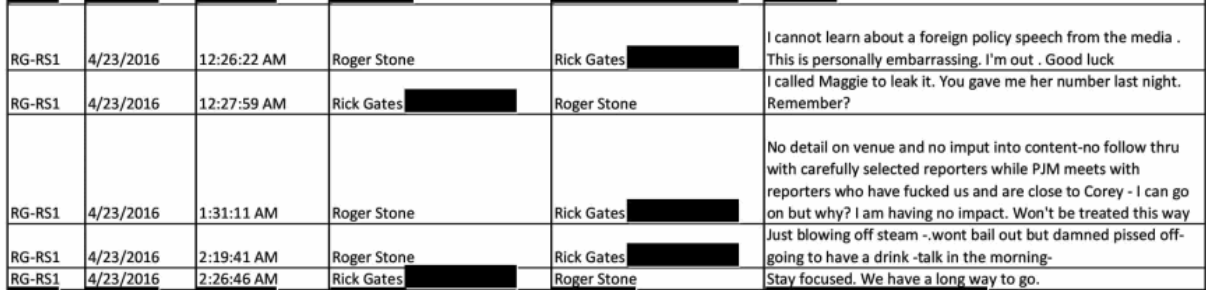
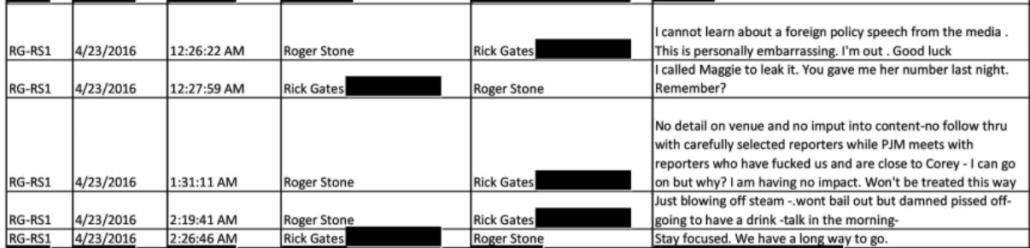
Evidence that both Roger Stone and Rick Gates used Maggie for various purposes came out in the Mueller investigation files, as when Gates claimed leaking Trump’s foreign policy speech to Maggie was a way to share it with Stone.
At Trump’s NY trial, Michael Cohen described how he deliberately misled Maggie about the nature of the payments he made to Stormy Daniels.

Perhaps the most damning example came in Cassidy Hutchinson’s testimony, where she described how, after her last appearance before the January 6 Committee while still represented by Stefan Passantino, he took a call from Maggie and confirmed that Hutchinson had just finished testifying to the committee.

His phone is ringing.

I look down at his phone. It’s Maggie Haberman calling him. And I looked at Stefan, and I said, “Stefan, did you tell Maggie Haberman that we were meeting with the committee today?”

And he’s like, “No, no. Maybe that’s not what she’s calling me about.”

And I said, “Stefan, did you tell Maggie that we were meeting with the committee today?

And he said, “No, no, but I should probably answer to see if she knows, right? I should answer.”

And said, “Stefan, no. I don’t think you should answer that call. She probably wants to know if we met with the committee today.”

He said, “Cass, I’m just going to answer. It will just be 2 seconds. I just want to find out what she’s going to talk to me about.”

He answers.

I can’t hear what she’s saying, but I hear Stefan say, “Yeah, yeah, we did just leave her third interview. You can put it out, but don’t don’t – don’t – don’t make it too big of a deal. I don’t think she’ll want it to be too big of a deal. All right. Thanks.”

And I said, “Stefan, was that Maggie Haberman asking about my interview?”

And he said, “Yeah, but don’t worry. She’s not going to make it a big deal.”

I said, “Stefan, I don’t want this out there.”

He said, “Don’t worry. Like, Maggie’s friendly to us. We’ll be fine.”

So I was just like, “Whatever.” I was annoyed.

Hutchinson went on to describe how, even as Passantino was discouraging Hutchinson from reviewing documents in a SCIF that would allow a follow-up appearance, Passantino and Alex Cannon spent the weekend talking to Maggie about Hutchinson’s testimony.

So I reached out to him on Monday, May 23rd: “Has [redacted] reached out about the SCIF?”

And then he was just kind of being wishy-washy with it.

He also let me know on that phone conversation that Maggie Haberman, quote, “got a story from the committee about my third interview,” end quote, and he spent he, Stefan, spent the whole weekend with Alex Cannon convincing Maggie Haberman not to publish the story that she got from the committee about my third interview.

Hutchinson described her particular disinterest in sharing her story with Maggie (and Josh Dawsey, another Trump whisperer).

And s0 now we’re moving into the phase of you know, I did my best throughout this whole period — I don’ like talking to reporters. Reporters would text me during this period. Ninety-nine percent of reporter texts always go unresponded to. I don’t like talking to reporters. I think there are some that I have, like, a friendship/working relationship with that I knew from being on the Hill and at the White House, but, like, Josh [Dawsey], Maggie Haberman, all those people, I stay very clear from.

But Josh [Dawsey], for example, had started reaching out to me and saying that he heard that the committee was in talks with Stefan about bringing me in for a SCIF interview and a live testimony; where did I stand on that with Stefan?

Say what you will about Maggie’s role in all this: Assuming it was her on Passantino’s phone (Hutchinson does not name the journalist in her book), she was just chasing a big story.

But there’s no doubt that one source of Hutchinson’s distrust of Passantino in the period leading up to her decision to get new lawyers stemmed from his willingness to share details of her testimony with Maggie — at least as she portrayed it — against her wishes.

“I don’t think you should answer that call,” Hutchinson said.

“Don’t worry,” the attorney representing Hutchinson but paid by a Trump entity said. “Like, Maggie’s friendly to us. We’ll be fine.”

None of that shows up in NYT’s faux savvy review of the game behind Barry Loudermilk’s referral of Liz Cheney for criminal investigation for allegedly intervening in Hutchinson’s legal representation at the time. NYT doesn’t bother to disclose to readers that, as Hutchinson described it, Maggie — who is bylined — played as significant a role in the breakup of the relationship between Passantino and Hutchinson as Cheney did.

Having failed to disclose Maggie’s alleged role in all that, here’s how — starting 28¶¶ in — NYT ultimately describes Loudermilk’s report and the claims within it.

The House report on Ms. Cheney, prepared by a Republican-led subcommittee on oversight, was specifically focused on the former representative, who broke with her G.O.P. colleagues over their ongoing support of Mr. Trump in 2021. But she has also infuriated Mr. Trump not only because she helped to lead the congressional investigation into him, but because she crossed party lines in the election and campaigned against him in support of Ms. Harris.

The report claimed that Ms. Cheney may have violated “numerous federal laws” by secretly communicating with Cassidy Hutchinson, a star witness for the Jan. 6 committee, without the knowledge of Ms. Hutchinson’s lawyer.

When Ms. Hutchinson was first approached to provide testimony to the committee, she was represented by a lawyer who had once worked in the Trump administration’s White House Counsel’s Office.

After meeting with Ms. Cheney, she hired a different lawyer and her subsequent public testimony was damaging to Mr. Trump. It included allegations that he had been warned his supporters were carrying weapons on Jan. 6, but expressed no concern because they were not a threat to him.

The report asked the F.B.I. to investigate whether Ms. Cheney’s dealings with Ms. Hutchinson were carried out in violation of a federal obstruction statute that prohibits tampering with witnesses. The report also accused Ms. Hutchinson of lying under oath to the committee several times and suggested that investigators examine whether Ms. Cheney had played any role in “procuring another person to commit perjury.” [my emphasis]

There’s a lot that’s misleading in this description. As I’ve noted, the section of the report describing DOD’s failures is actually longer (39 pages as compared to 36) than the section on Cheney and Hutchinson. Particularly given Loudermilk’s silence about Kash Patel’s role in what Loudermilk claims was DOD misconduct, to claim the report was “specifically focused” on Cheney is particularly misleading.

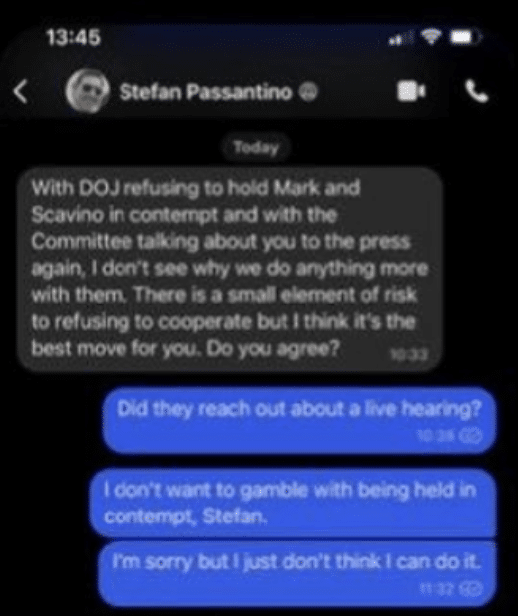
Maggie, writing with Alan Feuer, takes as proven the timeline Loudermilk lays out, which overstates what the evidence shows. While Cheney did communicate directly with Hutchinson, that was in June 2022, hours after Passantino had advised Hutchinson to take the “small element of risk to refus[e] to cooperate” with the committee any further in light of DOJ’s declination to press contempt charges against Mark Meadows. Hutchinson initiated the communication with Cheney and did so because, as she told Passantino, “I don’t want to gamble with being held in contempt.”
NYT asserts that what was damning about Hutchinson’s testimony after she ditched Passantino was Trump’s knowledge that people were refusing to go through magnetometers, but he wasn’t concerned because they wouldn’t hurt him. Hutchinson did tell that story publicly on June 28, 2022 (and J6C played earlier video testimony she had provided). But that thread of testimony started in her first interview in February 2022 and continued in her May 2022 interview, both of which Passantino attended. It all stemmed from texts she exchanged with Tony Ornato (texts that also make clear Trump “kept mentioning [a trip to the Capitol] before he took the stage” to give his speech).

To the extent this is among the things Loudermilk claimed Hutchinson lied about, Loudermilk’s case is based on word games, conflating formal intelligence with notice from Secret Service manning the rally that rally goers had (at least) flagpoles that were triggering the mags, misrepresenting a conversation Hutchinson claims she and Tony Ornato had with Mark Meadows, and ignoring that one of Ornato’s denials amounted to a claim he didn’t remember.

Plus, Hutchinson always emphasized that Trump’s concern was “get[ting] the shot,” packing enough bodies into the audience to make it look crowded, and not about ensuring that his supporters could keep their weapons before they marched to the Capitol. The claim that Trump knew his supporters were armed was legally damaging; it meant he knew the risk when he riled them up further about Mike Pence. But that’s not how Hutchinson spun it and it was testimony rooted in what she said in Passantino’s presence.

A reader might expect some assessment of Loudermilk’s claims in an article that boasts, as the headline of this does, that “Republicans Map a Case Against Liz Cheney.” No they didn’t. They floated a number of flimsy claims that don’t amount to a crime. You’re reporters. Act like it. Make that clear (as Philip Bump did here), rather than pretending Loudermilk’s claims aren’t mere whitewash.

The report neither links nor shows much understanding of the report itself. Even where it quotes lawyers about the viability of the charges, it doesn’t mention (for example) that the Jack Smith investigation resulted in a new Speech and Debate opinion that would apply to Cheney’s actions.

The real sin with the four-paragraph description of Loudermilk’s case, however, is one closely tied to Maggie’s own undisclosed role in it. NYT claims that Passantino was merely a former Trump White House Counsel. That’s not the issue. The issue, which goes to the core of the dispute and the reason Hutchinson replaced him, is that he was paid by entities associated with Trump, and Hutchinson came to believe he represented Trump’s interests over her own.

Loudermilk packages up as a crime actions Cheney took to give Hutchinson confidence her attorney was representing her interests, not Trump’s. Loudermilk packages up as a crime Hutchinson’s effort to avoid what even Passantino depicted as a risk of a contempt referral.

When Passantino told Hutchinson that it was okay for him to share information against her wishes because, “Maggie’s friendly to us,” was he also expecting that Maggie might misrepresent his role in all this (and leave his name unmentioned)?

That’s why you disclose such things.

The rest of this column (NYT bills it as analysis and claims the reporters who wrote it have “deep experience in the subject,” which is one way you might describe involvement in the story you’re telling) focuses on describing how delivering this report after Trump’s public demands, “reliev[es] Mr. Trump of the potentially fraught step of explicitly ordering the inquiry himself.”

A “friendly to us” reporter treats Trump’s word games as if they absolve him of responsibility.

¶¶4-14 describe Trump’s contradictory claims, including an uncorrected quote from Trump’s spox that “the nation’s ‘system of justice must be fixed and due process must be restored for all Americans.'”

¶¶15-23 describe Trump’s efforts to gin up investigations into his adversaries in his first term and going forward. The section includes multiple grossly misleading claims. First, it falsely insinuates that Trump never got the investigation of Hillary he demanded.

During his first presidential campaign, he often joined crowds at his rallies in chanting, “Lock her up!” — a reference to his opponent Hillary Clinton, whom he and other Republicans believed should have been investigated for using a private email server while she was secretary of state. After he won that election, however, Mr. Trump appeared to soften his stance, telling The New York Times editorial board that he did not want to “hurt the Clintons.”

But Mr. Trump, facing a special counsel investigation of his own, changed his mind again in 2018, telling his White House counsel that he wanted to order the Justice Department to investigate Mrs. Clinton.

[snip]

While the White House counsel ultimately declined to approve his plans to investigate Mrs. Clinton, Mr. Trump made clear on social media during his years in office that he believed various people should be prosecuted.

NYT simply ignores the Clinton Foundation investigation predicated in significant part on Bannon-associated oppo research that (as NYT reported) continued throughout Trump’s first term.

More problematic, given the suggestion that someone stopped Trump from getting a Special Counsel investigation into Hillary, it ignores that Special Counsel John Durham not only insinuated two false statement indictments against people associated with Hillary — both of which ended in acquittal — were conspiracies, but fabricated a claim about Hillary to which he dedicated an 18-page section in his final report.

NYT goes onto to — again — falsely suggest that Trump never got a special counsel investigation into Joe Biden.

Mr. Trump has called for Jack Smith, the special counsel who brought two criminal cases against him last year, to be “thrown out of the country.” And after he was arraigned on the first of Mr. Smith’s indictments, he said that, as president, he would appoint “a real special prosecutor” to “go after” President Biden and his family. (He has since backed away from his position on specifically investigating the Bidens.)

NYT’s “friendly” journalists would have you to believe they are ignorant that:

  • Trump extorted Ukraine for dirt on Hunter and Joe Biden
  • During Trump’s first impeachment, his personal attorney solicited such dirt from known Russian agents
  • Bill Barr set up a side channel via which Rudy could share that dirt obtained from Russian agents and others
  • Somehow, an FBI informant willing to frame Joe Biden came to share a claim that Mykola Zlochevsky bribed Biden that got laundered to the Biden investigation via that side channel
  • Trump spoke directly to both Barr and Jeffrey Rosen about the investigation into the Bidens
  • After David Weiss announced a plea deal with Hunter Biden, Trump attacked Weiss, contributing to threats against Weiss’ family
  • After Barr made public representations about the false bribery allegation, Weiss reneged on Hunter’s plea deal and obtained Special Counsel status and chased the bribery allegation, only to discover it was false

Trump already got his Special Counsel to investigate Joe Biden, and just in time for election season. And while it flopped when Weiss discovered Scott Brady’s vetting failed to find obvious problems with the bribery claim, it nevertheless led to felony charges against Hunter and a humiliating trial in June.

Suggesting Trump didn’t get a Special Counsel to investigate the Bidens is propaganda, just as suggesting he didn’t get one to pursue Hillary is.

But I guess that’s what Trump’s people know they’ll get when they work with a journalist “friendly to us.”

Share this entry

With Matt Gaetz, Donald Trump’s Myth Cannot Fail — It Can Only Be Failed

Folks, I know this is bad timing, but in about 20 minutes, I’m going to temporarily shut down comments here, as we’re going to do some planned maintenance. Hopefully it won’t take too long.

I keep thinking back to this June 2023 exchange between Matt Gaetz and John Durham.

It came at the end of Durham’s testimony after delivering his report, in which Durham said a lot of inflammatory things, but ultimately concluded that the allegations of Russian interference should have been investigated, but should have been opened at a lower level of investigation.

After four years, Durham blamed Hillary Clinton for things Russians (like those suspected of filling the Christopher Steele dossier with disinformation) had done. But he hadn’t done the one thing Republicans needed him to do: assert that the Russian investigation was a hoax.

At the end of it, Jim Jordan adopted a tactic he has come to use in his hearings. He took a break for votes, giving staffers a half hour to prepare a rebuttal. And then three Republican members took turns, including Matt Gaetz for his second turn, unrebutted by any Democratic member.

He came prepared.

Gaetz cued up video from Robert Mueller’s July 2019 testimony, showing Jim Jordan grilling Mueller about Joseph Mifsud. Jordan asserted that Bill Barr and John Durham were trying to find out what Mifsud was doing. After Durham responded that they did try to pursue that angle, Gaetz asserted that Durham’s investigation was “an op.”

You had years to find out the answer to what Mr. Jordan said was the seminal question, and you don’t have it. It just begs the question whether or not you were really trying to find that out. Because it’s one thing to criticize the FBI for their FISA violations, to write a report. They’ve been criticized in plenty of reports. Some have referred to your work as just a repackaging and regurgitation of what the Inspector General already told us. So if you weren’t going to do what Mr. Jordan said you were going to do in that video, and give us the basis for all of it, what’s this all been about?

Now, in point of fact, who Mifsud really was was never the seminal question. Or rather, he only ever became a question via conspiracy theories Jordan and Mark Meadows laundered through a sham Congressional appearance from George Papadopoulos. Under their direction, the Coffee Boy provided no primary documentation with which staffers could hold him to account. Instead, Papadopoulos laundered conspiracy theories first posted in right wing propaganda outlets.

Q Okay. So, and Mifsud, he presented himself as what? Who did he tell you he was?

A So looking back in my memory of this person, this is a mid-50’s person, describes himself as a former diplomat who is connected to the world, essentially. I remember he was even telling me that, you know, the Vietnamese prime minister is a good friend of mine. I mean, you have to understand this is the type of personality he was portraying himself as.

And, you know, I guess I took the bait because, you know, usually somebody who — at least in Washington, when somebody portrays themselves in a specific way and has credentials to back it, you believe them. But that’s how he portrayed himself. And then I can’t remember exactly the next thing that happened until he decided to introduce me to Putin’s fake niece in London, which we later found out is some sort of student. But I could get into those details of how that all started.

Q And what’s your — just to kind of jump way ahead, what’s your current understanding of who Mifsud is?

A My current understanding?

Q Yeah. A You know, I don’t want to espouse conspiracy theories because, you know, it’s horrifying to really think that they might be true, but just yesterday, there was a report in the Daily Caller from his own lawyer that he was working with the FBI when he approached me. And when he was working me, I guess — I don’t know if that’s a fact, and I’m not saying it’s a fact — I’m just relaying what the Daily Caller reported yesterday, with Chuck Ross, and it stated in a categorical fashion that Stephan Roh, who is Joseph Mifsud’s, I believe his President’s counsel, or PR person, said that Mifsud was never a Russian agent.

In fact, he’s a tremendous friend of western intelligence, which makes sense considering I met him at a western spying school in Rome. And all his interactions — this is just me trying to repeat the report, these are not my words — and when he met with me, he was working as some sort of asset of the FBI. I don’t know if that’s true or not. I’m just reporting what my current understanding is of this individual based on reports from journalists.

[snip]

Q And then at what point did you learn that, you know, he’s not who he said he was?

A Like I said, I don’t have the concrete proof of who this person is. I’m just going with reports. And all I can say is that I believe the day I was, my name was publicly released and Papadopoulos became this person that everyone now knows, Mifsud gave an interview to an Italian newspaper. And in this newspaper, he basically said, I’m not a Russian agent. I’m a Clinton supporter. I’m a Clinton Foundation donor, and that — something along those lines. I mean, don’t quote me exactly, you could look up the article yourself. It is in La Republica. And then all of a sudden, after that, he disappears off the face of the planet, which I always found as odd.

[snip]

I guess the overwhelming evidence, from what I’ve read, just in reports, nothing classified, of course, because I’m not privy to anything like that, and considering his own lawyer is saying it, Stephan Roh, that Mifsud is a western intelligence source. And, I guess, according to reports yesterday, he was working with the FBI. [my emphasis]

And that’s what led Barr and Durham to jump on a plane together and chase Papadopoulos’ conspiracy theories — without ever interviewing Papadopoulos directly. Mifsud’s own lawyer — the one who couldn’t help Durham figure out how to subpoena him — who started the conspiracy theory that Mifsud worked for Western, not Russian, spies.

Durham and Barr did more than just chase Papadopoulos’ conspiracy theories together. Durham fabricated a key part of the theory of his case. He ignored key events — most notably, Trump’s invitation for Russia to hack his opponent — that made all the actions of Hillary’s people make sense. He relied on a Twitter account as the foundation of his indictment against Igor Danchenko, then whined when such communications were deemed inadmissible without a witness to introduce them.

Yet ultimately, the rules of criminal procedure and some very very good defense attorneys (no doubt paid with life savings) managed to thwart Durham’s efforts to spin from his own fevered imaginations a conspiracy implicating Hillary Clinton.

For that, Matt Gaetz accused Durham of “inoculating” the FBI.

Your report seems to be less an indictment of the FBI and more of an inoculation — lower case I, of course. And like many inoculations, it may have worse consequences down the road. It’s just hard to pretend as though this was a sincere effort. When you don’t get to the fundamental thing that started the whole deal.

Because reality ultimately debunked Durham’s conspiracy theories, Gaetz deemed him to be part of the Deep State.

I get that Matt Gaetz’ nomination is one of the most likely to be rejected by the Senate. I get that there’s still a chance this guy — the guy who proclaims even a fellow conspiracist part of the Deep State if he permits himself to discover that reality doesn’t back his fever dreams — won’t be Attorney General.

But this is what it means that Trump wants to take a hammer to DOJ and FBI: not just that they’ll avoid any investigations implicating Trump or his allies, but they will find a way to meld reality to their own myth.

As it was, Bill Barr’s DOJ added post-it notes to evidence in ways that happened to feed Trump’s myth of grievance. They claimed travel records of the informant with something akin to a Let’s go Brandon cap matched his claims about Joe Biden accepting a bribe when, purportedly, the opposite is true.

Bill Barr’s DOJ already made shit up to feed Trump’s myth.

Since then, a Trump judge admitted a laptop full of evidence at a criminal trial with little more validation than an access to an iCloud account to which multiple outsiders had access, and an email sent to a publicly available email address.

But whoever Trump installs atop DOJ will take all this one step further. No longer will it be a select crony US Attorneys who forget to remove post-it notes with erroneous but convenient dates or claim travel records say the opposite of what they actually say. It will be the litmus test from the top: Donald Trump’s myths cannot fail, they can only be failed.

Update: Gaetz has withdrawn from consideration.

Share this entry

Ball of Threads: Durham Descends

LOLGOP finished this just in time for you to spend your day watching it while you wait. We describe how Bill Barr and John Durham attempted to criminalize being the victim of a hack-and-leak attack.

Here’s the Patreon for the series.

You can also subscribe on:
Apple Podcasts

Spotify 
YouTube
 
Audible

RSS
Podcast Addict

Share this entry

Bill Barr Didn’t Hear When Trump Asked, “Russia Are You Listening?”

One of the most surprising details in the book by former Mueller prosecutors, including Aaron Zebley, is that they added a contentious half paragraph the morning they finished the report.

For volume I, we discussed one last time whether the report was sufficiently clear about “coordination” with Russia. One of the sticking points: on July 27, 2016, Trump had made his “Russia, if you’re listening” speech urging Russia to find Clinton’s “missing” emails. Five hours later, the Russian GRU launched attacks into the Clinton team’s personal email accounts. This appeared to be Russia’s response to Trump’s speech.

Bob had tied our work to established criminal standards. We did not view this “call and response”—Trump’s publicly asking for an action and then Russia taking one—as sufficient for a criminal agreement or conspiracy. But without more explanation, we were concerned a reader might not understand why these July 27 events did not constitute “coordination.” That morning, we added a paragraph to the introduction to volume I to make our reasoning clearer (emphasis added):

“Coordination” does not have a settled definition in federal criminal law. We understood coordination to require an agreement—tacit or express—between the Trump Campaign and the Russian government on election interference. That requires more than the two parties taking actions that were informed by or responsive to the other’s actions or interest. We applied the term coordination in that sense when stating that the investigation did not establish that Trump campaign coordinated with the Russian government in its election-interference activities.

There’s more to this paragraph: it starts by explaining why prosecutors didn’t assess Trump’s actions in terms of “collusion,” another term that’s not a crime. Unlike “collusion,” though, “coordination” was included in Rod Rosenstein’s appointment order. As a prosecution and declination report, Mueller had to (and did) assess conduct in terms of law, not buzzwords or Rosenstein’s ill-considered measures.

Rather than providing clarity, this paragraph made things worse, because those who had spent years talking about “collusion,” incorrectly claimed the report had addressed it. No collusion!!! All the headlines blared. No collusion!!! Bill Barr keeps claiming.

In fact, as the book describes it, prosecutors added the coordination language, at least, not to expand the scope of the report (to include terms people used to describe it), but to address how they approached what the book calls “call-and-response:” when Russia and Trump’s campaign worked in concert without formally agreeing to do so.

Of late, I’ve come to understand this “call-and-response” structure as Russia’s effort to lock Trump in, ensuring a benefit to itself, in his compromise and America’s polarization, whether or not he took the actions Russia would prefer.

There’s a sad irony here. Prosecutors thought that the “are you listening” comment was so outrageous, they needed to explain why it was nevertheless not a crime, because of course must appear outrageous to everyone else.

But in reality, it didn’t appear to their bosses at all. Both Rod Rosenstein and Bill Barr, for example, repeatedly excised a key part of Mueller’s findings: that Russia was seeking to help Trump and Trump was happy to accept the help from a hostile foreign country.

Rod Rosenstein did so when announcing the Internet Research Agency troll indictment; Rosenstein even ad-libbed a claim that the indictment did not allege the information operation changed the outcome of the election.

One thing we noticed about Rosenstein’s remarks was that he never stated that the defendants’ actions were designed to help Trump and disparage Clinton, even though that was one of the core allegations of the indictment. And at the end of his remarks, he added something that wasn’t in the indictment: “There is no allegation,” he said, “that the charged conduct altered the outcome of the 2016 election.”

Bill Barr didn’t say Russia was trying to help Trump when he informed Congress of his spin of the results.

It omitted or misstated our analysis. In its discussion of volume I, the letter accurately stated our core charging decisions, but left out any reference to the intent of the Russian social media campaign to aid Trump in his bid for the White House, nor did it describe that same objective driving the hack-and-dump operation run by Russian military intelligence. There was no mention of the contacts between members of the Trump campaign and Russian officials and proxies. The letter also left out a core conclusion of volume I: that the “Russian government perceived it would benefit from a Trump presidency and worked to secure the outcome, and that the [Trump] Campaign expected it would benefit electorally from information stolen and released through [Russian military] efforts.

And Barr did it again — refused to say Russia was trying to help Trump — when he gave a press conference with the release of the Report.

[A]s he had in his March 24 letter, he omitted any mention of Russian support for Trump’s election bid. He then described the Russian military intelligence operation to steal and dump Clinton campaign emails, but again omitted the Russian government’s purpose of harming Clinton’s election bid in order to aid Trump. Barr also did not mention our finding that the Trump campaign expected it would benefit electorally from information stolen and released through Russian military intelligence efforts.

He then described the Russian military intelligence operation to steal and dump Clinton campaign emails, but again omitted the Russian government’s purpose of harming Clinton’s election bid in order to aid Trump. Barr also did not mention our finding that the Trump campaign expected it would benefit electorally from information stolen and released through Russian military intelligence efforts.

To be sure, the prosecutors’ larger gripe was always how Barr dealt with volume II. Mueller’s team had decided they would not to make a prosecutorial decision, but Barr spun it as a choice that they could not make such a decision. (My instincts that they deliberately left this for Congress are confirmed by the book.)

But the book tracks how the people overseeing the investigation refused to admit something central to it: Russia wanted to help Trump, and Trump invited that help.

“If it’s what you say I love it especially later in the summer.”

It’s an important observation given what came next. The entire Durham investigation was premised on ignoring Trump’s request for help. Two years later, for example, Barr insisted that the Russian investigation started from the Steele dossier (and astonishingly, Barr dismissed the possibility that Russia would want something in exchange for electing Trump).

Bill Barr and John Durham deliberately kept themselves ignorant of all that. Three years later, Barr continued to insist the investigation arose from the Steele dossier (and, insanely, said that since Russia didn’t need help doing a hack-and-leak, there was no reason to investigate Trump). Durham repeatedly tried to prevent those he charged from describing how Trump’s public comments (and their likely knowledge that another hacking attempted followed the comments) drove their concerns about Trump’s ties to Russia, even though as Marc Elias described, that was the reason they all started to focus on Russia.

Even at the end of his four year investigation, Durham claimed to have no idea that in response to Trump’s comments, Russia attempted to hack a new target.

Of course, Barr and Durham had to ignore Trump’s solicitation of a hack. If they hadn’t, they would never have had an excuse to launch the Durham probe, to pretend that investigating why Trump’s campaign got advance warning of the operation and then goaded it on made total sense. Barr and Durham had to pretend that none of this posed a risk to the country.

For a report for Bill Barr, Mueller added language trying to explain why they didn’t treat Trump’s successful solicitation of an attempted hack against his opponent as a crime.

But Barr, both before, in real time, and for years after, never even considered that a problem. Or couldn’t, because if he did, he couldn’t criminalize Hillary Clinton’s victimization at the hand of Russia.

Share this entry