The “Good Faith” Dodge: Moving From Torture to Business?

One short phrase in an article bmaz alerted me to yesterday set my blood to boiling.  I fumed about it off and on through the rest of the day and even found myself going back to thinking about it when I should have been drifting off to sleep.

The phrase?  “Good faith”

Here’s the phrase in the context of the article:

The U.S. Justice Department’s stepped up enforcement in the pharmaceutical industry has struck “the fear of God” in executives, a top lawyer at GlaxoSmithKline said today, addressing whether prosecutors have gone too far in building cases rooted in business conduct.

/snip/

The panel’s moderator, Jonathan Rosen, a white-collar defense partner in the Washington office of Shook, Hardy & Bacon, described what he called a “highly aggressive” enforcement environment.

Rosen posed questions to the panel members to explore the extent to which the government is criminalizing good-faith business decisions.

So, why would the longer phrase “criminalizing good-faith business decisions” set me off so? When I read that phrase, my mind flashed back to April, 2009 and the release of the torture memos.  Here is Eric Holder, as quoted by ABC News:

“Those intelligence community officials who acted reasonably and in good faith and in reliance on Department of Justice opinions are not going to be prosecuted,” he told members of a House Appropriations Subcommittee, reaffirming the White House sentiment. “It would not be fair, in my view, to bring such prosecutions.”

But Holder left open the door to some legal action, saying that though he “will not permit the criminalization of policy differences,” he is responsible as attorney general to enforce the law.

Uh-oh.  Now it’s even worse.  See the additional parallel?  Holder decried the “criminalization of policy differences” at the same time he said he wouldn’t prosecute those who acted in “good faith” on the torture memos.  The “good faith” in the business article above was smack in the middle of “criminalizing” “business decisions”. Read more

Share this entry

How the Fed Helped Qaddafi Keep His $200B in Loot

I suggested yesterday that the West will be playing dumb about the extent to which Qaddafi looted the Libyan people becomes known.

But what about how Qaddafi looted us–or, at least, the Fed?

As this article laid out, one of the means by which Qaddafi was looting was the Central Bank of Libya.

Moammar Kadafi secretly salted away more than $200 billion in bank accounts, real estate and corporate investments around the world before he was killed, about $30,000 for every Libyan citizen and double the amount that Western governments previously had suspected, according to senior Libyan officials.

The new estimates of the deposed dictator’s hidden cash, gold reserves and investments are “staggering,” one person who has studied detailed records of the asset search said Friday. “No one truly appreciated the scope of it.”

[snip]

Most of the money was under the name of government institutions such as the Central Bank of Libya, the Libyan Investment Authority, the Libyan Foreign Bank, the Libyan National Oil Corp. and the Libya African Investment Portfolio. But investigators said Kadafi and his family members could access any of the money if they chose to. [my emphasis]

Central Bank of Libya was a significant owner (and is now a 59% owner) in the Arab Banking Company, which got $35B of loans during the crisis.

Arab Banking Corp., the lender part- owned by the Central Bank of Libya, used a New York branch to get 73 loans from the U.S. Federal Reserve in the 18 months after Lehman Brothers Holdings Inc. collapsed.

The bank, then 29 percent-owned by the Libyan state, had aggregate borrowings in that period of $35 billion — while the largest single loan amount outstanding was $1.2 billion in July 2009, according to Fed data released yesterday. In October 2008, when lending to financial institutions by the central bank’s so- called discount window peaked at $111 billion, Arab Banking took repeated loans totaling more than $2 billion.

Yet all the time the ABC was borrowing $2B chunks of money, Qaddafi was sitting on $200B, which he could have used to provide the bank liquidity.

Mind you, this kind of looting was no doubt going on–and is no doubt going on today, as big banks refuse haircuts in Europe and housing fraud settlements–more generally. Qaddafi is just the very ugly face of how the Fed lending allowed people and corporations who had been looting for some time were able to keep that loot.

Share this entry

The West Is Shocked–Shocked!–to Find Qaddafi’s Loot in their Casinos!

[youtube]-Gf8NK1WAOc[/youtube]

Now that they’re dancing on Moammar Qaddafi’s grave (or would be, if the rebels would end the trophy show of his body so he can be buried), they’re no doubt faced with a dilemma.

How to get all the money they bribed Qaddafi with over the years back into circulation, paying for consultants on reconstruction and generating fees for their banks?

I expect we’ll see a series of articles like this one, expressing shock–shock!–that Qaddai managed to loot $200 billion from his country.

Moammar Kadafi secretly salted away more than $200 billion in bank accounts, real estate and corporate investments around the world before he was killed, about $30,000 for every Libyan citizen and double the amount that Western governments previously had suspected, according to senior Libyan officials.

The new estimates of the deposed dictator’s hidden cash, gold reserves and investments are “staggering,” one person who has studied detailed records of the asset search said Friday. “No one truly appreciated the scope of it.”

Oh, I’m sure some people “appreciated the scope of it”–like the Goldman Sachs banksters who “lost” almost all of Libya’s investment fund for it. And it’s not like our government hasn’t been fully aware this has been going on. That’s all before you assume we’ve been using SWIFT to monitor Qaddafi’s looting in the name of counterterrorism.

Better for those who want to continue to profit off this money to express shock, though, or Libyans and others might cop on that the big play here is to continue to profit.

(In related news, see this Real News Network video on the looting in Sub-Saharan Africa.)

Share this entry

Obama’s “Get Out of Jail for Helping 1.36% Card” for Banksters

Yesterday, I described how the Obama Administration was going to charge the banks just $8 billion for immunity from a whole new swath of crimes. Shahien Nasiripour has more details which make the deal look even shittier. First, the proposed deal does appear to provide states immunity not just from robo-signing and the lies banksters made at origination, but also for their securitization errors.

In return for getting the banks to agree to the refinancing scheme and give up higher interest income, the states would release the banks from civil claims related to loan originations, the stage at which many homeowners say they were duped by unscrupulous lenders.

Last month, state prosecutors proposed to effectively release the five big lenders from legal liability for allegedly wrongful securitisation practices related to the banks’ treatment of loan documents. Taken together, the release from liability over poor origination, securitisation, servicing and foreclosure practices could amount to an effective grant of immunity for the banks from civil claims, people familiar with the matter said.

And in exchange, the banks would pay 80% of their $25 billion penalty into a fund that the same people who botched HAMP would use to help just 1.36% of homeowners who are underwater on their homes.

About 150,000 borrowers could benefit from the refinancings, as the vast majority of US home loans are owned by investors and government-controlled mortgage giants Fannie Mae and Freddie Mac. By comparison, nearly 11m US borrowers are underwater, according to CoreLogic, a data provider. The average underwater homeowner owes $258,000 on his mortgage.

In other words, all the settlement would do is help those who crashed our economy stay in business. The vast majority of their victims–and the US economy–would continue to pay the price for their crimes.

Share this entry

Ben Bernanke Prepares to Rob My Mom

My mom’s pretty stubborn (I come by it naturally). So in spite of the fact that I have been warning her to move her primary banking out of Bank of America into a solvent bank for over a year, she has yet to do so.

Which is why I’m so troubled that Bank of America is about to use my mom’s savings to back its derivatives counterparties.

Bank of America Corp. (BAC), hit by a credit downgrade last month, has moved derivatives from its Merrill Lynch unit to a subsidiary flush with insured deposits, according to people with direct knowledge of the situation.

The Federal Reserve and Federal Deposit Insurance Corp. disagree over the transfers, which are being requested by counterparties, said the people, who asked to remain anonymous because they weren’t authorized to speak publicly. The Fed has signaled that it favors moving the derivatives to give relief to the bank holding company, while the FDIC, which would have to pay off depositors in the event of a bank failure, is objecting, said the people. The bank doesn’t believe regulatory approval is needed, said people with knowledge of its position.

Money’s fungible, right? That’s what the anti-choice people say, anyway. So what’s the big deal that BoA has taken Merrill Lynch’s exposure to the European mess and put that risk where mom keeps her retirement? Yves Smith explains. First, this will make it all-but-impossible to unwind Bank of America when it goes under without disrupting the personal accounts of people like my mom. Significantly, if those derivatives pay off (for example, if Greece defaults) or require more collateral (because BoA gets downgraded again), then counterparties would get their money before mom does.

The reason that commentators like Chris Whalen were relatively sanguine about Bank of America likely becoming insolvent as a result of eventual mortgage and other litigation losses is that it would be a holding company bankruptcy. The operating units, most importantly, the banks, would not be affected and could be spun out to a new entity or sold. Shareholders would be wiped out and holding company creditors (most important, bondholders) would take a hit by having their debt haircut and partly converted to equity.

This changes the picture completely. This move reflects either criminal incompetence or abject corruption by the Fed. Even though I’ve expressed my doubts as to whether Dodd Frank resolutions will work, dumping derivatives into depositaries pretty much guarantees a Dodd Frank resolution will fail. Remember the effect of the 2005 bankruptcy law revisions: derivatives counterparties are first in line, they get to grab assets first and leave everyone else to scramble for crumbs. So this move amounts to a direct transfer from derivatives counterparties of Merrill to the taxpayer, via the FDIC, which would have to make depositors whole after derivatives counterparties grabbed collateral. It’s well nigh impossible to have an orderly wind down in this scenario. You have a derivatives counterparty land grab and an abrupt insolvency. Lehman failed over a weekend after JP Morgan grabbed collateral. [Yves’ emphasis]

As Yves points out, this will quickly result in the depletion of FDIC’s deposit insurance to pay my mom back for the money the banksters snatched. She suggests that Congress will quickly vote to fund the Treasury so it can pay my mom–and millions of other Americans–to replace their insured funds.

But it’s even worse than that. During the savings & loan crisis, the FDIC did not have enough in deposit insurance receipts to pay for the Resolution Trust Corporation wind-down vehicle. It had to get more funding from Congress. This move paves the way for another TARP-style shakedown of taxpayers, this time to save depositors. No Congressman would dare vote against that. This move is Machiavellian, and just plain evil.

She’s probably right that even the most Do-Nothing Congress in American history will eventually fund Treasury. I’m just not convinced it’ll happen quickly, or without some really big hostages demanded, first.

Now, mom’s in pretty decent shape for a retiree–between some pensions and other retirement funds, she could wait out the Do-Nothing Congress. And heck, I’m even willing to lend mom a few bob, even if she is so stubborn.

But most Americans are living paycheck to paycheck, and millions of them depend on what they’ve got deposited in Bank of America. It seems to me that Ben Bernanke has just unilaterally decided to make those BoA depositers lend banksters their life savings until such time as the Do-Nothing Congress gets around to fixing what are, as we speak, foreseeable and unacceptable consequences of this move.

Update: Jeebus I had a lot of typos in this. I hope I’ve gotten them all.

Share this entry

Obama Administration’s Price Tag for Bank Lying, Predation, and (Probably) Securitization Fail: $8 Billion

Back when the foreclosure fraud settlement was purportedly only going to cover robo-signing abuses, the price tag was going to be $17 billion.

Now that the Obama Administration is desperately trying to craft a settlement deal to include origination problems, the price tag has grown to $25 billion.

Under the proposed terms of the settlement — which could total $25 billion — banks would get broad legal immunity from state lawsuits in exchange for refinancing underwater loans, those mortgages where borrowers owe more than their homes are worth, the sources said.

The deal could provide some relief to the battered U.S. housing market and clear up some uncertainty about banks’ legal exposure that has been a drag on their shares.

Banks have been holding out on a multi-billion-dollar settlement because they wanted broader legal immunity than state attorneys general were prepared to offer.

Originally, the states were only considering immunity for shortcuts taken during mortgage servicing and foreclosures, including the so-called “robo-signing” of documents to evict people behind on their mortgages.

In recent days, the state attorneys general agreed to release major banks from claims that they made legal errors when first originating the loans, such as approving loans for borrowers without verifying any income, according to two people familiar with the talks.

That means for all the additional things the banks would get immunity for–at the very least, the liars loans and the predatory lending, all the things they’re getting hammered for in reps and warrants suits, though the language might well immunize securitization failures–banks would pay just an additional $8 billion.

That, in spite of the fact that FHFA filed lawsuits against the banks that might be worth $40 billion, with $11.5 billion from Bank of America alone.

So basically Obama wants to fund HAMP 2.0 by letting banks out of at least 80% of what they stand to lose in court.

Share this entry

MOTU Rules: Material Support for Terror Edition

AmericaBlog’s Chris is right. We should not look at yesterday’s sentencing of Raj Rajaratnam as the first act of justice against the banksters who killed our economy.

As I’ve said many times before, if Rajaratnam is guilty, fine, find him guilty and send him to prison. But let’s not confuse this case with the much larger problem of Wall Street triggering the recession. Rajaratnam was a swindler and used insider information to profit by tens of millions of dollars. That’s a much different story than the trillions of dollars needlessly lost by Wall Street, yet we see no legal action related to those losses.

Not only doesn’t Rajaratnam’s sentence represent a victory for the 99%, a former FBI Agent claims that he was largely convicted because of his material support for the Tamil Tigers. (h/t scribe)

Jay Kanetkar, who was [FBI Tamil Tiger infiltrator] Rudra’s main F.B.I. handler from 1999 until he left the bureau in June 2006, says that Rajaratnam’s alleged involvement with terrorism was a significant factor in why the F.B.I. and the Department of Justice went to such extraordinary lengths to nail him. “It was a conscious decision,” Kanetkar says, “to treat Raj the terrorist the way they treated Al Capone when they got him for tax evasion.”

[snip]

By 2005, Rudra’s penetration of the Tigers’ network was so deep that the F.B.I. had acquired a comprehensive picture of the group’s fund-raising capability. Raj Rajaratnam’s name came up frequently. “On the recordings, he was spoken of in a reverential way, with all the kudos he got as a financial whizz,” says Kanetkar. “At the same time, he wasn’t a commoner, which is why it was hard for Rudra to get close to him. He was reserved for the big stuff.” For example, in September 2005, two Tamil Tiger members were duped by the F.B.I. In an attempt to have the Tigers removed from the government terrorism list, they agreed to pay $1 million to two “corrupt State Department officials” (in reality, F.B.I. agents) whom Rudra had introduced them to. The Tamils went straight from that meeting to Rajaratnam’s house, apparently to arrange to get the money, according to Rudra and Kanetkar.

“Rudra told us that the L.T.T.E. had given Raj a very large sum of money for him to invest in the Galleon fund,” says Kanetkar. “It was clear that the Tigers did have that kind of money. They were raising $1 million every time they held a function, and also going door to door—extorting people to pay thousands of dollars for the next wave of operations.” Kanetkar and his counterterrorist colleagues had been aware of evidence that Rajaratnam was using illegal insider information since 2001, when wiretaps caught an executive from the Intel Corporation offering him insider tips. The F.B.I. saw the two endeavors—terrorism and insider trading—as connected, says Kanetkar: “Money from insider trading was going into his pocket, and money from his pocket was going to the L.T.T.E.”

In other words, if you believe David Rose, the reason FBI prosecuted Rajaratnam as opposed to all the other banksters who engage in insider trading is because the gains from his insider trading went to fund the Tamil Tigers.

But there’s even something funky with that story.

According to Rose’s story, the FBI was aware of Rajaratnam’s insider training starting in 2001, when they got him on tape getting a tip from an Intel. According to Rose, the FBI was collecting evidence tying Rajaratnam to the Tigers as early as November 2002 (and was reviewing money transfers going back to 2000). And while Rose doesn’t mention it, we know the government was already using SWIFT to track terrorist financing by that point. That doesn’t help you track insider trading, but it does mean any suspicion that rajnaratam was financing terrorism would make his money transfers fairly transparent.

And while I’m not surprised in the least that the Bush DOJ chose not to prosecute Rajaratnam for insider trading (indeed, the implication of the Rose story is that the Obama DOJ is still ignoring a lot of insider trading that doesn’t have a terrorism aspect), the entire story suggests that the FBI was tracking a prominent trader’s alleged financing of terrorism for 7 years and not only never pursued him for that, but didn’t indict him for it when they got around to indicting on insider trading, even though at that same point DOJ was sending non-bankster material supporters to jail for 65-year sentences.

Now, maybe the Rose story oversells Rajaratnam’s ties to the Tamils, or at least his awareness that they were terrorists. Clearly, the case against Rajaratnam, unlike (say) that against Chiquita’s top managers during the same time frame, was not so cut and dry. Perhaps DOJ believed they couldn’t convict Rajaratnam.

But the lesson seems not only to be that this is one very small conviction that doesn’t even begin to touch the much larger crimes, but that MOTUs get treated differently even for terrorism-related crimes than ordinary people.

Share this entry

Why Is Thomas Perrelli Negotiating a Settlement If the Banksters Didn’t Commit Fraudulent Actions?

In his press conference today, Obama said,

Well, first, on the issue of — on the issue of prosecutions on Wall Street, one of the biggest problems about the collapse of Lehman’s and the subsequent financial crisis and the whole subprime lending fiasco is that a lot of that stuff wasn’t necessarily illegal, it was just immoral or inappropriate or reckless.

[snip]

So you know, without commenting on particular prosecutions — obviously, that’s not my job; that’s the attorney general’s job – you know, I think part of people’s frustrations — part of my frustration was a lot of practices that should not have been allowed weren’t necessarily against the law, but they had a huge destructive impact. And that’s why it was important for us to put in place financial rules that protect the American people from reckless decision-making and irresponsible behavior.

[snip]

The president can’t go around saying prosecute somebody. But as a general principle, if somebody is engaged in fraudulent actions, they need to be prosecuted. If they’ve violated laws on the books, they need to be prosecuted. And that’s the attorney general’s job. And I know that Attorney General Holder, U.S. attorneys all across the country — they take that job very seriously. [my emphasis]

His comments are funny for a number of reasons. Apparently, the President can’t go around saying “prosecute somebody,” but he can go around saying, “assassinate somebody.”

More curiously, though, he insists that if someone has engaged in “fraudulent actions, they need to be prosecuted.”

FHFA has sued 18 banks, a number of them for fraud, most of them in federal court. As part of those suits, it has sued a number of named individuals. DOJ, however, seems to have no interest in all those entities accused of fraud.

More troubling still, mortgage servicers have, in sworn depositions, admitted to fraud of a variety of types.

And yet Associate Attorney General Thomas Perrelli is busy trying to craft a settlement–not a prosecution–with those who engaged in this fraud. (And in the wake of CA’s withdrawal from the settlement talks, the banks are crowing that DOJ is still going to sign such a deal.)

The Administration needs to be asked not just why no big banksters have been prosecuted, but also why in the face of massive fraudulent actions, DOJ is choosing to settle, rather than prosecute.

Share this entry

Taking Back Wall Street Trash Talk

Well we are a little late getting started on the trash talk this weekend, I apologize about that. I have been fixated on the Anwar Awlaki scenario and, today, the Occupy Wall Street effort. In honor of the citizens trying to take back the Street in New York, this week’s music is by Jimmy Cliff; you can get it if you really want it. But, you must actually try.

That, folks, is what is meant by the term “a democracy, if you can keep it”. The people still have the power, the people still have the vote; but they must have the information, and they must have the desire to exercise their power. Our friends and colleagues at FDL, via Kevin Gosztola, are doing great work covering the protests. And, if you have seen what I have on Twitter, it really appears to be something significant starting to form in the Big Apple. I am told about 400 people have been arrested; let’s hope they are replaced by 4,000 others.

Quite frankly it is a rather lackluster day in college football, the only 2 games I really had my eye on are Nebraska at Wisconsin, and 13th ranked Clemson at 11th ranked Virginia Tech. The Clemson game is already over, with the Tigers laying an unheard of whipping on Frank Beamer and the Hokies in Blacksburg. Not so for the Badgers however, the Cornfuckers are in Camp Randall right now with the Huskers up by a point 14-13. The rest of the game should be something fun, and the quarterback for Wisconsin, Russell wilson is really a special kid.

On the pro end of things, it is really not a very enticing slate of games on tap. Seriously there are like three games worth watching. The first is the Stillers at the Texans. Normally, this would be an easy call; but Pittsburgh has not settled in yet this season, and Houston has a fine team and is at home. That is a pickem. The second decent tilt, and maybe my most anticipated game, is Deetroit at Dallas. The Kittehs are THE hot team this year, and Suh is gonna be Romo rib hunting. But the ‘Boys are a little tougher than people think, and are at the JerryDome. I am leery of this, but am still going to go with the Lions. The other game tomorrow of interest is the Pats at the Black Hole to visit those nice Raider chaps. Darren McFadden got a bit nicked up in his huge day against the Jets, Jets, Jets last week, but looks good to go tomorrow. Marcy smells a Rayduhs upset here. So do I. Honorable mention to the Jets versus Ravens on NBC’s Sunday Night Football. It’s in Baltimore, gonna go with the home team there.

Lastly, it is October baby. Reggie Jackson time! and playoff baseball is in full swing. Unless the game is at Yankee Stadium, in which case it is in full swim. Tampa Bay just clocked the Rangers behind 22 year old rookie sensation Matt Moore to open the series, but Texas is up 7-3 in the 7th inning tonight. Oops, Eva Longoria just hit a three run tater to bring it to 7-6. Rays are like butter. On a roll. Diamondbacks got freaking smoked by the BrewCrew today in game one of the NLDS. Arizona has the youngest team in baseball and has been on a great run this year, but still may be a year and another starting pitcher away from being serious contenders. Never count out Kirk Gibson though, and the DBacks are Gibby’s team through and through.

Share this entry

Why Blame the Failure of the 50-State Settlement Solely on Tom Miller?

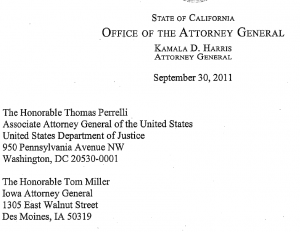
Yesterday, CA Attorney General Kamala Harris announced she was withdrawing from the 50-state foreclosure fraud settlement.

California Atty. Gen. Kamala Harris will no longer take part in a national foreclosure probe of some of the nation’s biggest banks, which are accused of pervasive misconduct in dealing with troubled homeowners.

Harris removed herself from talks by a coalition of state attorneys general and federal agencies investigating abusive foreclosure practices because the nation’s five largest mortgage servicers were not offering California homeowners relief commensurate to what people in the state had suffered, a person familiar with the matter said.

The big banks were also demanding to be granted overly broad immunity from legal claims that could potentially derail further investigations into Wall Street’s role in the mortgage meltdown, the person said.

With CA–the largest state and the one with the greatest foreclosure exposure–this effectively kills the settlement. See DDay for more on why Harris made this decision and what it means going forward.

But Harris’ letter announcing her decision makes something else (which had become increasingly obvious in recent weeks) clear.

Harris gives US Associate Attorney General Thomas Perrelli, not IA Attorney General Tom Miller, top billing on her letter.

This failure has become Perrelli’s baby as much as it is Miller’s.

When they held their last ditch attempt to save this meeting last week, they met in DC, not in IA or some other central location. And the settlement reportedly discussed at that meeting was heavily skewed towards giving the same people who fucked up HAMP another shot at trying to solve the housing situation.

About 80 per cent of the settlement figure, earmarked for the federal government, could be used to fund another round of debt and payment reductions for struggling US homeowners, people with knowledge of the Illinois document said. That would be split between principal reductions on first-lien mortgages and junior liens; payment forbearance for unemployed borrowers; and short sales, blight remediation and transition assistance for homeowners to move into rentals.

The remainder, about $4bn-$4.4bn in cash, could be designated for the states, which then would divide the proceeds to fund a variety of programmes, including assistance to borrowers. About half that amount could be used to pay up to $2,000 to an estimated 1.1m aggrieved borrowers who allege they were harmed by improper practices. [my emphasis]

So when Harris wrote…

California is hurting. We have the most homes and most home borrowers in default. During the period we have been negotiating, more than 560,000 additional homes in California have fallen into the foreclosure process. When we began this process 11 months ago, five of the ten cities hardest hit nationally by foreclosures were in California. Today, eight of those ten hardest-hit cities are here. And, recently, at the same time that we have been negotiating in good faith, foreclosures in California have surged again.

[snip]

Last week, I went to Washington, D.C. in hopes of moving our discussions forward. But it became clear to me that California was being asked for a broader release of claims than we can accept and to excuse conduct that has not been adequately investigated. In return for this broad release of claims, the relief contemplated would allow far too few California homeowners to stay in their homes.

What she was saying, politely but nevertheless saying, is that giving a state like CA that has been devastated by foreclosures perhaps $500 million to deal with the aftermath, and in the process let the banks off the legal hook for abuses beyond just robo-signing just won’t fly.

The Obama Administration may have been offering Harris less than $1,000 per each new homeowner who has fallen into default (to say nothing of all the previous foreclosures), whereas in a state settlement, NV Attorney General Catherine Cortez Masto was able to get about $57,000 per affected homeowner in a Morgan Stanley settlement.

That tells you two things. First, the Obama Administration still doesn’t understand the extent of the damage the banksters they are trying to protect have done. They don’t understand the scale of the challenges facing states and towns and homeowners affected by the banks’ crimes. And second, the “Department of Justice” was ready to sign away justice for scraps with which to fund another ineffectual Treasury-run program without, first, having forced the banks to face the full consequences of what will happen if they don’t offer principal write-downs.

In other words, if you didn’t already know it, DOJ was (and presumably still is) actively looking for ways not just to ignore the banksters’ crimes, but to help them avoid the non-legal consequences of those crimes, too. Which sort of explains the vitriol directed at Eric Schneiderman of late. Two prosecutors, after all, can conduct a national investigation of the banksters’ crimes, DOJ, and the NY Attorney General. And by refusing to go along with the criminally stupid deal Perrelli was negotiating, Schneiderman has made it a lot harder for for DOJ to sponsor yet more injustice.

Share this entry