The Productivity Problem

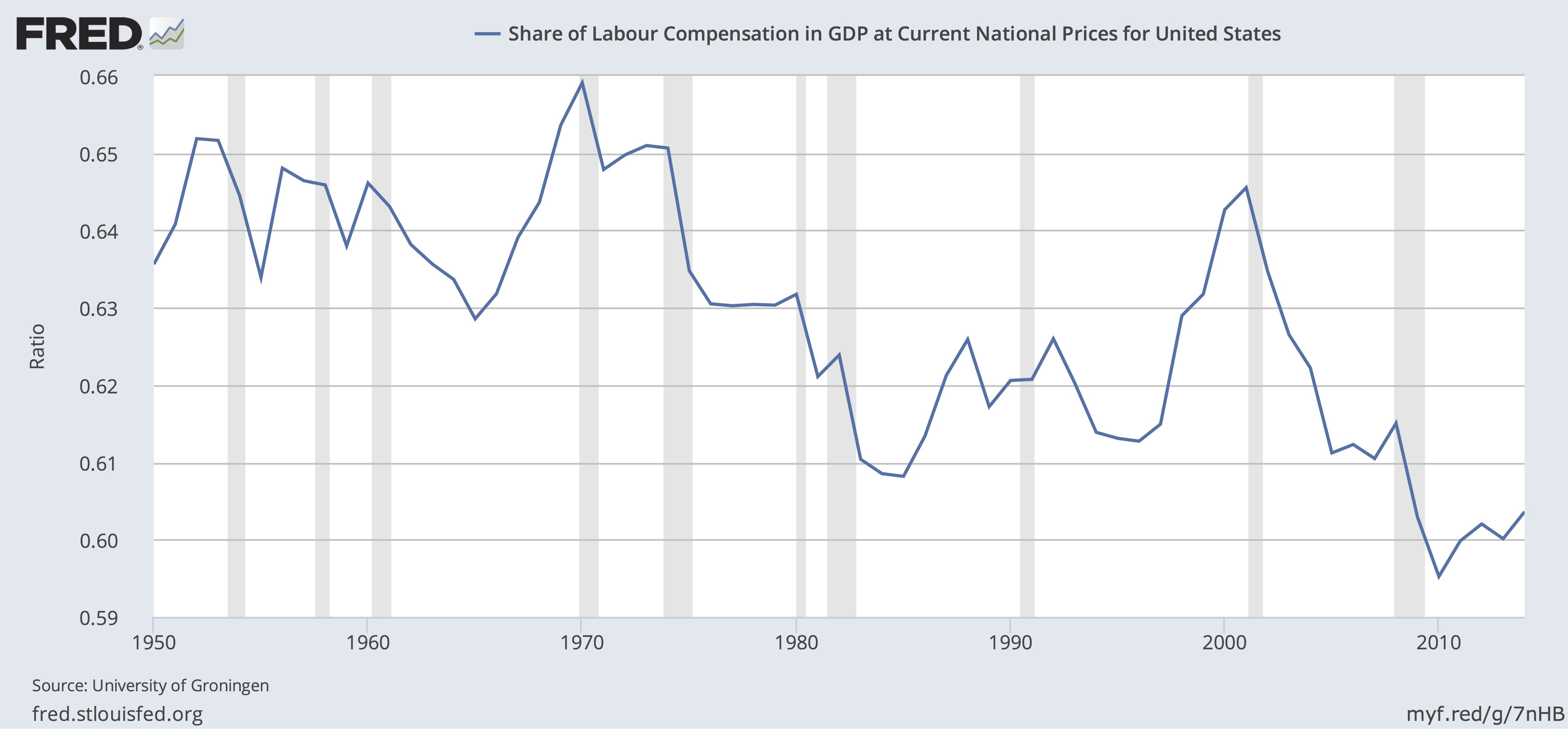
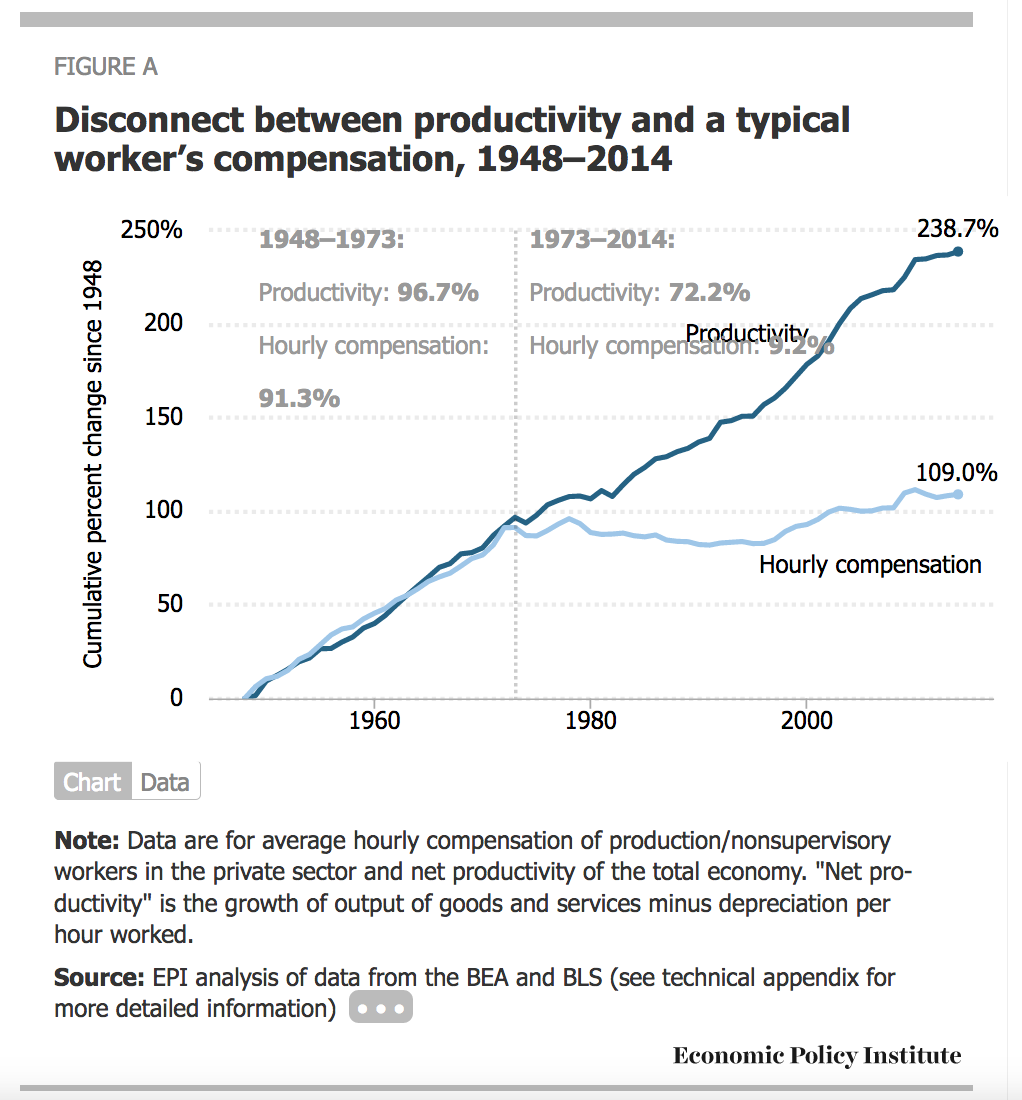
Productivity growth is apparently trending downward around the globe. The problem is addressed in Focus Economics, Why is Productivity Growth So Low: 23 Economic Experts Weigh In. The author, whose name I can’t find, begins by explaining the problem as economists see it.

Productivity is considered by some to be the most important area of economics and yet one of the least understood. Its simplest definition is output per hour worked, however, productivity in the real world is not that simple. Productivity is a major factor in an economy’s ability to grow and therefore is the greatest determinant of the standard of living for a given person or group of people. It is the reason why a worker today makes much more than a century ago, because each hour of work produces more output of goods and services.

It’s certainly true that the concept is important. The simple definition gives us the rough idea but the details are very difficult indeed. The text gives us the example of productivity at a branch bank.

Bill Conerly put it well in an article for Forbes: “Take banking, for example. Your checking account is clear as mud. The bank provides to you the service of processing checks, for which you don’t pay (aside from exorbitant fees for bounced checks and stop-payments). However, the bank does not pay you a market rate of interest on the money you keep in your checking account. It’s a trade: free services in exchange for free account balances. Government statisticians estimate the dollar value of the trade, so that the productivity of bankers can be assessed, but the figures are not very precise.

At least in that example, we can see how productivity improvement at a bank might improve your standard of living, perhaps indirectly by enabling the bank to pay a bit more interest on your checking account. Here are three different kinds of examples, in which we can see how improvements in reported productivity result in worse outcomes for us.

Productivity is defined as the ratio of output to hours worked. Output is measured by receipts to the producer. Hours worked are collected by the Census Bureau.

1. A pharmaceutical company raises the price of its generic drugs with no change in its costs. Its receipts go up while hours worked remain the same. Under the definition, productivity goes up.

2. A high frequency trading company inserts itself into an increasing number of purchases of securities on stock exchanges. The purchaser pays a higher price. The HFT company has higher revenue but hours worked remain the same. Again, by this definition, productivity goes up.

3. Two dominant corporations in the same industry merge. The new company fires a lot of people. Hours worked go down. Prices remain the same in the short run, and rise as the new entity exercises oligopoly power. With hours down and receipts up, productivity rises by definition.

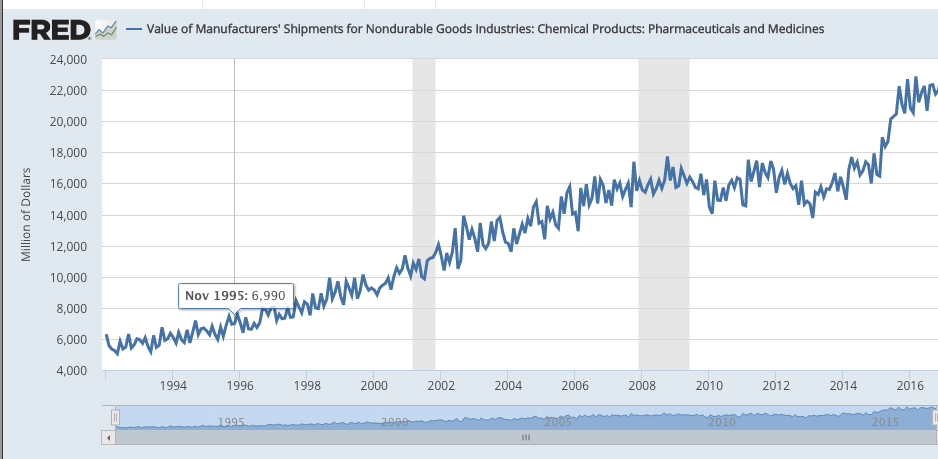
Are these examples realistic? In the medicine example, this article lays out the issues. For those interested, this chart shows the value of pharmaceuticals and medicines shipped by manufacturers beginning in 2000. It shows that there was a steady rise, with a sudden jump in 2013. This chart shows that per capita expenditure on pharmaceuticals and other medical products has nearly doubled since 2000.

It’s likely that there are several causes for this, not least the startling prices sought for new drugs. Government productivity figures do not take into account any improvement in the results that new drugs bring, although quality adjustments are made in calculating inflation figures. Given the increased pressure from insurers and doctors to switch to generics, and increased focus on drug prices as a problem, it’s reasonable to see this data and various reports as support for my drugs example. But it’s hard to put a dollar value on it.

On the second example, here’s an article from CFA Magazine written in 2011, detailing the costs of high frequency trading. More recent reports say that the problems are going away, and who knows because it’s hidden behind a wall of words mostly from the people who run the systems and their friends at the exchanges, and the captured SEC. Here’s a review of the literature (behind a paywall), which concludes with this: “This suggests that the identified economic benefits of HFTs (market making, venue competition, more trading opportunities) outweigh their economic costs (large-order predation and run games).” For my purposes, it’s clear that the older article tells us that initially, at least, HFT operated as my example suggests, raising productivity without doing anything useful.

As to the third example, the impact of private equity on employment is everywhere, and the concentration of economic power in oligopoly control of most industries is obvious. Dave Dayen has been writing about it for some time; here’s a recent example. Oligopolistic control also reduces paychecks for the remaining workers.

In these examples, and I could produce many more, productivity as defined by economists goes up but individual consumers are worse off. That is maddening. Once upon a time, we might have thought we could just ignore this kind of thing as an insignificant part of GNP, but that’s not true today, either in the US or globally. The economy, measured by output, is growing, but it is the opposite of the notion of productivity as good for society: it makes people’s lives worse. Except, of course, for a few rich people.

My three examples are exercises of market power. Here’s a long but worthwhile discussion of the harm it does and its increasing presence in the economy. Market power is not the same as rent-seeking, which is usually defined as an effort to get the government to give special treatment to one of a number of competitors. Both are damaging and both inflate productivity figures.

My examples show that reported productivity growth is most likely higher than the kind of productivity growth that the author discusses, the kind that increases the amount of goods and services available in the economy. It’s not unusual for an economics writer to assume only good people operate in the capitalist economy, and ignore the crooks and the cheats. Suppose the author is right that rising productivity that makes for a better life. If real productivity growth is even lower than the low reported productivity growth, his logic explains why life is getting worse for most of us.

Share this entry

A Different Kind Of Modeling Tool

In this post I pointed out that basic economics as taught in Econ 101 relies on math and physics from the 19th Century, and complained that economists are not taking advantage of advances in both math and physics. Several commenters pointed out that there are economists working with current math tools in various ways, and of course that’s true; it just is’t taught in introductory classes. One of the new approaches is Agent-Based Modeling, which has the potential to offer new theories of the economy that focus on observed behavior rather than ideology colored with moral judgments and guesses. Here’s an introduction.

Computers introduced new areas of mathematics by making it possible to do things that take too long if done by hand. This site introduces one of these, a cellular automaton called The Game of Life. There is a simulation at the link, which is fun, and shows how powerful the idea can be. The Game of Life operates on a two-dimensional grid like a sheet of graph paper. The squares, called cells, are either empty or occupied. There is a set of rules. At each iteration, the rules are applied to every cell, and the results are entered into the grid all at once. Each cell has 8 neighbors. An occupied cell is deemed to be live, and an empty cell is dead. Here are the rules, which can be found at the link with graphics:

1) Any live cell with fewer than two live neighbors dies, as if caused by under-population.
2) Any live cell with more than three live neighbors dies, as if by overcrowding.
3) Any live cell with two or three live neighbors lives on to the next generation.
4) Any dead cell with exactly three live neighbors becomes a live cell.

Start at time 0. The machine calculates the status of each cell for the first iteration. All results are entered at once. That’s called a tick, as in a clock tick. Then the process is repeated. The iterations continue until you lose interest, or because the simulation has an artificial cut-off. Even with these simple rules, you get surprisingly complicated outcomes. Try a few experiments with the simulator (click the clear button) at the link and you’ll see.

The Game of Life is two-dimensional, but there is no reason there can’t be any number of dimensions, including one. The Game of Life operates on a limited grid of squares, but that doesn’t have to be so either. It’s possible to imagine that the Game of Life operates on the outside of an open-ended cylinder, or some other surface. Most important, the rules of the Game of Life are simple. Each rule relates solely to status of the 8 neighbors of the cell to be calculated. Again, there is no limit to the rule sets that could be used, to the number of dimensions, to the shapes of the cells, or to the cells which are considered in calculating the status of each cell. And that makes this idea useful for other purposes.

Take the simple-minded version of economics described by Katrine Marçal in Who Cooked Adam Smith’s Dinner: unchanging individuals driven solely by self-interest. That can be modeled with simple rules. First, populate a huge grid with some black squares representing individuals. We endow each of them with different quantities of three objects and we assign each cell a valuation for each object, with some variety in both. We move the individuals one square after each turn. If two black squares come into contact, they engage in the exchange of objects if and only if the exchange benefits both by increasing the total value of objects each would have after the exchange. After such an exchange, the black cells are moved some distance apart. If there is no contact, they move one cell in the same direction as the previous iteration. As a side note, we use a different definition of contact than being in one of the eight neighboring cells: each cell moves one square at each tick and thus it’s possible for two live cells to occupy the same grid square.

Let’s crank this up mentally and watch it for a while. It seems intuitively obvious that eventually each cell will have some collection of objects that would maximize their total value for each cell’s valuation criteria. Also, it’s boring. So we run it again in our head, with different movements assigned to each unit. Again, we reach a stasis perhaps with different quantities of each object in each cell. Also, boring. We could make it last longer by adding more objects.

Alternatively, we could put them to work making more objects, assigning different productivity levels to the cells. After each iteration, each cell has a bit more of one or more of the objects depending on their productivity. We run the cellular automaton again in our heads, and we see that this time it isn’t obvious that it will reach equilibrium. That’s because we put no limits on the amount of each object that the cell values more highly. That’s not right: as a general rule humans do not have a use for an unlimited amount of anything, and desire less of some things than others, and for most things there is some level of decreasing marginal utility for stuff. So we learn that we need parameters for human desire. Also we learn that we didn’t account for consumption of the objects, or wearing out, or fair wear and tear, so we need a number that will reduce the amount of each object, perhaps every few ticks, or on some other schedule.

Suppose we combine two cells into one unit with a change in priorities to model the formation of a household. That changes things too. Not only does it affect production, it changes consumption and the nature of the equilibrium. If we let the two-cell critters add a couple of more we get even more complications.

Next we introduce the firm. One way would be to use a third dimension, so that our cells could be in one one level for their individual and household behaviors and in another for their participation in a firm, so that the production part moves to the firm. Firms would have their own production rules and their own distribution rules for gains. That introduces something more like money to mediate exchanges, and changes the rules of exchange. There would have to be model banks and model hedge funds and other aggregations of capital that would deal in meta-products like cash and stocks and bonds.

We could use other levels in the third dimension, or maybe a fourth dimension to represent participation in social groups such as governments, universities, political interest groups, Churches, bowling leagues and so on. These levels would add something more to the accumulations of the individual cells, measured in units of satisfaction, or pleasure, or other forces that motivate people. This could include negative forces like racism, hostility, and agression.

So far, the game is determinate, and does not model reality, which is contingent. To fix that, we allow the various levels to change the valuation of the objects of accumulation. To speed up the calculation, the code would use look-up tables for all the variables to determine the changes between ticks. So the various levels or dimensions could change the look-up tables in sensible ways, and occasionally in ways that aren’t so sensible. For example, the individual would change the value of some object not needed in a paired state, or needed because of “children”. The government state could change the value of the “tax”. The firm could change the valuation of the product. Or it could add a new product and set up a value. And so on. The Fed model can change interest rates. The government level could change its acquisition patterns.

This sketch suggests that we could create a very complicated model, with thousands of rules and calculations. But with efficient use of look-up tables, simple calculations and highly parallel operations, it’s just the kind of problem computers are good at.

To make this idea usable, there are open platforms for creation of models like this. Here’s one called Repast, and another called Swarm. And here’s a link to an exercise in modeling that raises interesting issues using Thomas Piketty’s r > g idea. Here’s a difficult article entitled Cellular Automata based Artificial Financial Market by Jingyuan Ding of Shanghai University China. The writer created a cellular automaton to model the capital markets.

Any tool can and will be misused. For example, economists could use existing theories of human behavior in constructing models. That would be a terrible mistake. The closer we get to empirically derived rules, the closer we get to a set of ideas about the economy that do not depend on assumptions like the efficient market hypothesis or that humans are solely rational utility-maximizers. A good test is whether the model produces booms and busts, common features in reality.

One good thing is that platforms like Repast and Swarm are used by modelers from other scientific fields like biology and political science. That might enable economists to learn from people outside their specialty. We can always hope.

Share this entry

The Outdated Math and Physics Behind Economics

In Who Cooked Adam Smith’s Dinner, Katrine Marçal traces the roots of mainstream economics and particularly neoliberalism. One of the strands she discusses is the the connection between economics and Newtonian physics. Newton believed that the universe was made up of fundamental particles. To understand complex physical things, you have to break them down into smaller and smaller pieces until you hit the unit of everything, the Lego blocks from which the universe is constructed: the atom and the photon (Newton thought the photon was a particle). From there you can work towards an understanding of the cosmos.

Particles are governed by forces. For Newton, the important force was gravity. The ultimate particle and the ultimate force can be used to explain a lot of the physical phenomena which we can observe with simple tools. Newton’s theory is deterministic: the future is predictable because particles only move in accordance with rigid laws.

In economics, the atom is the individual. The force that sets those atoms into motion is self-interest.

I’ve made passing reference to this before, but Marçal’s book brings it to the forefront. Most of the time when we hear about the history of economics after Smith, we hear about the math stuff, frequently starting with the idea of marginal utility generated by William Stanley Jevons around 1870. Jevons was a mathematician, who set out to create equations for the calculus of pleasure and pain as described by Jeremy Bentham. The subsequent history of economics can be read as a long math exercise using mostly calculus, and linear algebra (matrices) for modeling.

The thing is, math was just being formalized in the 1800s. Riemann completed the formalization of the calculus in 1854 (here’s an interesting history.) Other areas of math were being developed and formalized at that time, and development continues today, with, for example, fractal math. So maybe a good question is why economists stick with 19th Century math. Can’t they find something new that might work better than the obviously lousy models they use today that were incapable of predicting the Great Crash? I mean, how could anyone think it makes sense to model human beings as a large number of identical particles that only interact in monetary transactions and are otherwise unaffected by each other; and all of which are subject only the force of self-interest?

But just as math has advanced, so has physics. One of the changes is that physicists aren’t searching for ultimate particles any more; in fact as we currently understand things, we aren’t even sure the things studied are in some particular place. Physicists now study the relationships between various kinds of forces. They describe elementary particles by the forces through which they interact which in turn are defined in math terms, and terms that are a lot further from calculus than calculus is from addition. The relationships are mediated through the Schrödinger equation; It describes our observation small numbers of what we think today are elementary particles, but it is too hard to solve it for any large group of particles.

But in economics, nothing is complicated. It’s just individuals motivated by self-interest. And that’s a remarkably stupid thing. Has nothing changed in the last 150 years? Is linear algebra, which we learned in my junior year in high school, all these guys have learned from math and physics?

To put this another way, if economists were just cranking up their discipline today, with no theory of our current form of economy, they certainly would not use 19th C. math and physics as models. Would they use 18th C. markets in England and Scotland as their model? Of course not.

Fortunately I’m here to help. I’m happy to let economists continue the work of defining and collecting economic statistics, but it’s time to look for a more plausible theory. And as a starting place, I’ll put up a couple of posts with ideas for a new theory for the 21st C. No need to thank me. Which they won’t.

Share this entry

Who Cooked Adam Smith’s Dinner?

Who Cooked Adam Smith’s Dinner? is the title of a 2012 (2016 in the US) book by Katrine Marçal, a Swedish journalist. The title question is based on a famous bit from Adam Smith’ The Wealth of Nations*:

It is not from the benevolence of the butcher, the brewer, or the baker that we expect our dinner, but from their regard to their own interest.

But the butcher, the brewer and the baker did not cook for Smith. That job went to his mother, Margaret Douglas, later joined by his cousin, Jane Dauglas. These women took care of Smith’s household until they died. Smith never mentions their labor.

Marçal explores the impact of Smith’s omission on the study of economics. One thread is the feminist story: much of the crucial work of care is provided through benevolence, not for money, and so it not considered part of the economy or part of the field studied by economists. Marçal points out that when an economist marries his housekeeper, the GDP goes down.

Smith’s omission makes ti possible to make “markets” the center of the study of economics. Eventually theorists dreamed up the silly story of Homo Economicus with his rational calculation of individual advantage as the essential human characteristic. We identify that rationality as masculine as opposed to feminine in the context of male-centered history and culture. In feminist terms, homo economicus is ungendered and dominant; women are the other in every way.

Instead of this stunted theory, Marçal shows that the economy isn’t just about the production of things for the market. A huge part of the work of any society is care for one another. We care for children, for the aged, the sick, the abandoned, the orphan and the widow, those injured in war and those injured in mind. We care for our planet, our air, our parks and our public spaces, our cities, our lakes and rivers. Much of that care has nothing to do with markets. We do it solely out of benevolence, in direct contradiction to Smith.

If economists are ignoring the importance of care in the functioning of an economy, what are they doing? They tell us that they study the allocation of scarce resources. This is from the introductory textbook Economics by Samuelson and Nordhaus, 18th Ed. 2005:

Economics is the study of how societies use scarce resources to produce valuable commodities and distribute them among different people. Id. at 4.

Scarcity and efficiency are the important elements of this definition. Care for the vulnerable must not involve a scarce resource under this definition, probably because everyone blithely assumes that women will do it for free, and there are plenty of women. Importantly, care isn’t controlled by the demands of efficiency. If the baby cries, what does it even mean to talk about efficiency? We do whatever it takes and for as long as it takes. So taking care of each other is excluded from the study of economics from the outset under Samuelson’s definition.

In his textbook Introduction to Macroeconomics, 6th Ed. 2012, N. Gregory Mankiw quotes the 19th C. British economist Alfred Marshall: “Economics is a study of mankind in the ordinary business of life.”. Id. at viii. I’d guess Marshall meant “Malekind”. Mankiw adds that The word economics springs from a Greek word meaning household, and he talks about how households have to make decisions about who goes to work and who cooks, and who gets the extra dessert. Then he drops the idea that cooking dinner is part of the economy. Apparently when Mankiw talks about the ordinary business of life, he means “male business”, not changing poopy diapers or making dinner. It’s funny when you see it from the perspective Marçal demonstrates.

Of course Marçal is right to say that economics ignores a huge chunk of the work necessary to maintain us in the ordinary business of our lives. That doesn’t make it useless, to be sure. Marçal points out the utility of the data and statistics gathered by economists. But it does mean that the models economists are creating are likely to be useless because they purposefully ignore a crucial element of ordinary life. And it means that economics isn’t a plausible basis for thinking about human nature.

The book is informed by feminist theory, but it isn’t theoretical. It is an application of feminist theory to economics. Marçal uses uses words like “gendered”; and she writes:

It’s only woman who has a gender. Man is human. Only one sex exists. The other is a variable, a reflection, complementary. P. 159.

Then she gives concrete examples that make the meanings perfectly clear for people like me who don’t know anything about feminist theory. The result is that I began to leann a little about the theory, and it was much easier than trying to learn it on my own from primary sources**.

Marçal devotes several chapters to eviscerating the economists dream person, Homo Economicus, the ungendered center of their universe, the Man we all must become. These chapters expose the shallow thinking that neoliberal economists like Gary Becker bring to the discussion of human nature. She makes neoliberalism look childish and silly. I particularly liked the discussion of the hidden emotional vulnerabilities of neoliberal Man. We have to coddle Mr. Market, and steady him when he gets the jitters, which happens all the time, and which, of course, requires tons of money.

Marçal writes clear, direct and engaging prose. Like every good book this one clarified several inchoate ideas that have been floating around in my head, and it gave me several new ideas I hope to take up in future posts. I am grateful to my excellent daughter who gave me this book.

==========
* Here it is in context. I leave for my skeptical readers the pleasure of picking at the holes in this passage.

// In almost every other race of animals, each individual, when it is grown up to maturity, is entirely independent, and in its natural state has occasion for the assistance of no other living creature. But man has almost constant occasion for the help of his brethren, and it is in vain for him to expect it from their benevolence only. He will be more likely to prevail if he can interest their self-love in his favour, and shew them that it is for their own advantage to do for him what he requires of them. Whoever offers to another a bargain of any kind, proposes to do this. Give me that which I want, and you shall have this which you want, is the meaning of every such offer; and it is in this manner that we obtain from one another the far greater part of those good offices which we stand in need of. It is not from the benevolence of the butcher, the brewer, or the baker that we expect our dinner, but from their regard to their own interest. We address ourselves, not to their humanity, but to their self-love, and never talk to them of our own necessities, but of their advantages.//

**Another good book for this purpose is Possession, by A.S. Byatt.

Share this entry

Politicians Did Not Get Rich From Hollowing Out the Economy

In his inauguration speech Trump said:

For too long, a small group in our nation’s capital has reaped the rewards of government while the people have born the cost. Washington flourished, but the people did not share in its wealth. Politicians prospered, but the jobs left and the factories closed. The establishment protected itself, but not the citizens of our country. Their victories have not been your victories. Their triumphs have not been your triumphs and, while they celebrated in our nation’s capital, there was little to celebrate for struggling families all across our land.

He claims that politicians got rich by off-shoring jobs and driving up trade deficits. This is an instance of a standard Republican lie, that our problems are caused by politicians. In fact, all the profits from off-shoring went to corporate executives and owners of corporations. They made political contributions, sure, but that doesn’t enrich anyone. The gains to citizens were some lower prices at a cost of whatever wars and worse-paying jobs.

The decisions to off-shore and outsource jobs are made by corporate executives and controlling owners. They had many reasons to invest in other countries, ranging from a desire to protect their own businesses from being underpriced by foreign entitiesk, incentives offered by foreign countries, lower labor costs, and access to foreign markets among others.

US policy in both parties since at least WWII has been generally sympathetic to foreign investment for many reasons, not least the belief that nations linked by commerce and trade are less likely to go to war.

Foreign investment is always dangerous. The risks include expropriation, local governments that won’t or can’t stop violence against plants and equipment, lack of protection of intellectual property, and others. Karl Polanyi discusses these risks in The Great Transformation. Hannah Arendt agrees in The Origins of Totalitarianism. In different words, and with different emphasis, they say Western European capitalists solved this problem by enlisting the government to protect them when they invested abroad. The same thing happened here. Thorstein Veblen saw it clearly in 1904:

… [W]ith the sanction of the great body of the people, even including those who have no pecuniary interests to serve in the matter, constitutional government has, in the main, become a department of the business organization and is guided by the advice of the business men. Chapter 8, Principles of Business Enterprises.

Here’s a discussion of the implications of that statement for foreign investment.

Right down to today, capital enlists the support of the government to protect it so it can make profits in other countries, and government responds for its own reasons. We have always used military force for that purpose, but now the primary tool is trade treaties. The recent example of the TPP stands out. It was written by corporations and their lobbyists and lawyers, and supported by mainstream economists. It was opposed by working people and unions and most progressives. It was supported by a bipartisan majority of legislators. It should be noted that it was rejected by Trump and Sanders and disparaged by Clinton.

I won’t try to untangle all the interlocking interests, or to discuss the negotiations between the two camps, government and capital. But Trump’s assertion that Washington politicians got rich off foreign investment is stupid and false. The people who got all the money from from foreign investment are the executives and the obscenely rich people who own and control these corporations.

The incoherence of Trump’s statements in his inauguration speech and in his campaign speeches about corporate overseas investment is displayed in this New York Times article discussing Trump’s meeting with CEOs of giant US manufacturers. The reporters, Nelson Schwartz and Alan Rappeport, say that Trump told the “titans of American business” that they had better move manufacturing jobs here, threatened them with taxes that look like tariffs, and offered rewards like lower taxes and fewer environmental regulations. The reporters say that this is pointless, because taxes and regulations do not determine where corporate investment are made.

The reporters say that the real cause of overseas investment is Wall Street, by which they mean Capitalists, including hedge fund managers, giant Banks, and the richest investors.

In some cases, Gordon Gekko-like hedge fund managers are to blame, but much of the time, it is the drive for bigger returns on 401(k) accounts, pension plans and other retirement vehicles that depend on steadily rising corporate profits and, in turn, a buoyant stock market.

That’s just wrong. Many pension funds are operated by private Wall Street firms through Gordon Gekko-like managers. The largest funds spread management around among several management firms, and invest with hedge funds, and get investment advice from Wall Street firms for the funds they manage themselves. The idea that Wall Street cares about small investors or their IRAs is silly. I’ll just ignore the stupidity of using a movie character when it’s easy to identify the real perpetrators. You could just read this article to find one, Daniel Loeb.

The actual problem is that the federal government let the interests of the rich set our industrial policy with no public input, and actively ignored the interests of US workers and citizens, and sometimes even the security interests of the nation.

I suppose it’s possible that Trump meant that the rich have too much influence in government, and he means to change that. But seriously, can anyone imagine that the Republicans or the neoliberal Democrats will allow Trump to initiate trade wars over protectionist tariffs? Does anyone think that Trump will do anything to harm the interests of the rich, or that Trump doesn’t personally identify with the rich and their interests?

And exactly how is this different from that time President Obama chewed out the banksters over their greed in April, 2009? Nothing changed then. Why should this time be different?

It won’t be different until a solid majority of voters come to grips with the fact that the dangerous elites in this country aren’t college professors or scientists or liberals. The dangerous elites are the rich people who control the giant corporations and the people who support them, in and out of government.

Share this entry

The The Future of Work Part 3: An Example of Artificial Intelligence

We don’t have a clear definition of artificial intelligence, but we have some examples. One is machine translation, the subject of an article in the New York Times Magazine recently, The Great A.I. Awakening by Gideon Lewis-Krause (the”AI Article”). It’s a beautiful piece of science writing. The author had the opportunity to see how employees of Google developed a neural network machine translation system and implemented it. It’s long, but I highly recommend it. Rather than try to summarize it, I will draw out a few points.

The idea of neural net systems was inspired by our current understanding of the way the human brain works. There about 100 billion neurons in the average brain at birth. As we age, connections among neurons increase, so that each can be connected to as many as 10,000 other neurons. Thus, there are trillions of possible connections. Many of these are pruned as we age because they are not used. Many of the remaining connections are used to maintain the body, and to manage specific human processes, like the endocrine system, or to monitor for balance and pain.

One way to think about AI processes is to see them as pattern-matching systems. Until recently we didn’t have the processing power to handle even a tiny fraction of the brain’s connections, so the early efforts at simulating the brain were bound to fail. On the other hand, computers have been used for the purposes of matching patterns in relatively small sets of data. Here’s a technical example. One of the main lessons of the AI Article is that it takes massive amounts of processing power and massive amounts of data to begin to approach the connective power of the brain, Google also needed new mathematical theories to make it possible.

The astonishing thing is that the number of people needed to create those theories and do a preliminary setup is so small: maybe 10 all told. The full implementation required a team of 100 or so. More people were needed to create a new chip and get it working, and to install the new processors into the Google system, but again, the number seems to be in the hundreds, and it isn’t clear that there were that many new jobs.

The task was made easier by the fact that Google had a huge library of documents translated between languages. These served as training materials for the translation project. Google has a huge library of images, youtubes, and other materials suitable for training. There won’t be many jobs created in this area either.

These are two of the categories of new jobs identified by the White House in the report discussed here. There don’t seem to be many new openings in new fields, but who knows. And there is nothing here likely to create jobs for anyone but the most educated people, though, of course, there may be jobs created in related fields.

The new platform created by these small teams can be adapted for many different problems. Doubtless as those ramp up there will be some new jobs, but it seems unlikely that there will be a hiring burst. Instead, we will see a war of dollars as the big tech companies compete world-wide for the top talent. The AI Article says that the Google team includes people from around the world. We get one or two of the personal stories, and they are amazing.

The AI Article gives a good introduction to the way neural networks work. I caution readers that these parts are metaphorical, and it is unlikely to be useful to try to try to reason with those metaphors, either to extend them, or to make predictions about the future. The metaphor is not the thing. It is merely an aid to understanding the thing for those with little or no background. I link to a couple of pieces here that can be used to gain a deeper understanding of neural networks and deep learning.

At the end of the AI Article, there is a discussion of two possible ways of understanding consciousness. One view sees consciousness as something special beyond the mere physical actions of the brain. It finds it’s origins in the mind-body dualism of Descartes, and is a disparagingly referred to as The Ghost in the Machine. Religious people might see it as the soul, or the Atman; but I’m not sure that’s right. The other view dissolves this problem, and sees consciousness as an emergent phenomenon that arises from the complexity of the connectivity in the brain. The AI Article doesn’t go into this area in much detail.

And yet the rise of machine learning makes it more difficult for us to carve out a special place for us. If you believe, with Searle, that there is something special about human “insight,” you can draw a clear line that separates the human from the automated. If you agree with Searle’s antagonists, you can’t. It is understandable why so many people cling fast to the former view.

For those interested in pursuing this matter, see Consciousness Explained, by Daniel Dennett. The linked Wikipedia article gives a brief description of the book along with Searle’s objections to it.

I don’t know enough to have an opinion about any of this, but I hope other people are thinking about one aspect of this problem. In Western Liberalism, it is a given that there is something special about human beings, and about each of us individually. I don’t know how much of that arises from Christianity, with its emphasis on the relation between, and the likeness of, each individual to the Creator. There is something bound to be unnerving in the combination of a) the idea that our individual selves are just complications of our individual brains, and b) our increasing ability to model that complication in our electronic gear. I don’t have any immediate apocalyptic idea about this, not least for the reasons in this presentation. But every new idea about human beings has been twisted by despots and demagogues for their own purposes. It’s danagerous to pretend that isn’t going to happen with these ideas.

Share this entry

The Future of Work Part 2: The View From the White House

Top advisors in the Obama Administration published a report titled Artificial Intelligence, Automation, and the Economy in December 2016, which I will call the AI Paper. It’s a statement of the views of the Council of Economic Advisers, the Domestic Policy Council, the Office of Science and Technology Policy, the National Economic Council, and the US Chief Technology Officer, combining their views into a single report. There is a brief Executive Summary which gives a decent overview of the substance of the report, followed by a section on the economics of artificial intelligence technology and a set of policy recommendations. It’s about what you’d expect from a committee, weak wording and plenty of caveats, but there are nuggets worth thinking about.

First, it would be nice to have a definition of artificial intelligence. There isn’t one in this report, but it references an earlier report; Preparing For the Future of Artificial Intelligence, which dances around the issue in several paragraphs. Most of the definitions are operational: they describe the way a particular type of AI might work. But these are all different, just as neural network machine learning is different from rules-based expert systems. So we wind up with this:

This diversity of AI problems and solutions, and the foundation of AI in human evaluation of the performance and accuracy of algorithms, makes it difficult to clearly define a bright-line distinction between what constitutes AI and what does not. For example, many techniques used to analyze large volumes of data were developed by AI researchers and are now identified as “Big Data” algorithms and systems. In some cases, opinion may shift, meaning that a problem is considered as requiring AI before it has been solved, but once a solution is well known it is considered routine data processing. Although the boundaries of AI can be uncertain and have tended to shift over time, what is important is that a core objective of AI research and applications over the years has been to automate or replicate intelligent behavior. P. 7.

That’s circular, of course. For the moment let’s use an example instead of a definition: machine translation from one language to another, as described in this New York Times Magazine article. The article sets up the problem of translation and the use of neural network machine learning to improve previous rule-based solutions. For more on neural network theory, see this online version of Deep Learning by Ian Goodfellow and Yoshua Bengio and Aaron Courville. H/T Zach. The introduction may prove helpful in understanding the basics of the technology better than the NYT magazine article. It explains the origin of the term “neural network” and the reason for its replacement by the term “deep learning”. It also introduces the meat on the skeletal metaphor of layers as used in the NYT magazine article.

The first section of theAI Paper takes up the economic impact of artificial intelligence. Generally it argues that to the extent it improves productivity it will have positive effects, because it decreases the need for human labor input for the same or higher levels of output. This kind of statement is an example of what Karl Polanyi calls labor as a fictitious commodity. The AI Paper tells us that productivity has dropped over the last decade. That’s because, they say, there has been a slowdown in capital investment, and a slowdown in technological change. Apparently to the writers, these are unconnected, but of course they are connected in several indirect ways. The writers argue that improvements in AI might help increase productivity, and thus enable workers to “negotiate for the benefits of their increased productivity, as discussed below.” P. 10.

The AI Paper then turns to a discussion of the history of technological change, beginning with the Industrial Revolution. We learn that it was good on average, but lousy for many who lost jobs. It was also lousy for those killed or maimed working at the new jobs and for those marginalized, wounded and killed by government and private armies for daring to demand fair treatment. These are presumably categorized as “market adjustments”, which, according to the AI Paper, “can prove difficult to navigate for many.” P. 12 Recent economic papers show that Wages for those affected by these market adjustments never recover, and we can blame the workers for that: “These results suggest that for many displaced workers there appears to be a deterioration in their ability either to match their current skills to, or retrain for, new, in-demand jobs.” Id.

The AI Paper then takes up some of the possible results of improvements in AI technology. Job losses among the poorest paid employees are likely to be high, and wages for those still employed will be kept low by high unemployment. Jobs requiring less education are likely to be lost, while those requiring more education are likely safer, though certainly not absolutely safe. The main example is self-driving vehicles. Here’s their chart showing the potential for driving jobs that might be lost.

That doesn’t include any knock-on job losses, like reductions in hiring at roadside restaurants or dispatchers.

It also doesn’t include the possible new jobs that AI might create. These are described on pp 18-9. Some are in AI itself, though as the NYT magazine article shows, it doesn’t seem like there will be many. Some new jobs will be created because AI increases productivity of other workers. Some are in new fields related to handling AI and robots. That doesn’t sound like jobs for high school grads. Most of the jobs have to do with replacing infrastructure to make AI work. Here’s Dave Dayen’s description of the need to rebuild all streets and highways so autonomous vehicles can work. Maybe all those displaced 45 year old truck drivers can get a job painting stripes on the new roads. There are no numerical estimates of these new jobs.

The bad news is buried in Box 2, p. 20. Unless there are major policy changes, it’s likely that most of the wealth will be distributed to the rich. And then there’s this:

In theory, AI-driven automation might involve more than temporary disruptions in labor markets and drastically reduce the need for workers. If there is no need for extensive human labor in the production process, society as a whole may need to find an alternative approach to resource allocation other than compensation for labor, requiring a fundamental shift in the way economies are organized.

That certainly opens a new range of issues.

Update: the link to the AI Paper has been updated.

Share this entry

Halloween Monday: Dying for Love

In this roundup: Turkish troubles, good tech bad tech, fickle market reaction, and Halloween tricks-or-treats.

Because it’s Halloween I’m sharing a short film for Movie Monday based on that theme. It’s probably R-rated so don’t launch it in the office without the doors shut and/or the volume down. It parodizes so many cheap horror films of the 1980s-2000s including the Final Girl trope.

I need to watch this short a couple more times. The film is billed as a single take — one long, unbroken camera shot — but I’m not certain it is. I think there may be a hidden few cuts when the location changes from one end of a room to another. Look at this analysis of Alfred Hitchcock’s use of dissolve cuts in his 1948 film Rope and you’ll see what I mean by hidden cuts. Keep in mind that with digital technology, even dissolve cuts may be smoother and much less detectable than they were in 1948 with traditional film.

Turkish troubles

Good tech, bad tech, or something in between

  • Delta Airlines implements RFID baggage tracking app (Fortune) — FINALLY. I’ve been wondering ever since the furor over Walmart using RFID on inventory why airlines couldn’t use RFID and let their customers track their own bags. Only took ~16 years or so. And thank goodness this technology isn’t WiFi-enabled. Should save billions of dollars — let’s hope that trickles down to savings on tickets.
  • Toyota developing a keyless access system for carsharing (Detroit Free Press) — Really? Didn’t Toyota have keyless remote fobs that were hacked just last year?
  • SpaceX still investigating launchpad explosion (Business Insider) — To be fair, it’s not clear yet what triggered the explosion two months ago. Can’t say if this is good or bad technology or something else altogether. (Not going to mourn the loss of a satellite which was to provide internet to African continent via Facebook. This part I’d call bad tech. Can’t we come up with some other approach to providing internet besides a walled garden with fake news?)

The market = fickle mistress?[1]

Tricks or treats?

  • Spooky reads: scary seance scenes in fiction (Guardian) — Could be fun to read while waiting for trick-or-treaters to knock on your door.
  • What makes a good horror film? (OpenCulture) — If you’d rather watch than read something scary tonight, bone up first before surfing Netflix or Amazon for a film.
  • Werewolves in classic literature (Sententiae Antiquae) — Classic literature, as in Greek or Roman, has a surprising number of references to lycanthropy. Did they tell each other these stories to scare each other around the campfire?
  • Sluttiest Halloween costumes (McSweeney’s) — Of 1915, that is. In case you need a laugh and not a scare. I sure could right now; only one more week of election terror to go.

Watch out for little ghosts and goblins tonight!
__________
[1] Note: You’re not seeing things — I accidentally hit the Publish button before I’d updated the two market economics bits!

Share this entry

Security Territory and Population Part 5: Governmentality And Introduction to Foucault’s Method

In the fourth lecture in Security, Territory and Population, Michel Foucault introduces the idea of governmentality. He begins this lecture with a discussion of the change in the idea of governing that began in the 16th Century, when writers of the day began saying that the word covers a number of different relationships.

There is the problem of government of oneself…. There was of course the problem of the government of souls and of conduct, which was, of course, the problem of Catholic or Protestant pastoral doctrine. There is the problem of the government of children, with the emergence and of the great problematic of pedagogy in the sixteenth century. And then, perhaps only the last of these problems, there is that of the government of the state by the prince. How to govern oneself, how best to be governed, by whom should we accept to be governed, how to be the best possible governor?

Foucault sees these issues as the intersection of two trends, the breakup of feudalism and its gradual replacement by a centralized state; and the dispersion of religious belief brought on by the Reformation and the Counter-Reformation. Foucault says that the leading text is Machiavelli’s The Prince, both for its own ideas and for the range of texts disputing it. He says that the central idea of The Prince is that the Prince’s position as sovereign is external to his principality. He took the position by force, or by connivance with others, and his central object is retaining his power, protecting it both from external and internal threats.

Those reacting to Machiavelli emphasized the art of governing, as opposed to the art of neutralizing opposition. They observe that many people are in a position of governing, the father with the family, the teacher with the child, the master with the apprentice or employee, the judge, the mayor, the superior in a convent. Foucault points to a typology of government identified in the 16th Century by the French writer La Mothe Le Vaver. There are three levels of government, the governance of the self, which is the subject of morality; the governance of the family, which becomes identified with the economy; and the governance of the state.

These levels of governance bear on each other. If the self is well-governed, then the family is well-governed, and the state will be well-governed. If the State is well-governed, that leads to the good governance of the family and of the self. Foucault says that in this idealized arrangement the idea of the economy as a principle object of government begins to emerge. He traces this development through the 18th and 19th Centuries as the idea of the economy begins to take on the meaning it has today.

Foucault points to another writer, Guillaume de La Perriere, who wrote “Government is the right disposition of things arranged so as to lead to a suitable end.” This means first that governors act primarily on things, and not specifically on people. A suitable end is not necessarily the best end, but one that is achievable. The important point to Foucault is that government has to do with the relations between people and things, and the steps those who govern take with respect to those relationships.

There is a good bit more of this kind of exegesis of texts on the art of governance from the 16th to the late 18th Centuries, all in a similar vein. But for this theory to come into full practice, various obstacles had to be removed, and the apparatuses of security had to be developed more thoroughly. One of the barriers was the idea of sovereignty.

But we could also say that it is thanks to the perception of the specific problems of the population and the isolation of that level of reality that we call the economy, that it was possible to think, reflect and calculate the problem of government outside the juridical framework of sovereignty.

Another important factor was that the model of the economy should be the family. Foucault says that as the focus of government became the population and not the individual subject, the family lost its status as the model and became simply an element of the population, one useful for achieving some of the goals of the government.

And then, of course, there was the need to develop better understandings of the world and thus better apparatuses of security.

Finally we get to the definition of governmentality. Foucault says that it means three things.

1. “…[T]he ensemble formed by institutions, procedures, analyses and reflections, calculations, and tactics that allow the exercise of this very specific, albeit very complex, power that has population as its target, political economy as its major form of knowledge, and apparatuses of security as its essential technical instrument.”

2. The pre-eminence of government as the dominant form of power, which has led to the development of a series of specific apparatuses … and the development of knowledges.”

3. The process by which the state of law in the Middle Ages was transformed into what Foucault calls the security state, the form of government we have in the West today.

Governmentality becomes the focus of the rest of the lectures.

Commentary

1. I think the first definition is directly useful for understanding what Foucault is driving at. If so, why doesn’t he use a term like “art of government” or “governmental practice”? That leads me to think that the idea of mentality is important. There is a mental state that is conducive to the application of the security regime, both for the governor and for the governed. In the next lectures we take up the question of what that mentality might be.

2. In the second definition, Foucault uses the terms “knowledges” and “apparatuses”. Foucault’s method is described briefly in Section 4.3 of this article in the Stanford Encyclopedia of Philosophy.

…[S]ystems of thought and knowledge (epistemes or discursive formations, in Foucault’s terminology) are governed by rules, beyond those of grammar and logic, that operate beneath the consciousness of individual subjects and define a system of conceptual possibilities that determines the boundaries of thought in a given domain and period.

There is much more at the link. Apparatus is described here.

Foucault generally uses this term to indicate the various institutional, physical and administrative mechanisms and knowledge structures, which enhance and maintain the exercise of power within the social body.

From the text, I would have described it as the institutional and operational forms of knowledges in a specific society, so the difference is the addition of last phrase relating to exercise of power. To that end, we get this description of “power-knowledge”

One of the most important features of Foucault’s view is that mechanisms of power produce different types of knowledge which collate information on people’s activities and existence. The knowledge gathered in this way further reinforces exercises of power.

That explains his method of looking at old texts. He is trying to see the forms that knowledge took in prior times as a way of understanding the past and then teasing out the changes in ideas from time to time. It helps to see this because the lack of empirical data in the text might put off those people who see “facts” as the only form of knowledge.

3. Knowledges change from time to time, and the first part of Foucault’s method is to understand those changes; that’s the historical or archeological part. Why they change is the more difficult problem. Foucault takes that up under the term genealogy. The Stanford site has this:

Foucault intended the term “genealogy” to evoke Nietzsche’s genealogy of morals, particularly with its suggestion of complex, mundane, inglorious origins—in no way part of any grand scheme of progressive history. The point of a genealogical analysis is to show that a given system of thought (itself uncovered in its essential structures by archaeology, which therefore remains part of Foucault’s historiography) was the result of contingent turns of history, not the outcome of rationally inevitable trends.

As a simple example, for a number of years, Keynesianism was the form of knowledge about the economy. Then it was replaced by neoliberalism. That’s the historical situation as I see it today. Why it changed, the genealogy of that change, is open to discussion. One strand of the discussion can be found in Philip Mirowski’s Never Let A Serious Crisis Go To Waste.

4. Foucault suggests that the family as a model for the economy had to be overcome and replaced by operations on the population as a whole. As we know, the idea of the family as model for both government and for government of the economy as a whole has not died out, but like most bad ideas will never die.

Share this entry

In Attempted Hit Piece, NYT Makes Putin Hero of Defeating TPP

In an remarkable hit piece NYT spent over 5,000 words yesterday trying to prove that all of WikiLeaks’ leaks are motivated from a desire to benefit Russia.

That of course took some doing. It required ignoring the evidence of the other potential source of motivation for Julian Assange — such as that Hillary participated in an aggressive, and potentially illegal, prosecution of Assange for being a publisher and Chelsea Manning for being his source — even as it repeatedly presented evidence that that was Assange’s motivation.

Putin, who clashed repeatedly with Mrs. Clinton when she was secretary of state,

[snip]

In late November 2010, United States officials announced an investigation of WikiLeaks; Mrs. Clinton, whose State Department was scrambled by what became known as “Cablegate,” vowed to take “aggressive” steps to hold those responsible to account.

[snip]

Another person who collaborated with WikiLeaks in the past added: “He views everything through the prism of how he’s treated. America and Hillary Clinton have caused him trouble, and Russia never has.”

It also required dismissing some of the most interesting counterexamples to the NYT’s thesis.

Sunshine Press, the group’s public relations voice, pointed out that in 2012 WikiLeaks also published an archive it called the Syria files — more than two million emails from and about the government of President Bashar al-Assad, whom Russia is supporting in Syria’s civil war.

Yet at the time of the release, Mr. Assange’s associate, Ms. Harrison, characterized the material as “embarrassing to Syria, but it is also embarrassing to Syria’s opponents.” Since then, Mr. Assange has accused the United States of deliberately destabilizing Syria, but has not publicly criticized human rights abuses by Mr. Assad and Russian forces fighting there.

As I have noted, there is a significant likelihood that the Syria files came via Sabu and Anonymous from the FBI — that is, that it was actually an American spy operation. Even aside from how important a counterexample the Syrian files are (because they went directly contrary to Putin’s interests in protecting Assad, no matter how bad they made Assad’s western trade partners look), the provenance of these files and Assange’s current understanding of them deserve some attention if NYT is going to spend 5,000 words on this story.

But the most remarkable stunt in this 5,000 screed is taking Wikileaks’ efforts to show policies a great many people believe are counterproductive — most importantly, passing trade deals that benefit corporations while hurting real people, but also weakening other strong hands in climate change negotiations — and insinuating they might be a Putinesque plot. This bit requires editorial notes in line:

From November 2013 to May 2016, WikiLeaks published documents describing internal deliberations on two trade pacts: the Trans-Pacific Partnership, which would liberalize trade [ed: no, it would protect IP, the opposite of liberalizing trade] between the United States, Japan and 10 other Pacific Rim countries, and the Trade in Services Agreement, an accord between the United States, 21 other countries and the European Union.

Russia, which was excluded, has been the most vocal opponent of the pacts [this is presented with no evidence, nor even a standard of evidence. I and all of America’s TPP opponents as well as TPP opponents from around the world must redouble our very loud effort], with Mr. Putin portraying them as an effort to give the United States an unfair leg up in the global economy.

The drafts released by WikiLeaks stirred controversy among environmentalists, advocates of internet freedom and privacy, labor leaders and corporate governance watchdogs, among others. They also stoked populist resentment against free trade that has become an important factor in American and European politics. [Here, rather than admitting that this broad opposition to these trade deals shows that Putin is not the most vocal opponent of these pacts — contrary to their foundational assumption in this section — they instead portray a wide spectrum of well-considered activism as unthinking response to Putinesque manipulation. And note, here, a news outlet is complaining that ordinary citizens get access to critically important news, without even blushing? Also note the NYT makes no mention of the members of Congress who were also begging for this information, which makes it easier to ignore the profoundly anti-democratic nature of these trade agreements.]

The material was released at critical moments, with the apparent aim of thwarting negotiations, American trade officials said. [In a piece obscuring the unpopular and anti-democratic nature of these trade deals, the NYT gives these sources anonymity.]

WikiLeaks highlighted the domestic and international discord on its Twitter accounts.

American negotiators assumed that the leaks had come from a party at the table seeking leverage. [That anonymity again: NYT is protecting some bitter trade negotiators who’ve invented a paranoid conspiracy here. On what grounds?]

Then in July 2015, on the day American and Japanese negotiators were working out the final details of the Trans-Pacific Partnership, came what WikiLeaks dubbed its “Target Tokyo” release.

Relying on top-secret N.S.A. documents, the release highlighted 35 American espionage targets in Japan, including cabinet members and trade negotiators, as well as companies like Mitsubishi. The trade accord was finally agreed on — though it has not been ratified by the United States Senate — but the document release threw a wrench into the talks.

“The lesson for Japan is this: Do not expect a global surveillance superpower to act with honor or respect,” Mr. Assange said in a news release at the time. “There is only one rule: There are no rules.” [That the US spies on trade negotiations was of course not news by this point. But it is, nevertheless, worthy to point out.]

Because of the files’ provenance, United States intelligence officials assumed that Mr. Assange had gotten his hands on some of the N.S.A. documents copied by Mr. Snowden.

But in an interview, Glenn Greenwald, one of the two journalists entrusted with the full Snowden archive, said that Mr. Snowden had not given his documents to WikiLeaks and that the “Target Tokyo” documents were not even among those Mr. Snowden had taken.

The next paragraph goes on to note that the same NSA documents focused on climate negotiations between Germany and the UN, which seems to suggest the NYT also believes it is in petro-state leader Putin’s interest for the US attempts to dominate climate change negotiations to be thwarted, even as Assange describes US actions as protection petroleum interests, which of course align with Putin’s own.

In other words, as a central piece of evidence, the NYT spent 11 paragraphs repackaging opposition to shitty trade deals — a widely held very American view (not to mention a prominent one is most other countries affected) — into something directed by Russia, as if the only reasons to oppose TPP are to keep Russia on an equal shitty neoliberal trade footing as the rest of us, as if opposing the deals don’t benefit a whole bunch of red-blooded Americans.

That’s not only logically disastrous, especially in something billed as “news,” but it is very dangerous. It makes legitimate opposition to bad (albeit widely accepted as good within beltway and I guess NYT conventional wisdom) policy something disloyal.

NYT’s argument that Putin was behind WikiLeaks’ NSA leaks doesn’t hold together for a lot of reasons (not least that those two topics are probably not what Putin would prioritize, or even close). But it also has the bizarre effect, in a hit piece targeting Assange and Putin, of making Putin the hero of the anti-TPP movement.

And yet, NYT’s three journalists don’t seem to understand how counterproductive to their “journalistic” endeavor that argument is.

Update: Oy. As Trevor Timm notes, NYT worked with WL on the TPP release.

Share this entry