Denmark’s military intelligence service raised concerns for the first time about the United States in its annual threat assessment, saying in a report released Wednesday that shifts in American policy are generating new uncertainties for Denmark’s security.
The report points to the United States’ use of tariffs against allies and its intensified activity in the Arctic, and raises many of the same concerns that European leaders have voiced about the direction of President Trump’s America-first foreign policy.
“The United States uses economic power, including threats of high tariffs, to enforce its will, and no longer rules out the use of military force, even against allies,” the report said.
Particularly one specific sentence stands out in the annual threat assessment, where the Danish Defence Intelligence Service (FE) lists external threats and security policy challenges for Denmark.
And notably, it is not about Russia or China. For the first time, the intelligence service in the report titled ’Udsyn 2025’ also focuses on the United States under Donald Trump’s leadership.
»The US is now using its economic and technological strength as a means of power, even against allies and partners«, the main conclusion states.
In an interview with Politiken, the head of FE cites examples such as the threats and imposition of tariffs, the belligerence over Greenland (including US-Greenland talks that exclude Denmark), and attempting to make Denmark (and others) dependent on US technologies.
But with Donald Trump’s statements about wanting to take over Greenland, are you as a service then forced to be interested in the U.S.’s actions in the same way as you do with Russia and China?
»The U.S. has for many years been and remains our most important ally when it comes to our security. So we work closely with the U.S. and with the American services in several areas. That is no secret. It is also clear that we are concerned with how the U.S. acts and also have dialogue with the U.S. regarding American interests«.
But doesn’t it almost go without saying that if someone wants to take over part of Denmark’s territory, it is your job to keep track of it?
»There is no doubt that it interests us and falls within our task. What instruments we use, we do not comment on«.
Is the U.S. our friend or enemy?
»I think that is a political question. We do not focus on friends and enemies; our task is to look at what security policy challenges and threats Denmark faces«.
Not a friend.
Not an enemy.
Someone who presents security challenges and threats.
Politiken goes on:
According to Professor of International Politics Ole Wæver from the University of Copenhagen, it is remarkable that FE »finally« suggests that the U.S. and Europe are no longer two sides of the same coin. For Denmark, he describes it as a »painful divorce« because, compared to many other European countries, we have been »hyper-Atlantic«.
»One thing is that we cannot take for granted that the U.S. is our eternal, reliable ally when we need to counter a threat from Russia and China. The next is how to relate to the fact that the U.S. itself can be a threat. Not least in Greenland. If the service really delved into that question, they would need to write an entire chapter about it in Udsyn«, he says.
Those are not exactly the words any US ambassador or US Secretary of State wants to hear said about the US. The US poses challenges and threats like an ex-spouse, rather than being an eternal, reliable ally? Ouch.
[Let us pause to remember that Trump is the ex-spouse of not one, but two women. Post-Stormy Daniels, we can only speculate on the status of his relationship with wife #3. One can only imagine how much money it has cost Trump to minimize the challenges and threats posed by ex-spouses. But I digress.]
Trump has taken the US relationship with the rest of the world from being the “Leader of the Free World” to “America First” to “America Against the World.” Lovely.
Perhaps Trump might understand this if I put it another way: We’re talking about the Ryder Cup, with Nukes. (And Trump will recall how the Ryder Cup without nukes turned out.)
Share this entry
https://www.emptywheel.net/wp-content/uploads/2025/12/Danish-Defense-Intelligence-Service-logo.jpeg15051149Peterrhttps://www.emptywheel.net/wp-content/uploads/2016/07/Logo-Web.pngPeterr2025-12-10 17:15:342025-12-10 17:46:04Other Nations are Updating their Threat Assessments, Too
Nevertheless, Freedman’s observations about the process behind the document — that Michael Anton is thought to have started it, before he left in September, and Stephen Miller may have finished it — provide one possible explanation for why the document is so short, shoddy, and unenthusiastic about matters of standard policy.
It is worth reading the most recent NSS in its entirety. It is less polished than its predecessor, betrays little evidence of consultation, and is considerably shorter (33 as against 70 pages). It reads like time had run out and a deadline had been reached. It ends abruptly with a short discussion on Africa, this administration’s least important region, without a proper conclusion. It was released without fanfare in the early hours of Friday morning, without a press conference, suggesting the White House was not sure what to do with it.
The first draft has been attributed to Michael Anton, who was the Director of Policy Planning in the State Department until September 2025, when he left. It may be that Stephen Miller, Trump’s deputy chief of staff who represents the hardest line MAGA views, completed the document or at least oversaw its completion. This perhaps explains why, as Gideon Rachman notes, when restating standard policy positions, for example on Taiwan, the prose is ‘dutiful’ – ‘one senses that the author’s heart is not in it.’ Only on the civilizational issues and when praising Trump does it get fired up.
Much of the document seeks to give the administration’s disparate policies, including those directed against DEI hires or climate change or immigration, some coherence and international relevance.
This hypothesis — that some of its unfinished nature arises from having its author, Michael Anton, depart before he finished would raise a bunch of questions in any case.
Politico first reported Anton’s departure in August (so in the wake of the Anchorage summit), but said he would leave once he finished the National Security Strategy.
A senior Trump administration official and a Senate aide said Anton plans to depart this fall. The State Department later confirmed that he is leaving his post.
Anton, who directs the State Department’s Policy Planning Staff, has been a low-profile but powerful presence with major roles on Russia, Iran and other foreign policy matters, including helping shape President Donald Trump’s still-unpublished national security strategy.
With Secretary of State Marco Rubio also serving as the national security adviser, a handful of political appointees such as Anton and Counselor Mike Needham have taken on more of the daily responsibilities of running the State Department.
Anton is expected to leave as the Trump administration wraps up writing the national security strategy, of which he is a lead author, according to the senior administration official. The official, and others, were granted anonymity to discuss internal deliberations.
[snip]
The Senate aide and another person familiar with administration dynamics said that Anton had been frustrated by Office of Presidential Personnel Director Sergio Gor shooting down a number of his potential hires and officials with the Trump administration such as Pentagon policy chief Elbridge Colby freelancing on key issues.
Anton had tried to resign in the spring amid frustration with the foreign policy processes of the administration, but Needham refused to let him do so, according to the Senate aide and two other people familiar with the matter.
The aide and one of those people said Anton was frustrated after being passed over as deputy national security adviser in the reshuffle after the departure of former national security adviser Mike Waltz.
But he ended up leaving in September, months before the NSS was dumped onto the world with no notice.
Which makes the Defense One claim all the more interesting. There’s a longer version of the NSS, which is even more inflammatory.
A longer version of the NSS, circulated before the White House published the unclassified version late Thursday night, shares the main points: competition with China, withdrawal from Europe’s defense, a new focus on the Western Hemisphere. But the unpublished version also proposes new vehicles for leadership on the world stage and a different way to put its thumb on the scales of Europe’s future—through its cultural values.
It was even more hostile to the EU than the public version is.
Austria, Hungary, Italy, and Poland are listed as countries the U.S. should “work more with…with the goal of pulling them away from the [European Union].”
“And we should support parties, movements, and intellectual and cultural figures who seek sovereignty and preservation/restoration of traditional European ways of life…while remaining pro-American,” the document says.
It excluded European nations from the alternative to the G7 it proposed, a C5 composed of China, Russia, India, Japan, and the US.
His national security strategy proposes taking this a step further, creating a new body of major powers, one that isn’t hemmed in by the G7’s requirements that the countries be both wealthy and democratically governed.
The strategy proposes a “Core 5,” or C5, made up of the U.S., China, Russia, India and Japan—which are several of the countries with more than 100 million people. It would meet regularly, as the G7 does, for summits with specific themes.
Most interesting — and something to which I’ll return — the unpublished version disavows hegemony.
The full NSS also spends some time discussing the “failure” of American hegemony, a term that isn’t mentioned in the publicly released version.
“Hegemony is the wrong thing to want and it wasn’t achievable,” according to the document.
These are, at this point, just data points. The existing NSS is shoddy and illogical. Michael Anton was going to see it through to completion but did not. There is reportedly a longer version — could that be what Anton wrote? Or could that be why he left before it was finished?
https://www.emptywheel.net/wp-content/uploads/2025/12/Screenshot-2025-12-10-at-11.24.51-AM.png486482emptywheelhttps://www.emptywheel.net/wp-content/uploads/2016/07/Logo-Web.pngemptywheel2025-12-10 06:42:132025-12-10 06:42:13Michael Anton and the Secret National Security Strategy
One reason I laid out what Stephen Miller and Trump’s other sad little advisors think they’re doing in their National Security Strategy is because once you do that, it makes it even more clear that their overestimation of their own competence is dooming the United States.
Fully seven pages of the short (33 pages as compared to Trump’s 68-page 2017 NSS and Sleepy Joe Biden’s 48-page 2022 one) document blather about what it is trying to accomplish: two pages announcing the adoption of utilitarianism over values, two laying out what the US should want, another laying out what Trump thinks the US wants from the world, and two more laying out what means the US has to get there.
This is the work of a bunch of men who imagine they are competent telling everyone who came before them that they were doing things wrong.
Yet by laying all that out — by writing down what they imagine competence would deliver — they make it clear how badly they’re screwing up.
Effectively, Donald Trump has already done significant, if not grave, damage to six of the ten things that Trump claims America wants:
Continued survival of US sovereignty
Protect the country from human trafficking, foreign influence, propaganda, and espionage
“A resilient national infrastructure that can withstand natural disasters, resist and thwart foreign threat”
The most dynamic economy
A robust industrial base
Unrivaled soft power that “believe[s] in our country’s inherent greatness and decency”)
Start with the obvious ones.
Donald Trump and Marco Rubio and Elon Musk spent the first six months of this Administration trashing America’s soft power. These boys seem to imagine they can replace it with something that “believe[s] in our country’s inherent greatness and decency.” Except no one else will believe in American decency after it suddenly withdrew funding that resulted in the deaths of 600,000 people, two thirds of them children. People won’t trust you after you renege on paying the bills.
Or consider that 2nd bullet, which reads this way:
We want to protect this country, its people, its territory, its economy, and its way of life from military attack and hostile foreign influence, whether espionage, predatory trade practices, drug and human trafficking, destructive propaganda and influence operations, cultural subversion, or any other threat to our nation.
As for the rest? On her first day in office, the Attorney General stopped policing foreign influence, destructive propaganda, and influence operations; then Kristi Noem piled on by shutting down other programs combatting foreign influence and propaganda.
And, as an endlessstream of stories reveal, both Pam Bondi and Noem have reassigned those who would hunt spies and human traffickers to go hunt undocumented grannies and day laborers instead.
Worse, the priority on weaponization has resulted in the loss of those people. Just the firing of a bunch of people who took a knee during the George Floyd protests to deescalate resulted in the firing of a counterintelligence Deputy Assistant Director and a supervisor.
a. In late March 2025, Plaintiff Jane Doe 5 was informed that she was being removed at the direction of Defendant Patel from her position at FBI Headquarters as a Deputy Assistant Director for the FBI overseeing counterintelligence at the direction of Defendant Patel because she kneeled on June 4, 2020. Plaintiff Jane Doe 5 had been specifically identified in then-Representative Gaetz’s letter. Plaintiff Jane Doe 5 retained her SES status but was demoted to a Section Chief position.
b. In April 2025, Plaintiff Jane Doe 6 was serving as the Legal Attache for the FBI based overseas along with her family. In that capacity, Plaintiff Jane Doe 6 had previously provided briefings to Defendant Patel with which he said he was very impressed. Nevertheless, on April 3, 2025, an FBI senior leader informed her that she was being removed from her term position in the Senior Executive Service to a non-Senior Executive Service position, abruptly uprooting her entire family and resulting in a significant pay decrease. The FBI senior leader informed Plaintiff Jane Doe 6 that Defendant Patel had indicated that his mind was made up and could not be changed.
c. In April 2025, Plaintiff Jane Doe 9 was demoted from her position as a supervisor overseeing all FBI ransomware and malware investigations. An FBI senior leader informed her that the demotion came straight from top level FBI leadership.
d. In April 2025, Defendant Patel directed the removal of Plaintiff Jane Doe 8 from her position supervising a counterintelligence squad.
That’s part of the problem with bullet 3: The NSS’ grand plan to make America’s infrastructure more resilient. Along with gutting those who protect against foreign influence, Noem has gutted those who protect against hacking and natural disasters.
Again, Trump did affirmative damage rather than achieving his goals.
Then there’s the question of sovereignty.
For all its yapping about America First, the NSS doesn’t deal with the way that Trump has been trading away America’s advantages to any rich foreigner with millions in cryptocurrency. Just yesterday, for example, Trump approved the sale of one of Nvidia’s most complex chips to China on the same day Houston’s US Attorney rolled out showy prosecutions for Chinese men accused of illegally exporting those very same chips.
“The United States has long emphasized the importance of innovation and is responsible for an incredible amount of cutting-edge technology, such as the advanced computer chips that make modern AI possible,” said Assistant Attorney General for National Security John A. Eisenberg. “This advantage isn’t free but rather the result of our engineers’ and scientists’ hard work and sacrifice. The National Security Division, along with our partners, will vigorously enforce our export-control laws and protect this edge.”
Alan Hao Hsu aka Haochun Hsu, 43, Missouri City, and his company, Hao Global LLC, both pleaded guilty to smuggling and unlawful export activities Oct. 10.
According to now unsealed court documents, between October 2024 and May 2025, Hsu and others knowingly exported and attempted to export at least $160 million worth of export-controlled Nvidia H100 and H200 Tensor Core graphic processing units (GPUs).
Trump already authorized the export of even more complex chips to Saudi Arabia and Abu Dhabi, the same sovereigns backing Paramount’s hostile bid to take over a big chunk of the US entertainment industry (that’s after China’s Tencent was dropped).
And these are just the areas where Trump has most obviously failed his own standards.
He built in a gimme in those standards he actually accomplished by claiming to want nuclear deterrent but then stating, falsely, that the Golden Dome would deliver such a deterrent.
We want the world’s most robust, credible, and modern nuclear deterrent, plus next-generation missile defenses—including a Golden Dome for the American homeland—to protect the American people, American assets overseas, and American allies.
Mark Kelly explained how unrealistic this effort was months ago.
And as for the hope that the rest of the world will use American technology, one of the things Trump wants from the rest of the world?
We want to ensure that U.S. technology and U.S. standards—particularly in AI, biotech, and quantum computing—drive the world forward.
As for American biotech, the rest of the world is instead importing America’s scientists who’ve been defunded as part of Trump’s anti-intellectual purges.
There’s plenty else in this NSS (such as other references to America’s technical superiority) where the boys aspire to have skills they affirmatively destroyed.
As such, the NSS isn’t so much a strategy (a word they scare quote when they define it): it’s a confession that these self-declared competent people are failing to meet their own standards.
Share this entry
https://www.emptywheel.net/wp-content/uploads/2025/09/Screenshot-2025-09-23-at-9.58.28-AM.png9461312emptywheelhttps://www.emptywheel.net/wp-content/uploads/2016/07/Logo-Web.pngemptywheel2025-12-09 08:13:322025-12-09 08:15:17White Man’s Burden: Trump Is Failing Six of Ten Metrics on His Own Open Book Test
1896 sculpture of Cain by Henri Vidal, not 2025 sculpture of Marco Rubio
Speeches by national leaders at the opening of the UN General Assembly (UNGA) have multiple goals and various audiences. Leaders of small countries hope to raise concerns with large countries in a setting where they can be the center of attention, if only for 15 minutes. Leaders of ostracized countries often seek to justify the behavior that got them ostracized in the first place. Some speeches are aimed at the leaders in the room, while others are aimed at the folks back home. Some are aimed at allied leaders, and others at competitors and still others at enemies.
Under normal circumstances, preparation for the US president’s speech is probably on par with preparing the State of the Union address to Congress. Both speeches utilize folks from multiple agencies and both are subject to weeks and months of internal debates about what will and will not get into the speech. While the SOTU address is as long as the President wants to make it, the UN politely asks that UNGA addresses be kept to 15 minutes or less, because so many leaders will be speaking. The UNGA speech is primarily foreign policy, while the SOTU is more domestic, but both are critical to laying out the president’s – and by extension, the USA’s – positions on all kinds of things.
For UNGA, the State Department takes the lead (broadly speaking) in preparing drafts and posing options to the final decisionmakers in the White House. Other agencies like DOD, Treasury, Commerce, and DHS, as well as folks like the Director of National Intelligence, all weigh in and put their requests into the funnel out of which the final draft emerges.
While all the prep work on the speech is under way, so too is the prep work for listening to the speeches delivered by other leaders. Is it more of the same, are there new policy nuances, or even major changes of direction being conveyed? Different analysts at State, DOD, and the Intelligence community will prepare a list of “what to listen for” points as they get ready to listen to the UNGA speeches from the countries within their purview. Once the speeches have been made, these same folks will then be sharing their analysis with their superiors and the White House. “Here’s what we heard . . . , here’s what it means . . . , and here’s how it may affect our own policies and responses . . .”
Meanwhile, every other foreign ministry and intelligence service in the world does the same with the UNGA speech of the President of the United States of America. Especially when that president is Donald J. Trump.
So what will these folks notice about Trump’s speech, and what will their analysis of his speech lead them to think or do?
First, they will notice the absolute dichotomy between policy prescriptions and petty personal grievances. Yes, the speechwriting team and the professionals behind them put a lot of substantive stuff into the draft of the speech that went on the teleprompter, but Trump went off-script so much that it was easy for that stuff to get lost in the verbal flood of whining about his domestic political enemies alternated with his own personal self-promotion. If the substance was prepared to fill the 15 minute time slot, the whining and boasting filled another 45 minutes or so. That 3:1 ratio speaks volumes about what matters to Trump: “Three parts me, and one part everyone else. And that ratio is me being generous to everyone else.”
Second, even in the substantive parts of the speech, the presentation was arrogant and insulting. (Why yes, I do think Stephen Miller had a large role in shaping the speech. Why do you ask?) Trump’s “I alone can fix it” from campaigns gone by was echoed in Trump’s declaration at UNGA that he has always been right about everything. From immigration to energy to wars to peacemaking to cultural issues to history, Trump’s assertion that he is always right and that the world would be better off if everyone just bowed down and did what he said was at the center of his speech. The prepared draft of the speech might have been more polite about it, but the message was the same. All the world could see how Trump views them — little kids who need to listen to Daddy, and then do what Daddy says so that they don’t get punished.
Third, Trump’s UNGA speech was a confirmation and distillation of something these folks have seen since 2015 from Trump: facts are optional to Donald Trump. They will see that science takes a back seat to whatever Trump’s particular views and preferences are. Signed agreements, especially those signed by someone other that Trump, are optional, not binding. Historical facts that do not fit with Trump’s worldview are overlooked, ignored, or blithely dismissed as irrelevant. Leaders and nations who seek to move Trump and US policies with fact-based arguments will have a very difficult, if not impossible task if they follow this route.
Fourth, Trump has no use for the opinions of other leaders, unless they comport with his own opinions. Dozens of nations call what Israel is doing in Gaza “genocide” but Trump does not give a damn. Countries of all political stripes recognize the reality of climate change (even as they might differ in how it should be addressed), but not Donald Trump.
Fifth, this speech confirms yet again that what Trump desperately seeks is validation. In his head, he dreams of giving his own version of Sally Field’s academy award acceptance speech — “I haven’t had an orthodox career and I’ve wanted more than anything to have your respect. The first time [I won] I didn’t feel it, but this time I feel it. And I can’t deny the fact that you like me. Right now, you like me! Thank you.”
Sixth, these analysts from other nations regularly ask themselves “How long will Trump hold to a given position?” He renegotiated the NAFTA treaty with Canada and Mexico in 2019 and finalized it in 2020, only to come back in 2025 and ask “who would have ever sign a thing like this?” Grudges over personal slights he will carry with him for decades, but agreements with other leaders and other nations are much less predictable.
The danger to all of this is one basic thing: the world is learning –again — not to listen to the United States.
When Trump and RFK Jr. issued their untethered-to-scientific-analysis declaration that Tylenol should not be used by pregnant women, not only did the US medical community loudly shout “NO!” but so did medical leaders around the world (UK, Spain, India, Australia, etc.). The US has a long record of leadership in medical research and treatment — think of the elimination of smallpox and the work to do the same with polio — but now? Around the world, folks are asking what used to be an unimaginable question: Should we listen to anything medical coming out of the CDC?
When Trump made his big Liberation Day announcements and sought to put tariffs on almost every nation, he followed up on this with all kinds of exceptions, adjustments, and incoherent statements. Today the tariffs might look like this, but next week they went down, then a month later some of them went higher than before . . . and what the hell will they look like next year?
When NGOs and other leaders around the world found the rug yanked out from under them when Trump used DOGE to cancel grants for things like malaria prevention and anti-AIDS programs, as well as letting US food aid funneled through USAID rot in warehouses rather than be delivered to those who feed the hungry, they had to ask if the word of the US is worth anything any more. “We had a five year agreement – you put up this and we’ll handle that — and after 3 years, you reneged. Why should we trust you the next time you want to make a deal?”
Trump and his lackeys can laugh at the world all they want, but if the financial world follows the lead of the medical world and the scientific world, and ceases to trust that the word of the US is good, the US will be in a world of hurt. A non-trivial portion of US debt is held by foreign governments. When the Canadian public decided not to travel to the US or buy US bourbon, that hit the US hospitality industry hard. If foreign governments decide that rather than buying US treasury bonds, they’d prefer bonds from Germany or France or Australia, that will mean the US government would have to offer higher rates of return in order to get the money needed to pay for tax breaks for the rich run the US government.
In the world of international affairs, trust matters, and Donald Trump is pissing away what it took decades to earn. Good luck with that, Secretary of State/National Security Advisor/Archivist of the United States Marco Rubio.
[Corrected to fix a minor editing error regarding bond costs in the penultimate paragraph.]
Share this entry
https://www.emptywheel.net/wp-content/uploads/2025/09/Paris_Tuileries_Garden_Facepalm_statue.jpg6831024Peterrhttps://www.emptywheel.net/wp-content/uploads/2016/07/Logo-Web.pngPeterr2025-09-24 13:30:332025-09-24 14:08:53What Trump’s UNGA Speech Tells the World
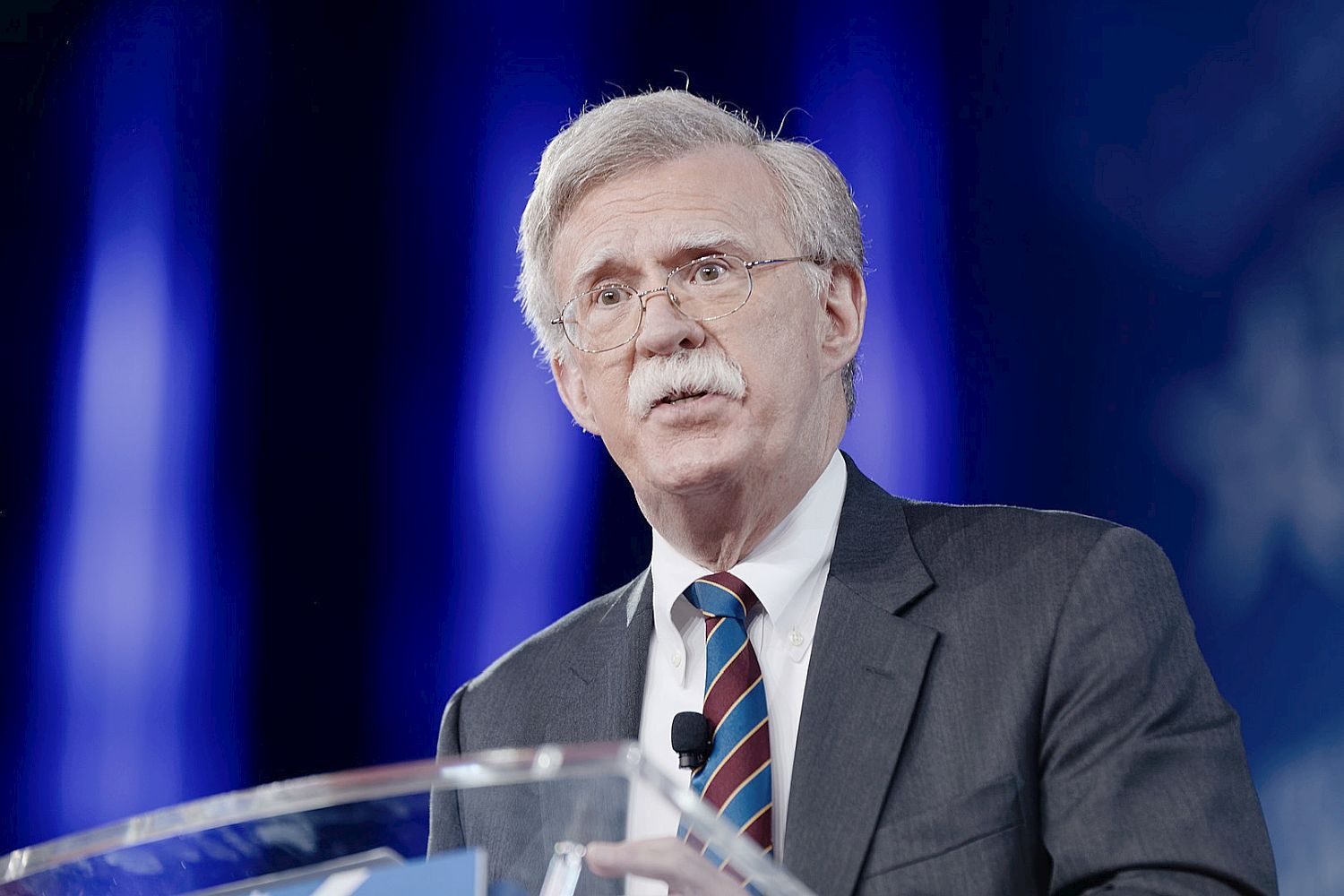
Let me throw a minority report opinion at you, based on this video, first released on YouTube two days before the FBI served a dawn warrant on John Bolton’s home:
I doubt former National Security Adviser John Bolton expressed any new personal opinions in the video above with regard to Putin and Russia.
Bolton’s general opinion about Trump’s transactional approach to international relations certainly isn’t new.
But Bolton spent more than 12 minutes airing out his opinions on Trump’s handling of Russia, Ukraine, India-Pakistan, and tariffs.
He also shared his opinion that Trump’s so-called “list of accomplishments” is Trump trying to accrue to obtain a Nobel Peace Prize.
US support of Israel’s bombing of Iran in July, supported by Bolton, makes the nomination a joke as does continuing US support of Netanyahu’s genocidal handling of Gaza.
These conflicting approaches to international relations may pose leverage for Putin to pressure Trump on Ukraine, using Trump’s narcissistic desire for a Nobel Peace Prize — a prize former president Jimmy Carter, vice president Al Gore, and the first Black American president Barack Obama have been awarded. Bolton doesn’t make this point but he does say Putin is manipulating Trump.
Bolton’s criticism of Trump isn’t limited to the video above, or his remarks in his 2020 book, In The Room Where It Happened. Bolton has been interviewed by many outlets here and abroad during which his criticisms are laid out and only growing as Trump continues to flog his erratic and transactional foreign policies. Here are a sampling of interviews with Bolton:
In this excerpt from the Hindustan Times interview above:
10:34 [MATTOO] You know Ambassador Bolton, if I could bring you back to that question of trust uh moving forward in uh the partnership with America. Lots of commentators over the years in India have been skeptical about the relationship with the United States. They’re saying that look this is a country that fundamentally has a lot more leverage than we do. That’s the question you know do you have the cards and the the sense that there is in India is that yes America is willing now to use its leverage in a way that is coercive, is extremely transactional, uh, and is in some ways brutal.
And you’ve seen President Trump speak very appre, in a very appreciatory tone about tariffs, saying that we’re willing to use it time and again for our foreign policy instruments. There’s a sense that defense technology could be something that America uses as well. And for example, our fighter jet uh something like General Electric fighter jet engines which India is co-developing with the United States to use for our fighter jets is something that India took a significant leap of trust in the United States to develop that partnership uh after years and years as you might be familiar with of suspicion about Washington.
What do you think what has happened over the last couple of weeks does to trust in the relationship? And if you’re speaking to an Indian audience as you are now, how do you pitch to them that the American relationship is one that they should still rely on, should still work on, should still continue to develop?
11:45 [BOLTON] Well, unfortunately, what Trump has done on the tariffs generally uh is destroy uh decades of effort with India, but with a lot of other countries as well uh to build up good faith and trust and reliance on the United States and uh it will take time to repair that. That’s that’s the unfortunate reality. But but here’s where I think it’s important to understand that Trump is aberrational. I don’t know anybody else uh Republican or Democrat who ran for president, let’s just say in 2024, who if elected would behave anything like this. Trump’s doing a lot of things domestically in the United States that are cause for great concern for us as well. And I don’t know any other candidate from 2024 who would do that.
12:30 [BOLTON] Uh, Trump doesn’t have a philosophy. Uh so I think ultimately there’s no legacy for him to leave to his successors, whoever they might be. Uh and I believe that the uh the uh the the force of his personality inhibits a lot of people from speaking up, but that doesn’t mean they agree with what he’s doing. That’s very unfortunate in my view.
12:52 [BOLTON] But I think the uh the the the true strategic sense here uh particularly for a country like India with its assets and capabilities and uh and threats that it faces right on its own border uh is is just to take a deep breath and remember that the world’s going to last longer than the next three and a half years. And uh it’s not pleasant to go through this. I’m not not going to try and persuade anybody of that. But uh but our objective should be to keep the damage to the relationship uh at a minimum uh and then to think about how to repair it as quickly as we can thereafter because I think that when Trump walks off the stage uh he will take almost uh the bulk of this history with him.
While criticizing Trump and his foreign policy (or lack thereof), Bolton makes a point of calling Trump an aberration so often through so many media outlets that it seems like a campaign slogan.
In the Hindustan Times Bolton also noted Trump’s repression of free speech critical of his geopolitics. Bolton had to know that he would face more aggressive tactics by the Trump administration to squelch his criticism.
But what if this was the point? To egg Trump on with repeated critical comments Bolton knew from experience would hit a nerve with Trump, to goad him into attacking Bolton?
What if Bolton made it — the investigation into him including the raid on his home yesterday — happen on purpose? In other words, a MIHOP gambit?
If so, what are the next moves by Bolton and Trump?
Chair Nadler. Okay. Now, recent reporting suggests that the
President plans to seek payback against those individuals he
believes crossed him during the impeachment proceedings. I am
sorry to have to ask. Has the President, the Attorney General,
or any other Administration official asked the FBI to open an
investigation into Joe Biden, Hunter Biden, John Bolton, or any
Member of Congress?
Mr. Wray. Mr. Chair, I have assured the Congress and I can
assure the Congress today that the FBI will only open
investigations based on the facts, law, and proper predication.
Chair Nadler. I understand that, and I assume that it is
correct that neither the President, the Attorney General, or
any other Administration official has asked the FBI to open
improper political investigations?
Mr. Wray. No one has asked me to open an investigation
based on anything other than the facts, law, and proper
predication.
Later in the hearing, Rep. Joe Neguse (D, CO-02):
I want to give you an opportunity to clarify earlier part
of your testimony. The Chair had asked a question, and I think
there was some confusion around your answer. So, with respect
to a recent article that alleges that the Administration may be
attempting to initiate political investigations or politically
motivated investigations, rather, into their political
opponents, has the President, the Attorney General, or any
Member of the Administration asked you to initiate an
investigation into John Bolton?
I am not asking whether or not that request would be
improper or proper or whether or not if such a request was
made, if you have initiated such an investigation. I am simply
asking if they have asked you to do so.
Mr. Wray. I understand why you’re asking the question, and
I would just tell you my commitment to doing things by the book
includes not talking about whether any particular investigation
does or does not exist. You shouldn’t read anything into that.
That’s not a hint that anything is happening. It’s just I don’t
think that’s a question that I can responsibly answer if I’m
going to be faithful to my commitment to doing things by the
book.
Mr. Neguse. Well, we appreciate–
Mr. Wray. I will tell you, as I said to the Chair–I will
tell you, as I said to the Chair, that no one has asked me to
open any investigation on anything that’s not consistent with
the facts, the law, and proper predication.
Mr. Neguse. I would just say, Director Wray, with all
respect, as you could probably imagine, these questions, both
the question the Chair posed and the question that I posed, are
not academic or esoteric for us. Seven months ago, Special
Counsel Mueller sat in the same chair that you are in, and we
all know now, that the very next day, the President had his
infamous call with the President of Ukraine, in which he sought
foreign interference in our elections. Of course, as you know,
in just a few hours, the Senate will render judgment in the
impeachment trial of the President.
So, one can ask reasonable questions as we read these
reports that we just over the course of the last few days as to
potentially what other actions this Administration might take.
So, again, I appreciate your earlier answer, and I want to move
on to a different topic, which is election interference.
There was an article just a few weeks ago in the New York
Times, and I would ask for unanimous consent to enter it into
the record. “ `Chaos Is the Point’: Russian Hackers and Trolls
Grow Stealthier in 2020,” by Matthew Rosenberg, Nicole
Perlroth, and David Sanger of the New York Times.
[The information follows:]
MR. NEGUSE FOR THE RECORD
==========================================
[GRAPHICS NOT AVAILABLE IN TIFF FORMAT]
Mr. Neguse. In the article, there are a couple of
references to new developments in terms of the way in which
Russian actors, the intelligence apparatus is engaging in
disinformation in attempted interference in our elections. I
wonder if you could comment about two in particular? I will
just quote.
“One of the two Russian intelligence units that hacked
into Democrats in 2016, `Fancy Bear,’ has shifted some
of its work to servers based in the United States in an
apparent attempt to thwart the NSA, which is limited to
operating abroad. Also, the trolls at the Internet
Research Agency are trying to exploit a hole in
Facebook’s ban on foreigners buying political ads,
paying American users to hand over personal pages and
setting up offshore bank accounts to cover their
financial tracks.”
I wonder if you could expand in greater detail on both of
those two issues and how the FBI, I guess, is addressing both
of those developments.
Mr. Wray. So, certainly, I appreciate the interest. I think
I’d have to be pretty careful about how much detail I could
provide in an open hearing. I would say that we believe–we
assessed that the Russians continue to engage in malign foreign
influence efforts of the sort that I was describing before–
fake personas, trolls, bots, state-sponsored media, the whole
gamut in the bag of tricks.
We also assessed that just like any sophisticated actor,
that they continue to refine their approach. We saw that from
2016-2018. We’ve seen it from 2018 moving forward. Happily,
we’re refining our approach, too, and we’re trying to stay
ahead of it.
(emphasis mine)
In 2020, during Trump’s first administration, neither the Trump DOJ nor the Democratic Party-led House launched investigations into John Bolton as Trump’s NSA, and in the FBI’s case, did not launch an investigation based on politics into Bolton.
Trump has now overseen a massive purge of intelligence and security personnel, many of whom share one or two things in common: they were involved in investigations in which Trump was a central figure, or they were involved in investigations related to Russia.
How will the Trump administration justify investigating Bolton now when his first administration didn’t appear to have done so? What’s Team Trump’s next move? What about Bolton’s?
Share this entry
https://www.emptywheel.net/wp-content/uploads/2019/10/JohnRBolton_CPAC-2017_byMichaelVadon-Wikimedia_24FEB2017_1500x1000.jpg10001500Raynehttps://www.emptywheel.net/wp-content/uploads/2016/07/Logo-Web.pngRayne2025-08-23 13:57:402025-08-23 22:12:01John Bolton and the MIHOP Gambit
Usually when I publish a Breathing Room post, it’s a bit of a break from politics. Unfortunately there’s little in our lives not affected by politics and current events.
Everything you eat or drink has been political, but now food and beverages are even more volatile than eight months ago.
A simple weekly task like grocery shopping is rife with pitfalls, more so than during the early days of the pandemic.
Here’s a sampling of fresh groceries I frequently order from the local store of a national grocer:
This is ridiculous, a form of stupid bingo. Whatever I planned to cook this week is out the window if it relies on any of these out of stock or low inventory items.
Sure, I could go to the farmer’s market to see if I can find a locally grown option, but I have my suspicions the local farmers are having problems getting vegetables picked.
It’s possible some farmers might not show up at the market because they’re immigrants — no idea what their legal status may be but it doesn’t matter if they are scared they may be grabbed. The Asian gentleman with the gorgeous cōng, the Hispanic couple with the tasty zapallitos, the other Hispanic family with the calabazas and repollos may not be there this year.
Some items aren’t and haven’t been available because of persistent bad weather due to climate change. I haven’t been able to buy Napa cabbage with any regularity for two years now. Some dishes I cook are just not the same using regular green cabbage as a substitute.
The problem isn’t just Stephen Miller’s irrational and cruel immigration policies but the inability of the US to restrain its consumption of oil and natural gas, making climate change worse each year.
I’ll work my way around these supply chain disruptions and shortages. I’ll manage around the absurd prices on some items thanks to Trump’s irrational approach to overseas trade.
What really worries me: how do the folks in the bottom deciles navigate this? Are their children not getting enough fruits and vegetables because their parents can’t buy enough of them on their budget, or can’t find them even if they can afford them? How are families supposed to spend more precious time and gas running all over to find vegetables?
How the hell is this making America great again?
Don’t answer that, it’s a rhetorical question. None of this political bullshit causing shortages is necessary except to shake people down.
This is an open thread — tell us how you’re filling your shopping cart. Tell us how you’re helping others make ends meet.
Share this entry
https://www.emptywheel.net/wp-content/uploads/2023/03/Vegetables_MarisolBenitez-Unsplash_26MAR2023_rot90deg.jpg10001500Raynehttps://www.emptywheel.net/wp-content/uploads/2016/07/Logo-Web.pngRayne2025-07-13 10:00:122025-07-13 02:38:19Breathing Room: What’s in Your Shopping Cart?
On March 18, 1969, the U.S. military launched a secret program authorized by then-president Richard Nixon. Code named Operation Menu, the U.S. bombed targets in Cambodia until May 26, 1970.
The program was never authorized by Congress; information about the bombings were withheld from both Congress and the American public.
It was a gross abuse of executive power and the basis for drafting an Article of Impeachment against Nixon. The article did not receive adequate support in Congress because a number of members of Congress felt they had not done enough to restrain Nixon with regard to the Vietnam War, and public opinion had not yet shifted firmly against Nixon because of the Watergate scandal.
Three of six Articles of Impeachment did receive approval, however; the unauthorized bombing of Cambodia emphasized the abuses of power delineated in the approved articles.
Fortunately for Nixon, Republican members of Congress took him aside and told him they had the votes to impeach and remove him if he didn’t resign. Nixon resigned on August 9, 1974, avoiding hearings and heightened scrutiny of his abuses of his office.
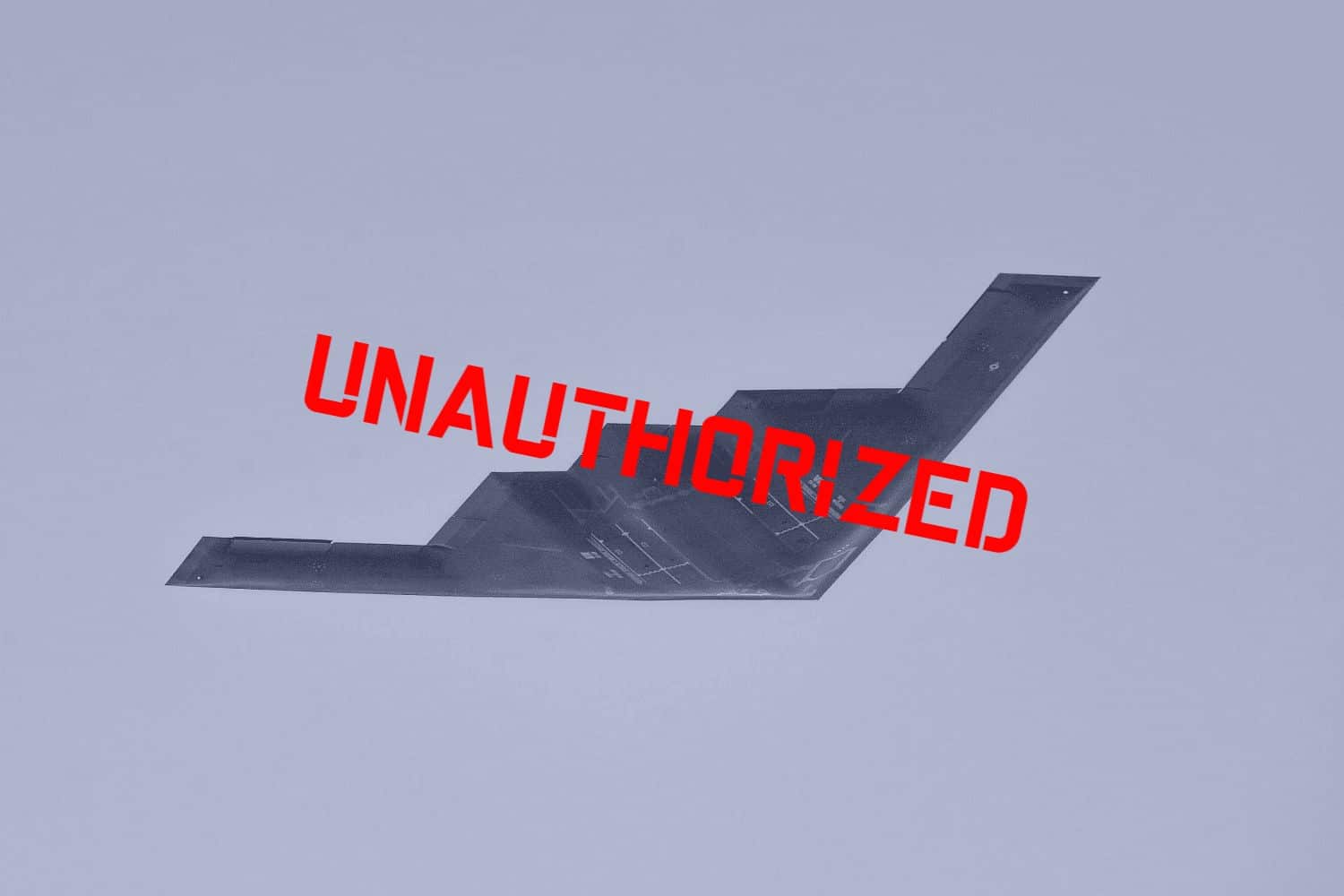
Donald Trump authorized the bombing of Iran. His secretary of defense did not restrain him by requiring an Authorization for Use of Military Force. Neither of them made much effort to keep the mission secret as it launched Saturday as Trump posted about it to his personal Truth Social account.
Congress was not informed of the operation in order to debate an AUMF. Congress received testimony from Trump’s director of national intelligence Tulsi Gabbard on March 25 in front of the Senate Intelligence Committee, in which she said,
… The IC continues to assess that Iran is not building a nuclear weapon and Supreme Leader Khamenei has not authorized the nuclear weapons program that he suspended in 2003. The IC continues to monitor closely if Tehran decides to reauthorize its nuclear weapons program.
In the past year, we have seen an erosion of a decades-long taboo in Iran on discussing nuclear weapons in public, likely emboldening nuclear weapons advocates within Iran’s decision-making apparatus. Iran’s enriched uranium stockpile is at its highest levels and is unprecedented for a state without nuclear weapons. …
There were exchanges with the media and public between the administration about Gabbard’s statement regarding the enriched uranium stockpile. If the status of that stockpile had changed with a firm move toward arming a weapon occurred, there has been no effort to communicate that with the Senate Intelligence or Armed Services Committees.
The American public was lied to by Trump who announced this past Thursday, “Based on the fact that there’s a substantial chance of negotiations that may or may not take place with Iran in the near future, I will make my decision whether or not to go within the next two weeks.”
Trump waffled publicly about U.S. military action against Iran, saying, ““You don’t know that I’m going to even do it,” Trump told one reporter. “I may do it. I may not do it. Nobody knows what I’m going to do. … “ I have ideas as to what to do, but I haven’t made a final [call] … I like to make a final decision one second before it’s due, you know?”
Trump failed to request approval from Congress before making that final call some time between Thursday and Saturday.
It’s possible the call had already been made and Trump’s apparent indecision was a head fake. An analyst with Haaretz seemed to think this was a possible strategy. EDIT: The Atlantic published an article at 12:29 a.m. ET Sunday in which they reported Trump had already decided to bomb Iran on Wednesday, before his public statement about a two-week window of decision.
Head fake or no, Trump violated the Constitution’s Article I, Section 8 which grants Congress the power to declare war. It is not a power granted to the executive who “shall take Care that the Laws be faithfully executed” under Article II, Section 3.
Trump has already repeatedly failed under the Take Care clause. This first strike against Iran conducted without Congressional approval should be a road too far.
The blowback from this may be enormous, beginning with global economic effects due to instability in the fossil fuels market and may include terrorist or overt military strikes against U.S. targets, perhaps by way of surrogate networks Gabbard also testified about on March 25.
Trump is without a doubt worse than Nixon. He should be impeached — again, yes — and this time removed from office.
Share this entry
https://www.emptywheel.net/wp-content/uploads/2025/06/B2Bomber_SteveHarvey-Unsplash_22JUN2025_mod-unauth.jpg10001500Raynehttps://www.emptywheel.net/wp-content/uploads/2016/07/Logo-Web.pngRayne2025-06-22 01:45:322025-06-22 10:13:35Without a Doubt, Worse than Nixon
Journalists need to validate this information and ask Whiskey Pete Hegseth WTAF is going on that so many tanker aircraft were deployed flying due east of the U.S. on a Sunday night.
Note the timing of each post with newer at the top and older at the bottom; the top two were obtained via Threadreader (time not available but assumed to be later than 21:02 ET), the others via Xitter. There may have been newer posts on Xitter but the platform wouldn’t let me dig any deeper without logging in and that’s not an option for me.
The number of tankers dispatched in the same direction on a Sunday night is quite odd given 40,000 active duty personnel deployed at multiple bases in the Middle East and at least two naval destroyers in the vicinity. The vessels are part of an increasing naval presence in the region over the last several months.
Now note the tantrum Trump had this evening on Truth Social – or a tantrum-like statement mimicking Trump’s habits – in which Trump appears to order stepped up ICE raids in blue cities and states, using DHS as a political weapon. (Stephen “Baby Goebbels” Miller, is this your work?)
Note especially the timing of the tantrum.
What a coincidence that one hour after this tantrum on Trump’s blog there are more than 20 military tanker aircraft in the air. It’s almost as if somebody wants their opposition to be too preoccupied to notice there has been no Authorization for Use Military Force or Declaration of War approved by Congress let alone an attack on the US meriting such authorization/declaration.
You might want to contact your members of Congress about this and ask them WTF.
You might also ask them whether they would consider impeachment and conviction for abuse of office in the form of politicization of an entire cabinet-level function.
Share this entry
https://www.emptywheel.net/wp-content/uploads/2025/06/Wikipedia_KC-135_refuels_an_F-16_Fighting_Falcon.jpg10011500Raynehttps://www.emptywheel.net/wp-content/uploads/2016/07/Logo-Web.pngRayne2025-06-16 05:03:302025-06-16 05:03:30Sunday Night WTF: Tankers with a Tantrum
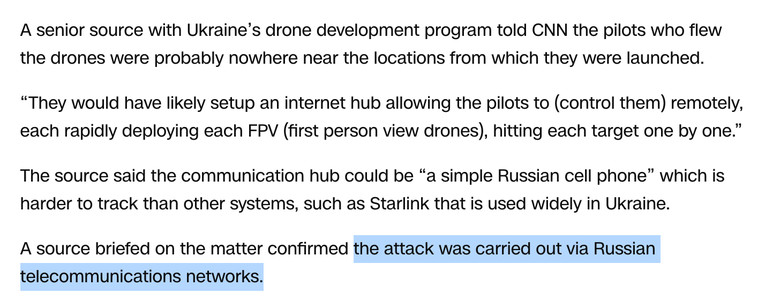
The brazenness of using Russia’s telecom networks is noteworthy, especially after concerns that Ukraine’s military operations could be compromised by Russian access to Elon Musk’s Starlink satellite communications.
The avoidance of Starlink for this mission named Operation Spiderweb (Ukrainian: Operatsija Pavutyna) suggests Ukraine accepted this possibility as reality and deliberately worked around the compromised network.
The success of the mission may also suggest this was a solid assumption and avoiding Starlink an effective decision.
There are two points in reporting about Operation Spiderweb which haven’t been analyzed further:
CNN and other outlets reported the number of drones Ukraine used to attack Russian military aircraft (117) and the amount of time the operation took from inception to the attack (one year, six months and nine days). The candor is rather shocking; perhaps cognitive dissonance explains why there haven’t been many analysts picking apart these openly shared details.
But these details may have messages within them considering how in-your-face they are. The number 117 seems peculiar because it’s an odd number though it’s not prime. Were all the drones that were smuggled in deployed? Was this another reason why the Trojan Horse wooden sheds were booby trapped — to eliminate any drones that did not deploy properly? Or perhaps the number simply is what it is on the face of it.
The exactness of the operation’s inception, though, seems deliberate, as if launch date meant something. Depending on how the one year, six months, and nine days are counted, the spiderweb began on November 22, 2023 or on December 23, 2023.
November 22 marked the beginning of the Orange Revolution in 2004.
December 23 marked the holiday observed by Ukraine’s Armed Forces — Operational Servicemen Day.
Just as importantly, June 1 on which the attack occurred was the anniversary of the day Ukraine transferred the last of its nuclear warheads to Russia in 1996 under the terms of the Budapest Memorandum to which the US was a party. In other words, this message might not have been intended just for Russia.
The Budapest Memorandum may also explain the role of SBU to effect this operation. While one source in CNN’s reporting attributed the successful mission to “Ukraine’s special services,” most reports credited the operation to the SBU.
SBU is Ukraine’s counterintelligence organization with paramilitary features. It does not have the same reporting structure as Ukraine’s Armed Forces. It’s also responsible for the security of Ukraine’s president and reports directly to him. The flat structure may have ensured the level of secrecy necessary to carry out Operation Spiderweb.
The not-quite-military role of the SBU may also have been critical to lawfare. An operation conducted by SBU may be construed as a counterintelligence operation and not a military operation, fuzzing the ability of the target to respond under terms of its own doctrine or terms of treaties. If a trigger for Russia to launch an escalated military response is the use of conventional kinetic weapons on its soil by another country’s armed forces, Operation Spiderweb skirts this threshold having used non-traditional weapons deployed by a counterintelligence function.
By its subtle emphasis on the Budapest Memorandum, Ukraine made a point of Russia’s failure to comply with the memorandum’s terms after repeated threats of nuclear attacks against Ukraine and the west. Targeting long-range aircraft capable of carrying nuclear weapons, Ukraine punctuated the Memorandum’s terms including nuclear non-proliferation.
Ukraine’s president Volodymyr Zelenskyy has had a number of top military personnel swapped out during the course of the Russo-Ukraine war (ex. the commander of the Joint Forces of the Armed Forces in June 2024, the commander-in-chief of the Armed Forces in February 2024, all regional military recruitment chiefs in August 2023), which might have suggested to outsiders cohesiveness could have been compromised by poor performance, disagreements with the conduct of the war, and plain old corruption. The personnel changes may have given the appearance Ukraine was not fully aligned toward repelling Russian aggression.
But as Sun Tzu wrote in The Art of War, all warfare is based on deception.
The illusion these personnel changes created may have been relied upon as a head fake, allowing Vladimir Putin and the Russian military to feel excessively confident about the outcome of the war. That confidence was surely ruptured just as Russia and Ukraine entered a new round of negotiations to end the war this Monday in Istanbul. Russia opened by presenting a “memorandum” of terms but Ukraine has expressed its lack of faith in Russia’s compliance with co-signed memoranda.
Which brings up a third point not discussed in media coverage of Operation Spiderweb: by eliminating a sizeable portion of Russia’s capacity to deliver nuclear weapons, Ukraine has blunted Russia’s threat against the west and China.
This was worth all the military aid provided to Ukraine to date, and then some. Ukraine has more than earned a place in the European Community and NATO.
Share this entry
https://www.emptywheel.net/wp-content/uploads/2022/02/UkraineFlag_MaxKukurudziak-Unsplash_24FEB2022-scaled.jpg17092560Raynehttps://www.emptywheel.net/wp-content/uploads/2016/07/Logo-Web.pngRayne2025-06-04 06:18:232025-06-04 06:18:23The Art of War, Ukraine Edition