The Most Complex Friday Night News Dump, Ever?

President Trump arrived late to a healthcare announcement yesterday and didn’t take any questions.

Starting around the same time, DOJ launched some of the most complexly executed Friday Night News dumps going.

Epstein Limited Hangout

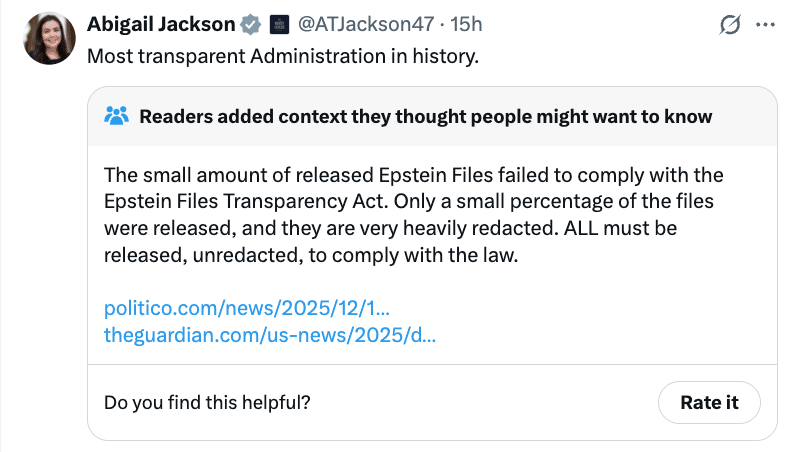
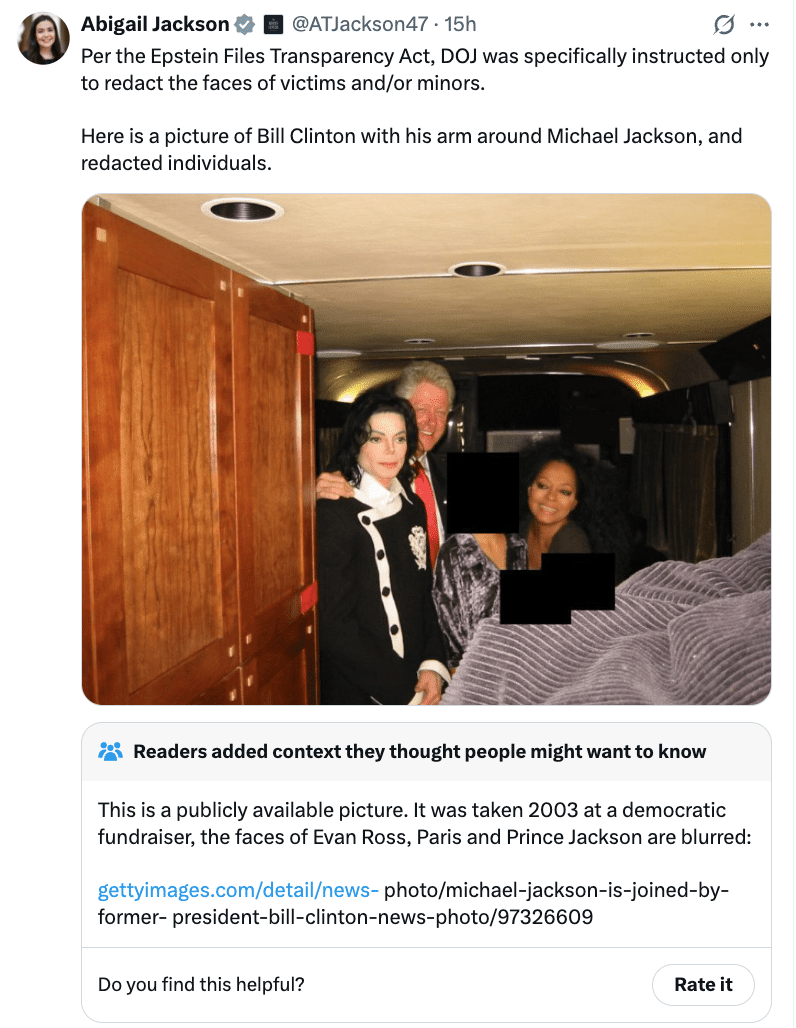
The big attraction was the release of the first batch of the Epstein files. The limited release violates the law, which required all files to be released yesterday.

Instead, there were a whole bunch of Bill Clinton photos, the document reflecting Maria Farmer’s complaint from 1996, that went ignored for years, and redacted grand jury transcripts that clearly violate the law. [Update: They have now released the SDNY ones.] The government did not release the proposed indictment and prosecution memo for the indictment that should have been filed in 2007; that may be sealed as deliberative.

Todd Blanche’s wildly dishonest letter (particularly with regards to his claimed concern for victims, after being admonished repeatedly by judges for failing to take that responsibility seriously and a last minute bid that promised but failed to put Pam Bondi on the phone) explaining the release emphasizes how Bondi took over a hundred national security attorneys off their job hunting hackers and spies to conduct a second review; it does not mention the even bigger review the FBI accomplished in March.

The review team consisted of more than 200 Department attorneys working to determine whether materials were responsive under the Act and. if so, whether redactions or withholding was required, The review had multiple levels. First, 187 attorneys from the Department’sNational Security Division (NSD) conducted a review of all items produced to JMD for responsiveness and any redactions under the Act. Second, a quality-control team of 25 attorneys conducted a second-level review to ensure that victim personally identifying information wasproperly redacted and that materials that should not be redacted were not marked for redaction.The second-level review team consisted of attorneys from the Department’s Office of Privacy and Civil Liberties (OPCL) and Office of Information Policy (OIP)—these attorneys are experts in privacy rights and reviewing large volumes of discovery. After the second-level review team completed its quality review, responsive materials were uploaded onto the website for public production as required under the Act. See Sec. 2(a). Finally, Assistant United States Attorneys from the Southern District of New York reviewed the responsive materials to confirm appropriate redactions so that the United States Attorney for the Southern District of New York could certify that victim identifying information was appropriately protected.

That John Eisenberg’s department was in charge of a second pass on these documents is of some interest; there’s no specific competence Nat Sec attorneys would have, but Eisenberg has helped Trump cover stuff up in the past, most notably the transcript of his perfect phone call with Volodymyr Zelenskyy.

Thus far the limited hangout has shifted the focus onto Clinton and away from Trump, but as Kyle Cheney lays out, it risks creating a WikiLeaks effect, in which a focus remains on Epstein for weeks or even months.

Deputy Attorney General Todd Blanche confirmed Friday that the documents would be released on a rolling basis through the holidays — and possibly beyond. And, in court papers filed shortly after Friday’s partial release, the Justice Department emphasized that more files are still undergoing a review and redaction process to protect victims and new Trump-ordered investigations before they can be released.

The daily drip is a remarkable result for President Donald Trump, who has urged his allies to move past the Epstein files — prompting jeers from Democrats who say he’s trying to conceal details about his own longtime relationship with Epstein. Trump has maintained for years that he and Epstein had a falling out years ago, and no evidence has suggested that Trump took part in Epstein’s trafficking operation. Trump advocated for the release of the files only after Republicans in Congress rebuffed his initial pleas to keep them concealed.

[snip]

Trump is no stranger to the political power of intermittent disclosures of derogatory information. In 2016, Trump led the charge to capitalize on the hack-and-leak operation that led to daily publications of the campaign emails of Hillary Clinton and her top allies. The steady drumbeat of embarrassing releases — amplified by Trump and a ravenous press corps — helped sink Clinton’s campaign in its final weeks.

And that’s before the political and legal response to this limited hangout. Some victims are already expressing disappointment — most notably, by the redaction of grand jury material and names they know they shared, as well as the draft indictment from Florida.

Tom Massie and Ro Khanna, while originally giving DOJ the benefit of the doubt, are now contemplating measures they can take — potentially including contempt or impeachment — to enforce this law.

After Fox News was the first to report that the names of some politically exposed persons would be redacted, DOJ’s favorite transcriptionist Brooke Singman told a different story.

And Administration officials are getting burned by Elon’s fascism machine for their dishonesty.
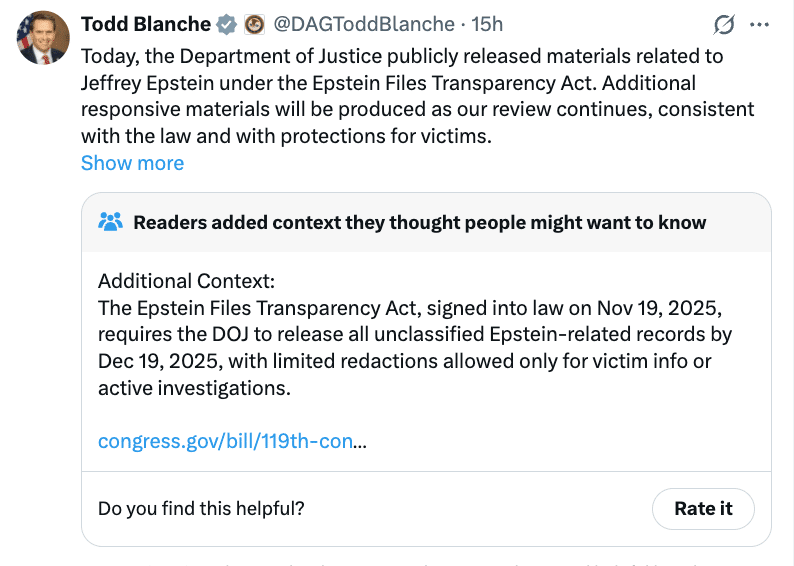
Once again, Trump’s top flunkies may be overestimating their ability to contain their scandal.

Todd Blanche behind the selective prosecution

Meanwhile, efforts by those same flunkies to punish Kilmar Abrego continue to impose costs.

There have been parallel proceedings with Abrego in the last month. Just over a week ago in his immigration docket, Judge Paula Xinis ordered Kilmar Abrego to be released from ICE custody for the first time since March, and then issued another order enjoining DHS from taking him back into custody at a check-in the next day. Effectively, Xinis found the government had been playing games for months, making claims they had plans to ship Abrego to one or another African country instead of Costa Rica, which had agreed to take him. Those games were, in effect, admission they had no order of removal for him, and so could no longer detain him.

[B]ecause Respondents have no statutory authority to remove Abrego Garcia to a third country absent a removal order, his removal cannot be considered reasonably foreseeable, imminent, or consistent with due process. Although Respondents may eventually get it right, they have not as of today. Thus, Abrego Garcia’s detention for the stated purpose of third country removal cannot continue.

But even as that great drama was happening, something potentially more dramatic was transpiring in Abrego’s criminal docket.

Back on December 4, Judge Waverly Crenshaw, who had been receiving, ex parte, potential evidence he ordered the government turn over in response to Abrego’s vindictive prosecution claim, canceled a hearing and kicked off a fight over disclosures with DOJ. Four days later he had a hearing with the government as part of their bid for partial reconsideration, but then provided a limited set of exhibits to Kilmar’s attorneys.

Then yesterday, in addition to a request that Judge Crenshaw gag Greg Bovino — who keeps lying about Abrego — Abrego’s team submitted filings in support of the bid to dismiss the indictment. One discloses that Todd Blanche’s office was pushed by people within Blanche’s office, including Aakash Singh, who is centrally involved in Blanche’s other abuse of DOJ resources, including by targeting George Soros.

Months ago now, this Court recognized that Deputy Attorney General Todd Blanche’s “remarkable” admission that this case was brought because “a judge in Maryland…questioned” the government’s decision to deport Mr. Abrego and “accus[ed] us of doing something wrong”1 may “come close to establishing actual vindictiveness.” (Dkt. 138 at 7-8). The only thing the Court found missing from the record was evidence “tying [Mr. Blanche’s statements] to actual decisionmakers.” (Id. at 8). Not anymore. Previously, the Court rightly wondered who placed this case on Mr. McGuire’s desk and what their motivations were. (Dkt. 185 at 2). We now know: it was Mr. Blanche and his office, the Office of the Deputy Attorney General, or “ODAG.” On April 30, 2025, just three days after Mr. McGuire personally took on this case, one of Mr. Blanche’s chief aides, Associate Deputy Attorney General Aakash Singh, told Mr. McGuire that this case was a [redacted]2 (Abrego-Garcia000007). That same day, Mr. Singh asked Mr. McGuire: [redacted] (Abrego-Garcia000008). Mr. McGuire responded with a timing update, saying he wanted to about a strategic question, and assuring Mr. Singh [redacted] and [redacted] (Abrego-Garcia000008). These communications and others show, as the Court put it, that [redacted] and [redacted] (Dkt. 241 at 5, 7). The “remarkable” statements “com[ing] close” to establishing vindictiveness (Dkt. 138 at 7-8) came from the same place— ODAG—as the instructions to Mr. McGuire to charge this case. The only “independent” decision (Dkt. 199 at 1) Mr. McGuire made was whether to acquiesce in ODAG’s directive to charge this case, or risk forfeiting his job as Acting U.S. Attorney—and perhaps his employment with the Department of Justice—for refusing to do the political bidding of an Executive Branch that is avowedly using prosecutorial power for “score settling.”3

2 The Court’s December 3 opinion (Dkt. 241) remains sealed, and the discovery produced to the defense in connection with Mr. Abrego’s motion to dismiss for vindictive and selective prosecution was provided pursuant to a protective order requiring that “[a]ny filing of discovery materials must be done under seal pending further orders of this Court” (Dkt. 77 at 2). Although the defense does not believe that any of these materials should be sealed for the reasons stated in Mr. Abrego’s memorandum of law regarding sealing (Dkt. 264), the defense is publicly filing a redacted version of this brief out of an abundance of caution pending further orders of the Court.

3 See Chris Whipple, Susie Wiles Talks Epstein Files, Pete Hegseth’s War Tactics, Retribution, and More (Part 2 of 2), Vanity Fair (Dec. 16, 2025), https://www.vanityfair.com/news/story/trump-susie-wiles-interview-exclusive-part-2.

While the specific content of this discovery remains redacted, the gist of it is clear: Blanche’s office ordered Tennessee prosecutors to file charges against Abrego in retaliation for his assertion of his due process rights.

We know similar documents exist in other cases — most notably, that of LaMonica McIver, Jim Comey, and Letitia James — but no one else has succeeded in getting their hands on the proof.

The Jim Comey stall

Speaking of which, the news you heard about yesterday is that DOJ filed its notice of appeal in both the Jim Comey and Letitia James’ dismissals.

The move comes after DOJ tried to indict James again in Norfolk on December 4 and then tried again in Alexandria on December 11, after which the grand jury made a point of making the failure (and the new terms of the indictment, which Molly Roberts lays out here) clear; Politico first disclosed the Alexandria filings here.

But I think the more interesting development — filed close to the time of the notice of appeals (the notices landed in my email box around 5:44-46PM ET on the last Friday before Christmas and the emergency motion landed in my email box around 5:17PM) — was yet another emergency motion in the Dan Richman case, something DOJ (under Lindsey the Insurance Lawyer’s name) keeps doing. After Judge Colleen Kollar-Kotelly issued her ruling that sort of said DOJ had to return Dan Richman’s stuff and move the remaining copy to EDVA, DOJ filed an emergency motion asking for clarification and an extension and (in a footnote) reconsideration. After Kollar-Kotelly granted the extension and some clarification (while grumbling about the tardiness and largely blowing off the motion for reconsideration), DOJ asked for another extension. Then DOJ filed a motion just informing Kollar-Kotelly they were going to do something else, the judge issued a long docket order noting (in part) that DOJ had violated their assurances they wouldn’t make any copies of this material, then ordering Richman to explain whether he was cool with this material ending up someplace still in DOJ custody rather than EDVA.

In its December 12, 2025, Order, the Court ordered the Government to “return to Petitioner Richman all copies of the covered materials, except for the single copy that the Court [] allowed to be deposited, under seal, with the U.S. District Court for the Eastern District of Virginia.” See Dkt. No. 20. The Court ordered the Government to certify compliance with its Order by 4:00 p.m. ET on December 15, 2025. Id. The Court further ordered that, until the Government certified compliance with its December 12 Order, the Government was “not to… share, disseminate, or disclose the covered materials to any person, without first seeking and obtaining leave of this Court.” See Order, Dkt. No. 20 at 2 (incorporating the terms of Order, Dkt. No. 10).

On December 15 (the Government’s original deadline to certify compliance with the Court’s December 12 Order), the Government requested a seven-day extension of its deadline to certify compliance with the Court’s December 12 Order. Dkt. No. 22. Petitioner Richman consented to this extension. Id. And the Government represented that it would “continue to comply with its obligation… not to access or share the covered materials without leave of the Court.” Id. at 11 (citing Order, Dkt. No. 10 and Order, Dkt. No. 20). So the Court granted the Government’s request for extension, thereby continuing the Government’s deadline to certify compliance with the Court’s December 12 Order to 4:00 p.m. ET on December 22. Order, Dkt. No. 26.

As of this date, the Government has not certified compliance with the Court’s December 12 Order. Accordingly, the Government is still under a Court order that prohibits it from accessing Petitioner Richman’s covered materials or sharing, disseminating, or disclosing Petitioner Richman’s covered materials to any person without first seeking and obtaining leave of this Court. See Dkt. No. 10; Dkt. No. 20; Dkt. No. 22; Dkt. No. 26. As the Government admits, the Government provided this copy of Petitioner Richman’s materials to the CISO “after the Government filed its emergency motion,” Gov’t’s Mot., Dkt. No. 31 at 1, fn. 1, in which the Government represented that it would “continue to comply with its obligation… not to access or share the covered materials without leave of the Court.” Dkt. No. 22 at 11.

In last night’s motion for emergency clarification (which had all the clarity of something written after a Christmas happy hour), DOJ explained that they couldn’t deposit the materials (which according to Kollar-Kotelly’s orders, would no longer have the single up-classified memo that Richman first shared his entire computer so FBI could get eight years ago) because there was no Classified Information Security Officer in the courthouse serving DOD, CIA, and ODNI. So they raised new complaints — basically, yet another motion for reconsideration. After having claimed, last week, that they had just a single copy of Richman’s data, they noted that actually they had it in a bunch of places, then pretended to be confused about storage devices.

d. The Court further clarified its order on December 16, 2025, stating that the Court “has not ordered the Government to delete or destroy any evidence.” ECF No. 27 at 2. But the Court has also instructed the Government that it may not “retain[] any additional copies of the covered materials.” ECF No. 20 at 2. The government has copies of the information in its systems and on electronic media. It is not clear how the government can avoid “retaining” the materials without deleting them.

e. The Court has not yet otherwise explained whether the Government must provide to Richman the original evidence “obtained in the Arctic Haze investigation (i.e., hard and/or flash drives and discs currently in the custody of the FBI,” ECF No. 22 at 9, some subset thereof (e.g., not including classified information), whether the Government must provide Richman the covered materials in some other fashion, and what else the Government must do (or not do) to comply with the December 12, 2025 order.

After they confessed, last week, that neither the discontinued e-Discovery software nor the now-retired and possibly impaired FBI agent could reconstruct what happened with Richman’s data five years ago, they insisted they were really keeping track of the data, Pinky Promise.

f. Notwithstanding the passage of time, changes in personnel, and the limits of institutional memory, the Government emphasizes that the materials at issue have at all times remained subject to the Department of Justice’s standard evidence-preservation, record-retention, and chain of custody protocols. The Government is not aware of any destruction, alteration or loss of original evidence seized pursuant to valid court-authorized warrants. Any uncertainty reflected in the Government’s present responses regarding the existence or accessibility of certain filtered or derivative working files does not undermine the integrity, completeness, or continued preservation of the original materials lawfully obtained and retained. The Government’s responses are offered to assist the Court in tailoring any appropriate relief under Rule 41(g) in a manner consistent with its equitable purpose, while preserving the Government’s lawful interests and constitutional responsibilities with respect to evidence obtained pursuant to valid warrants and subject to independent preservation obligations.

Every single thing about the treatment of Richman’s data defies this claim, which is why he had a Fourth Amendment injury to be redressed in the first place.

Nevertheless, in this their second motion fashioned as a motion for clarification, they they propose, can’t we just keep all the data and Pinky Promise not to do anything with it?

g. Rather than require the government to “return” or otherwise divest its systems of the information, the government respectfully suggests that the more appropriate remedy would simply be to direct the government to continue not to access the information in its possession without obtaining a new search warrant. It is not clear what Fourth Amendment interest would be served by ordering the “return” of copies of information (other than classified information) that is already in the movant’s possession, and that the government continues to possess, at least in the custody of a court (or the Department of Justice’s Litigation Security group, as may be appropriate given the presence of classified information). And the Court’s order properly recognizes that it is appropriate for the government to retain the ability to access the materials for future investigative purposes if a search warrant is obtained. ECF No. 20 at 1. Forcing transfer of evidentiary custody from the Executive Branch to the Judiciary would depart from the traditional operation of Rule 41(g), which is remedial rather than supervisory, and would raise substantial separation-of-powers concerns. The government respectfully suggests that the best way to do that is to allow the executive branch of government to maintain the information in its possession, rather than forcing transfer of evidence to (and participation in the chain of custody by) a court. See, e.g., United States v. Bein, 214 F.3d 408, 415 (3d Cir. 2000) (applying then-Rule 41(e) and noting that it provided for “one specific remedy—the return of property”); see also Peloro v. United States, 488 F.3d 163, 177 (7th Cir. 2007) (same regarding now-Rule 41(g)).

Having violated their promise not to make copies without permission once already, they Pinky Promised, again, they wouldn’t do so.

b. The Government shall continue not to access or share the covered materials without leave of the Court. See ECF No. 10 at 4; ECF No. 20 at 2.

And then they offered a horseshit excuse to ask for a two week extension beyond the time Kollar-Kotelly responds to their latest demands (partly arising from their own stalling of this matter into Christmas season) — that is, not a two week extension from yesterday, which would bring them to January 2, but instead two weeks from some date after December 22, which was at the time Richman’s next deadline.

a. Because it is yet not clear to the Government precisely what property must be provided to Richman by December 22, 2025 at 4:00 PM (and what other actions the Government must or must not take to certify compliance with the December 12, 2025 order as modified), the Government respectfully requests that it be provided an additional fourteen days (because of potential technological limitations in copying voluminous digital data and potential personnel constraints resulting from the upcoming Christmas holiday) from the date of the Court’s final order clarifying the December 6, 2025 order to certify compliance. 1

1 An extension of the compliance deadline is merited by the extraordinary time pressure to which the Government has been subjected and the necessity of determining, with clarity, what the Government must do to comply with the December 12, 2025 order as clarified and modified. See Fed. R. Civ. P. 60(b)(6); see also ECF No. 22 at 6–7 (summarizing applicable legal principles). [my emphasis]

They asked, effectively, to stall compliance for a month.

As a reminder, the grand jury teed up before Aileen Cannon convenes on January 12.

Kollar-Kotelly’s response (which landed in my email box at 7:06, so definitely after prime Christmas happy hour time) was … weird. In addition to granting the government part of the extension they requested (until December 29), she all of a sudden asked Richman what happened after he voluntarily let the FBI image his computer so they could ensure there was no classified information in it.

At present, in this second request, the Court would benefit from additional detail from Petitioner Richman regarding the Government’s imaging of Petitioner Richman’s personal computer hard drive in 2017. In 2017, Petitioner Richman consented to have the Government seize his personal computer hard drive, make a copy (an “image”) of his personal computer hard drive, and search his personal computer hard drive for the limited purpose of identifying and deleting a small subset of specified material. The Court is requesting information as to whether the hard drive that Petitioner Richman consented to have imaged by the Government was ever returned to Petitioner Richman, and, if so, whether any of the specified material had been removed from the hard drive that was returned.

Now maybe she’s asking this question simply to refute DOJ’s claim that any material independently held has to be held by a CISO.

The answer to this question is publicly available in the 80-page IG Report on this topic.

On June 13, 2017, FBI agents went to Richman’s home in New York to remove his desktop computer. On June 22, 2017, FBI agents returned the desktop computer to Richman at his home in New York after taking steps to permanently remove the Memos from it. While at Richman’s residence on June 22, 2017, the FBI agents also assisted Richman in deleting the text message with the photographs of Memo 4 from his cell phone.

It’s not clear why they ever kept the image in the first place (remember, they didn’t obtain a warrant to access it until well over two years later).

But I worry that Kollar-Kotelly is getting distracted from the clear recklessness — including DOJ’s most recent defiance of her order and their own Pinky Promises — for which Richman is due a remedy by the distinction between his physical property (the hard drive he got back eight years ago) and his digital property (the image of that hard drive, his Columbia emails, his iCloud, his iPhone, and iPad). The most serious abuse of his Fourth Amendment rights involved his phone, which DOJ only ever had in digital form, regardless of what kind of storage device they stored that content on (which we know to be a Blu-ray disc).

And meanwhile, everything about the government’s actions suggest they’re going to string Kollar-Kotelly along until they can get a warrant from the judge, Cannon, who once said Trump had to be given boxes and boxes of highly classified documents back because they also contained a single letter written by Trump’s personal physician and another letter published in Mueller materials.

They are just dicking around, at this point.

There’s a lot of shit going down in documents signed (as this emergency motion is) with Todd Blanche’s name. He still seems to believe he can juggle his way through politicizing the Department of Justice with some carefully executed Friday Night document dumps.
Share this entry

Colleen Kollar-Kotelly’s Attempted Baby-Splitting Leads to Exploding Diaper

I suppose I should have reminded readers, somewhere in my close tracking of Judge Colleen Kollar-Kotelly’s attempt to craft a nifty solution to a difficult Fourth Amendment question, that she authored a 2004 FISA opinion from which a decade of bulk collection on Americans arose.

I delayed doing so, in part, because Tulsi Gabbard has deprecated the link to the official version and so I need to go find a copy. But this post describes the substance of the opinion. This post describes how subsequent phone dragnet opinions relied on it. And this timeline explains how, after Kollar-Kotelly was just the second FISA Judge read into the unconstitutional Stellar Wind program, and after she raised concerns about it, a guy named Jim Comey refused to reauthorize it in its then current form, which led to a famous standoff in a hospital, much drama, but only limited (and still largely undisclosed!) changes in the program, before Kollar-Kotelly wrote an opinion authorizing bulk collection that would be the cornerstone for 11 more years of bulk collection.

Judge Colleen Kollar-Kotelly has a history with difficult Fourth Amendment decisions.

And she has a history with Jim Comey.

When we last reviewed this difficult Fourth Amendment question, Kollar-Kotelly had simply waved her hands over the original sins of unscoped seizures and overseized data targeting Dan Richman — which she deemed plausible Fourth Amendment violations but not something she had to deal with, she said, because she had found the later search of that likely unscoped data was itself a violation of the Fourth Amendment and so could apply a bunch of DC precedents that all addressed property that was, in the initial seizure, lawfully collected to data she agreed was plausibly also unlawfully collected. Then she ordered the government to send that unlawfully searched data to EDVA, where different precedents would apply, and where the government could get a warrant to access what they wanted.

In a motion to modify and clarify that was also, in a footnote, a motion for reconsideration, the government deftly asked to change the rules such that they would be able to keep the fruits of several iterations of unlawful searches, and Dan Richman would be gagged from revealing that’s what happened.

So here’s what Kollar-Kotelly — she of the history of difficult Fourth Amendment decisions and she with the two decade history with Jim Comey — has done since.

First, she issued an order bitching about the government’s last minute request and complaining that they didn’t raise these issues on the first go-around, but giving the government permission to keep anything derivative of those three iterations of unlawful seizures.

The Government’s [22] Motion, which was filed approximately one hour before the deadline for the filing of a certification of compliance set forth in this Court’s [20] Order, raises a variety of issues related to the handling of classified information and information that may be subject to the Government’s own privileges, including the attorney-client privilege and the deliberative process privilege. The Government could have-and should have-raised many of these issues earlier in its initial Response to Petitioner Richman’s [1] Motion for Return of Property, but it did not do so. The Court will clarify its [20] Order at greater length by separate order and, if appropriate, will request further briefing from the parties. For now, the Court notes three important clarifications:

[snip]

Further, this Court’s Order directed the return of Petitioner Richman’s own materials (and any copies of those materials), not any derivative files that the Government may have created. See Order, Dkt. No. 20, at 1 (directing the return of the original materials, copies of those materials, and any materials “directly obtained or extracted” from them); see also id. at 41 (explaining that the Court would not bar the Government from “using or relying on” the relevant materials in a separate investigation or proceeding). Accordingly, compliance with the Court’s Order will not intrude upon any of the Government’s privileges.

This order, by itself, would amount to permitting the government to use stuff tainted by a breach of attorney-client privilege (Jim Comey’s attorney-client privilege), something she has not dealt with at all.

Then yesterday, Kollar-Kotelly issued an order noting (in a footnote) the government request for reconsideration they buried in a footnote, but blowing it off …

1 In a footnote, the Government requests reconsideration of this Court’s merits ruling that the Government’s retention of the materials at issue violates Petitioner Richman’s Fourth Amendment right against unreasonable seizures. See Gov’t’s Mot., Dkt. No. 22, at 7 n.5. However, the primary focus of the Government’s [22) Emergency Motion is the proper scope of the remedy to be awarded. Accordingly, the Court focuses here on issues that are directly relevant to the issue of remedy.

… But also requiring (among other things) the parties to explain three things, with the following deadlines:

  • By 9:00 a.m. ET on Wednesday, December 17, 2025, the government should share its great ideas on how to keep all this data secure at EDVA.
  • By 10:00 a.m. ET on Wednesday, December 17, 2025, the government should explain what it has from the original searches.
  • By 2:00 p.m. ET on Wednesday, December 16, 2025, Richman should explain what he wants back, some of which may be influenced by the 10AM briefing.

The order pertaining to that 10AM explanation betrays how inadequate the original baby-splitting solution was, not least because Kollar-Kotelly doesn’t unpack that the stuff the government originally seized from Richman is evidence — or at least includes it.

Second, the Government argues in its [22] Emergency Motion that the Court’s Order “appears to require the Government to delete or destroy evidence originally, and lawfully, obtained pursuant to search warrants issued by the U.S. District Court for the District of Columbia in 2019 and 2020.” Gov’t’s Mot., Dkt. No. 22, at 5. To be clear, the Court has not ordered the Government to delete or destroy any evidence; instead, it has ordered the Government to return certain materials to Petitioner Richman, while depositing others with a third-party custodian for safekeeping. However, to ensure that the remedy awarded in this case is appropriately tailored to the facts, the Court would benefit from more factual details regarding the Government’s execution of the search warrants issued in this District in 2019 and 2020. Id. Accordingly, it is ORDERED that, no later than 10:00 a.m. ET on Wednesday, December 17, 2025, the Government shall file with the Court a brief response to the following questions:

(1) Does the Government have in its possession a complete copy of any of the following:

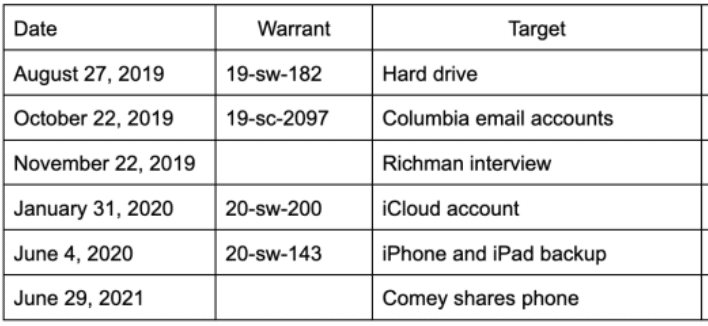
(i) the “forensic image” of Petitioner Richman’s personal computer hard drive that the Government was authorized to search under the warrant issued in this District on August 27, 2019;

(ii) the information disclosed by Columbia University to the Government pursuant to the warrant issued in this District on October 22, 2019;

(iii) the information disclosed by Apple to the Government pursuant to the warrant issued in this District on January 30, 2020; or

(iv) the “contents of a hard drive … containing backup files of one Apple iPad 4 and one Apple iPhone 5S” that the Government was authorized to search under the warrant issued in this District on June 4, 2020?

(2) Under each of the four search warrants at issue, the Government was authorized to seize only responsive material, which constituted a subset of the information it was permitted to search. Did the Government create a separate file, disk, hard drive, or any other segregated collection of responsive material for any of the following:

(i) the material seized from Petitioner Richman’s personal hard drive pursuant to the warrant issued in this District on August 27, 2019;

(ii) the material seized from Petitioner Richman’s Columbia University email accounts pursuant to the warrant issued in this District on October 22, 2019;

(iii) the material seized from Petitioner Richman’s iCloud account pursuant to the warrant issued in this District on January 30, 2020; or

(iv) the material seized from the backup files of Richman’s Apple iPad 4 and Apple iPhone 5S pursuant to the warrant issued in this District on June 4, 2020? [my emphasis]

As Kollar-Kotelly alludes to elsewhere, these questions should have been answered before she made her original decision. But she doesn’t acknowledge that she would have needed this information, in part, to understand whether the first two seizures violated the Fourth Amendment, which — if they do — would mean her application of multiple precedents that all assume the initial seizure was lawful would be totally inapt.

But there are two reasons why even these belated questions are inadequate to her purpose.

First, as Kollar-Kotelly noted in her own opinion, which she cited via William Fitzpatrick’s opinion which in turn cited this FBI declaration, when the FBI searched all this data in September, they searched a full extraction of Richman’s phone and iPad.

For this search, an FBI agent was instructed to review “a Blu-ray disc that contained a full Cellebrite extraction and Reader reports” for two of Petitioner Richman’s devices to identify “conversations between [Petitioner Richman] and [Mr. Comey].”

As the full quote from the FBI declaration explained, when Francis Nero did that search, he received a Blu-ray sealed with red evidence tape.

On or about September 12, 2025, while assigned to the Director’s Advisory Team, I was requested by Special Agent Spenser Warren to review a Blu-ray disc that contained a full Cellebrite extraction and Reader reports of an iPhone and iPad backups. I was requested to review the Cellebrite extraction for conversations between RICHMAN and JAMES COMEY. SA Warren handled this agent a manilla envelope sealed with red evidence tape that contained the Blu-ray disc with the Cellebrite extraction.

We know this full extraction contained attorney-client communications. Kollar-Kotelly doesn’t ask, in her second question above, how privileged communications were treated back in 2019 and 2020. She needed to ask whether the FBI only scoped the data not covered by Richman’s privilege declarations (which is what happened, if they scoped it at all) or whether they gave him scoped materials on which to make privilege declarations. Whichever it is, though, there needs to be a question 3, because the government never had the right to search privileged materials (except, arguably, on the original image itself, because such searches were not yet explicitly prohibited).

More importantly, if Spenser Warren handed Nero the full extraction, then it doesn’t matter what happened in step 2 of Kollar-Kotelly’s question above, because the government simply searched, without a warrant, unscoped data that should have been destroyed. That red evidence tape may well be what the government did to ensure that the FBI didn’t snoop on unscoped data. If so, the smoking gun in this chain of unlawful seizures was the decision, by someone on the Director’s Advisory Team, to search unscoped data without a warrant. That’s not covered by Kollar-Kotelly’s questions at all.

The other reason Kollar-Kotelly’s questions are inadequate is because of this disclosure (which didn’t make Fitzpatrick’s opinion and so may not be before her).

5 The Order also required the government to provide, in writing, by the same deadline: “Confirmation of whether the Government has divided the materials searched pursuant to the four 2019 and 2020 warrants at issue into materials that are responsive and non-responsive to those warrants, and, if so, a detailed explanation of the methodology used to make that determination; A detailed explanation of whether, and for what period of time, the Government has preserved any materials identified as non-responsive to the four search warrants; A description identifying which materials have been identified as responsive, if any; and A description identifying which materials have previously been designated as privileged.” ECF No. 161 at 1-2.

Despite certifying on November 6 that it had complied with the Court’s Order, ECF No. 163, the government did not provide this information until the evening of November 9, 2025, in response to a defense inquiry. The government told the defense that it “does not know” whether there are responsive sets for the first, third, and fourth warrants, or whether it has produced those to the defense, and said that in that regard, “we are still pulling prior emails” and the “agent reviewed the filtered material through relativity but there appears to be a loss of data that we are currently trying to restore.” [my emphasis]

On November 9, in response to the same questions Kollar-Kotelly asked in her order but posed by Fitzpatrick, the government told Comey — but not in writing! — that they had no fucking clue what happened with the first, third, and fourth warrants, because something happened with Relativity, the software on which these distinctions would have been preserved. So they had to pull prior emails to figure out what the fuck they were doing searches on.

The government may still have no fucking clue what they’re dealing with, because they asked for a 48-hour extension on both their own deadlines.

Richman agreed to that delay but only if he also got an extension.

Counsel for Petitioner has informed the Government that he takes no position on this request, but respectfully requests that the Court provide Petitioner an equivalent extension of time to file his brief, see ECF No. 27 at 3, should the Court grant the Government’s motion.

Late yesterday, Kollar-Kotelly issued a docket order granting the government its two-day extension on the easier question — how to keep this data secure at EDVA — but just a two hour extension to the harder deadline — what the fuck happened with this data. She did not, however, grant Richman an extension at all, so his response must now be filed two hours after the government’s response.

The Court is in receipt of the Government’s 28 Motion for Additional Time to Respond to this Court’s 27 Order for supplemental submissions, which the Government filed at 6:28 p.m. ET this evening. The Government’s 28 Motion is GRANTED IN PART and DENIED IN PART. The Government’s Motion is GRANTED as to the 9:00 a.m. deadline for the submission of “best practices on safekeeping evidence,” which is CONTINUED to 9:00 a.m. ET on Friday, December 19, 2025. The Motion is GRANTED IN PART and DENIED IN PART as to the Government’s deadline to respond to the factual questions presented in this Court’s 27 Order. The Government shall file brief responses to these questions no later than 12:00 p.m. ET on Wednesday, December 17, 2025. The Motion is otherwise DENIED. Petitioner Richman’s response deadline is unchanged.

Again, Kollar-Kotelly needed answers to these questions before she crafted the baby-splitting solution. Because if the original data was overseized and then not preserved in its scoped form (or if someone fiddled with Relativity in the interim to muddle what data was properly seized in the first search), then her application of DC precedent was inappropriate. At least some of this data was — as far as we know (though there may be other warrants) — always unlawfully seized.

That 2004 opinion Kollar-Kotelly wrote was an attempt to solve an enormous problem caused by unlawful government spying, but it served as the cornerstone for 11 more years of unlawful government spying. This particularly baby-splitting solution may lack the gravity of that earlier opinion, but in its currently muddled form, has the potential of causing another decade of problems.

Update: DOJ’s response is here. They actually admit to the problem with Relativity (though don’t name Relativity and try to obscure the timing of DOJ dropping it, which almost certainly has to post-date the January 6 investigation).

These responses are provided with the qualification that the search warrants were obtained five and six years ago.

[snip]

Search warrants directed at these materials were issued by the United States District Court for the District of Columbia. These warrants included language for following a filter process for attorney-client privileged information. As to the iCloud account and backup files for the iPad 4 and iPhone 5S, these materials were combined and provided to Richman and his counsel for filtering. The filtered version was then provided back to the government for review. Correspondence reviewed by the present investigative team indicates that the primary case agent then committed to reviewing the filtered version through an e-discovery program. Between 2020 and 2025, the Department of Justice stopped using this e-discovery program and a loss of data occurred. The government has attempted to restore this data but has not been successful.

The government has contacted the primary case agent. The primary case agent stated that he always followed and complied with the terms of a search warrant, and that his behavior in this case would have been no different. However, due to the passage of time [redacted], the primary case agent could not specifically describe the process followed in 2019 and 2020.

In a redaction in this passage and an earlier one (for which DOJ appears not to have filed a motion to seal), they must describe something that happened to the original lead case agent. That is, for some reason he can’t fully reconstruct what he did five years ago.

And they have yet to reconstruct what was lost in dropping Relativity.

In short, they’re basically saying these warrant returns are so old, neither the person who managed them nor the software paid to preserve them are available to do so any longer.

Their solution to that, DOJ says, is for them to have a filter AUSA and a filter Agent review it all to find out if there is a segregated version within the larger set.

Finally, as to the materials described in this section, the government respectfully requests that the Court allow a filter FBI agent and a filter AUSA to review only the previously filtered versions, which, according to FBI records, are contained on the relevant storage devices. The purpose of this limited review would be to determine whether any sort of segregated version of responsive material exists on the storage devices.

This should change Kollar-Kotelly’s entire approach. DOJ confesses they have no fucking clue whether the data they have is legal or not.

But it likely will not.

Update: Richman’s response is here. It goes big, demanding that all materials be taken away from the government.

Share this entry

The Epistemology of the Epstein Scandal

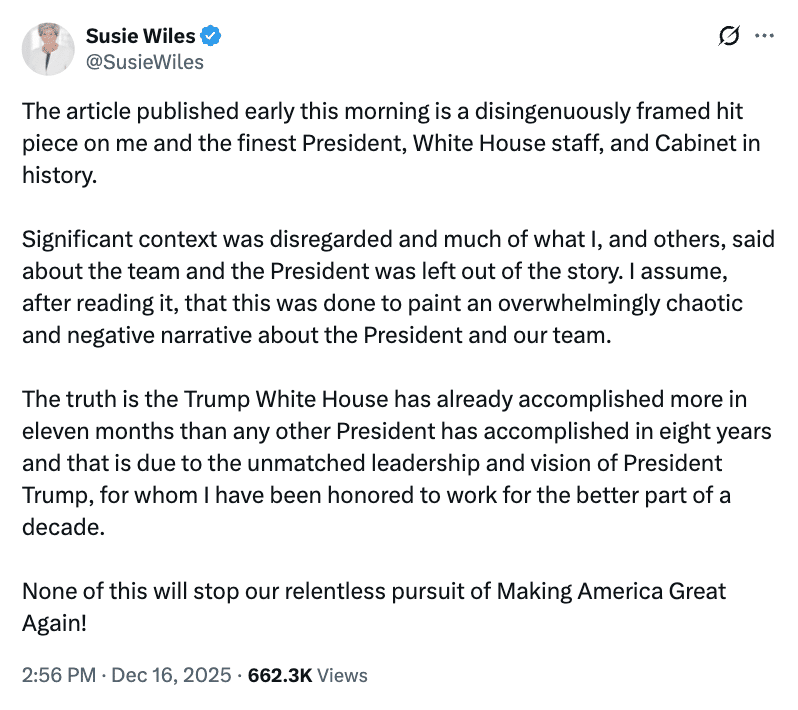
One of the longest part of Vanity Fair’s two-part (one, two) interview with Susie Wiles focuses on Jeffrey Epstein. It goes like this:

¶1: Chris Whipple’s explanation of why it’s important.
¶2: Wiles’ admission she underestimated the import of it.
¶3: A review of Pam Bondi’s binder fiasco, with Wiles commenting on Bondi’s fuck-up.
¶4: A report on how many FBI agents reviewed the files, with Wiles’ claim they weren’t just searching for Trump.
¶5: Wiles’ claim there was nothing bad on Trump in the files, just him and Epstein being “young, single playboys.”
¶6: Wiles debunking Trump’s false claims about Clinton’s ties to Epstein.
¶7: Wiles describing that Kash Patel and Dan Bongino really understood Epstein, except Kash was wrong.
¶8: Wiles’ failure to offer an explanation for Todd Blanche’s interview with Ghislaine Maxwell.
¶9: Wiles’ claim that Trump was pissed Ghislaine got moved.
¶10: Wiles’ claim that the birthday letter to Epstein is not from Trump.
¶11 – ¶12: Wiles’ claim that Trump would sit for a deposition in his WSJ lawsuit if necessary.
¶13: Whipple explaining the threat of the Epstein files again, then quoting Wiles on who cares about it.
¶14: Someone at the White House who might be JD Vance explaining who cares about it.
¶15: A specific mention of Vance, with further explanation of those who care about Epstein.

Elsewhere, Wiles credits herself with a great read of electoral outcomes (even while describing her own prediction that Jack Ciattarelli might beat Mikie Sherill last month): She was certain they would win last year, she didn’t think November would be that bad, they’re going to win midterms.

Her confidence (even if feigned) is why I’m so interested in Wiles’ description of the relative knowledge about Epstein. As noted, she admitted to Whipple that she didn’t understand how important this scandal could be, deferring knowledge on such issues to Kash Patel, Dan Bongino, and JD Vance — two of whom she describes as conspiracy theorists.

Wiles told me she underestimated the potency of the scandal: “Whether he was an American CIA asset, a Mossad asset, whether all these rich, important men went to that nasty island and did unforgivable things to young girls,” she said, “I mean, I kind of knew it, but it’s never anything I paid a bit of attention to.”

[snip]

The people that really appreciated what a big deal this is are Kash [Patel] and [FBI deputy director] Dan Bongino,” she said. “Because they lived in that world. And the vice president, who’s been a conspiracy theorist for a decade…. For years, Kash has been saying, ‘Got to release the files, got to release the files.’ And he’s been saying that with a view of what he thought was in these files that turns out not to be right.” [brackets original]

But then six paragraphs after describing that longtime Trump loyalist Kash Patel was totally into [a false belief] about the Epstein files, first Wiles and then someone who might be JD Vance (who is mentioned in the following paragraph) describe their understanding of who cares about this: “people that are sort of new to our world.”

The Epstein files debacle poses a dire political threat to Trump and the future of the GOP. “The people that are inordinately interested in Epstein are the new members of the Trump coalition, the people that I think about all the time—because I want to make sure that they are not Trump voters, they’re Republican voters,” Wiles said. “It’s the Joe Rogan listeners. It’s the people that are sort of new to our world. It’s not the MAGA base.”

A senior White House official described the mindset of an overlapping bloc of voters who are angered by both Trump’s handling of the Epstein files and the war in Gaza. It’s as much as 5 percent of the vote and includes “union members, the podcast crowd, the young people, the young Black males. They are interested in Epstein. And they are the people that are disturbed that we are as cozy with Israel as we are.”

Susie Wiles, who has been around Trump since he was first elected, claims “the people that are inordinately interested in Epstein” are “not the MAGA base”!!!

And then that anonymous White House official who might be JD Vance (whom Wiles explains is a conspiracy theorist) describes that the “young Black males” are the ones who care about Epstein.

To be fair, it is the case that the MAGAt base voters who do care deeply about this — people like Charlie Kirk, Benny Johnson, and Jack Posobiec — quickly fell in line when Trump demanded they stop talking about Epstein in July.

But like Kash and Bongino themselves, these are the people who made Epstein specifically and conspiracy theories about pedophiles more generally some of the central glue of  Trump’s coalition.

As I wrote for TPM’s anniversary series, the superpower of reclaiming attention which Trump has honed with these same far right trolls has always been developed in parallel with the use of conspiracy theories about pedophilia — from Posobiec’s Pizzagate, to QAnon, to Epstein — to keep that attention.

On July 8, something happened to Donald Trump that I’ve not seen happen in the entire decade he has dominated presidential politics. As his base clamored for more disclosures about sex trafficker Jeffrey Epstein, his superpower — his ability to grab and redirect attention — briefly failed him. “Are you still talking about Jeffrey Epstein?” he whined when a journalist asked about the Justice Department’s decision to abort any further disclosure of documents related to the case. “This guy’s been talked about for years.”

[snip]

Two things had disrupted Trump’s superpower. First, after Trump’s top DOJ appointees — Attorney General Pam Bondi, FBI Director Kash Patel, and his deputy Dan Bongino – had fueled, then disappointed, MAGA’s demand for Epstein disclosures, the failure to fulfill their promises fed the conspiracy itself. By thwarting the conspiracists’ demands, Bondi, especially, created rifts and distrust in Trump’s own base.

Conspiracy theories about Epstein were always non-falsifiable; the mob will never be satisfied. But Bondi made that dynamic worse.

More important for understanding what happened in July: the very same online trolls who’ve been critical partners in Trump’s success managing attention were precisely the same people who had spun those conspiracy theories. There is a direct through-line from a relatively small set of social media accounts that helped Trump win the 2016 election to PizzaGate and, after that, QAnon. QAnoners played a key role in Trump’s 2021 insurrection attempt, and its adherents remain a substantial portion of Trump’s base. Since 2016, pro-Trump trolls’ exploitation of social media algorithms to redirect political news coverage — whether from legacy media or newer outlets — has disrupted traditional news cycles.

And while some of what Wiles says about Epstein — her claim Trump was pissed Ghislaine got moved, her feigned certainty that the birthday letter is not from Trump — is clearly bullshit, Wiles and the anonymous person who might be JD nevertheless offered a very specific, and very inaccurate, description of which Trump voters care about Epstein.

Maybe they’re telling this tale because it’s the same thing they told House members in a bid to kill the Massie-Khanna discharge petition. Maybe they’re telling this tale because everyone Wiles thinks knows about Epstein is a conspiracy theorist and the guy who really knows is just a former young playboy.

But even though Trump got Kirk and Benny and Posobiec to give up their sustained demand for Epstein materials, it remains the case that Trump has never fully recovered from the fiasco in July. First Mike Johnson had to flee a week early in July or risk embarrassing votes, then Bondi’s desperate bid — using the White House situation room — to convince Lauren Boebert to defect from the discharge petition backfired, then the Epstein fiasco ultimately led Marjorie Taylor Greene to break with Trump more substantially.

And tomorrow, DOJ will be forced to hand over the Epstein files themselves.

For five months, Epstein has remained at least a low-level burn undermining Trump’s ability to manage the public’s focus and his own policy goals. The Epstein thing was the first thing that led Republicans to defect, and now they’re defecting left and right.

And yet Wiles (and her anonymous friend who might be conspiracy theorist JD Vance) professes to believe the only people who care about Epstein are the young Black voters that Trump just won over last year?

That’s either a fantastic lie. Or a confession that explains far more about why Trump has bolloxed Epstein so badly.

Update: On Xitter, Liz Wheeler (no known relation), one of the recipients of Bondi’s binder, focuses on the same passages I did — blaming Wiles for misinforming Trump about how important this is to MAGAts. But she doesn’t note what I do: that Wiles, at least, is still unclear how important it is.

It now makes total sense as to why President Trump has—at times—dismissed the Epstein scandal and even called it a “hoax.” Over the summer, Trump said he did not understand why many of his supporters were so fixated on Epstein.

Well, now why know why he said that—it would seem Susie Wiles was the one misinforming Trump about the MAGA base’s concerns.

We care about the Epstein files because we want transparency, we want the elites held accountable, and we want JUSTICE for the Epstein victims.

Share this entry

The Government Attempts to Gag Dan Richman from Speaking about His Own Data

There’ve been a flurry of government filings in the Dan Richman case.

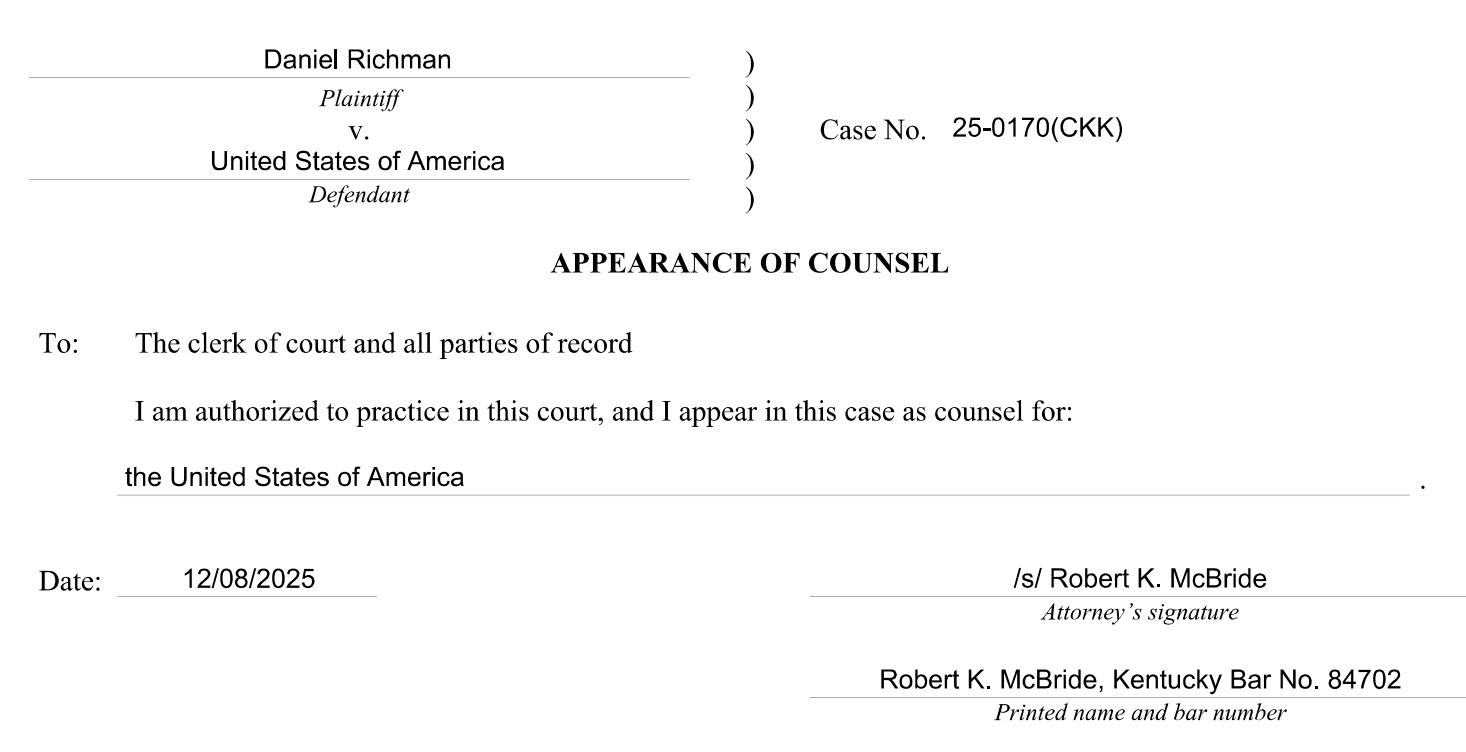
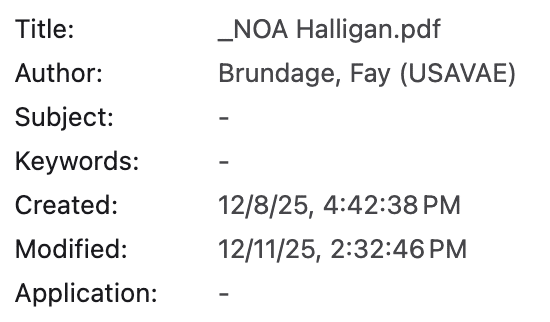
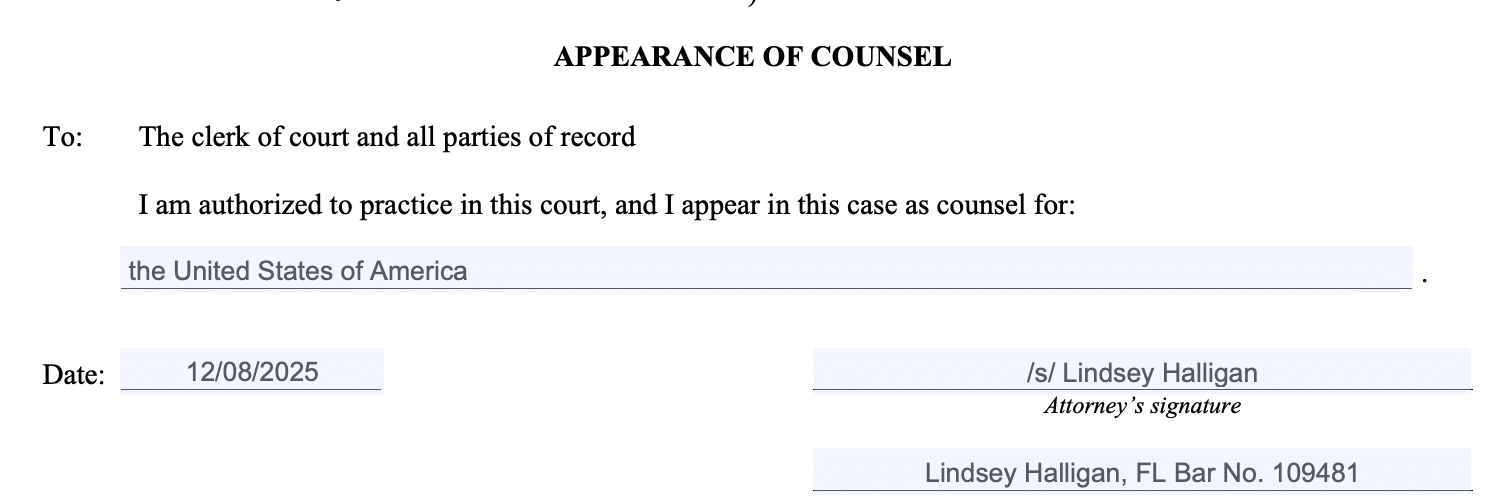
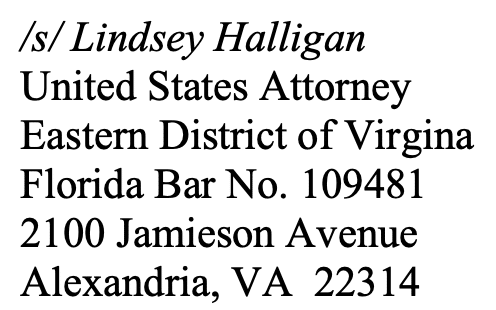
In addition to correcting Lindsey Halligan’s confusion over her own identity and that of Robert McBride, the government has written an emergency request asking for a week to comply with Judge Colleen Kollar-Kotelly’s order to destroy all evidence after depositing a copy with EDVA.

Only, the entire motion reneges on that claim.

Some of the government requests are reasonable — they’ll promise not to access the data in the interim week, they don’t want to return the Jim Comey memo that was up-classified after he sent it to Richman in 2017 because it is now classified, and they don’t want Pam Bondi to make promises herself (which is different from Todd Blanche doing so).

To that latter end, though, they cannot imagine any reason why it’d be necessary for someone at Main DOJ — and not someone at EDVA — to certify compliance, not even given Pam Bondi’s repeated intrusion in this matter.

The Attorney General has directed appropriate Department of Justice personnel to seek clarification of the obligations imposed by this Court’s order and to take steps to comply with those obligations. But there is no practical or legal reason to require the Attorney General to immediately and personally certify compliance on the unusually expedited timeframe imposed by the Court’s order, rather permit her to rely on any of her hundreds of attorneys and officers, including any attorney employed by the U.S. Attorney’s Office for the Eastern District of Virginia or the Department of Justice, generally.

The reason why, of course, is that lawyers have shared this information between — at least — EDVA, WDVA, and SDFL. And the only people with authority over all those offices are Pam Bondi and Todd Blanche.

In a footnote, the DOJ request preserves a request for reconsideration, which makes you wonder whether there’s not more going on.

5 The Government maintains its position that the Government did not engage in an impermissible search in the 2025 investigation, nor did the Government engage in an unreasonable seizure by continuing to hold the documents obtained by the Government through a lawful search warrant in 2019. Petitioner Richman voluntarily provided these documents pursuant to consent, and while the consent agreement with Petitioner Richman includes limitations on searches, it does not provide, in the event of a prohibited search, for return of property or render continued possession of the property an unlawful seizure. Accordingly, this Court erred in treating any impermissible search as authorizing this Court’s order under Rule 41(g)—which addresses unlawful or harmful seizures—and the Court should grant reconsideration on that basis.

In a paragraph that could invite estoppel considerations, half of Trump’s defense team from his Florida prosecution (in which Todd Blanche and Lindsey Halligan argued the government had no business seizing records because their retention violated the Federal Records Act) argued that they can’t turn over the materials because … they’re covered by the Federal Records Act.

The Government is simultaneously complying with a litigation hold put in place pursuant to a preservation letter from counsel for James Comey.3 See Gov. Ex. 1 at 19. The Government further understands that copies of portions of the relevant files are in the possession of government personnel (e.g., having been printed, saved locally, or emailed). Finally, the Government understands that the relevant files may include e-mails and other electronic communications between Petitioner Richman and James Comey, when both individuals were employed at the FBI, and regarding government business. 4 Such files are undoubtedly property of the Government and are likewise required to be maintained by the Government, and in the Government’s possession, pursuant to the Federal Records Act of 1950.

3 The Government’s compliance with the order may also implicate the Government’s obligation to maintain files pursuant to the Federal Records Act. See 44 U.S.C. § 3301 et seq.

4 Indeed, as the Court noted in its December 12, 2025 opinion, the Arctic Haze investigation in part concerned alleged “theft and conversion of public records.” See ECF No. 19 at 8; see also 18 U.S.C. § 641.

Nothing about this claim is consistent with a goddamn thing Blanche and Halligan argued before Aileen Cannon in 2022.

Not.

A.

Thing.

As noted, the government wants to avoid giving Richman the stuff they’ve copied and emailed, deeming those government records.

It repeats this concern in its request for clarification.

b. It is similarly unclear to the Government whether the Court means for the Government to provide Richman with all copies of portions of the covered materials that are in the possession of government personnel (e.g., having been printed, saved locally, or emailed) in addition to a full and complete copy of the covered materials, or whether the Court intended that such documents be destroyed by the Government. The provision of such documents to Richman might in some cases (e.g., if a document from the covered materials was attached to an email sent by an attorney for the Government) seriously implicate the Government’s attorney-client privilege, the attorney work-product doctrine, attorney-client confidentiality, the deliberative process privilege, and, potentially, other applicable law, including, but not limited to, sealing orders accompanying the search warrants and any potential grand jury material subject to Rule 6(e) of the Federal Rules of Criminal Procedure.

And then it repeats it in the order itself!

3. Other than providing full and complete copies of the covered materials to Richman (not including any classified information) and the Classified Information Security Officer for the United States District Court for the Eastern District of Virginia, the Government shall maintain the original evidence (and any other portions of the covered materials in the possession of the Government) and shall not access the covered materials or share, disseminate, or disclose the covered materials to any person without first seeking and obtaining a Court order.

This is the opposite of what Kollar-Kotelly ordered. They’re asking only for the protective order, not the return — or at least destruction — of Richman’s property!

Most interestingly, though, the proposed order seeks to prevent Richman from using the hypothetically returned data — his own data!!! — for any purpose other than “this proceeding,” which would permit him to expand his Fourth Amendment complaints, but not to bitch (or sue) about what they did with his data.

8. Materials produced to Richman pursuant to this Order may be used solely for purposes of this proceeding and shall not be disclosed, disseminated, or used for any other purpose absent further order of the Court.

The problem, of course, is that it is his data. DOJ would be returning this data because … it is his data. While this may be in the order for no reason other than boilerplate, this would gag Richman from talking about what the FBI did when they conducted unlawful searches of his data (which evidence would be withheld anyway on the other complaints).

Sorry, FBI, maybe you shouldn’t have conducted warrantless searches of someone’s data if you wanted to withhold evidence othe unlawful searches of Dan Richman’s data you did.

But a judge has ruled it is his data — it belongs to him. And the notion that you’re going to gag him about what the data looked like after being returned from six years of FBI custody defies the very claims of property rights that Judge Kollar-Kotelly has already granted.

Update: Judge KK clarified her order on these two issues, while granting the delay (but complaining that DOJ didn’t raise them in briefing).

Further, this Court’s Order directed the return of Petitioner Richman’s own materials (and any copies of those materials), not any derivative files that the Government may have created. See Order, Dkt. No. 20, at 1 (directing the return of the original materials, copies of those materials, and any materials “directly obtained or extracted” from them); see also id. at 41 (explaining that the Court would not bar the Government from “using or relying on” the relevant materials in a separate investigation or proceeding). Accordingly, compliance with the Court’s Order will not intrude upon any of the Government’s privileges.

Finally, it was not the Court’s intention to require a personal certification of compliance by the Attorney General of the United States. The Court’s Memorandum Opinion makes clear that a designee of the Attorney General could discharge this responsibility. See Mem. Op., Dkt. No. 21, at 4 (“The Court shall further ORDER the Attorney General of the United States or her designee to certify …. “). The Court also understood the certification of compliance to be among the responsibilities that the Attorney General may delegate in the routine performance of her duties. Consistent with these understandings, the Court shall clarify its Order to specify that a designee of the Attorney General may certify compliance.

Share this entry

Colleen Kollar-Kotelly’s Baby-Splitting with Dan Richman’s Devices

Judge Colleen Kollar-Kotelly issued an order that — if DOJ abides by it — should have the effect of forcing DOJ to do what they should have done in the first place before charging Jim Comey: Obtain a warrant for materials it claims supports their imagined crime.

At first, this looks like a tidy solution — and (as Politico notes) it may well present unbridgeable barriers to a renewed indictment of Jim Comey in EDVA, to say nothing of the Grand Conspiracy in SDFL. It’s also a solution that may prove resilient to appeal and because of that, avoid further scrutiny of its apparent tidiness.

But I’m not sure it is a just solution.

Start with the end result: DOJ has to destroy all copies of Dan Richman’s data in its possession, but first, Kollar-Kotelly ordered, they must give a copy of it all under seal to EDVA.

[T]he Court shall further ORDER that, before returning the covered materials to Petitioner Richman, the Government may create one complete electronic copy of those materials and deposit that copy, under seal, with the U.S. District Court for the Eastern District of Virginia, which shall have supervisory authority over access to this material, for future access pursuant to a lawful search warrant and judicial order. The U.S. District Court for the Eastern District of Virginia may then exercise its discretion to decide whether to allow Petitioner Richman an opportunity to move to quash any such warrant before it is executed.

Kollar-Kotelly describes this as a balancing solution, protecting Richman but preserving the government’s ability to use this data against Comey.

Allowing the Government to retain a copy in its own possession therefore would not provide adequate redress to Petitioner Richman. Meanwhile, requiring the Government to return all copies of the files to Petitioner Richman could unduly impede the Government’s interests in pursuing future investigations and prosecutions if—as the Government strongly suggests in its briefing—it intends to pursue further prosecution of Mr. Comey. See supra Section III.C. The appropriate way to balance these interests, and to provide redress to Petitioner Richman without transforming his motion into a “collateral (and premature) motion to suppress evidence in another criminal proceeding,” see Gov’t’s Opp’n & Mot. at 7, is to allow a copy of the files to be retained for

As noted, this solution may well pose grave problems for the government, at least its hopes of reindicting in EDVA.

When Magistrate Judge William Fitzpatrick first laid out the Fourth Amendment violations involved in the searches targeting Jim Comey, he speculated that the reason DOJ did not get a warrant to access the material is because they were rushing to beat the statute of limitations.

That may be part of it, but there’s another reason. The theory of crime behind the indictment is that Jim Comey lied in September 2020 when he said that he had never authorized anyone at the FBI to leak anonymously. But as Comey laid out as part of his bid for a Bill of Particulars, none of the exhibits presented to the grand jury match that theory: they either involve stuff Richman did publicly or stuff he did after he left the FBI.

Here, the government has repeatedly failed to provide a coherent factual basis for its theory that Mr. Comey authorized Mr. Richman to be an “anonymous source” in news reports regarding the Midyear Exam investigation while Mr. Richman was “at the FBI.” Of the communications following Mr. Comey’s October 28, 2016 letter that the government cites in both briefs, none reflect Mr. Comey authorizing Mr. Richman to be an anonymous source. For instance, the communications show Mr. Richman discussed materials that were already public, like Mr. Comey’s letter to Congress. See, e.g., Opp. at 3 (“Wittes and I are spending a lot of time saying your letter means exactly, and only what it says.” (emphasis added)); id. at 3-4 (quoting the defendant as telling Mr. Richman that Richman’s contributing to a New York Times Opinion piece “would [be] shouting into the wind,” and “that they would ‘figure it out’” without Richman’s contributions). And even where the government alleges that Mr. Comey encouraged Mr. Richman to speak to the press in late October and early November 2016, there is no indication that Mr. Richman did so anonymously; to the contrary, one of the exhibits the government cites references Mr. Richman’s televised interview with Anderson Cooper. Opp. at 4 (citing ECF No. 138-6, 138- 7). The remaining communications cited by the government in its Opposition to Defendant’s Motion to Dismiss Indictment Based on Vindictive and Selective Prosecution suffer from numerous defects, but most critically, all occurred after February 7, 2017, when Mr. Richman left the FBI. This alone makes the government’s theory that Mr. Richman was “at the FBI” when these communications occurred incomprehensible. [Emphasis original]

To get a warrant — at least for the theory of the case presented in the EDVA indictment — DOJ would have to lay out what it failed to here, that there’s probable cause that Comey intentionally had Richman leak stuff anonymously while still at the FBI. Worse, in a warrant affidavit, unlike in a grand jury, the FBI would have to be honest about all the exculpatory evidence, such as the date Richman left. And even assuming DOJ could get that warrant, they would have to adhere to the terms of it; the warrant likely would not permit them to access materials that post-date Richman’s FBI departure, for example, which is the stuff they want the most.

Putting the materials at EDVA — where DOJ claims, unpersuasively, any and all ongoing investigation is — would ensure that prosecutors from WDVA or SDFL have to go there to obtain this information for other investigations. Even if Aileen Cannon approved an outrageous warrant for the Grand Conspiracy investigation, EDVA would have some visibility on it, most notably on any claim that there’s something criminal about releasing a memo showing Trump’s corruption when John Durham couldn’t find a crime in that after four years of looking.

And putting the material at EDVA would ensure that prosecutors do what they tried to avoid with their bid for a filter protocol: ignoring Fourth Circuit precedent by excluding courts from any privilege determination. They will not get a warrant in EDVA that does not provide Comey an opportunity to assert his own privilege claims.

Where I have some discomfort with Kollar-Kotelly’s opinion, though, is in limiting her holding to how badly DOJ fucked Richman’s Fourth Amendment rights.

As she laid out, Richman described three ways DOJ violated his Fourth Amendment rights: (1) by seizing data outside the temporal limits of the warrants, (2) by failing to scope the data specific to the crimes under investigation and sealing or destroying the rest, and then (3) by searching the raw data without a warrant five years later.

To obtain the return of his property under Rule 41(g), Petitioner Richman must show that “the property’s seizure was illegal.” United States v. Wright, 49 F.4th 1221, 1225 (9th Cir. 2022) (citation modified). Petitioner Richman contends that the Government’s seizure of his property violated his Fourth Amendment rights “in at least three ways.” Pet’r’s T.R.O. Mem., Dkt. No. 9- 1 at 17. First, he argues that the Government “exceeded the scope” of the prior warrants it obtained in 2019 and 2020 to search his property by “seizing both responsive and non-responsive materials.” Id. at 17–20. Second, he argues that the Government has continued to retain his materials for an “unreasonable” period of time. Id. at 17, 20–22. Third, he argues that the Government executed an unreasonable warrantless search of the retained property in 2025. Id., at 17, 22–23.

William Fitzpatrick, in ruling these were likely Fourth Amendment violations, put the fault on the original Arctic Haze investigators more than on the current Jim Comey team.

There is nothing in the record to suggest the government made any attempt to identify what documents, communications or other materials seized from Mr. Richman constituted evidence of violations of 18 U.S.C. § 641 and § 793. To be clear, ensuring that agents and prosecutors seize only those things which a court has authorized is a critical early step in the execution of any warrant and an elemental responsibility of all government agents.

But having laid those out as three problems, Kollar-Kotelly then flattens item one and two into one issue: the initial seizure. Her initial discussion discusses only whether or not the government scoped the material it seized within the two crimes at question; it ignores the question of the temporal overseizure, which (unless there are warrants DOJ is hiding) should be clearcut.

Petitioner Richman’s motion concerns the Government’s seizure of his property pursuant to four different search warrants executed in 2019 and 2020. Petitioner Richman claims that the Government’s execution of these warrants violated his Fourth Amendment rights because the Government seized more material than the warrants authorized. Pet’r’s Mem., Dkt. No. 2-1 at 13. Petitioner Richman neither contests the validity of the four search warrants nor disputes the fact that the warrants permitted the Government to search his property “broadly.” Id. Petitioner Richman, however, claims that the warrants only authorized the Government to seize information that constituted “evidence and/or instrumentalities of” a violation of either 18 U.S.C. § 641 (theft and conversion of government property) or 18 U.S.C. § 793 (unlawful gathering or transmission of national defense information).

But then she just waves her hands and says she doesn’t have enough information to hold that that is a Fourth Amendment violation.

In light of Magistrate Judge Fitzpatrick’s findings, the Court concludes that Petitioner Richman has established a reasonable basis for his claim that the Government exceeded the scope of the 2019 and 2020 “Arctic Haze” warrants when seizing his property. On the present record, however, the Court shall not determine whether Petitioner Richman has conclusively established a violation of his Fourth Amendment rights based on his claim that the 2019 and 2020 “Arctic Haze” seizures at issue were overbroad. Magistrate Judge Fitzpatrick’s findings raise a substantial question as to whether Petitioner Richman’s Fourth Amendment rights were violated when the Government executed the 2019 and 2020 warrants at issue. However, the parties have not provided the Court with additional information in the record that would enable the Court to make a conclusive determination of Petitioner Richman’s Fourth Amendment claim about over-seizure as to the 2019 and 2020 “Arctic Haze” warrants.

So Kollar-Kotelly bases her baby-splitting ruling exclusively on DOJ’s search in 2025 without a warrant.

The Court will address each of Richman’s arguments in turn. In doing so, the Court concludes that, although the Government’s initial seizure of Richman’s property and its continued retention of that property did not violate Richman’s Fourth Amendment rights, the Government’s warrantless search of his property in 2025—approximately five years after it initially seized that property—did violate those rights. The Court further concludes that the Government’s mishandling of Petitioner Richman’s property renders its continued retention of that property an unreasonable Fourth Amendment seizure.

My guess is Kollar-Kotelly did this because she didn’t need to pursue the question further to achieve her Solomonic outcome. Simply finding a clear Fourth Amendment violation — here, in searching Richman’s data without a warrant — proved enough to find him aggrieved and injured.

There are several problems with this.

Having dispensed with the mystery overseizure by date and the failure to seize the data pertinent to two suspected crimes and seal the rest, Kollar-Kotelly then applies four different decisions to this data:

  • United States v. Jacobsen: A 1984 case about the test of white powder after having seized it.
  • Asinor v. DC: An effort to get a bunch of physical cell phones (one belonging to an independent journalist) back years after DC’s Metropolitan Police Department seized them at an August 13, 2020 George Floyd protest. Last year, Greg Katsas ruled for the protesters.
  • In the Matter of the Search of 26 Digital Devices: A set of opinions in which first Magistrate Judge Michael Harvey and subsequently then-Chief Judge Beryl Howell considered a warrant to access a bunch of devices. Harvey first held that the government could not go back into data retractions after closing an investigation. Howell reversed that.

Here’s how Kollar-Kotelly incorporated these decisions.

Judge Howell noted two critical procedural requirements for searches of stored extracts of digital device data from prior investigations, both of which had been satisfied in the case before her. First, and most fundamentally, “in order for the [G]overnment to search a cell phone’s digital data[,] the [G]overnment must get a probable cause warrant.” Digital Devices II, 2022 WL 998896, at *15 (citing Riley v. California, 573 U.S. 373 (2014)). Second, “[o]nce the government’s investigation unearths the likelihood that evidence of offenses not covered by the initial warrant exists, the government must set forth adequate probable cause and particularity to secure a warrant expanding the scope of its search of previously seized evidence.” Id.

Although nearly all of Judge Howell’s reasoning remains powerfully persuasive, one aspect of her analysis appears to have been altered by the D.C. Circuit’s intervening decision in Asinor v. District of Columbia, 111 F.4th at 1262. Judge Howell’s decision that the closure of the prior investigation did not preclude the Government from obtaining a warrant to search the stored extracts for a later proceeding rested in part on a conclusion that “[t]he Fourth Amendment does not operate as an arbiter of law enforcement retention policies for lawfully seized evidence.” Digital Devices II, 2022 WL 998896, at *1. Although Judge Howell’s conclusion on this point is consistent with the law of many circuits, the D.C. Circuit recently held in Asinor that the Fourth Amendment does regulate the Government’s retention of evidence by requiring “continuing retention of seized property to be reasonable.” 111 F.4th at 1261. The court reasoned that although it is not clear from the text of the Fourth Amendment’s protection of the right to be “secure” against “unreasonable . . . seizures” whether the provision regulates retention after an initial lawful seizure, history and common-law tradition from the Founding era support the conclusion that the reasonableness requirement governs not only the “taking possession” but also the “continued retention” of property. Id. at 1254–55.

[snip]

Applying each of these principles, the Court concludes that it was reasonable for the Government to retain Petitioner Richman’s files after it closed the “Arctic Haze” investigation, but only so long as the Government adequately protected those files by refraining from accessing or searching them without a warrant.

But let’s go back and look at the problems. The most direct precedent, the 26 Digital Devices, involves warrants served the same year (2021) as the phones were originally seized. There’s a difference between retention for a matter of months and for years.

And all of these rulings assume the initial seizure was legal; by hand-waving over the two claimed overseizures in 2020 (one based on temporal overseizure, another based on failure to scope and seal), Kollar-Kotelly has applied potentially inapt precedents to this case, and in so doing simply said that the government needed a warrant and the government needs a warrant.

And then she sent the data to EDVA in the Fourth Circuit, where a different set of precedents apply which … now that part of the decision looks especially reckless.

From there, Kollar-Kotelly goes further, refusing to adopt Richman’s application of taint to the data the government already unlawfully seized (Kollar-Kotelly dodges all discussion of DOJ’s attorney-client violations in this opinion as well).

Finally, Petitioner Richman requests an order barring the Government from “using or relying on in any way” the information derived from the image of his laptop. See Pet’r’s Rule 41(g) Mem. at 26; see also id. at 19 (arguing that the Government should be “barred from using evidence obtained from” the image in its case against Mr. Comey). This remedy would be broader than an order for return of property to which Petitioner Richman is entitled. It would not only deprive the Government of the opportunity to use Petitioner Richman’s materials as evidence, but it would also presumably bar the Government from presenting testimony or Finally, Petitioner Richman requests an order barring the Government from “using or relying on in any way” the information derived from the image of his laptop. See Pet’r’s Rule 41(g) Mem. at 26; see also id. at 19 (arguing that the Government should be “barred from using evidence obtained from” the image in its case against Mr. Comey). This remedy would be broader than an order for return of property to which Petitioner Richman is entitled. It would not only deprive the Government of the opportunity to use Petitioner Richman’s materials as evidence, but it would also presumably bar the Government from presenting testimony or pursuing investigative leads based on what Government agents learned by reviewing those materials before returning them. Such a broad order might also bar the Government from seeking to obtain the materials again in the future by obtaining a valid search warrant from a judicial officer

Here, too, Kollar-Kotelly’s initial scope — accepting just one of Richman’s three claimed injuries — allows her a baby-splitting solution. The searches that got into Jim Comey’s privileged communication would have been illegal on the scope issue, but Kollar-Kotelly is making it available the government (pending a warrant and privilege review) in a way in which Comey would not have Fourth Amendment injury.

As I said, perhaps Kollar-Kotelly adopted this solution because she just wants an answer that is far easier than the data provides. Perhaps she adopted the solution because something that the unnamed AUSA with whom she was in communication (who might be Jocelyn Ballantine) explained — at least — the temporal overcollection but did so in such a way that renders the AUSA’s testimony unavailable to Richman.

First, although the Court has been in communication with attorneys from the U.S. Attorney’s Office for the District of Columbia, 1 the U.S. Attorney’s Office for the District of Columbia has not yet entered an appearance to make representations on behalf of the Government, and counsel for the Government has not yet been identified. See Pet’r’s Ex. A, Dkt. No. 9-2.

1 These attorneys have helpfully facilitated communication on administrative matters. The Court appreciates counsel’s prompt assistance on these matters.

And maybe it’ll work? Maybe this will result in Richman’s entire digital life collecting dust in EDVA, where his standing to challenge it is much less clear.

Or maybe DOJ will give the data to Richman (as opposed to simply destroying it) and he’ll have basis to prove the two underlying Fourth Amendment injuries and be able to (and willing to) ask for more.

But while it is an interesting ruling for the Comey case, it is a highly unsatisfying ruling from a Fourth Amendment.

Update: The government is requesting a week, during which period they claim they won’t access the data. But in a footnote they ask for reconsideration because Kollar-Kotelly found a Fourth Amendment violation with a search, not a seizure.

5 The Government maintains its position that the Government did not engage in an impermissible search in the 2025 investigation, nor did the Government engage in an unreasonable seizure by continuing to hold the documents obtained by the Government through a lawful search warrant in 2019. Petitioner Richman voluntarily provided these documents pursuant to consent, and while the consent agreement with Petitioner Richman includes limitations on searches, it does not provide, in the event of a prohibited search, for return of property or render continued possession of the property an unlawful seizure. Accordingly, this Court erred in treating any impermissible search as authorizing this Court’s order under Rule 41(g)—which addresses unlawful or harmful seizures—and the Court should grant reconsideration on that basis.

Share this entry
Ed Martin and Lindsey Halligan posing together in his office. They both look really weird, with him being bottom-heavy and forward leaning,and her propped up on ugly shoes.

Lindsey Halligan Can’t Tell the Difference between a Man, a Woman, and a Ham Sandwich

Oh hey!

If it’s Thursday, it must be get no-billed by the Letitia James grand jury again!

Virtually every outlet (Politico, NYT, WaPo, AP, CNN) reports that DOJ tried again to indict New York’s Attorney General, once again getting no-billed by the grand jury. Maybe, just maybe, there’s not probable cause that Attorney General James did what frothers claim she did?

The day was not entirely a loss for Lindsey the Insurance Lawyer Masquerading as a US Attorney, though.

She almost managed to comply with Judge Colleen Kollar-Kotelly’s order yesterday to comply with Judge KK’s earlier order from last Saturday.

Before Judge KK’s deadline of 10 AM, Lindsey the Insurance Lawyer Masquerading as a US Attorney filed something called, “NOTICE of Appearance by Lindsey Halligan on behalf of UNITED STATES OF AMERICA (Halligan, Lindsey) (Entered: 12/11/2025),” dated Monday, which looks like this:

The metadata shows that Fay Brundage created the document. It also shows that it was actually created on December 8, as if they thought the better of actually filing a notice of appearance.

And at the same time, Robert McBride filed something called, “NOTICE of Appearance by Robert Kennedy McBride on behalf of UNITED STATES OF AMERICA (McBride, Robert) (Entered: 12/11/2025),” also dated Monday, which looks like this:

The metadata for that show no one changed the metadata from the original US Courts template created in 2008.

Hours and hours after Judge KK’s deadline, Lindsey the Insurance Lawyer Masquerading as a US Attorney filed something called, “NOTICE Certificate of Compliance by UNITED STATES OF AMERICA (Halligan, Lindsey),” meant to comply with this order from Judge KK.

The United States and its agent, the Attorney General of the United States, are ORDERED to identify, segregate, and secure the image of Petitioner Richman’s personal computer that was made in 2017, his Columbia University email accounts, and his iCloud account; any copies of those files; and any materials obtained, extracted, or derived from those files (collectively, “the covered materials”) that are currently in the possession of the United States.

The United States and its agents, including the Attorney General of the United States, are further ORDERED not to access the covered materials once they are identified, segregated, and secured, or to share, disseminate, or disclose the covered materials to any person, without first seeking and obtaining leave of this Court.

Here’s the language of the certificate of compliance, which is also dated December 8, which — hey! — is closer than Lindsey the Insurance Lawyer Masquerading as a US Attorney normally gets.

On December 6, 2025, the Court entered an Order [DE 10] stating that the government would “identify, segregate, and secure the image of Richman’s computer that was made in 2017, his Columbia University email accounts, and his iCloud account; any copies of those files; and any materials obtained, extracted, or derived from those files . . . currently in the possession of the United States.” The Court further ordered the government to not access, share, disseminate, or disclose these materials without further permission of the Court. Finally, the Court required the government to certify compliance with the Order by 12:00 p.m. ET on December 8, 2025.

The metadata shows that our good friend James Hayes — the guy in the thick of efforts to try to use material unlawfully accessed — is back, if only in spirit.

According to Carol Leonnig, Lindsey will be formally nominated to be US Attorney (which was already in the works). But Chuck Grassley pushed back on Trump’s complaints about the confirmation process (though without mentioning blue slips specifically). Honestly, it would be a lot of fun to have a Lindsey the Insurance Lawyer confirmation hearing.

But she may be too busy studying up on the difference between a man, a woman, and a ham sandwich.

Share this entry

Donald Trump Will Piss Away the Western Order Investing in Jared Kushner’s Imagined Business Savvy

It is just over nine years to the day since Jared Kushner naively asked Russian Ambassador Sergei Kislyak to use Russian secure facilities to communicate in such a way that US spies wouldn’t find them.

Kushner went forward with the meeting that Kislyak had requested on November 16. It took place at Trump Tower on November 30, 2016.1139 At Kushner’s invitation, Flynn also attended; Bannon was invited but did not attend.1140 During the meeting, which lasted approximately 30 minutes, Kushner expressed a desire on the part of the incoming Administration to start afresh with U.S.-Russian relations.1141 Kushner also asked Kislyak to identify the best person (whether Kislyak or someone else) with whom to direct future discussions—someone who had contact with Putin and the ability to speak for him.1142

The three men also discussed U.S. policy toward Syria, and Kislyak floated the idea of having Russian generals brief the Transition Team on the topic using a secure communications line.1143 After Flynn explained that there was no secure line in the Transition Team offices, Kushner asked Kislyak if they could communicate using secure facilities at the Russian Embassy.1144 Kislyak quickly rejected that idea.1145

Shortly after Kushner indicated his enthusiasm for back-channel discussions that US spies couldn’t find, Sergei Kislyak threw Sergey Gorkov at him — someone who would dangle financial goodies that would require overturning sanctions to collect, someone functionally analogous to Kirill Dmitriev.

The accounts from Kushner and Gorkov differ as to whether the meeting was diplomatic or business in nature. Kushner told the Office that the meeting was diplomatic, with Gorkov expressing disappointment with U.S.-Russia relations under President Obama and hopes for improved relations with the incoming Administration.1157 According to Kushner, although Gorkov told Kushner a little bit about his bank and made some statements about the Russian economy, the two did not discuss Kushner’s companies or private business dealings of any kind.1158 (At the time of the meeting, Kushner Companies had a debt obligation coming due on the building it owned at 666 Fifth Avenue, and there had been public reporting both about efforts to secure lending on the property and possible conflicts of interest for Kushner arising out of his company’s borrowing from foreign lenders.1159)

In contrast, in a 2017 public statement, VEB suggested Gorkov met with Kushner in Kushner’s capacity as CEO of Kushner Companies for the purpose of discussing business, rather than as part of a diplomatic effort. In particular, VEB characterized Gorkov’s meeting with Kushner as part of a series of “roadshow meetings” with “representatives of major US banks and business circles,” which included “negotiations” and discussion of the “most promising business lines and sectors.”1160

It’s all there in the Mueller Report, plain as day: From the very start Jared Kushner planned to use his role in Trump’s White House for his own benefit. It was in the background of his dealings with Mohammed bin Salman, who has domesticated him since. It was the plan for Russia, too, until Mike Flynn’s shitty OpSec scuttled the plan.

Even in the first iteration of this fraud, Jared was hiding what he was doing from the Secretary of State — at that point Rex Tillerson.

And then Kirill Dmitriev picked right up where he left off eight years earlier, finding the weak venal levers for Trump and, ultimately, Jared. The plan didn’t succeed in February. It came closer but didn’t succeed in August. In November, once Dmitriev finally got Kushner on board, it seems to be succeeding.

It’s all worth revisiting again given this important (but nauseating) report from WSJ– one they themselves suggest is the follow-up to their report, Make Money Not War: Trump’s Real Plan for Peace in Ukraine.

The way the Russians succeeded in getting Trump to sell out Ukraine and the West (and I promise you, Trump has no fucking clue the ramifications of this and probably doesn’t give a fuck anyway) was by taking the $300 billion seized by Europe as punishment for their invasion of Ukraine — money Europeans were hoping to use to arm Ukraine — and instead used it to bribe Trump, effectively.

The Trump administration in recent weeks has handed its European counterparts a series of documents, each a single page, laying out its vision for the reconstruction of Ukraine and the return of Russia to the global economy.

The proposals have sparked an intense battle at the negotiating table between America and its traditional allies in Europe. The outcome stands to profoundly alter the economic map of the continent.

The U.S. blueprint has been spelled out in appendices to current peace proposals that aren’t public but were described to The Wall Street Journal by U.S. and European officials. The documents detail plans for U.S. financial firms and other businesses to tap roughly $200 billion of frozen Russian assets for projects in Ukraine—including a massive new data center to be powered by a nuclear plant currently occupied by Russian troops.

Another appendix offers America’s broad-strokes vision for bringing Russia’s economy in from the cold, with U.S. companies investing in strategic sectors from rare-earth extraction to drilling for oil in the Arctic, and helping to restore Russian energy flows to Western Europe and the rest of the world.

[snip]

If the U.S. vision prevails, it would override Europe’s own plans to shore up Ukraine’s wartime government and further cement Russia’s economic isolation. The result is what several officials described as a frenzied race to move ahead before the U.S. imposes its own arrangements.

U.S. officials involved in the negotiations say Europe’s approach would quickly deplete the frozen funds. Washington, on the other hand, would tap Wall Street executives and private-equity billionaires to invest the money and expand the amount available to invest. One official involved in the talks said the pot could grow to $800 billion under American management. “Our sensibility is that we really understand financial growth,” the official said.

On Wednesday, Ukrainian President Volodymyr Zelensky said he had held productive conversations with the investment firm BlackRock’s chief executive, Larry Fink.

The U.S. negotiating team sees shared economic activity and energy interdependence as the cornerstone of its business-for-peace philosophy: Ukrainian data centers would draw power from the currently Russian-occupied Zaporizhzhia nuclear plant, Europe’s largest, for example.

Some European officials who have seen the documents said they weren’t sure whether to take some of the U.S. proposals seriously. One official compared them to President Trump’s vision of building a Riviera-style development in Gaza. Another, referring to the proposed U.S.-Russia energy deals, said it was an economic version of the 1945 conference where World War II victors divvied up Europe. “It’s like Yalta,” he said.

Just as pitching Trump on a Riviera where millions of Gazans once lived, Bibi Netanyahu solicited Trump’s assistance in genocide, so has Dmitriev convinced Trump to sell out the Western order by turning the nuclear plant they stole into fuel for a data center.

As Judd Legum lays out, this is all happening via a guy, Jared, effectively serving as an agent of the Saudis.

Kushner is engaged in activities that can only be conducted by government officials. The Logan Act bars private citizens from engaging in negotiations with foreign governments without authorization. Kushner is acting in an authorized capacity, under Trump’s direction, and that creates a host of legal issues.

As a de facto SGE with substantial authority, the Foreign Emoluments Clause of the Constitution prohibits Kushner from accepting “any present, Emolument, Office, or Title, of any kind whatever, from any King, Prince, or foreign State.”

Since leaving the White House in 2021, Kushner has raised at least $4.8 billion for Affinity Partners, his private equity firm. Nearly 99% of Affinity Partners’ funding comes from foreign sources. The largest investment, $2 billion, came from the Public Investment Fund of Saudi Arabia (PIF).

The Saudi government pays Kushner 1.25% of its investment, or $25 million annually. Other investors, including the governments of Qatar and the United Arab Emirates (UAE), pay annual fees of up to 2%. As of September 2024, Affinity Partners had collected $157 million in fees, mainly from Middle Eastern governments.

Kushner is continuing to collect these fees as he serves in a top foreign policy role for the Trump administration. This is precisely the kind of behavior the Foreign Emoluments Clause was designed to prevent.

See also Legum’s assessment of Jared’s role in Paramount’s effort to buy Warner using foreign (and Jared’s) money.

Horse trading away a half century alliance is bad enough.

But remember: These people are horrible businessmen. There’s no sign that Jared has any competence to judge these deals on the merits. He’s not a competent businessman, he’s a captured one.

And Trump was vastly more successful as a businessman when reality TV show producers controlled the plot than he every was IRL.

Throw enough goodies at my son-in-law and I will betray Europe, Donald Trump seems to be saying.

And that’s all it took.

Share this entry

Judge Colleen Kollar-Kotelly Demands Someone at DOJ Put Ethical Skin in the Game

Around mid-day (maybe my time? maybe yours?), everything went wrong in the Dan Richman docket, in his bid to stop DOJ from violating his Fourth Amendment rights in their bid to indict Jim Comey.

The Clerk alerted the filers of four of the last filings they had fucked up.

Richman’s attorneys — lawyers from NY who filed docket # 9 and 15 — had filed a document signed by the people who posted it under someone else’s PACER login. The Clerk reminded Richman’s lawyers the person who actually signs into PACER to file something must have signed the document.

The other error was potentially more serious. DOJ’s two filings, 12 and 13, which were DOJ’s identical bid to lift the restraining order on accessing Richman’s data and opposing Richman’s motion for a TRO, noticed a different error. Best as I can explain it, the guy who filed this stuff, John Bailey, is not on the filings at all.

Not scintillating, perhaps. But nevertheless a testament to the fact that this docket, with its NY lawyers for Richman and a mix of shady lawyers for DOJ, were not doing what the clerk’s office checks to make sure the people actually making court filings have ethical skin in the game.

This came after another apparent problem in the docket. By all appearances, Pam Bondi had blown off Judge Colleen Kollar-Kotelly’s order that someone at DOJ confirm they were following her order that the entire government will stay out of Dan Richman’s stuff until Friday.

The Attorney General of the United States or her designee is further ORDERED to certify that the United States is in compliance with this Order no later than 12:00 p.m. ET on Monday, December 8, 2025.

It turns out DOJ’s failure to file anything on the docket was just another problem with the docket.

After both DOJ and Richman filed their filings yesterday (which I wrote about here) and after neither responded to Judge KK’s order that if they want to discuss these files, they may need to do a filter protocol, Judge KK weighed in again.

She noticed the same thing I did!! None of the people making these claims wanted to put their own ethical skin in the game. This is, significantly, what she seemed to be looking for when she made sure Richman got someone to file a notice of appearance.

Today’s order reveals what happened with her order to file a notice of compliance by Monday: They emailed it, two minutes before her deadline (but fucked up Lindsey the Insurance Lawyer’s filing … and anything else would frankly shock me at this point, because this has happened with pretty much everything filed under her name since she first showed up for Trump).

In response to this Court’s [10] Order dated December 6, 2025, Attorney Robert K. McBride sent an email to this Court’s Chambers at approximately 11 :58 a.m. ET on December 8, 2025, attaching a document certifying the Government’s compliance with the Court’s [10] Order, along with proposed Notices of Appearance for himself and Attorneys Todd W. Blanche and Lindsey Halligan. 1

1 The document that the Court is construing as a proposed Notice of Appearance for Attorney Halligan was attached with the filename “NOA Halligan,” but the substance of the document appeared to be a Notice of Appearance for Attorney Blanche. Another document attached to Attorney McBride’s email, entitled “NOA Blanche” was identical to this document except that it omitted Attorney Blanche’s Bar number.

She then laid out the two problems I did here. “[P]roviding documents by email is not a substitute for filing them on the docket.” “Attorney Bailey’s electronic signature does not appear in the body of the Government’s [12] Response and Motion–only the electronic signatures of Attorneys Blanche, Halligan, and McBride appear-and Attorney Bailey has not filed a notice of appearance.”

And then she laid out the problem with it — the reason I’ve been watching it closely this week.

To ensure that counsel who are accountable for the Government’s representations and legal positions in this matter are accurately identified in the official record of this case, it is ORDERED that all counsel of record for the Government shall file notices of appearance no later than 10:00 a.m. ET tomorrow, December 11, 2025.

She needs someone to hold accountable. She needs ethical skin in the game.

And then she ordered someone to file a certification of compliance on the docket, like she originally expected, by tomorrow morning.

It is further ORDERED that, no later than the same deadline, 10:00 a.m. ET tomorrow, December 11, 2025, the Government shall file on the docket its certification of compliance with this Court’s [10] Order dated December 6, 2025.

Who knows what happens next?!?!

What I do know is Todd Blanche and his buddies are awfully squirmy about what they’re doing. And I’m not the only one who noticed.

Update: Here are two other dockets in which Todd Blanche played a key role:

  • In LaMonica McIver, in which he is witness, substitute US Attorney, and the guy who bypassed PIN, only the AUSAs appear.
  • In Jeffrey Epstein (and Ghislaine Maxwell), in which Blanche was the only signer of the original motion to unseal and in the district where he worked as an AUSA, he did file a notice of appearance, before others filed after him. Of course he got admitted in DC via representing Trump.

Update: Welp. DOJ failed. Robert McBride and Lindsey Halligan filed notices of appearance (albeit in each other’s names). Todd Blanche did not.

But they did not, as Judge Kollar-Kotelly ordered them to do, filed their certification of compliance to the docket.

Share this entry

Michael Anton and the Secret National Security Strategy

Lawrence Freedman must have finished his post on the National Security Strategy before the latest news on it, which is that there’s an even more alarming longer version.

Nevertheless, Freedman’s observations about the process behind the document — that Michael Anton is thought to have started it, before he left in September, and Stephen Miller may have finished it — provide one possible explanation for why the document is so short, shoddy, and unenthusiastic about matters of standard policy.

It is worth reading the most recent NSS in its entirety. It is less polished than its predecessor, betrays little evidence of consultation, and is considerably shorter (33 as against 70 pages). It reads like time had run out and a deadline had been reached. It ends abruptly with a short discussion on Africa, this administration’s least important region, without a proper conclusion. It was released without fanfare in the early hours of Friday morning, without a press conference, suggesting the White House was not sure what to do with it.

The first draft has been attributed to Michael Anton, who was the Director of Policy Planning in the State Department until September 2025, when he left. It may be that Stephen Miller, Trump’s deputy chief of staff who represents the hardest line MAGA views, completed the document or at least oversaw its completion. This perhaps explains why, as Gideon Rachman notes, when restating standard policy positions, for example on Taiwan, the prose is ‘dutiful’ – ‘one senses that the author’s heart is not in it.’ Only on the civilizational issues and when praising Trump does it get fired up.

Much of the document seeks to give the administration’s disparate policies, including those directed against DEI hires or climate change or immigration, some coherence and international relevance.

This hypothesis — that some of its unfinished nature arises from having its author, Michael Anton, depart before he finished would raise a bunch of questions in any case.

Politico first reported Anton’s departure in August (so in the wake of the Anchorage summit), but said he would leave once he finished the National Security Strategy.

A senior Trump administration official and a Senate aide said Anton plans to depart this fall. The State Department later confirmed that he is leaving his post.

Anton, who directs the State Department’s Policy Planning Staff, has been a low-profile but powerful presence with major roles on Russia, Iran and other foreign policy matters, including helping shape President Donald Trump’s still-unpublished national security strategy.

With Secretary of State Marco Rubio also serving as the national security adviser, a handful of political appointees such as Anton and Counselor Mike Needham have taken on more of the daily responsibilities of running the State Department.

Anton is expected to leave as the Trump administration wraps up writing the national security strategy, of which he is a lead author, according to the senior administration official. The official, and others, were granted anonymity to discuss internal deliberations.

[snip]

The Senate aide and another person familiar with administration dynamics said that Anton had been frustrated by Office of Presidential Personnel Director Sergio Gor shooting down a number of his potential hires and officials with the Trump administration such as Pentagon policy chief Elbridge Colby freelancing on key issues.

Anton had tried to resign in the spring amid frustration with the foreign policy processes of the administration, but Needham refused to let him do so, according to the Senate aide and two other people familiar with the matter.

The aide and one of those people said Anton was frustrated after being passed over as deputy national security adviser in the reshuffle after the departure of former national security adviser Mike Waltz.

But he ended up leaving in September, months before the NSS was dumped onto the world with no notice.

Which makes the Defense One claim all the more interesting. There’s a longer version of the NSS, which is even more inflammatory.

A longer version of the NSS, circulated before the White House published the unclassified version late Thursday night, shares the main points: competition with China, withdrawal from Europe’s defense, a new focus on the Western Hemisphere. But the unpublished version also proposes new vehicles for leadership on the world stage and a different way to put its thumb on the scales of Europe’s future—through its cultural values.

It was even more hostile to the EU than the public version is.

Austria, Hungary, Italy, and Poland are listed as countries the U.S. should “work more with…with the goal of pulling them away from the [European Union].”

“And we should support parties, movements, and intellectual and cultural figures who seek sovereignty and preservation/restoration of traditional European ways of life…while remaining pro-American,” the document says.

It excluded European nations from the alternative to the G7 it proposed, a C5 composed of China, Russia, India, Japan, and the US.

His national security strategy proposes taking this a step further, creating a new body of major powers, one that isn’t hemmed in by the G7’s requirements that the countries be both wealthy and democratically governed.

The strategy proposes a “Core 5,” or C5, made up of the U.S., China, Russia, India and Japan—which are several of the countries with more than 100 million people. It would meet regularly, as the G7 does, for summits with specific themes.

Most interesting — and something to which I’ll return — the unpublished version disavows hegemony.

The full NSS also spends some time discussing the “failure” of American hegemony, a term that isn’t mentioned in the publicly released version.

“Hegemony is the wrong thing to want and it wasn’t achievable,” according to the document.

These are, at this point, just data points. The existing NSS is shoddy and illogical. Michael Anton was going to see it through to completion but did not. There is reportedly a longer version — could that be what Anton wrote? Or could that be why he left before it was finished?

And we’re left with something that could have been written by Russia.

Share this entry

The False Claims Todd Blanche, Robert McBride, and Some Lady Impersonating a US Attorney Tell to Justify a Crime

Update: I realize that DOJ never complied with this part of Judge Kollar-Kotelly’s order.

The Attorney General of the United States or her designee is further ORDERED to certify that the United States is in compliance with this Order no later than 12:00 p.m. ET on Monday, December 8, 2025.

This court filing is a smokescreen.

DOJ — in the persons of Todd Blanche, some lady impersonating a US Attorney, and First AUSA Robert McBride — have responded to Dan Richman’s demand that they stop illegally rifling through his data.

It’s a remarkable filing for two reasons.

First, they cite a bunch of precedents claiming that one cannot use Rule 41 to thwart a prosecution. Best as I can tell, every single one of those precedents pertain to someone trying to withhold his own property to thwart his own prosecution. Michael Deaver trying to stop a Special Prosecutor investigation of himself. Paul Manafort trying to thwart a prosecution of himself. Justin Paul Gladding in a case where he was trying to get his own non-CSAM data back after a conviction. A grand jury case where the subject of the investigation tried to get his files back.

None of these apply here.

Effectively, Todd Blanche is saying Dan Richman has to lay back and enjoy digital compromise to allow the FBI to prosecute his friend and who cares if they’re breaking the law to do so.

But I’m also struck by the lies Blanche and the lady impersonating a US Attorney tell along the way. Consider this passage.

Richman served as a special government employee at the FBI between June 2015 and February 2017.1 Shortly after his departure from the FBI, the Government began investigating whether Richman had disclosed classified information to The New York Times concerning Comey’s decisionmaking process concerning the FBI’s investigation into former Secretary of State Hillary Clinton’s use of a private email server. See CM/ECF No. 1-1 at 3. The investigation demonstrated, among other things, that Comey had used Richman to provide information to the media concerning his—that is, Comey’s—decisionmaking process concerning the Clinton email investigation and that Richman had served as an anonymous source in doing so.

During the course of the investigation, the Government sought and obtained four search warrants in this district authorizing the Government to search for and seize evidence of violations of 18 U.S.C. §§ 641 and 793 from certain email accounts utilized by Richman, a hard drive containing a forensic image of his personal computer, and his iCloud account.2 See CM/ECF No. 1-1 at 3.

Comey provided relevant testimony to the Senate Judiciary Committee shortly before his employment as FBI Director was terminated, and again in September 2020. In May 2017, he testified in response to questioning from Senator Grassley that he had never authorized someone at the FBI to serve as an anonymous source regarding the Clinton email investigation. And in September 2020, he reaffirmed that testimony in response to questioning from Senator Cruz.

1 The government has provided the concise factual summary herein out of an abundance of caution as a result of the Court’s December 6, 2025 temporary restraining order (the “TRO”). See CM/ECF No. 9 at 4. Should the Court have meant the TRO to permit the government to use materials obtained via the relevant search warrants as part of this litigation, the government is prepared to provide a more detailed factual summary if necessary.

2 The investigators sought to obtain evidence of violations of 18 U.S.C. § 641 because it appeared that Richman and Comey were using private email accounts to correspond regarding official government business, i.e., that their correspondence were “record[s]” of the United States. See id.

First, the passage makes a confession, one that Lindsey the Insurance Lawyer Impersonating a US Attorney’s Loaner AUSAs never made: the use of May 2017 files involving attorney-client privilege had no basis in the prosecution, because they long post-dated the time Dan Richman left the FBI.

The filing misstates the genesis of Arctic Haze and the focus on Dan Richman. The investigation didn’t start by focusing on Richman. The focus on Richman appears to have started when John Durham discovered his communications while rifling through the image he shared with the Inspector General (a detail that seems quite sensitive, given the redactions).

The claim that the investigation demonstrated that Comey used Richman,

to provide information to the media concerning his—that is, Comey’s—decisionmaking process concerning the Clinton email investigation and that Richman had served as an anonymous source in doing so.

Is not backed by anything in the public record. Richman was not anonymous when doing this in fall 2016, and there’s no evidence that Comey asked Richman to do this in February 2017, where he was also an on-the-record source.

This filing obscures the fact that when Comey told Chuck Grassley he had not leaked anything anonymously, it preceded the time when Richman did share his memos anonymously, and he disclosed that publicly a month later, meaning it could not conceivably have been a lie on May 3, 2017 (before he shared the memo) or after June 8, 2017, in September 2020, because he had already disclosed it.

McBride claims he’s not using the unlawfully accessed materials in this filing, but he did disclose something new: that Richman and Comey were investigated under 18 USC 641 not because Comey shared a memo that the Inspector General would later rule was official FBI material, but because they were conducting official business on personal accounts (which is rich given that Lindsey the Insurance Lawyer masquerading as US Attorney used Signal for official business).

The lies are important for a reason beyond the cynicism: They obscure that if the FBI tried to get a warrant for these very same files, they would never be able to access the files they want.

And so they’re telling Dan Richman to just lay back and enjoy the Fourth Amendment violations.

Update: Richman’s response says exactly what I did (but in fancy lawyer-speak): The citations DOJ relied on all pertain to someone trying to get their own content back to prevent their own prosecution.

[I]n every single case cited by the government on this point, the movant was the target of an active investigation or the defendant in a charged criminal case. See In re Sealed Case, 716 F.3d at 604, 607 (observing that “the [DiBella] Court . . . found that each motion was tied to a criminal prosecution in esse because both movants had been arrested and indicted at the time of appeal” and that the movant in the case before it was “the subject of an ongoing grand jury investigation”) 6 ; Martino v. United States, 2024 WL 3963681, at *1 (3d Cir. Aug. 28, 2024) (movant was the “subject of an ongoing grand jury investigation” and brought a Rule 41(g) Motion tied to “his criminal prosecution”) (emphasis added); United States v. Nocito, 64 F.4th 76, 79 (3d Cir. 2023) (movant entities were owned by person charged with crime); In re Grand Jury, 635 F.3d 101, 105 (3d Cir. 2011) (finding DiBella’s second requirement met because “the property was seized in connection with an ongoing grand jury investigation of which the appellant is a target”) (emphasis added); In re Warrant Dated Dec. 14, 1990 & Recs. Seized From 3273 Hubbard Detroit, Mich. on Dec. 17, 1990, 961 F.2d 1241, 1242 (6th Cir. 1992) (involving “records . . . sought in connection with a criminal investigation of the appellants for tax evasion, filing of fraudulent tax returns, and conspiracy”).

Professor Richman is not a subject, target, or defendant. Though the government elides this fact, it bears repeating: because Professor Richman is not a prospective criminal defendant, he has no suppression remedy to address an ongoing violation of his constitutional rights. His property was seized five years ago, pursuant to warrants tied to a separate and since concluded investigation, and there is no indictment and no pending criminal case.

I actually think they might envision including him in a Grand Conspiracy indictment. But they’re pretending they’re not currently working on this and so got too cute for their own good — he notes that they twice dismissed his claims of irreparable harm because he was only at risk of being a witness at trial.

Share this entry