Welcome to 2024: New Little Habits, New Little Hopes

[NB: check the byline, thanks. /~Rayne]

“Ours is essentially a tragic age, so we refuse to take it tragically. The cataclysm has happened, we are among the ruins, we start to build up new little habitats, to have new little hopes. It is rather hard work: there is now no smooth road into the future: but we go round, or scramble over the obstacles. We’ve got to live, no matter how many skies have fallen.

― D.H. Lawrence, Lady Chatterley’s Lover (1928)

I let our side down yesterday observing the year’s first holiday. My mind has been chock full, too full to pull out anything cogent. I’m still not certain this essay will make much sense. It may look more like shards of stale cookies shaken out of an overstuffed jar.

Part of the challenge has been all that has happened this past year. There’s too much going on my life right now, an attestation to the craziness of the sandwich generation. Helping adult children establish themselves while helping elderly parents in their final descent can be a bit much. Hats off to all of you who’ve negotiated this stage of life without appearing in handcuffs on local or cable news because damn. I don’t know how you did it.

My sibling who has borne the brunt of caring for my parents has adopted a colorful label for the daily eldercare circus – a fuck show.

“What a fuck show,” they said, pounding their fist into their thigh as they punctuated what they’ve had to do to keep their sanity and avoid going postal. Every day is like a blow; every day requires the distraction of self-administered pain to redirect one’s focus.

When we got together this past month for a download on my parents’ condition and what will happen next, my sibling brought a fifth of a funky flavored vodka they’d recently sampled with their young adult son. My nephew liked it as did his buddies, but at his age they’ll drink almost anything without much discernment.

Sibling pulled out the bottle, asking me to try it and give my opinion. Smirnoff’s Spicy Tamarind Vodka, the bottle read, a bright and colorful design wrapped around the entire bottle. What the hell, I thought. It offered a decent break from the ongoing hours-long discussion about my parents’ version of the Divine Comedy. We arrived at the circle of hell where oddball alcoholic beverages might be welcome.

Welcome, but skeptically so. Tamarind is a popular flavoring used in Central and South America; the festive label’s design reflected Mexican cultural with skulls – a Dia del los Muertos theme.

It was rather fitting, considering the topics we’d been discussing. Illness and death were prominent themes throughout the previous couple of hours, including including a goofy story about a local Catholic priest trying to encourage use of their church’s cemetery over that of another parish.

Bring on the tamarind vodka, by all means.

It was funky – tart, a little tingly, a faintly herbaceous flavor which was both familiar and strange. We both agreed that unlike my nephew this wasn’t something we could drink straight.

“But what the hell do you do with it? I’ve never heard of tamarind before,” sibling asked. I’m more familiar with tamarind as a flavoring in southeast and central Asian foods, but not in any dishes or beverages I’ve prepared.

“What the hell do we have to lose?” I said. “Let me experiment with it.” I threw together a few things and ended up with a highly palatable beverage which lubricated our remaining now-darkly funny download.

Ladies and gentlemen, I give you a new cocktail: The Fuck Show.

In a cocktail shaker filled with ice, mix:

1 jigger hibiscus syrup
1-2 jiggers hibiscus tea
6 dashes cranberry bitters
1 jigger tamarind vodka

Shake and strain into a martini glass.

For a Fuck Show North, pour the above mixture over a highball glass filled with ice and top with lemon -flavored sparkling water. Stir and serve.

Yes, there’s a Fuck Show North, a complement to Fuck Show South which my sibling handles. My father-in-law is a competitive son of a bitch, one who has refused his entire life to be bested without a fight. There was plenty to discuss about that gentleman’s terminal velocity taking my household with him.

Sibling and I drank several of these newfangled cocktails and managed to laugh our asses off, looking more like those grinning death’s heads on the tamarind vodka bottle.

I raise this fresh cocktail I’ve poured myself as a nightcap to my sibling whose thigh must be permanently bruised from each blow they’ve applied rather than take out their frustration on others.

This icy cold Fuck Show is for you, sib. May 2024 treat us better in spite of the reality that all things tend toward increasing entropy.

We live in hope.

~ ~ ~

Look, we need to be frank with ourselves about the road ahead into 2024. It looks murky as hell.

There will be all kinds of prognostications claiming disaster is imminent on the other side of that murk for Democrats, documented by anecdotes obtained from people in flyover country.

The truth is disaster is certain if you fucking give up, if you buy into bullshit prepared by a failed media ecosystem which exists solely to make a profit and not to serve the public’s best interests or further democracy through which it has prospered.

If you’re going to give up, step aside and get out of the goddamned way.

The truth is far more complex than corporate-owned U.S. media will convey. Major outlets coverage of Trump’s crooked behavior over the course of his lifetime superbly exemplifies their inability to effectively communicate threats to the public and their own interests. You’ve seen here at this site many examples of what they’ve not covered, omitted, or distorted.

George Santos is another example of Big Media’s failings; the man should never have been elected to office but the biggest New York city and state newspaper couldn’t be bothered. Rep. Elise Stefanik should have been and should still be hammered in the media for her support of Santos which legitimized him in the public’s eye.

The rest of the corporate media’s coverage is the same save for a few bright, brave exceptions.

The truth is there will be surprises the corporate media will do a shitty job covering because corporate media is locked into narratives, the same ones they have relied on for decades. Their business model increasingly under pressure by vulture capitalists, they stick to what has worked in the past because it’s predictable.

Dig deeper. Read more broadly. Support smaller local media outlets like The North Shore Leader which covered Santos’ sketchiness The New York Times ignored.

Don’t overlook outlets abroad which had good reputations for thorough and unbiased reporting. In the age of the internet with translation capability at your fingertips, it’s absurd not to look outside of the U.S. news rut for a different perspective.

No matter what you read, act. Make a plan and act. I’ve said it before a number of times here that it can be surprising how little it takes to become a leader – in this country’s political system, they’re the people who show up and do the work. That’s it, that’s all it takes to make change happen. Show up, do the work.

But, but, but…there are no buts. Find a way to show up. Can’t do it physically in person? Then find a way to make calls, emails, send texts, bake and contribute goods for bake sales, whatever.

For Christ’s sake, fucking lick envelopes. I have literally spent days stuffing and sealing envelopes for a Democratic Party club. Just show up, ask what needs to be done, and do it.

We are heading into the toughest part of an existential fight for this democracy. It’s going to be an ugly, messy fuck show. Plan on it — bring gloves, sanitizer, wear safety glasses and masks and good walking shoes. And then do the work to beat back the fascists.

For some of us it really is a matter of life and death – how many women will die due to complications from a pregnancy they couldn’t end? How many trans persons will give up because they are unable to live life as normal human beings with autonomy over their bodies? How many persons will die from COVID this coming year because of right-wing propaganda supported by elected GOP officials? How many futures will be shortened because children today may not get the food, health care, and education they need, their families couldn’t obtain shelter to protect them?

I’ll repeat myself again, having said this after a painful election:

You want to keep your republic? I’ll tell you what I tell my kids: YOU HAVE TO WANT IT BADLY. And then you fucking find a way to make a contribution beyond showing up to vote. Democracy isn’t easy and neither am I.

Let’s fucking go, people. Let’s hit the road and tear into 2024 like we want a viable future badly.

This is an open thread.

Share this entry

What Jack Smith Didn’t Say in His Double Jeopardy Response

Jack Smith just submitted his response to Trump’s immunity claims before the DC Circuit.

While most attention will be on the absolute immunity claims, given the disqualification of Trump in Colorado and Maine, I’m more interested in Smith’s response to Trump’s claim that his impeachment acquittal precludes these charges.

That’s because, depending on how this appeal goes, Jack Smith could make the question of Trump’s (dis)qualification much easier by superseding this indictment with an insurrection charge.

Most of the response argues that impeachment and criminal charges are different things. That argument is likely to prevail by itself.

In addition, though, the response repeated a passage, almost verbatim, that appeared in Smith’s response before Chutkan. In it, Smith said that the elements of offense currently charged do not overlap with the elements of offense for an insurrection charge.

Any double-jeopardy claim here would founder in light of these principles. Without support, the defendant asserts that his Senate acquittal and the indictment in this case involve “the same or closely related conduct.” Br.52. Not so. The single article of impeachment alleged a violation of “Incitement of Insurrection,” H.R. Res. 24, 117th Cong. at 2 (Jan. 11, 2021) (capitalization altered), and charged that the defendant had “incit[ed] violence against the Government of the United States,” id. at 3. The most analogous federal statute is 18 U.S.C. § 2383, which prohibits “incit[ing] . . . any rebellion or insurrection against the authority of the United States or the laws thereof.” A violation of Section 2383 would therefore require proof that the violence at the Capitol on January 6, 2021, constituted an “insurrection against the authority of the United States or the laws thereof” and that the defendant incited that insurrection. Incitement, in turn, requires proof that the speaker’s words were both directed to “producing imminent lawless action” and “likely to incite or produce such action.” Brandenburg v. Ohio, 395 U.S. 444, 447 (1969) (per curiam); NAACP v. Claiborne Hardware Co., 458 U.S. 886, 927-28 (1982). None of the offenses charged here—18 U.S.C. § 371, 18 U.S.C. § 1512(c)(2) and (k), and 18 U.S.C. § 241—has as an element any of the required elements for an incitement offense. And the elements of the charged offenses—e.g., conspiring to defeat a federal governmental function through deceit under Section 371, obstruct an “official proceeding” under Section 1512, and deprive persons of rights under Section 241—are nowhere to be found in the elements of a violation of Section 2383 or any other potential incitement offense. The mere fact that some of the conduct on which the impeachment resolution relied is related to conduct alleged in the indictment does not implicate the Double Jeopardy Clause or its principles. See Dixon, 509 U.S. at 696.

This doesn’t mean that Smith will supersede Trump, if this appeal succeeds. There are a lot of reasons not to do so (including that Trump would get to file a motion to dismiss that charge).

That said, Smith might have another reason to do so if SCOTUS significantly narrowed the obstruction charge in the Fischer appeal, because the obstruction charge is how Smith is presenting the evidence that Trump caused the attack on the Capitol.

In my view, this language keeps options open.

Share this entry

Rudy Giuliani’s Scott Brady Interview Doesn’t Appear in His Warrant Affidavit

I’m about to do a larger post on some of the warrants targeting Rudy Giuliani and Lev Parnas, but first I want to make a point about the April 21, 2021 warrant targeting Rudy.

It doesn’t once mention Rudy’s January 29, 2020 interview with the Pittsburgh US Attorney’s office.

It sources Rudy’s own claims about his activities to a series of articles, interviews, and Tweets.

But the affidavit never once mentions that Rudy Giuliani sat for a 4-hour interview with the Pittsburgh US Attorney and nine other people on January 29, 2020.

NYT first disclosed the interview in this December 2020 article.

Mr. Giuliani’s lawyer, Robert J. Costello, asked the Justice Department for a meeting to discuss what he felt was explosive information about Hunter Biden that he had gathered from people in Ukraine and elsewhere, according to a person with direct knowledge of the matter.

In response, Mr. Brady called Mr. Costello and offered to meet. Mr. Giuliani and Mr. Costello sent reams of documents to Pittsburgh, then traveled there on Jan. 29. They were picked up by F.B.I. agents and stopped for breakfast before meeting for nearly four hours at the local F.B.I. office with Mr. Brady and his top deputies on the inquiry, Stephen Kaufman and Ira Karoll, the person said.

Rudy described the interview at length in a letter claiming that the government should never have seized his devices (and revealing that SDNY requested, in both November 2020 and January 2021, to do so).

[I]n January 2020, counsel for Giuliani contacted high officials in the Justice Department, to inform them that Giuliani wanted to provide evidence for their consideration about the Ukraine. Within a day, the United States Attorney for the Western District of Pennsylvania, Scott W. Brady, contacted Giuliani’s counsel and offered to hold a meeting in Pittsburgh with both the United States Attorney’s office personnel and the FBI. Mayor Giuliani immediately accepted, and a meeting was scheduled for January 29, 2020.

On January 29, 2020, Mayor Giuliani and his counsel, flew to Pittsburgh at their own cost, where they were met by agents of the FBI and transported to FBI headquarters in Pittsburgh. Present at that meeting were the United States Attorney, the First Assistant United States Attorney, the Chief of the Criminal Division, and two additional Assistant United States Attorneys (“AUSA’s”) from the Western District of Pennsylvania. The FBI was represented by the Special Agent in Charge (“SAIC”) of the Pittsburgh FBI, the Assistant Special Agent in Charge (“ASAIC”), and three other special agents of the FBI.

Prior to the meeting, Giuliani’s counsel had provided the Pittsburgh United States Attorney’s office with documents and an extensive outline of the subject matter to be discussed, so that the Government could be fully informed and prepared to ask probing questions. Giuliani began the meeting by making a presentation with handouts. During his presentation, and at the end of it, the Mayor and his counsel answered every question they were asked, to the apparent satisfaction of all of the Government officials in the room. In addition to the presentation, Giuliani provided the Government with the names and addresses of individual witnesses, both in the United States and in Ukraine, that could corroborate and amplify the information that the Mayor was providing. Subsequent to that meeting, and covering a period of months, counsel for Giuliani received a number of inquiries, discussions and requests from the First Assistant United States Attorney. All requests were granted and all inquiries were answered. [my emphasis]

At Scott Brady’s deposition before House Judiciary Committee, there was an extensive exchange about that interview — including regarding then-Principal Associate Deputy Attorney General Seth DuCharme’s request that Brady sit in on the interview personally — which I first wrote about here.

And I’ll get copies for everyone. It’s very short. This is an email from Seth DuCharme to you, subject: “Interview.” The date is Wednesday, January 15, 2020. And, for the record, the text of the email is, quote, “Scott I concur with your proposal to interview the person we talked about would feel more comfortable if you participated so we get a sense of what’s coming out of it. We can talk further when convenient for you. Best, Seth.” And tell me if you recall that email.

A Yes, I do recall it.

Q Okay. And the date, again, is January 15, 2020, correct?

A That’s right.

Q So that was 14 days before the interview that you just described at which you were present, correct?

A Correct.

Q Does that help you recall whether this email between you and Seth DuCharme was referring to the witness that you participated in the interview of on January 29, 2020?

A Yes, it definitely did.

Q Okay. Just for clarity, yes, this email is about that witness?

A Yes, that email is about setting up a meeting and interview of Mr. Giuliani.

Q Okay. So the witness was Mr. Giuliani? That’s who you’re talking about?

A Yes.

Q Okay. And it was, in your judgment, important to get Mr. DuCharme’s opinion or, quote, “concurrence” about interviewing Mr. Giuliani. Is that fair to say?

A As I sit here, I don’t know if it was about interviewing Mr. Giuliani or just the logistics of where the interview would take place Pittsburgh, New York, D.C. It might’ve been about that.

Q So you needed Mr. DuCharme’s opinion about where the interview would be taking place?

A No, I didn’t need his opinion.

Q Oh. I’m just trying to

A Yeah.

Q understand, what was the reason, if you can recall, why you consulted with Mr. DuCharme about that particular decision, about whether or not you should interview Mr. Giuliani and any other aspect of that decision?

A Yeah, I I don’t know. I may have just been circling back to him, saying, “Hey, here’s the plan.” And he said, “Yeah, that sounds fine.”

Q Okay. Well, he also said that he would feel more comfortable if you participated, right?

A In that email, he did, yes.

Q Yeah. Was that consistent with what your experience with Mr. DuCharme was when you discussed interviewing Mr. Giuliani, or is there something unusual about the email?

A I don’t remember that there’s anything unusual. I would’ve sat in on that interview anyways, in all likelihood.

Q Okay. And just I don’t want to take this away from you, because I know you and I

A Oh, sure.

Q just have one copy. But just, again, what this email says is, “I concur with your proposal to interview the person we talked about.” And then he says, “Would feel more comfortable if you participated so we get a sense of what’s coming out of it.” Do you see that?

A Uhhuh.

Q Okay.

A Yes.

Q So what did he mean by “we”? Who was he referring to by “we”? Do you know?

A I don’t know.

Q Okay. Is it fair to infer that he is referring to the Attorney General and the Office of the Deputy Attorney General where he was working?

A I don’t know. Yeah, some group of people at Main Justice, but I don’t know specifically if it was DAG Rosen, Attorney General Barr, or the people that were supporting them in ODAG and OAG.

Brady would go on to concede there were a number of things — such as Rudy’s attempts to reach out to Mykola Zlochevsky and his possession of a hard drive of data from Hunter Biden — that Rudy never told the Pittsburgh US Attorney.

Q Okay. Then the other question I think that I have to ask about this is: This is a prior inconsistent statement of Mr. Zlochevsky that your investigation did not uncover, but it’s a statement that Mr. Giuliani was certainly aware of. Would you agree?

A Yes, if based on your representation, yes, absolutely.

[snip]

Okay. And what I am asking you is, have you ever heard that during the course of your investigation that Mr. Giuliani actually learned of the hard drive material on May 30th, 2019?

A No, not during our 2020 vetting process, no.

Q Mr. Giuliani never shared anything about the hard drives or the laptop or any of that in his material with you?

Mr. [Andrew] Lelling. Don’t answer that.

Q Oh, you are not going to answer?

Mr. Lelling. I instruct him not to answer.

Q. He did answer earlier that the hard drive. That Mr. Giuliani did not provide a hard drive.

Mr. Lelling. Okay.

Mr. Brady. He did not provide it. We were unaware of it.

By his own telling, Rudy spent four hours telling a team of ten people about these matters, and yet this affidavit doesn’t mention that interview at all.

To be sure, in his book, Geoffrey Berman — who was likely fired for conducting this investigation — provides one explanation for why Rudy’s 302s wouldn’t be incorporated in any warrant affidavit targeting Rudy: because the FBI refused to share those 302s with the NY Special Agent in Charge, William Sweeney.

So in January 2020 he came up with a plan. He described this plan he had hatched as “an intake process in the field.” That made it sound almost normal. The Department of Justice, in order to deal with the large influx of evidence, was going to employ this tried-and-true method in order to keep it all straight! But in all my years as a prosecutor and defense attorney, I had never heard of “an intake process in the field,” and neither had my executive staff or Sweeney.

His plan was to run all Ukraine-related matters, including information that Giuliani was peddling about the Bidens, through two other districts. His choices were Rich Donoghue, the US Attorney for the Eastern District of New York, who sat in Brooklyn; and Scott Brady, the US Attorney for the Western District of Pennsylvania, in Pittsburgh. Donoghue would oversee all Ukraine-related investigations, and Brady would handle the intake of information from Rudy and his lawyer.

This scheme, notably, did not include me or SDNY, which, as the office running the Lev and Igor case, was well versed in all things Ukraine. Barr’s implication seemed to be that with such a fire hose of material coming in from Rudy and his lawyer, we needed to spread the work out. And we had to have some kind of traffic cop to keep it all organized and flowing in the right direction—which was to be Brady in Pittsburgh.

All of this, of course, was utter nonsense. If somebody has information about an ongoing case, they typically hire a lawyer and approach the office that’s involved. Regardless of the quality or veracity of the material, I wanted to see it. We were the office with the background to determine its value. And we certainly would have had our own questions for Rudy, because he was a close associate of the two guys we just indicted. What’s more, our office was only a taxi ride away for Rudy and his lawyer—Pittsburgh was a 350-mile trip for them.

We could have handled whatever information Rudy had. With more than two hundred fully capable attorneys, I would have found a couple more to throw into the mix if it came to that. But that’s not what was driving the attorney general’s machinations. I believe it was really an effort by Barr to keep tabs on our continuing Lev and Igor investigation and keep us segregated from potentially helpful leads or admissions being provided by Rudy.

This became immediately clear to me and to Sweeney when we tried to access the information Rudy was providing. Rudy and his lawyer met several times with Main Justice and then with Brady’s team in Pittsburgh. There were FBI reports of those meetings, called 302s, which we wanted to review. So did Sweeney. Sweeney’s team asked the agents in Pittsburgh for a copy and was refused. Sweeney called me up, livid.

“Geoff, in all my years with the FBI I have never been refused a 302,” he said. “This is a total violation of protocol.”

Sweeney asked Jacqueline Maguire, his special agent in charge, to reach out to the acting head of the FBI’s office in Pittsburgh, Eugene Kowel, to request the 302s and related information. A few days later Kowel got back to Maguire and repeated what Brady had told him about the 302s: “It’s not my job to help the Southern District of New York make a case against Rudy.” [my emphasis]

Yet SDNY had to wait until Bill Barr was long gone before they got approval to serve this warrant. How is it possible that in the month and a half since Merrick Garland came in, SDNY had never gotten permission to read the 302s from Rudy’s “cooperation” in Pittsburgh?

Related: In related news, in a request for a delay in responding to Hunter Biden’s lawsuit against Rudy and his former attorney now creditor Robert Costello, it appears they are represented by the same firm.

Share this entry

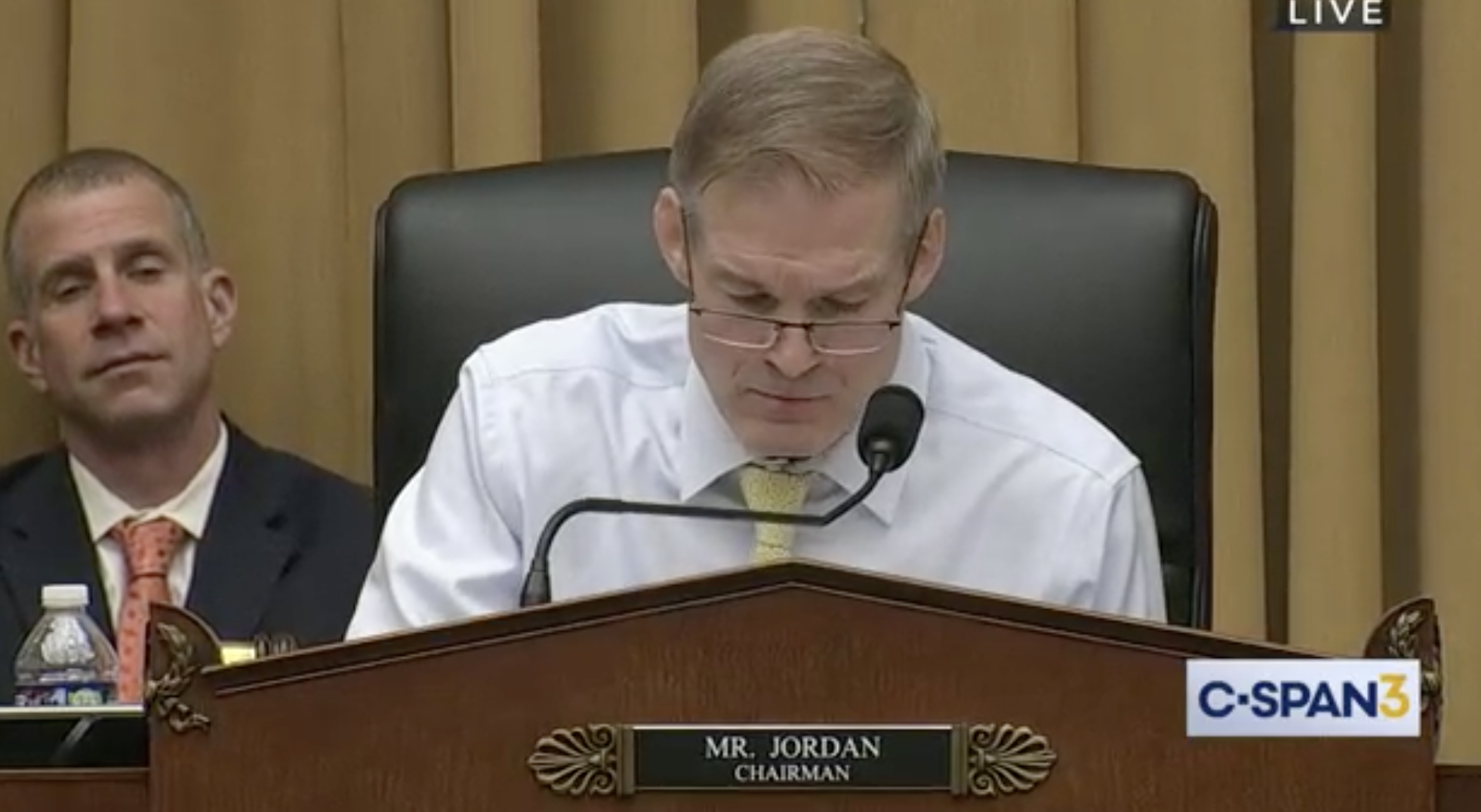
Jim Jordan Says Trump’s Years of Blowing Off Subpoenas May Merit Impeachment

In another ploy to get journalists at dick pic-sniffing right wing outlets like JustTheNews and NBC to air false claims, Jim Jordan and James Comer sent the White House a letter demanding any communications the White House had with Hunter Biden or his lawyers about blowing off a subpoena that — the letter itself notes — was issued before the chairmen obtained support of the House to issue impeachment subpoenas.

They base their claim that the President knew his son was going to blow off a subpoena on a misrepresentation of what Press Secretary Karine Jean-Pierre said later that day: that the President was familiar with what his son was going to say.

Look, as you know, Hunter Biden is a private citizen, and so I certainly would refer you to his representatives. Look, the President was certainly familiar with what his son was going to say, and I think what you saw was from the heart from his son. And you’ve heard me say this, you’ve heard the president say this, when it comes to the president and the first lady, they’re proud of him continuing to rebuild his life. They are proud of their son.

Perhaps Jean-Pierre was suggesting Joe Biden knew Hunter would say things like, “James Comer, Jim Jordan, Jason Smith, and their colleagues have distorted the facts,” a true statement similar to comments Joe himself has made. Perhaps Jean-Pierre’s comment meant that Joe Biden knew his son would say that Jordan and Comer, along with Jason Smith, “ridiculed my struggle with addiction [and] belittled my recovery,” something consistent with her own focus on his recovery. Given Jean-Pierre’s observation that “what you saw was from the heart,” perhaps she was referring to Hunter’s tribute to his parents’ love:

During my battle with addiction, my parents were there for me. They literally saved my life. They helped me in ways that I will never be able to repay. And of course they would never expect me to. In the depths of my addiction, I was extremely irresponsible with my finances. But to suggest that is grounds for an impeachment inquiry is beyond the absurd. It’s shameless. There’s no evidence to support the allegations that my father was financially involved in my business because it did not happen.

[snip]

They have taken the light of my Dad’s love — the light of my Dad’s love for me and presented it as darkness.

There is nothing in her statement that confirms foreknowledge that Hunter would blow off the subpoena, something conceded in the letter that her statement only, “suggests that the President had some amount of advanced knowledge that Mr. Biden would choose to defy two congressional subpoenas” [my emphasis].

Nevertheless, serial liar Comer and subpoena scofflaw Jordan use Jean-Pierre’s statement to insinuate that Joe Biden has committed what they themselves call a potentially impeachable offense of dissuading a subpoena recipient from complying with it.

Later on December 13, when asked whether President Biden had watched Mr. Biden’s statement, White House Press Secretary Karine Jean-Pierre stated that President Biden was “certainly familiar with what his son was going to say.”11 Ms. Jean-Pierre declined, however, to provide any further details about the President’s actions or whether the President approved of his son defying congressional subpoenas.12 Nonetheless, Ms. Jean-Pierre’s statement suggests that the President had some amount of advanced knowledge that Mr. Biden would choose to defy two congressional subpoenas.

Under the relevant section of the criminal code, it is unlawful to “corruptly . . . endeavor[] to influence, obstruct, or impede the due and proper exercise of the power of inquiry under which any investigation or inquiry is being had by . . . any committee of either House or any joint committee of the Congress[.]”13 Likewise, any person who “aids, abets, counsels, commands, induces or procures” the commission of a crime is punishable as a principal of the crime.14

In light of Ms. Jean-Pierre’s statement, we are compelled to examine the involvement of the President in his son’s scheme to defy the Committees’ subpoenas.

[snip]

[T]he fact that the President had advanced awareness that Mr. Biden would defy the Committees’ subpoenas raises a troubling new question that we must examine: whether the President corruptly sought to influence or obstruct the Committees’ proceeding by preventing, discouraging, or dissuading his son from complying with the Committees’ subpoenas. Such conduct could constitute an impeachable offense.

11 Press Briefing by Press Secretary Karine Jean-Pierre and NSC Coordinator for Strategic Communications John Kirby. White House Briefing Room (Dec. 13, 2023).

12 Id. 13 18 U.S.C. § 1505 (Obstruction of proceedings before departments, agencies, and committees).

14 18 U.S.C. § 2(a).

Once you wade through all the bad faith and misrepresentation, this is a breathtaking development: Donald Trump’s most vigorous defender in Congress, Jim Jordan, someone who himself defied a subpoena to cover up Trump’s actions, has accused Donald Trump of committing an impeachable offense.

There are a slew of ways that Donald Trump, “prevent[ed], discourag[ed], or dissuad[ed]” witnesses from complying with subpoenas, during both his impeachments, the January 6 Committee, and elsewhere. Most famously, during the first impeachment, for example, Trump attorney Jay Sekulow got Trump to permit Trump attorney John Dowd to represent Lev Parnas and Igor Fruman. In a response to a subpoena that was very similar to the pre-impeachment vote subpoena sent to Hunter Biden, Dowd made a bunch of claims about attorney-client relationships that, with the exception of the tie to Dmitry Firtash, have since been disproven, all in an attempt to deprive Congress of their testimony. While Parnas eventually cooperated with impeachment, neither Fruman nor Rudy did. Indeed, Trump’s entire Administration blew off the inquiry.

Trump did the same with the January 6 inquiry. Trump attempted to pressure Cassidy Hutchinson about her testimony. Even better documented, Robert Costello described that Trump’s lawyer instructed him to withhold materials about a meeting involving a bunch of lawyers but also Mike Flynn based on an attorney-client privilege claim. On Jordan’s logic, Trump should join Bannon in his 4-month contempt sentence for that intervention.

In short, while Comer and Jordan manufactured the claim that President Biden knew Hunter was going to blow off a subpoena, the evidence that Trump has ordered everyone in his orbit to do the same for years is overwhelming.

Once you argue that instructing people to blow off subpoenas merits impeachment, you’ve made the case for a third Trump impeachment.

Comer and Jordan have already surfaced far more evidence supporting an impeachment of Donald Trump than Joe Biden. Three major examples are:

  • Ties between DOJ access and dirt on Hunter Biden: In response to Comer’s allegations about Hunter and Joe Biden, Lev Parnas has renewed allegations he made in the past, much of which are backed by known communications and the recently released warrants from SDNY. Of particular note, he described that Rudy floated access with Trump’s DOJ in exchange for dirt on the Bidens with both Yuriy Lutsenko and Dmitry Firtash. Parnas also claimed that when he attempted to fly to Vienna on October 9, 2019, he believed he would retrieve content stolen from a Hunter Biden laptop.
  • Efforts to funnel Rudy Giuliani’s dirt to the investigation into Hunter Biden: Chuck Grassley revealed that during his first impeachment, when Trump was emphasizing the import of investigating Burisma corruption, his own DOJ shut down a 3.5-year old investigation into Mykola Zlochevsky. Testimony from Scott Brady enhanced what we already know about the dedicated channel Bill Barr set up days later for dirt Rudy had obtained, including from known Russian agents. Of particular import, Brady revealed that he mined the recently closed Zlochevsky investigation to obtain informant testimony about how Zlochevsky changed his story about Joe Biden during the course of impeachment. Brady and Gary Shapley both provided new details of how that information got shared with the Hunter Biden investigative team, with Brady submitting interrogatories about what they were investigative and getting David Weiss’ intervention to brief the information they obtained. Ultimately, after Trump yelled at Bill Barr about the Hunter Biden investigation, Richard Donoghue ordered the Delaware investigators to accept the FD-1023 memorializing Zlochevsky’s changed story about Biden; Bill Barr confessed that he was involved in this process. In short, Jordan and Comer, with an assist from Grassley, have confirmed many of the suspicions that drove the first impeachment.
  • Trump’s involvement in Tony Bobulinski’s inconsistent FBI testimony: The disgruntled IRS agents released Tony Bobulinski’s draft interview report (from the same day as the briefing about Zlochevsky’s changed Biden claims), key claims in which are not backed by previously unreleased communications. The disclosure of testimony that Hunter Biden alleges to be false comes even as Cassidy Hutchinson’s book describes a secret meeting Mark Meadows had weeks after that FBI interview, at which Trump’s chief of staff handed Bobulinski something that could be an envelope.

Thanks to Comer and Jordan — with an important assist from Grassley — Republicans have exposed that Trump has been corruptly involved in the Hunter Biden investigation — the Hunter Biden investigation they’re using to impeach Joe Biden — from the start.

But this letter is different.

Comer and Jordan never admitted that all the rest — all the evidence that Trump corruptly ginned up an investigation into Joe Biden’s kid — merited impeachment. They have claimed the opposite, even in the face of Grassley’s stunning claim that Trump’s DOJ shut down an investigation into Zlochevsky opened when Biden was Vice President.

But here, at long last, they’re admitting that Trump’s years-long efforts to stonewall Congress may merit impeachment.

Mind you, the outlets that believed this letter was newsworthy didn’t mention that fact. Instead, they treated Jordan’s stunning hypocrisy as if it were a good faith intervention. They didn’t even mention that Jordan himself blew off a subpoena to protect Trump!

We know why John Solomon — implicated himself in all these events — pretended this was all good faith. Solomon doesn’t pretend to be anything but a pro-Trump propagandist.

But NBC has no excuse. Either it is too stupid to recognize that this Jordan letter is the height of bad faith … or it is too addicted to dick pic-sniffing clicks to explain all that to their readers.

At some point, Jim Jordan’s confession that Donald Trump really did deserve impeachment becomes the story.

Update: I should have included Luke Broadwater — the NYT scribe who can’t do basic things like test the provenance of documents — in the right wing outlets that simply parroted Jordan’s garbage.

Share this entry

Garrett Ziegler’s Landscaping Problem

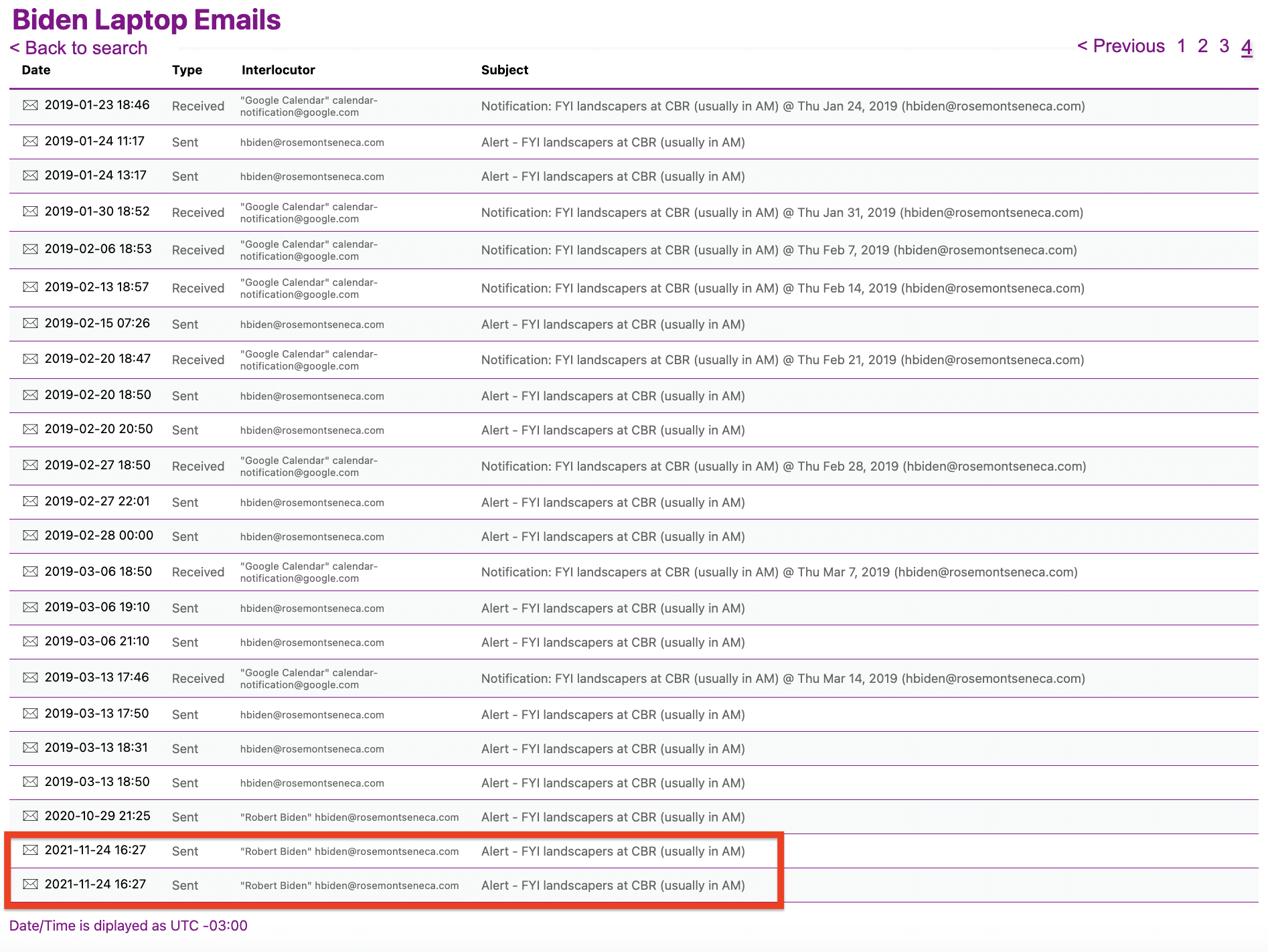
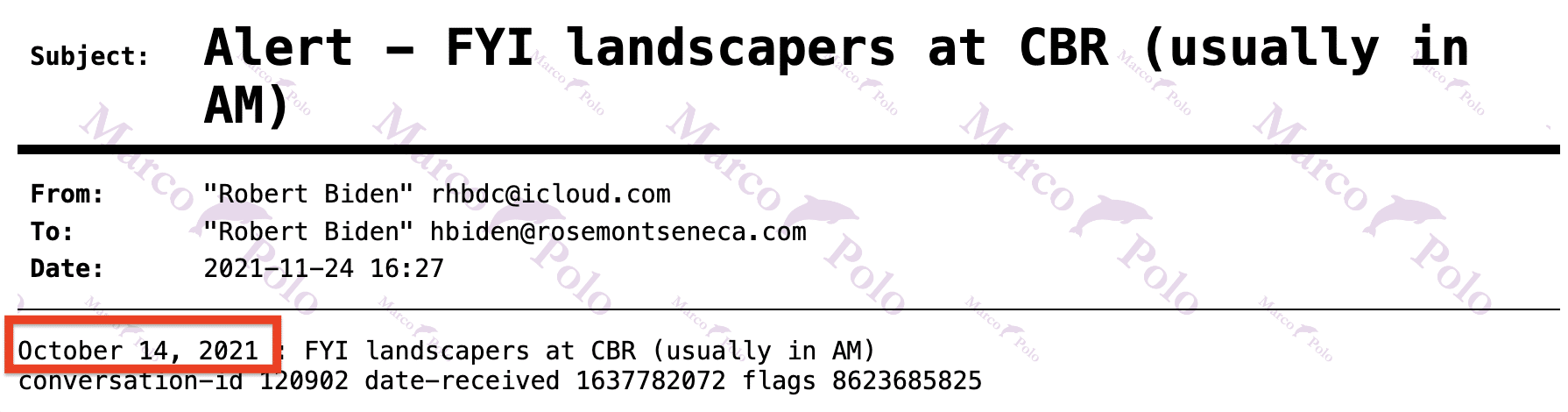
According to emails posted at BidenLaptopEmails dot com made available by Garrett Ziegler, sometime around May 31, 2017, someone set a Google alert for weekly landscaping work, which usually took place in the mornings. Many weeks, Hunter Biden would receive a Google alert on Wednesday, reminding him landscapers would show up the next day. Then the next day, his iCloud email would email his RosemontSeneca email (hosted by Google) with a reminder.

In the depths of his addiction — again, per emails made available by Garrett Ziegler — the only emails that Hunter Biden “sent,” the only sign of life on his email accounts, was that email. For weeks on end, the only communication “from” Hunter is that eerie repetitive notice: “Alert – FYI landscapers at CBR (usually in AM).” It’s like that Google alert is a phantom, always there in Hunter’s email box.

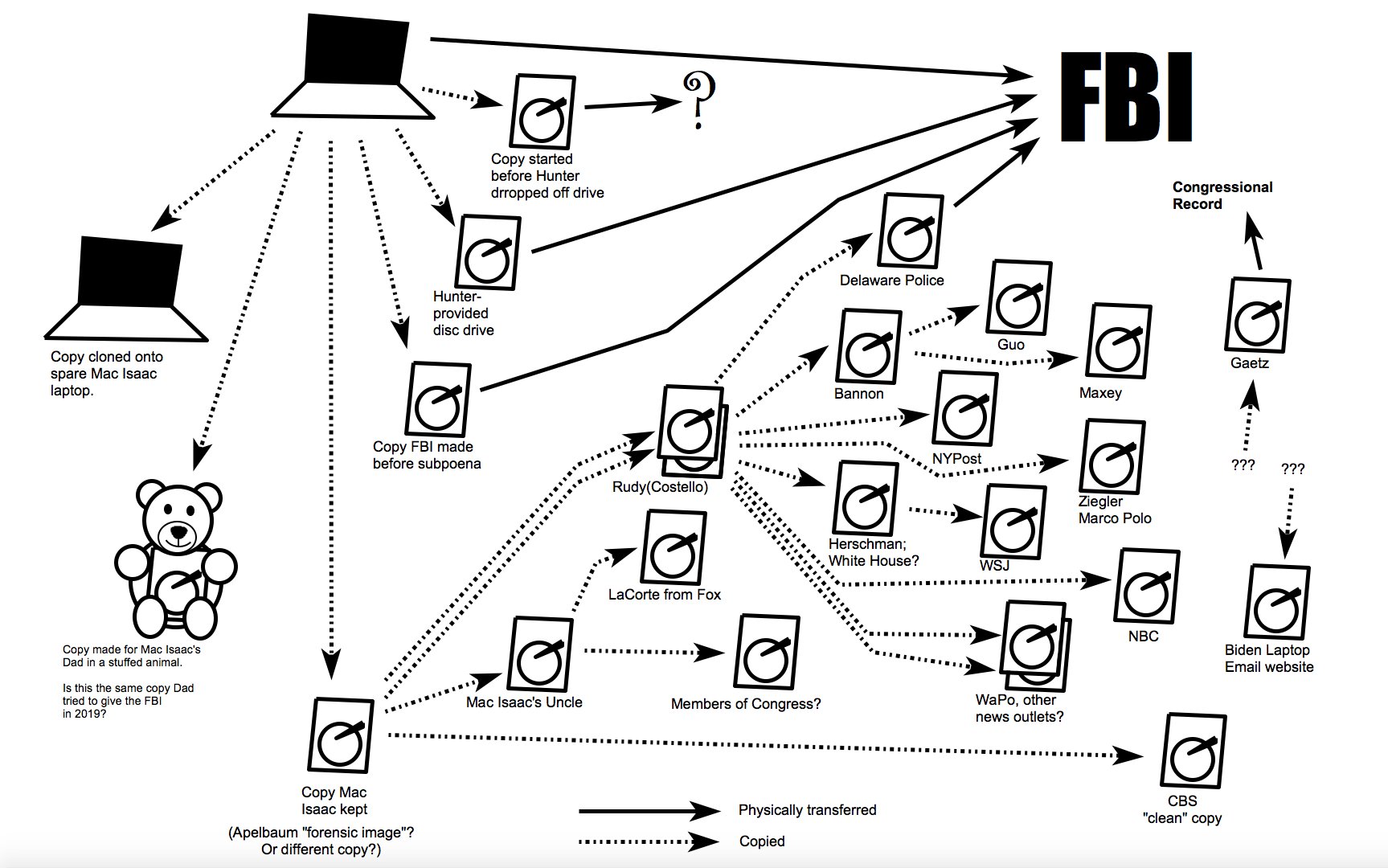
I’m not sure the technical explanation for it — though I expect that experts would be able to use the nature of those weekly alerts to determine what inboxes were really used to load up the laptop that found its way to John Paul Mac Isaac and from there, on a hard drive, to Rudy Giuliani and then, another hard drive, to Garrett Ziegler. The technical explanation may also explain why the FBI relied on the laptop for Google alert information rather than the information the FBI received from Google itself, as I laid out here.

“Alert – FYI landscapers at CBR (usually in AM).” There must be over 150 versions of either the Google alert or the email from Hunter’s iCloud email to Hunter’s RosemontSeneca email in the collection made available by Garrett Ziegler.

In fact, those emails, “Alert – FYI landscapers at CBR (usually in AM),” may doom Ziegler’s effort to defeat Hunter Biden’s hacking lawsuit against him.

Ziegler filed his response, along with a sworn but not notarized declaration from Ziegler himself, yesterday.

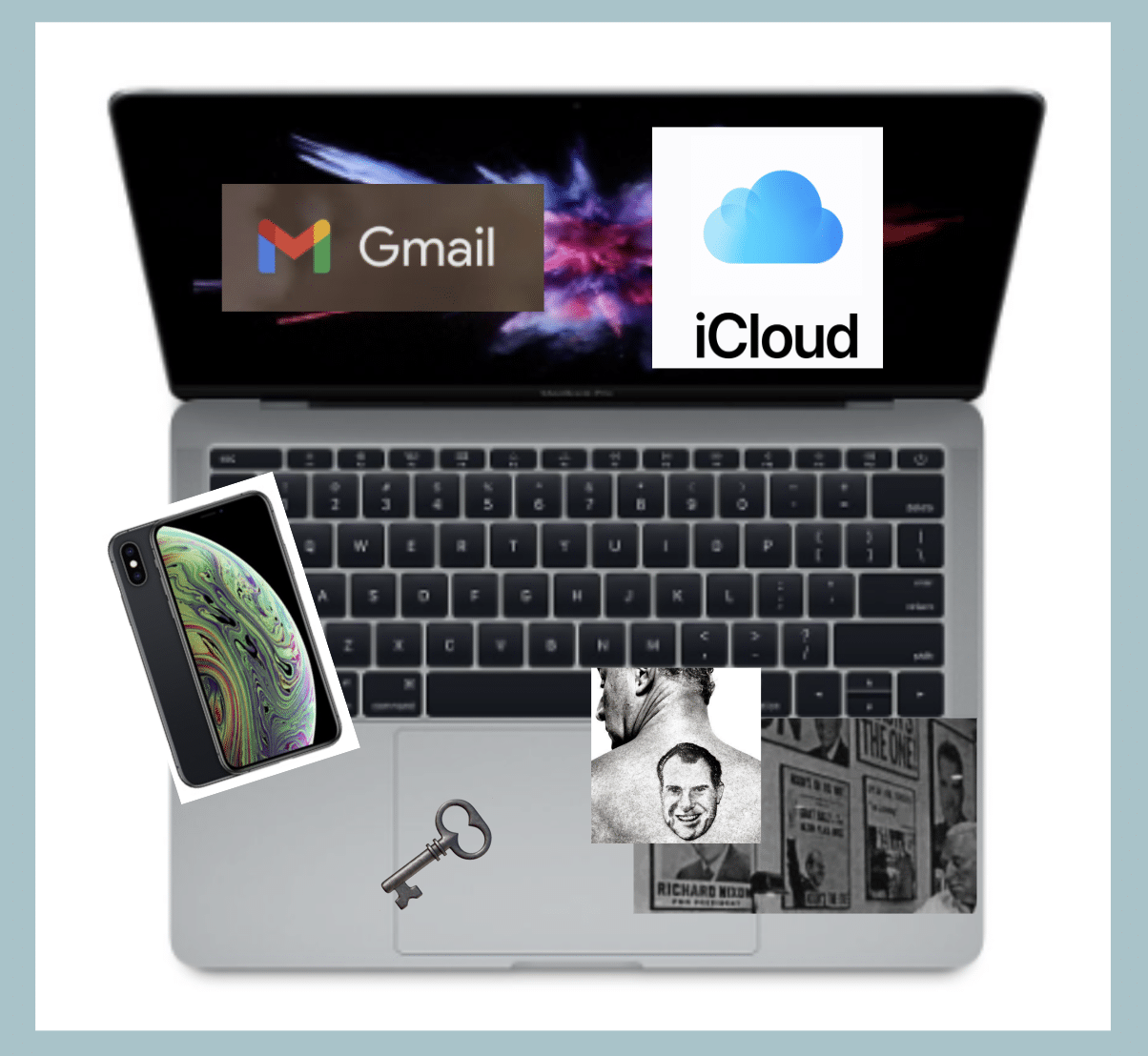
As to the claim that he hacked Hunter Biden’s phone — which I’ve noted is a key vulnerability for Ziegler — Ziegler admits he used a password to access the backup from a phone Hunter allegedly owned in 2019.

19. Paragraph 29 falsely casts my comments to imply thta I and Defendant Marco Polo “hacked” into Plaintiff’s iPhone backup file.

20. In the case of the iPhone backup file referred to in paragraph 29, I received a copy of an iPhone backup file which existed as part of the copied files.

21. Also contained on the external hard drive given to me were files containing passcodes, which are essentially similar in function to passwords designed to allow access to password-protected files. Although it took months of examination, we were able to locate the passcode which allowed access to the iPhone backup file. Those files existed on the external hard drive when it was first given to me.

But he argues that because the disk drive he received from an associate of Rudy Giuliani had the password for the phone on it, and because Hunter never owned the hard drive on which Ziegler received both sets of data, he did not “hack” anything.

Plaintiff selectively cites to Defendant Ziegler’s December 2022 remarks about decrypting a specific file which stored the passcode to the iPhone backup file, both of which were on Defendants’ copy of the Laptop. (Compl. at ¶ 29). The Complaint falsely suggests Defendants “hacked” into Plaintiff’s iPhone backup. (Zeigler Decl. at ¶ 19). Defendants received a copy of Plaintiff’s iPhone backup file which existed as part of the files. (Id. at ¶ 20). When Defendants received the external hard drive, it contained passcodes, which allowed access to the iPhone backup file. (Id. at ¶ 21).

[snip]

Moreover, Plaintiff does not allege unlawful access to a computer within the meaning of the CFAA. A computer user “without authorization” is one who accesses a computer the user has no permission to access whatsoever—an “outside hacker[ ].” Van Buren v. United States, 141 S. Ct. 1648, 1658, (2021). Here, Plaintiff admitted that Defendants accessed and used a hard drive that Plaintiff never possessed. Specifically, Plaintiff alleges that Defendants accessed a hard drive provided by a third party which contains a copy (duplicates) of files. (Compl. at ¶ 18). Plaintiff does not allege that Defendants possessed or accessed Biden’s computer or original files.

Plaintiff alludes to his actual iPhone and iCloud account when he alleges that “at least some of the data that Defendants have accessed, tampered with, manipulated, damaged and copied without Plaintiff’s authorization or consent originally was stored on Plaintiff’s iPhone and backed-up to Plaintiff’s iCloud storage.” (Id. at ¶ 28). However, Plaintiff alleges no facts which demonstrate Defendants ever accessed any computer, storage, or service which Plaintiff either owns or has exclusive control over. Likewise, the Complaint also shows facts which conclusively prove that Defendants had no need to access any service or storage because the laptop copy in their possession admittedly contained all of the necessary information, including the passcode to view all of the files contained on the Biden Laptop regardless of encryption. (Id. at ¶ 18). Put simply, both the encrypted iPhone backup file and the passcode to open the iPhone backup file were on the Laptop copy.

Given that Hunter’s lawsuit also names a bunch of John Does, blaming his access to this backup on Rudy’s unnamed associate and Rudy and John Paul Mac Isaac may not help Ziegler.

In any case, Ziegler may hope he doesn’t have to rely on this argument. His response actually spends more time arguing that venue, in California, is improper than he does that using a password to access an encrypted backup is legal. The “work” Ziegler did to make ten years of Hunter Biden’s emails available took place in Illinois. He has no employees or board members in California. Fewer than 10% of Marco Polo’s supporters live in California (Ziegler doesn’t say what percentage of his donations they provide, however).

His venue argument and his hacking argument ignore a part of Hunter’s lawsuit, though, which alleges that Ziegler “directed illegal conduct to occur in California.”

Plaintiff is informed and believes that Defendant Ziegler intentionally directed illegal conduct to occur in California and has therefore subjected himself to jurisdiction in California.

Similarly, his response only mentions Hunter’s allegation that in addition to accessing that iPhone, he also accessed data in the cloud once.

Plaintiff accuses Defendants of “knowingly accessing and without permission taking and using data from” Plaintiff’s devices or “cloud” storage (Compl. at ¶¶ 40, 41), computer service (id. at ¶ 42), or protected computer (id. at ¶ 35) but fails to identify a single device Defendants accessed without authorization

That allegation is a key part of alleging that Ziegler broke the law in California.

40. Defendants have violated California Penal Code § 502(c)(1) by knowingly accessing and without permission taking and using data from Plaintiff’s devices or “cloud” storage, including but not limited to, Plaintiff’s encrypted iPhone backup to devise or execute a scheme to defraud or deceive, or to wrongfully obtain money, property, or data.

41. Defendants also have violated California Penal Code § 502(c)(2) by knowingly and without permission accessing, taking, copying, and making use of programs, data, and files from Plaintiff’s devices or “cloud” storage, including but not limited to, Plaintiff’s encrypted iPhone backup.

Ziegler denies accessing any computer in the possession of Hunter Biden. That falls short of denying that he hacked data owned by Hunter Biden.

22. Neither I nor any person associated with Marco Polo have accessed, or attempted to access, any computer, device, or system owned or controlled by Plaintiff. We are not hackers, we are simply publishers, and the Plaintiff is attempting to chill our First Amendment rights and harass us through a frivolous and vexatious lawsuit.

I think Ziegler has a problem with his description of where the iPhone backup came from in the first place: he says that the “laptop” was in Hunter Biden’s possession when the iPhone backup was saved to it on February 6, 2019.

The metadata concerning the duplicated iPhone backup file on our external hard drive indicates that the last backup made of the iPhone file to the plaintiff’s laptop, which he left at the repair show of John Paul Mac Isaac on April 12, 2019, occurred on February 6, 2019, while still in the plaintiff’s possession based upon all the facts known to me to be provably true beyond dispute.

Hunter may be able to prove that Ziegler, of all people, doesn’t believe that to be true, doesn’t believe that when that iPhone was backed up on February 6 — a day when someone presenting as Hunter was involved in a car accident in DC — Hunter was in possession of that laptop.

But the bigger problem Ziegler that has is that phantom landscaping reminder.

According to emails that Garrett Ziegler has made publicly available, an October 14, 2021 notice triggered by a Google alert was received on November 24, 2021, long past the time, per Ziegler’s declaration, he was in possession of this hard drive.

Again, I’m not sure how that happened technically. But if it involved either Apple servers or Google servers (or both, given that the notice was dated October 24, 2021), that would get you venue in California.

Hunter Biden may not have been in possession of Apple’s and Google’s servers in 2021, but accessing them using passwords stored on the hard drive — at least one password that Ziegler admits to using — would also constitute hacking.

Update, to answer a question below: The text of the email shows that the notice was October 14, but the email was received on November 24, 2021.

Share this entry

Clarence Thomas’ Club Votes Against Democracy

SCOTUS denied Jack Smith’s effort to get a SCOTUS review of Trump’s absolute immunity claim immediately.

SCOTUS will wait until after DC Circuit hears arguments on January 9, decides the issue, and then they’ll take it up at their leisure, when they’re not taking rich vacations with right wing donors.

This is the easiest of all decisions before SCOTUS, because by taking the case right away, they might make all their other decisions easier.

But instead, they’re stalling.

Share this entry

Luke Broadwater’s Attempt at Fact-Checking Covers Up Fabrications and IRS Sloppiness

NYT has two articles out fact-checking GOP lies in support of impeachment.

One, from Adam Entous, is really worth reading. It describes how a text that Hunter Biden sent his daughter Naomi, which joked about the fact that Joe Biden had made his sons work their way through college, has been misrepresented to instead suggest that Hunter was giving his father 50% of his diminished 2019 earnings.

Hunter felt dejected, and, while apparently under the influence of drugs, wrote a series of angry and often nonsensical messages to Naomi in which he threatened to cut her off financially.

“Find an apartment with Peter by next week,” Hunter instructed. “And send me the keys and leave all of my furniture and art. I love all of you. But I don’t receive any respect.”

Then he sent the text message that Republicans have used to suggest that Hunter’s foreign income was going to enrich his father.

[snip]

Hunter’s oft-told story about giving half of his salary to his father appeared to originate during his freshman year at Georgetown.

His roommate at the time recalled Hunter telling him and his twin brother “a million times” that then-Senator Biden encouraged him to work, saying, “You can keep half of the paycheck, but you have to hand over the other half for ‘room and board.’”

It was a story, and a theme, that Hunter continued to invoke, especially after he married Ms. Buhle and they had three daughters — Naomi, Finnegan and Maisy — all of whom attended Sidwell Friends, a costly Washington private school, where they were surrounded by wealthier families.

Hunter told close friends that he was worried that his daughters had become spoiled. According to family members, he would frequently tell them the story about how he had to work in college and pay half of his salary to his father, in hopes of encouraging them to be more self-sufficient.

In other words, Republicans are literally trying to impeach Joe Biden because he made his sons work their way through college, and at a time he was broke, Hunter tried to do the same with his daughters.

Note that the underlying back story Entous describes, in which Hunter attempted to find specialized medical care for his daughter Finnegan, shows that while in Fox News pundit Keith Ablow’s care, Hunter was somehow cut off from the digital world.

Then Ablow responds to his own email, which this time is marked [External], noting that “His [apparently meaning Hunter’s] email is screwed up,” and then saying he had texted Rock.

From: Keith Ablow <kablow[redacted]>
Sent: Thursday, January 3, 2019 11:40 AM
To: Positano [redacted]; rhbdcicloud
Subject: [EXTERNAL]Re: From Keith

CAUTION: External Email.

Rock
His email is screwed up

I texted you

The doctor responds — happy to help — and provides his contact. Ablow thanks him. Hunter responds to that, plaintively,

Guys are you getting my emails?

And though neither of the external interlocutors ever said a thing directly to Hunter, Ablow says, yes, suggesting they had gotten his emails, then instructs Hunter to contact the doctor and “send him the x-rays,” even though in the original email Hunter already sent 2 jpgs.

Hunter then tried to email the doctor directly, using the same email included in Ablow’s email (possibly even using the link from the doctor’s own email), and it bounces, “RecipientNotFound; Recipient not found by SMTP address lookup.”

Hunter’s digital rupture from the outside world is part of the back story to how his digital life got packaged up for delivery, eventually, to Congress. And it should raise provenance questions about every other aspect of this investigation.

Which brings us to the other NYT story, an attempt to fact check that was, instead a confession that NYT scribe Luke Broadwater either doesn’t care or doesn’t know how to assess evidence and claims for reliability.

Broadwater feigns fact-checking Republican representations of a text Hunter sent in 2017, claiming to be sitting next to his father while he was trying to strong arm a business associate, which is another communication that Republicans are sure proves Joe Biden was in business with his son.

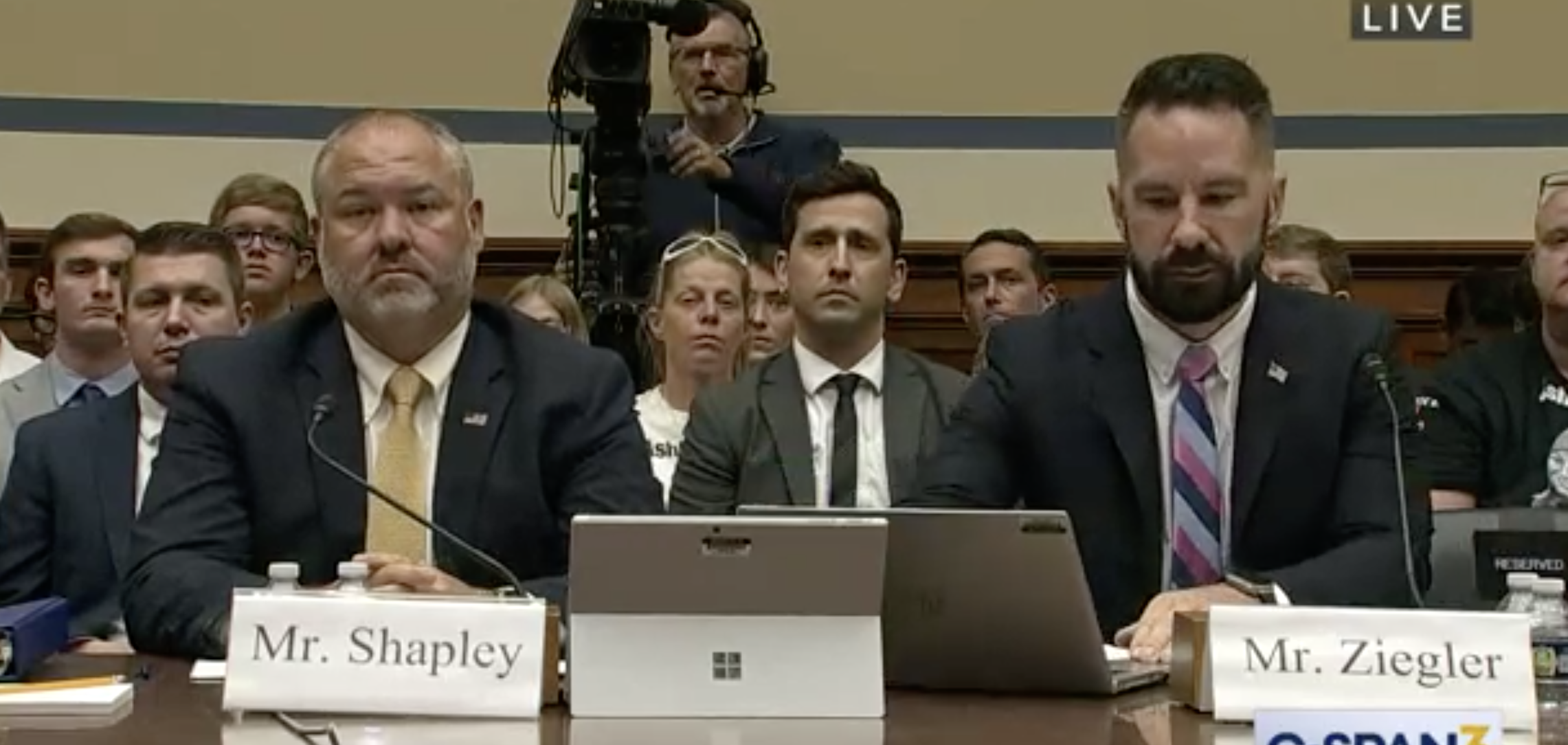
Before I show you what Broadwater wrote, let me reconstruct how we have the claim in the first place. Gary Shapley provided the texts to Congress in May. He shared them, he claimed, as proof that investigators were denied the ability in August 2020 to obtain location data — he doesn’t say for whom — and to search the guest house at Joe Biden’s house.

For example, in August 2020, we got the results back from an iCloud search warrant. Unlike the laptop, these came to the investigative team from a third-party record keeper and included a set of messages. The messages included material we clearly needed to follow up on.

Nevertheless, prosecutors denied investigators’ requests to develop a strategy to look into the messages and denied investigators’ suggestion to obtain location information to see where the texts were sent from.

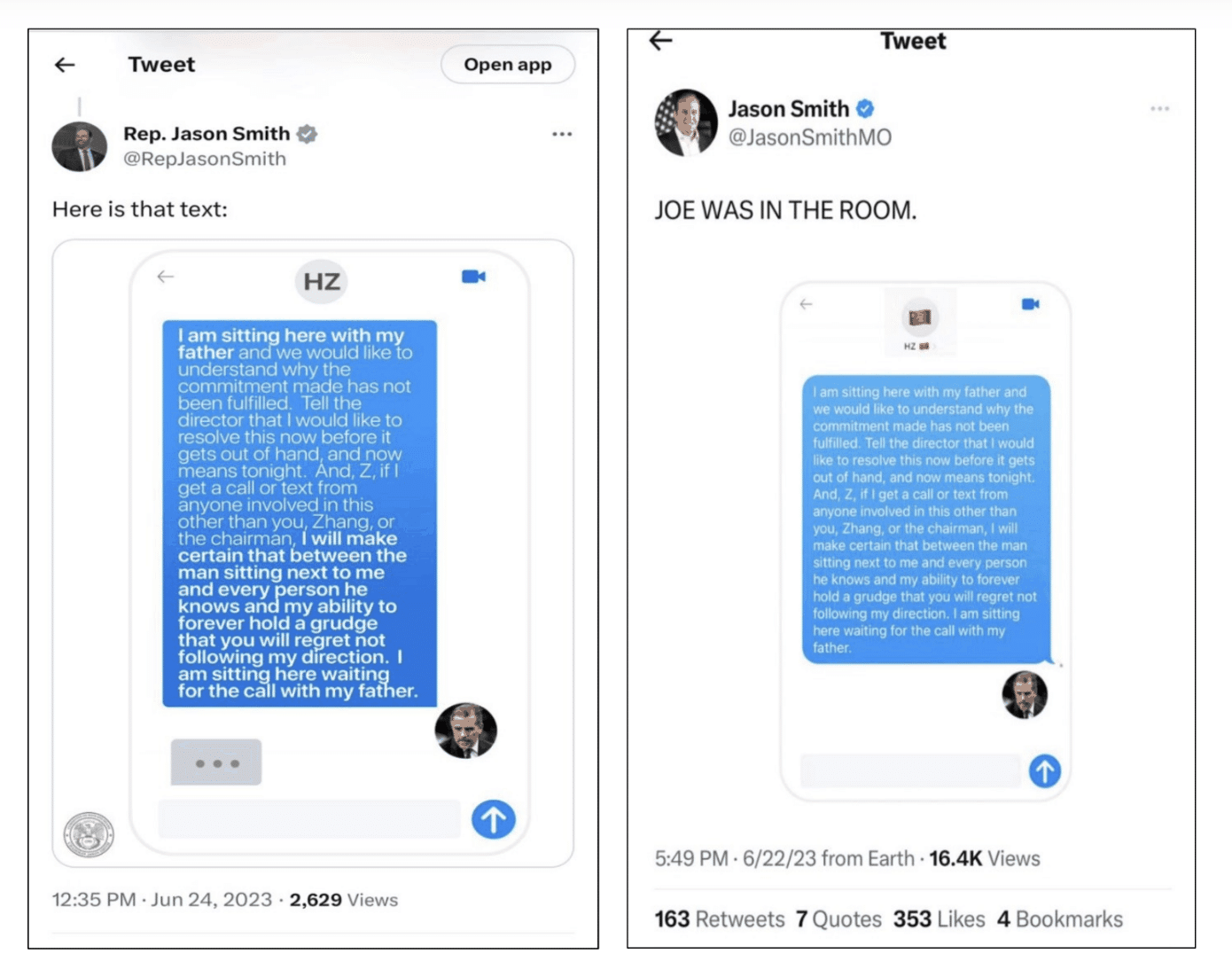
For example, we obtained a July 30th, 2017, WhatsApp message from Hunter Biden to Henry Zhao, where Hunter Biden wrote: “I am sitting here with my father and we would like to understand why the commitment made has not been fulfilled. Tell the director that I would like to resolve this now before it gets out of hand, and now means tonight. And, Z, if I get a call or text from anyone involved in this other than you, Zhang, or the chairman, I will make certain that between the man sitting next to me and every person he knows and my ability to forever hold a grudge that you will regret not following my direction. I am sitting here waiting for the call with my father.”

Communications like these made it clear we needed to search the guest house at the Bidens’ Delaware residence where Hunter Biden stayed for a time. [my emphasis]

Already, at this point, the savvy interlocutor would have asked Shapley, “why do you need location data? You get about five different kinds of location information in an iCloud warrant. What more did you need?”

Which might have led Shapley to confess he really wanted to get a location warrant targeting Joe, not Hunter.

If these texts were ever introduced at trial, Hunter’s lawyers would likely point out that they were obtained in reliance on the laptop obtained from John Paul Mac Isaac. At the point they got those warrants in August 2020 — effectively obtaining text messages that were available on the laptop — the FBI still had never validated the laptop to make sure no one had tampered with it either before it got into the custody of John Paul Mac Isaac or while in JPMI’s custody. That is, the warrant to obtain these texts may well be a classic case of poisonous fruit, and the texts could be affected by an alteration done to Hunter Biden’s contact list in the period in January 2019 when he was staying in Keith Ablow’s property and seems to have been partially cut off from the digital world; his contacts were restored — from what, it’s not clear — on January 24, 2019.

As Shapley was walking Congressional staffers through these texts, he admitted that they weren’t WhatsApp messages themselves, they were summaries. He wasn’t sure who had done the summaries.

Q Okay. And these aren’t WhatsApp messages, these are summaries of WhatsApp messages, correct?

A Yeah, that’s correct. Because it was something about the readability of the actual piece, right? It was easier to summarize in a spreadsheet.

Q Okay. And who did the summary? Who prepared this document?

A It was either the computer analysis guy or [Ziegler], one or the other.

Who did the summaries matters, because whoever it was did a shoddy job. In one crucial case, for example, whoever did the summaries interjected their opinion about what a screen cap that showed in the message was. It is the only indication in the exhibit shared with Congress that identifies the first name of Hunter’s interlocutor.

This interjection — a parenthetical comment recording that this was “(believed to be Zhao)” but included inside quotation marks as if it was part of the screencap — is the only place where Zhao’s first name is identified. Elsewhere, he is always referred to as “Zhao” or “Z,” even in a summary also referring to “Zang” and “Zhang.” Nowhere in this “summary” is his WhatsApp identifier included, as it would be in reliable WhatsApp texts summaries (here, from Vladislav Klyushin’s trial). It’s not the only parenthetical comment included as if it were part of a direct quote, but as we’ll see, it is a critical one.

Even in spite of the inherent unreliability of this summary, the shoddiness of the underlying IRS work, Republicans love it.

Jason Smith took these unreliable summaries and fabricated them into texts, creating the illusion that they had a solid chain of evidence for these texts.

Smith’s tweets of these texts went viral.

In spite of the fact that Abbe Lowell has attempted to get Congress to correct this viral claim twice, Smith left it up.

The summary and the fabrications of the text and Smith’s use of the initials “HZ” matter because there’s a dispute between Republicans and their IRS source about the identity of the person involved.

Shapley said the texts involved Henry Zhao, consistent with Smith’s fabrication.

But in a later release, James Comer described the interlocutor as Raymond Zhao — which is consistent with the interjection in the summary (and other communications regarding this business deal).

On July 30, 2017, Hunter Biden sent a WhatsApp message to Raymond Zhao—a CEFC associate—regarding the $10 million capital payment:

As we’ll see, Broadwater predictably “fact checks” this as a dispute between Democrats and Republicans. It’s not. Before you get there, you first have to adjudicate a conflict between the guy who led the IRS investigation for more than two years, Gary Shapley, and James Comer. It’s a conflict sustained by the shoddiness of the underlying IRS work.

This is a story showing not only that James Comer and Jason Smith don’t know what they’re talking about, but are willing to lie and fabricate nevertheless, but even the IRS agents may not know what they’re talking about, and if they don’t, it’s because the standard of diligence on the investigation of Joe Biden’s son was such that they didn’t even include the identifier of the person to whom Hunter was talking, which would make it easy or at least possible to adjudicate this dispute.

This is a story that discredits the IRS agents — for their sloppy work and for their bogus claims to need location data to further investigate this and the conceit that it ever would have been appropriate to get location data for Joe Biden or search his guest home in August 2020. It is a story that shows that when faced with uncertainty created by the sloppiness of their IRS sources, Republicans instead just make shit up.

But here’s how Luke Broadwater describes the conflict:

‘I am sitting here with my father’

One WhatsApp message that has received much attention was provided by an I.R.S. investigator who testified before Congress under whistle-blower protections. In it, Hunter Biden invoked his father, who was then out of office, while pressing a potential Chinese business partner in 2017 to move ahead with a proposed energy deal.

“I am sitting here with my father and we would like to know why the commitment has not been fulfilled,” the message states. On its face, the message seemed to suggest Joe Biden was in league with his son pressuring for a payment to the family.

But Democrats have argued it is more likely an example of Hunter Biden’s bluster than an accurate statement of Joe Biden’s involvement in a shakedown. A lawyer for Hunter Biden says he does not remember sending the message.

The president has denied he was present at the time.

Broadwater turns this into an unknowable question about whether Biden was sitting next to Hunter, and claims it’s just about competing partisan arguments.

But this is a confession about Broadwater’s own abilities or work ethic, not a fact-check of truth claims. Because if you don’t understand or explain that the claim itself builds off provenance problems, you’re actively covering up several layers of shoddiness in this impeachment stunt.

If the point is to test the reliability of the impeachment inquiry, it’s that other story that needs to be told.

Share this entry

Colorado Accelerates Timeline and Scope of SCOTUS Review of Trump’s January 6 Conduct

Colorado just booted Trump from the ballot, building on the lower court ruling that no only was January 6 an insurrection, but Trump is an officer thereby disqualified to be President.

I’m not going to read the opinion closely — I’m sure the whole world will do that.

This ruling’s impact will be more important for the way it will accelerate and expand the scope of the Supreme Court’s review of Trump’s January 6 conduct. The state has stayed their decision until January 4, giving Trump time — but not much — to appeal.

Therefore, to maintain the status quo pending any review by the U.S. Supreme Court, we stay our ruling until January 4, 2024 (the day before the Secretary’s deadline to certify the content of the presidential primary ballot). If review is sought in the Supreme Court before the stay expires on January 4, 2024, then the stay shall remain in place, and the Secretary will continue to be required to include President Trump’s name on the 2024 presidential primary ballot, until the receipt of any order or mandate from the Supreme Court.

There’s a non-zero possibility this will lead SCOTUS to accelerate their consideration of the Absolute Immunity appeal, which is more important in the near and long term. After all, if Trump were found guilty, then states really could and should consider the 14th Amendment implications.

One more point: Because Trump will have appealed by January 4, he will be on the primary ballot, giving SCOTUS lots of time to consider this issue before the General. But it really does put the onus on SCOTUS to decide a lot of these issues quickly.

Share this entry

Hearing Footsteps: The Paper Trail of Political Interference David Weiss Is Trying to Bury

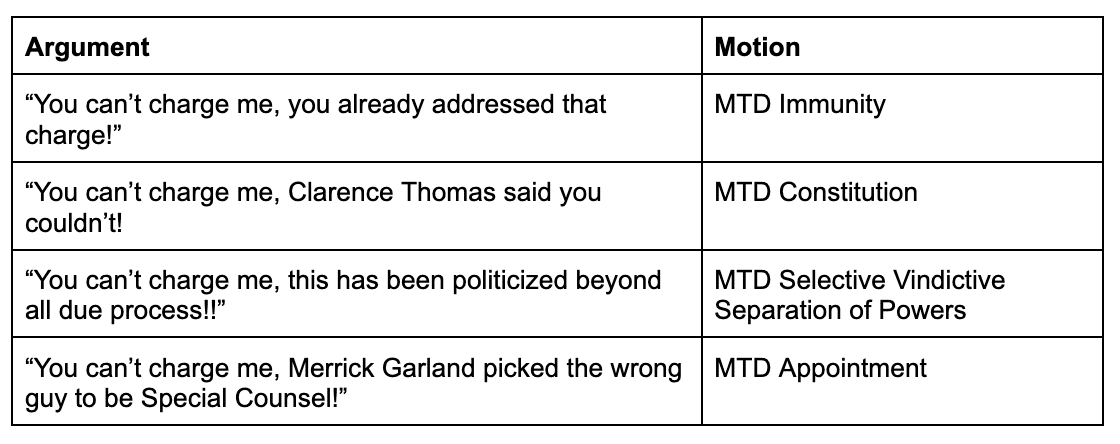
Update: Given confusion mentioned in comments, I thought I’d do another handy dandy chart to describe the motions to dismiss, like I did for Trump’s. This post addresses the MTD Selective Vindictive Separation of Powers. 
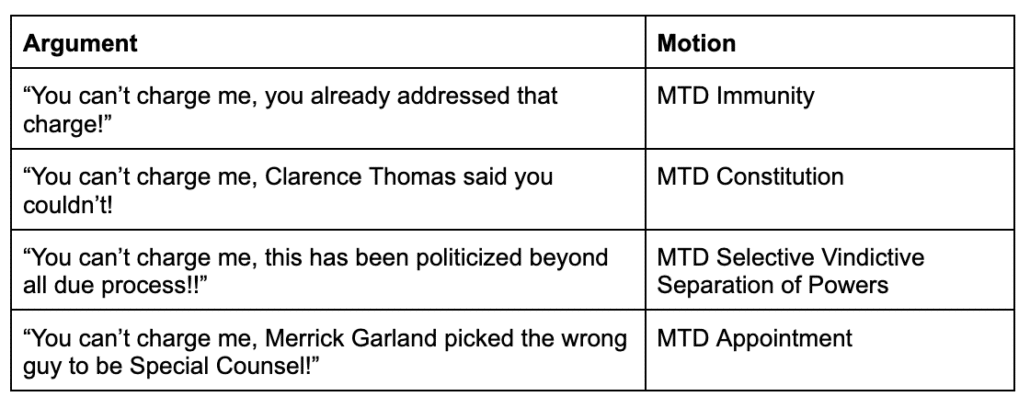
Abbe Lowell’s motion to dismiss the gun charges against Hunter Biden for selective and vindictive prosecution and violation of separation of powers only asks for discovery in passing.

Often, MTDs for selective prosecution are requests for discovery. For comparison, in a bid to argue that Jan6er David Judd was charged more harshly than Portland rioters, his excellent public defender, Elizabeth Mullin, conceded that she did not yet have proof he was treated worse because he was a Trump supporter, but then asked for six specific things to prove the case.

Mr. Judd does not yet contend the allegations below are sufficient for dismissal of the charges against him. However, they are sufficient for the Court to compel specific discovery regarding disparities in charging decisions.

[snip]

(1) Communication between the Department of Justice (“Main Justice”) and the U.S. Attorney’s Office for the District of Oregon regarding prosecution of defendants arrested in connection with protests in 2020.

(2) Communication between management at the U.S. Attorney’s Office for the District of Oregon and line Assistant U.S. Attorneys regarding prosecution of defendants arrested in connection with protests in 2020.

(3) Communication between the Department of Justice (“Main Justice”) and the U.S. Attorney’s Office for the District of Columbia regarding prosecution of defendants arrested in connection with the January 6 demonstrations at the U.S. Capitol.

(4) Communication between management at the U.S. Attorney’s Office for the District of Columbia and line Assistant U.S. Attorneys regarding prosecution of defendants arrested in connection with the January 6 demonstrations at the U.S. Capitol.

(5) Communication between the Department of Justice (“Main Justice”) and the U.S. Attorney’s Office for the District of Columbia regarding prosecution of the D.C. Fireworks Defendant.

(6) Communication between management at the U.S. Attorney’s Office for the District of Columbia and line Assistant U.S. Attorneys regarding prosecution of the D.C. Fireworks Defendant.

Mullin’s bid didn’t work. Judge Trevor McFadden ruled that January 6 was different than Portland — though he did use her argument to treat Jan6ers leniently at sentencing.

Compare that statement with this one, from page 50 of Abbe Lowell’s 60-page selective and vindictive MTD, where he asserts that this is the exceptional case where a defendant can prove vindictive prosecution without discovery.

Cases where a defendant can show actual vindictiveness without discovery may be few and far between, but this is surely one.

Lowell closes the entire brief with a similar statement, footnoted with the assertion that, “Were there to be any doubt at all, the basis for discovery and an evidentiary hearing has well been established.”

“[O]ur society is not bettered by law enforcement that. . . is not conducted in a spirit of fairness or good faith.” Banks, 383 F. Supp. at 397. This prosecution falls in that category, and the Court should dismiss the indictment. 109

109 As stated through this and the other motions to dismiss, the record available to the Court supporting dismissal is extraordinary. Were there to be any doubt at all, the basis for discovery and an evidentiary hearing has well been established.

This argument — that if Hunter Biden hasn’t met his burden for outright dismissal, then surely he should be granted discovery — is four other times relegated to a footnote.

One such footnote appears in a passage purporting to lay out the legal standards that govern this issue, in which Lowell cites a bunch of precedents from other circuits about dismissal in case of selective, vindictive, or separation of powers violations.

When a prosecution is selective, vindictive, or violates separation of powers, the tainted charges must be dismissed. See id. at 700 (“Preservation of this system of checks and balances requires the courts to invalidate actions that. . . undermine the authority and independence of one or another coordinate Branch.”) (citations omitted); In re Aiken Cnty., 725 F.3d 255, 264 n.7 (D.C. Cir. 2013) (“If the Executive selectively prosecutes someone based on impermissible considerations, the equal protection remedy is to dismiss the prosecution . . . .”).42

42 Where a defendant has not carried his burden, but has demonstrated a “colorable claim,” discovery and an evidentiary hearing should be permitted. United States v. Heidecke, 900 F.2d 1155, 1159 (7th Cir. 1990); United States v. Jones, 159 F.3d 969, 978, n.8 (6th Cir. 1998) (granting discovery to give the defendant “the opportunity to move to dismiss the indictment” for selective prosecution). See Mr. Biden’s Discovery Mot (filed concurrently). [my emphasis]

Armstrong, the precedent making it almost impossible for a defendant to get discovery, the one that Principal Senior Assistant Special Counsel Leo Wise cited 48 times in his bid to defeat subpoenas, does not appear in this section (though it does appear in several other places and in the discovery motion).

As this footnote does, two other such footnotes specifically cite a motion for discovery and evidentiary hearing filed the same day. In those other two instances, Lowell cites the line in this NYT article describing that David Weiss told an associate that he preferred not to bring any charges because the average American would not be charged for these crimes.

[T]he New York Times reported that “Mr. Weiss told an associate that he preferred not to bring any charges, even misdemeanors, against Mr. Biden because the average American would not be prosecuted for similar offenses.” 9

9 Michael Schmidt et al., Inside The Collapse Of Hunter Biden’s Plea Deal, N.Y. Times (Aug. 19, 2023), https://www.nytimes.com/2023/08/19/us/politics/inside-hunter-biden-plea-deal.html. The article does not disclose the source. The account is most likely true considering the charging statistics, DOJ enforcement policies described below, and Mr. Weiss’s initial reluctance in prosecuting Mr. Biden on this charge. If it is true, it is extremely damning evidence of discriminatory prosecution. Thus, to the extent there is any doubt, the Court should grant Mr. Biden’s request for discovery and an evidentiary hearing. See Mr. Biden’s Discovery Mot. (filed concurrently).

[snip]

DOJ confirmed its own improper motive when, under fire from Congress and the public, it resorted to a rarely used gun charge that reports indicate Special Counsel Weiss himself admitted would not have been brought against the average American.85

85 Michael S. Schmidt et al., Inside The Collapse Of Hunter Biden’s Plea Deal, N.Y. Times (Aug. 19, 2023), https://www.nytimes.com/2023/08/19/us/politics/inside-hunter-biden-plea-deal.html. As noted above, the article does not disclose the source, and to the extent there is any doubt about the veracity of the claim, the Court should grant Mr. Biden’s request for discovery and an evidentiary hearing. See Mr. Biden’s Motion for Discovery and an Evidentiary Hearing (filed concurrently). [my emphasis]

I have repeatedly predicted we’d see this language in Hunter’s selective prosecution motion, because it provides what virtually no defendant ever has: proof that the prosecutor himself recognized he was selectively prosecuting a defendant.

If Lowell can find these witnesses — experts on gun crimes who said Hunter was charged only because he was prominent and a Weiss associate whom Weiss purportedly told he knew that average Americans would not be prosecuted for such crimes –and get them to testify, then he would have what virtually no other defendant would: Proof that the prosecutor who brought the charge knew that similarly situated defendants would not be charged, but charged the defendant anyway.

But I assumed the proof that David Weiss had said that would require witness testimony.

Perhaps it doesn’t.

Consider that the last instance (in this filing) where Lowell relegates a request for discovery and an evidentiary hearing to a footnote, he makes an assertion — that DOJ has long believed that Hunter’s rights must take precedence over efforts by Trump to interfere in this prosecution — that he does not cite.

But as DOJ itself has long believed, Mr. Biden’s rights must come first and efforts by members of Congress and the former President to interfere have tainted this prosecution beyond purification. As a result, there is no constitutional option but to dismiss this case.40

40 If the Court has any doubt that the material set out in this motion is sufficient to warrant outright dismissal of these charges, it should permit discovery and conduct an evidentiary hearing. Mr. Biden has already sought discovery from DOJ and information from third-parties with knowledge of former President Trump’s influence, and DOJ has not responded to the requests and filed an opposition for this information to be disclosed. [my emphasis]

To be sure, we know that David Weiss’ investigative team, led by Lesley Wolf, made repeated efforts — not always successful — to shield the investigative team from Trump’s efforts to interfere.

For example, Tim Thibault told the House Judiciary Committee that one reason he shut down Peter Schweizer as a source was because then-Supervisory Special Agent Joe Gordon reached out, insinuating they already had laptop-based evidence, and said that if a case against Hunter Biden ever went to trial and Hunter’s attorneys found the FD-1023 from Schweizer that the Washington Field Office had shared with the Hunter team, it would give Hunter’s attorneys ammunition.

A And then fast-forward to sometime in October, I received an unsolicited call —

Q Uh-huh.

A — from the supervisor of the Hunter Biden case. I knew him because he had been assigned to Washington Field Office as the case agent.

[snip]

A And I said: Okay. What are your concerns? And basically said: Look, the information isn’t of any value to us, number one. My — I deduced from everything he said that they already had the information —

Q Uh-huh.

A — from some other source, some other channel, maybe not a human source but some other channel. He also said that that person was politically connected —

Q Uh-huh.

A — and partisan in his view and he was concerned about the source being on media platforms.

[snip]

A So I was getting a call from this supervisor. And my — my takeaway was we don’t need your source reporting and also: Why are you sending a file to our — to our case file that we didn’t know about? Right? So Washington Field Office wrote this 1023 and it went to headquarters and it went to Baltimore.

[snip]

A I understand you don’t need the reporting anymore. I understand that if this goes to trial, Hunter Biden’s attorney —

Q Uh-huh?

A — could have some ammunition.

Regarding that very same laptop, Gary Shapley complained to Congress that Weiss’ office had prevented Joseph Ziegler from seeing a report addressing the “quality and completeness of imaged/recovered information from the hard drive.”
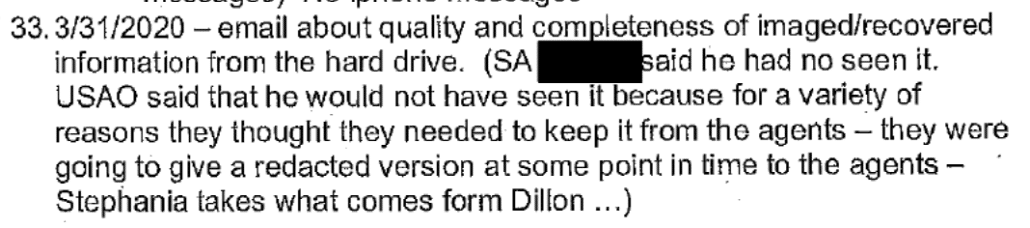
Ziegler himself complained that he hadn’t been able to interview Tony Bobulinski — the guy whom Donald Trump personally hosted at an election debate and who subsequently had a clandestine meeting with Trump’s chief of staff — because, prosecutors told him, Bobulinski, “was not viewed as a credible witness.”

In investigative team meetings that occurred after this, I can recall that agents on the investigative team brought up on multiple occasions to the assigned prosecutors that they wanted to do an interview of Bobulinski with the assigned case agents. I can recall being told that they would think about it and then ultimately being told there was no need for the team to interview Bobulinski and that Bobulinski was not viewed as a credible witness.

And Scott Brady not only confirmed Gary Shapley’s claim that Lesley Wolf repeatedly refused to be briefed by Scott Brady’s team because she didn’t want dirt from Rudy Giuliani, but also that David Weiss had to — and did — intervene before Wolf would share information about her investigation with Brady.

Okay. So, looking at paragraph four on page 2, as it continues onto page 2, the second full sentence, it says: The prosecution team discussed the Hunter Biden related work of the Pittsburgh USAO on several occasions, as it was a line item on the recurring prosecution team’s call agenda for a long period of time. Assistant U.S. Attorney Lesley Wolf told us the Pittsburgh USAO and U.S. Attorney Scott Brady requested to brief the Delaware USAO’s Hunter Biden’s investigative team on multiple occasions, but they were turned down by AUSA Wolf and the Delaware USAO. Is it accurate that you had requested multiple times, you or your office, to brief the Delaware U.S. Attorney’s Office?

A Yes.

[snip]

Chairman Jordan. Got it. Got it. Now, also, based on what you said, throughout the process, you said that the Delaware U.S. Attorney’s Office wasn’t willing to cooperate, so much so that you had to send interrogatories?

Mr. Brady. Yes, we had conversations, asked for communication and a flow of information, mostly one way from us to them, but also, as I testified, we wanted to make sure we weren’t duplicating what they were doing. They would not engage. And so finally, after me calling Mr. Weiss and saying can you please talk to your team, this is important, this is why we want to interact with them, the response that we got back is you can submit your questions to our team in written form, which we did.

This is an important instance where, at least per Scott Brady, Lesley Wolf was attempting to prevent the politicization of the case, but David Weiss overruled her.

Finally, Shapley also provided documentation of his own complaint that, “This investigation has been hampered and artificially slowed by various claims of potential election meddling.”

There are abundant examples where Lesley Wolf attempted to shield the investigative team from Trump’s efforts to intervene. Lowell cites none of them, nor other public evidence, such as Ziegler’s testimony that there were emails (probably his original supervisor’s memorialization of Trump’s improper influence). Instead, he asserts without citation that DOJ has long believed that Hunter’s rights must come first.

I’m mindful that, in the exhibits accompanying his motion to dismiss because the diversion immunizes Hunter Biden from further charges, Lowell also didn’t include the bulk of documentation that NYT and Politico appear to have relied on for stories about how the plea deal collapsed.

That is, it’s possible that one of the documents that NYT received records someone — possibly Wolf — sharing with Chris Clark the explanation that Weiss really wanted to avoid any charges, even misdemeanors. If Abbe Lowell has that document, he’s playing coy.

Indeed, that’s an important dynamic in the motion for discovery and an evidentiary hearing. In a footnote (footnote six in this post), it purports to support both the selective and vindictive motion and the immunity one.

1 To the extent the Special Counsel disputes the facts laid out in Mr. Biden’s Motion to Dismiss the Indictment Based on Immunity Conferred By His Diversion Agreement and the Declaration of Christoper Clark (his former counsel), filed contemporaneously, as noted in that Motion at Note 1, an evidentiary hearing where all the participants to the negotiations (including U.S. Attorney David Weiss) should be held on that motion as well.

The footnote it cites in the immunity motion (footnote seven) asks Judge Maryanne Noreika, if she needs more proof regarding the immunity conferred by the diversion agreement, to include David Weiss (and “responsible members of his prosecution team,” which would include Wolf) among the witnesses.

If the Court believes that parol evidence should be considered, Mr. Biden requests an evidentiary hearing in which all participants in the negotiation of the Diversion Agreement, including Mr. Weiss and the responsible members of his prosecution team, can be called as witnesses to address the extensive recapitulation provided in Mr. Clark’s Declaration.

Even in the discovery motion, Lowell doesn’t provide a list of things like the one that David Judd’s attorney included in hers.

Instead, he simply points to the October 8 and November 15 discovery requests he already made and describes that Weiss’ team responded with silence.

On October 8, 2023 and November 15, 2023, as well as in follow-up correspondence on November 15, Mr. Biden wrote to the prosecution with tailored and enumerated discovery requests, many of which are routine in a criminal defense case such as this one. 2 The October 8 requests included customary Rule 16 discovery requests and 19 specific requests under Brady, Agurs, Giglio, and the Fifth Amendment, Rule 26/Jencks Act and similar requests. These requests have largely been met with silence and will be the subject of a motion to compel should this case proceed. However, the November 15, 2023 requests as well as the motion for Rule 17 subpoenas filed that same day seek information bearing directly on the issues addressed in the motions to dismiss filed concurrently herewith—selective and vindictive prosecution, political interference, and separation of powers concerns. The prosecution has not responded to or addressed these requests by Mr. Biden in any fashion. During a meet and confer phone call on December 1, 2023, Mr. Biden’s counsel even asked Messrs. Wise and Hines for a status update of the prosecution’s discovery, and specifically whether the government intended to make any additional productions in the near-term or respond to our various discovery request letters, to which Mr. Hines responded that the government would “let the discovery stand for itself.”3 [my emphasis]

The November 15 discovery request is similar to the subpoena request from the same day (which Lowell invokes in footnote 3), though it includes any communications discussing an investigation of Hunter that involve Geoffrey Berman as well.

1. All documents and records reflecting communications from January 20, 2017 to the present (the “Relevant Time Period”) to, from, between, or among Donald J. Trump, William P. Barr, Geoffrey Berman, Scott W. Brady, Richard Donoghue, or Jeffrey A. Rosen relating to or discussing any formal or informal investigation or prosecution of Hunter Biden, or a request thereof.

2. All documents and records reflecting communications from the Relevant Time Period to, from, between, or among Donald J. Trump, William P. Barr, Geoffrey Berman, Scott W. Brady, Richard Donoghue, or Jeffrey A. Rosen and any Executive Branch official, political appointee, Department of Justice official, government agency, government official or staff person, cabinet member, or attorney for President Trump (personal or other) discussing or concerning Hunter Biden.

SDNY investigated both Hunter and James Biden as part of their investigation into Patrick Ho and Gal Luft, so there may be communications between Berman and Weiss on that topic. Berman’s investigation of Lev Parnas would have covered the October 2019 meeting at which Parnas believed he’d receive laptop-based dirt from a Burisma associate. Plus, Berman would have been told to stand down on Rudy Giuliani’s December 5, 2019 meeting with Andrii Derkach, in deference to Richard Donoghue. His book describes that those discussions were quite heated.

The October 8 request is — as Lowell claims — more conventional (at least on its face). It asks for the evidence Weiss has about Hunter’s addiction. It asks for affidavits in support of warrants. And some of that — a request for communications on the drafting of the plea agreement and stats on prosecutions of these gun charges — definitely would support Lowell’s motions to dismiss.

There are unsurprising additions, such as any communications regarding leaks to the press, including through cut-outs (which is how I think the October 6, 2022 leak happened).

Any documents and/or information reflecting communications between anyone in your Office or any member of the investigative team or their supervisors (including FBI and IRS agents) with any member of the press or public concerning the investigation, and any documents and/or information reflecting leaks of information concerning the investigation or prosecution of Mr. Biden to the press, any private person, or any government official or employee who was not authorized to receive such disclosure.

Sure, this likely aims to discover whether Shapley and Ziegler had any role, including through cut-outs, in the leaks in this case. But as I noted in my post on that NYT story, there are several claims in it attributed to a “senior law enforcement official with knowledge of the situation” who claimed to have knowledge of things only David Weiss would know.

Then there are things that look innocuous, but might be particularly problematic for Weiss. Given my suggestion above that there may be documentation of a claim that Weiss told an associate he didn’t want to charge Hunter at all, a collection of all the communications anyone in his office had with lawyers for Hunter might pose hazards for this prosecution.

Any documents and/or information reflecting communications between anyone in your Office and any attorney representing Mr. Biden from the onset of the investigation to June 20, 2023.

Normally, when someone takes over a case from a prior defense attorney, they usually get the case file from their predecessor. Lowell would be expected to ask Clark for this. But there are at least two other sets of lawyers who would have been involved (including an investigative interview with George Mesires), which would justify this request. Complying with this request would involve Principal Senior Assistant Special Counsel Leo Wise seeing communications that David Weiss may have attempted to use him to sheep dip from this prosecution.

Then there’s a request for 302s.

A. Any draft FBI-302s, FD-1023s or interview memoranda describing such interviews.

B. Any requests by investigating agents or members of the Department of Justice to edit, revise, or otherwise change the content of any 302 or interview memorandum

This would include the FD-1023s from Peter Schweizer and the Zlochevsky informant, the 302 from Luft, as well as the draft 302 from Tony Bobulinski (and any record that DOJ intervened to prevent its completion), at least three of which Wolf attempted to keep from investigators.

Weiss may be imaging he can withhold these based on a claim that the gun charge doesn’t implicate these documents pertaining to politicized witnesses, and normally he’d be right. Except Judge Noreika already permitted Jason Smith to file an amicus, including protected grand jury materials, based in part on the argument that this has gotten so much publicity already. Plus, in both Jack Smith’s prosecutions of the former President and the serial treatment of Mike Flynn, there is arguably support for sharing such information (I asked Weiss’ spox if his team would adhere to the discovery approaches in those cases and got no response whatsoever to my question).

Finally, there are communications with Congress.

Any documents and/or information reflecting communications between any Member of Congress, Committee or Subcommittee of Congress, or congressional staff and any person at the U.S. Department of Justice, including your Office, concerning the investigation or prosecution of Mr. Biden, including the decision to bring any particular charges.

This would include the letter, cited in the selective MTD, that Chuck Grassley and Ron Johnson sent in 2021 regarding any gun charges against Hunter.

It would include the many letters sent to Merrick Garland.

It would also include the transcripts of the many interviews — including Brady, Thibault, from Lesley Wolf last week, and from Weiss himself — Jim Jordan did. At least some of those were shared with DOJ for an accuracy review. And in Weiss’ transcript, he made a claim that has already been rebutted in Chris Clark’s declaration, in which he described Weiss’ First AUSA saying there was no ongoing investigation into Hunter Biden.

This is an area where the Jack Smith precedent may be pertinent: in a response to Trump’s demand to subpoena Congress (which Lowell doesn’t do), Thomas Windom revealed that Smith shared 260 January 6 Committee transcripts with Trump. Jim Jordan has spent five months quizzing almost every member of the Hunter Biden investigative team about whether there was political interference on this case, which seems to make it relevant for any litigation about Congress’ usurpation of David Weiss’ role.

Normally, none of this would be discoverable and Principal Senior Assistant Special Counsel Leo Wise is likely to come back and say it is Jencks, which only will be relevant if these witnesses testify.

As I keep saying, normally none of this goes anywhere. I am assuredly not saying this will work.

What I am trying to lay out is that Lowell is going about via different tactics, in part by arguing this known proof of political interference is Brady (Brady about Brady!), not just evidence of selective prosecution hidden behind 48 invocations of Armstrong.

If Lowell prevails with his argument — his strongest argument, in my opinion — that Hunter is immune from prosecution on the gun charges, none of this may matter (until Lowell makes the same argument in Los Angeles, before a different Trump appointed judge). But once you get into the argument about improper influence on this case, David Weiss might begin to hear footsteps.


Share this entry

John Paul Mac Isaac’s Serial Inaccuracies and the Ablow Laptop

Right wing purveyors of the Hunter Biden “laptop” story say that John Paul Mac Isaac, the legally blind computer repairman who made a copy of a laptop that he said Hunter Biden dropped off, then sent a copy of the data to Rudy Giuliani, was perfectly entitled to do so. They point to the intake form JPMI used, stating that,

Equipment left with the Mac Shop after 90 days of notification of completed service will be treated as abandoned and you agree to hold the Mac Shop harmless for any damage or loss of property.

In Hunter Biden’s countersuit against JPMI, he noted that Delaware law only deems tangible personal property to be abandoned after a year, and requires some bureaucracy before someone can assert to own the property.

8. Contrary to Mac Isaac’s Repair Authorization form, Delaware law provides that tangible personal property is deemed abandoned when “the rightful owner has left in the care or custody of another person and has failed to maintain, pay for the storage of, exercise dominion or control over, and has failed to otherwise assert or declare the ownership rights to the [] property for a period of 1 year.” (25 Del. C. § 4001) (emphasis added). The procedure to obtain lawful title to abandoned personal property requires the person in possession of the property to file a petition in a court of competent jurisdiction. (25 Del. C. § 4003). Other obligations must then also be satisfied before obtaining lawful title, such as the court sending notice to the owner and the petitioner posting notice in five or more public places, and advertising the petition in a newspaper. (25 Del. C. § 4003(b)). [emphasis original]

The requirements of Delaware law have attracted the most attention amid debates whether JPMI was entitled to share the laptop with Rudy Giuliani.

More important to questions of Computer Fraud and Abuse Act lawsuits like the one Hunter filed against Rudy Giuliani, however, Abbe Lowell notes that JPMI’s intake form promises to “secure [his customers’] data.”

12. Moreover, even if the Repair Authorization form were enforceable under Delaware law, by its own terms, it provides abandonment of only any “equipment” that is left behind at the Mac Shop, and not the data on or embedded within any such equipment. In fact, the Repair Authorization form states that the Mac Shop will make every effort to “secure your data.” (Compl. Ex. A). Customers who sign Mac Isaac’s Repair Authorization form do not, therefore, waive any rights under Delaware law for the data that any equipment might contain. Reputable computer companies and repair people routinely delete personal data contained on devices that are exchanged, left behind, or abandoned. They do not open, copy, and then provide that data to others, as Mac Isaac did here.

13. At no time did Mr. Biden grant Mac Isaac any permission to access, review, copy, or disseminate for his own purposes any electronically stored data that ever was created or received or maintained by Mr. Biden (regardless of how Mac Isaac came into possession of such material). [my emphasis]

Hunter Biden did not, if he indeed signed that intake form, authorize JPMI to grant other people access to his data. Yet JPMI gave it to Rudy who gave it to half the world, including the NY Post, as this illustration from Thomas Fine lays out.

There are multiple theories of CFAA that Abbe Lowell might have in mind as he sues those who’ve disseminated Hunter’s data: I discussed that cracking the password of the iPhone stored on the device or accessing data stored in the cloud might qualify. It’s also possible, however, that Lowell would argue that simply accessing the drive that JPMI shared amounts to unauthorized access, even under JPMI’s own intake form, because he said he would keep the data secure.

Those details will undoubtedly be a part of all the litigation going forward.

But there’s another detail about the intake form that deserves more attention. JPMI didn’t identify the laptops that were dropped off, beyond simply saying they were three MacBook Pros.

JPMI doesn’t claim to have paperwork tying a serial number to any of these three laptops until the FBI put one, for the laptop given to the FBI, on a subpoena in December 2019.

JPMI doens’t claim to have proof that the laptop he would go on to give to the FBI — some of the contents of which he shared with Rudy Giuliani who then shared it with half the world, including the NY Post  — was the laptop he claims someone dropped off on April 12, 2019.

Normally, that would not be a big deal. But, as described in his book, the laptop he gave the FBI does not match any of the three laptops he claims were dropped off on April 12, 2019.

One at a time, I performed a quick inspection of the machines. The fifteen-inch laptop was a complete write-off. It had extensive liquid damage, and because the drive was soldered to the logic board, data recovery was beyond my capability. (If a Mac can’t power on, you won’t be able to access the drive and get to the data.)

The thirteen-inch 2015 MacBook Pro was in slightly better shape. It could boot up, but the keyboard was unresponsive. I pulled out an external keyboard and asked for permission to log in.

[snip]

I moved on to the last Mac, a thirteen-inch 2016 MacBook Pro. The drive was soldered onto the logic board. This one powered on but then would shut down. I suspected that there was a short in the keyboard or trackpad, and if I took it apart, I could at least get it to boot and possibly recover the data.

JPMI described three machines:

  • A 15″ laptop, of unknown date, with soldered drive
  • A 13″ laptop from 2015
  • A 13″ laptop from 2016 with a soldered drive

By description, JPMI claims the last one is the one he gave to the FBI.

Based on the serial number, the laptop turned over to the FBI is a 13-inch 2017 PowerBook purchased in October 2018 (the October 2018 purchase date is consistent when it was added to Hunter’s Apple account).

It can’t be the first laptop described here, because it’s a 13″ PowerBook, but it’s a different year — 2017 rather than 2015 or 2016 — than both the 13″ PowerBooks JPMI described.

The difference in year might be no big deal.

The other description JPMI gives about the laptop he claims to be the one he recovered is: According to several people who’ve checked, the laptop shared with the FBI has a removable hard drive.

The entire reason why JPMI claims to have copied the files in the manner he did — by dragging-and-dropping files — is because he didn’t have ports to plug both a keyboard, power, and a cable to his own server. Instead, he plugged in the server and a keyboard, and did the drag-and-drop in three passes, recharging the battery between each pass.

That’s what, he claims, led him to look at Hunter’s files more closely, starting with dick pics and moving onto an “income” document conveniently marked with a purple dot.

Finally, I went in the back to check on Hunter’s liquid-damaged MacBook Pro. It had powered off, dying overnight during the file transfer. I now realized that this was not going to be a simple drag-and-drop procedure. There was about three hundred gigabytes’ worth of data, but not enough charge in the battery to do it all in one go. I started to charge the unit again, planning to give it a couple of hours before making a second attempt. But I also decided to see what had been successfully transferred to the server, praying I didn’t have to start all over again.

[snip]

I changed the folder view to a columns view, to see the files and folders in an alphabetical list. Clicking on a folder in the list opens up a new column with the contents of the folder, and clicking on a file in that column brings up a preview of the file. Eventually, in two separate windows, I would be able bring up both the original desktop and what I had copied, compare them, and transfer the missing files to the recovery window. But first I had to wait until there was enough of a charge in the battery to power on the Mac and keep it on.

[snip]

Here’s where things started to get interesting.

The previous recovered window was open on the left, and I was waiting for the hundreds of files on the original to populate to the right. Scrolling down, I started to see files that didn’t align. I started to individually drag and drop the files to the recovery folder. It took only a few files before I noticed pornography appearing in the right column.

[snip]

I continued copying files until I got to one titled “income.pdf.” I likely wouldn’t even have noticed it if it hadn’t been tagged with a purple dot. On a Mac, you can apply tags, or color codes, to files as an organizational aid. It seemed odd that someone who clearly had zero organizational skills would bother tagging this one file purple. It was begging to be clicked open. So I did.

But once JPMI realized the battery was draining, he could have simply swapped the hard drive into a separate laptop, with functioning keyboard, to copy the files that way.

Indeed, that seems to be (per Gary Shapley’s notes) what the FBI did: just put the hard drive in a new laptop.

FBI determined in order to do a full forensic review a replacement laptop had to be purchased so the hard drive could be installed, booted and imaged.

[snip]

c. Lesley said (while laughing) that because a lot of p[e]op[l]e are going to be asking for the laptop

d. Josh Wilson stated that (while laughing) so whoever they are they are going to have to buy a laptop to put the hard rive in so they can read it [fixed errors in people]

Once you understand the laptop had a removable drive, then JPMI’s excuse for snooping in Hunter’s private files disappears.

But here’s why I can’t stop thinking about the fact that JPMI has no proof of which laptops he received and the laptop described in his book doesn’t match the one he shared with the FBI. One explanation for this discrepancy is ineptitude: during the entire period he was writing the book, he never even consulted the subpoena (the data for which he had provided the FBI). Another is he needed to invent an excuse, after the fact, to explain why he was reading Hunter’s stuff.

But there’s one other potentially related issue.

There aren’t three laptops. There are at least four.

The fourth is the laptop found at Keith Ablow’s in 2020, the one reportedly discovered after Hunter Biden left in February 2019. That laptop is reportedly one that Hunter first signed onto on September 1, 2018, at 10:34AM PDT, also a 13″ MacBook Pro, but one with a touch bar. The next day, Apple emailed Hunter to tell him he had gotten a new laptop — something that didn’t happen for many of his other new devices (including the one that first accessed his iCloud account in October 2018, the one that would end up with the FBI).

If that’s correct, then Hunter initiated the laptop left at Ablow’s in February 2019 in September 1, 2018. And the laptop ultimately shared with the FBI was initiated on October 21, 2018. Though there were accesses to his iCloud and other accounts from new devices almost every week in this period, there’s no sign at all that the touch bar MacBook (as opposed to one after another iPhone and an iPad) had been lost or inactivated.

And if the activity that packaged up Hunter’s digital life happened on the same laptop that ended up in a computer repair shop in Wilmington, then both would be presumed to be at Ablow’s in the same period in late January to early February. That’s an odd occurrence in the first place, since Hunter was going to get treatment, not to work on his memoir. But it’s also odd that the laptop ultimately shared with the FBI stopped synching on the same day that a laptop — possibly the Ablow one? — was purportedly deleted.

There are two problems with this story. None of the three laptops that JPMI describes receiving is the one shared with the FBI. And there’s not a good explanation for why two Hunter Biden laptops would be at Ablow’s property and why the one presumably in Hunter’s presence would stop synching the same day some other laptop was deleted.

This is all background for another post. But one thing that’s clear is none of the laptops JPMI describes in his book can be the one shared with the FBI. And there’s another laptop out there, which would have been present in the same place and time as the laptop that ultimately was shared with the FBI.

Share this entry