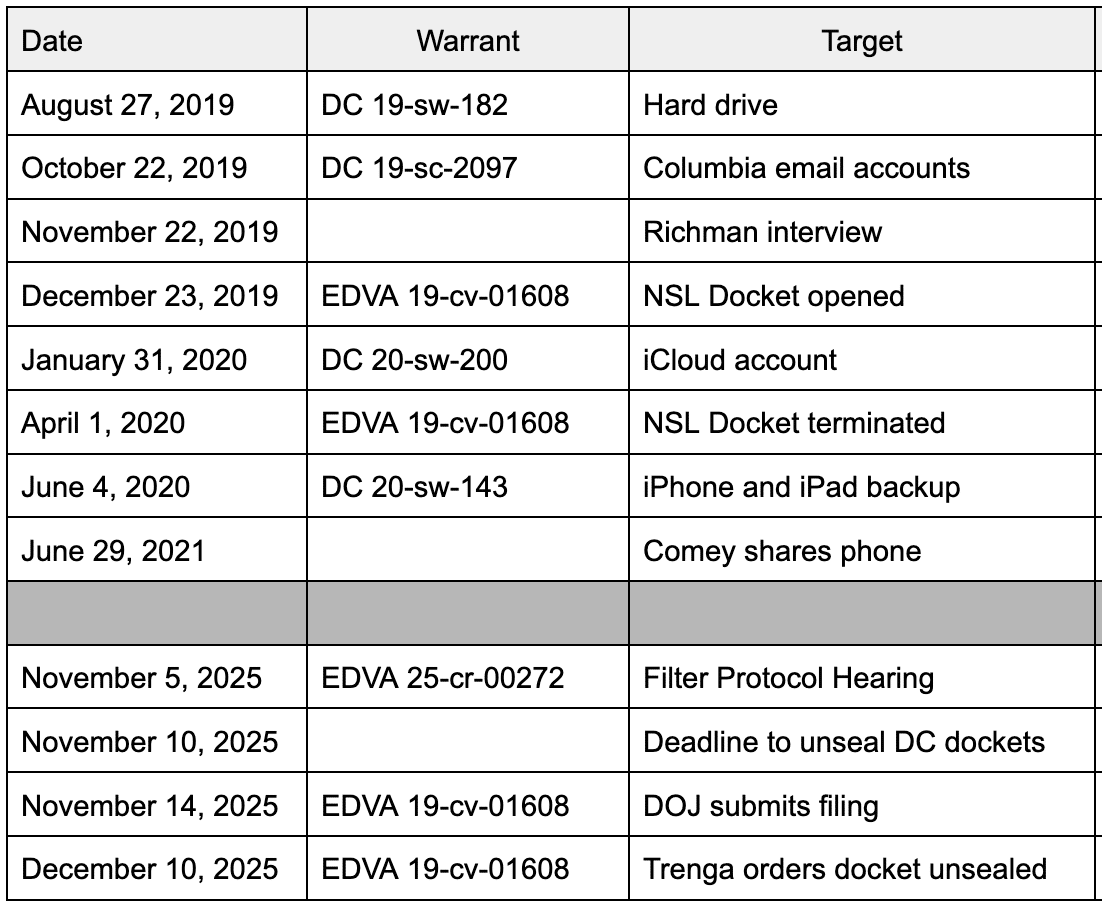
Not long after something happened in November to prevent four Dan Richman dockets from being unsealed in DC District, Judge Anthony Trenga ordered a docket about a National Security Letter from the same period as the Dan Richman investigation (which he referred in 2019 to then Magistrate Judge Michael Nachmanoff) to be unsealed.
Both the four Dan Richman dockets and the NSL docket remain substantially sealed.
As I have laid out before, when Magistrate Judge William Fitzpatrick first held a hearing about DOJ’s bid to breach Jim Comey’s privilege on November 5, he started the hearing by focusing on all the sealed documents. When he asked Loaner AUSA Tyler Lemons about the status of the underlying warrants, Lemons equivocated.
THE COURT: Mr. Lemons, what’s the status of that?
MR. LEMONS: Thank you, Your Honor. Your Honor, we have made a request to the issuing district as to those search warrants, for them to be unsealed. My understanding, last speaking with an AUSA in that district, is that motion has not been filed at this time. They are preparing to provide notice to other potentially interested parties, per their practice and the rules they have to abide by in that district. So we requested it, and our understanding is at this time that the warrants all remain completely under seal. That is the only reason why the government designated these search warrants as protected material and filed them under seal and understands why the defense filed them under seal. If it was in my power and ability here today, those search warrants would be totally unsealed. [my emphasis]
After the hearing Fitzpatrick ordered that the parties take steps to unseal both the underlying warrant dockets and the sealed filings about them.
ORDERED that the Government shall, on or before November 10, 2025, move in the issuing district to unseal the four 2019 and 2020 search warrants referenced in the Government’s Reply to Defendant’s Response to the Government’s Motion for Implementation of Filter Protocol (ECF 132), together with all attendant documents, or, in the alternative, file a motion in the issuing district setting forth good cause as to why the subject search warrants and all attendant documents should remain under seal, in whole or in part; and it is further
[snip]
ORDERED that, if necessary, the Court shall hold a hearing on the pending motions to seal (ECFs 56, 72, 109, and 133) on November 21, 2025, at 10:00 a.m. in Courtroom 500, and the materials subject to those motions shall remain UNDER SEAL until further order of the Court; and it is further
ORDERED that, to the extent the Government seeks to seal Exhibit A to Defendant’s Response to the Government’s Motion for Expedited Ruling (ECF No. 55-1), the Government shall file a supporting brief in accordance with Local Criminal Rule 49 on or before November 12, 2025; Defendant may file a response on or before November 19, 2025; and, if necessary, the Court shall hold a hearing on the Government’s sealing request on November 21, 2025, at 10:00 a.m. in Courtroom 500;
Over a month ago, by November 10, the Loaner AUSAs in EDVA should have filed to unseal the four warrant dockets in DC or they should have filed a motion in DC “setting forth good cause as to why the subject search warrants and all attendant documents should remain under seal.”
If the Loaner AUSAs followed that order, it would seem to suggest someone insisted on keeping the dockets in DC sealed.
Fitzpatrick listed those dockets in a footnote of his November 17 opinion (that is, a week after DOJ would have had to file to keep everything sealed) granting Comey access to the grand jury transcripts in his case.
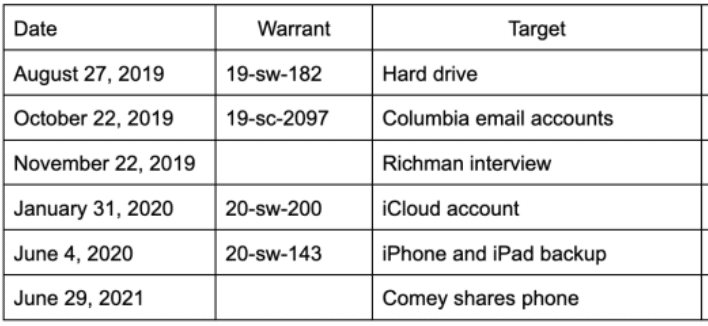
2 Search warrant 19-sw-182 was issued on August 27, 2019, and authorized the search of Mr. Richman’s hard drive from February 1, 2017 to April 30, 2017. ECF 89-1.
Search warrant 19-sc-2097 was issued on October 22, 2019, and authorized the search of Mr. Richman’s Columbia University and Law School email accounts from March 1, 2016 to May 30, 2017. ECF 89-2.
Search warrant 20-sw-200 was issued on January 31, 2020, and authorized the search of Mr. Richman’s iCloud account from March 1, 2016 to May 30, 2017. ECF 89-3. Attachment B to the warrant specifically limits the information to be seized to “non-privileged communications.” Id.
Search warrant 20-sw-143 was issued on June 4, 2020, and authorized the search of the backup files for Mr. Richman’s iPad and iPhone from March 1, 2016 to May 30, 2017. ECF 89-4. Attachment B to the warrant specifically limits the information to be seized to “non-privileged communications.” Id.
I just checked. They’re still sealed.

Some weeks ago, I did what any resourceful person would do to try to solve a docket mystery: I asked Seamus Hughes (of CourtWatch fame) if he could find anything.
He didn’t find any docket at DC asking to keep the files sealed.
What he did find is at least as interesting.
He found a docket, described as National Security Letter 19-498157 and listing Bill Barr as the defendant, which was originally referred to Michael Nachmanoff when he was a Magistrate Judge, with a recent update. On December 10, Judge Anthony Trenga, citing a response from DOJ on November 14 (which is sealed), ordered the docket about a 2019-2020 National Security Letter to be unsealed.
Aside from that order though, it remains substantially sealed.
This docket may be totally unrelated to the Comey case.
But the table above shows how neatly the two overlap. The NSL docket was opened a month after a Dan Richman interview in November 2019, and it was closed before DOJ obtained warrants to seize the iPhone which they’ve since been snooping into.
Maybe Santa can help us unwrap this in time for Christmas.
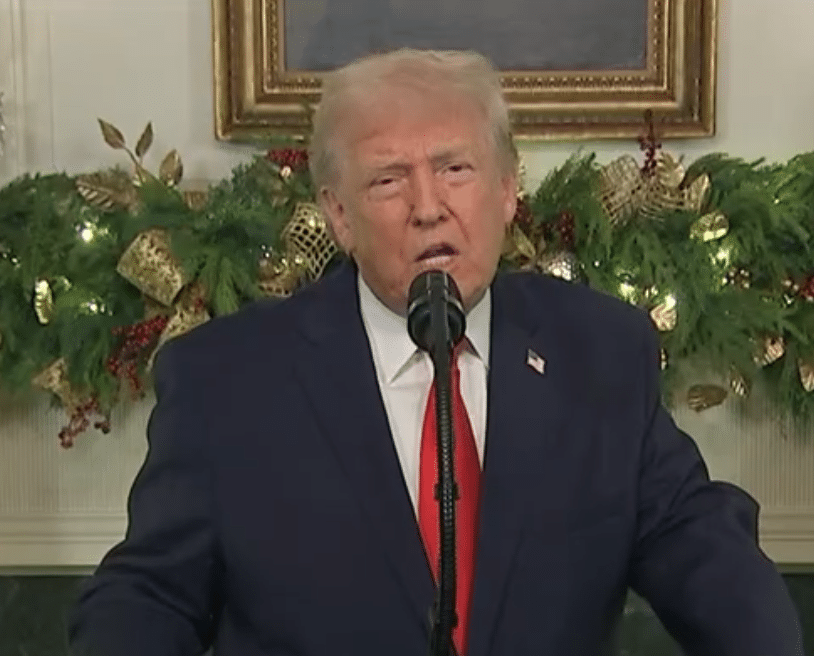
I was going to write about how Trump’s promise, last night, to send a bunch of service members a $1,776 checks, was actually a confession that there will be no tariff rebates for civilians.
Two paragraphs after Trump introduced his false claims about tariffs — “my favorite word” — he said that because of tariffs, along with the Big Ugly, Trump was sending some number (he bolloxed the number repeatedly) service members would get a check.
This historic trend will continue. Already, I’ve secured a record-breaking $18 trillion of investment into the United States, which means jobs, wage increases, growth, factory openings and far greater national security. Much of this success has been accomplished by tariffs, my favorite word, tariffs, which for many decades have been used successfully by other countries against us, but not anymore. Companies know that if they build in America, there are no tariffs, and that’s why they’re coming home to the U.S.A. in record numbers. They’re building factories and plants at levels we haven’t seen. A.I., automobiles, we’re doing what nobody thought was even possible, not even remotely possible. There has never, frankly, been anything like it.
[snip]
Because of tariffs, along with the just passed One Big, Beautiful Bill, tonight I am also proud to announce that more than 1,000, 450,000, think of this, 1,450,000 military service members will receive a special, we call warrior dividend before Christmas, a warrior dividend. In honor of our nation’s founding in 1776, we are sending every soldier $1,776. Think of that. And the checks are already on the way. Nobody understood that one until about 30 minutes ago. We made a lot more money than anybody thought because of tariffs, and the bill helped us along. Nobody deserves it more than our military. And I say congratulations to everybody. And by the way, we now have record enlistment in our military, and last year we had among the worst recruitment numbers in our military’s history. What a difference a year makes.
He once was offering bigger refunds — $2,000 — for everyone but high income people. That was, as Dean Baker did the math at the time, totally unaffordable, even ignoring that Trump is likely to have to pay some portion of the tariffs back, only to importers, not the consumers who have paid increased prices for consumer goods.
Doing the simple arithmetic, the country has 340 million people. If 10 percent of these people fit Trump’s definition of high-income, and therefore don’t get the rebate, roughly 300 million people would get the checks.
At $2,000 a piece it would come to $600 billion, more than twice what Trump is collecting from us with his import taxes. Since he’s already $330 billion short, how can Trump think he has money to pay down the national debt? Also, he seems not to know that our deficit this year is projected to be $1.8 trillion, so he is actually adding considerably to the debt and would be adding even more with his $600 billion tariff “rebate.”
So, I figured, promising a smaller number (but hiding the smaller amount in patriotic shlock) to a far smaller number of people would serve the purpose of the rebates — to generate public support for keeping the tariff revenue rather than paying them back — in a way that would be hard to oppose.
Who would begrudge service members a check, after all.
But once you give that $2.5 billion away (assuming the larger number is the correct one), you’ve started eating into the $100 billion you might be able to use to give money away.
The service members were going to get the check instead of everyone.
But according to Defense One, even that is not what is going on. Trump is taking money Congress allocated to expand housing allowances and paying it as a direct check instead.
President Donald Trump’s $1,776 checks for more than a million troops, announced Wednesday, come from Congressionally-allocated reconciliation funds intended to subsidize housing allowances for service members, a senior administration official confirmed.
During a prime-time TV address, Trump said he was “proud to announce” that “1,450,000 military service members will receive a special, we call ‘warrior dividend,’ before Christmas.” He added that to honor the nation’s founding, “we are sending every soldier $1,776. Think of that. And the checks are already on the way.”
The senior administration official told Defense One in an emailed statement late Wednesday evening that Defense Secretary Pete Hegseth directed the Pentagon to “disburse $2.6 billion as a one-time basic allowance for housing supplement” to all eligible service members ranks 0-6 and below.
“Congress appropriated $2.9 billion to the Department of War to supplement the Basic Allowance for Housing entitlement within The One Big Beautiful Bill,” the senior official said. “Approximately 1.28 million active component military members and 174,000 Reserve component military members will receive this supplement.”
It has nothing to do with tariffs (though was provided, without enough guidance to prevent such a gimmick, in the Big Ugly bill). Trump just told that lie along with his $18 trillion lie in order to claim his tariffs have been less disastrous than they have been.
Who knows? Maybe Trump will bankrupt the country to send rebates to cover over how much consumers have paid for these tariffs.
For now, though, Trump is simply piling lie on top of lie about it all.
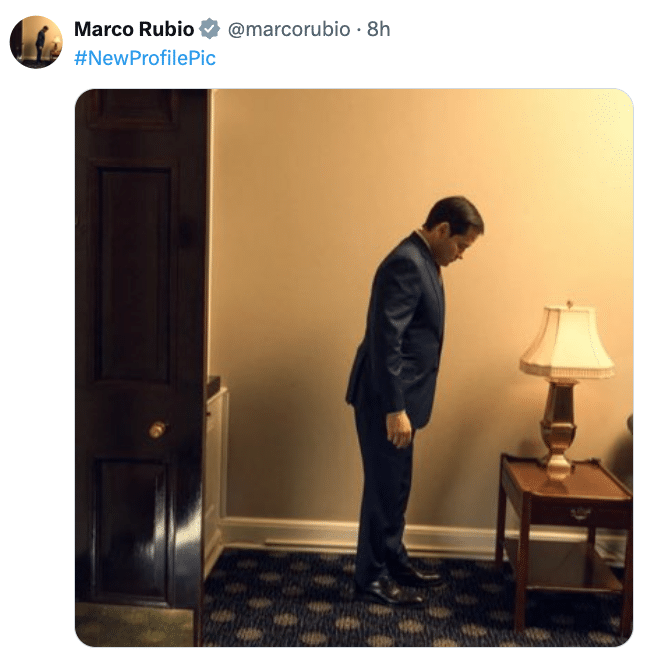
The right wing response to the Vanity Fair profile of Susie Wiles (one, two) reveals a lot about the structure of Trump’s power.
While there’s nothing surprising in the profile, Chris Whipple caught Wiles admitting to failures those of outside the White House bubble all recognize, or making laughably false claims to cover them up. And while mostly the response to the profile has been a typical beltway feeding frenzy, much of the focus has been on those expressions of truth or false claims, including how some of them — Wiles’ claims that Trump was targeting Letitia James, her confession that Trump is seeking regime change in Venezuela, Trump’s awareness that Putin wants all of Ukraine — could have lasting legal and political repercussions.
Not so the right wing, though. Theirs has been a two-fold response: first, declaring not that the profile got anything wrong, much less made up any of the abundant direct quotes, but instead that they remain loyal to Susie Wiles. After everyone had performed their expression of loyalty, the right wing turned to complaining that photographer Christopher Anderson captured Trump’s aides’ ugliness and warts.
Behind those expressions of loyalty and vanity complaints, however, the profile includes a string of confessions that Trump, that Susie Wiles, that they all have failed.
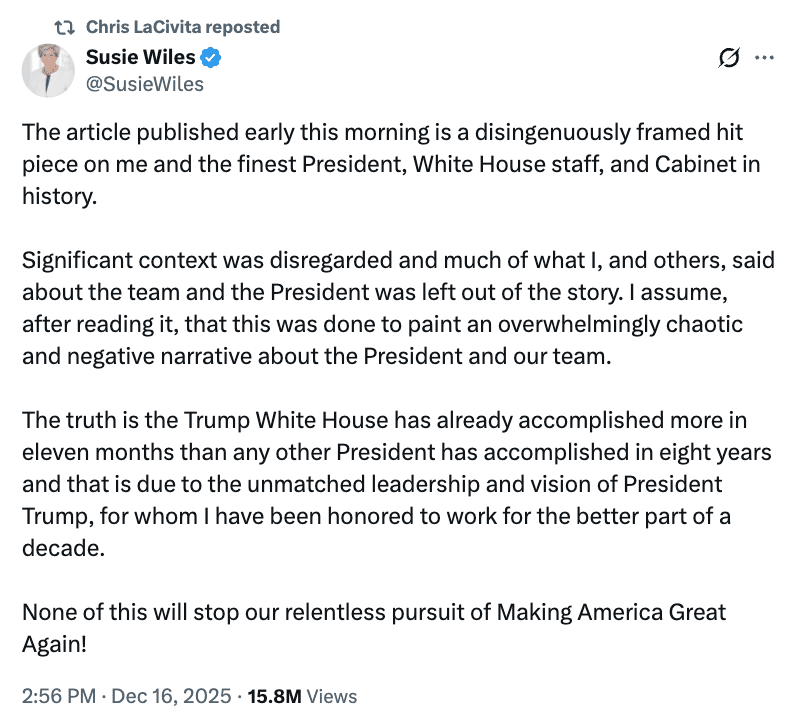
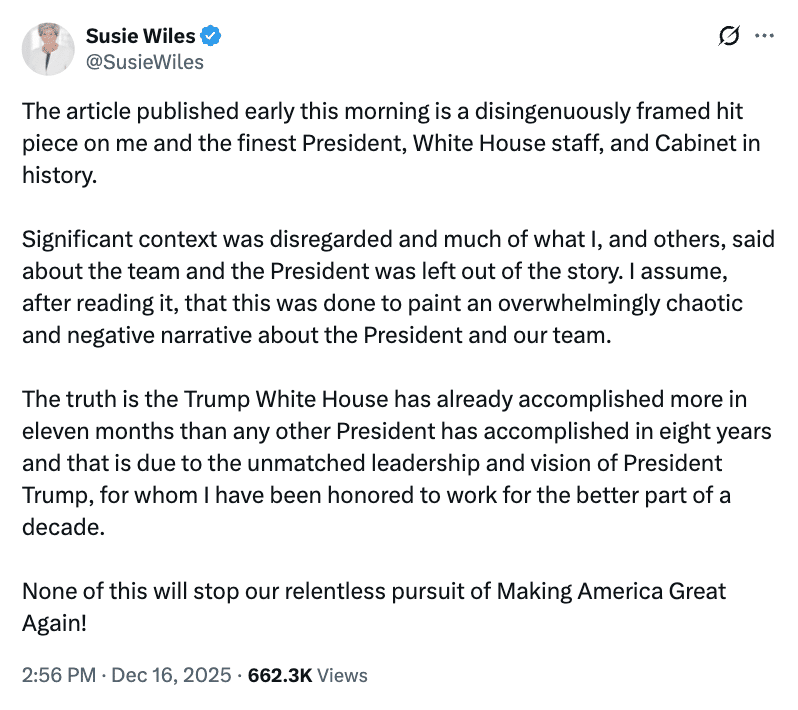
The immediate response was a performance of loyalty. First Wiles claimed in a (for her) very rare tweet that the profile had taken things out of context and ignored positive things she said. Then one after another Trump loyalist RTed that tweet and testified to how great she is and how loyal they are to her or she is to Trump.
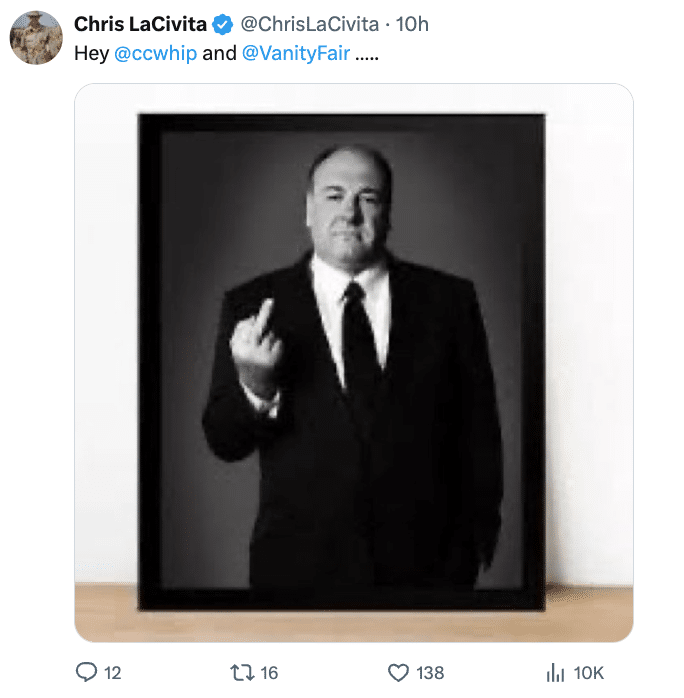
The loyalty oaths were particularly amusing to watch through Chris LaCivita’s eyes. First he RTed Wiles’ tweet.
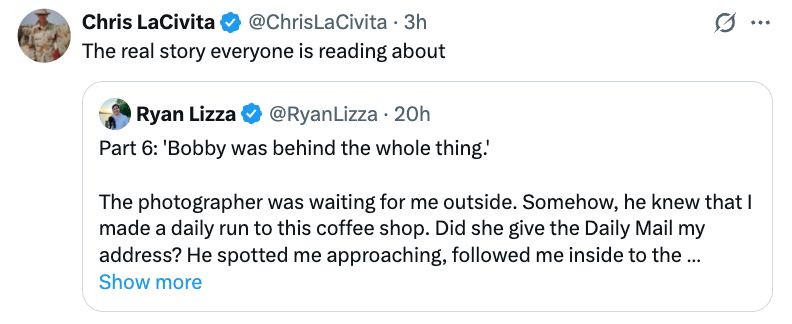
Then he tried to distract with yesterday’s scandal.
Then he posted one…
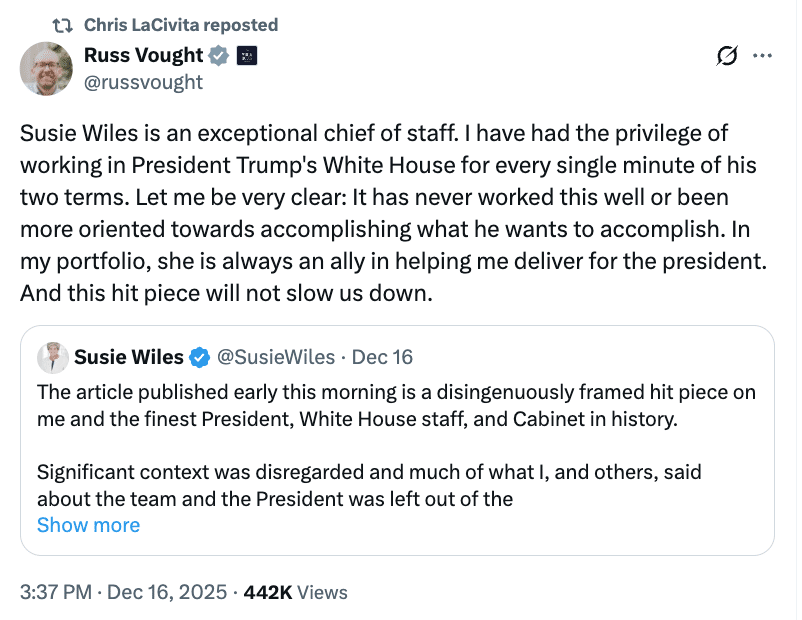
After another declaration of loyalty to Wiles. This Don Jr tweet — “When others cowered, she stood strong” is quite long and amusing in the original.

Scott Bessent’s claim of inaccuracy is especially notable given how Wiles described half of Trump’s advisors to be opposed to Trump’s tariffs (as I’ll show below).
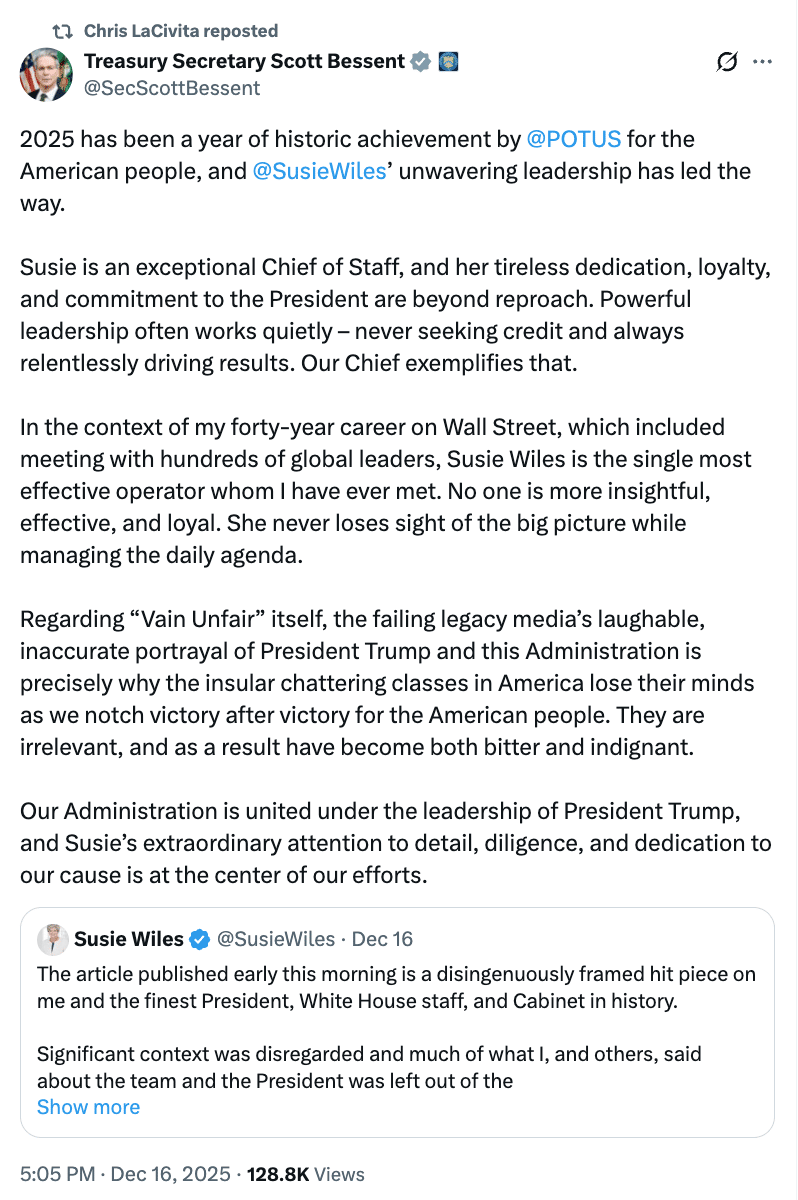
LaCivita thought dumb boomerang memes would be persuasive.

More celebration of blind loyalty.
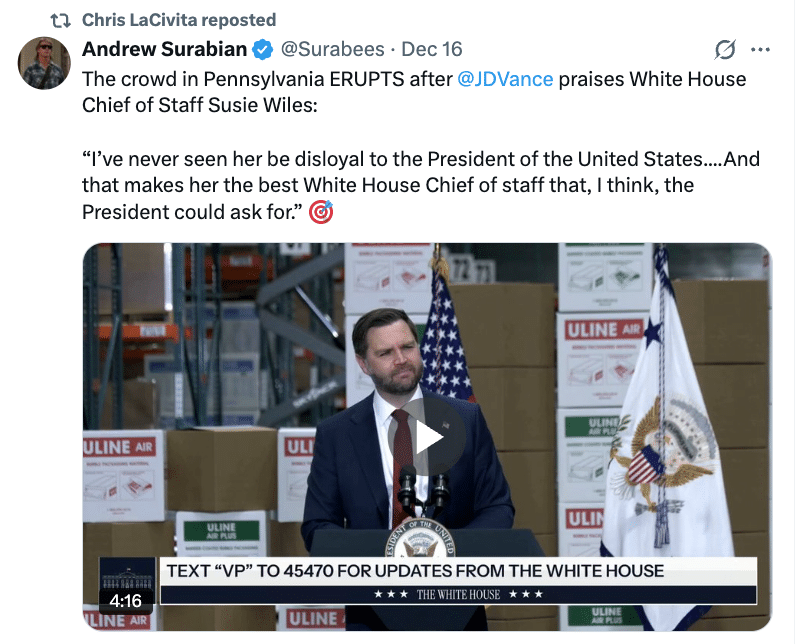
Failures hailing her role in their failure.

All leading up to this tweet, from the lady who used to pretend to be objective but now works with the former Trump spox who tried to hide behind the shrubbery, once.
Rachael Bade really did claim it was a big scoop to describe a “Wiles loyalist and Trump ally” explaining what was visible on Xitter for all to see as “circling the motherfucking wagons.”
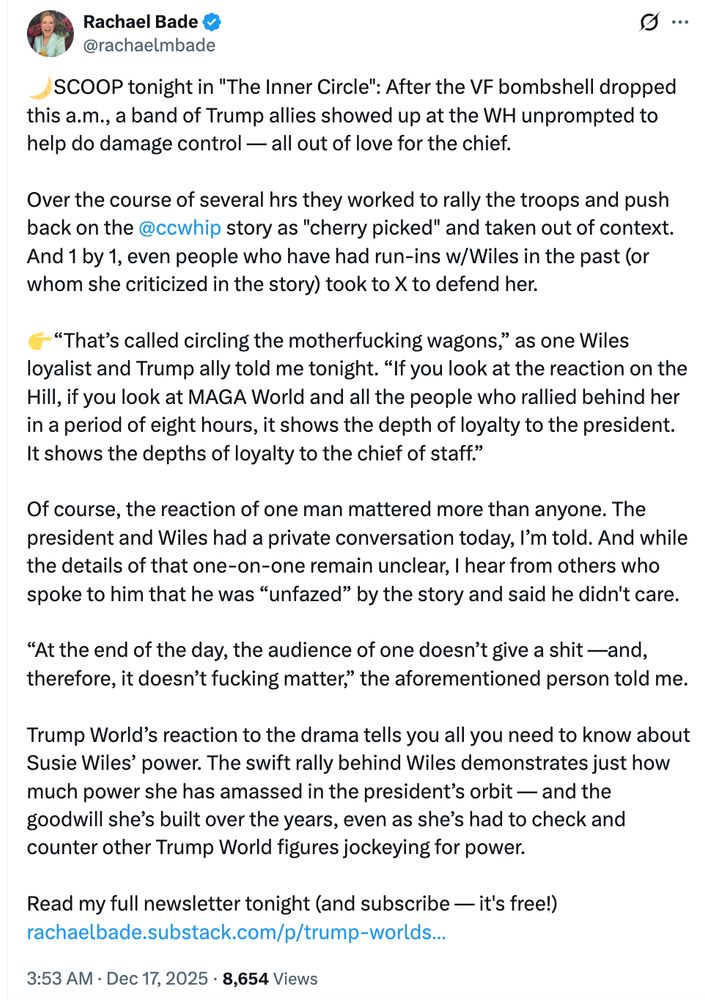
Sure. It’s clear that’s what you were doing. But honestly, a good many people who read the profiles weren’t seeking to split the White House, they were seeking to understand what Trump’s low-key Chief of Staff does or thinks.
The loyalty that prevents you from seeing the failures she confessed doesn’t prevent us from seeing them.
Then people started complaining about the photography, particular a picture that revealed the slop on Karoline Leavitt’s face and the injection marks in her lips.
WaPo did a great interview with the photographer, Christopher Anderson, where he explained his view of photojournalism and truth.
I want to talk to you about the portraits that you did for Vanity Fair. As I assume you have heard, they’ve caused a bit of a splash on social media. Can you tell me how you conceived of them?
I conceived of it many years ago. I did a whole book of American politics called “Stump” (2014), where I did all close-ups. It was my attempt to circumnavigate the stage-managed image of politics and cut through the image that the public relations team wants to be presented, and get at something that feels more revealing about the theater of politics. It’s something I’ve been doing for a long time. I have done it to all sides of the political spectrum, not just Republicans. It’s part of how I think about portraiture in a lot of ways: close, intimate, revealing.
[snip]
The images are really arresting. What is your response to people who say that these images are unfair? There’s been a lot of attention about Karoline Leavitt’s lips and [what appear to be] injection sites.
I didn’t put the injection sites on her. People seem to be shocked that I didn’t use Photoshop to retouch out blemishes and her injection marks. I find it shocking that someone would expect me to retouch out those things.
[snip]
Were they coming camera-ready, or was there a hair-and-makeup team?
Most of them came camera-ready or with their own hair-and-makeup team. Karoline Leavitt has her own personal groomer that was there.
I mean, we don’t know if Karoline Leavitt still has that groomer today now that the photos are published.
Well, what can I say? That’s the makeup that she puts on, those are the injections she gave herself. If they show up in a photo, what do you want me to say? I don’t know if it says something about the world we live in, the age of Photoshop, the age of AI filters on your Instagram, but the fact that the internet is freaking out because they’re seeing real photos and not retouched ones says something to me.
Click through for the great quote about Stephen Miller’s plea for kindness.
But none of this pushback — none of it — claims that lifelong chronicler of Chiefs of Staff Chris Whipple ever made up a quote.
Accordingly, that means no one has disputed Wiles’ admission that Trump’s policies have largely failed.
Here’s how Whipple summarized Trump’s term so far, close to the beginning of part one:
It’s been a busy year. Trump and his team have expanded the limits of presidential power, unilaterally declared war on drug cartels, imposed tariffs according to whim, sealed the southern border, achieved a ceasefire and hostage release in Gaza, and pressured NATO allies into increasing their defense spending.
At the same time, Trump has waged war on his political enemies; pardoned the January 6 rioters, firing nearly everyone involved in their investigation and prosecution; sued media companies into multimillion-dollar settlements; indicted multiple government officials he perceives as his foes; and pressured universities to toe his line. He’s redefined the way presidents behave—verbally abusing women, minorities, and almost anyone who offends him. Charlie Kirk’s assassination in September turbocharged Trump’s campaign of revenge and retribution. Critics have compared this moment to a Reichstag fire, a modern version of Hitler’s exploitation of the torching of Berlin’s parliament.
How he tells this story — though Wiles’ own assessments of Trump’s success or failure — is more interesting. The following, save the last one, are presented in the order Whipple addresses them in the profile.
End the congressional filibuster and remove Nicolás Maduro from power. [A November portrayal; results still TBD]
The agenda was twofold: ending the congressional filibuster and forcing Venezuelan president Nicolás Maduro from power.
Pardon just those who were January 6 “happenstancers.” [Wiles lies to cover up her failure to achieve this goal]
Wiles explained: “In every case, of the ones he was looking at, in every case, they had already served more time than the sentencing guidelines would have suggested. So given that, I sort of got on board.” (According to court records, many of the January 6 rioters pardoned by Trump had received sentences that were lighter than the guidelines.) “There have been a couple of times where I’ve been outvoted,” Wiles said. “And if there’s a tie, he wins.”
Preserve parts of USAID. [Complete failure, but one Marco Rubio is lying about]
Musk forged ahead—all throttle, no brake. “Elon’s attitude is you have to get it done fast. If you’re an incrementalist, you just won’t get your rocket to the moon,” Wiles said. “And so with that attitude, you’re going to break some china. But no rational person could think the USAID process was a good one. Nobody.”
[snip]
Did Rubio have any regrets about the untold number of lives that PEPFAR’s evisceration might cost? “No. First of all, whoever says that, it’s just not being accurate,” he told me. “We are not eviscerating PEPFAR.
Stephen Miller’s deportation policies. [In Wiles’ estimation, a failure]
Not long after the El Salvador deportation fiasco, in Louisiana, ICE agents arrested and deported two mothers, along with their children, ages seven, four, and two, to Honduras. The children were US citizens and the four-year-old was being treated for stage 4 cancer. Wiles couldn’t explain it.
“It could be an overzealous Border Patrol agent, I don’t know,” she said of the case, in which both mothers had reportedly been arrested after voluntarily attending routine immigration meetings. “I can’t understand how you make that mistake, but somebody did.”
Tariffs. [Wiles failed to prevent Trump’s worst instincts and the results have been worse than she imagined]
Wiles believed a middle ground on tariffs would ultimately succeed, she said, “but it’s been more painful than I expected.”
Invading blue cities. [Wiles says Trump won’t do this to stay in power]
Will the president use the military to suppress or even prevent voting during the midterms and beyond?
“I say it is categorically false, will not happen, it’s just wrongheaded,” she snapped.
November’s election. [Wiles knew they were in trouble, but even so was overoptimistic]
Wiles thought the GOP had a chance of electing the governor in New Jersey, but she knew they were in for a tough night.
The Epstein files. [Trump and Kash, both lying about what was in the files but that’s okay because MAGAts aren’t obsessed with Epstein]
For years, Kash has been saying, ‘Got to release the files, got to release the files.’ And he’s been saying that with a view of what he thought was in these files that turns out not to be right.”
[snip]
Wiles said. “It’s the Joe Rogan listeners. It’s the people that are sort of new to our world. It’s not the MAGA base.”
Murderboats and frivolous wars. [Pure self-deception]
“Not that he wanted to kill people necessarily, but stopping the killing wasn’t his first thought. It’s his first and last thought now.”
[snip]
“He wants to keep on blowing boats up until Maduro cries uncle. And people way smarter than me on that say that he will.”
Russian peace efforts. [Wiles says they’re lying about Russia wanting peace]
Trump’s team was divided on whether Putin’s goal was anything less than a complete Russian takeover of Ukraine. “The experts think that if he could get the rest of Donetsk, then he would be happy,” Wiles told me in August. But privately, Trump wasn’t buying it—he didn’t believe Putin wanted peace. “Donald Trump thinks he wants the whole country,” Wiles told me.
In October I asked Rubio if that was true. “There are offers on the table right now to basically stop this war at its current lines of contact, okay?” he said. “Which include substantial parts of Ukrainian territory, including Crimea, which they’ve controlled since 2014. And the Russians continue to turn it down. And so…you do start to wonder, well, maybe what this guy wants is the entire country.” (In Wiles’s office is a photograph of Trump and Putin standing together, signed by Trump: “TO SUSIE YOU ARE THE GREATEST! DONALD.”)
Trump would only spend 90 days on retribution. [Wiles is in denial]
“Yes, I do,” she’d replied. “We have a loose agreement that the score settling will end before the first 90 days are over.”
In late August, I asked Wiles: “Remember when you said to me months ago that Trump promised to end the revenge and retribution tour after 90 days?”
“I don’t think he’s on a retribution tour,” she said.
Trump’s biggest accomplishments: Peace and the Big Ugly
“I think the country is beginning to see that he’s proud to be an agent of peace. I think that surprises people. Doesn’t surprise me, but it doesn’t fit with the Donald Trump people think they know. I think this legislation [the so-called One Big Beautiful Bill], which funded the entire domestic agenda, is a huge accomplishment. And even though it isn’t popular in total, the component parts of it are. And that will be a very big deal in the midterms.”
That is, like the Epstein scandal more generally, Wiles either invents bubble-wrapped fictions about Trump’s own success, or concedes she, or Trump, has failed.
But Trump’s aides — the people complicit in this failure — don’t care.
They’re just going to circle the motherfucking wagons and demand loyalty.
I suppose I should have reminded readers, somewhere in my close tracking of Judge Colleen Kollar-Kotelly’s attempt to craft a nifty solution to a difficult Fourth Amendment question, that she authored a 2004 FISA opinion from which a decade of bulk collection on Americans arose.
I delayed doing so, in part, because Tulsi Gabbard has deprecated the link to the official version and so I need to go find a copy. But this post describes the substance of the opinion. This post describes how subsequent phone dragnet opinions relied on it. And this timeline explains how, after Kollar-Kotelly was just the second FISA Judge read into the unconstitutional Stellar Wind program, and after she raised concerns about it, a guy named Jim Comey refused to reauthorize it in its then current form, which led to a famous standoff in a hospital, much drama, but only limited (and still largely undisclosed!) changes in the program, before Kollar-Kotelly wrote an opinion authorizing bulk collection that would be the cornerstone for 11 more years of bulk collection.
Judge Colleen Kollar-Kotelly has a history with difficult Fourth Amendment decisions.
And she has a history with Jim Comey.
When we last reviewed this difficult Fourth Amendment question, Kollar-Kotelly had simply waved her hands over the original sins of unscoped seizures and overseized data targeting Dan Richman — which she deemed plausible Fourth Amendment violations but not something she had to deal with, she said, because she had found the later search of that likely unscoped data was itself a violation of the Fourth Amendment and so could apply a bunch of DC precedents that all addressed property that was, in the initial seizure, lawfully collected to data she agreed was plausibly also unlawfully collected. Then she ordered the government to send that unlawfully searched data to EDVA, where different precedents would apply, and where the government could get a warrant to access what they wanted.
In a motion to modify and clarify that was also, in a footnote, a motion for reconsideration, the government deftly asked to change the rules such that they would be able to keep the fruits of several iterations of unlawful searches, and Dan Richman would be gagged from revealing that’s what happened.
So here’s what Kollar-Kotelly — she of the history of difficult Fourth Amendment decisions and she with the two decade history with Jim Comey — has done since.
First, she issued an order bitching about the government’s last minute request and complaining that they didn’t raise these issues on the first go-around, but giving the government permission to keep anything derivative of those three iterations of unlawful seizures.
The Government’s [22] Motion, which was filed approximately one hour before the deadline for the filing of a certification of compliance set forth in this Court’s [20] Order, raises a variety of issues related to the handling of classified information and information that may be subject to the Government’s own privileges, including the attorney-client privilege and the deliberative process privilege. The Government could have-and should have-raised many of these issues earlier in its initial Response to Petitioner Richman’s [1] Motion for Return of Property, but it did not do so. The Court will clarify its [20] Order at greater length by separate order and, if appropriate, will request further briefing from the parties. For now, the Court notes three important clarifications:
[snip]
Further, this Court’s Order directed the return of Petitioner Richman’s own materials (and any copies of those materials), not any derivative files that the Government may have created. See Order, Dkt. No. 20, at 1 (directing the return of the original materials, copies of those materials, and any materials “directly obtained or extracted” from them); see also id. at 41 (explaining that the Court would not bar the Government from “using or relying on” the relevant materials in a separate investigation or proceeding). Accordingly, compliance with the Court’s Order will not intrude upon any of the Government’s privileges.
This order, by itself, would amount to permitting the government to use stuff tainted by a breach of attorney-client privilege (Jim Comey’s attorney-client privilege), something she has not dealt with at all.
Then yesterday, Kollar-Kotelly issued an order noting (in a footnote) the government request for reconsideration they buried in a footnote, but blowing it off …
1 In a footnote, the Government requests reconsideration of this Court’s merits ruling that the Government’s retention of the materials at issue violates Petitioner Richman’s Fourth Amendment right against unreasonable seizures. See Gov’t’s Mot., Dkt. No. 22, at 7 n.5. However, the primary focus of the Government’s [22) Emergency Motion is the proper scope of the remedy to be awarded. Accordingly, the Court focuses here on issues that are directly relevant to the issue of remedy.
… But also requiring (among other things) the parties to explain three things, with the following deadlines:
The order pertaining to that 10AM explanation betrays how inadequate the original baby-splitting solution was, not least because Kollar-Kotelly doesn’t unpack that the stuff the government originally seized from Richman is evidence — or at least includes it.
Second, the Government argues in its [22] Emergency Motion that the Court’s Order “appears to require the Government to delete or destroy evidence originally, and lawfully, obtained pursuant to search warrants issued by the U.S. District Court for the District of Columbia in 2019 and 2020.” Gov’t’s Mot., Dkt. No. 22, at 5. To be clear, the Court has not ordered the Government to delete or destroy any evidence; instead, it has ordered the Government to return certain materials to Petitioner Richman, while depositing others with a third-party custodian for safekeeping. However, to ensure that the remedy awarded in this case is appropriately tailored to the facts, the Court would benefit from more factual details regarding the Government’s execution of the search warrants issued in this District in 2019 and 2020. Id. Accordingly, it is ORDERED that, no later than 10:00 a.m. ET on Wednesday, December 17, 2025, the Government shall file with the Court a brief response to the following questions:
(1) Does the Government have in its possession a complete copy of any of the following:
(i) the “forensic image” of Petitioner Richman’s personal computer hard drive that the Government was authorized to search under the warrant issued in this District on August 27, 2019;
(ii) the information disclosed by Columbia University to the Government pursuant to the warrant issued in this District on October 22, 2019;
(iii) the information disclosed by Apple to the Government pursuant to the warrant issued in this District on January 30, 2020; or
(iv) the “contents of a hard drive … containing backup files of one Apple iPad 4 and one Apple iPhone 5S” that the Government was authorized to search under the warrant issued in this District on June 4, 2020?
(2) Under each of the four search warrants at issue, the Government was authorized to seize only responsive material, which constituted a subset of the information it was permitted to search. Did the Government create a separate file, disk, hard drive, or any other segregated collection of responsive material for any of the following:
(i) the material seized from Petitioner Richman’s personal hard drive pursuant to the warrant issued in this District on August 27, 2019;
(ii) the material seized from Petitioner Richman’s Columbia University email accounts pursuant to the warrant issued in this District on October 22, 2019;
(iii) the material seized from Petitioner Richman’s iCloud account pursuant to the warrant issued in this District on January 30, 2020; or
(iv) the material seized from the backup files of Richman’s Apple iPad 4 and Apple iPhone 5S pursuant to the warrant issued in this District on June 4, 2020? [my emphasis]
As Kollar-Kotelly alludes to elsewhere, these questions should have been answered before she made her original decision. But she doesn’t acknowledge that she would have needed this information, in part, to understand whether the first two seizures violated the Fourth Amendment, which — if they do — would mean her application of multiple precedents that all assume the initial seizure was lawful would be totally inapt.
But there are two reasons why even these belated questions are inadequate to her purpose.
First, as Kollar-Kotelly noted in her own opinion, which she cited via William Fitzpatrick’s opinion which in turn cited this FBI declaration, when the FBI searched all this data in September, they searched a full extraction of Richman’s phone and iPad.
For this search, an FBI agent was instructed to review “a Blu-ray disc that contained a full Cellebrite extraction and Reader reports” for two of Petitioner Richman’s devices to identify “conversations between [Petitioner Richman] and [Mr. Comey].”
As the full quote from the FBI declaration explained, when Francis Nero did that search, he received a Blu-ray sealed with red evidence tape.
On or about September 12, 2025, while assigned to the Director’s Advisory Team, I was requested by Special Agent Spenser Warren to review a Blu-ray disc that contained a full Cellebrite extraction and Reader reports of an iPhone and iPad backups. I was requested to review the Cellebrite extraction for conversations between RICHMAN and JAMES COMEY. SA Warren handled this agent a manilla envelope sealed with red evidence tape that contained the Blu-ray disc with the Cellebrite extraction.
We know this full extraction contained attorney-client communications. Kollar-Kotelly doesn’t ask, in her second question above, how privileged communications were treated back in 2019 and 2020. She needed to ask whether the FBI only scoped the data not covered by Richman’s privilege declarations (which is what happened, if they scoped it at all) or whether they gave him scoped materials on which to make privilege declarations. Whichever it is, though, there needs to be a question 3, because the government never had the right to search privileged materials (except, arguably, on the original image itself, because such searches were not yet explicitly prohibited).
More importantly, if Spenser Warren handed Nero the full extraction, then it doesn’t matter what happened in step 2 of Kollar-Kotelly’s question above, because the government simply searched, without a warrant, unscoped data that should have been destroyed. That red evidence tape may well be what the government did to ensure that the FBI didn’t snoop on unscoped data. If so, the smoking gun in this chain of unlawful seizures was the decision, by someone on the Director’s Advisory Team, to search unscoped data without a warrant. That’s not covered by Kollar-Kotelly’s questions at all.
The other reason Kollar-Kotelly’s questions are inadequate is because of this disclosure (which didn’t make Fitzpatrick’s opinion and so may not be before her).
5 The Order also required the government to provide, in writing, by the same deadline: “Confirmation of whether the Government has divided the materials searched pursuant to the four 2019 and 2020 warrants at issue into materials that are responsive and non-responsive to those warrants, and, if so, a detailed explanation of the methodology used to make that determination; A detailed explanation of whether, and for what period of time, the Government has preserved any materials identified as non-responsive to the four search warrants; A description identifying which materials have been identified as responsive, if any; and A description identifying which materials have previously been designated as privileged.” ECF No. 161 at 1-2.
Despite certifying on November 6 that it had complied with the Court’s Order, ECF No. 163, the government did not provide this information until the evening of November 9, 2025, in response to a defense inquiry. The government told the defense that it “does not know” whether there are responsive sets for the first, third, and fourth warrants, or whether it has produced those to the defense, and said that in that regard, “we are still pulling prior emails” and the “agent reviewed the filtered material through relativity but there appears to be a loss of data that we are currently trying to restore.” [my emphasis]
On November 9, in response to the same questions Kollar-Kotelly asked in her order but posed by Fitzpatrick, the government told Comey — but not in writing! — that they had no fucking clue what happened with the first, third, and fourth warrants, because something happened with Relativity, the software on which these distinctions would have been preserved. So they had to pull prior emails to figure out what the fuck they were doing searches on.
The government may still have no fucking clue what they’re dealing with, because they asked for a 48-hour extension on both their own deadlines.
Richman agreed to that delay but only if he also got an extension.
Counsel for Petitioner has informed the Government that he takes no position on this request, but respectfully requests that the Court provide Petitioner an equivalent extension of time to file his brief, see ECF No. 27 at 3, should the Court grant the Government’s motion.
Late yesterday, Kollar-Kotelly issued a docket order granting the government its two-day extension on the easier question — how to keep this data secure at EDVA — but just a two hour extension to the harder deadline — what the fuck happened with this data. She did not, however, grant Richman an extension at all, so his response must now be filed two hours after the government’s response.
The Court is in receipt of the Government’s 28 Motion for Additional Time to Respond to this Court’s 27 Order for supplemental submissions, which the Government filed at 6:28 p.m. ET this evening. The Government’s 28 Motion is GRANTED IN PART and DENIED IN PART. The Government’s Motion is GRANTED as to the 9:00 a.m. deadline for the submission of “best practices on safekeeping evidence,” which is CONTINUED to 9:00 a.m. ET on Friday, December 19, 2025. The Motion is GRANTED IN PART and DENIED IN PART as to the Government’s deadline to respond to the factual questions presented in this Court’s 27 Order. The Government shall file brief responses to these questions no later than 12:00 p.m. ET on Wednesday, December 17, 2025. The Motion is otherwise DENIED. Petitioner Richman’s response deadline is unchanged.
Again, Kollar-Kotelly needed answers to these questions before she crafted the baby-splitting solution. Because if the original data was overseized and then not preserved in its scoped form (or if someone fiddled with Relativity in the interim to muddle what data was properly seized in the first search), then her application of DC precedent was inappropriate. At least some of this data was — as far as we know (though there may be other warrants) — always unlawfully seized.
That 2004 opinion Kollar-Kotelly wrote was an attempt to solve an enormous problem caused by unlawful government spying, but it served as the cornerstone for 11 more years of unlawful government spying. This particularly baby-splitting solution may lack the gravity of that earlier opinion, but in its currently muddled form, has the potential of causing another decade of problems.
Update: DOJ’s response is here. They actually admit to the problem with Relativity (though don’t name Relativity and try to obscure the timing of DOJ dropping it, which almost certainly has to post-date the January 6 investigation).
These responses are provided with the qualification that the search warrants were obtained five and six years ago.
[snip]
Search warrants directed at these materials were issued by the United States District Court for the District of Columbia. These warrants included language for following a filter process for attorney-client privileged information. As to the iCloud account and backup files for the iPad 4 and iPhone 5S, these materials were combined and provided to Richman and his counsel for filtering. The filtered version was then provided back to the government for review. Correspondence reviewed by the present investigative team indicates that the primary case agent then committed to reviewing the filtered version through an e-discovery program. Between 2020 and 2025, the Department of Justice stopped using this e-discovery program and a loss of data occurred. The government has attempted to restore this data but has not been successful.
The government has contacted the primary case agent. The primary case agent stated that he always followed and complied with the terms of a search warrant, and that his behavior in this case would have been no different. However, due to the passage of time [redacted], the primary case agent could not specifically describe the process followed in 2019 and 2020.
In a redaction in this passage and an earlier one (for which DOJ appears not to have filed a motion to seal), they must describe something that happened to the original lead case agent. That is, for some reason he can’t fully reconstruct what he did five years ago.
And they have yet to reconstruct what was lost in dropping Relativity.
In short, they’re basically saying these warrant returns are so old, neither the person who managed them nor the software paid to preserve them are available to do so any longer.
Their solution to that, DOJ says, is for them to have a filter AUSA and a filter Agent review it all to find out if there is a segregated version within the larger set.
Finally, as to the materials described in this section, the government respectfully requests that the Court allow a filter FBI agent and a filter AUSA to review only the previously filtered versions, which, according to FBI records, are contained on the relevant storage devices. The purpose of this limited review would be to determine whether any sort of segregated version of responsive material exists on the storage devices.
This should change Kollar-Kotelly’s entire approach. DOJ confesses they have no fucking clue whether the data they have is legal or not.
But it likely will not.
Update: Richman’s response is here. It goes big, demanding that all materials be taken away from the government.
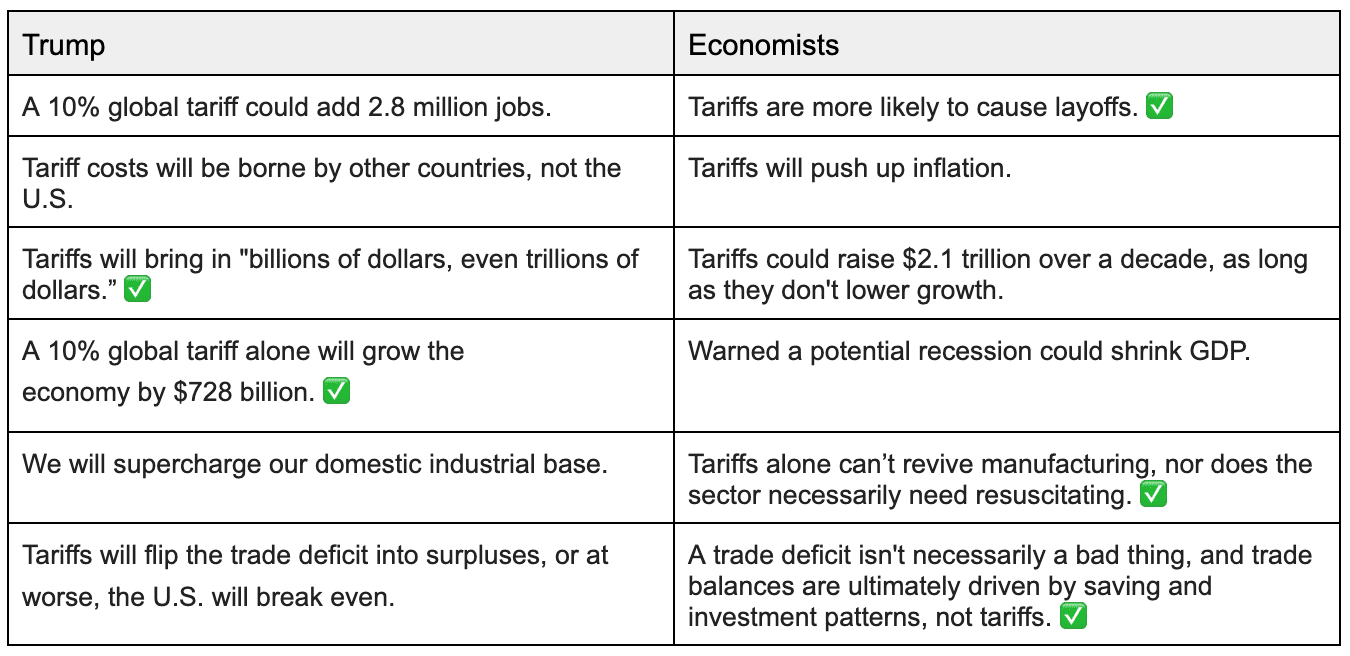
WSJ had a heavily-produced story on Sunday, “Why Everyone Got Trump’s Tariffs Wrong,” purporting to assess the claims that Trump and economists had made … at some point about his tariffs.
This table includes the six allegedly competing claims WSJ assesses; I’ve added a check marking whichever side WSJ claimed was really right.
For most of six paired predictions, WSJ makes a show of adjudicating who was right, giving Trump credit on two predictions and less ostentatiously confirming economists’ predictions on three.
For example, WSJ provides this table purporting to show that both Trump and the economists were wrong about inflation (with steeper tables showing the spike in coffee and appliances); for some reason, WSJ indexes this to January 1, 2024 prices, not 2025 (and some of the tables at WSJ’s source show steeper spikes).
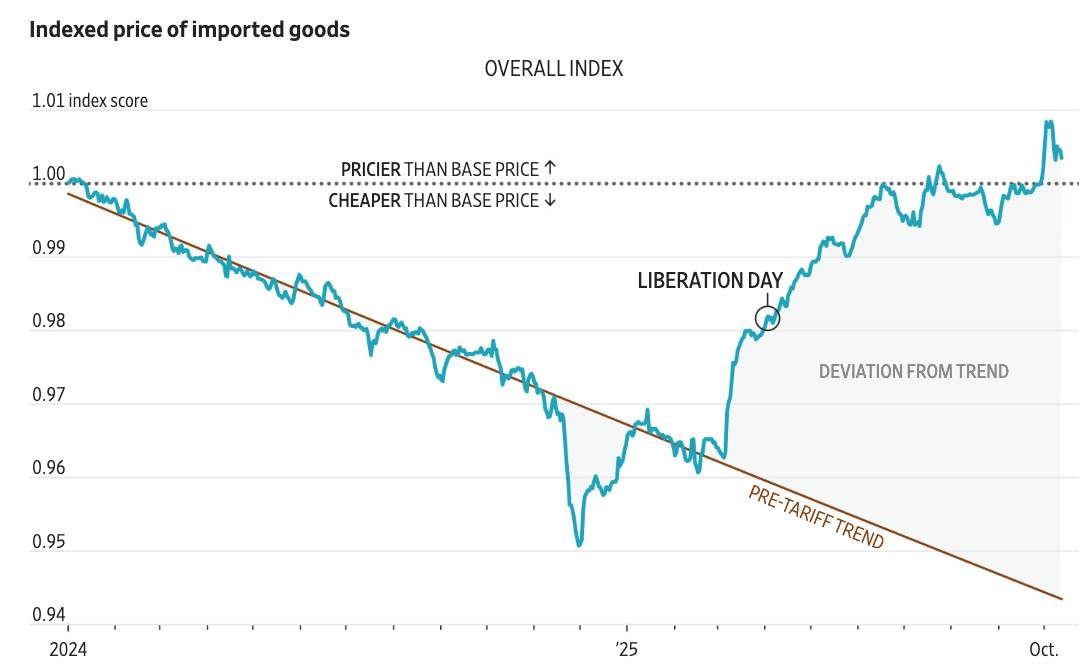
WSJ judges that economists were wrong this way:
Tariffs swiftly hit Americans’ wallets as major retailers from Macy’s to Best Buy raised prices in response to the duties.
“The magnitude and speed at which these prices are coming to us is somewhat unprecedented in history,” Walmart Chief Financial Officer John David Rainey told The Wall Street Journal in May.
But the worst inflation fears haven’t come to pass. Inflation has for months hovered around 3%—higher than the Federal Reserve’s 2% target, though still lower than many economists’ expectations.
But starting in the very next paragraph, WSJ explains why inflation wasn’t as bad as predicted: first, because Trump reversed the worst tariffs. Then, because companies are still trying to figure out what the fuck his tariff policy will be, especially after the Supreme Court gets done with it, and so haven’t passed on all of the tariffs, which they will eventually do.
Another factor at play: Trump’s repeated policy shifts on tariffs.
Many companies have said they want to see where tariffs will ultimately settle before introducing more price changes. The still-undecided Supreme Court case on Trump’s authority to impose tariffs gives them another reason to wait a bit longer.
Economists predict higher prices as companies draw down on their pre-tariffed inventory and renegotiate contracts with retailers and distributors.
If no new tariffs are announced, the Fed estimates the current ones will take nine months to work their way through the economy. That could push inflation from goods down in the back half of 2026. But “we haven’t been able to predict this with any precision,” said Fed Chairman Jerome Powell. “No one is.”
The rest of the article has similar equivocations. WSJ returns to Trump’s decision to reverse many of the tariffs when discussing the GDP growth (and notes that AI has kept the GDP afloat, without also noting that it’s likely in a bubble that is beginning to crash).
Trump has also walked back and delayed many of his threatened duties.
WSJ’s discussion of Trump’s failure to bring manufacturing back returns to changing policy.
Big projects will likely take years to materialize, if they happen at all, as government policies could shift again in that time.
And the flux makes this assessment impossible. Two days ago, for example, WSJ hailed September’s good job’s report.
The U.S. added 119,000 jobs in September, far more than economists had expected. But the figure was an outlier from previous months, in which job growth had lagged. As of September, the unemployment rate reached 4.4%, the highest in four years.
But that got revised downward today and — Justin Wolfers describes in reading today’s report — in reality there may be zero or negative job growth since Trump tried to impose his big tariffs, which if that proves true, would vindicate the economists.
WSJ gives Trump credit for predicting some revenue growth even while noting he wildly exaggerated how much growth there might be, but then admits that not only will much of the revenue go away if SCOTUS throws out the tariffs, but Trump would have to pay some portion — potentially as much as half — of the tariffs back.
Future collections hang on the Supreme Court’s decision on Trump’s authority to impose the tariffs, expected in coming days.
If the court strikes down tariffs imposed under the International Emergency Economic Powers Act, monthly revenue collected would fall by more than half. More than $100 billion already collected might also need to be refunded.
And WSJ also notes that a lot of the data it would need to measure all this is delayed (it doesn’t address Trump’s efforts to tamper with the data).
Perhaps the most salient assessment in the story is the last line: “As long as Trump continues to surprise the market with tariffs, trade will remain volatile,” which is both a platitude and an observation that you can’t assess many of these claims using regular measures, because the tariffs are not (or not just) about creating a precondition to shift trade flows.
Trump’s tariffs aren’t just tariffs. They are week-to-week business uncertainty.
They are also, just as importantly, about giving Trump a tool to attempt to leverage power, something captured in a different WSJ story, this interview with Meredith McGraw, in which Trump offers word salad to explain why tariffs are so cool.
When asked if he has alternative ways to use tariffs, the president said there are other laws but they are not as “nimble, not as quick.” He added, “I can do other things, but it’s not as fast. It’s not as good for national security.”
Trump also argued that tariffs gave him leverage in negotiations with other countries.
“I just used tariffs 10 minutes ago, just before you came, to settle the new inflammation that took place with Thailand and Cambodia,” Trump said. “And I told them, ‘If you have the war, not only am I going to break the trade deal we have, but I’m going to put tariffs on your country.’” He added, “Nobody can do that but me.”
“Nobody can do that but me,” Trump said of an authority that SCOTUS is likely to say he cannot lawfully do.
Worse, Trump equates being able to coerce other countries nimbly with national security. But it is anything but.
Consider how inconsistent Trump’s logic is. In the same week that Trump approved the sale of Nvidia chips to China (which chips China promptly said they would limit use), chips that remained, that very day, illegal to ship to China, the White House halted negotiations on similar kinds of technology with the UK because the Brits would not bow to Trump’s demands on food and tech standards. Trump wants to send chips to China instead of (just) shitty chicken, but he won’t send chips to the UK unless they accept US shitty chicken and Nazi Xitter posts.
None of it makes sense.
And this misrepresentation of how Trump is using tariffs — treating as sincere his false claims about how he claims he is using them — is just part of the reason why the reporting on Trump’s catastrophic tariffs has been so shitty.
To be sure, there has been persistent reporting on how badly his tariffs have devastated farm markets, especially soybeans but now shifting to wheat. There have been stories on how China has gotten pretty much what it has wanted. But there has been less coverage of how Trump’s stupid ass trade war — and China’s preparation for it since Trump’s last Administration — has created the opportunity for China to leverage its rare earth dominance and soybean consumption to bring Trump to heel.
Trump thought America was the irreplaceable market, and attempted to leverage access to it accordingly. But as he has discovered how little of all that he understands, it has backfired, giving China leverage it otherwise didn’t have.
And, if we can believe Vanity Fair’s profile of Susie Wiles, half of Trump’s advisors knew it wouldn’t work in real time.
“So much thinking out loud is what I would call it,” said Wiles of Trump’s chaotic tariff rollout. “There was a huge disagreement over whether [tariffs were] a good idea.” Trump’s advisers were sharply divided, some believing tariffs were a panacea and others predicting disaster. Wiles told them to get with Trump’s program. “I said, ‘This is where we’re going to end up. So figure out how you can work into what he’s already thinking.’ Well, they couldn’t get there.”
Wiles recruited Vance to help tap the brakes. “We told Donald Trump, ‘Hey, let’s not talk about tariffs today. Let’s wait until we have the team in complete unity and then we’ll do it,’ ” she said. But Trump barreled ahead, announcing sweeping “reciprocal” tariffs, from 10 to 100 percent—which triggered panic in the bond market and a sell-off of stocks. Trump paused his policy for 90 days, but by that time the president’s helter-skelter levies had given rise to the TACO chant: “Trump Always Chickens Out.”
Wiles believed a middle ground on tariffs would ultimately succeed, she said, “but it’s been more painful than I expected.”
All this is so painful not just because tariffs are a stupid policy and the way in which Trump implemented them is even stupid. It is painful because Trump has no fucking ability to discern what is good for America, and he doesn’t much care if he fucks up and destroys entire markets as a result.
And coverage of Trump’s destruction of the soybean market has not yet called out the systematic lies Republicans tell claiming Trump’s grant of $12 billion to struggling farmers is only an attempt (again) to reverse the damage he did, which will not come close to making farmers whole. Right wingers are, across the board, hailing Trump’s payoff and blaming the damage Trump did on Joe Biden … and almost no one is calling out the projection and lies.
Trump’s tariffs are a failure not just as tariffs, in fulfilling their purported purpose. But because Trump knows so little about the markets he’s trying to alter, he’s simply making the US vulnerable.
Update: Paul Krugman has more on what we learned from yesterday’s job numbers.
[T]he data show a weak labor market. Employment isn’t falling off a cliff, but job growth has been weak and hasn’t kept pace with the number of people seeking work. The headline unemployment rate in November was 4.6 percent, up from an average of 4 percent in 2024. That number is close to triggering the Sahm Rule, an economic rule of thumb devised by Claudia Sahm, a former economist at the Board of Governors of the Federal Reserve, that has historically been highly successful at identifying the early stages of a recession.
We can’t do a strict application of the Sahm Rule yet because Sahm’s method is based on the average unemployment rate over the past three months. Unfortunately, the shutdown prevented the Bureau of Labor Statistics from collecting key data in October. But if we do an interpolation of October’s unemployment rate by averaging over September’s rate of 4.4% and November’s rate of 4.6%, we can estimate that October’s unemployment rate was 4.5%. And those 3 months of unemployment numbers bring us within a whisker of the unemployment rise that, according to the Sahm Rule, signals that a recession is on the horizon.
The state of the economy looks even worse if we take a wider view of the labor market.
[snip]
Normally, when a president experiences a troubled economy during his first year he dispatches his
flying monkeysminions to declare that it’s all his predecessor’s fault. And some Trump officials, like Scott Bessent, are indeed trying to play the blame game. But this standard political tactic is unlikely to work for this president.First, the economy that Trump inherited when he took office was in much better shape than today’s economy, with lower unemployment combined with faster job growth, and inflation trending down.
Second, Trump’s radical policy changes – huge (illegal) tariffs, mass deportations, big tax cuts (for the rich), benefit cuts (for the poor and middle class), mass layoffs of federal workers, disinvesting in huge green energy projects and aid to farmers — have been clearly damaging to everything besides crypto and AI. It strains credulity – even for the Trump faithful – to claim that we are still in Joe Biden’s economy.
One of the longest part of Vanity Fair’s two-part (one, two) interview with Susie Wiles focuses on Jeffrey Epstein. It goes like this:
¶1: Chris Whipple’s explanation of why it’s important.
¶2: Wiles’ admission she underestimated the import of it.
¶3: A review of Pam Bondi’s binder fiasco, with Wiles commenting on Bondi’s fuck-up.
¶4: A report on how many FBI agents reviewed the files, with Wiles’ claim they weren’t just searching for Trump.
¶5: Wiles’ claim there was nothing bad on Trump in the files, just him and Epstein being “young, single playboys.”
¶6: Wiles debunking Trump’s false claims about Clinton’s ties to Epstein.
¶7: Wiles describing that Kash Patel and Dan Bongino really understood Epstein, except Kash was wrong.
¶8: Wiles’ failure to offer an explanation for Todd Blanche’s interview with Ghislaine Maxwell.
¶9: Wiles’ claim that Trump was pissed Ghislaine got moved.
¶10: Wiles’ claim that the birthday letter to Epstein is not from Trump.
¶11 – ¶12: Wiles’ claim that Trump would sit for a deposition in his WSJ lawsuit if necessary.
¶13: Whipple explaining the threat of the Epstein files again, then quoting Wiles on who cares about it.
¶14: Someone at the White House who might be JD Vance explaining who cares about it.
¶15: A specific mention of Vance, with further explanation of those who care about Epstein.
Elsewhere, Wiles credits herself with a great read of electoral outcomes (even while describing her own prediction that Jack Ciattarelli might beat Mikie Sherill last month): She was certain they would win last year, she didn’t think November would be that bad, they’re going to win midterms.
Her confidence (even if feigned) is why I’m so interested in Wiles’ description of the relative knowledge about Epstein. As noted, she admitted to Whipple that she didn’t understand how important this scandal could be, deferring knowledge on such issues to Kash Patel, Dan Bongino, and JD Vance — two of whom she describes as conspiracy theorists.
Wiles told me she underestimated the potency of the scandal: “Whether he was an American CIA asset, a Mossad asset, whether all these rich, important men went to that nasty island and did unforgivable things to young girls,” she said, “I mean, I kind of knew it, but it’s never anything I paid a bit of attention to.”
[snip]
The people that really appreciated what a big deal this is are Kash [Patel] and [FBI deputy director] Dan Bongino,” she said. “Because they lived in that world. And the vice president, who’s been a conspiracy theorist for a decade…. For years, Kash has been saying, ‘Got to release the files, got to release the files.’ And he’s been saying that with a view of what he thought was in these files that turns out not to be right.” [brackets original]
But then six paragraphs after describing that longtime Trump loyalist Kash Patel was totally into [a false belief] about the Epstein files, first Wiles and then someone who might be JD Vance (who is mentioned in the following paragraph) describe their understanding of who cares about this: “people that are sort of new to our world.”
The Epstein files debacle poses a dire political threat to Trump and the future of the GOP. “The people that are inordinately interested in Epstein are the new members of the Trump coalition, the people that I think about all the time—because I want to make sure that they are not Trump voters, they’re Republican voters,” Wiles said. “It’s the Joe Rogan listeners. It’s the people that are sort of new to our world. It’s not the MAGA base.”
A senior White House official described the mindset of an overlapping bloc of voters who are angered by both Trump’s handling of the Epstein files and the war in Gaza. It’s as much as 5 percent of the vote and includes “union members, the podcast crowd, the young people, the young Black males. They are interested in Epstein. And they are the people that are disturbed that we are as cozy with Israel as we are.”
Susie Wiles, who has been around Trump since he was first elected, claims “the people that are inordinately interested in Epstein” are “not the MAGA base”!!!
And then that anonymous White House official who might be JD Vance (whom Wiles explains is a conspiracy theorist) describes that the “young Black males” are the ones who care about Epstein.
To be fair, it is the case that the MAGAt base voters who do care deeply about this — people like Charlie Kirk, Benny Johnson, and Jack Posobiec — quickly fell in line when Trump demanded they stop talking about Epstein in July.
But like Kash and Bongino themselves, these are the people who made Epstein specifically and conspiracy theories about pedophiles more generally some of the central glue of Trump’s coalition.
As I wrote for TPM’s anniversary series, the superpower of reclaiming attention which Trump has honed with these same far right trolls has always been developed in parallel with the use of conspiracy theories about pedophilia — from Posobiec’s Pizzagate, to QAnon, to Epstein — to keep that attention.
On July 8, something happened to Donald Trump that I’ve not seen happen in the entire decade he has dominated presidential politics. As his base clamored for more disclosures about sex trafficker Jeffrey Epstein, his superpower — his ability to grab and redirect attention — briefly failed him. “Are you still talking about Jeffrey Epstein?” he whined when a journalist asked about the Justice Department’s decision to abort any further disclosure of documents related to the case. “This guy’s been talked about for years.”
[snip]
Two things had disrupted Trump’s superpower. First, after Trump’s top DOJ appointees — Attorney General Pam Bondi, FBI Director Kash Patel, and his deputy Dan Bongino – had fueled, then disappointed, MAGA’s demand for Epstein disclosures, the failure to fulfill their promises fed the conspiracy itself. By thwarting the conspiracists’ demands, Bondi, especially, created rifts and distrust in Trump’s own base.
Conspiracy theories about Epstein were always non-falsifiable; the mob will never be satisfied. But Bondi made that dynamic worse.
More important for understanding what happened in July: the very same online trolls who’ve been critical partners in Trump’s success managing attention were precisely the same people who had spun those conspiracy theories. There is a direct through-line from a relatively small set of social media accounts that helped Trump win the 2016 election to PizzaGate and, after that, QAnon. QAnoners played a key role in Trump’s 2021 insurrection attempt, and its adherents remain a substantial portion of Trump’s base. Since 2016, pro-Trump trolls’ exploitation of social media algorithms to redirect political news coverage — whether from legacy media or newer outlets — has disrupted traditional news cycles.
And while some of what Wiles says about Epstein — her claim Trump was pissed Ghislaine got moved, her feigned certainty that the birthday letter is not from Trump — is clearly bullshit, Wiles and the anonymous person who might be JD nevertheless offered a very specific, and very inaccurate, description of which Trump voters care about Epstein.
Maybe they’re telling this tale because it’s the same thing they told House members in a bid to kill the Massie-Khanna discharge petition. Maybe they’re telling this tale because everyone Wiles thinks knows about Epstein is a conspiracy theorist and the guy who really knows is just a former young playboy.
But even though Trump got Kirk and Benny and Posobiec to give up their sustained demand for Epstein materials, it remains the case that Trump has never fully recovered from the fiasco in July. First Mike Johnson had to flee a week early in July or risk embarrassing votes, then Bondi’s desperate bid — using the White House situation room — to convince Lauren Boebert to defect from the discharge petition backfired, then the Epstein fiasco ultimately led Marjorie Taylor Greene to break with Trump more substantially.
And tomorrow, DOJ will be forced to hand over the Epstein files themselves.
For five months, Epstein has remained at least a low-level burn undermining Trump’s ability to manage the public’s focus and his own policy goals. The Epstein thing was the first thing that led Republicans to defect, and now they’re defecting left and right.
And yet Wiles (and her anonymous friend who might be conspiracy theorist JD Vance) professes to believe the only people who care about Epstein are the young Black voters that Trump just won over last year?
That’s either a fantastic lie. Or a confession that explains far more about why Trump has bolloxed Epstein so badly.
Update: On Xitter, Liz Wheeler (no known relation), one of the recipients of Bondi’s binder, focuses on the same passages I did — blaming Wiles for misinforming Trump about how important this is to MAGAts. But she doesn’t note what I do: that Wiles, at least, is still unclear how important it is.
It now makes total sense as to why President Trump has—at times—dismissed the Epstein scandal and even called it a “hoax.” Over the summer, Trump said he did not understand why many of his supporters were so fixated on Epstein.
Well, now why know why he said that—it would seem Susie Wiles was the one misinforming Trump about the MAGA base’s concerns.
We care about the Epstein files because we want transparency, we want the elites held accountable, and we want JUSTICE for the Epstein victims.
Judge Colleen Kollar-Kotelly issued an order that — if DOJ abides by it — should have the effect of forcing DOJ to do what they should have done in the first place before charging Jim Comey: Obtain a warrant for materials it claims supports their imagined crime.
At first, this looks like a tidy solution — and (as Politico notes) it may well present unbridgeable barriers to a renewed indictment of Jim Comey in EDVA, to say nothing of the Grand Conspiracy in SDFL. It’s also a solution that may prove resilient to appeal and because of that, avoid further scrutiny of its apparent tidiness.
But I’m not sure it is a just solution.
Start with the end result: DOJ has to destroy all copies of Dan Richman’s data in its possession, but first, Kollar-Kotelly ordered, they must give a copy of it all under seal to EDVA.
[T]he Court shall further ORDER that, before returning the covered materials to Petitioner Richman, the Government may create one complete electronic copy of those materials and deposit that copy, under seal, with the U.S. District Court for the Eastern District of Virginia, which shall have supervisory authority over access to this material, for future access pursuant to a lawful search warrant and judicial order. The U.S. District Court for the Eastern District of Virginia may then exercise its discretion to decide whether to allow Petitioner Richman an opportunity to move to quash any such warrant before it is executed.
Kollar-Kotelly describes this as a balancing solution, protecting Richman but preserving the government’s ability to use this data against Comey.
Allowing the Government to retain a copy in its own possession therefore would not provide adequate redress to Petitioner Richman. Meanwhile, requiring the Government to return all copies of the files to Petitioner Richman could unduly impede the Government’s interests in pursuing future investigations and prosecutions if—as the Government strongly suggests in its briefing—it intends to pursue further prosecution of Mr. Comey. See supra Section III.C. The appropriate way to balance these interests, and to provide redress to Petitioner Richman without transforming his motion into a “collateral (and premature) motion to suppress evidence in another criminal proceeding,” see Gov’t’s Opp’n & Mot. at 7, is to allow a copy of the files to be retained for
As noted, this solution may well pose grave problems for the government, at least its hopes of reindicting in EDVA.
When Magistrate Judge William Fitzpatrick first laid out the Fourth Amendment violations involved in the searches targeting Jim Comey, he speculated that the reason DOJ did not get a warrant to access the material is because they were rushing to beat the statute of limitations.
That may be part of it, but there’s another reason. The theory of crime behind the indictment is that Jim Comey lied in September 2020 when he said that he had never authorized anyone at the FBI to leak anonymously. But as Comey laid out as part of his bid for a Bill of Particulars, none of the exhibits presented to the grand jury match that theory: they either involve stuff Richman did publicly or stuff he did after he left the FBI.
Here, the government has repeatedly failed to provide a coherent factual basis for its theory that Mr. Comey authorized Mr. Richman to be an “anonymous source” in news reports regarding the Midyear Exam investigation while Mr. Richman was “at the FBI.” Of the communications following Mr. Comey’s October 28, 2016 letter that the government cites in both briefs, none reflect Mr. Comey authorizing Mr. Richman to be an anonymous source. For instance, the communications show Mr. Richman discussed materials that were already public, like Mr. Comey’s letter to Congress. See, e.g., Opp. at 3 (“Wittes and I are spending a lot of time saying your letter means exactly, and only what it says.” (emphasis added)); id. at 3-4 (quoting the defendant as telling Mr. Richman that Richman’s contributing to a New York Times Opinion piece “would [be] shouting into the wind,” and “that they would ‘figure it out’” without Richman’s contributions). And even where the government alleges that Mr. Comey encouraged Mr. Richman to speak to the press in late October and early November 2016, there is no indication that Mr. Richman did so anonymously; to the contrary, one of the exhibits the government cites references Mr. Richman’s televised interview with Anderson Cooper. Opp. at 4 (citing ECF No. 138-6, 138- 7). The remaining communications cited by the government in its Opposition to Defendant’s Motion to Dismiss Indictment Based on Vindictive and Selective Prosecution suffer from numerous defects, but most critically, all occurred after February 7, 2017, when Mr. Richman left the FBI. This alone makes the government’s theory that Mr. Richman was “at the FBI” when these communications occurred incomprehensible. [Emphasis original]
To get a warrant — at least for the theory of the case presented in the EDVA indictment — DOJ would have to lay out what it failed to here, that there’s probable cause that Comey intentionally had Richman leak stuff anonymously while still at the FBI. Worse, in a warrant affidavit, unlike in a grand jury, the FBI would have to be honest about all the exculpatory evidence, such as the date Richman left. And even assuming DOJ could get that warrant, they would have to adhere to the terms of it; the warrant likely would not permit them to access materials that post-date Richman’s FBI departure, for example, which is the stuff they want the most.
Putting the materials at EDVA — where DOJ claims, unpersuasively, any and all ongoing investigation is — would ensure that prosecutors from WDVA or SDFL have to go there to obtain this information for other investigations. Even if Aileen Cannon approved an outrageous warrant for the Grand Conspiracy investigation, EDVA would have some visibility on it, most notably on any claim that there’s something criminal about releasing a memo showing Trump’s corruption when John Durham couldn’t find a crime in that after four years of looking.
And putting the material at EDVA would ensure that prosecutors do what they tried to avoid with their bid for a filter protocol: ignoring Fourth Circuit precedent by excluding courts from any privilege determination. They will not get a warrant in EDVA that does not provide Comey an opportunity to assert his own privilege claims.
Where I have some discomfort with Kollar-Kotelly’s opinion, though, is in limiting her holding to how badly DOJ fucked Richman’s Fourth Amendment rights.

As she laid out, Richman described three ways DOJ violated his Fourth Amendment rights: (1) by seizing data outside the temporal limits of the warrants, (2) by failing to scope the data specific to the crimes under investigation and sealing or destroying the rest, and then (3) by searching the raw data without a warrant five years later.
To obtain the return of his property under Rule 41(g), Petitioner Richman must show that “the property’s seizure was illegal.” United States v. Wright, 49 F.4th 1221, 1225 (9th Cir. 2022) (citation modified). Petitioner Richman contends that the Government’s seizure of his property violated his Fourth Amendment rights “in at least three ways.” Pet’r’s T.R.O. Mem., Dkt. No. 9- 1 at 17. First, he argues that the Government “exceeded the scope” of the prior warrants it obtained in 2019 and 2020 to search his property by “seizing both responsive and non-responsive materials.” Id. at 17–20. Second, he argues that the Government has continued to retain his materials for an “unreasonable” period of time. Id. at 17, 20–22. Third, he argues that the Government executed an unreasonable warrantless search of the retained property in 2025. Id., at 17, 22–23.
William Fitzpatrick, in ruling these were likely Fourth Amendment violations, put the fault on the original Arctic Haze investigators more than on the current Jim Comey team.
There is nothing in the record to suggest the government made any attempt to identify what documents, communications or other materials seized from Mr. Richman constituted evidence of violations of 18 U.S.C. § 641 and § 793. To be clear, ensuring that agents and prosecutors seize only those things which a court has authorized is a critical early step in the execution of any warrant and an elemental responsibility of all government agents.
But having laid those out as three problems, Kollar-Kotelly then flattens item one and two into one issue: the initial seizure. Her initial discussion discusses only whether or not the government scoped the material it seized within the two crimes at question; it ignores the question of the temporal overseizure, which (unless there are warrants DOJ is hiding) should be clearcut.
Petitioner Richman’s motion concerns the Government’s seizure of his property pursuant to four different search warrants executed in 2019 and 2020. Petitioner Richman claims that the Government’s execution of these warrants violated his Fourth Amendment rights because the Government seized more material than the warrants authorized. Pet’r’s Mem., Dkt. No. 2-1 at 13. Petitioner Richman neither contests the validity of the four search warrants nor disputes the fact that the warrants permitted the Government to search his property “broadly.” Id. Petitioner Richman, however, claims that the warrants only authorized the Government to seize information that constituted “evidence and/or instrumentalities of” a violation of either 18 U.S.C. § 641 (theft and conversion of government property) or 18 U.S.C. § 793 (unlawful gathering or transmission of national defense information).
But then she just waves her hands and says she doesn’t have enough information to hold that that is a Fourth Amendment violation.
In light of Magistrate Judge Fitzpatrick’s findings, the Court concludes that Petitioner Richman has established a reasonable basis for his claim that the Government exceeded the scope of the 2019 and 2020 “Arctic Haze” warrants when seizing his property. On the present record, however, the Court shall not determine whether Petitioner Richman has conclusively established a violation of his Fourth Amendment rights based on his claim that the 2019 and 2020 “Arctic Haze” seizures at issue were overbroad. Magistrate Judge Fitzpatrick’s findings raise a substantial question as to whether Petitioner Richman’s Fourth Amendment rights were violated when the Government executed the 2019 and 2020 warrants at issue. However, the parties have not provided the Court with additional information in the record that would enable the Court to make a conclusive determination of Petitioner Richman’s Fourth Amendment claim about over-seizure as to the 2019 and 2020 “Arctic Haze” warrants.
So Kollar-Kotelly bases her baby-splitting ruling exclusively on DOJ’s search in 2025 without a warrant.
The Court will address each of Richman’s arguments in turn. In doing so, the Court concludes that, although the Government’s initial seizure of Richman’s property and its continued retention of that property did not violate Richman’s Fourth Amendment rights, the Government’s warrantless search of his property in 2025—approximately five years after it initially seized that property—did violate those rights. The Court further concludes that the Government’s mishandling of Petitioner Richman’s property renders its continued retention of that property an unreasonable Fourth Amendment seizure.
My guess is Kollar-Kotelly did this because she didn’t need to pursue the question further to achieve her Solomonic outcome. Simply finding a clear Fourth Amendment violation — here, in searching Richman’s data without a warrant — proved enough to find him aggrieved and injured.
There are several problems with this.
Having dispensed with the mystery overseizure by date and the failure to seize the data pertinent to two suspected crimes and seal the rest, Kollar-Kotelly then applies four different decisions to this data:
Here’s how Kollar-Kotelly incorporated these decisions.
Judge Howell noted two critical procedural requirements for searches of stored extracts of digital device data from prior investigations, both of which had been satisfied in the case before her. First, and most fundamentally, “in order for the [G]overnment to search a cell phone’s digital data[,] the [G]overnment must get a probable cause warrant.” Digital Devices II, 2022 WL 998896, at *15 (citing Riley v. California, 573 U.S. 373 (2014)). Second, “[o]nce the government’s investigation unearths the likelihood that evidence of offenses not covered by the initial warrant exists, the government must set forth adequate probable cause and particularity to secure a warrant expanding the scope of its search of previously seized evidence.” Id.
Although nearly all of Judge Howell’s reasoning remains powerfully persuasive, one aspect of her analysis appears to have been altered by the D.C. Circuit’s intervening decision in Asinor v. District of Columbia, 111 F.4th at 1262. Judge Howell’s decision that the closure of the prior investigation did not preclude the Government from obtaining a warrant to search the stored extracts for a later proceeding rested in part on a conclusion that “[t]he Fourth Amendment does not operate as an arbiter of law enforcement retention policies for lawfully seized evidence.” Digital Devices II, 2022 WL 998896, at *1. Although Judge Howell’s conclusion on this point is consistent with the law of many circuits, the D.C. Circuit recently held in Asinor that the Fourth Amendment does regulate the Government’s retention of evidence by requiring “continuing retention of seized property to be reasonable.” 111 F.4th at 1261. The court reasoned that although it is not clear from the text of the Fourth Amendment’s protection of the right to be “secure” against “unreasonable . . . seizures” whether the provision regulates retention after an initial lawful seizure, history and common-law tradition from the Founding era support the conclusion that the reasonableness requirement governs not only the “taking possession” but also the “continued retention” of property. Id. at 1254–55.
[snip]
Applying each of these principles, the Court concludes that it was reasonable for the Government to retain Petitioner Richman’s files after it closed the “Arctic Haze” investigation, but only so long as the Government adequately protected those files by refraining from accessing or searching them without a warrant.
But let’s go back and look at the problems. The most direct precedent, the 26 Digital Devices, involves warrants served the same year (2021) as the phones were originally seized. There’s a difference between retention for a matter of months and for years.
And all of these rulings assume the initial seizure was legal; by hand-waving over the two claimed overseizures in 2020 (one based on temporal overseizure, another based on failure to scope and seal), Kollar-Kotelly has applied potentially inapt precedents to this case, and in so doing simply said that the government needed a warrant and the government needs a warrant.
And then she sent the data to EDVA in the Fourth Circuit, where a different set of precedents apply which … now that part of the decision looks especially reckless.
From there, Kollar-Kotelly goes further, refusing to adopt Richman’s application of taint to the data the government already unlawfully seized (Kollar-Kotelly dodges all discussion of DOJ’s attorney-client violations in this opinion as well).
Finally, Petitioner Richman requests an order barring the Government from “using or relying on in any way” the information derived from the image of his laptop. See Pet’r’s Rule 41(g) Mem. at 26; see also id. at 19 (arguing that the Government should be “barred from using evidence obtained from” the image in its case against Mr. Comey). This remedy would be broader than an order for return of property to which Petitioner Richman is entitled. It would not only deprive the Government of the opportunity to use Petitioner Richman’s materials as evidence, but it would also presumably bar the Government from presenting testimony or Finally, Petitioner Richman requests an order barring the Government from “using or relying on in any way” the information derived from the image of his laptop. See Pet’r’s Rule 41(g) Mem. at 26; see also id. at 19 (arguing that the Government should be “barred from using evidence obtained from” the image in its case against Mr. Comey). This remedy would be broader than an order for return of property to which Petitioner Richman is entitled. It would not only deprive the Government of the opportunity to use Petitioner Richman’s materials as evidence, but it would also presumably bar the Government from presenting testimony or pursuing investigative leads based on what Government agents learned by reviewing those materials before returning them. Such a broad order might also bar the Government from seeking to obtain the materials again in the future by obtaining a valid search warrant from a judicial officer
Here, too, Kollar-Kotelly’s initial scope — accepting just one of Richman’s three claimed injuries — allows her a baby-splitting solution. The searches that got into Jim Comey’s privileged communication would have been illegal on the scope issue, but Kollar-Kotelly is making it available the government (pending a warrant and privilege review) in a way in which Comey would not have Fourth Amendment injury.
As I said, perhaps Kollar-Kotelly adopted this solution because she just wants an answer that is far easier than the data provides. Perhaps she adopted the solution because something that the unnamed AUSA with whom she was in communication (who might be Jocelyn Ballantine) explained — at least — the temporal overcollection but did so in such a way that renders the AUSA’s testimony unavailable to Richman.
First, although the Court has been in communication with attorneys from the U.S. Attorney’s Office for the District of Columbia, 1 the U.S. Attorney’s Office for the District of Columbia has not yet entered an appearance to make representations on behalf of the Government, and counsel for the Government has not yet been identified. See Pet’r’s Ex. A, Dkt. No. 9-2.
1 These attorneys have helpfully facilitated communication on administrative matters. The Court appreciates counsel’s prompt assistance on these matters.
And maybe it’ll work? Maybe this will result in Richman’s entire digital life collecting dust in EDVA, where his standing to challenge it is much less clear.
Or maybe DOJ will give the data to Richman (as opposed to simply destroying it) and he’ll have basis to prove the two underlying Fourth Amendment injuries and be able to (and willing to) ask for more.
But while it is an interesting ruling for the Comey case, it is a highly unsatisfying ruling from a Fourth Amendment.
Update: The government is requesting a week, during which period they claim they won’t access the data. But in a footnote they ask for reconsideration because Kollar-Kotelly found a Fourth Amendment violation with a search, not a seizure.
5 The Government maintains its position that the Government did not engage in an impermissible search in the 2025 investigation, nor did the Government engage in an unreasonable seizure by continuing to hold the documents obtained by the Government through a lawful search warrant in 2019. Petitioner Richman voluntarily provided these documents pursuant to consent, and while the consent agreement with Petitioner Richman includes limitations on searches, it does not provide, in the event of a prohibited search, for return of property or render continued possession of the property an unlawful seizure. Accordingly, this Court erred in treating any impermissible search as authorizing this Court’s order under Rule 41(g)—which addresses unlawful or harmful seizures—and the Court should grant reconsideration on that basis.
Yesterday, the guy in charge of FBI’s National Security Branch, Michael Glasheen, exhibited the same kind of cowardice that allowed January 6 to happen, when he delivered the scripted lines that Kash Patel and Donald Trump permit him to say at the Global Threats Hearing. First, he sustained the bullshit claim that Antifa was the greatest threat to the US, then he played dumb when asked about the Proud Boys.
This is precisely the kind of cowardice that allowed January 6 to happen.
To be sure, there are several layers of cowardice built into this. Glasheen shouldn’t have been testifying in the first place; Kash should have been. But unusually for the Global Threats hearing, Kash blew off the committee entirely and Kristi Noem left early after one and then another Democrat personalized the veterans her goons have targeted and the Americans she arrested.
Then early in the hearing, Bennie Thompson (after making a clear misstatement to call the shooting of two National Guards members in DC only to have Noem refuse to admit that Rahmanullah Lakhanwal received asylum under Trump) asked Glasheen about terrorist threats. Here’s how USA Today described the exchange.
“When you look at the data right now, you look at the domestic terrorist threat that we’re facing right now, what I see from my position is that’s the most immediate violent threat that we’re facing on the domestic side,” he said.
But when Rep. Bennie Thompson, D-Mississippi, the ranking chairman of the House Homeland Security committee, asked whether the group is headquartered or how many members it has, Glasheen did not have answers.
“We are building out the infrastructure right now,” Glasheen said.
“So what does that mean?” Thompson replied. “We’re trying to get the information. You said antifa is a terrorist organization. Tell us, as a committee, how did you come to that? How many members do they have in the United States, as of right now?”
Glasheen said the number is “very fluid” and that the investigation into the movement and its members is ongoing, comparing it to al-Qaeda and ISIS.
[snip]
“Well, the investigations are active,” Glasheen responded, pausing before closing his mouth.
Thompson shook his head.
“Sir, you wouldn’t come to this committee and say something you can’t prove. I know you wouldn’t do that. But you did,” the congressman said, ending the exchange.
The exchange was one of the most-reported stories from the hearing yesterday (the advantage Ranking Members have for going first).
But few provided the background.
It was this kind of cowardice — it was precisely this kind of politicized threat focus — that allowed January 6 to happen. Bill Barr, too, was pushing the Antifa myth in advance of Trump’s insurrection. Trump even prepared precisely the kind of terrorist designation in advance that he rolled out in the wake of the Charlie Kirk killing, no doubt anticipating clashes that didn’t arise.
More troubling, a bunch of people in the Proud Boys network were treated as informants on Antifa rather than used to collect awareness of the militia. There was Jenny Loh, as Brandi Buchman described in her coverage of the trial.
Tarrio’s next witness is teed up for Monday after much commotion: FBI informant Jennylyn Salinas, also known as “Jenny Loh.”
Loh’s anticipated appearance threw proceedings into disarray last week as defense attorneys claimed they had no idea Loh was an informant. Loh maintains she told her handlers nothing about her interactions with the Proud Boys and that once the government became aware that she could be called to testify in the case, her informant relationship ended completely. Prosecutors say Loh, who was associated with Latinos for Trump, was an informant from April 2020 through this January and only received a single payment from the bureau after sharing footage with agents of people harassing her at home. Loh has said that her communications with the FBI were not about Proud Boys but the threat that antifa posed.
More troubling still, there was “Aaron,” whose participation in the Kansas City cell made it incredibly difficult for prosecutors to prosecute those participants. WaPo described his testimony while describing the larger problem.
[A]t least four FBI sources were approached by the defense. Two others are on trial. And it was federal prosecutors who undermined the credibility of a federal informant, suggesting that the man — who only pronounced his name as “Aaron” — had deleted evidence and eliciting testimony that he repeatedly understated his own participation in the riot.
[snip]
On cross-examination, “Aaron” — who did not spell his name into the trial record — acknowledged that a member of his Kansas City Proud Boys chapter “had said some pretty wild things” about violence in advance of Jan. 6 that he did not share with the FBI. He admitted entering the Capitol without FBI authorization and not revealing that he helped prop open a gate for other rioters.
He later tried to justify his actions to agents by saying he thought he could help stop the destruction of “items of historical significance or historical artifacts,” according to the testimony.
The evidence shown in court indicates that many of the FBI sources inside the Proud Boys were asked only about their ideological opponents on the left, even as the right-wing group was implicated in threats and violence at protests across the United States.
[snip]
“Aaron” testified Wednesday that before Jan. 6, the FBI never asked him to look for information about the Proud Boys. When he informed his handler that he was coming to D.C. for the protest, he was asked only “to try to see if I could locate someone in D.C. that had nothing to do with the Proud Boys,” he testified.
The FBI missed an attack on the Capitol in significant part because they treated right wing threat actors as informants rather than a far more urgent threat.
I have no doubt Glasheen knows he’s chasing ghosts, which explains his discomfort. I have no doubt that Glasheen, as Chris Wray did before him, is treading carefully to avoid being fired. He probably calculates, correctly, that if he gets fired, a less competent whack job would replace him.
This is all by design: The fearmongering at FBI did, already, and will, again, blinds the FBI to real threats.