Clarence Thomas’ Non-Recusal Might Have Also Hidden the Missing Mark Meadows Texts

As folks were discussing in comments, yesterday WaPo and CBS revealed damning details about communications between Ginni Thomas and Mark Meadows leading up to the insurrection. About 1% of the texts Meadows turned over to the January 6 Committee involved Ms. Thomas.

The messages, which do not directly reference Justice Thomas or the Supreme Court, show for the first time how Ginni Thomas used her access to Trump’s inner circle to promote and seek to guide the president’s strategy to overturn the election results — and how receptive and grateful Meadows said he was to receive her advice. Among Thomas’s stated goals in the messages was for lawyer Sidney Powell, who promoted incendiary and unsupported claims about the election, to be “the lead and the face” of Trump’s legal team.

The text messages were among 2,320 that Meadows provided to the House select committee investigating the Jan. 6 attack on the U.S. Capitol. The content of messages between Thomas and Meadows — 21 sent by her, eight by him – has not previously been reported. They were reviewed by The Post and CBS News and then confirmed by five people who have seen the committee’s documents.

[snip]

It is unknown whether Ginni Thomas and Meadows exchanged additional messages between the election and Biden’s inauguration beyond the 29 received by the committee. Shortly after providing the 2,320 messages, Meadows ceased cooperating with the committee, arguing that any further engagement could violate Trump’s claims of executive privilege. Committee members and aides said they believe the messages may be just a portion of the pair’s total exchanges.

As WaPo notes, after November 24, there are no more texts provided to the Committee until after the riot.

The text exchanges with Thomas that Meadows provided to the House select committee pause after Nov. 24, 2020, with an unexplained gap in correspondence. The committee received one additional message sent by Thomas to Meadows, on Jan. 10, four days after the “Stop the Steal” rally Thomas said she attended and the deadly attack on the Capitol.

You can click through to read what a nutjob Ms. Thomas is. But for this post, I’m interested in the how the texts that got turned over or did not relate to Justice Thomas’ decision, on January 19, not just not to recuse from the decision on whether Trump’s invocation of privilege over materials at the Archives, but to cast the single vote to uphold Trump’s privilege claim. Thomas’ participation in that decision may have had the effect of making a decision that would have — if four other Justices agreed with him — had the effect of shielding damning communications involving his spouse.

This table is just a sketch, but one I hope helps the discussion among those who know the law and the details of the various requests better than I. This table shows that had Thomas’ decision been successful, it probably would have prevented damning texts from his spouse from being shared with the Committee (or, ultimately, DOJ’s criminal investigators), but just as importantly would have hidden the absence and possible destruction of some records that would be covered both by the Presidential Records Act (marked as PRA in the table) and relevant to the by-then ongoing grand jury investigation (marked as obstruction).

Several factors affect the legal status of any texts that should have been covered by Justice Thomas’ participation:

  • Trump’s claims of privilege were absurdly broad, covering things like visitor logs that under other Presidents are routinely released
  • While Mark Meadows’ claims of privilege were not as absurd as (say) Steve Bannon’s, it seems likely he, too, took an expansive approach to privilege claims
  • All of Trump’s flunkies (including Meadows and Bannon) were using Trump’s claims of privilege to justify withholding purportedly privileged in their own possession
  • Anything Meadows claimed was covered by privilege would be covered by the Presidential Records Act and so should have been — but in Meadows’ case, because he did White House business on his personal email and phone, often were not — shared with the Archives
  • Mark Meadows replaced his phone after the time multiple grand juries had started an investigation into January 6; replacing his phone had the likely effect of destroying any communications not otherwise stored in or backed up to the cloud; the risk he destroyed Signal texts is particularly high

Justice Thomas’ decision would have covered everything in the first line: privileged comms that were properly archived, privileged stuff that Meadows didn’t archive, and privileged stuff that got destroyed. The scenario I’m seeing a lot of people address is just box (A), with the logic being, what if there were comms that were actually archived involving Ginni that were deemed privileged, what if those comms were especially damning?

But the decision that such comms are not privileged means the Committee and DOJ can now address stuff in Meadows’ possession and/or that have been destroyed. As it happened, the Committee has been able to identify Meadows comms in box (E) and possibly even in box (F) via his production: things that should have been archived but were not (this post and this post address the kinds of communications described in Meadows’ contempt referral are in box (E)). It is virtually certain there are a bunch of comms in box (B): stuff Meadows treated as privileged that were not properly archived. Now both the Committee and DOJ can claim those are covered by his contempt. In the process, the Committee or, more likely, DOJ may discover communications involving the former President that should have been archived, proof not just that Meadows is in contempt, but also that he violated the PRA.

The real risk to Meadows, though — and the place where Justice Thomas’ ethical violations could turn into something else — comes in box (C): with comms that, because of the broadness of the original privilege claims, would be treated under Trump’s now defeated privilege claim, but comms that, because Meadows replaced his phone during an ongoing grand jury investigation, the destruction of which might amount to obstruction of that investigation.

What DOJ is doing with other criminal subjects in the January 6 investigation is identifying Signal and Telegram texts that got destroyed on one phone by seizing the phones of others who did not destroy their side of the communication. In the case of Meadows, for example, we’ve already identified a Signal text that seems to remain in Jim Jordan’s custody but that Meadows may no longer have.

Justice Thomas’ failed attempt to uphold Trump’s (and therefore Meadows’) insanely broad privilege claims might have had the effect of making it clear that Meadows had destroyed privileged communications that would be covered by the ongoing January 6 grand jury investigation.

It’s not just embarrassing texts involving his spouse that Justice Thomas could have covered up with his participation in that decision. It is also potential criminal obstruction exposure because Meadows replaced his phone.

Particularly given the big gap in texts in what Meadows turned over between November 24 and January 10, those might be far more important than the crazypants things Ginni said.

Share this entry

Jeffrey Rosen Targeted Project Veritas’ Office Manager Long before Merrick Garland Targeted James O’Keefe

According to a recent NYT story, Project Veritas paid $50,000 to a former Mike Pence lawyer and House staffer, Mark Paoletta, to get members of Congress to push back against the criminal investigation into the rat-fucking organization.

After the criminal investigation into Project Veritas became public last fall, a prominent Republican lawyer who was lobbying on behalf of the organization and Mr. O’Keefe briefed a group of congressional Republicans on the case, to urge them to try to persuade the Justice Department to back off the investigation because the group did nothing wrong, according to a person briefed on the matter.

[snip]

Lobbying filings show that Mr. Paoletta was paid $50,000 during the last two months of last year to inform members of Congress about the F.B.I. raid on Mr. O’Keefe.

That’s really telling. After Project Veritas won a fight to get a Special Master appointed to review records seized in a raid on James O’Keefe and others last year, they balked at DOJ’s effort to make them foot the entire bill, telling a tale about their gritty “upstart journalism.”

The government argues that an upstart journalism organization with a current annual budget that recently hovers around $22 million is better suited to fund Special Master proceedings than a goliath arm of the U.S. government featuring a long-standing bloated budget, currently at $31.1 billion.2 The government’s demand that a press entity bear considerable financial burdens to defend against the government’s unconstitutional attack on a free press is corrosive to the First Amendment. The exercise of First Amendment rights is a guaranteed right, not a luxury subject to taxation at the government’s whim. Imposing daunting costs during the pendency of an investigation meant to resolve important First Amendment questions inflicts its own kind of abridgement. When exorbitant costs may be levied against the media simply for acting in accord with settled First Amendment precedent, the process becomes the punishment.

[snip]

For Project Veritas, an upstart journalism organization, each dollar spent on Special Master fees and expenses is a dollar not spent publishing news stories or investigating leads.

They won that fight and thus far, Special Master Barbara Jones has billed almost $40,000, which will be split 50-50.

It turns out, though, that PV’s claim that they would spend every cent saved on Special Master fees on what they euphemistically call “news stories,” was false. Instead, they were spending it to get Chuck Grassley (whose former top staffer Barbara Ledeen used to have close ties to PV), Jim Jordan, and other of the most corrupt Republicans to write letters to Merrick Garland complaining about “brazen and inconsistent standards” and “partisan or other improper motive.” (As we’ll see, it turns out they should have been complaining to Jeffrey Rosen.)

What’s interesting is those letters that Barbara Ledeen’s former boss and Jim Jordan and Ron Johnson signed all suggest they took their understanding of PV’s actions entirely from the public record. They cite news articles.

Congress was told that Don Jr was involved before the stupidest Republicans wrote to complain

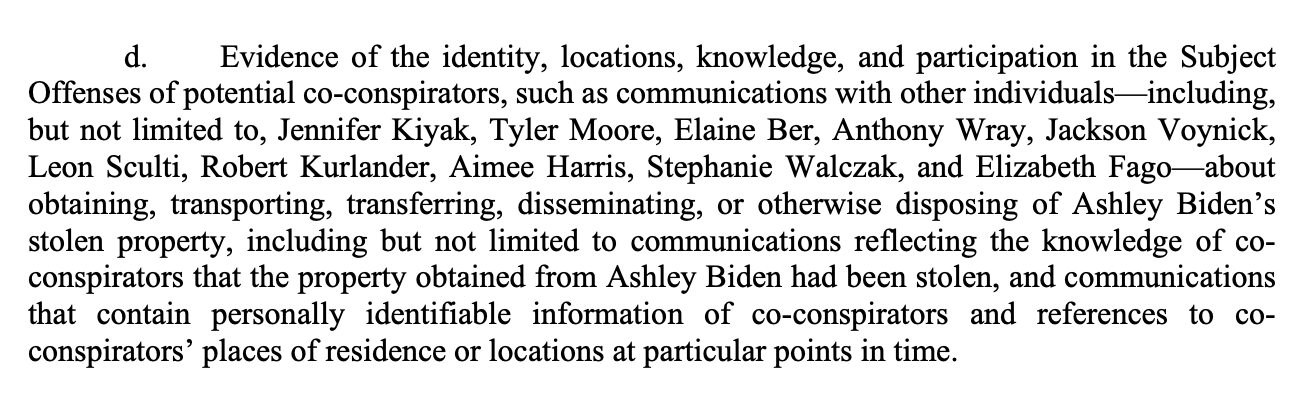
Not so, as reported by the NYT. Paoletta apparently knew — and shared — details that had not yet been reported by the press. Paoletta knew of a September 6, 2020 fundraiser held by Elizabeth Fago and attended by Don Jr where Ashley Biden’s diary — allegedly stolen — was passed around.

In August, Ms. Harris reached out to Robert Kurlander, a friend who had been sentenced to 40 months in prison in the 1990s on a federal fraud charge and had expressed anti-Biden sentiments online, to say she had found the diary. The two believed they could sell it, allowing Ms. Harris to help pay for the lawyers representing her in the custody dispute.

New details from interviews and documents have further fleshed out what happened next. Mr. Kurlander contacted Elizabeth Fago, the Trump donor who would host the fund-raiser attended by Donald Trump Jr. When first told of the diary, Ms. Fago said she thought it would help Mr. Trump’s chances of winning the election, according to two people familiar with the matter.

Richard G. Lubin, a lawyer for Ms. Fago, declined to comment.

On Sept. 3, Ms. Fago’s daughter alerted Project Veritas about the diary through its tip line.

Three days later, Ms. Harris and Mr. Kurlander — with the diary in hand — attended the fund-raiser attended by Donald Trump Jr. at Ms. Fago’s house in Jupiter, Fla., to see whether the president’s re-election campaign might be interested in it. While there, Mr. Kurlander showed others the diary. It is unclear who saw it.

It appears that Paoletta had originally been told — and told members of Congress — that Don Jr advocated calling the FBI, only to follow up to express uncertainty about that point.

The lawyer, Mark Paoletta, said that upon learning about the diary at the fund-raiser, Donald Trump Jr. showed no interest in it and said that whoever was in possession of it should report it to the F.B.I. But shortly thereafter Mr. Paoletta, who had served as Vice President Mike Pence’s top lawyer in the White House, called back the congressional Republicans to say he was unsure whether the account about Donald Trump Jr.’s reaction was accurate.

We know from past history, Don Jr doesn’t call the FBI when offered dirt on an opponent. Instead, he says “If it’s what you say, I love it, especially closer to the election.”

Project Veritas was willing to pay $50,000 to tell members of Congress that this crime might impact powerful fundraisers (Fago was named on the PV warrants) and the former President’s son, but didn’t want to foot the full bill for a Special Master.

SDNY always gets emails before they do an overt search

The fact that PV told members of Congress that this involved the former President’s son explains why PV is so pissed upon discovering what has been obvious to me from the start: That before obtaining warrants to seize James O’Keefe’s phones, DOJ had first obtained emails that provided the evidence to get the warrants for his phones.

The Government disclosed many of its covert investigative steps in the ex parte context of the Affidavit, including each email search warrant it had obtained pursuant to the SCA in this investigation.

This is precisely what SDNY did with Michael Cohen and Rudy Giuliani, and it’s what Magistrate Judge Sarah Cave was talking about when she referred to the “considerable detail” in the affidavit.

Third, the Court has reviewed the Materials in camera and observes that they contain considerable detail about individuals who may have already provided information to the Government—voluntarily or involuntarily—such that unsealing of the Materials “could subject [them] to witness tampering, harassment, or retaliation.”

PV revealed that in a motion asking Judge Analisa Torres to claw back this information.

The government apparently disdains the free press, and candor to the Court and opposing counsel. In light of the government’s violations of Project Veritas’s First Amendment, journalistic, and attorney-client privileges, as well as the government’s attendant failure to disclose these matters before or during the litigation of our motion for appointment of a Special Master, Project Veritas requests that this Court, pursuant to its supervisory powers, inherent authority, and Fed. R. Crim. P. 41(g), enter an Order requiring the government to:

(1) immediately halt access, review, and investigative use of Project Veritas materials that the government obtained from Microsoft (cf. November 12, 2021 Order acknowledging pause in government extraction and review of James O’Keefe’s mobile devices);

(2) inform this Court and counsel whether the government used a filter team to conduct a review of the data it seized from Microsoft on the basis of both attorney-client and journalistic privileges;

(3) inform this Court and counsel of the identities of any prosecutors, agents, or other members of the investigative team who have reviewed any data seized from Microsoft, what data they reviewed, and when they reviewed it; and

(4) disclose to the Court and counsel the identity of any other third party to which the government issued demands for Project Veritas data under the Electronic Communications Privacy Act (“ECPA”) with or without a non-disclosure order.

This interim relief is necessary to avoid compounding the harm to Project Veritas caused by the government’s violations of law and principles of candor and to enable Project Veritas to seek appropriate further relief.

I’ve put the dates of these warrants below; those dates and targets totally undermine everything PV has been complaining about.

PV has been complaining about “journalists” when DOJ first found evidence of a crime from their office manager

That’s because the first person targeted at PV was their “human resources” manager; that may be a reference to Jennifer Kiyak, who is named in the warrant targeting O’Keefe but listed on Project Veritas Exposed as PV’s Office Manager.
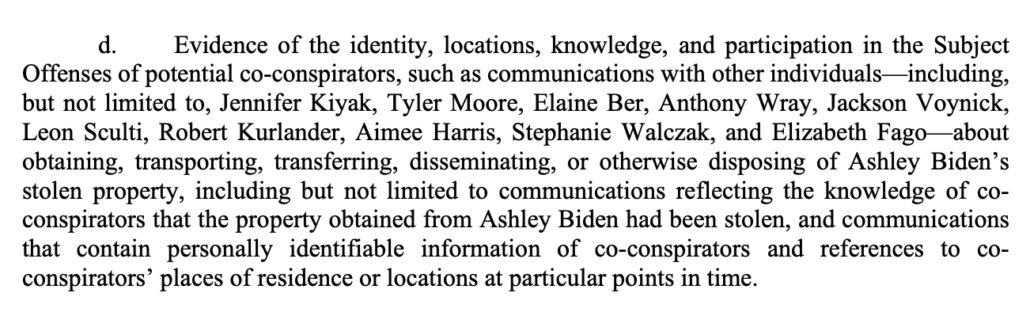
An office manager would have been the one to arrange payment of $40,000, and by getting her emails and — given that the FBI first targeted her in a subscriber record, may have been traced backwards from contacts with Ms. Biden — DOJ probably obtained plenty of evidence that the “journalists” had done far more than journalism.

Moreover, the first warrant to get “journalists'” emails was obtained while Jeffrey Rosen was Acting Attorney General, and all but one of these warrants for email (the one against O’Keefe) were obtained before Merrick Garland was confirmed. All of these email warrants were obtained before Garland imposed his new media guidelines, guidelines that Billy Barr’s DOJ never adhered to.

In other words, PV has been complaining for months that Merrick Garland targeted “journalists” when in fact they should be complaining that Jeffrey Rosen targeted someone who would, in no way, under any administration, be covered by media guidelines.

DOJ tells PV to hold their complaints until they are indicted

DOJ’s response to PV’s wails (which I wrote up in more detail here) is genuinely hysterical. They say, over and over, that PV can wait until they’re indicted to challenge these warrants.

Movants can raise these issues if there is an indictment filed charging them in connection with the investigation,

[snip]

The materials referenced by the Movants were obtained pursuant to duly authorized legal process that are not subject to challenge by the Movants in this pre-indictment stage.

[snip]

Second, the Movants seek pre-indictment discovery regarding the process used to review the materials referenced by the Movants, the identities of those who participated in that process, and the identities of third parties on which other legal process may have been served in the course of the investigation.

[snip]

To the extent the Movants may potentially be entitled at some point to the disclosures that they seek, any such entitlement would only be triggered, if at all, by the filing of an indictment charging them in connection with the investigation, and not before.2 In the event of a criminal proceeding, as Judge Oetken noted, they would have the opportunity to litigate any privilege or suppression issues, but they cannot do so during the pre-indictment phase of an ongoing grand jury investigation.

They acknowledge that PV would love to know who or what else has been investigated.

Of course, the Movants, like any subjects of a federal grand jury investigation, would like to know about every investigative step the Government is taking during the course of a criminal investigation, but that is not the law, for good reason.

No doubt so would Don Jr.

It also suggested there are other aspects of this investigation that DOJ is keeping secret.

The Government refrained from publicly disclosing details of the investigation, and continues to do so, for the same reasons that this Court denied production to the Movants of the affidavit (the “Affidavit”) submitted in support of the issuance of the search warrant dated November 5, 2021 that is the focus of this Part I matter and that Judge Cave ruled should remain sealed: to protect the ongoing grand jury investigation.

Keep in mind, there are necessarily other warrants out there that list other crimes, such as ones involving Harris and Kurlander that would name theft itself. In fact, the first order targeting PV mentions 18 USC 873 — blackmail.

Which means we can’t rule out that the nomination of Fago to the National Cancer Advisory Board a month after the election might be under investigation too.

These events are covered by three SDNY dockets: 21-mc-813 for James O’Keefe21-mc-819 for Eric Cochran, and 21-mc-825 for Spencer Meads.

2020

June: Ashley Biden moves to Philadelphia.

July: Aimee Harris moves into space formerly occupied by Ms. Biden.

August: Harris reaches out to fraudster Robert Kurlander, who contacts Elizabeth Fago.

September 3: Stephanie Walczak offers diary to PV.

September 6: Diary is shared at a fundraiser attended by Jr.

Mid-September: Kurlander and Harris fly to NY with the diary.  Spencer Meads travels to Florida and Harris shows more of Ms. Biden’s belongings.

Early October: A PV operative calls Ms. Biden and claims he wants to return the diary; PV takes her agreement as confirmation the diary is hers.

October 12: O’Keefe sends email, not mentioning Ms. Biden by name (but clearly referring to her) explaining his decision not to publish “Sting Ray” Story.

October 16: PV calls Joe Biden to extort an interview.

Late October: PV pays $40,000 for the diary.

October 25: National File publishes pages from Ashely Biden’s diary, linking parallel New York Post campaign targeting Hunter. It explains the provenance of the diary this way:

National File also knows the reported precise location of the physical diary, and has been told by a whistleblower that there exists an audio recording of Ashley Biden admitting this is her diary.

[snip]

National File obtained this document from a whistleblower who was concerned the media organization that employs him would not publish this potential critical story in the final 10 days before the 2020 presidential election. National File’s whistleblower also has a recording of Ashley Biden admitting the diary is hers, and employed a handwriting expert who verified the pages were all written by Ashley. National File has in its posession a recording of this whistleblower detailing the work his media outlet did in preparation of releasing these documents. In the recording, the whistleblower explains that the media organization he works for chose not to release the documents after receiving pressure from a competing media organization.

November 3: PV provides the diary to local law enforcement in FL.

November 22: DOJ uses subpoena for subscriber information of PV’s Human Resources Manager.

November 24: DOJ obtains 2703(d) order for HR manager’s email headers from 9/1/2020 to present.

December 8: Fago appointed to National Cancer Advisory Board.

2021

January 14: DOJ obtains warrant for emails of Eric Cochran, Spencer Meads, and HR manager from 1/1/20 through present.

January 26: DOJ obtains warrant for emails from another PV “journalist” from 1/1/20 through present.

March 5: DOJ obtains warrant for emails of three other PV “journalists” from 1/1/20 through 12/1/20.

March 9: DOJ obtains email headers for additional PV “journalist” from 9/1/20 through 12/1/20.

April 9: DOJ obtains warrant for O’Keefe’s emails from 9/1/20 through 12/1/20.

October 26: Paul Calli call DOJ, asks for AUSA Mitzi Steiner, and asked to speak about the PV investigation; Steiner asked how Calli had obtained her name, what else he had obtained, and declined to speak with Calli.

October 27: Lawyers for Project Veritas inform the DOJ that they will accept service for a subpoena relating to the investigation

November 3, 3:49 PM: Search warrants for Eric Cochran and Spencer Meads approved.

November 4, AM: FBI executes search warrants on former PV employees, Cochran and Spencer Meads.

November 4: PV lawyers accept service of subpoena.

November 4, one hour after the search: Mike Schmidt reaches out to Cochran and O’Keefe for comment about the investigation.

November 5, 11:18 AM: Warrant for O’Keefe authorized

November 5: NYT publishes story on investigation including language that PV would later baseless claim had to have come from the FBI.

November 6: FBI executes a search warrant on James O’Keefe

November 6: Schmidt contacts O’Keefe for comment.

November 6: Lawyers for Project Veritas ask the FBI to sequester material from the phone.

November 7: DOJ declines PV’s request and states the FBI has complied with all media guidelines.

November 8, 6:11PM: DOJ emails PV and tells them the extraction may start as soon as the next day.

November 8: After PV says it’ll file a legal challenge, FBI says it’ll only stop extraction after PV files such a challenge.

November 10: On behalf of PV, Calli Law moves to appoint a Special Master.

November 11, 12:51-12:53AM: Calli asks for confirmation that DOJ stopped extraction and review on O’Keefe’s phone on November 8.

November 11, 7:57AM: DOJ responds that the substantive review of O’Keefe’s phone was paused upon filing of motion on November 10.

November 11; 2:13PM: Judge Analisa Torres sets initial briefing schedule; in response to Torres order, DOJ stops extraction of O’Keefe phone.

November 12: In response to DOJ request, Torres extends briefing schedule.

November 12: Greenberg Traurig lawyer Adam Hoffinger, representing Eric Cochran, asks for Special Master to apply to materials seized from him, as well.

November 12: Letter signed by FL attorney Brian Dickerson but apparently docketed by NY lawyer Eric Franz asks for Special Master to apply to Spencer Meads

November 12, 3:49PM: Calli asks for clarification on review and extraction.

November 12, 3:59PM: DOJ responds that, “upon the filing of your motion, the Government paused the review of all material obtained from the search of your  client’s residence.”

November 14: Calli submits clarification letter regarding extraction and review.

November 15: Torres sets schedule in Cochran docket.

November 15: DOJ requests permission to reply to PV on November 19.

November 15: Calli requests inquiry into government leaks to NYT.

November 16: Torres grants permission to respond on November 19.

November 16: Ian H. Marcus Amelkin asks to delete initials of PV source, A.H., from docket.

November 17: Torres denies Amelkin request without prejudice.

November 17: Cochran motion to appoint Special Master.

November 18: For Meads, Dickerson formally moves for Special Master (and also complains that FBI seized dated devices).

November 19: Calli requests extension on response deadline for PV subpoena.

November 19: Government files opposition to request for Special Master and inquiry into purported leaks.

November 19: DOJ requests permission to respond to motion for extension on subpoena. Torres grants request.

November 21: DOJ opposition to extend subpoena deadline.

November 21: Government motion to oppose unsealing affidavits.

November 22: Torres denies motion for extension on subpoena.

November 22: PV reply to government opposition to Special Master.

November 23: Torres denies motion (including from RCFP) to unseal affidavits.

November 23: Cochran reply to government opposition to unseal affidavits.

November 24: Meads reply to refusal to unseal affidavits, including letters from House and Senate complaining to DOJ.

Share this entry

Trevor McFadden Rewards a White Lady for Endorsing a Revolution and Bragging about Violence against Cops

Yesterday, Trevor McFadden blew off DOJ’s request that Jenny Cudd be sentenced to jail time as well as DOJ’s request for a continuance of Cudd’s sentence so DOJ can determine what to do given that Cudd reneged on her statement of offense. Instead, the Trump appointee sentenced Cudd to two months of probation and a $5000 fine. Given the other sentences for January 6 defendants and even McFadden’s other sentencing decisions, it’s hard to view this sentence as anything else but a reward to Cudd for endorsing a revolution and refusing to fully cooperate with the government.

I could not listen in on the sentencing hearing. It was held in person, and McFadden — perhaps because he would like to hide his naked partisanship from the public — doesn’t turn on his public line for in-person hearings. At least forty other people besides me tried to call into this hearing.

But according to Jordan Fischer, the entire hearing was about whether those — like Cudd — who participated in a violent attempt to interfere with the peaceful transfer of power are being treated differently than Portland protestors arrested blocks away from Federal property. Cudd even publicly stated that she wished the effort to interfere with the vote certification had succeeded, basically a public boast that she wanted to obstruct the an official proceeding, the original crime with which she was charged.

Cudd’s attorney, Marina Medvin, accused the DOJ of “gamesmanship” and suggested prosecutors were recommending jail time not because of her individual actions, but because of her political views. She dismissed Cudd’s social media statements as “drunken tirades” and repeatedly drew comparisons to how federal prosecutors have charged, or not charged, protestors in Portland and during the confirmation hearings for Supreme Court Justice Brett Kavanaugh. McFadden was the right audience for those arguments, having repeatedly made the same comparisons himself during other hearings in Capitol riot cases.

Before delivering his sentence, McFadden said he didn’t believe in “aggregate justice” and that he found the DOJ’s sentencing recommendation for Cudd “disproportionate” from others with similar conduct.

“It does feel like the government had had two different standards here, and I can’t abide by that,” he said.

Cudd herself delivered a short statement promising to continue to fight for “free, fair and transparent elections” and saying she’d suffered financial and social consequences from her arrest, including threats against her and her business. She also expressed regret — that the challenge to certification of electoral votes on Jan. 6 was disrupted.

“I believe we would have a very different country if that debate process had not been interrupted that day,” Cudd said.

The reason we can be absolutely certain that McFadden rewarded Cudd because she doubled down on the glee with which she interfered with the vote certification (aside from his repeated explicit promises to sentence January 6 defendants lightly) is because we can compare her sentence with that of her co-defendant Eliel Rosa, who is different from Cudd in five ways: Rosa is an immigrant from Brazil, he pled guilty to a less serious misdemeanor than Cudd (parading versus entering restricted grounds), he not only fully cooperated with the investigation but actually turned himself in, unlike Cudd he was not in communication with the Proud Boys, and unlike Cudd, he is not known to have endorsed revolution the night before the riot.

McFadden sentenced Rosa to a longer period of probation than he did Cudd.

As the government has repeatedly described, after Cudd went to the rally on January 5, she came back to her hotel room at the Willard Hotel and endorsed a revolution.

On January 5, 2021, Cudd posted a video to social media in which she said, “a lot of . . . the speakers this evening were calling for a revolution. Now I don’t know what y’all think about a revolution, but I’m all for it . . . . Nobody actually wants war, nobody wants bloodshed, but the government works for us and, unfortunately, it appears that they have forgotten that, quite a lot. So if a revolution is what it takes then so be it. I don’t know if that is going to kick off tomorrow or not. We shall see what the powers that be choose to do with their power, and we shall see what it is that happens in Congress tomorrow at our United States Capitol. So either way I think that either our side or the other side is going to start a revolution.” [my emphasis]

The next day, as she was marching to the Capitol in a bulletproof sweatshirt (reflecting pre-planning for violence), she stated that she planned to convene with the Proud Boys who were — at that moment — kicking off a violent attack on the Capitol.

The following day, on January 6, 2021, Cudd posted about marching toward the Capitol. According to a newspaper in Texas, at approximately 12:30 p.m., Cudd posted a live video to social media in which she stated that she was about 3 miles from the Capitol, that she intended to convene with the Proud Boys2 at the Capitol, and that she was wearing a bulletproof sweatshirt.

2 Cudd appears to have been communicating with a member of the Proud Boys on and around January 6; however, the government is not aware of any additional connection Cudd has to the group.

The government even cited Cudd’s boasts about the violence used against cops.

“So we get to the Capitol and some of the patriots had already broken down all of the barricades, and they had literally ripped out the fence . . . Pushing and pushing and pushing. And we got the police to back off. So we get up there and the scaffolding that they had put up for the inauguration, there were people that were starting to climb it. We had to scale a wall to get there. There were people that were starting to climb the scaffolding. And we just pushed and pushed and pushed and pushed and yelled ‘go’ and yelled ‘charge’ and on and on and on. We just pushed and pushed and pushed, okay? And we got in. We got up the top of the Capitol. There was a door that was open. We went through the door. And we were inside

In October, McFadden sentenced Rosa to twelve months of probation (he did not fine Rosa, if I recall correctly, because Rosa already lost his job as a result of his role in the insurrection).

Yesterday, Trevor McFadden rewarded Rosa’s co-defendant by giving her just two months of probation, as compared to Rosa’s year of probation.

With that sentence, then, McFadden rewarded a white lady for attacking democracy.

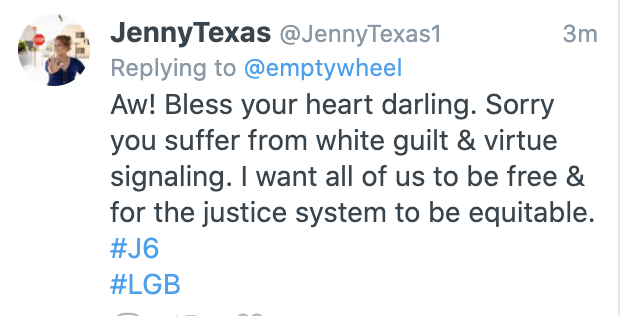
Update: On Twitter, Cudd claimed that my factual observation about the way McFadden coddled her arises out of white guilt.

Share this entry

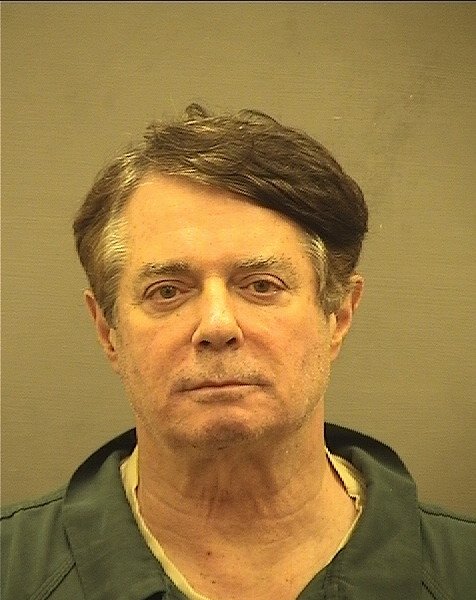
Paul Manafort Prevented from Flying to Dubai

As Knewz first reported and AP has now matched, Paul Manafort was pulled from a flight to Dubai on Sunday because his passport was revoked.

Former Trump adviser Paul Manafort was removed from a plane at Miami International Airport before it took off for Dubai because he carried a revoked passport, officials said Wednesday.

Miami-Dade Police Detective Alvaro Zabaleta confirmed that Manafort was removed from the Emirates Airline flight without incident Sunday night but directed further questions to U.S. Border and Customs Protection. That agency did not immediately respond to an email Wednesday seeking comment.

A lawyer who has represented Manafort did not immediately return a call and email seeking comment Wednesday.

As a reminder, Manafort’s pardon did not include his actions in an August 2, 2016 meeting with alleged Russian spy Konstanin Kilimnik, at which he seemingly traded his strategy to win the election for $19 million in financial benefit and a commitment to help carve up Ukraine.

Nor was Manafort pardoned for his efforts, which continued at least until he was arrested, to help Kilimnik carve up Ukraine to Russia’s liking.

Nor was Manafort pardoned for his role in all the influence-peddling that Rudy Giuliani was involved with in Ukraine through 2020.

This was three days ago. The fact that Sean Hannity has not been wailing about the poor treatment of Manafort since suggests either that there’s not a good way to spin it, or that Manafort has some reason to want to keep this quiet.

Update: NBC’s Tom Winter says that, contrary to other reports, he was simply not permitted to board and that he can apply for a new passport. It’s not clear why he speaks of a “new investigation.”

Share this entry

Imagine if DOJ Used the Hunter Biden Inquiry to Get Testimony against Rudy Giuliani…

I’m going to return to my argument that The Laptop is functionally equivalent to the Steele dossier. But until I do, I want to return to the parallels between the Ukrainian influence peddling investigation of Hunter Biden and that of Rudy Giuliani.

First, take a look at this passage from the Ken Vogel-bylined NYT story that inflated new life in The Laptop story.

People familiar with the investigation said prosecutors had examined emails between Mr. Biden, Mr. Archer and others about Burisma and other foreign business activity. Those emails were obtained by The New York Times from a cache of files that appears to have come from a laptop abandoned by Mr. Biden in a Delaware repair shop. The email and others in the cache were authenticated by people familiar with them and with the investigation.

Elsewhere, the NYT story reports that the investigation into Hunter Biden turned to his influence peddling in 2018, well before the laptops in question were purportedly dropped off at a blind computer repairman’s shop.

The investigation, which began as a tax inquiry under the Obama administration, widened in 2018 to include possible criminal violations of tax laws, as well as foreign lobbying and money laundering rules, according to the people familiar with the inquiry.

The contents on The Laptop were iCloud content, which the FBI could have and would have preferred to obtain with a warrant. We know the emails in question weren’t deleted by all parties because sources for stories describe still having them.

In other words, it’s unlikely that The Laptop played a critical role in the FBI investigation into the President’s son, because the FBI had other, better ways to obtain the same content and because the FBI had already turned to these matters well before the laptop got shared with the FBI on December 9, 2019.

So let’s go back to the way that Vogel-bylined NYT article reflated The Laptop story. The passage I quoted says three things:

  1. Prosecutors have looked at emails in question.
  2. NYT had obtained emails from what it credulously calls The Laptop.
  3. The “Laptop” emails were authenticated by “people familiar with them and with the investigation.”

The source for the first claim is likely someone who was a witness in the DE investigation (and we know that witnesses who have offered up their testimony have been part of the recent Murdoch-driven campaign to reflate it). The second claim is simply NYT’s ham-handed effort to make it clear the emails they received were part of the same campaign as the original NY Post story.

The third claim, however, is interesting. Written as it is, it suggests there are people who are familiar with both the investigation and the email cache. That would seem to suggest that some of the very limited universe of people involved with The Laptop — Rudy Giuliani, Steve Bannon, Robert Costello, and Mac Isaac — believe they know something about the Hunter Biden investigation.

Let’s focus on Robert Costello for the moment: He loves to be a cut-out. And when Billy Barr set up a special back channel to ingest Ukrainian-provided Russian dirt on Hunter Biden, Costello was that back channel. In other words, the lawyer that Rudy and Steve Bannon share is one possible source for that third claim, but if he were, it would suggest investigators in Delaware had spoken with him as a witness because he knew of the process by which he came to be in possession of a sketchy laptop.

Whatever testimony the source of that third claim offered could be shared with SDNY, which is investigating Rudy’s own influence-peddling scandal with Ukraine.

With all that mind, take a look at this passage of Philip Bump’s excellent summary of all the ways that laptop story is sketchy.

Giuliani was central to that effort. In late 2018, he began exploring the idea that Biden, as vice president several years before, had improperly tried to influence Ukraine to block an investigation of Burisma, a company for which Hunter Biden served as a board member. This story, promoted by an investigator targeted for termination by the U.S. government, was later debunked, but it seemed a promising line of attack. On April 1, 2019, a writer linked to Giuliani named John Solomon wrote the first of several stories about the allegations.

On April 12, the laptops were dropped off at Mac Isaac’s repair shop. Mac Isaac is legally blind and was not able to identify Hunter Biden by sight. One of the laptops, though, bore a sticker for the Beau Biden Foundation, an organization dedicated to Hunter’s late brother.

At some point in the middle of this month, Hunter Biden left Burisma’s board. Presumably he was by that point aware that questions were being asked about his role. If not, it became very clear on May 1, when the Times elevated the Burisma question in its coverage.

In the meantime, Volodymyr Zelensky had been elected president of Ukraine, and efforts to pressure him to announce an investigation into Biden began. In early May 2019, Giuliani planned a trip to Ukraine to dig up information that might damage Biden — a plan that was covered in the press. After broad outcry, he scrapped the trip. But the signal was sent: Giuliani was seeking information deleterious to Biden.

Later that month, someone in Kyiv was approached about buying Hunter Biden’s emails. This was not reported until Oct. 21, 2020, a week after the Post’s story about the laptop.

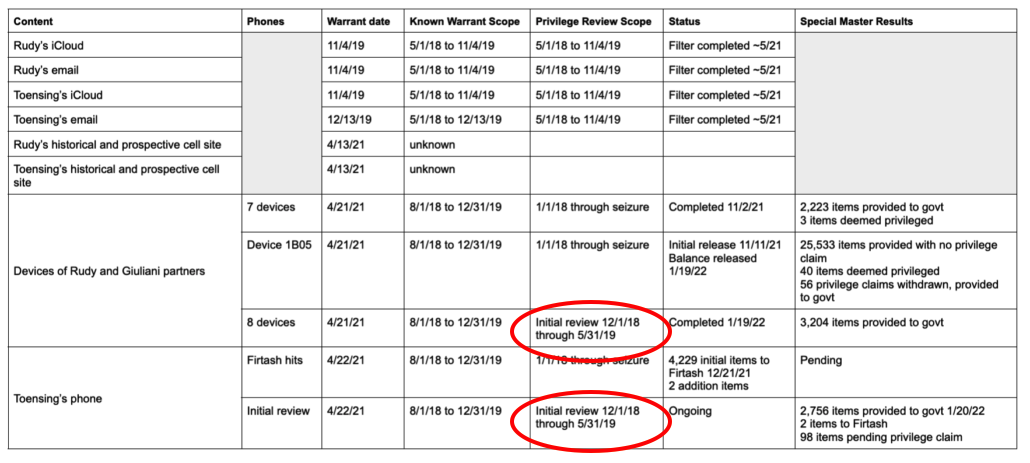
This time period — December 2018 until May 2019 — is precisely the time period that prosecutors asked Special Master Barbara Jones to prioritize for her privilege review of the last set of Rudy’s phones (as well as the one phone from Victoria Toensing).

In the initial incarnation of this investigation — the one charged in 2019, before Lev Parnas started running his mouth — the focus of this investigation was exclusively on how Rudy got Marie Yovanovitch fired.  But in September 2020, that part of the investigation was put on hold to await Rudy.

Yovanovitch’s name doesn’t appear in Bump’s summary at all. Yet it happened in the same month — May 2019, the culmination of this effort — when Rudy was going to go to Kyiv to dig up dirt on Hunter Biden, and when someone was wandering around Kyiv offering to sell what looks like what ended up packaged as The Laptop.

Whether or not Rudy’s effort to solicit what ended up being dirt that looked just like The Laptop was originally the focus of the investigation, DOJ has now obtained a privilege review of Rudy’s comms from that time period when he was soliciting it.

Share this entry

“The Laptop” Is the Functional Equivalent of The Steele Dossier, 1: Rudy Is the Real Scandal

I’m going to explain how The Laptop that Rudy Giuliani floated just before the election is the functional equivalent of the Steele dossier.

Before I do, let me make a fairly obvious (if counterintuitive) point: Of the three people that powerful Ukrainians attempted to cultivate for their ties to the Vice President or President — Paul Manafort, Hunter Biden, and Rudy Giuliani — just one provably affected US policy through the Vice President or President: Rudy.

Contrary to what you may have read, for example, Manafort actually wasn’t the one who prevented the GOP platform from being strengthened to support Ukraine, JD Gordon was (though Trump’s do-not-recall answer about his own involvement can’t rule that out). Mueller’s decision not to prosecute Gordon as an agent of Russia was only recently made public (thanks to the relentless work of Jason Leopold and his lawyer).

And while there’s a lot of circumstantial evidence that Manafort entered into a quid pro quo on August 2, 2016, trading campaign strategy for a commitment to help carve up Ukraine to Russia’s liking along with $19 million a financial benefit for Manafort personally, because the investigation into Manafort became public in 2016, his ongoing efforts to push that Russian plan to dismember Ukraine never (as far as has been made public) had the involvement of Trump. It’s possible Trump was involved or Manafort got certain commitments in 2016, but Manafort’s own cover-up prevented DOJ from determining whether or not that was true.

According to the NYT story that has renewed the frenzy around the laptop Rudy Giuliani released just before the election, Federal prosecutors still haven’t determined whether Hunter Biden’s treatment of Chinese, Kazakh, and Ukrainian influence efforts amounted to a crime. But they do have evidence that Hunter Biden tried to be explicit that he could not influence his father to help Burisma.

In one email to Mr. Archer in April 2014, Mr. Biden outlined his vision for working with Burisma. In the email, Hunter Biden indicated that the forthcoming announcement of a trip to Ukraine by Vice President Biden — who is referred to in the email as “my guy,” but not by name — should “be characterized as part of our advice and thinking — but what he will say and do is out of our hands.”

The announcement “could be a really good thing or it could end up creating too great an expectation. We need to temper expectations regarding that visit,” Hunter Biden wrote.

Vice President Biden traveled to Kyiv, the Ukrainian capital, about a week after the email.

In the same April 2014 email, Hunter Biden indicated that Burisma’s officials “need to know in no uncertain terms that we will not and cannot intervene directly with domestic policymakers, and that we need to abide by FARA and any other U.S. laws in the strictest sense across the board.”

He suggested enlisting the law firm where he worked at the time, Boies Schiller Flexner, to help Burisma through “direct discussions at state, energy and NSC,” referring to two cabinet departments and the National Security Council at the White House.

The firm “can devise a media plan and arrange for legal protections and mitigate U.S. domestic negative press regarding the current leadership if need be,” Mr. Biden wrote in the email.

And sworn testimony from experts in both parties say Hunter did not dissuade his father from taking steps to crack down on corruption.

Of these three well-connected Americans being cultivated by powerful and corrupt Ukrainians — some but not all of them known Russian agents — only Rudy Giuliani is known to have had a direct effect on policy. Among other things, Rudy got Marie Yovanovitch fired. In only Rudy’s case, then, do we have clearcut proof that a Ukrainian influence operation had the desired effect of  changing American policy. Though even there, it’s not yet clear whether Rudy’s unregistered influence peddling was criminal.

(Obviously, Manafort pled guilty to being an unregistered Ukrainian agent during the earlier period, and he got paid orders of magnitude more than Hunter Biden did, too.)

So as we fight about The Laptop again, based on a reference to verified emails in a NYT article bylined by serial Rudy mouthpiece Ken Vogel, the first thing we should keep in mind is that there’s far more evidence that Rudy Giuliani successfully influenced the President or Vice President as a secret agent of Ukraine than Hunter Biden.

Share this entry

The Lesson Marina Ovsyannikova Offers to Chuck Todd and Lester Holt

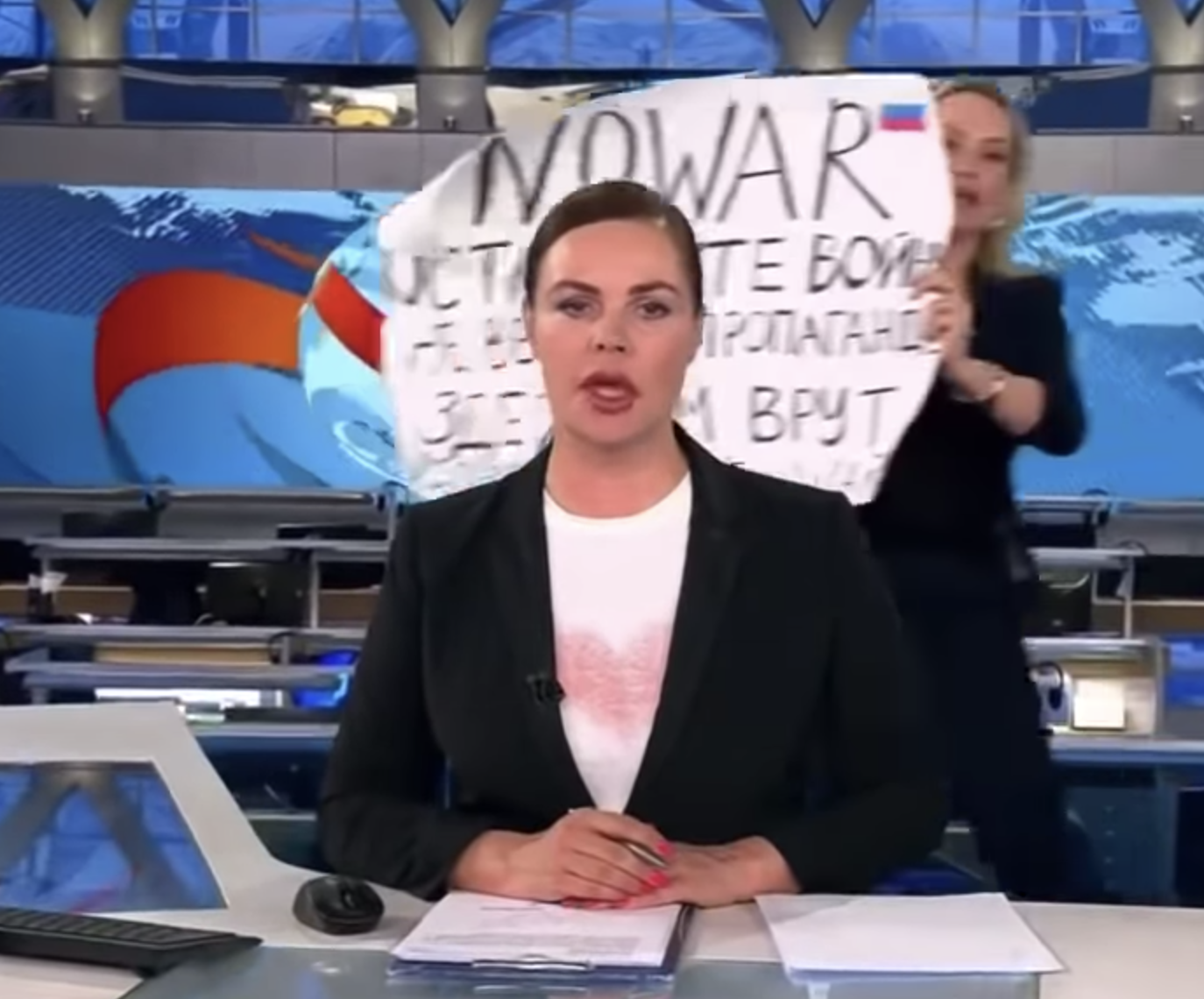
Yesterday, an editor at Russia’s official Channel One news, Marina Ovsyannikova, came onto a live broadcast and held up a sign condemning Russia’s war on Ukraine.

Predictably, she was quickly detained; thus far, her attorneys have been unable to locate her (though one outlet has said she’ll be charged under Russia’s new crackdown law).

Shortly after her detention, a pre-recorded video was released, in which she explained her actions. She spoke of the shame she feels about her past involvement in Putin’s lies.

What is happening right now in Ukraine is a crime and Russia is the aggressor. And the responsibility for this aggression lies on the conscience of only one person. This man is Vladimir Putin. My father is Ukrainian. My mother is Russian. And they were never enemies. And this necklace on my neck is a symbol of the fact that Russia must immediately stop the fratricidal war and then our brotherly peoples will still be able to reconcile.

Unfortunately, in recent years I have been working on Channel One, working for Kremlin’s propaganda. And I am very ashamed of it. I am ashamed that I was letting them tell those lies from the screen. I’m ashamed that I allowed to “zombify” the Russian people.

We kept silent in 2014, when all this was just in the beginning. We didn’t go to rallies when the Kremlin poisoned Navalny. We just silently watched this inhumane regime.

And now the whole world has turned away from us, and even 10 generations of our descendants will not be enough to wash away the shame of this fratricidal war. We are Russian people — thoughtful and smart. It’s up to us to stop this madness. Come out to rallies. Don’t be afraid of anything. They can’t imprison all of us.

It was an incredibly brave — and because she planned her actions in advance — well-executed protest.

But make no mistake. Ovsyannikova is not, like another brave journalist who spoke up this week, Yevgenia Albats, someone who has criticized the regime in the past, someone whose witness now is a continuation of years of brave reporting.

Rather, Ovsyannikova is someone who, a profile describes, “was a cog in a big machine of Channel One’s news production.” She was part of the the production of official truth. And as she describes, hers is the lesson of regret for that complicity, someone who will forever own a part of Putin’s crimes because she took the comfortable route of contributing to and participating in Putin’s exercise of power. She will almost certainly pay a stiff price for her speech, but she is also someone who did nothing, up till now, as Putin kept raising the price of speaking freely.

While Ovsyannikova’s protest will likely resonate for some time, I would hope that complicit journalists in countries where it’s not too late to defend democracy reflect seriously on Ovsyannikova’s shame. Even as Russia rains bombs down on Ukraine, journalists like Chuck Todd and Lester Holt invited Bill Barr onto their TV to tell lies about Russia’s attack on democracy in the United States, to tell lies about Trump’s extortion of Ukraine, to tell lies about his role in an attack on democracy. Like Ovsyannikova, Todd and Holt sit, comfortable, polished, and complicit, as Barr told lies that were a direct attack on democracy and rule of law.

And like Ovsyannikova, they are doing nothing to rebut the lies of authoritarianism before it’s too late.

Update: Ovsyannikova has surfaced and is thus far facing only administrative crimes, so days, not years, in jail.

Update: Ovsyannikova was fined 30,000 rubles and released, but that apparently only covers the social media video, not the protest on TV.

Share this entry

A White Board of the Sedition-Curious

Contrary to what a lot of people imagine, I don’t keep visual representations — like some cork board with a bunch of strings attached — of the investigations I follow, not even the sprawling January 6 investigation. Instead, I just try to capture important developments here, where I can refer back to them. There are several such relationships unpacked in recent weeks.

Roger Stone and Stewart Rhodes bug out at the same time after insurrection

For example, a bunch of people have asked me what I make of the WaPo report based on video taken by some Danish journalists who were filming a documentary of Roger Stone on January 6.

As you read it, keep in mind that the Get Me Roger Stone video team was following Roger Stone during key periods of 2016, including at the RNC.

Mueller at least attempted — as Stone feared Mueller would in real time — to mine the video for clues about Stone’s activities. For example, in one of the same email chains where Stone told Randy Credico to “do a [Frank] Panta[n]gel[i],” he and Credico were panicking about what Get Me Roger Stone writer Morgan Pehme was saying about 2016.

So even assuming Roger Stone wasn’t engaged in his everyday type of performance when being filmed for these film-makers, he would be acutely aware of the legal hazards of having a documentary team following around while crimes were being committed.

That’s why the report is most interesting for the times when Stone made sure to ditch the camera team: at precisely the time of a key Proud Boy planning meeting, during a meeting that Joshua James may have reported in on, and as the riot unfolded at the Capitol.

For example, the videographers did not track Stone when he left the hotel at 9PM on January 5 with Sal Greco.

At about 8:50 p.m. on Jan. 5, after the Danish filmmakers had left him, Stone exited the Willard again with his bodyguard, off-duty New York City police officer Sal Greco, a live-stream video shows. Their destination was unclear, though Stone had said he had a 9 p.m. appointment to have his hair dyed.

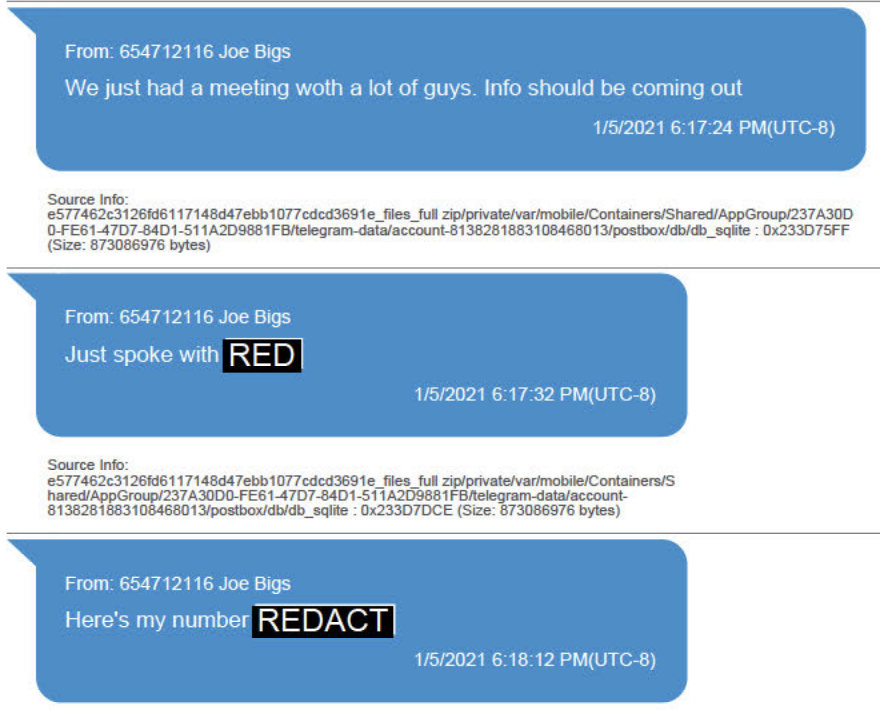
Just minutes after that — just before 9:17 PM — Joe Biggs and Ethan Nordean were meeting with as-yet unidentified people putting together their plan for the riot.

Then there was a meeting with Bernie Kerik at 10AM at the Willard; hotel staff prevented videographers from watching that meeting.

The filmmakers told The Post that Stone appeared to change his plans after an encounter in the Willard lobby around 10 a.m. with Bernard Kerik, a former New York City police commissioner working in Giuliani’s command center at the hotel. The filmmakers began recording their conversation but were forced to leave by hotel staff. It is unclear what was said.

There’s good evidence that Joshua James checked in with Michael Simmons before and after that meeting.

Finally, Stone blew off the videographers from just before the Proud Boys kicked off a riot until almost the moment both Stone-related militias stood down.

At about 12:40 p.m., some ofStone’s guests left his suite. Stone’s team and the filmmakers agreed to separate for lunch and then reconvene two hours later. Stone planned to speak at a smaller rally near the Capitol later that afternoon.

But as the filmmakers ate in their hotel room, they saw news footage of a riot escalating at the Capitol. Around 2:30 p.m., Guldbrandsen headed out to capture the scene while Frederik Marbell, the director of photography, rushed to Stone’s room.

“Kristin Davis opened the door and said that Roger was taking a nap, so I couldn’t film,” Marbelltold The Post.

Outside the room, Marbell attempted to reach Stone by text message starting at 3:03 p.m. The messages went unanswered for 24 minutes, when Stone responded and offered to go to Marbell’s room.

By about 4 p.m., with the Capitol in chaos, Stone had still not arrived at Marbell’s room. Marbell returned to Stone’s room and began knocking. About five minutes later, room service arrived and Marbell snuck inside, he said.

“Roger was not taking a nap. He was on the phone with someone,” Marbell said.

Stone condemned the riot to the filmmakers at 4:18 p.m., saying: “I think it’s really bad for the movement. It hurts, it doesn’t help. I’m not sure what they thought they were going to achieve.

These are like Stone’s July 2016 meeting with Nigel Farage at the RNC: The stuff he knew well to and did hide from the camera. That’s where the sweet spot of Stone’s interactions are.

All that said, the report shows that key Stone actions the camera team captured exactly map the known central events of the planning for the insurrection.

For example, Stone put together a Friends of Stone Signal list, including Enrique Tarrio, once it became clear Trump had lost. That fed Flynn’s efforts.

He told them to monitor a group chat on the app Signal titled “F.O.S.” — friends of Stone. Tarrio of the Proud Boys was among the group’s members, a later shot of Stone’s phone showed.

[snip]

On Nov. 5, Stone drew up a Stop the Steal action plan that was visible on Alejandro’s laptop in footage captured by the filmmakers. As protesters were mobilized, the plan said, state lawmakers would be lobbied to reject official results. That tactic later proved central to Trump’s efforts.

Also that day, Stone had a 15-minute call with Flynn, the video shows. He told Flynn they could “document an overwhelming and compelling fraud” in each battleground state and urged him to spread the word on social media. That day, Flynn, Trump’s campaign and his sons Donald Jr. and Eric began using #StopTheSteal on Twitter.

Just after this mobilization, both Tarrio and Biggs started calling for civil war.

Later that month, Stone was coordinating with Mike Flynn and Ali Alexander.

Stone moved quickly after Trump’s defeat to help mobilize the protest movement that drew thousands to the nation’s capital on Jan. 6, 2021, The Post found. He privately strategized with former national security adviser Michael Flynn and rally organizer Ali Alexander, who visited Stone’s home in Fort Lauderdale, Fla., in late November 2020 for a dinner where Stone served pasta and martinis.

In the days and weeks leading up to Thanksgiving (when Flynn would be pardoned and Sidney Powell would, like Stone, start grifting off claims of a stolen election), Flynn and Powell were at Lin Wood’s properties in South Carolina, plotting away.

I was most struck, however, by the unsurprising news that in addition to Tarrio, Stone also used Signal messages with Stewart Rhodes.

Stone used an encrypted messaging app later in January to communicate with Oath Keepers leader Stewart Rhodes, who is also charged with seditious conspiracy, and Proud Boys leader Enrique Tarrio, the footage shows.

When I saw the description in James’ statement of offense of the way Rhodes bugged out of town immediately after the riot, I suspected that someone had instructed Rhodes that they were going to be hunted.

At Rhodes’s instruction, James, Vallejo, and others met Rhodes that evening at a restaurant in Vienna, Virginia. Rhodes discussed saving “the Republic” by stopping the transfer of presidential power and began to make plans to oppose the Inauguration on January 20, 2021, including by having people open-carry firearms at state capitols around the country.

While at the restaurant, Rhodes and James came to believe that law enforcement was searching for Rhodes and others after their attack on the Capitol. The group immediately returned to their hotel, collected their belongings, and met at a nearby gas station. There, James saw what he estimated to be thousands of dollars’ worth of firearms, ammunition, and related equipment in Rhodes’s vehicle. Rhodes divvied up various firearms and other gear among James and others who occupied a total of three cars. Rhodes left his mobile phone with one person and departed with another person in that person’s car so that law enforcement could not locate and arrest him. The three cars departed in separate directions.

James returned to Alabama with some of Rhodes’s gear, including firearms and other tactical equipment.

According to the videographers, Stone bugged out at about the same time and in the same frantic manner as Rhodes did.

As a mob ransacked the Capitol on Jan. 6, 2021, Roger Stone, Donald Trump’s longest-serving political adviser, hurried to pack a suitcase inside his elegant suite on the fifth floor of the Willard hotel. He wrapped his tailored suits in trash bags, reversed his black face mask so its “Free Roger Stone” logo was hidden, then slipped out of town for a hastily arranged private flight from Dulles International Airport.

“I really want to get out of here,” Stone told an aide, as they were filmed at the hotel by a Danish camera crew for a documentary on the veteran Republican operative. Stone said he feared prosecution by the incoming attorney general, Merrick Garland. “He is not a friend,” Stone said.

I would, at this point, be shocked if Rhodes and Stone hadn’t communally decided they needed to bolt. The remaining question I have, though, is whether someone in government — like Mark Meadows — alerted Stone or someone close to him that the FBI had switched immediately into investigative mode.

Sidney Powell springs for the sedition gaslight defense

In the same way that the Danish videographers confirm that Roger Stone and Mike Flynn were conspiring early in the post-election process, a recent BuzzFeed report reveals that Sidney Powell is now using her hard-won grift to pay for the defense of some Oath Keepers.

Since October, the organization, Defending the Republic, has been making monthly payments to the defense attorney for Kelly Meggs, a member of the militant group the Oath Keepers who is charged with seditious conspiracy for his role in the Jan. 6 Capitol riot. In an interview, the attorney, Jonathon Moseley, said he was aware of “at least three or four other defendants who have that arrangement” as well. The Oath Keepers’ general counsel, Kellye SoRelle, said that one of those others is the group’s founder, Stewart Rhodes. Offered the chance to deny that, his lawyers said they don’t discuss funding.

The revelation, which has not been previously reported, sheds new light on the activities of Powell’s organization, which was incorporated in December 2020 “to defend the constitutional rights of all Americans.” By last August, the group had raised nearly $15 million, according to its audited financial statements, and since then has raked in untold cash in donations and sales of merchandise, including T-shirts, drink coasters, and highball glasses adorned with the organization’s logo. Yet despite mounting legal scrutiny from federal and state investigators, Defending the Republic has disclosed almost nothing about where that money has been going.

[snip]

Powell’s involvement in the Oath Keepers case helps explain how some of the defendants, most of whom are far from wealthy, have been able to work with private attorneys who charge hundreds of dollars an hour rather than court-appointed lawyers. But it also raises questions as to who is dictating their defense strategy. In recent months, defense attorneys have raised many of the same far-flung conspiracies about COVID-19, antifa, and the deep state that appeared in lawsuits against the federal government filed by Powell herself.

As Ken Bensinger notes and I have traced, Jonathon Moseley has chosen to use court filings to engage in conspiracy theorizing rather than a more typical defense.

But on top of the futility of such an approach to actually obtain an optimal outcome, it serves to undermine rule of law more generally. Moseley’s approach is not all that different from the one that Powell herself used with Mike Flynn in attempting to blow up his prosecution by inventing false claims about the government. There was no evidence to support it, but it fed the frothers.

Tellingly, Powell’s efforts did nothing but make Flynn’s outcome worse. Thus, the defense plan, such as it existed, served to undermine rule of law and then make it all go away with a Presidential pardon. I’ve long assumed that that was the hope for Kelly Meggs and Kenneth Harrelson (who has adopted a similarly conspiratorial defense approach): that they could stall through 2025 in hopes a Republican would pardon them for their alleged sedition.

On March 4, Judge Amit Mehta appointed Andrew Wise of Miller Chevalier as conflict counsel to inquire into conflicts between Moseley’s representation of Meggs and (at least in the civil suit) Stewart Rhodes). That’s likely to bring a review of compensation arrangements, which may lead to inquiries about what Powell is paying Moseley to do.

Interestingly, BuzzFeed suggests that Juli Haller, who represents Meggs’ wife Connie, but also Ryan Samsel, may be on this dole. There was a time when Samsel looked like he might have considered flipping but that time is long gone.

Roger Stone’s pardon grift

And now, having covered Roger Stone’s Stop the Steal grift and Sidney Powell’s Defending the Republic grift, we come to Stone’s pardon-selling.

The Daily Beast adds to the earlier WaPo report (the first item here) that addressed all the pardons Roger Stone pitched Trump to make in the days between when he bolted from DC quickly and the day any such power expired. It notes that in mid-January 2021, Stone was playing all sides of the Florida scandal that engulfs Matt Gaetz.

It’s already known that Stone lobbied for pardons for both Gaetz and Greenberg in the waning days of the Trump administration. But it wasn’t known that Stone also advocated for a pardon for this third man connected to Gaetz and Greenberg: Stephen Alford, a serial fraudster from the Florida panhandle.

That development was first revealed by The Washington Post in a draft memo published earlier this month. But the Post report didn’t mention Alford—his name only appears in a document the Post obtained and uploaded online—and the link hasn’t been explored.

Two months after Stone advocated for Alford’s absolution, that allegiance dissolved when Alford became Gaetz’s scapegoat for the investigation. (Stone also eventually blasted Alford as part of the “deep state.”)

Just weeks before, however, Stone was in Alford’s corner, lobbying for a pardon.

Much of this is just scammy Florida politics. I’m interested in two details of this.

First, one of the ties TDB did find between Alford — the guy who attempted to extort Gaetz’s dad — and Stone goes through Oleg Deripaska.

According to a person with direct knowledge of the events, however, Alford had one powerful friend: A Republican lobbyist close to Stone.

Weeks after Alford’s pardon request was declined, that lobbyist shared some more information: Matt Gaetz was in trouble. And the lobbyist, this person said, had the details, including images of Gaetz with young women at a sex party.

While it’s unclear how the lobbyist—an associate of Oleg Deripaska—came into this information, Stone had by that time known about the Gaetz allegations for months; Greenberg had told Stone all about their involvement with a 17-year-old, both over text messages and in a confession he drafted at Stone’s request, as part of the pardon process.

It didn’t take long for Alford to cobble together a plan—and it was a doozy: He would secure Gaetz a presidential pardon in exchange for $25 million, which Alford would supposedly use to repatriate an FBI agent taken hostage in Iran who has long been considered dead.

TDB then describes how this plan, involving a lobbyist with ties to Deripaska, was behind the campaign against the NYT story on Gaetz’ legal woes.

When The New York Times broke the investigation in late March last year, Gaetz used Alford’s ploy as ammo. He fired off a tweetstorm, claiming the Times report was a “planted leak” designed to torpedo an investigation into “criminal extortion” plot “to smear my name.”

The central figure in Gaetz’s narrative, however, wasn’t Alford; it was Alford’s lawyer, whose role was limited to holding the money in an escrow account while Alford negotiated the release.

That lawyer had one special characteristic: Three decades ago, he served as a DOJ prosecutor. And that fact equipped the narrative with a “deep state” hook—a Roger Stone special.

Gaetz doubled down that night on Tucker Carlson’s late-night Fox News talk show, explaining the convoluted “leaking” and “smearing” plot to a befuddled Carlson, who remarked that it was “one of the weirdest interviews I’ve ever conducted.”

The next day, Stone piped up to defend Gaetz, using the same language.

And I’m interested in that because Glenn Greenwald was another key player in this anti-NYT campaign, including as recently as December.

Click through for the details on Gaetz paying Stone until he stopped paying Stone.

Update: One more note about Stone’s plan for pardons. Unsurprisingly he pushed for pardons for Assange and Stone, and unsurprisingly he did so in the same terms that Greenwald did — as the best way to get back at the Deep State.

Hell yes ,I would pardon Julian Assange and Edward Snowden- they are persecuted because they exposed the same people who attempted the Russia Collusion Hoax, the Ukraine hoax the last phony impeachment and are now pushing you’re their new phony impeachment.

The plan is a telling document of how Stone exploited Trump’s narcissism and grievances to get things done. The UK Supreme Court just rejected Assange’s bid to appeal, so the initial extradition request will go to Priti Patel for approval (though he still has several avenues of appeal).

Share this entry

Steve Bannon’s Phantom Executive Privilege

In a reply motion demanding to know why DOJ subpoenaed the toll records for him, the lawyer Steve Bannon shares with Rudy Giuliani, Robert Costello, claims DOJ obtained the email information, including hundreds of pages from Google, for different Robert Costellos, not him.

The hundreds of pages of email information they obtained from Google, including email addresses (and IP addresses) of the sender and recipient, date and time of the emails, metadata, social media and meeting (Google Hangouts) data, information as to whether each email was read, remained unread, was deleted, or what filing box the recipient put it in, and more [See e.g., 0011510001249; 001339-1732] were all for another completely uninvolved citizen apparently named Robert Costello or Robert M. Costello. In fact, not one of the email accounts the Government sought access to in this case, intending to get defense counsel’s emails, actually was defense counsel’s email account.

He even issued a declaration stating, among other things, that,

I have no association whatsoever with email accounts with the addresses “[email protected],” or “[email protected],” or “[email protected],” or “[email protected].”

We shall see how the government explains this claimed mix-up, assuming Judge Carl Nichols permits them to file a surreply (Costello claims he only just discovered these weren’t his emails after reviewing them for months).

That said, Costello did not deny association with email accounts with the addresses of, [email protected], [email protected], or [email protected], which appear to be included in the friends and family accounts of the main Gmail account in question. And though Costello claims to provide the exhibits to back his claims, he doesn’t provide the Comcast return and doesn’t provide back-up for the bulk of the returns he is complaining about (US 001339-001732 below).

What Costello has also shown is that, in a memo to DOJ, he claimed to quote from a letter from Justin Clark, who would have been acting as Trump’s lawyer, invoking privilege on Trump’s behalf.

“President Trump vigorously objects to the overbreadth and scope of these requests and believes they are a threat to the institution of the Presidency and the independence of the Executive Branch.” Mr. Clark added that:

“Through the Subpoenas, the Select Committee seeks records and testimony purportedly related to the events of January 6th, 2021, including but not limited to information which is potentially protected from disclosure by the executive and other privileges, including among others, the presidential communications, deliberative process, and attorney-client privileges. President Trump is prepared to defend these fundamental privileges in court.

As I’ve previously noted, at a meeting on November 3 at which Costello was supposed to be presenting that memo, Costello alternately claimed:

  • He had had no communications with Trump lawyers prior to October 18
  • Clark refused to reach out to the January 6 Committee on behalf of Costello or Bannon
  • Costello could not recall who brought up Executive Privilege first, him or Clark
  • Costello did not ask Clark to attend the hearing because he wouldn’t contact the committee on his behalf (even though his later complaint was that the Committee refused to have a Trump lawyer present)

In that November 3 meeting, Costello said he’d provide all the backup to support his claims.

But when JP Cooney asked for all the documents Costello claimed to be relying on in the memo and an interview with DOJ and the FBI on November 3, 2021, Costello said, “as soon as I locate the letter I received from Justin Clark, acting as counsel for President Trump, I will forward that under separate cover.” Cooney responded, making sure, “please review and let us know if this constitutes your entire production.”

There’s no evidence in this filing that Costello ever provided it.

Which may be why, in a follow-up interview on November 8 — after searching and (at least as this record shows) not finding any letter from Clark — Costello told DOJ:

There are additional discrepancies disclosed by the materials Costello has included.

In his declaration, Costello (who, remember, was investigated as part of the Mueller investigation for helping to dangle pardons) complained that this meeting to stave off an indictment didn’t work like all the previous times he had had such meetings.

[I]t is clear to me that the representatives of the United States Attorney’s Office for the District of Columbia never had any intention of engaging in a lawyer like discussion of the legal merits of a prosecution of Mr. Bannon for criminal contempt of Congress. This position was and is shocking to me because of the many prior instances when this same Office declined to prosecute others, including sitting United States Attorney Generals based upon a referral from Congress.

There’s more: For example, Costello misrepresents when he joined Bannon’s defense team for this.

But the key detail is that Costello claimed to have a letter from Trump invoking Executive Privilege. And when DC USAO asked to see it, Costello changed his story.

Update, April 19: I’ve updated the timeline below with two documents DOJ submitted on April 15. They raise further inconsistencies in Costello’s statements to the FBI and DOJ in his interviews.


BATES STAMP RANGE: US 001093-001883

US 001093: Grand jury subpoena

US 001145-001768: 623-page return from Internet provider showing IP activity, status (read or unread, inbox, etc.) and other details concerning emails and other activity offered by the carrier obtained with a Section 2703(d) Order on November 11, 2021 [US 001733] that includes a case number [US 001732-001735] and returned on December 7, 2021.  Returns include:

US 001769-001789: Costello’s 302s

US 001808: Yahoo return

US 001833-001878: Subpoenas for home, direct office, and cell phone from September 1 to October 20, 2021

US 001834: Case number

US 001842: Case number

US 001863: Subscriber record showing payment method for Costello’s cell phone

US 001866: Costello’s data usage

US 001872; Grand jury subpoena

US 001874-001875:  SMS (text messaging) information, including the numbers to which texts were sent and from which they were received

TIMELINE

March 5: Beginning date for Costello records request (last event involving Bannon and Costello in Kolfage)

September 22: First contact between J6 and Bannon

September 23: Bannon subpoena

September 24: Costello accepts service

October 5: Media reports on subpoenas to Mark Meadows and others; call from Justin Clark

October 6: Clark instructs Costello to invoke whatever privileges he can, including executive, deliberative, and attorney-client

October 6: Costello claims Clark invoked privilege; Costello’s memo quotes Clark invoking privilege; undated call with Tonolli (actually on October 12)

October 7, 10AM: Original deadline for document production

October 7, 5:05PM: Costello letter claiming Trump invoked privilege

October 8: Thompson letter to Bannon rejecting non-compliance

October 12: Call with Tonolli re representation from Trump

October 13: Costello and Clark speak

October 13: Second Costello letter, demanding accommodation with Trump

October 14: Clark corrects Costello that he had simply reiterated his October 6 letter

October 14, 10AM: Original date for Bannon testimony

October 15: Thompson letter noticing failure to comply with subpoena, warning of contempt meeting, setting response deadline for October 18, 6PM

October 16: Clark emails Costello stating clearly that he had not told him he had immunity from testifying

October 18: Thompson letter to Bannon with deadline; Trump sues Thompson and the Archives on privilege issues; Costello claims he sent a note to Thompson;

October 18, 6:50 PM: White House says no privilege after 2017

October 19: Bannon claims they intended to respond; Amerling letter to Costello; J6 business meeting to hold Bannon in contempt; Thompson letter to “change course”?

October 20: Rules committee meeting to hold Bannon in contempt

October 21 Bannon held in contempt

October 25: Costello email exchange with Cooney (and Phillips); Costello asks for meeting after October 27

October 28: Matthew Graves confirmed as US Attorney

October 29: Cooney suggests November 3

November 1: Costello emails memo arguing against prosecution, dated October 29

November 2: Kristin Amerling interview

November 3: Costello informs he’ll be joined by Katz; First interview with Robert Costello; Cooney follows up asking for documents

November 4: Cooney asks Costello to confirm full production

November 5: Matthew Graves sworn in as US Attorney

November 8: Second interview with Robert Costello

November 11: Subpoena to Internet provider

November 12: End date for Costello records request

November 12: Indictment

November 15: Bannon arrest; David Schoen and Evan Corcoran file notices of appearance

November 18: At status conference, government says there are just 200 documents of discovery

December 2: Costello moves to appear PHV; Government asks if Bannon intends to rely on advice of counsel defense

December 7: Returns on Internet provider (623 pages)

December 7 to 16: Bannon refuses to submit joint status report

January 4: DOJ turns over 790 pages of records from Costello

January 6: Bannon request for more information on Costello

January 7: Government response to Bannon request

January 14: Bannon discovery request letter; Bannon motion to compel regarding Costello

January 28: Government response to discovery demand

February 4: In guise of Motion to Compel, Bannon complains about “spying” on Robert Costello

Share this entry

Questions about the Proud Boys Superseding Indictment

As noted here, DOJ charged Enrique Tarrio, along with the existing leadership conspiracy defendants and Dominic Pezzola, This is just the second superseding indictment against the key Proud Boys. And while it’s good that Tarrio was finally included and there are hints of interesting coordination, unlike with the Oath Keepers conspiracy, where each superseding indictment pointed to a relentless march in one direction, where the Proud Boy investigation is heading is far less clear to me.

For now, I’ll assume that’s simply because they’re holding their cards close.

Who is missing

My first question pertains to the non-inclusion of certain people in this indictment.

The first is William Pepe, who had been charged with Dominic Pezzola on the indictment that got consolidated with this one. He has either flipped (which would be especially noteworthy given that he is represented by John Pierce), or he’s just sitting out there in a conspiracy with himself.

Another person not included here is Ron Loerkhe. With Jimmy Haffner, he was instrumental in breaching the East side of the Capitol and seems to have provided military structure to the attack. The two of them remain charged only by complaint and in February DOJ got a 3 month continuance on their case.

A third is Aaron Whallon-Wolkind, a close associate of Zach Rehl’s who kibbitzed the attack from Philadelphia that day. He was raided back in October, seemingly suggesting he too might get charged. The indictment doesn’t charge him. It also leaves out some of his statements that were in earlier court filings.

Who is cooperating and who is not

Thus far, there is only one overt cooperator in the Proud Boy cases: Matthew Greene, the former co-defendant of Dominic Pezzola (who has been moved onto this indictment) and Pepe (who has disappeared).

There are three senior Proud Boys — named as Person 1, Person 2, and Person 3 — whose status remains unknown. All three had key leadership positions. And they presumably were involved in a video chat Tarrio scheduled for December 20 to discuss Person 3’s comment that, “most of the protest will be at the capital building given what’s going on inside.” Person 1 is almost certainly Jeremy Bertino, who lives in SC; a number of well-informed people believe Person 2 is Wolkind. [h/t CH]

There are other Proud Boys who could be included in this indictment but who aren’t. Dan “Milkshake” Scott got a continuance in February for 120 days; that filing stated that he and the government had not yet even started plea negotiations. Joe Biggs’ co-travelers on the Arthur Jackman indictment are all still charged individually, even though two of them were literally touching Biggs at key moments during the day; the government is only now sorting through conflicts posed by John Pierce’s representation of three of them that would have to precede any plea discussions. Zach Rehl’s co-travelers also remain charged by complaint (and just misdemeanors, too); in February the government got a continuance until April. Jeff Finley, who also with Rehl and the others for part of the day, got a continuance in February until late March, to allow for “continued discussions about the case.” [Corrected to note Finley is a PB] Gabriel Garcia, who seemed to be one of the most useful people reporting back so others could coordinate from outside the riot, seems headed for trial by himself.

Father Jeremy and son Jeffrey Grace remain in uncertain status, too. After dad got busted for paling around with Proud Boys last summer, they’ve been in flux but still just charged (not even with each other!) with trespassing. In February Jeffrey’s case got continued until St. Patricks Day and Jeremy’s got continued to April.

Meanwhile, on Friday, Ricky Willden set a change of plea hearing for April 7, pretty far in advance as these things go. Because he was charged directly with indictment, it’s not clear what the government knows, but he has ties to the Proud Boys and others.

The inconsistent references

In addition to the three Person-Numbers, this indictment refers to people by all manner of convention.

It names Stewart Rhodes in describing the meeting he had with Tarrio in a parking garage after Tarrio was released from jail on January 5.

Then there are multiple people described as “an individual whose identity is known to the grand jury,” the most interesting of whom is the person who shared a 9-page document about occupying key buildings in DC.

But that’s also the way the indictment describes Ryan Samsel before explaining that he, “put one arm around BIGGS’s shoulder and spoke to him” before be broke through the first barrier in front of the Capitol. On Friday, Jia Cobb (who took over the Samsel case from Tim Kelly when several people were added), ordered Samsel transported from the State Jail in Pennsylvania he had been in to a the Federal jail where DC jail residents had been moved to. Since Samsel has been charged, there’s no reason not to name him, just as Rhodes is named.

Where is Trump

As I noted earlier, there’s no mention of Enrique Tarrio’s visit to the White House in December. The White House claimed that was no big deal, and maybe it is.

But this indictment also leaves out all mention of Proud Boys, including Tarrio, playing on Trump’s Stand Back and Stand By comment.

Where is the obstruction charge?

In some ways, this indictment charges more aggressively than the earlier one. As other indictments have, it swaps the 18 USC 371 conspiracy (with a maximum sentence of 5 years) for an 18 USC 1512(k) conspiracy (with a maximum sentence of 20 years).

It charges all the men for the assaults originally charged just against Donohoe and Pezzola.

But it doesn’t include an obstruction charge for Tarrio, in spite of his explicit efforts to prevent others from cooperating, recordings of which were publicly released.

Where does this go from here?

I’ve been expecting and predicting this indictment since December 28. But for the life of me, I’m not sure where DOJ expects to go from here.

This indictment describes the numbers of people massed at several stages of the operation. 65 members on the Ministry of Self Defense (MOSD) Members Group. 90 people in the New MOSD members group created on January 4. Approximately 100 Proud Boys who met at the Washington Memorial the morning of the attack. Donohoe bragging at 12:00PM on January 6 that “WE ARE WITH 200-300 PBS,” just before they kicked off the riot.

Perhaps this framework is meant to provide a way to implicate all those others, 300 people who agreed, by signing up, that they were following a plan that DOJ has now shown (and that Matthew Greene’s cooperation was designed to show) was a plan to occupy buildings from the start.

But otherwise, this still feels really dispersed, and the prosecution team (which consists of three visible members for the leadership conspiracy, including Erik Kenerson, Jason McCullough, and Luke Jones, and about four detailees from other offices for satellite cases; a fourth prosecutor who had been on the core cases, Christopher Berridge, left immediately after Greene pled) has a far harder caseload than the significantly larger team on the Oath Keepers.

Perhaps something will really start to crystalize as some of these continuances end in April. Or perhaps DOJ will be serially prosecuting Proud Boys for the foreseeable future.

Share this entry