WaPo Is Suppressing Information that Might Debunk Devlin Barrett’s Latest Spin

Last week, I asked the WaPo if they would release the two reports — one from Johns Hopkins professor Matt Green and the other from InfoSec expert Jake Williams — that were the basis of this report on the “Hunter Biden” “laptop.”

I had asked once before, in May 2022.

But since I had originally asked, a bunch of things had happened to make those reports more newsworthy. Hunter Biden had countersued John Paul Mac Isaac (here’s the WaPo’s report). James Comer has stumbled over and over in his unabashed effort to manufacture a scandal (in which the WaPo has played along, still treating it as a credible investigation). Delaware US Attorney David Weiss’ office released a plea deal to which Hunter Biden is expected to plead guilty next week (here’s the WaPo report). IRS agents claiming to be whistleblowers, Gary Shapley and Whistleblower X, shared notes that raised questions about the FBI treatment of the device (but WaPo didn’t mention that in their report). Abbe Lowell claimed that Shapley misidentified Hunter Biden’s interlocutors in some key WhatsApp messages (something else WaPo didn’t mention even while repeating the substance of the contested WhatsApp texts). Denver Riggleman, who has been working as part of a Hunter Biden team to examine what has been released, has alleged some of the data has been manipulated (something WaPo hasn’t bothered to cover at all).

That all led me to start looking at the publicly released (but unreliable) emails at BidenLaptopEmails dot com, where I’ve discovered that during a period when Hunter Biden was getting Ketamine treatment and bookended by two communications from him that indicated he was not getting outside comms, someone:

  • Split Hunter’s Uber account, on which his two iCloud accounts had previously been joined
  • Accessed Hunter’s rhb iCloud account from a browser
  • Changed the password and related phone numbers to his rhb iCloud account
  • Installed and gave full access to his droidhunter gmail account a real app, called Hunter, that can send email on someone else’s behalf
  • Signed into that droidhunter account using a new device
  • Again changed emails and phone numbers associated with his rhb account
  • Asked for a full copy of his rhbdc iCloud account
  • Reset the password of that rhbdc iCloud account
  • Made droidhunter account the notification email for the rhbdc account
  • Downloaded all Hunter’s Apple Store purchases
  • Made changes to the Uber (and Waze) account associated with an XS phone that would be included in the “laptop”
  • Restored rhb as an alternate address to the account
  • Restored contacts from an unidentified prior change
  • Obtained — including at the droidhunter email account — a download link of the entire rhbdc iCloud account
  • Backed up the XS phone to the laptop
  • Gotten a trial app of a photo editor
  • Backed up an iPad to the laptop
  • Changed the iTunes password
  • Added the Dr. Fone account, allowing you to adopt a chosen second phone number for a phone, to a second of Hunter’s accounts
  • Signed into the droidhunter account from a burner phone
  • Restored the prior trusted phone number
  • Added software that could record calls
  • Started erasing and then locked a laptop — probably the one that would eventually end up in Mac Isaac’s store
  • Got a new Mac phone for the droidhunter account

That series of changes are not the only emails in the MarcoPolo set that should raise questions about whether Hunter Biden’s digital identity may have been compromised.

Two that are important to the topic of this post are, first, that a great many devices logged into Hunter Biden’s iCloud accounts in 2018 and 2019, yet many of them don’t appear to be tied to him getting his own new iPhone or computer, and only rarely are the existing devices shut down or passwords changed afterwards. The sheer number should have raised alarms that people had broken into Hunter Biden’s iCloud accounts when the IRS asked Apple for Hunter Biden’s subscriber information in November 2019, in advance of writing a subpoena for the laptop in custody of John Paul Mac Isaac. Additionally, there were a bunch of attempts to get into Hunter Biden’s Venmo account, and the account added two new Remembered Devices within 12 minutes of each other in August 2018, one in the LA foothills and the other in Las Vegas. That and other details (including texts and emails) might have raised questions about whether sex workers from the very same escort service on which the IRS had predicated this entire investigation took steps to compromise Hunter Biden’s devices.

But the timeline above provides some reason to believe that at the time the “laptop” was packaged up for delivery to John Paul Mac Isaac, Hunter Biden did not have complete — if any — control of his own communications.

I wouldn’t be able to prove whether Hunter Biden was hacked during this key period in 2019. It would require subpoena power and access to reliable data. But as it happens, Whistleblower X had subpoena power — and was already watching Hunter Biden closely — in precisely the period this happened.

For those of us who don’t have subpoena power, though, we have to rely on publicly available evidence, filtered through partisan gatekeepers alleged to have tampered with the device.

The two reports done for the WaPo are the only known assessments of the drive containing the “laptop” primarily using forensic — as opposed to a correlative — methodology. The correlative methodology, which shows all the communications on the drive confirm the others, unsurprisingly concludes that the “laptop” came from one of Hunter Biden’s several iCloud accounts.

The forensic methodology looked for digital verification — not just of email signatures, but also of the drive itself. Both Green and Williams raised questions about the treatment of and missing digital signatures on the drive, questions that seem to match what Riggleman’s team is seeing.

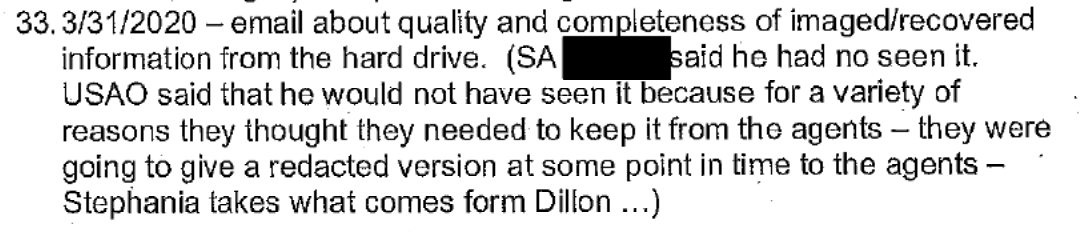
Indeed, the concerns that Green and Williams raised may explain something the FBI itself found. Shapley’s notes recorded that on March 31, 2020, someone wrote an email “about quality and completeness of imaged/recovered information from the hard drive” — an email that was being intentionally withheld from the agents (especially Whistleblower X) who might one day testify at trial.
This sounds like it might reflect the same concerns raised by anyone external examining the drive forensically. If it does, it would suggest that some of the irregularities everyone can see in drives released via Rudy Giuliani and Steve Bannon always existed, including in the one shared with the FBI and in any separate drive shared with Republicans in Congress.

Because of all the new questions raised about the “laptop,” and because of the centrality that the Republicans want it to have on the upcoming election, I thought it reasonable to ask the WaPo to do what even the Washington Examiner was willing to do: show their work. While the Examiner’s report from Gus Dimitrelos tellingly excludes many of the details I’ve laid out above and hides both some key later device accesses and types of apps — especially spyware — loaded onto Hunter Biden’s iCloud accounts, while the way the Examiner released it exacerbated the privacy violations on Hunter Biden himself, it nevertheless was useful for explaining how two iCloud accounts were loaded up onto one laptop and how the government was able to obtain WhatsApp texts that don’t show up on the unencrypted parts of the laptop.

After I made several requests, WaPo PR manager Savannah Stephens declined to release the reports, calling the two reports, “foundational reporting documents.”

Marcy, thank you for reaching out. We do not release foundational reporting documents. Our coverage at the time was transparent about how the study was conducted, including this report.

Even though it has two reports that could significantly impact fairly pressing debates — debates the WaPo itself treats as important — the WaPo refuses to release more on these expert reports on the laptop.

Instead of doing that, the WaPo is instead paying Devlin Barrett to do what he does best — write down as true what right wingers tell him to write, not what the public evidence actually shows.

In a story with Matt Viser (the same guy who repeated the content of contested WhatsApp texts without revealing that Abbe Lowell had contested them), Barrett wrote that the testimony of the men he calls “whistleblowers” “show Hunter Biden’s laptop had little role in the investigation into Hunter Biden.”
Barrett and Viser utterly misrepresent the debate over the laptop — dodging the question, in the lede, at least, of whether the laptop can help get to the truth — something once considered the purview of journalism and something WaPo’s own report on this drive had previously done.

For more than two years, Democrats and Republicans have hotly debated the importance of the “Hunter Biden laptop” — insisting that it was either key evidence of corruption or fool’s gold meant to con 2020 voters into abandoning then-candidate Joe Biden.

Both theories were largely wrong, according to two of the agents closest to the investigation of tax crimes allegedly committed by President Biden’s son.

[snip]

But the agents’ accounts also indicate that the laptop played at best a small role in the criminal investigation into potential tax and gun-purchasing violations. Far from a smoking gun, the laptop appears to have been mostly an afterthought to the reams of text messages, emails and other evidence that agents gathered from Hunter Biden’s cloud data. A lawyer for one of those agents said he nevertheless was frustrated by the Justice Department’s refusal to let them review the laptop’s contents.

I’m very interested in the project of this column, because not only is this not what Shapley and Whistleblower X’s testimony said, but it misrepresented and misunderstands how evidence works.

This is a tax investigation. It came from, per Whistleblower X, his examination of what is probably a Russian escort service. But it’s a tax investigation: it relies on financial data that comes directly from banks and other financial institutions, institutions that are — to the extent they aren’t tainted by identity theft or hacking, like people seem to have tried to do to Hunter Biden’s Venmo — inherently reliable.

As for emails and texts, the IRS agents’ testimony (taken in conjunction with the report that the Washington Examiner was ethical enough to release), shows that the IRS didn’t obtain what is probably Hunter Biden’s rhb iCloud account — from which the cited, contested WhatsApp messages were probably obtained a second time — until August 2020, after it got some of the same material on the laptop. That potential taint may be why someone told Barrett to downplay the import of the laptop.

While the laptop may not have played a key role in substantiating a tax case against Hunter Biden, it may well have tainted the evidence in the case. It may well be part of the reason why Hunter Biden is getting to plead to misdemeanor rather than felony tax charges — because as even Whistleblower X explained that he had been told, there are emails that raised concerns about whether this could be charged at all, suggesting this case couldn’t withstand discovery.

Plus, WaPo is being coy here: The laptop may have played little part in a tax investigation reliant on bank records. But it did play a central part in allegations, including WaPo’s own reporting, of foreign influence peddling involving (among others), Burisma, the hack of which became public between the time the IRS started using this laptop as evidence and the time they learned Rudy Giuliani had a role in it.

That part is all pitch, though — yet another instance where Devlin Barrett writes down what right wingers tell him to say and WaPo reports it as if it were true. It’s what WaPo pays him to do.

It’s the claims about the laptop — from an outlet sitting on two reports that raise questions about its reliability — that I find especially curious. Start with this paragraph, which conflates the steps FBI took in November 2019 to authenticate that the laptop was Hunter Biden’s — subscriber information from Apple, a purchase record in Delaware, two but maybe only two phone calls with Mac Isaac, and “other intelligence” — with what the AUSA on the case said about it almost a year later.

After being handed the device by a Wilmington, Del., computer shop owner in 2019, the FBI quickly concluded by examining computer data as well as Hunter Biden’s phone records that the laptop was genuinely his and did not seem to have been tampered with or manipulated.

That last bit — “did not seem to have been tampered with or manipulated” — published by an outlet sitting on two reports that show the laptop was tampered with? It is a paraphrase from a meeting in October 2020, not a description of legal process served in November 2019. And therein lies a big part of the scandal.

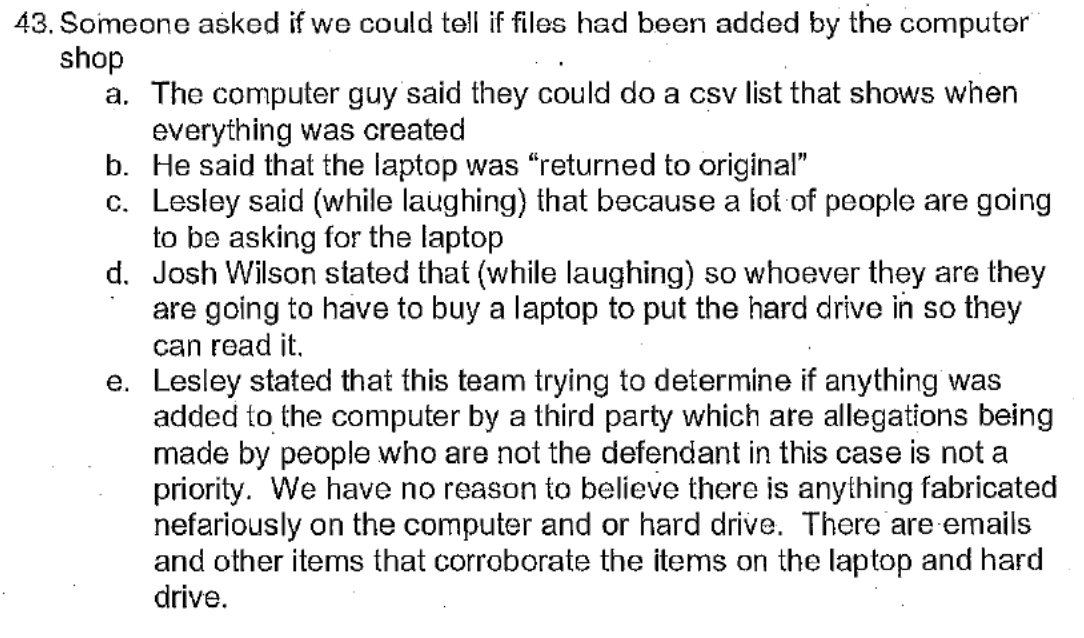
In the actual quote, Wolf — painted as the bad guy here by the IRS agents — was saying that it “is not a priority” for the investigative team to see “if anything was added to the computer by a third party” even after learning that the lawyer for the President, whose demands for this investigation had raised influence problems from the start of the investigation, had some kind of tie to it.

This is as if Peter Strzok, rather than just failing to make sure people writing FISA applications had adverse information about the Steele dossier (which is what frothers think the IG Report showed), had instead said, “fuck it, I don’t care if it is tainted.” These notes show the Hunter Biden investigative team did what right wingers accuse the Crossfire Hurricane team of doing, blowing off the import of the involvement of a campaign in a key piece of evidence.

When the WaPo conflates those two items again later in the piece, they date the quote to May 2020.

Democrats suggested the data might have been doctored or possibly a Russian-backed disinformation campaign. The information provided by IRS agents to Congress seems to put both the accusations and counter-accusations to rest.

FBI agents were able to determine in early November 2019 that the device they had was registered to Hunter Biden, and phone records showed he had been in contact with the computer shop owner.

“We have no reason to believe there is anything fabricated nefariously on the computer and or hard drive. There are emails and other items that corroborate the items on the laptop,” Shapley wrote in notes that dated that determination to around May 2020.

Dating Lesley Wolf’s comment saying they had no reason to believe anything on the laptop was fabricated to May 2020 is either a deliberate error or a confession that two journalists proclaiming the laptop to lack any taint have no fucking clue what they’re reading.

Wolf said this, at a meeting the investigative team had on October 22, 2020, in the wake of the discovery that Rudy Giuliani had some tie to the laptop, as the team scrambled to memorialize how they had treated a key piece of evidence about which a bunch of questions would now be raised.

A Yes. So there are a couple significant parts of this. One was that, at this time, the laptop was a very big story, so we were just making sure that everything was being handled appropriately.

So we wanted to go through the timeline of what happened with the laptop and devices.

Because the laptop had become a huge story, “we were just making sure that everything was being handled appropriately,” Devlin Barrett’s star “whistleblower” explained.

And Shapley shows Wolf saying that they had no knowledge, in October 2020, of any fabrications on the laptop. But he records her saying that after “computer guy” said “they could do a csv list that shows when everything was created.”

That is, Wolf said this after “computer guy” described something they had not yet done ten months after obtaining the laptop, had not yet done two months after getting warrants relying on the laptop, that they would need to do to make sure the laptop had not been altered by third parties. Wolf said this after “computer guy” described that the FBI had not done very basic things to verify the integrity of the laptop they should have done ten months earlier, before relying on it.

Again, I’m not sure whether WaPo’s journalists are dishonest or just stupid. But this exchange is critical for another reason. Lesley Wolf’s assertion about the integrity of the laptop relied on correlation: by matching emails on the laptop with emails that could be obtained directly from the provider.

There are emails and other items hat corroborate the items on the laptop and hard dive.

This is the method that Washington Examiner’s expert used to proclaim the laptop authentic. It’s the method that a bunch of other right wing journalists have gotten experts to use to validate the laptop.

If you steal someone’s iCloud account, the way to prove that it is authentic is by proving that it is their iCloud account, which is what correlation does.

But “computer guy” was suggesting using a forensic method, ten months after the fact, to test the integrity of the laptop itself. DDOSecrets has done this test on the publicly released emails — and half of them have a last modified date of February 11, 2019, right towards the end of the timeline I show above.

Lesley Wolf made her comment on October 22, 2020. No one in Gary Shapley’s interview asked him what happened after that. Nor does Devlin Barrett seem curious to ask.

If “computer guy” subsequently did this test, there’s good reason to believe he would have found what DDOSecrets did: that while these emails match the ones in Hunter Biden’s accounts, they were all packaged up on February 11, 2019, at a time it’s not clear Hunter Biden had control of his own digital accounts.

If you use a forensic method to validate these files, you’re not going to get the same results as a correlative method. That’s why it would be very useful for the debate about the laptop for WaPo to share the two known expert reports done using forensic methods on the drive itself, rather than correlation.

There’s one more hilarious thing about this Devlin Barrett creation. He, predictably, repeats his “whistleblower’s” complaints about not getting stuff pertaining to the laptop.

Shapley said a federal prosecutor on the case, Lesley Wolf, told him that the IRS agents couldn’t see the laptop. “At some point, they were going to give a redacted version, but we don’t even think we got a full — even a redacted version. We only got piecemeal items,” Shapley told the committee, voicing his frustration that he would have liked to see all the data.

Devlin Barrett — dishonest or stupid? — quotes Shapley’s testimony out of context. The full quotation makes it clear Shapley is referring, again, to a discussion that took place on October 22, 2020. More importantly, Shapley is not referring to the laptop!!

And when it came down to item number 33 on page 2, Special Agent [Whistleblower X] is saying like, well, I haven’t seen this information. And AUSA Lesley Wolf says, well, you haven’t seen it because, for a variety of reasons, they kept it from the agents. And she said that at some point they were going to give a redacted version, but we don’t even think we got a full — even a redacted version. We only got piecemeal items [my emphasis]

That particular quotation, identified clearly as item number 33, is the report about the laptop — which I’ll copy again here to make it so easy even Devlin Barrett might understand it:

To help a right winger allege corruption, Devlin Barrett quotes his complaint that his team was not given the actual forensic report about the laptop. Corruption, in this story, is withholding a forensic report that might tell people what they need to know about the laptop.

And yet that is precisely what WaPo itself refuses to do: release two reports that raise questions about the quality and completeness of the drive.

According to Devlin Barrett’s own standard — at least the standard he applies when he’s parroting right wingers — withholding such a report is a sign of corruption.

Even the plain language of Gary Shapley’s contemporaneous notes show that Devlin’s claim that, “information provided by IRS agents to Congress” “put[s] … the accusations” that “the data might have been doctored or possibly a Russian-backed disinformation campaign” … “to rest” is wildly false (dishonest or stupid?). It does the opposite: It shows that ten months after beginning to rely on the laptop, the FBI still had not done basic forensic checks of the data on it and the AUSA leading the investigation didn’t think doing so was a priority.

That should be the story. That’s the scandal.

And true to form, Devlin Barrett spins the exactly opposite tale.

The WaPo has in its possession some of the only available information that can help to explain what the FBI saw by March 2020, two independent equivalent reports to the one that Shapley implies it is corrupt to withhold.

And unlike the Washington Examiner, they won’t release it.
Share this entry

“I can get any source on the planet.” The Pre-History of Gal Luft’s Pre-“Whistleblower” Indictment

In this post I noted that Gal Luft — the guy who got James Comer all hot and bothered about having a “whistleblower” confirming his conspiracy theories about Hunter Biden — was indicted on November 1, 2022, before the Republicans even won back the House. The timing alone debunks Luft’s and GOP claims that he was charged as retaliation for coming forward to Republicans.

But he might have been charged even before that.

That’s because the statutes of limitation for many of the substantive charges against him — save the alleged conspiracy to violate FARA — would have expired before he was indicted if he hadn’t fled the country when the person referred in his indictment as co-conspirator-1, Chi Ping Patrick Ho, was arrested in November 2017.

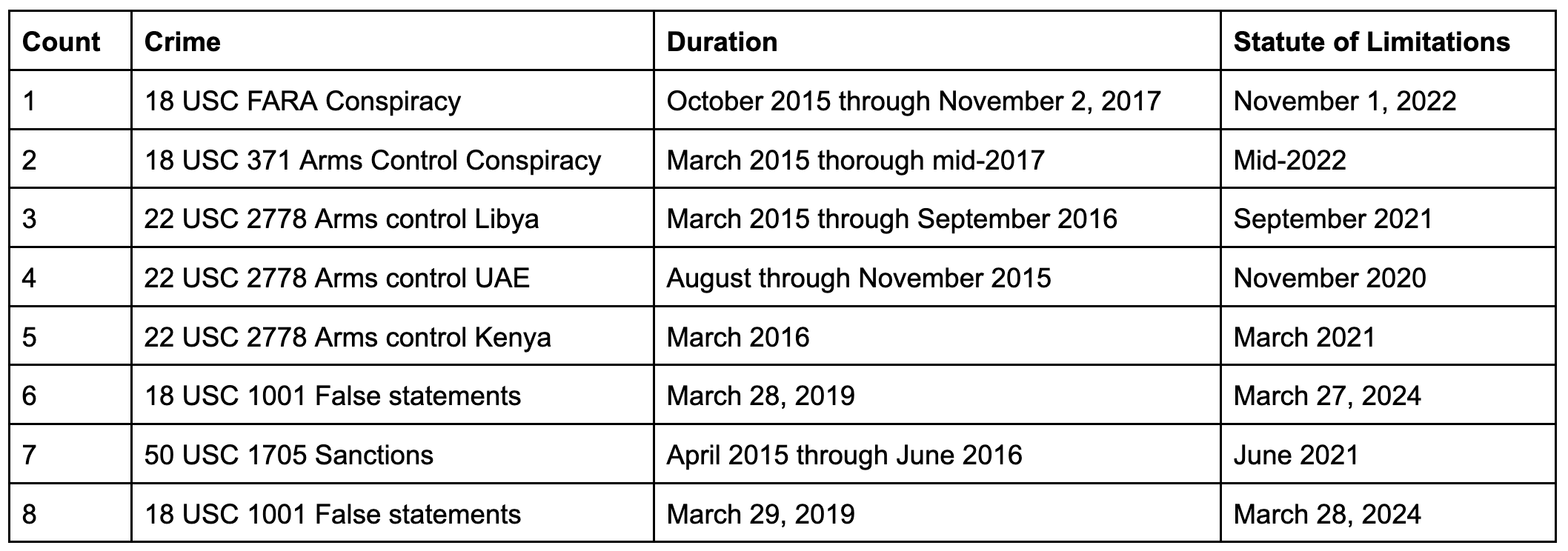
Here’s what the charges, duration, and five year Statute of Limitation looks like for the indictment against Luft.

It seems exceedingly likely that SDNY charged Luft on November 1, 2022 because that’s the day the Statute of Limitations would otherwise have expired on the headline charge: the conspiracy to get James Woolsey to act on behalf of CEFC by using Luft’s NGO as a cut-out.

But the five year Statutes of Limitations would have started expiring on the other substantive charges starting in November 2020.

DOJ could still indict Luft on those charges because — as they allude to in the indictment — once his alleged co-conspirator Patrick Ho was charged in November 2017, he fled the US and never returned.

Since the arrest of an associate (“CC-1”) on different U.S. charges in mid-November 2017, LUFT has remained outside the United States.

The known Luft docket doesn’t show any complaint prior to the indictment. But SDNY doesn’t always include prior charges in the prosecution docket (note, for example, that the Oleg Deripaska docket starts with a superseding indictment as document number 1, thereby hiding the timing and content of the prior indictment).

But if DOJ wanted to preserve those other charges until such time as they indicted on the last-expiring one, they might have obtained one or several serial complaints charging them, in case Luft ever happened to fly into the US unexpectedly, which would otherwise have cause those Statutes of Limitation to expire. If that’s right, then SDNY may have started charging Luft as early as November 2020, with more controversial charges involving Iran and Libya the following year.

With that in mind, I want to look at what the Patrick Ho prosecution — Luft’s alleged co-conspirator in counts 1 and 2, as well as Hunter Biden’s associate and legal client through the beginning of Ho’s own prosecution in 2018 — says about the investigation into Luft.

Based on search warrant return dates, DOJ appears to have obtained probable cause against Ho by June 20, 2016 — possibly based off a FISA warrant noticed during the prosecution. Before his arrest, DOJ continued to obtain Ho’s cloud communications at least through March 6, 2017 — meaning they were collecting communications Ho had with Luft during the period he was cultivating the Woolsey deal, and would have been collecting emails with Hunter Biden, except — unless I fucked up the search — none of the noticed email accounts show up in the MarcoPolo set.

While it’s clear CEFC did use charity to try to cultivate Hunter Biden, it’s not entirely clear what role Ho’s NGO played in that process (or whether Hunter had direct involvement with it). It’s worth noting on this point, charges against the Chadian whom Ho was convicted of trying to bribe were dropped. And Woolsey is not known to have been charged, in part because the Chinese payments to him were too well laundered through (allegedly) entities like Luft’s own NGO — likely the same reason why Tony Podesta wasn’t charged for involvement in Paul Manafort’s Ukrainian influence peddling.

Ho was first charged by complaint on November 16, 2017, then arrested as he landed in JFK two days later. On his arrest, the FBI took possession of six USB drives, at least two phones, and an iPad, all of which they presumably searched.

In the wake of Ho’s arrest, DOJ took other overt steps, which they cited in a detention filing to describe how much more they learned after Ho’s arrest. Those steps including interviewing witnesses, executing search warrants — including for Ho’s Virginia NGO, and subpoenaing documents from third parties.

The government first publicly mentioned the arms and Iran conduct subsequently charged against Luft in an October 2018 motion in limine. Because Ho seemed to be preparing to claim his involvement in Chad and Uganda — the two countries he was charged with attempting to bribe — involved charity, a defense that would have skirted aspects of the charged crime, Foreign Corrupt Practices Act, the government argued they should be able to introduce evidence that Ho was pushing CEFC business, not just charity.

On October 2014, the defendant sent his assistant an email stating, “I am going to BJ [i.e., Beijing] this Friday to see [the Chairman of CEFC NGO and CEFC China] on Sat afternoon. The documents I want to send him before hand in separate items are: . . . 7. Iranian connection (brief).”4 On the same date, the defendant sent his assistant another email, attaching a document, which stated, in pertinent part:

7) Iranian Connection . . . Iran has money in a Bank in china which is under sanction. Iran wishes to purchase precious metal with this money. The precious metal is available through a Bank in HK which cannot accept money from the Bank in China which holds the money but is under sanction. The Iranian agent is looking for a Chinese company acting as a middle man in such transactions and will pay commission. (details to be presented orally) The Iranian connection has strong urge to establish trading relationship with us in oil and products . . . .

The following year, in June 2015, the defendant received an email that stated, in pertinent part: “The Iranian team will arrive in BJ . . . . See the attached.” The attachment referenced in the email was a PowerPoint presentation entitled “Presentation to Potential Partners Iran Petroleum Investments.” The next day, the defendant forwarded the email to his assistant, stating, “For writing report to [the Chairman of CEFC NGO and CEFC China].”

The following year, in June 2016, the defendant emailed another individual, blindcopying his assistant, and stated, in pertinent part, “Will get [two executives of CEFC China] to meet with [oil executive at company with operations in Iran] in BJ, and [another individual] also on another occasion if he comes. You can start organizing these. . . . Other matters ftf [i.e., face to face].” [paragraph 78]

[snip]

The defendant also sought to and did broker arms transactions unrelated to the Chad and Uganda schemes charged in this case. For example:

In March 2015, an individual sent the defendant an email, stating, “I have the list and end user agreement. Pls advise next step.” On the same day, the defendant replied, in pertinent part, “Find a way to pass them onto me and we can execute that right away[].” The individual replied, “Attached. [W]e have the funding and processing mechanisms in place. If it works nice there will be much more. Also for S. Sudan.” The attachment to this email was a document entitled “End User Certificate,” certifying that the user of the goods in question would be the Ministry of Defense of the Republic of Libya. The goods listed on the document included numerous arms. [paragraph 48]

The following month, the defendant sent an email that stated in pertinent part: “It so turns out Qatar also needs urgently a list of toys from us. But for the same reason we had for Libya, we cannot sell directly to them. Is there a way you could act as an intermediary in both cases?” The person whom the defendant emailed replied: “Qatar good chance bc there is no embargo. Libya is another case bc going against an embargo is tricky.” The defendant responded: “Qatar needs new toys quite urgently. Their chief is coming to China and we hope to give them a piece of good news. Please confirm soonest.” [paragraph 48]

As linked above, several of the documents described in this motion describing “other uncharged conduct” are documents listed in Luft’s own indictment. Given that he fled upon Ho’s arrest, he seems to have recognized the threat to himself at that point, in 2017. If not, the public docketing of these documents should have made that clear.

The government repeated these references to communications with Luft — among other places — in their sentencing memorandum for Ho, submitted on March 18, 2019, just days before the meeting with Luft in Belgium.

So Luft was on notice about this part of the criminal investigation into him when he arranged that meeting and pitched dirt on Hunter Biden. The meeting was literally days after Ho was sentenced on March 25, 2019.

SDNY didn’t charge Ho with either of the conspiracies in which he is named as Luft’s co-conspirator, even though their understanding of the arms control conspiracy was well-advanced by the time of his trial in November 2018. He remained imprisoned in the US until June 8, 2020, well over a year after the interview with Luft, after which Ho was deported to Hong Kong. Admittedly, that was the height of the pandemic and Ho was already 70, and so would have been difficult to keep jailed.

But the timing of Luft’s meeting with the SDNY and FBI — literally days after Ho’s sentencing — suggests that SDNY took that opportunity to advance the several overt prongs of the investigations against him, regardless of what dangle — true or not — about Hunter Biden Luft offered. They had already, publicly, made clear they believed it was criminal conduct.

Luft was on notice about that before the Brussels meeting and, as alleged in the indictment, he lied about the arms control scheme and discussions with Iran.

It probably would have been easier to extradite him from the US Embassy in Brussels than it would from Cyprus, so clearly SDNY wasn’t ready to arrest him yet.

There’s no False Statements charge in the indictment pertaining to Woolsey, however, so it’s unclear whether the FBI asked Luft about that.

Trump’s Criminal Division head, Brian Benczkowski, took credit for the Ho sentencing (and may have had to approve the meeting with Luft). So it seems likely even Bill Barr’s DOJ were fine with those two prongs of the Luft prosecution.

The Woolsey allegation, of course is a different matter.

So, too, might another one be.

Count 7 of his indictment charges Luft with violating sanctions against Iran. It starts, as such charges do, with an explanation of the IEEPA authorizing such sanctions, generally. It spends six paragraphs describing the sanctions regime against Iran. It spends eight paragraphs describing the charged conduct involving Iran. Then, before the two paragraphs charging Luft for evading Iran sections, his indictment includes this paragraph:

80. Several months later, on or about October 10, 2016, CC-2 emailed GAL LUFT, the defendant, that CC-2 had a Chinese client who needed Russian oil, which LUFT confirmed he could help provide: “I just got off the phone with Russia. They have this.” Forwarding this email to CC-1, LUFT wrote: “If [CC-2] really has this client we need to grab it. This is exactly what we need. . . . I can get any source on the planet.”

That’s not related to the current charges (though if Luft continued to pursue business with Russia, particularly after 2017 and 2022 sanctions, those might amount to IEEPA sanctions violations as well). But it suggests DOJ’s interest into Luft may extend beyond China.

Share this entry

Maggie and Mike Back Together Again, This Time on, or with, January 6 Corrupt Purpose

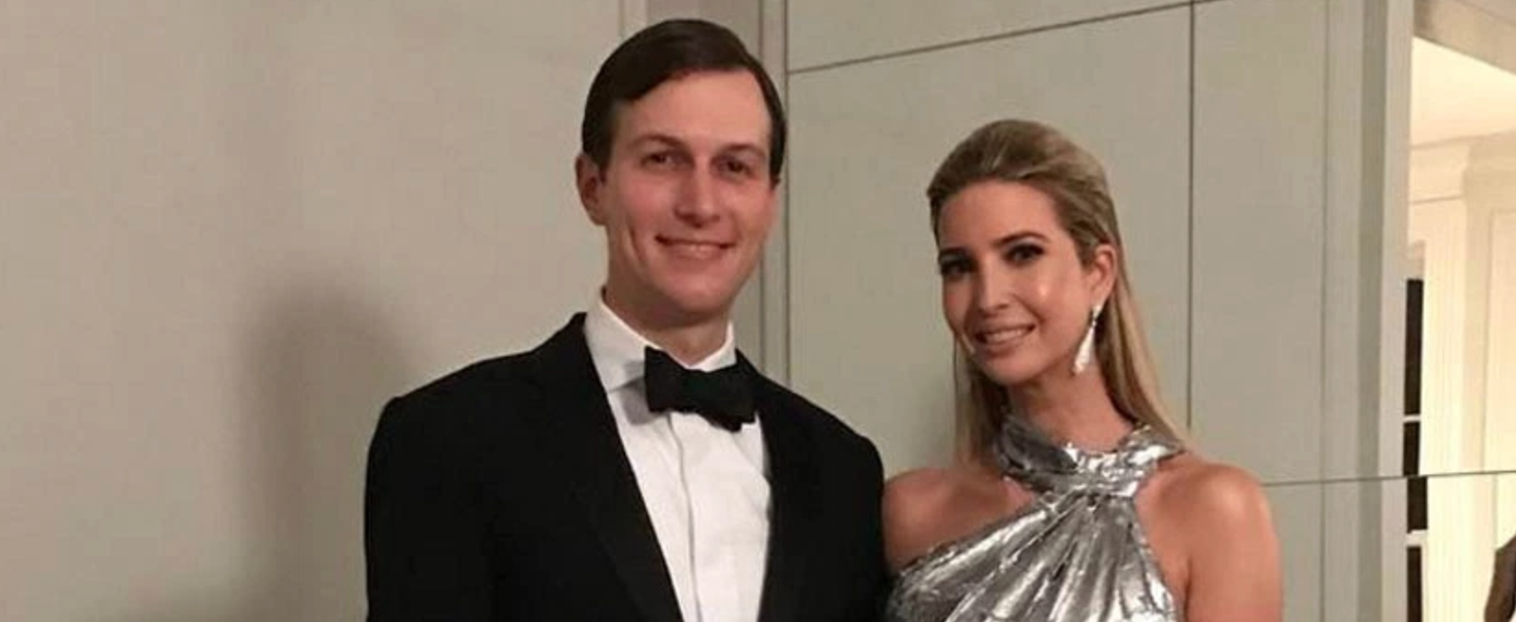
Yesterday, the NYT broke the news that Jared Kushner testified before Jack Smith’s grand jury last month and told them — in testimony that conflicts with other witness testimony — that his father-in-law really did believe he had won the election.

Federal prosecutors investigating former President Donald J. Trump’s attempts to overturn the 2020 election have questioned multiple witnesses in recent weeks — including Mr. Trump’s son-in-law, Jared Kushner — about whether Mr. Trump had privately acknowledged in the days after the 2020 election that he had lost, according to four people briefed on the matter.

The line of questioning suggests prosecutors are trying to establish whether Mr. Trump was acting with corrupt intent as he sought to remain in power — essentially that his efforts were knowingly based on a lie — evidence that could substantially bolster any case they might decide to bring against him.

Mr. Kushner testified before a grand jury at the federal courthouse in Washington last month, where he is said to have maintained that it was his impression that Mr. Trump truly believed the election was stolen, according to a person briefed on the matter.

The scoop, which brings the old team of Maggie and Mike back together again, is fine. Whoohoo! Another top witness.

Just as interesting that Jared has testified is the news — buried in paragraph 31 — that Ivanka has not yet testified before the grand jury, though there’s a good deal of wiggle room about whether she has complied with a document subpoena or whether she has spoken with prosecutors outside of a grand jury.

The New York Times reported in February that Mr. Smith’s office had subpoenaed Mr. Kushner and his wife, Ivanka Trump, to testify before the grand jury. The special counsel’s office has yet to question her before the grand jury. Ms. Trump testified before the House committee last year.

Maggie and Mike, always solicitous of Ivanka and her family, mention Ivanka’s testimony to the January 6 Committee, but they neglect to mention that after Ivanka testified to the January 6 Committee, the committee specifically called her out for her lack of candor, effectively inviting DOJ to consider false statements charges for her. So it may not be a good sign for Ivanka that she hasn’t been called before the grand jury.

That’s an interesting detail, but given that this is Maggie and Mike, I’m as interested in what appears between the Jared news and the Ivanka news: Maggie and Mike’s explanation for why (they claim) this matters. They explain that asking whether Trump knew he lost is important to ascertaining whether he had a “corrupt purpose” in obstructing the vote certification. Based on that premise, Maggie and Mike raise doubts about whether Jack Smith will be able to charge this, because without that, they suggest, Smith will lack one key element of the obstruction statute.

Maggie and Mike don’t mention that dozens — probably over a hundred — people have been convicted under 18 USC 1512(c)(2) for their actions on January 6 already; by DOJ’s most recent count, 310 people have been charged with it. Many if not most of them tried to argue at some point that their crimes were cool because they really did believe Donald Trump’s lies.

To be fair to poor Maggie and Mike, who after all are mere journalists, the conceit that Trump might dodge obstruction charges because he believed his own hype is one that has long been parroted by TV lawyers, and Maggie and Mike do cite several lawyers talking about how having proof that Trump knew he lost would strengthen the case.

But we have two years of public record showing that’s not how it works.

What VIP obstruction looks like: Alan Hostetter

Here’s what a guilty verdict for obstructing January 6 looks like in reality, taken from findings that Reagan-appointed Judge Royce Lamberth wrote up to support his guilty verdict yesterday for Alan Hostetter, a southern California anti-mask activist who played a key role in organizing others from southern California to come to DC on January 6.

In December 2021, I wrote about the challenges and import of prosecuting people like Hostetter — I called him and similar figures organizer-inciters — for obstruction, in part because it’s a test of whether DOJ will be able to hold even more senior people accountable for inciting others to commit violence.

Like Trump, Hostetter is a VIP who didn’t enter the Capitol, but who spent the weeks leading up to January 6 riling up others to obstruct the vote certification. As such, he’s a really good read on how obstruction might apply to Trump.

Every time Lamberth presides over a bench trial, he writes up and dockets his findings. I could hug him for doing so, because they provide a really superb way to understand how a very senior judge who has been presiding over these cases for over two years views them. Journalists and TV lawyers who, unlike Lamberth, haven’t been living and breathing January 6 for two years could learn a lot from reading every one of his findings reports, or at least this one.

Lamberth pointed to the following evidence to support his guilty verdict that Hostetter had obstructed the vote certification:

After arriving at the West Plaza, Mr. Hostetter advanced underneath the inauguration stage scaffolding and up a set of stairs leading to the inauguration stage. While on the stairs, Mr. Hostetter used a bullhorn to cheer on the crowd below as it violently fought against police and attempted to break the lines. Meanwhile, on a landing at the top of the stairs, several officers formed a line to prevent a group of rioters from reaching the inauguration stage. Mr. Hostetter’s co-conspirator, Mr. Taylor, joined the group of rioters and began pushing against the officers who were blocking access to the stage.

[snip]

Mr. Hostetter’s actions obstructed and impeded the proceeding by, together with the actions of others, forcing the evacuation of Congress and the end of the certification session, as shown in the testimony of Inspector Hawa and Mr. Schwager. By joining the riot, exhorting the crowd, standing with a vanguard of rioters making a highly-visible and violent effort to access the inauguration stage, and remaining on the Upper West Terrace for two hours while police attempted to clear out rioters, Mr. Hostetter helped ensure that Congress was under a sufficient security threat requiring adjournment and then an inability to resume the official proceeding that their actions helped to disrupt.

It’s not just that Hostetter’s own physical premise obstructed the vote certification, his exhortations to other, more violent people, did too.

Lamberth specifically noted that Hostetter’s purpose was to obstruct an election result he viewed as fraudulent.

Among other evidence … Mr. Hostetter’s own testimony[] demonstrate[s] that Mr. Hostetter understood his purpose on that day to be stopping an election result that he viewed as fraudulent by obstructing or impeding the Electoral College Certification.

Lamberth cited multiple exhibits and testimony showing that Hostetter knew the significance of the Electoral Certification. Notably, he describes how Hostetter listened to Trump explaining what he wanted, and then took action.

Mr. Hostetter testified that he had been closely following the efforts to overturn the 2020 Presidential Election and news about what was happening with the Electoral College Certification. Additionally, Mr. Hostetter testified that he listened to speeches at the Ellipse given by Rudy Giuliani and President Trump, was engaged by them, and remembers President Trump talking about Vice President Pence. During President Trump’s speech, President Trump made statements concerning what he wanted to happen with the certification and Vice President Pence’s role in the certification, which Mr. Hostetter heard.

Lamberth substantiated Hostetter’s corrupt purpose — what Maggie and Mike claim requires proof of knowledge that Trump lost — by pointing to the former cop’s consciousness of wrong-doing by walking, armed with a hatchet, onto Capitol grounds, what Dabney Friedrich adopted as “otherwise illegal means” standard to meet the statute’s corrupt purpose requirement.

Mr. Hostetter had the necessary mental state to meet the “corruptly” requirement. First, by himself carrying an inherently dangerous weapon into the restricted grounds of the Capitol, Mr. Hostetter used an unlawful means, specifically the independently felonious means of entering and remaining in a restricted building with a deadly or dangerous weapon.

Lamberth also pointed to Hostetter’s own incitement of others as evidence of corrupt purpose.

Additionally, Mr. Hostetter sent numerous messages and made speeches before and immediately after January 6 effectively calling for revolution. He also recorded videos in which he called for executions of public officials in connection with the 2020 Presidential Election.

Importantly, Lamberth specifically addresses, and dismisses the import of, Hostetter’s claims that he believed he was doing something good.

I also find that even if Mr. Hostetter genuinely believed the election was stolen and that public officials had committed treason, that does not change the fact that he acted corruptly with consciousness of wrongdoing. Belief that your actions are ultimately serving a greater good does not negate consciousness of wrongdoing.

[snip]

[T]he point isn’t that the defendant needs to understand what he’s doing is morally wrong; it’s that he needs to understand that what he’s doing is unlawful. Even if Mr. Hostetter sincerely believed–which it appears he did–that the election was fraudulent, that President Trump was the rightful winner, and that public officials committed treason, as a former police chief, he still must have known it was unlawful to vindicate that perceived injustice by engaging in mob violence to obstruct Congress.

And Lamberth addresses the mid-point of the appellate debate at the DC Circuit on corrupt purpose in the Fischer decision — requiring an unlawful benefit to find corrupt purpose.

I find that Mr. Hostetter took these actions in order to provide an unlawful benefit to his preferred presidential candidate, President Trump–by disrupting the Electoral College Certification that would have led to President Trump’s loss of the presidency.

Requiring finding an unlawful benefit is not, yet, the standard for obstruction in the DC Circuit. A separate panel considered the standard for corrupt purpose in Thomas Robertson’s appeal on May 11. But it is likely to be the most conservative standard that the DC Circuit (and even SCOTUS) would adopt, so Lamberth is protecting this verdict in advance of further rulings from the Circuit.

In any case, as I’ve noted over and over, even if that were the standard, it would apply to Trump if he were charged far more easily than any of the 300-plus people who’ve already been charged with obstruction for January 6. For Trump, whether he believes he won or not is not only unnecessary, but because he was trying to steal the election, it’s easier to prove corrupt purpose under this standard for him than for anyone else.

This is what applying the obstruction statute to January 6 looks like in real life. One after another judge has, like Lamberth, explained why it doesn’t matter whether someone believed that Trump won.

It doesn’t matter. Maggie and Mike built an entire story around a standard that two years of directly applicable precedents — precedents that will dictate terms of the elements of offense if Trump ever is charged under 18 USC 1512(c)(2) — show doesn’t matter.

Whether Trump believes he won doesn’t matter for 18 USC 1512(c)(2).

Jared Kushner’s central role in monetizing the lies

Whether Trump knew he won doesn’t matter for 18 USC 1512(c)(2).

It does matter — a lot — for any campaign finance charges arising out of January 6, and in that, it could have an indirect impact on Jack Smith’s charging decisions.

And, in part because Jared made himself scarce for January 6 itself, that’s actually the area where the former President’s son-in-law has more personal exposure than on the conspiracy to obstruct the vote certification.

This is a point MSNBC’s Lisa Rubin made at length in response to this news yesterday (and her coverage of this is so good I hereby create a special category of people who happen to be lawyers but even in spite of that provide superb TV analysis based on the actual facts).

Here’s how J6C addressed it.

Several days earlier, Trump Campaign Senior Advisor Jason Miller had explained the intention for this round of advertisements in an email. He wrote that, “the President and Mayor Giuliani want to get back up on TVASAP, and Jared [Kushner] has approved in budgetary concept, so here’s the gameplan” in order to “motivate the GOP base to put pressure on the Republican Governors of Georgia and Arizona and the Republican controlled State legislatures in Wisconsin and Michigan to hear evidence of voter fraud before January 6th.”317 Miller anticipated a budget of $5 million and asked for the messaging to follow an earlier round of advertisements, “but the endings need to be changed to include phone numbers and directions to call the local Governor or state legislature.”318 On December 22nd, Jason Miller texted Jared Kushner that “POTUS has approved the buy.”319

[snip]

Trump Campaign leadership was fully aware of post-election fundraising totals. According to Coby, President Trump’s son-in-law and senior advisor Jared Kushner “had the most interest in the digital program” and “would just check in on [fundraising] results,” and routinely received updates regarding fundraising from Coby.70 Coby also made clear that Kushner was heavily involved in the Campaign’s budget process71 and that he updated Kushner on TMAGAC’s post-election fundraising totals.72

The Select Committee received documents confirming Kushner’s involvement. For example, on November 8, 2020, Kushner requested that a daily tracker be created showing the Trump Campaign’s financial position from election day forward.73 In an email, Kushner noted that the tracker would allow the Campaign to consider its cash flow ahead of the creation of “a new entity for POTUS[’s] other political activities.”74 Just days after the election, and after the Campaign had three of its four best fundraising days ever on November 4th, 5th, and 6th,75 Kushner was preparing for the launch of President Trump’s new leadership PAC, Save America. Kushner stated that he needed this new daily tracker because the Trump Campaign was going to continue fundraising post-election.76 Kushner continued to receive these detailed daily trackers, which included Save America’s fundraising hauls, through at least December 2020.77

Jared Kushner isn’t much use as a witness about Trump’s actions and intent on January 6 itself.

He’s a central witness to the decision to monetize Trump’s lies by sowing violence — and even, to then use that money for purposes other than addressing election integrity. That’s why his grand jury testimony last month is of interest.

And his claim that Trump really believed he won may not help Trump; it may hurt Jared. But then, Jared has a very direct interest in claiming that all this fundraising based off lies were based on a good faith belief Trump had won.

Campaign finance fraud is an otherwise illegal action

I’m not promising here that Trump will be charged with obstruction — though, as noted, I long ago pointed to people like Hostetter as early tests of whether he could be, and his conviction yesterday shows how that might work.

I’m saying that people who came late to the understanding that DOJ is using obstruction to prosecute January 6 — which I first mapped out 23 months ago — seem little interest in the two years of precedent about how it will be applied. I include, for special notice, this “model prosecution memo” from JustSecurity — which doesn’t even mention the Justin Walker concurrence in Fischer (which Lamberth addressed in his findings), much less the pending Robertson decision in the DC Circuit that will dictate this application for Thomas Robertson, for Alan Hostetter, and for Donald Trump — in that category.

Trump’s knowledge of his loss matters far more for his decisions about fundraising than it does for obstruction charges. But they may influence any obstruction charges, because campaign finance violations — Trump’s fundraising through the moment he sicced his mob on the Capitol — would be one way DOJ could prove otherwise illegal conduct to meet that corrupt purpose standard under 18 USC 1512(c)(2) if that’s what the DC Circuit adopts in Robertson.

Plus, profiting off false claims of being robbed is another way that Trump personally benefitted from the incitement, even ignoring his bid to stay in power.

Update: This post on Maggie’s curious foray into campaign finance journalism notes that shortly after that misleading story, she and Mike broke the news of the Jared and Ivanka subpoena, which Maggie and Mike claimed was about calling off dad’s attack.

After I started unpacking Maggie’s story, I got distracted with the possibility that DOJ will tie Trump and Rudy Giuliani and John Eastman directly to the almost-murder of Michael Fanone. So, in the interim, Maggie broke the news that Smith’s prosecutors had subpoenaed Jared and Ivanka.

That story, written with Mike Schmidt, is exceptional only for the fact that they managed to avoid most of the hype about “aggressive steps” that peppers most reporting on Jack Smith. It pointed to things like the morning Oval Office meeting (Ivanka’s response to which her Chief of Staff Julie Radford was likely already questioned about, since — as the J6C Report noted explicitly — Radford was far more candid about it than Ivanka) and efforts to get Trump to call off his mob as likely topics of questioning.

Smith no doubt wants to get Jared and Ivanka’s stories about such topics locked in. Given questions about their candor before J6C, too, Smith will likely also give them an opportunity to revise their prior answers so they more closely match known facts.

Back to Maggie’s solo endeavor to read FEC filings.

[snip]

As it happens, all this ties back to Maggie’s newest story breaking the news of a subpoena to Ivanka and Jared. I’m sure Jack Smith wants to ask Ivanka and Jared about their efforts to get dad to call off his mob.

But he may also want to know why Herschmann — a lawyer whose legal status in the White House remains entirely unexplained — why Herschmann, according to Pat Cipollone’s testimony, told the White House Counsel not to join in that Oval Office meeting where Trump ordered Pence to break the law because “this is family.”

“This is family,” Cipollone said Herschmann told him before he walked in the door. “You don’t need to be here.”

I would imagine that Jack Smith wants to know why, at that moment when Trump prepared to give his Vice President an illegal order, Herschmann was treated as family.


Share this entry

Poof! How Jack Smith Made 800,000 Pages into 4,500

This post talks about what the government filing in the Trump stolen documents case says about the evidence. This other post talks about the legal argument against a delay.

As I noted, Trump’s response to DOJ’s bid for a December trial made an argument for complex designation, based in part on the volume of evidence involved. If that argument convinces Aileen Cannon, Trump is more likely to get her to order a significant delay.

It’s a reasonable argument — and would be more so were the discovery burden as onerous as Trump laid out.

But at least according to the government’s reply, it’s not. Not even close. The government reply shows how Trump inflated these numbers and how the government has streamlined the discovery process.

Whereas Trump claimed there were 800,000 pages of evidence,

Therein, the Government produced more than 428,300 records (in excess of 833,450 pages) consisting of approximately 122,650 emails (including attachments) and 305,670 documents gathered from over ninety (90) separate custodians.

DOJ noted that only about 4,500 of that is “key” to the case and a third of that consists of email headers involving two people.

Although the Government’s production included over 800,000 pages, the set of “key” documents was only about 4,500 pages. 2

2 Nearly one-third of the over 800,000 pages consists of non-content email header and footer information obtained pursuant to 18 U.S.C. § 2703(d) for two account holders.

Whereas Trump complained about 57 terabytes of surveillance footage,

The initial production also included some 57 terabytes of compressed raw CCTV footage (so far there is approximately nine months of CCTV footage, but the final number is not yet certain).

DOJ explained that while the footage might be selected from across nine months of time, here, too, DOJ has selected the key bits and “many” of the cameras don’t record continuously (which means some do, which would be stuff obtained since the August search).

The Government similarly identified to the Defendants a small subset of “key” CCTV footage referenced in the Indictment or otherwise pertinent to the case. See id. And although the CCTV footage the Government obtained and produced comes from various months, the Defendants’ characterization of the production as including “nine months of CCTV footage,” see Resp. at 4, is misleading. The Government obtained footage only from selected cameras (many of which do not continuously record) from selected dates throughout the period for which it obtained footage

This argument may well make or break the government’s bid for a timely trial, because they’ll need to refute Trump’s complex designation bid to keep on a tight schedule.

And that’s one of many reasons (another is to make sure Trump and, especially, Walt Nauta can see what else they might be looking forward to) why they’re basically providing everything up-front, include Jencks production reflecting what witnesses have said about this case, which they’re not obligated to turn over until the morning of trial. And they’re providing every witnesses’ testimony, not just those they’re calling at trial.

The Defendants also rely on the Government’s statement in its discovery letter that “there will be additional productions of discovery” related to some devices and search warrant returns, and note that “the Government has not produced all interview-related materials, including certain witness statements and associated memorialization of those statements.” Resp. at 4. Defendants omit representations in the Government’s discovery letter about the timing of discovery that has been and will be provided. The Government has informed the defense that it intends to disclose promptly all witness statements and associated memorialization of those statements, even if they would not be discoverable under 18 U.S.C. § 3500. To that end, the Government has already produced all unclassified witness statements and the associated memorialization of those statements for interviews that occurred prior to May 12, 2023, and transcripts of all grand jury testimony from the District of Columbia and the Southern District of Florida through the present. See ECF No. 30 at 1. In the next week, the Government will produce unclassified witness statements and associated memorialization for interviews conducted between May 12, 2023, and June 23, 2023. The Government has made these productions promptly following arraignment despite having no obligation to do so. See ECF No. 28 at 4, obligating the Government to turn over Jencks Act material no later than “the morning of the first day of trial.”

With respect to the devices and search warrant returns, the Government has produced all applications for search warrants and the warrants themselves, in order to facilitate the Defendants’ ability to file pretrial motions. The Government has also produced all relevant content from devices it obtained, except for (a) three devices that were produced voluntarily, the relevant content of which will be produced in the next week; and (b) two of Defendant Nauta’s devices. For Defendant Nauta’s devices, the Government has already produced much of the responsive filtered, scoped content based on the Government’s earlier review of the devices’ content in a different form. In short, the Government has promptly produced thorough discovery in an organized manner, to include early production of Jencks Act materials. It also bears emphasis that the Government has already sought a nearly four-month continuance of trial, in part because of the need for both sides to review and process discovery. Mot. at 3. There is no discovery-related reason to further delay the jury selection in this case beyond December 2023. [my emphasis]

The government really did have this prosecution all prepped to go.

The rest of this, while also intended to help persuade Judge Cannon that the government has done everything it can to facilitate discovery here, provides a few interesting details about the case.

First, one of the last things the government is turning over are the three devices produced voluntarily. These probably came from a cooperating witness or witnesses, and if that’s right, DOJ may have held them until everyone had filed their appearance and signed a protective order, since any cooperating witnesses are most likely to be targeted for harassment.

The government seems to have seized two of Walt Nauta’s devices recently, possibly with arrest. The government seems to think they had most of this content already (perhaps from a backup). The phones themselves might include Signal or other encrypted app primarily available from the phones themselves.

The timing described is the most interesting thing:

  • The first batch of discovery included everything prior to May 12, around when Jack Smith decided to charge this in Florida
  • The government is about to turn over everything between May 12 and June 23
  • It has already provided all grand jury testimony from grand juries in DC and SDFL

Note the last bullet: You don’t need to specify that you’re referring to the DC and SDFL grand juries if they are the only ones.

Indeed, the scope of that discovery suggests DOJ may have started with a third grand jury after June 23. It’s not even — necessarily — New Jersey (though that’s the most obvious possibility). If evidence was altered in New York, it could be there too.

The government has provided Trump and Nauta virtually every unclassified thing they’d need to defend this case and bundled it up to make it easy (which, again, will also make it easier for Nauta to decide whether he really wants to risk his future on Trump winning the 2024 election).

The hold-up now is that at least two attorneys have not submitted their SF-86 forms to get clearance — which, the government helpfully notes, are due today: “The Court has set a deadline of today for them to do so. ECF No. 57.”

Meanwhile, any other hypothetical grand juries can keep working.

Update: Both Trump and Nauta’s lawyers have submitted their certificates of compliance with Judge Cannon’s order that they submit their SF-86 forms by yesterday. Chris Kise, who is the lawyer who may be disqualified from clearance (because he has recently worked as an agent of Venezuela’s government), technically did not comply: he still has to be fingerprinted, though promises that will be done by next Monday. Meanwhile, Nauta’s lawyers have laid the groundwork for a 6th Amendment challenge to the requirement that they get clearance. It’s an interesting issue, but he’s being disingenuous about why Judge Cannon (separation of powers) and the jury (because they only see things after CIPA has been finished) don’t need clearance.

Update: ABC reports that the guy who handled the surveillance video has received a target letter.

Special counsel Jack Smith in recent weeks transmitted a target letter to the staffer indicating that he might have perjured himself during a May appearance before the federal grand jury hearing evidence in the classified documents probe, the sources told ABC News.

[snip]

Reached Thursday by ABC News, the employee declined to answer questions about a possible target letter and his discussions with investigators, saying only, “It’s none of your business.”

Stanley Woodward, a lawyer who has represented the employee and who represents several other Trump advisers, declined to comment to ABC News.

By description (see this post for background), this is the IT contractor Yuscil Taveras (whom NYT described to be represented by Woodward) not longtime maintenance guy Carlos Deoliveira (whom WaPo described to be represented by John Rowley).

This makes the timing of the discovery more interesting. The government is about to turn over DC grand jury materials and other interviews from after May 12 — that is, they haven’t yet turned over Taveras’ to Woodward. That suggests they may be about to charge him before they turn that over.

Taveras testified to the DC grand jury, so if he is charged with perjury, he’ll be charged there.

This likely complicates Woodward’s life significantly.

Share this entry

Jay Bratt to Chris Kise: You Already Made that Frivolous Presidential Records Act Argument

This post talks about the government’s legal argument against delay in the Trump stolen documents case. This other post talks about the filing’s description of the evidence in the case. 

My favorite part of the government’s reply to Trump’s request to put off his Espionage Act trial indefinitely comes in how they rebut Trump’s argument that there are novel issues that will require more time.

DOJ dismisses Trump’s suggestion that there’s a question about whether the Special Counsel could prosecute him by pointing to the appeal from the key witness protecting Roger Stone, Andrew Miller.

In re Grand Jury, 916 F.3d 1047, 1052–54 (D.C. Cir. 2019), the D.C. Circuit held that a special counsel appointed by the Attorney General has the authority to investigate and prosecute federal crimes.

More hilarious is the way they dismiss the claim that Trump needs a lot of time to make the Presidential Records Act argument he lifted from (noted non-attorney) Tom Fitton. They do so in several ways: noting that the argument really isn’t going to work and that even if they want to try it, the only thing they need to try is the indictment.

But then they note that Trump, with one of his existing counsel — Chris Kise, already made that argument, before Judge Cannon.

As for the impact of the Presidential Records Act on this prosecution, any argument that it mandates dismissal of the Indictment or forms a defense to the charges here borders on frivolous. The PRA is not a criminal statute, and in no way purports to address the retention of national security information. The Defendants are, of course, free to make whatever arguments they like for dismissal of the Indictment, and the Government will respond promptly. But they should not be permitted to gesture at a baseless legal argument, call it “novel,” and then claim that the Court will require an indefinite continuance in order to resolve it.

[snip]

As with any pretrial dispositive motion, all that is necessary is the Indictment—which the Defendants have had for over a month. And in fact, Trump (including his current counsel) has already briefed in this Court a variation of this argument. See, e.g., No. 22-CV-81294-CANNON, ECF No. 171 (filed Nov. 8, 2022). The legal issues Defendants raise do not justify deviation from a speedy trial date, much less open-ended deferral of considering one.

Jay Bratt went easy on Trump: He doesn’t bother reminding Kise (and Aileen Cannon) how that worked out before the 11th Circuit the last time they tried it.

Ultimately, though, the core nugget of the filing is this: The Speedy Trial Act requires a judge to set a trial date.

Any discussion of setting a trial date must begin with the Speedy Trial Act of 1974, 18 U.S.C. §§ 3161–3174 (the “Act”). The very first sentence of the Act forecloses Defendants’ proposal here:

In any case involving a defendant charged with an offense, the appropriate judicial officer, at the earliest practicable time, shall, after consultation with the counsel for the defendant and the attorney for the Government, set the case for trial on a day certain, … so as to assure a speedy trial.

18 U.S.C. § 3161(a). The Defendants chide the Government for seeking an “expedited” trial (Resp. at 1, 2, 8), but in doing so they have it exactly backward. A speedy trial is a foundational requirement of the Constitution and the United States Code, not a Government preference that must be justified. See U.S. Const. amend. VI; 18 U.S.C. Ch. 208 (captioned “Speedy Trial”).

[snip]

“That public interest cannot be served, the Act recognizes, if defendants may opt out of the Act entirely,” id., which the Defendants effectively try to do here by requesting an indefinite adjournment of the trial, for a minimum of some fifteen months.1 See Barker v. Wingo, 407 U.S. 514, 519 (1972) (noting the “societal interest in providing a speedy trial which exists separate from, and at times in opposition to, the interests of the accused.”).

This filing doesn’t get very deep into Trump’s claims about the election. It side-steps the issues I pointed to — voters’ need to know whether Trump reneged on the promises he made the last time he got elected. It acknowledges picking a jury may be tough but says that’s good reason to get started on it earlier. It even notes that Trump’s busy work schedule, like those of a lot of powerful people charged with a crime, is not an excuse to put off trial indefinitely.

[T]he demands of Defendants’ professional schedules do not provide a basis to delay trial in this case. Many indicted defendants have demanding jobs that require a considerable amount of their time and energy, or a significant amount of travel. The Speedy Trial Act contemplates no such factor as a basis for a continuance, and the Court should not indulge it here.

While I find several of these arguments persuasive, ultimately, it’s unclear whether this filing will work. We’re at the point where we’ll get the first hint of how Judge Cannon plans to approach this case.

But by laying out that she cannot do what Trump has asked, simply delay the case indefinitely, it simplifies her choices.

Share this entry

Keith Ablow’s Unallocated Space in Hunter Biden’s Memory

In the third part of Gus Dimitrelos’ report* on the laptop attributed to Hunter Biden, he examines what he could find in the unallocated space of the laptop — the place where deleted files go on computers until they eventually get written over. He does it, in laymen’s terms, to prove that there was someone at the keyboard of the laptop, deleting individual files by hand, which he claims (falsely) is proof that, “Robert Hunter Biden is in control of the MacBook Laptop.”

He shows remarkably little interest in what got deleted.

At least two of the files deleted from the laptop pertain to the therapist from whom the President’s son was getting Ketamine treatment during the period his digital life appears to have been taken over, Keith Ablow, and in whose office the DEA discovered different laptop owned by Hunter Biden in 2020.

According to two people familiar with the matter, a different Hunter Biden laptop landed in the custody of the DEA in February when they executed a search warrant on the Massachusetts office of a psychiatrist accused of professional misconduct. The psychiatrist has not been charged with a crime.

Hunter Biden was not a target of the search or the investigation, and his lawyer ultimately got his laptop back. It’s not clear why his computer was left in the doctor’s office.

Who is Keith Ablow?

One enduring mystery about the “Hunter Biden” “laptop” affair is why the son of a top Democrat ended up doing Ketamine therapy with a Fox personality just weeks short of allegations that the shrink had sexually harassed patients, an accusation that would lead to his suspension.

Ablow’s career on Fox extended back years by the time in 2018 when Hunter Biden got involved with him. He made obnoxious comments both about the Obamas and marriage equality and a ludicrous pitch in favor of Newt Gingrich. There’s no reason a Democrat should ever have trusted him.

And then, shortly after the time when Hunter Biden’s digital world appears to have been taken over by his droidhunter Gmail, several lawsuits accusing Ablow of sexual harassment went public.

The women allege that Dr. Keith Ablow, an author who was a contributor to Fox News network until 2017, abused his position while treating them for acute depression, leaving them unable to trust authority figures and plagued with feelings of shame and self-recrimination.

“He began to hit me when we engaged in sexual activities,” wrote one plaintiff, a New York woman, in a sworn affidavit filed with her lawsuit. “He would have me on my knees and begin to beat me with his hands on my breasts,” she wrote, “occasionally saying, ‘I own you,’ or ‘You are my slave.’”

The malpractice lawsuits, two of them filed on Thursday in Essex Superior Court and a third filed last year, paint a picture of a therapist who encouraged women to trust and rely on him, then coaxed them into humiliating sexual activities, often during treatment sessions for which they were charged. When the New York woman had trouble paying her therapy bills, she said, Ablow advised her to work as an escort or stripper because the work was lucrative.

The three lawsuits were settled. But as a result Ablow’s medical license was suspended. As noted above, for some reason the DEA searched his office a year later, where they found yet another Hunter Biden laptop left behind.

Update: Here’s a picture of Ablow speaking at a Trump rally in MA on March 4, 2017.


Deleting Ablow

In fact, the accusations against Ablow were one of two things that Dimitrelos found in the unallocated space of what would have been the laptop.

On February 25, 2019, Hunter Biden texted someone else a link to the BoGlo report on the accusations, which had been published four days earlier. “My psychiatrist,” Hunter Biden explained in a follow-up text. “I can’t catch a break,” he said in the third. If authentic, these texts appear to capture Hunter’s immediate response to the abuse allegations, and the four-day delay in his discovery of them.

That someone would delete those is interesting enough.

But I’m far more interested in the other file Dimitrelos found. It was a December 10, 2018 invoice, sent by iChat. It reflected the following psychotherapy sessions with Hunter, which were identified as “New Incident”:

  • November 10, 2018: 90 minutes
  • November 11, 2018: 90 minutes
  • November 12, 2018: 30 minutes
  • November 14, 2018: 60 minutes
  • November 14, 2018: 60 minutes
  • November 15, 2018: 60 minutes
  • November 16, 2018: 60 minutes

It was a three page invoice, but Dimitrelos only shows the first page, so there could be more sessions in the weeks between November 16 and December 10, 2018. All sessions were paid by credit card within days.

But even just that single page shows that Hunter was spending time with Ablow in the period when he obtained new devices — including the laptop believed to be the one that ended up in John Paul Mac Isaac’s shop.

It’s easy to see, then, how and when Ablow might have come into possession of a Hunter Biden laptop and Hunter Biden might have started using the new one that would end up becoming a big political hit job.

[Update: I corrected my timeline here. Hunter Biden started using the laptop believed to be the one brought to Mac Isaac’s shop in October, not November.]

Baystate or Bluewater

Dimitrelos says the invoice, “correlates [with] email communications with Keith Ablow and the Practice Manager.”

But the invoice doesn’t. It differs with the emails we see with Ablow and his practice manager, a woman named Tiffany Bartholemew, as they appear in the BidenLaptopEmails dot com collection, in at least one key respect. The bill is from “Bluestate Psychiatry.” But Bartholomew writes from “Bluewater Wellness.”

The discrepancy may arise from a difference in treatment: and therefore also payment schemes. Of the emails related to Ablow sent by Hunter, about a dozen had to do with accommodations, including:

  • Emails Bartholomew sent on December 4, 2018 (and so before the invoice) about payment for “this week” at Plum Island Rental
  • The confirmation for that reservation, sent the same date as the invoice, to the rhbdcicloud and cc’ed to Bartholomew, followed by one sent on January 3, not cc’ed to Bartholomew, providing instructions for getting in
  • An email sent on January 26 from the “manager of Dr. Ablow’s cottage”
  • Seven emails from a guy who seems to have made himself Hunter’s Chief of Staff at a meeting on January 24, all of which pertain in part or in whole to finding a new place in Newburyport, MA

Those were all sent to the rhbdcicloud. Another email from Bartholomew, sent to the same email, alerted Hunter to a rescheduled Yoga session while in Massachusetts.

There were several other more curious emails involving Bartholomew:

  • An email sent on January 5, 2019 to rhbdc at me.com, seemingly asking Hunter for advice about how to deal with an insane temp leaving adverse reviews on Google
  • An MP4, dated January 8, 2019, titled Neverending story, sent first via Google Drive from a Gmail account, then forwarded the next day from her Ablew email account, both times to the rhbdcicloud

In this same period, Hunter paid someone with the last name Bartholomew but a different first name, via Venmo, for purchases at CVS, using his rhbrspdc account.

Guys are you getting my emails?

But several of the emails demonstrate Hunter’s communication woes during this period.

The very first email from Hunter Biden to Ablow in the Marco Polo set, sent on January 3, 2019, was misaddressed, and bounced. It was sent again, with the subject line “yyyy.”

While no body of that text appears in the Marco Polo set, Ablow responded to it, adding a third person, Rock, and asking for help getting a doctor to review Hunter’s daughter’s x-rays from a bad skiing accident.

Hunter responds, saying he is attaching the x-rays (and reply emails show jpg attachments):

I am attaching the X-rays and would so much appreciate your helopmputting [sic] them in the right hands.

Hunter and Ablow exchange two emails among themselves.

Then Ablow responds to his own email, which this time is marked [External], noting that “His [apparently meaning Hunter’s] email is screwed up,” and then saying he had texted Rock.

From: Keith Ablow <kablow[redacted]>
Sent: Thursday, January 3, 2019 11:40 AM
To: Positano [redacted]; rhbdcicloud
Subject: [EXTERNAL]Re: From Keith

CAUTION: External Email.

Rock
His email is screwed up

I texted you

The doctor responds — happy to help — and provides his contact. Ablow thanks him. Hunter responds to that, plaintively,

Guys are you getting my emails?

And though neither of the external interlocutors ever said a thing directly to Hunter, Ablow says, yes, suggesting they had gotten his emails, then instructs Hunter to contact the doctor and “send him the x-rays,” even though in the original email Hunter already sent 2 jpgs.

Hunter then tried to email the doctor directly, using the same email included in Ablow’s email (possibly even using the link from the doctor’s own email), and it bounces, “RecipientNotFound; Recipient not found by SMTP address lookup.”

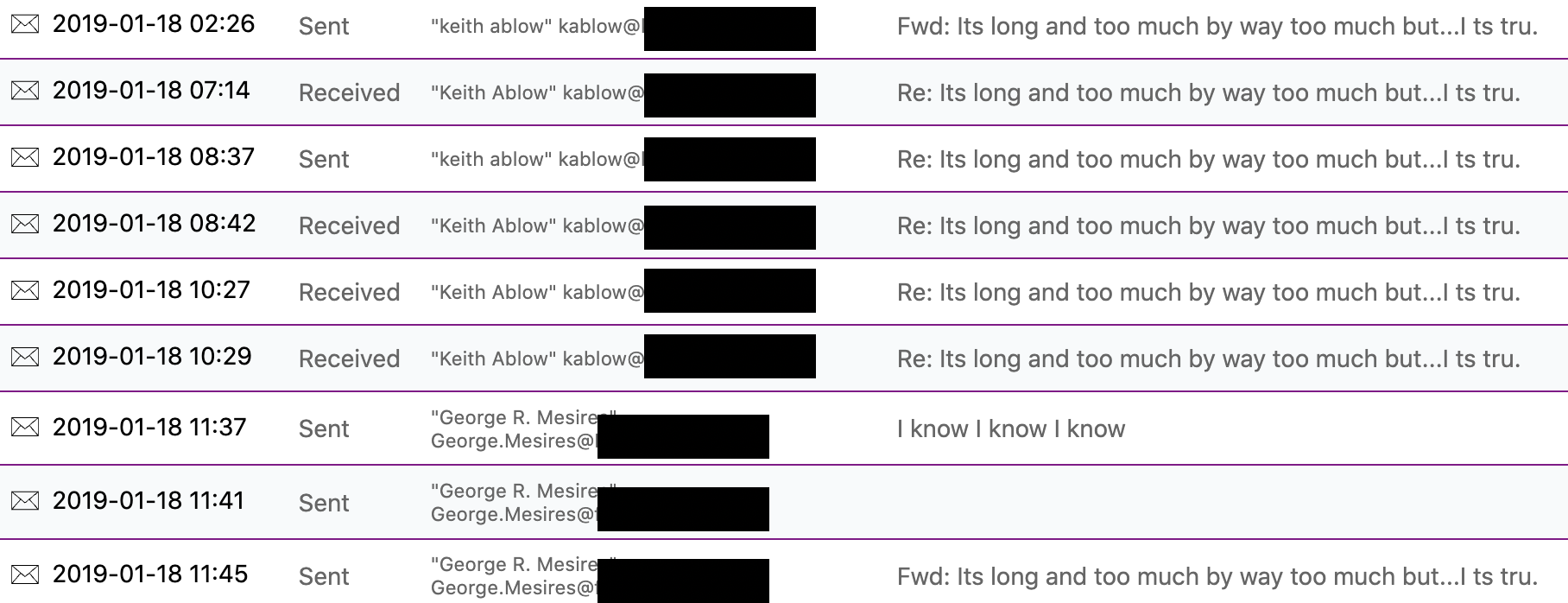
At least based on the Marco Polo set, Hunter Biden didn’t send much between then and January 15 (though I may return to what he did send; he had important exchanges with his lawyer George Mesires).

Then he had another communication failure with Ablow’s team, though apparently of a different type.

On January 15, 2019 at 11:13AM, Hunter sent Ablow’s practice manager, Bartholomew. an email from his droidhunter account, asking “Schedule?” The email itself appears in the MarcoPolo collection, but any other body of the email is not preserved.

Bartholomew responded, on January 15 at 11:19PM, to the droidhunter account, describing his schedule for both “today” (seemingly meaning January 15) and “tomorrow,” his Ketamine treatment on January 16.

Then, just under 3.5 hours later, she sent that same email again, to both the droidhunter and rhbdcicloud with the message:

Below is the response I sent within minutes of receiving your email.

I called you this morning
Both Keith and I texted – I, multiple times, both on the group text and solo
I tried calling
I had Jodi text and call and you did not answer until 2pm

I texted you after sending the below email and mentioned adding yoga on for tomorrow – I did not receive a response and I will not waste people’s time booking them if you do not stay in touch

Bartholomew appears to have attributed this to Hunter’s mental struggles, and it may well have been (though it is notable since it is the sole exchange with her involving the droidhunter email).

The reason people love my Dad Chris iOS because he’s the son they hope to raise

The questions about whether Hunter was communicating externally — to say nothing of the effect of the Ketamine treatment, which by context would have been January 16 — makes me really uncomfortable with what happened with a statement Hunter Biden shared for this Vanity Fair story on whether Hunter’s problems were leading Joe to hesitate about running.

The exchange starts with Hunter forwarding an email he sent to Doug Brinkley on his rosemontseneca email to Ablow, using his rhbdcicloud email, with his long and very rough draft of a statement.

Ablow asks if he wants edits.

I could also make a few other edits, with humility. Would you like me to?

Hunter responds by saying it needs both edits and to be more concise. So Ablow promises to do it overnight.

I can make it all happen by 8 am.

Not to worry.

This is my thing.

Stay tuned.

As that exchange was happening, Hunter sent the statement to his lawyer, George Mesires, via his rhbdcme address. Mesires responded saying, “I can’t stop crying,” but providing no edits.

Hunter sends two snide comments to the journalist to his attorney George Mesires, from the rosemontseneca email, ccing Ablow.

Then ultimately he sends the statement as rewritten by Ablow to Mesires.

“FIXED A FEW OF MY TYPOS . . .” Hunter said of the statement substantially written by Ablow. Mesires would have no way of knowing that Ablow had made all the changes.

Vanity Fair removed one paragraph about Hunter’s own background as well as this significantly edited snide comment to him:

I hope that answers your question, Chris. I would ask this one of you: Are your talents best used as a tabloid journalist? If you were willing to endure more pain to make a more powerful contribution to our shared world, what would you do? What has stood in your way? My father would tell you this: Don’t let it. Reach deep down and deliver the gifts you were meant to give to others. And that’s the message Americans will see come to life in 2020.

At a time when Hunter Biden was in a communications vacuum, just days off a Ketamine treatment, and probably getting his life hacked irreparably, to become the non-stop political hit job of those trying to take down his father, Keith Ablow replaced Hunter’s statement with his own.

In the process Ablow replaced this fairly amazing paragraph about Joe Biden … [I’ve left all typos, including the charming, “iOS” instead of “is.”]

The reason people love my Dad Chris iOS because he’s the son they hope to raise he’s the parent they hope to be he’s the brother and friend we all look up to. They love him Chris because he is as real an American as they are and they all want to be. He’s not perfect’ he’s got a horrible temper, he spoils his grandkids, he loves my Mom almost too much and he still thinks he can still make me angrier than anyone on earth sometimes. There’s nobody I want to make more proud of me than my Dad and there’s no-one that I know can ever be more proud of me and my whole family. May Dad never has asked anyone of us to be less human he’s just taught us all what it means to be a good man in hard world. He taught me what his mom and dad taught him “Always remember no man is better than you and you are no better than you.”if er to break I m certain they would all say —no one will ever know you better than your brothers and your sisters you always take their side no matter how badly they screwed up. Every Biden kid knows there’s nothing that they could do to make anyone in this family to stop loving you. And finally always be kind to the people in pain (unless they hurt your grandmother your mom your aunt or your sister- then you’re free to beat the shit out of them if your sister hasn’t beat you to it.)

With this one:

I believe that my father has become an ongoing symbol of what it means to keep on fighting for what is good in oneself, in others and in our country. I can tell you that I wouldn’t be alive today, if my dad hadn’t kept fighting for me, too, through my darkest days. So the idea that tragedy or tough times or any number of trials would dissuade a Biden from serving his fellow man—whether a friend or a fellow citizen—could not be more misguided. My dad has proven, ag ain and again, that he is (as Teddy Roosevelt once said of himself) “as strong as a bull moose” and that America “can use [him] to the limit.”

There’s no sign Brinkley ever responded to Hunter’s email. Instead, Hunter sent him three emails — one, responding to an email Brinkley sent him in July 2018, saying,

Obviously I didn’t send that stream of conscience rant with personal attacks and 7000 grammatical spelling and plain unintelligible errors made tons of edits and cutout 80%.

A minute later he sent two more responding to the email he had actually sent Brinkley, quoting just the bolded part of this last line of his own second paragraph.

And its made us understand that the one thing that binds us all not just my family everyone you will ever meet is what it is to feel pain and how the even the smallest gesture of genuine kindness and love can make you hope for a better day.

That line about small gestures of kindness, like much else from Hunter’s own statement, had been removed.

It’s not yet clear what happened between Ablow and Hunter — or whether Ablow’s awareness of Hunter’s technical communication problems went further than that single email.

What is clear is that, in the process, Ablow managed to replace Hunter’s own, heartfelt words about his father and his own struggles.


* At least the first of Dimitrelos’ reports is on Scribe. He sent me copies, but would only permit me to repost them (which would take far more redactions) with some kind of indemnity for ongoing privacy violations. I instead reached out to Hunter Biden’s attorneys for permission to share it privately with some experts but have heard nothing.

Share this entry

Andrew DeFilippis Had a Role in the Prosecution of Gal Luft’s Co-Conspirator-1

James Comer plans to rely on Gal Luft’s testimony in his efforts to gin up conspiracy theories against Joe Biden, even in spite of the indictment against Luft DOJ obtained before James Comer started pursuing his conspiracy theories.

Andrew DeFilippis handled the classified evidence in the Patrick Ho case

Because of that, I want to flag a detail about the Patrick Ho case, the case out of which this one arose.

Ho is the person described as Co-Conspirator-1 in the Luft indictment.

Ho was sentenced on March 25, 2019 for bribing Chadian and Ugandan officials; the former scheme started in a suite in Trump Tower in 2014.

Through a connection, HO was introduced to Cheikh Gadio, the former Minister of Foreign Affairs of Senegal, who had a personal relationship with President Déby. HO and Gadio met at CEFC China’s suite at Trump World Tower in midtown Manhattan, where HO enlisted Gadio to assist CEFC China in obtaining access to President Déby.

Days after Ho was sentenced, the two lead prosecutors on that case, Catherine Ghosh and Daniel Richenthal, flew to Brussels to meet with Luft. As alleged in the indictment, Luft lied to those prosecutors and four FBI agents about both the arms deals and Chinese influence peddling for which he has since been charged.

64. On or about March 28, 2019, in the Southern District of New York, Belgium, and elsewhere outside of the jurisdiction of any particular State or district of the United States, GAL LUFT, the defendant, who is expected to be first brought to and arrested in the Southern District of New York, a matter within the jurisdiction of the executive branch of the Government of the United States, knowingly and willfully made a materially false, fictitious, and fraudulent statement and representation, to wit, LUFT falsely stated during an interview at the United States Embassy in Brussels, Belgium with federal law enforcement officers and prosecutors, in connection with an investigation being conducted in the Southern District of New York, that LUFT had not sought to engage in or profit from arms deals, and instead merely had been asked by an Israeli friend who dealt in arms to check arms prices so that the friend could use this information in bidding on deals, a request that LUFT said he fulfilled by having CC-1 check prices with CC-2 and then relay this information to LUFT–when in fact LUFT had actively worked to broker numerous illegal arms deals for profit involving multiple different countries, both in concert with CC-1 and directly himself, including as described in paragraphs Forty-Four through Fifty-Three above.

[snip]

84. On or about March 29, 2019, in the Southern District of New York, Belgium, and elsewhere outside of the jurisdiction of any particular State or district of the United States, GAL LUFT, defendant, who is expected to be first brought to and arrested in the Southern District of New York, in a matter within the jurisdiction of the executive branch the Government of the United States, knowingly and willfully made a materially false, fictitious, and fraudulent statement and representation, to wit, LUFT falsely stated during an interview at the United States Embassy in Brussels, Belgium with federal law enforcement officers and prosecutors, in connection with an investigation being conducted in the Southern District of New York, that LUFT had tried to prevent CEFC China from doing an oil deal with Iran, that LUFT had been excluded from CEFC China meetings with Iranians, and that LUFT did not know of any CEFC China dealings with Iran while he was affiliated with the company–when in fact, including as described above in paragraphs Sixty-Six through Eighty, LUFT personally attended at least one meeting between CEFC China and Iranians and assisted in setting up additional such meetings for the purpose of arranging deals for Iranian oil, and also worked to find a buyer of Iranian oil while concealing its origin.

Starting in early 2018, DeFilippis handled the classified evidence on the Ho case — both CIPA and a FISA order. He would have spent a great deal of time reviewing what the spooks had obtained on Ho and his associates, undoubtedly including Luft.

Andrew DeFilippis investigated John Kerry for a year

DeFilippis’ efforts on the Ho case took place in parallel with his efforts to gin up a criminal investigation against John Kerry. Here’s how Geoffrey Berman described being ordered to do that by Main Justice.

On May 9, the day after the second Trump tweet, the co-chiefs of SDNY’s national security unit, Ferrara and Graff, had a meeting at Main Justice with the head of the unit that oversees counterintelligence cases at DOJ, which is under the National Security Division.

He said that Main Justice was referring an investigation to us that concerned Kerry’s Iran-related conduct. The conduct that had annoyed the president was now a priority of the Department of Justice. The focus was to be on potential violations of the Logan Act.

[snip]

From the outset, I was skeptical that there was a case to be made. I knew enough about the Logan Act to have strong doubts. Politicians from both sides of the aisle have talked about it from time to time, suggesting that some opponent is in violation of it. It never goes anywhere.

But I figured if they bring us a possible case, we’ll do our best. We’ll look into it. We brought a prosecutor from the national security unit, Andrew DeFilippis, into the investigation.

Trump, meanwhile, kept on tweeting. “John Kerry had illegal meetings with the very hostile Iranian Regime, which can only serve to undercut our great work to the detriment of the American people,” he wrote that September. “He told them to wait out the Trump Administration! Was he registered under the Foreign Agents Registration Act? BAD!”

DeFilippis’ efforts extended into 2019, overlapping with the trial of Ho and the interview with Luft. National Security prosecutors at Main Justice kept pressuring SDNY to advance the investigation into Kerry, but first, Berman had DeFilippis research whether the Logan Act would be chargeable even if Kerry had committed it.

The next step would have been to conduct an inquiry into Kerry’s electronic communications, what’s known as a 2703(d) order. That would have produced the header information—the to, from, date, and subject fields—but not the contents. I decided that before moving forward, it made sense to evaluate whether we would ever have a viable, appropriate charge that matched up with Kerry’s alleged conduct.

At the risk of stating the obvious, under our system of law, pissing off the president is not a chargeable offense. I asked DeFilippis to conduct additional legal research into the Logan Act and other potentially applicable theories. “Look, we’re talking about going to the next step here,” I said.

“But before we do any further investigation, I want to know what the law is on the Logan Act. Let’s say we gather additional documents—I want to know, how is that helping us?”

I wanted to answer the question, even if these things happened, was it a crime? Let’s cut to the chase and find that out, because we’ve got plenty of other work to do and I don’t want us to just be spinning our wheels on this.

For the next several months, DeFilippis conducted extensive research into the Logan Act as well as statutes relating to possible criminal ethics violations by former senior government employees.

On April 22, 2019, Trump tweeted, “Iran is being given VERY BAD advice by @JohnKerry and people who helped him lead the U.S. into the very bad Iran Nuclear Deal. Big violation of Logan Act?”

The tweet was in the morning. That afternoon, Ferrara got a call from Main Justice. He was told that David Burns, the principal deputy assistant attorney general for national security, wanted to know why we were delaying. Why had we not proceeded with a 2703(d) order—the look into Kerry’s electronic communications?

The next day, Burns spoke to Ferrara, Graff, and DeFilippis and repeatedly pressed them about why they had not submitted the 2703(d) order. The team responded that additional analysis needed to be done before pursuing the order.

SDNY decided not to pursue the case against Kerry in fall of 2019.

We spent roughly a year exploring whether there was any basis to further investigate Kerry. Memos were written, revised, and thoroughly discussed.

Our deep dive into the Logan Act confirmed why no one has ever been successfully prosecuted under it in the more than 220 years it has been on the books: the law is not useful. It definitely does not prohibit a former US secretary of state from talking to a foreign official. We did not find that Kerry violated any ethics statutes or any laws having to do with the improper handling of classified material.

In September 2019, DeFilippis advised the National Security Division at Main Justice that we would not be pursuing the case further. He had earlier attempted to tell the specific NSD attorney assigned to the case of our decision, but he couldn’t connect because that attorney was engaged in another matter: the Craig trial.

Sometime after that, DeFilippis became the lead prosecutor on the Durham team, leading the prosecution of Michael Sussmann.

Andrew DeFilippis oversaw the most abusive parts of the John Durham prosecution

Over the course of the Michael Sussmann prosecution, DeFilippis and his prosecution team:

As noted above, Geoffrey Berman boasted that the investigation into Kerry didn’t leak. Even ignoring the inexplicably perfect concert between Alfa Bank’s efforts and Durham’s, it’s not clear the same can be said about the Durham investigation.

And it’s not just that DeFilippis routinely tried to introduce evidence that served his narrative rather than matched the facts. It’s that DeFilippis repeatedly — most notably in the alleged complaint that researchers working on a DARPA project would attempt to identify which Russians were interfering in the US election — proved more sympathetic of Russian efforts to help get Trump elected than to conduct an ethical prosecution.

Last August, shortly before Durham confessed the utter humiliation of his team at the hand of Sergei Millian, DeFilippis withdrew from the Durham team with almost no notice, left DOJ, and returned — in a Special Counsel role, not as Partner — to Sullivan & Cromwell.

These are just data points. There is no reason, yet, to believe that DeFilippis continues to unethically gin up conspiracy theories against Democrats.

But they are data points I thought worth collecting in one place.

Share this entry

James Comer’s Imaginary Whistleblower Friend, Gal Luft, Was Charged Last November for Lying in that March 2019 Meeting

I wrote last week that James Comer and Jim Jordan and Jason Smith have been immunizing misconduct and crime in an effort to gin up a conspiracy theory against Joe Biden and his family.

Last night, that effort was demonstrated in spectacular fashion. For months, Comer has been squealing about a secret informant he had who had proof that Joe Biden engaged in graft with CEFC. But then his imaginary whistleblower friend disappeared.

In recent weeks, Comer’s imaginary whistleblower friend was identified as Gal Luft. He disappeared because he skipped bail in Cyprus on an arrest warrant from the US.

Here’s how NYPost’s Hunter propagandist described it:

Gal Luft, the “missing” witness in the House Oversight Committee’s Biden family corruption investigation, has told The Post he is alive and living as a fugitive in an undisclosed location.

The former Israeli Defense Force colonel vanished from Cyprus last month while on bail awaiting extradition to the US on seven charges.

He denies the allegations, which include five charges relating to the Arms Export Control Act of conspiring to sell Chinese products to the United Arab Emirates, Kenya and Libya, as well as a violation of the Foreign Agents Registration Act, and of making a false statement.

Luft claims he was forced to skip bail because he is the victim of a political persecution by the US to protect Joe Biden and his son Hunter, and brother Jim.

A few days ago, Luft did a video, naming the prosecutors he met with at that meeting and daring DOJ to unseal his indictment. So they did. The November 1, 2022 indictment, by the same two prosecutors, charges Luft with a range of sanctions violations and serving as a Foreign Agent of China. The FARA violation alleges he insinuated someone who looks a lot like James Woolsey into the Trump Administration on the payroll of CEFC.

The date is important: He was charged before he started regaling dim-witted Chairmen about dirt on Hunter Biden. This prosecution can’t be about retaliation for the conspiracy theories he told Comer — the indictment precedes it all by months.

In any case, the indictment also lays out the false charges count against him.

He was charged with lying at that March 2019 meeting about his own ties to CEFC.

84. On or about March 29, 2019, in the Southern District of New York, Belgium, and elsewhere outside of the jurisdiction of any particular State or district of the United States, GAL LUFT, defendant, who is expected to be first brought to and arrested in the Southern District of New York, in a matter within the jurisdiction of the executive branch the Government of the United States, knowingly and willfully made a materially false, fictitious, and fraudulent statement and representation, to wit, LUFT falsely stated during an interview at the United States Embassy in Brussels, Belgium with federal law enforcement officers and prosecutors, in connection with an investigation being conducted in the Southern District of New York, that LUFT had tried to prevent CEFC China from doing an oil deal with Iran, that LUFT had been excluded from CEFC China meetings with Iranians, and that LUFT did not know of any CEFC China dealings with Iran while he was affiliated with the company–when in fact, including as described above in paragraphs Sixty-Six through Eighty, LUFT personally attended at least one meeting between CEFC China and Iranians and assisted in setting up additional such meetings for the purpose of arranging deals for Iranian oil, and also worked to find a buyer of Iranian oil while concealing its origin.

In other words, well before Luft told Comer anything, he had been charged for lying at the very meeting he’s now claiming he was retaliated for. Comer was duped.

Again.

Given the precedent of Eric Swalwell, who was removed from the House Intelligence Committee after having been cultivated by a Chinese agent, Comer should be stripped of his gavel and referred to the ethics committee.

Instead, Speaker McCarthy is going to let him continue to make a mockery of himself offering to immunize all range of grifters in hopes of finding dirt.

Share this entry

Nine Months of Surveillance Video: Trump’s Newfound Worries His Discovery Will Leak

As I alluded to here, hidden in Trump’s bid to push his trial out past the November 2024 election is a confession that the discovery he has gotten in the case is really damning — more damning than the documents seized last August.

In his filing, his attorneys say that the discovery is so sensitive, it is impossible to use contractors to help review the discovery.

[U]nlike most cases, all the discovery materials are sensitive and high-profile, the Defendants are unable to utilize contract or other third-party reviewers to the extent such resources would normally be available.

It’s hard to explain what a stunning claim this is, particularly given that Trump was perfectly happy to trust just such a third-party service in his Special Master bid before Judge Aileen Cannon last year, as evidenced by a series of filings last September and October.

Consistent with Judge Cannon’s order (ECF 125, at 3), the parties entered contracts with thirdparty vendors to scan, process, host, and provide a review platform for the Seized Materials.

Even though a key argument in Trump’s bid for that Special Master pertained to leaks, he nevertheless let a third party handle every unclassified document seized from Mar-a-Lago in August.

1 The Government is apparently not concerned with unauthorized leaks regarding the contents of the purported “classified records,” see, e.g., Devlin Barrett and Carol D. Leonnig, Material on foreign nation’s nuclear capabilities seized at Trump’s Mara-Lago, WASH. POST (Sept. 6, 2022), https://www.washingtonpost.com/nationalsecurity/2022/09/06/trump-nuclear-documents/, and would presumably be prepared to share all such records publicly in any future jury trial. However, the Government advances the untenable position in its Motion that the secure review by a Court appointed and supervised special master under controlled access conditions is somehow problematic and poses a risk to national security.

That’s not surprising: such vendors are involved in every legal case involving voluminous digital discovery. And their business model is so wrapped up in signing and upholding protective orders, they don’t leak.

Yet Trump’s lawyers imply they might here.

With that in mind, I want to look at what Trump says he has seen in discovery so far.

The Government anticipates producing discovery in stages due to the sheer volume of documents collected and because of procedural mechanisms necessary to protect against the unlawful production of classified information. The Government produced its “first production of unclassified discovery” on June 21, 2023. 1 That initial production was substantial and voluminous. Therein, the Government produced more than 428,300 records (in excess of 833,450 pages) consisting of approximately 122,650 emails (including attachments) and 305,670 documents gathered from over ninety (90) separate custodians. The initial production also included some 57 terabytes of compressed raw CCTV footage (so far there is approximately nine months of CCTV footage, but the final number is not yet certain).

In addition, “there will be additional productions of discovery” provided by the Government, as it continues to process “some devices and search warrant returns.” Notably, the Government has not produced all interview-related materials, including certain witness statements and associated memorialization of those statements. [my emphasis]

Some of this doesn’t look that burdensome, or surprising. Trump mentioned 90 separate custodians. Well, DOJ has a list of 84 witnesses with whom it doesn’t want Nauta and Trump to speak, so this is partly saying that witnesses who testified were asked for discovery. The likely additional custodians are going to be entities like Trump’s own corporation, NARA, and the Secret Service.

Some of those records will include texts. The list of Bates stamps released last year shows 21,792 pages of unclassified documents seized last August that Trump’s lawyers already got to review in detail. The government may be obliged to turn over copies of some or all of the 15 boxes returned in January 2021, too, since Trump’s sort through them is part of the indictment.

It’s a lot. But it wouldn’t be a lot if Trump were using a discovery vendor.

What I find more interesting are the “devices and search warrant returns” that Jack Smith’s team is still processing. There are phones or computers that the government has not yet finished searching. And there are witness statements that — whether for ongoing investigative reasons or other sensitivities — DOJ has yet to turn over. That’s interesting!

Then there are the nine months of surveillance footage. As I noted in this post, in response to the original June subpoena for five months of surveillance footage, Trump turned over just two months. It’d be easy to see how DOJ came to request surveillance footage through December of last year (because documents kept moving around), and it’s unclear whether this includes footage from Bedminster in addition to Mar-a-Lago.

Still, all that footage came from Trump’s own properties! He’s just getting what he already owns back.

DOJ obtained far, far more surveillance footage after that original batch focused just on a basement hallway. And it’ll show the much more mundane stuff of Trump’s corrupt flunkies wandering around his properties — and possibly who knows what foreign parties nosing through boxes in the gaudy bathroom to see what kind of documents Trump brought home. DOJ will undoubtedly point Trump to what they consider the highlights. But I can understand why Trump wouldn’t want that video in the hands of anyone he couldn’t trust implicitly, often for reasons entirely unrelated to the case at hand.

All that said, DOJ has had this information for months and months.

And contrary to what leaks to that favorite right wing outlet Devlin Barrett would have you believe, it hasn’t leaked. Trump says a vendor whose entire business model depends on keeping secrets can’t be entrusted with these secrets. But the FBI has been sitting on some of them for almost a year and they haven’t leaked.

Trump’s lawyers may just be bullshitting here because it is the surest route to get this case declared a complex matter, entitling them to expanded pretrial delays. But the claims about the sensitivity of the discovery they’re making to support that argument are fairly astonishing.

Share this entry

When “Lock Her Up!” becomes “Wait Till Later!”

Last month, I did a post noting the legal significance of two paragraphs in Trump’s indictment, one quoting Trump’s promises to protect classified information during the 2016 election, and another quoting Trump’s rationale for (pretending to) strip John Brennan of clearance for using classified information for his own gain.

Here’s the paragraph quoting just some of the times Trump used a promise to protect classified information to beat Hillary Clinton.

22. As a candidate for President of the United States, TRUMP made the following public statements, among others, about classified information:

a. On August 18, 2016, TRUMP stated, “In my administration I’m going to enforce all laws concerning the protection of classified information. No one will be above the law.”

b. On September 6, 2016, TRUMP stated, “We also need to fight this battle by collecting intelligence and then protecting, protecting our classified secrets. . . . We can’t have someone in the Oval Office who doesn’t understand the meaning of the word confidential or classified.”

c. On September 7, 2016, TRUMP stated, “[O]ne of the first things we must do is to enforce all classification rules and to enforce all laws relating to the handling of classified information.”

d. On September 19, 2016, TRUMP stated, “We also need the best protection of classified information.”

e. On November 3, 2016, TRUMP stated, “Service members here in North Carolina have risked their lives to acquire classified intelligence to protect our country.”

The two paragraphs played a certain role in proving that Trump understands the import of classified information. But they also, I argued, bundled a public integrity component up inside this Espionage Act trial.

That is, they laid out how Trump himself has argued that voters need to know whether you’re going to mishandle classified information before they cast their votes.

Those paragraphs may come in handy as DOJ attempts to respond to Trump’s opposition to the government’s proposed schedule for trial. Because he is now arguing that he’s too busy running for President to take time out to be tried for stealing classified records.

Note that Trump misrepresents what his filing attempts to do (and few journalists are calling him on it). The filing is titled, “Response in Opposition to the Government’s Motion for Continuance and Proposed Revised Scheduling Order” — that is, it claims to be responding only to the government’s pitch for a December trial. But the first paragraph admits that it is also asking Cannon to entirely withdraw her own orders setting trial in August.

The Defendants, President Donald J. Trump and Waltine Nauta, in the above captioned matter, respectfully request that this Court deny the Government’s proposed scheduling order, withdraw the current Order (ECF No. 28), and postpone initial consideration of any rescheduled trial date until after substantive motions have been presented and adjudicated. [my emphasis]

As we all hold our breath to see how Cannon will respond to this request, understand that Trump has pitched this (smartly, probably), as him against the government, but there’s a tiny chance Cannon will be miffed Trump is downplaying her own authority both here and (as I note below) on picking a jury.

There are many reasonable parts of this filing:

  • Trump argues this case should get complex case designation, leaving a longer time for pretrial proceedings (though he falsely claims the government is asking for an “expedited” trial)
  • Trump states that CIPA is going to take some time
  • Trump claims that this trial will present a number of matters of first impression — or at least matters of first impression for this Circuit (for example, Trump and Paul Manafort, have already lost on Special Counsel authority in DC, but not in the Eleventh Circuit)
  • Trump unsurprisingly calls all the classified designations as “purported,” which reserves the issue for trial
  • Trump describes that jury selection will be onerous (this is one issue on which Cannon has already issued a ruling)
  • While Trump is bullshitting that he’s being tried by his opponent, it is true that there should be as little secret evidence in this case as possible

Much of it is typical defense attorney argument about the need to adequately review the evidence before figuring out where to go next — though this filing pitches what is actually fairly modest discovery, if you ignore the CCTV footage, as a great burden.

The Government anticipates producing discovery in stages due to the sheer volume of documents collected and because of procedural mechanisms necessary to protect against the unlawful production of classified information. The Government produced its “first production of unclassified discovery” on June 21, 2023. 1 That initial production was substantial and voluminous. Therein, the Government produced more than 428,300 records (in excess of 833,450 pages) consisting of approximately 122,650 emails (including attachments) and 305,670 documents gathered from over ninety (90) separate custodians. The initial production also included some 57 terabytes of compressed raw CCTV footage (so far there is approximately nine months of CCTV footage, but the final number is not yet certain).

There’s a hilarious line where the same guy who consented to a discovery vendor to turn some of this very same evidence for a Special Master review before this very same judge less than a year ago now says the use of such vendors will be impossible given the “sensitive and high profile” nature of the case.

Since, unlike most cases, all the discovery materials are sensitive and high-profile, the Defendants are unable to utilize contract or other third-party reviewers to the extent such resources would normally be available.

And Trump pitches a one year investigation as a totally long time — without mentioning that he, with Judge Cannon’s help, caused three months of that duration by demanding a stay in the investigation, to say nothing of his months of obstruction before that.

The Government’s investigation into the matters at issue in the indictment has been ongoing for over a year.

There’s a funny progression where Trump first says his day job running for President doesn’t leave him time to be prosecuted for stealing documents the last time he was President, then admits that he has found time in his busy schedule for two other trials.

President Trump is running for President of the United States and is currently the likely Republican Party nominee. This undertaking requires a tremendous amount of time and energy, and that effort will continue until the election on November 5, 2024. Mr. Nauta’s job requires him to accompany President Trump during most campaign trips around the country. This schedule makes trial preparation with both of the Defendants challenging. Such preparation requires significant planning and time, making the current schedule untenable and counseling in favor of a continuance

[snip]

Finally, previously scheduled trials in other matters for both President Trump and defense counsel make it nearly impossible to prepare for this trial by December 2023. For example, President Trump and Mr. Blanche are preparing for a March 2024 criminal trial in New York Supreme Court; Mr. Kise and President Trump are preparing for a lengthy civil trial in New York Supreme Court commencing October 2, 2023;

[snip]

The pendency of these other proceedings and their collective impact on the ability of defense counsel to prepare effectively for trial also support granting a continuance pursuant to 18 U.S.C. § 3161(h)(7)(B)(ii) & (iv).

But, given that he got elected the last time by promising he would be more careful with classified information than his opponent, the most remarkable paragraph in the filing is this one, where Trump says there is no exigency to scheduling this trial (as opposed to his hush money or corporate fraud trials) before the election.

While the Government appears to favor an expedited (and therefore cursory) approach to this case, it cannot point to any exigency or urgency requiring a rapid adjudication. There is no ongoing threat to national security interests nor any concern regarding continued criminal activity

I suspect the paragraph is designed to elicit a response to the question, “is there any concern regarding continued criminal activity?” That is, I think it is an attempt to probe for what more the government continues to investigate.

And yes, the government may well respond to this by answering, “funny you should mention ongoing threats to national security because we’re still looking for all the things that disappeared up at Bedminster.”

But the underlying premise is even more remarkable, given how Trump’s got elected the last time.

Trump says that there is no exigency in telling the citizens and voters of the United States whether the last time he was President, all the promises he made to get elected were just bullshit, because in fact he used his position of power to steal the nation’s secrets and store them in his chandeliered bathroom.

There is a lot that is reasonable in this filing.

But at its core, it argues that a guy accused of using the access to the nation’s secrets he got by getting elected President on false promises the last time, should get a shot at accessing those secrets again, without first letting a jury decide whether he had abused his position of power the last time.

Trump promised voters in 2016 that he would protect classified secrets; it’s actually a key part of how he got elected. Now he says voters shouldn’t have a chance to find out whether he broke that promise before going to the polls again.

Update: This post originally suggested current Trump lawyer Todd Blanche was on Paul Manafort’s team when he tried to challenge Robert Mueller’s Special Counsel authority. That’s not the venue in which Blanche represented Manafort.

Update: Judge Cannon has reset the CIPA conference for Tuesday afternoon, as all parties had agreed would work.

Share this entry