The Frothy Right Gets More Excited about an Eight Year Old Phone than Contemporaneous Metadata

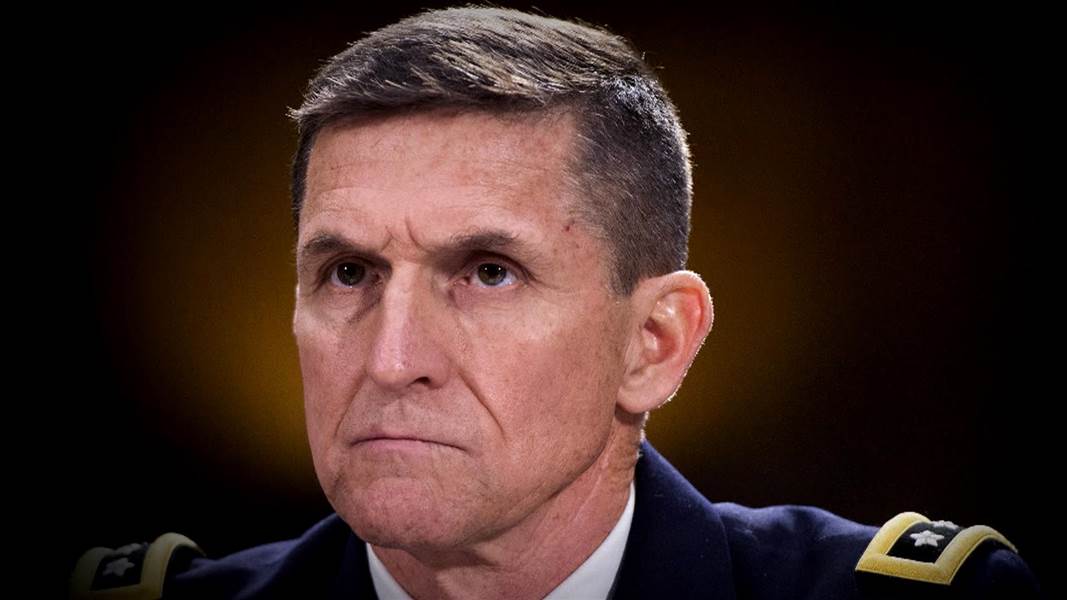
As is her wont, Mike Flynn lawyer Sidney Powell engaged in another little bit of theater yesterday.

She demanded that prosecutors turn over two BlackBerry phones, reportedly used by Joseph Mifsud, that “has only recently come into [the government’s] possession,” (which presumably means the Attorney General fed her these details after he returned from Italy). Powell demanded the phones as Brady evidence, even though she didn’t make any effort to claim the phones had anything to do with the crimes her client pled guilty to, crimes he committed in 2017.

Rather, she claims these phones show something that went down in 2014, presumably relating to his termination from DIA.

This information is material, exculpatory, and relevant to the defense of Mr. Flynn, and specifically to the “OCONUS LURES” and agents that western intelligence tasked against him likely as early as 2014 to arrange—unbeknownst to him—“connections” with certain Russians that they would then use against him in their false claims.

She helpfully provides the SIM and IMEI data for the phones, which would enable skilled InfoSec experts with a tolerance for working in gray areas of the law to pull up any metadata still available.

But she also describes that these phones are a 9900 Bold — a phone that dates to May 2011 — and a Classic SQC100-1 that dates to December 2014. In other words, these are old phones, ancient in terms of modern smart phones. They date to before the only known alleged interaction between Mifsud and Flynn, at the RT dinner where he got paid to sit with Vladimir Putin. And while it’s possible they have comms involving George Papadopoulos, it is virtually certain they have nothing pertaining to the lies Mike Flynn told in 2017.

Which means it is virtually certain they contain no Brady evidence pertaining to this case.

But the filing worked as, I’m sure, she (and the Attorney General?) planned, to work the conspiracist right into a frenzy based on a claim that has no basis in the law.

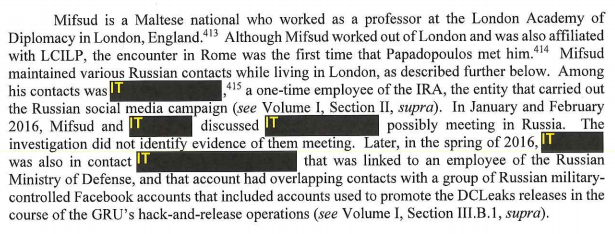
In addition to being insufficiently curious about Mifsud’s presence at that RT gala, the frothy right still have never shown any awareness of this passage, which shows that Mifsud was in touch with someone who seems to have had ties to both the IRA part of the 2016 Russian operation and the GRU side.

Even if Mifsud has had ties to Western intelligence in 2011, it doesn’t say anything about whether he had closer ties to Russia in 2016, when it matters (even for the Papadopoulos story, much less the Flynn one). That’s what spies do. They recruit people with access to people they want information about.

In short, Sidney Powell and Bill Barr have gotten the frothy right more worked up about an 8 year old phone than they have ever been about metadata contemporaneous to Russia’s efforts to sway the 2016 elections.

Update: A pro-conspiracy Italian asserts that these are Mifsud’s British phones, not his Italian ones, which would show his network in Italy. Of course, neither are his Russian ones, if he has separate phone for each country he frequents, and those would be the ones of interest, allegedly, to Powell.

Share this entry

The Significance of Fiona Hill’s Testimony: “Whatever Drug Deal Sondland and Mulvaney Are Cooking Up”

A number of people on Twitter have asked me to elaborate on some comments I’ve made about the significance of Fiona Hill’s testimony before the Ukraine impeachment team yesterday.

It’s unclear whether she shared details of her testimony or whether most of the reporting comes from Jamie Raskin (who notably got the import of the State IG’s urgent briefing utterly wrong). But NYT has thus far offered the key description (citing at least two other people beyond Raskin).

Force Bolton to shit or get off the pot

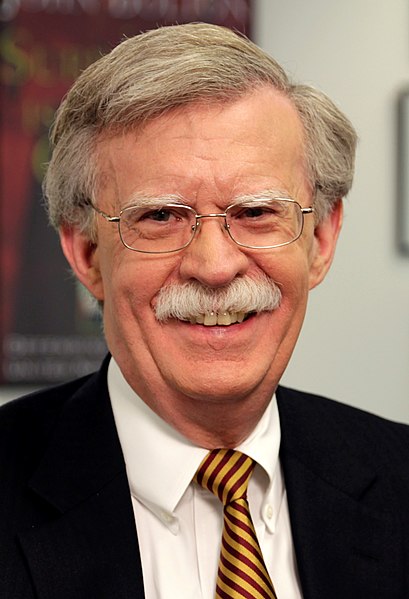
First, the NYT describes Hill citing the abrasive John Bolton saying two fairly stunning things which were bound to make headlines. First, she described Bolton saying Rudy was a “hand grenade” who would blow everyone up (a quote Rudy has already responded to).

Mr. Bolton expressed grave concerns to Ms. Hill about the campaign being run by Mr. Giuliani. “Giuliani’s a hand grenade who’s going to blow everybody up,” Ms. Hill quoted Mr. Bolton as saying during an earlier conversation.

Then, after a July 10 meeting where it became clear Trump was withholding security assistance for campaign propaganda, according to reports of Hill’s testimony, Bolton asked her to tell Deputy White House Counsel John Eisenberg that he was not part of “whatever drug deal” Trump’s flunkies were pursuing.

“I am not part of whatever drug deal Sondland and Mulvaney are cooking up,” Mr. Bolton, a Yale-trained lawyer, told Ms. Hill to tell White House lawyers, according to two people at the deposition.

It was clear even before the July 25 call that kicked off this whole scandal that Bolton was on the outs. Tellingly, Bolton was specifically excluded from the call.

But since then, Bolton has (like James Mattis) been talking about writing a book, telling his story for history, rather than for the present and the sake of the Constitution.

By including these two quotes in her testimony, Hill not only ensured that Bolton will be the target of Trump’s ire (after all, Hill didn’t say these things, Bolton reportedly did). But it will force Bolton to either deny them (if he’s certain Hill didn’t take contemporaneous notes), or take a stand against activities he clearly recognized were wrong.

And if Bolton testifies in the impeachment inquiry about his concerns, it will represent someone about whom there can be no doubts as to Republican partisan loyalty. If Hill’s inclusion of Bolton’s comments leads Trump’s former National Security Advisor to provide damning testimony to the impeachment inquiry, it will change both the profile of the inquiry and the possible response attacks.

Force Sondland to rewrite his ever-evolving testimony

Hill’s testimony about that July 10 meeting also provided damning testimony about Gordon Sondland, who is scheduled to testify on Thursday.

One of the most dramatic moments she described came in the July 10 meeting in Mr. Bolton’s office that included Mr. Sondland; Kurt D. Volker, then the special envoy for Ukraine; Rick Perry, the energy secretary; and two Ukrainian officials.

The purpose of the meeting was to talk about technical assistance to Ukraine’s national security council. The Ukrainians were eager to set up a meeting between Mr. Trump and Mr. Zelensky, who was elected on a promise to clean up corruption and resolve the country’s five-year war with Russian-armed separatists.

Mr. Bolton was trying to not commit to a meeting, according to Ms. Hill’s testimony. Mr. Sondland got agitated, Ms. Hill testified, and let out that there was an agreement with Mr. Mulvaney that there would be a meeting if Ukraine opened up the investigations the White House was seeking.

Mr. Bolton immediately ended the meeting abruptly. As the group moved toward the door, Mr. Sondland said he wanted them to come down to the ward room next to the White House mess to discuss next steps. Mr. Bolton pulled Ms. Hill aside to instruct her to go to the ward room and report to him what they talked about.

When she got downstairs, Mr. Sondland was talking with the Ukrainians and specifically mentioned Burisma, the Ukrainian energy firm that had Hunter Biden, the former vice president’s son, on its board.

Sondland has already test driven two drafts of his intended testimony, much as Michael Cohen did two years ago before he gave false testimony to Congress. Even the most recent of those drafts appears to be rendered inoperative by Hill’s testimony.

I’m sure Adam Schiff would have preferred that Sondland not get another chance to craft his testimony (and I suspect Sondland’s lawyer is trying to convince him that the possibility of being named Secretary of State is not worth perjuring himself for, which is why he’s probably not yet planning on invoking the Fifth).

But thus far, Sondland doesn’t seem to have discovered a story that he can tell that coheres with the other known testimony.

Hill ties Sondland’s actions to Trump

Hill also provided testimony — testimony we know that is backed by other witnesses — that Sondland was playing the role he was playing because the President wanted him to be.

At one point, she confronted Mr. Sondland, who had inserted himself into dealings with Ukraine even though it was not part of his official portfolio, according to the people informed about Ms. Hill’s testimony.

He told her that he was in charge of Ukraine, a moment she compared to Secretary of State Alexander M. Haig Jr.’s declaration that he was in charge after the Ronald Reagan assassination attempt, according to those who heard the testimony.

According to whom, she asked.

The president, he answered.

This will tie Trump directly to this scheme and make Sondland’s later denials about whether he knew Trump to be lying about a quid pro quo even more obviously false than they already are. This is not Rudy freelancing, or State ordering him to, but Trump ordering everyone to.

Hill implicates John Eisenberg

I noted the central role of John Eisenberg in attempts to cover this quid pro quo up weeks ago (and noted that he succeeded in preventing any record of an early quid pro quo from being being made).

Eisenberg is the guy who decided to put the transcript of the July 25 call on the Top Secret server. Eisenberg had a role in framing the crimes, as described to DOJ, such that they could shunt them to Public Integrity and dismiss them, rather than open up another Special Counsel investigation into the President’s extortion.

But Hill’s testimony makes it clear Eisenberg was told of what Bolton analogized to crimes well before the call.

Ms. Hill went back upstairs and reported the encounter to Mr. Bolton, who promptly instructed her to report the issue to John A. Eisenberg, a deputy White House counsel and the chief legal adviser for the National Security Council, along with his line about the drug deal, which he meant metaphorically.

Mr. Eisenberg told Ms. Hill he would report it up his chain of command, which would typically mean Pat Cipollone, the White House counsel.

Eisenberg (whose FBI 302 from the last Trump criminal investigation DOJ is trying to withhold) would have been on the hook anyway for a clear attempt to cover up Trump’s crime. But the revelation that he had advance warning that a crime was in process — and apparently did nothing to prevent it — changes his exposure significantly.

It was the OMB Director, misappropriating funds, in the National Security Advisor’s office

Finally, Hill puts Mick Mulvaney at the scene of the crime.

As I’ve said before, one part of this scandal that has gotten far too little attention is that, to extort Ukraine, Trump withheld funds appropriated by Congress, funds about which there was bipartisan agreement.

Last week, CNN and WSJ reported that to do this, OMB changed the way the funds were distributed, putting a political flunkie in charge, also a detail that has gotten far too little attention.

Not only does that raise the Constitutional stakes of the Executive’s refusal to spend the funds Congress had duly appropriated, but it shows consciousness of guilt.

And per Hill’s testimony Mick Mulvaney, serving in the dual role of OMB chief and Chief of Staff, knew that those funds were being withheld for a quid pro quo or (as John Bolton described it) a drug deal.

Senate Republicans might not ever convict Trump for demanding foreign countries invent propaganda on his political allies. They might feel differently once it becomes clear that the crime involves refusing to do what Congress, with its power of the purse, told him to, without even telling Congress he was doing so (or why). They may not care about Trump pressing for any political advantage for their party, but they may care about Trump neutering their most important authority.

Share this entry

The Criminal Investigation into Paul Manafort Was (and May Still be) Ongoing–and Likely Pertains to Trump’s Ukraine Extortion

Robert Mueller was never able to determine whether Paul Manafort entered into a quid pro quo on August 2, 2016, trading — either on his own or with the approval of Trump — promises to help carve up Ukraine to Russia’s liking in exchange for help winning the election.

Mueller never made that determination, in part, because Manafort lied during the period he was purportedly cooperating with the investigation.

Here’s what Mueller did determine was reliable:

First, Manafort and Kilimnik discussed a plan to resolve the ongoing political problems in Ukraine by creating an autonomous republic in its more industrialized eastern region of Donbas,922 and having Yanukovych, the Ukrainian President ousted in 2014, elected to head that republic.923 That plan, Manafort later acknowledged, constituted a “backdoor” means for Russia to control eastern Ukraine.924 Manafort initially said that, if he had not cut off the discussion, Kilimnik would have asked Manafort in the August 2 meeting to convince Trump to come out in favor of the peace plan, and Yanukovych would have expected Manafort to use his connections in Europe and Ukraine to support the plan.925 Manafort also initially told the Office that he had said to Kilimnik that the plan was crazy, that the discussion ended, and that he did not recall Kilimnik asking Manafort to reconsider the plan after their August 2 meeting.926 Manafort said [redacted] that he reacted negatively to Yanukovych sending-years later-an “urgent” request when Yanukovych needed him.927 When confronted with an email written by Kilimnik on or about December 8, 2016, however, Manafort acknowledged Kilimnik raised the peace plan again in that email.928 Manafort ultimately acknowledged Kilimnik also raised the peace plan in January 2017 meetings with Manafort [redacted — pertains to him admitting continuation of the plan into 2018] 929

Second, Manafort briefed Kilimnik on the state of the Trump Campaign and Manafort’s plan to win the election.930 That briefing encompassed the Campaign’s messaging and its internal polling data. According to Gates, it also included discussion of “battleground” states, which Manafort identified as Michigan, Wisconsin, Pennsylvania, and Minnesota.931 Manafort did not refer explicitly to “battleground” states in his telling of the August 2 discussion, [redacted]

Third, according to Gates and what Kilimnik told Patten, Manafort and Kilimnik discussed two sets of financial disputes related to Mana fort’s previous work in the region. Those consisted of the unresolved Deripaska lawsuit and the funds that the Opposition Bloc owed to Manafort for his political consulting work and how Manafort might be able to obtain payment.933

922 The Luhansk and Donetsk People’s Republics, which are located in the Donbas region of Ukraine, declared themselves independent in response to the popular unrest in 2014 that removed President Yanukovych from power. Pro-Russian Ukrainian militia forces, with backing from the Russian military, have occupied the region since 2014. Under the Yanukovych-backed plan, Russia would assist in withdrawing the military, and Donbas would become an autonomous region within Ukraine with its own

Although Mueller included this significant summary of the issue in his Report (and a description of how Rick Gates kept sending polling data to Konstantin Kilimnik, to be shared with Ukrainian oligarchs and Oleg Deripaska’s GRU-linked aide, Viktor Boyarkin), the government nevertheless refused to release the details regarding this dispute that were laid out in court filings and exhibits regarding his breach of his plea deal when WaPo tried to liberate them starting in March. The government explained that, “a number of matters [related to his lies that were referred] to other offices in the Department of Justice … remain ongoing,” and asked for any further matters in WaPo’s challenge be deferred until six months later, which happens to be Tuesday. Judge Amy Berman Jackson never ruled differently, so that’s where things have stood, at least on the public docket, since April, shortly after the Mueller Report was released.

That’s interesting because the government accused Manafort of lying about five different topics. Some are definitely related to each other, and some (as well as his underlying guilty verdicts) are also definitely related to recent events relating to Ukraine and Russia. Which is why it’s worth looking back to learn what Manafort worked hardest to obscure in September and October 2018. Doing so suggests that Trump’s Ukraine call — including the demand for election help and Volodymyr Zelensky implementation of the Steinmeier Formula since — may simply be one step in paying off his campaign debts from 2016. As such, Rudy Giuliani’s involvement with Lev Parnas and Igor Fruman may just be the continuation of what Manafort was pursuing — also being paid by a cut-out system — even after he got sent to jail.

In this post, I’ll look specifically at how the lies Manafort told do and may relate to current events. In a follow-up, I hope to show how the issues for which he was prosecuted also relate to current events, well beyond Trump’s efforts to undermine Manafort’s prosecution to make a pardon easier. Taken together, such analysis will show that the Ukraine scandal is completely inseparable from the Russia one.

Manafort told five lies

Altogether, the government tried to hold Manafort accountable for five lies. Those were:

  1. How he got paid using a kick-back system involving a SuperPAC, Rebuilding America Now, which (on top of violating prohibitions on coordination with the campaign) may have accepted funds from foreigners. Mueller’s team never seemed to figure out how that scheme worked, in part because Manafort never settled on an explanation for the kickbacks. ABJ ruled that Manafort lied about this.
  2. Whether he tried to dissociate Konstantin Kilimnik from his own witness tampering to hide the true role of the Hapsburg Group, some former European leaders Manafort used to lobby for Viktor Yanukovych’s party. Effectively, the government accused Manafort of trying to suggest that Kilimnik wasn’t willfully part of what he was doing during a period that spanned from February (when the actual witness tampering happened) through April 2018 (when Manafort tried to tamper again). ABJ agreed in principle that Manafort had lied about this, but ruled the government did not present a preponderance of the evidence, so didn’t count this against him in sentencing.
  3. Whether he lied to adapt his story to a more exonerating one being told by a Trump flunkie — it’s not clear who — involved in doing something — it’s not clear what — to save Trump’s campaign in the last days during which Manafort managed the campaign. ABJ agreed he had.
  4. What the fuck he was doing on August 2, 2016, and (though this is always unstated) whether his lies to hide repeated discussions to support a Ukrainian “peace” plan between then and April 2018 were an attempt to hide an effort to pay off a quid pro quo tied to assistance winning the election.
  5. Whether Manafort spoke to the Administration after inauguration, either directly or indirectly. ABJ ruled that the government had not provided evidence that Manafort lied about his ongoing communications with the Administration.

Of these lies, the lies about another investigation (lie 3 above) seem to be unrelated to the rest. That’s because they involved, well before the Mueller investigation finished, another part of DOJ, and so almost certainly have nothing to do with Russia or Ukraine. Unsurprisingly, the Trump campaign may have been willing to cheat multiple ways to win the 2016 electionm.

The kickback system (lie 1 above) may or many not relate to the Russian and Ukraine questions. Mueller was never able to sort it out, so it’s not clear what to make of it. For my purposes, however, it’s relevant that Manafort’s claims of working for “free” may turn out to be false. Instead, Paul Manafort — who pled guilty a year ago to laundering money and refusing to register to hide how his influence campaigns in the US were being paid for by Ukrainian oligarchs — may have been paid to run Trump’s campaign by foreigners laundering those payments via various means. That’s significant because, last week, DOJ accused Lev Parnas and Igor Fruman of laundering money (from sources Russian, Ukrainian, and unknown) through various front companies, including one called Global Energy Production apparently created for the function, to engage in influence campaigns relating to Ukraine, effectively the same kind of scheme that Manafort engaged in for years. Particularly given that Rudy claims to be both working for and employing Lev Parnas and Igor Fruman, it raises questions about whether his claims to be working for “free” are also bogus, just a lie to hide how the cut through works.

Kilimnik and Manafort’s efforts to push a Ukraine “peace” plan overlap with their witness tampering

Lies 2 and 4 are obviously related, because Konstantin Kilimnik — as Manafort’s tie to several Ukrainian oligarchs and Oleg Deripaska — is at the center of both of them. Manafort’s efforts to deny that Kiliminik was his co-conspirator may have been motivated by nothing more than a need to permit Kevin Downing to claim, falsely, that Manafort’s guilty plea affirmed no “collusion” between the President’s campaign manager and any Russians had occurred. Not only did ABJ affirmatively state that, whatever Kilimnik’s ties to GRU, his role did amount to a link to Russia.

So Manafort was both trying to lie that he had pled guilty to entering a conspiracy with a Russian suspected of ties to GRU, but he was lying to hide precisely what the nature of any conspiracy that may have tied assistance with the 2016 election to help implementing a Ukraine “peace” plan favored by Russia and Russian-aligned Ukrainian oligarchs.

Still, even within that context, there are details of the two Kilimnik lies that deserve more attention. Consider how the timeline of the two sets of lies intersect in 2018, months after Manafort was first charged, in the weeks and months after Trump had reportedly told allies that he was sure he would survive the Mueller investigation because Manafort would not flip on him.

In the weeks after that claim was published, from February 5 through 10, 2018, Manafort was still trying to deliver on his “New initiative for Peace” (PDF 82).
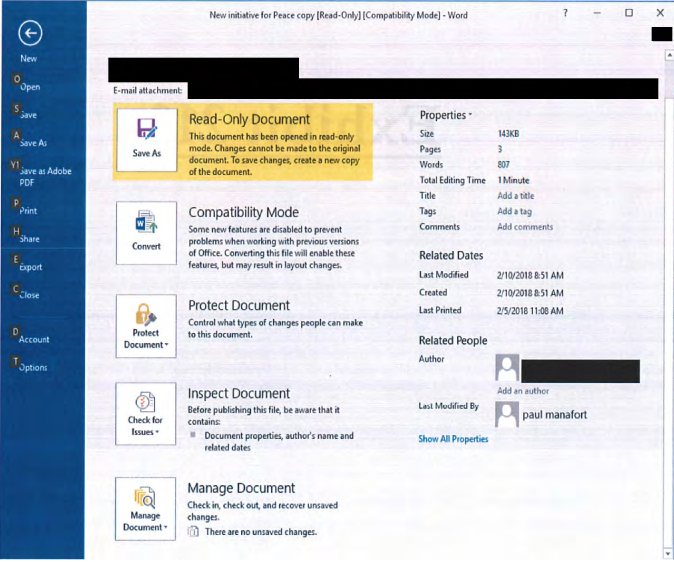
Later in February, after Mueller unveiled Rick Gates’ cooperation and made it clear he was pursuing another of the vehicles Manafort used to hide his influence operations, the Hapsburg Group, he and Kilimnik reached out to key players in that influence operation (who, unbeknownst to Manafort, had already been cooperating for some time) in an attempt to get them to lie about the influence operation. Those contacts, over Telegram and WhatsApp, took place between February 24 and 28.

But knowing that another part of his past influence operation was under scrutiny still didn’t dissuade Manafort from pursuing that “peace” plan Kilimnik first pitched him on August 2, 2016, amid a discussion of how to get Trump elected. On March 9, he was sending some unnamed person related documents from Kilimnik. (PDF 92ff) The breach hearing and other documents make it clear this was an effort to test the viability of a Ukrainian candidate, including his willingness to implement the “peace” plan.
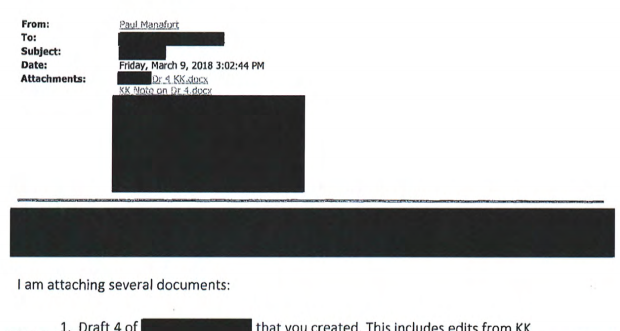
He was doing it again on March 26. (PDF 97)

Manafort would try to dissociate this polling from the people who were really implementing, including, apparently, trying to pretend that Kilimnik didn’t know about it.

Then — included in the contacts that (the government says) were part of Manafort’s conspiracy to obstruct with Kilimnik, though it’s not clear how — there were more contacts with the Hapsburg Group flacks on April 4.
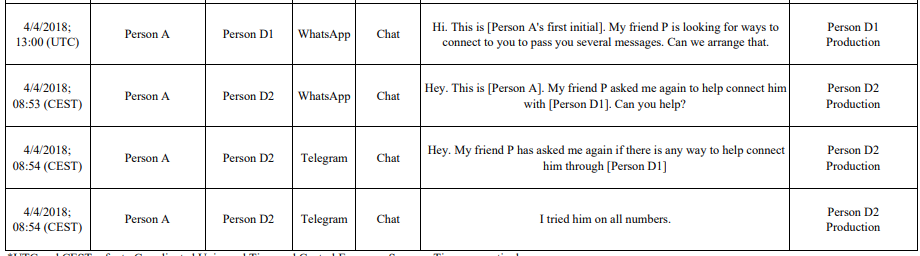
In fact, Manafort’s efforts to pursue this “peace” plan continued even further, with him hoping that some unnamed person would find documents valuable on May 4. (PDF 95)
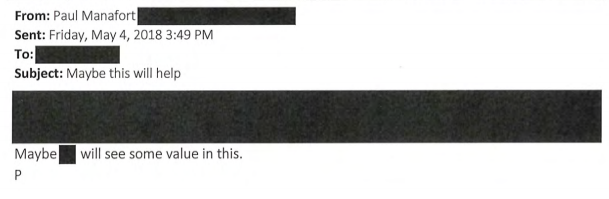
There’s a lot more sealed evidence about how relentlessly Manafort pursued a Ukrainian “peace” plan between August 2, 2016 and at least the time he was jailed for bail violations in June 2018 (though remember, the government alleges he continued to communicate in incriminating ways even from jail, via laptops carried by his attorneys). Altogether, there are 38 exhibits documenting Manafort’s false denials of his actions on that front. Because the government says it has (or had) an ongoing investigation into such matters, we don’t get to see what the exhibits are. But Manafort’s lawyer, Kevin Downing (who filled in at Parnas and Fruman’s bail hearing the other day) has seen them. And Downing, reportedly, was sharing details of Manafort’s cooperation with other lawyers in Manafort’s Joint Defense Agreement with the President, including Rudy Giuliani.

Trump “hired” his “free” defense attorney Rudy Giuliani on April 19, 2018, after current Parnas and Fruman attorney John Dowd quit. And once Manafort could no longer pursue  his Ukraine “peace” plan, Rudy got involved in efforts to press for certain concessions in Ukraine.

Manafort’s attempts to communicate with the Administration (excepting via counsel)

Finally, there’s the last alleged lie, the one ABJ said prosecutors did not prove.

It’s not really clear what prosecutors believed Manafort was communicating about, beyond hires (like Steve Calk) in the Administration, because the topic of interest (which in some redactions appears to be too short to refer to Ukraine or Russia) is redacted in the documents released. They only submitted six exhibits to substantiate their claim. But the two unredacted exhibits presented in support of their case are notable.

UPDATE, 5/26/21: The further unsealing of these documents have revealed that they pertain to lobbying Department of Labor about ERISA, and so are probably totally unrelated.

On May 15, Manafort drew up a document that (the government’s declaration makes clear) included a section titled “Targets,” along with notes indicating Manafort would reach out to people about those targets. (PDF 152)
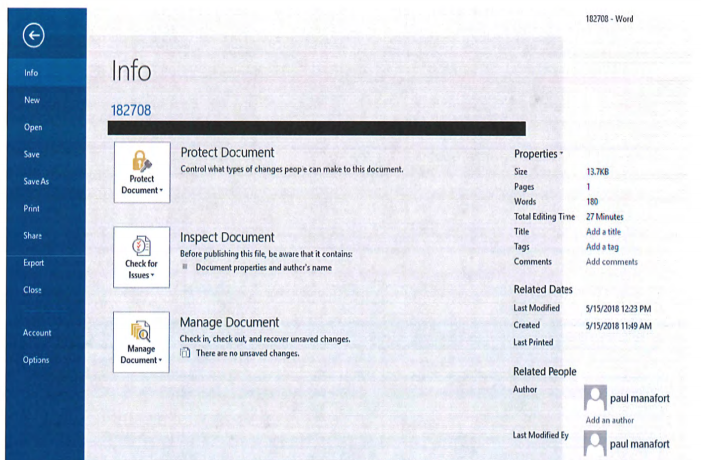
It might be a coincidence, but Manafort draws up this document right at the beginning of Parnas and Fruman’s efforts to donate big money to key Republicans through their shell company.

And on May 25, someone asked Manafort via WhatsApp whether it was cool to invoke his name if he or she met with Trump the following week, one-on-one. (PDF 156)
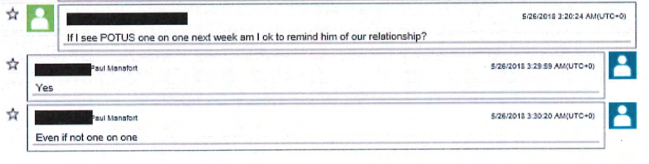
In the breach hearing, ABJ summarizes this:

You say that what he said was false because he did in fact agree to have messages sent to the administration on his behalf. And you point to evidence in which he offered to have other people contact the [redacted] on behalf of Mr. [redacted], for example, or to press buttons. But that outreach appears to have been two people outside the administration who themselves would have contacts within. There is some evidence that Mr. Gates said that Mr. Manafort said he still had connections, and that another individual asked Mr. Manafort if he, that individual, could tell [redacted (the President)] he was still close to Manafort.

And you have his involvement in lobbing with respect to [redacted], and Exhibit 404 is this memo summarizing the group’s plan that say, somewhat ambiguously, [redacted] will find out if [redacted] did her bit and get her to call [redacted] And it’s not even crystal clear that he was supposed do that by calling her.

In explaining the lie, Greg Andres makes it clear that Manafort was also representing in March that he had the ability to send messages to someone (probably Trump) in the Administration.

Significantly, Manafort lawyer Richard Westling dismisses that anyone would value Manafort’s advice or support at a time when he was already under indictment.

he was already under indictment at this point and, you know, the idea that he was going to pass a message and it would have some value, frankly, no offense to Mr. Manafort, but I can’t see that.

It’s notable that Downing did not make that claim because — as recent reports make clear — Rudy continued to consult Manafort on these Ukraine issues even after he went to prison, through Downing.

Especially since, in all its representations about these ongoing communications, the government makes clear,

for the purposes of proving the falsity of Manafort’s assertions in this section, the government is not relying on communications that may have taken place, with Manafort’s consent, through his legal counsel. We previously so advised the defense.

It’s clear the government knew Manafort continued to communicate with Trump via Downing and Rudy; they just weren’t going to reveal that they had pierced privilege or what they had learned.

The Ukrainian grifters timeline

Now consider how the timelines of Manafort’s relentless pursuit of a “peace” deal, his witness tampering with Kilimnik, and his efforts to communicate with Trump overlap with the known timeline of the Ukrainian grifters (I’ll continue to update this). It suggests that Parnas and Fruman kicked in their influence operations just as Manafort’s legal problems made him unable to do so.

February 5-10, 2018: Manafort working on “a new Peace initiative”

February 19, 2018: Manafort email pertaining to “peace” plan

February 21, 2018: Manfort emails document pertaining to “peace” plan to undisclosed recipients

February 23, 2018: Mueller reveals Rick Gates’ plea deal

February 24-28, 2018: Kilimnik and Manafort attempt to script testimony of Hapsburg Group flacks

March 2, 2018: Pentagon issues final approval to send Javelin missiles to Ukraine

March 3, 2018: Fruman participates in high donor meeting at Mar-a-Lago

March 9, 2018: Manafort working on polling regarding Ukraine “peace” plan for potential client

March 26, 2018: Manafort working on Ukraine “peace” plan

April 4, 2018: Kilimnik again attempts to witness tamper with Hapsburg Group flacks

Early April, 2018: Reported halt to Ukraine’s cooperation with Mueller

April 11, 2018: Parnas and Fruman form Global Energy Producers

April 19, 2018: Trump “hires” “free” defense attorney Rudy Giuliani

April 29, 2018: Someone first solicits help creating a website for GEP

May 2, 2018: NYT reports that Ukraine has stopped cooperating with Mueller probe

May 4, 2018: Manafort sends unnamed person information on Ukraine plan

May 8, 2018: Parnas and Fruman meet with Trump and seven other people “about preparations for victory in the midterm elections;” Fruman raises “America’s support for Israel and Ukraine,” topics about which “Trump … was absolutely positive”

May 15, 2018: Real estate lawyer Russell Jacobs deposits $1.26 million pass through funds into Aaron Investments LLC

May 15, 2018: Manafort document lists “Targets” and reflects commitment on his part to reach out about them.

May 17, 2018: Parnas LLC Aaron Investments donates $325,000 to Trump PAC, America First Action in the name of GEP

May 21, 2018: Parnas has breakfast with Don Jr and Tommy Hicks Jr, head of America First

May 24, 2018: Someone again solicits help creating a website for GEP

June 8, 2018: Manafort charged with witness tampering; prosecutors move to revoke bail

June 21, 2018: GEP donates $50K to Ron DeSantis

September 14, 2018: Manafort enters into what would be a failed plea agreement, admitting he laundered money and influence on behalf of Ukrainian oligarchs, but entering into a five week process of learning what prosecutors know

Mid-to-late 2018: Rudy referred to Parnas and Fruman for work with “Fraud Guarantee”

Around November 2018: Rudy starts working for Parnas and Fruman

Late 2018: While Parnas and Rudy were eating together, “someone” approached Rudy and gave him information about Ukraine

January 8, 2019: Manafort lawyer’s redaction fail reveals that Manafort was asked about the Ukraine “peace” plan and that Manafort was lying about whether it got raised while working on the campaign and also that he was being asked about ongoing contacts with the Administration

Background

I have laid out the structure of Manafort’s lies in these posts:

The primary sources for them are these documents:

Share this entry

The President’s Joint Defense Agreement with the Russian Mob

If we survive Trump and there are still things called museums around that display artifacts that present things called facts about historic events, I suspect John Dowd’s October 3 letter to the House Intelligence Committee will be displayed there, in all its Comic Sans glory.

In it, Dowd memorializes a conversation he had with HPSCI Investigation Counsel Nicholas Mitchell on September 30, before he was officially the lawyer for Lev Parnas and Igor Fruman, now placed in writing because he had since officially become their lawyer. He describes that there is no way he and his clients can comply with an October 7 document request and even if he could — this is the key part — much of it would be covered by some kind of privilege.

Be advised  that Messrs. Parnas and Fruman assisted Mr. Giuliani in connection with his representation of President Trump. Mr. Parnas and Mr. Fruman have also been represented by Mr. Giuliani in connection with their personal and business affairs. They also assisted Joseph DiGenova and Victoria Toensing in their law practice. Thus, certain information you seek in your September 30, 2019, letter is protected by the attorney-client, attorney work product and other privileges.

Once that letter was sent, under penalty of prosecution for false statements to Congress, it became fact: Parnas and Fruman do work for Rudy Giuliani in the service of the President of the United States covered by privilege, Rudy does work for them covered by privilege, and they also do work for Joseph Di Genova and Victoria Toensing about this matter that is covered by privilege.

Dowd might be forgiven if he immediately adopted the strategy that worked so well in guiding Trump through the Mueller investigation: just engage in a 37-person conspiracy to obstruct justice and name it a Joint Defense Agreement. Indeed, there are even similarities with current events. Then, John Dowd, Jay Sekulow, and Rudy Giuliani offered things of value to the others in the JDA — pardons — in exchange for their silence or even lies. Conspicuously, Toensing represented two people that — the Mueller Report seems to suggest — weren’t entirely candid in their testimony, Erik Prince (who managed to lose texts that explained why he was taking back channel meetings with Russians) and Sam Clovis (who sustained his lack of memory of being told that Russians were offering emails long enough for George Papadopoulos to change his mind on that front). Papadopoulos even managed to call Marc Kasowitz, when he still represented the President, to ask if he also wanted to represent a coffee boy with an inclination to lie to the FBI. The strategy all built to its successful crescendo when, instead of cooperating with prosecutors as he signed up to do, Paul Manafort instead figured out what they did and didn’t know, lied to keep them confused, and reported it all back through his own attorney, Kevin Downing, and Rudy to the President.

It was never really clear who was paying the lawyers (aside from the RNC paying Hope Hicks’ lawyers and some other key staffers). And as details of Manafort’s lies came out, it became clear there was some kind of kick-back system to keep the lawyers paid.

Still, Mueller never tied Manafort’s trading of campaign strategy for considerations on Ukraine and payment by Ukrainian and Russian oligarchs to the President. And so it may have seemed sensible for Dowd, in a bit of a pinch, to adopt the same strategy, with Rudy representing everyone, Dowd representing the Ukrainian grifters, and Kevin Downing even filling in in a pinch.

It all might have worked, too, if Parnas and Fruman hadn’t gotten arrested before they managed to flee the country, headed for what seems to have been a planned meeting a day later with their sometime attorney Rudy Giuliani in Vienna, just one day after a lunch meeting with him at Trump Hotel across the street from the Department of Justice that was busy inking an indictment against the Ukrainians even as they paid money to Trump Organization for their meal.

I mean, it still could work. Trump is still the President and DOJ, at least, will give some consideration to the attorney-client claims, so long as Rudy and Trump can maintain the illusion that Rudy is and was really doing legal work for the President.

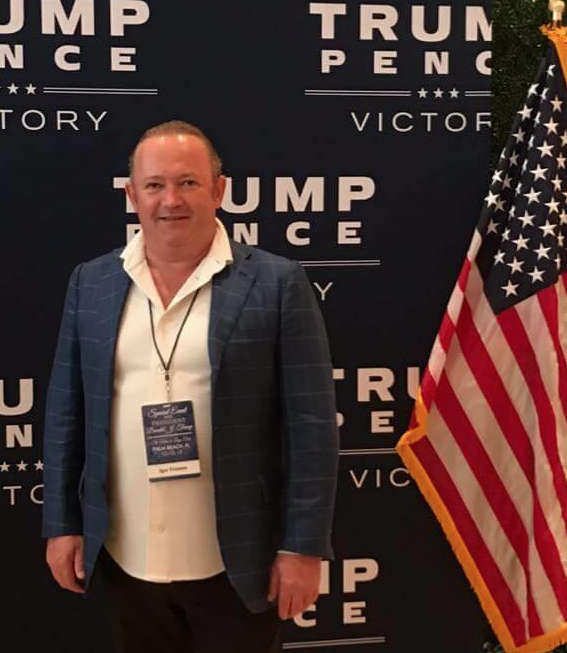
But something that Dowd may not have considered, before he sent a letter to Congress laying out an incestuous nest of ethical atrocities, is that by the time he sent the letter, DiGenova and Toensing were on the record as representing Dmitry Firtash, a Ukrainian oligarch who was named in some of the early search warrants targeting Paul Manafort. And in March, Rudy Giuliani went on the record to explain that Firtash was, “one of the close associates of [Semion] Mogilevich, who is the head of Russian organized crime, who is Putin’s best friend.” Yesterday, Reuters closed the circle, making it clear that Parnas and Fruman work for Firtash, the former as a translator for DiGenova and Toensing’s representation of Firtash.

Firtash, by the way, is in Vienna, where Parnas and Fruman attempted to flee and where the President’s lawyer was planning to meet them a day later.

Thus, when Dowd wrote Congress, explaining that Rudy worked for both Trump and the Ukrainian grifters, and the Ukrainian grifters worked for DiGenova and Toensing, he was asserting that the President is a participant in an ethical thicket of legal representation with a mob-linked Ukrainian oligarch fighting extradition (for bribery) to the United States. And all of that, Dowd helpfully made clear, related to this Ukraine scandal (otherwise he could not have invoked privilege for it).

In other words, the President’s former lawyer asserted to Congress that the President and his current lawyer are in some kind of JDA from hell with the Russian mob, almost certainly along with the President’s former campaign manager, who apparently gets consulted (via Kevin Downing) on these matters in prison.

If that weren’t all overwhelming enough, there’s one more twist.

The reason Rudy was emphasizing the mob ties of his current partner in crime lawyering, Dmitry Firtash, back in March is because the President’s former former lawyer, Michael Cohen, shared a lawyer at the time with Firtash, Lanny Davis. Davis, the Democratic version of Paul Manafort, is every bit as sleazy as him (which should have been a huge red flag when Davis was parading Cohen around as a big hero). Curiously, at a time when Davis was also representing Firtash and Cohen was furiously trying to come up with some incriminating evidence he could tell prosecutors that might keep him out of jail, Cohen apparently didn’t mention Ukraine at all. Now, the lawyer that Cohen used to but no longer shares with Firtash claims he has some insight onto these Ukrainian dealings. That’s likely just a desperate effort to stay relevant. But who knows?

Until then, John Dowd’s desperate attempt to make this scandal go away the same way he made the Russia scandal go away (if you pretend they’re not actually all the same scandal and thus even the past JDA strategy may end up failing) at the same time involved admitting, in a letter to Congress, that his former client and his then current not-yet-but-soon-to-be-indicted clients are in a Joint Defense Agreement with the Russian mob.

Don’t take my word for it. Take John Dowd’s legal representation to Congress.

Share this entry

The Problem with Letting the Client-in-Chief Rewrite Impeachment Strategy Mid-Week

Daily Beast confirms something I asserted in this post. Trump wrote the intemperate letter that White House Counsel Pat Cipollone signed his name to (with help from Rudy Giuliani, before Rudy started looking down the gun of indictment for conspiracy).

It was crafted, in large part, by President Donald Trump himself.

According to two people familiar with the process, White House Counsel Pat Cipollone had multiple meetings with President Trump in the days leading up to the issuance of the letter. During those meetings with Cipollone, the president would get especially animated when names such as Rep. Adam Schiff (D-CA), chair of the House Intelligence Committee leading the probe into the whistleblower complaint, came up. The sources said that Trump enthusiastically suggested adding various jabs at Democratic lawmakers and would request that their “unfair” treatment of him be incorporated into the letter.

The result was what Bob Bauer, who served as President Obama’s White House counsel, called a “remarkable” and “extraordinarily political document.”

Trump had also privately consulted on the letter with Rudy Giuliani, his notably pugnacious personal lawyer who is at the center of the Ukraine and Biden-related scandal engulfing the administration. Trump talked to Giuliani about how he and the White House should proceed in fighting back and challenging the legitimacy of the impeachment probe, one of the sources noted.

The problem with this (well, one problem) is precisely the one I noted in my post.

The tell — for those teams of well-compensated journalists treating this as a factual document — might have been the addressees. While the letter got sent to Adam Schiff, Eliot Engel, and Elijah Cummings, it did not get sent to Jerry Nadler, who has been pursuing an impeachment inquiry of sorts since the Mueller Report came out. The White House knows Nadler is also part of the impeachment inquiry, because even as the White House was finalizing the letter, Trump’s DOJ was in DC Chief Judge Beryl Howell’s courtroom fighting a House Judiciary request for materials for the impeachment inquiry.

While Trump had Cipollone address the letter to all the Democratic Chairs he was furious at, at that moment, he did not address it to Jerry Nadler, who also has been pursuing impeachment. There’s perhaps good reason why Cipollone didn’t send it to Nadler: because none of the claims made about the Adam Schiff-led Ukraine-related impeachment inquiry are true of the Nadler-led Russia and other corruption led impeachment inquiry, which has tried accommodation, has allowed lawyers to cite White House equities in interviews, and included public hearings.

Indeed, even as Trump was writing this letter and making Cipollone sign it, Trump’s DOJ was arguing an entirely different strategy before DC’s Chief Judge Beryl Howell, effectively arguing that because Nadler was being so accommodating, DOJ could not be forced to turn over grand jury testimony.

The result is a rather significant whiplash to DOJ’s legal strategy with HJC. On Tuesday, in an apparent effort to convince Judge Howell that DOJ was not obstructing HJC’s requests for FBI 302s, which don’t have the protections of the grand jury, they (apparently for the first time) suggested that HJC was going to get most of the 302s they were asking for, including the 302s for two of the guys defending against turning them over, DAAG James Burnham and AAG Jody Hunt, both of whose names are on these filings.

The Department currently anticipates making the remaining FBI-302’s available under the agreed upon terms as processing is completed, so long as they do not adversely impact ongoing investigations and cases and subject to redaction and potential withholding in order to protect Executive Branch confidentiality interests. These include, in alphabetical order (1) Stephen Bannon; (2) Dana Boente; (3) James Burnham; (4) James Comey; (5) Annie Donaldson; (6) John Eisenberg; (7) Michael Flynn; (8) Rick Gates; (9) Hope Hicks; (10) Jody Hunt; (11) Andrew McCabe; (12) Don McGahn; (13) Reince Priebus; (14) James Rybicki; (15) Jeff Sessions. In addition, the Committee requested the FBI-302 for the counsel to Michael Flynn, which also has not yet been processed.

Last night, however, they submitted filings that suggested that because Congress is pursuing impeachment their prior offer for accommodation may no longer be valid.

Finally, as explained in the Department’s filing of October 8, 2019, and its September 13, 2019 response to the Committee’s Application, in early June, the Department agreed to provide to the Committee access to certain FBI-302s in order to accommodate its oversight responsibilities following the Committee’s issuance of a subpoena in April and subsequent letter in May. As further noted in paragraph two of the Department’s Tuesday filing, that agreement includes confidentiality provisions that significantly limit the use and dissemination of information that the Committee accesses. The Department has consistently viewed this agreement as part of the accommodation process in connection with the Committee’s oversight activities. As the Court is aware, subsequent to the filing of this application regarding Rule 6(e) materials, the Speaker of the House stated publicly that, in her view, the House of Representatives has now commenced an impeachment inquiry (in addition to its regular oversight responsibilities). To the extent the Committee now believes future productions in this process are part of that impeachment inquiry, that implicates very different issues for the Executive Branch as a whole–as set forth by the White House in its letter of Tuesday, October 8, 2019, to the Speaker and Chairmen of three committees. The Department and the Committee have not yet discussed whether they may need to amend the current agreement to ensure appropriate handing by the Committee in order for the accommodation process to continue as anticipated. The Department will work diligently with the Committee to resolve this issue and to continue a productive accommodation process.

Effectively, on Tuesday morning DOJ argued that HJC was wrong, their request was not part of an impeachment inquiry, in part because it was so accommodating, so it couldn’t have any grand jury material. Two days later, however, DOJ is saying the very same cooperative process has become an impeachment inquiry that — in spite of Jerry Nadler being excluded from the recipients of Cipollone’s letter — DOJ now considers an impeachment inquiry, and so DOJ won’t comply because other parts of Congress are playing hardball.

Heads I win and you can’t have grand jury materials, tails you lose and you can’t have grand jury materials, is effectively the argument here.

That, and (as noted) DOJ is now claiming that US v Nixon is not binding precedent.

This is what happens when you let the Client-in-Chief do all the lawyering.

Share this entry

Consider How Paul Manafort’s Fate May Have Affected Marie Yovanovitch

WaPo has published fired Ambassador to Ukraine Marie Yovanovitch’s prepared statement from her deposition today. It’s a powerful statement from a committed public servant — so go read it yourself.

But reporters have started focusing on a detail Yovanovitch included, but exclusively as it relates to yesterday’s events. When she asked Deputy Secretary of State John Sullivan why she had been withdrawn with almost no notice, he told her Trump had been pressuring State to do so since Summer 2018.

Finally, after being asked by the Department in early March to extend my tour until 2020, I was then abruptly told in late April to come back to Washington from Ukraine “on the next plane.” You will understandably want to ask why my posting ended so suddenly. I wanted to learn that too, and I tried to find out. I met with the Deputy Secretary of State, who informed me of the curtailment of my term. He said that the President had lost confidence in me and no longer wished me to serve as his ambassador. He added that there had been a concerted campaign against me, and that the Department had been under pressure from the President to remove me since the Summer of 2018. He also said that I had done nothing wrong and that this was not like other situations where he had recalled ambassadors for cause.

It is true that these events would have shortly followed the first efforts from Lev Parnas and Igor Fruman to cultivate Trump and his “free” lawyer, Rudy Giuliani, whom Trump “hired” (for free) in April.

At almost precisely that time, in April 2018, Ukraine stopped cooperating with Mueller on the Manafort prosecution, possibly in response to the approval of an export license for Javelin missiles, one of the same things Trump used again this summer to extort Ukraine.

Nevertheless, Trump’s efforts to fire Yovanovitch took place even while — in spite of Ukraine’s halt to their cooperation — things started going south for the President’s former campaign manager.

The government first moved to revoke Manafort’s bail because he was tampering with witnesses on June 4. Amy Berman Jackson sent him to jail (first club fed, then after his lawyers got cute, Alexandria jail) on June 15. Jurors in EDVA returned a guilty verdict on August 21. And on September 14, Manafort entered into what purported to be a cooperation agreement with Mueller’s prosecutors (but what, instead, turned out to be an intelligence gathering effort on what they knew and wanted to know, intelligence he shared with Trump). Throughout that period, Trump expressed real worry that Manafort would really flip on him.

As I will show, virtually everything we know about Manafort’s purported cooperation effort connects, in some way, to this Ukraine affair. Plus, we know that Rudy Giuliani was consulting with Manafort as he pursued his schemes. And Manafort’s lawyer Kevin Downing — the same one coordinating on these issues with Rudy — represented Parnas and Fruman in their EDVA appearance yesterday.

This Ukraine story is nothing more than the continuation of the Russian story, and much of it goes through Paul Manafort. Thus, it’s not surprising that as it looked increasingly likely that Manafort would pay for his crimes, and might implicate Trump in them, Trump tried to shut down one area of pressure.

Parnas and Fruman are likely just facilitators to make that happen.

Share this entry

Judicial Watch Reveals Reza Zarrab’s Lawyer May Have Pitched Rosenstein on Special Counsel Pick

I love when Judicial Watch liberates documents they think are damning but actually demonstrate that conspiracy theories are false, as they did when they liberated Bruce Ohr documents showing he actually helped the FBI vet the Steele dossier. Then there’s the recent release showing that current US Attorney George Terwilliger was pushing Bill Barr’s theory that Jim Comey deserved to be fired the weekend before Robert Mueller was hired.

But there’s something potentially more important in that batch.

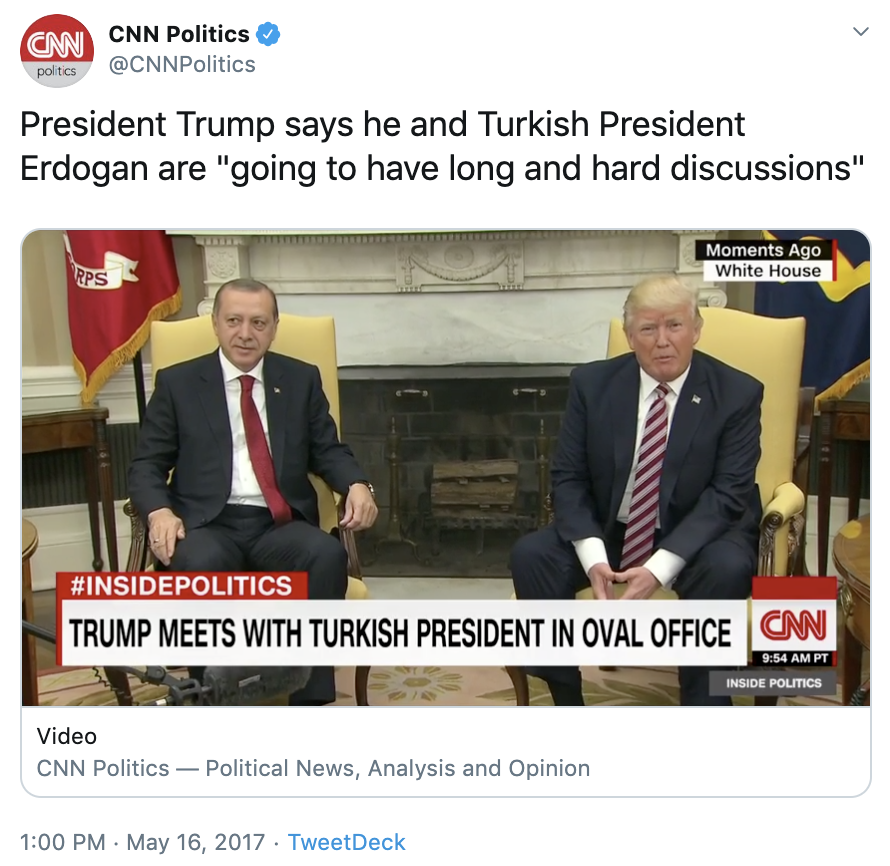
The WaPo’s coverage of Rudy Giuliani and Michael Mukasey’s efforts to pressure Rex Tillerson to push DOJ to release Turkish money launderer Reza Zarrab contextualizes the fall 2017 meeting by recalling that Trump and Erdogan met on May 16, 2017


The two leaders finished their first meeting and performed their ceremonial handshake at about 1PM.

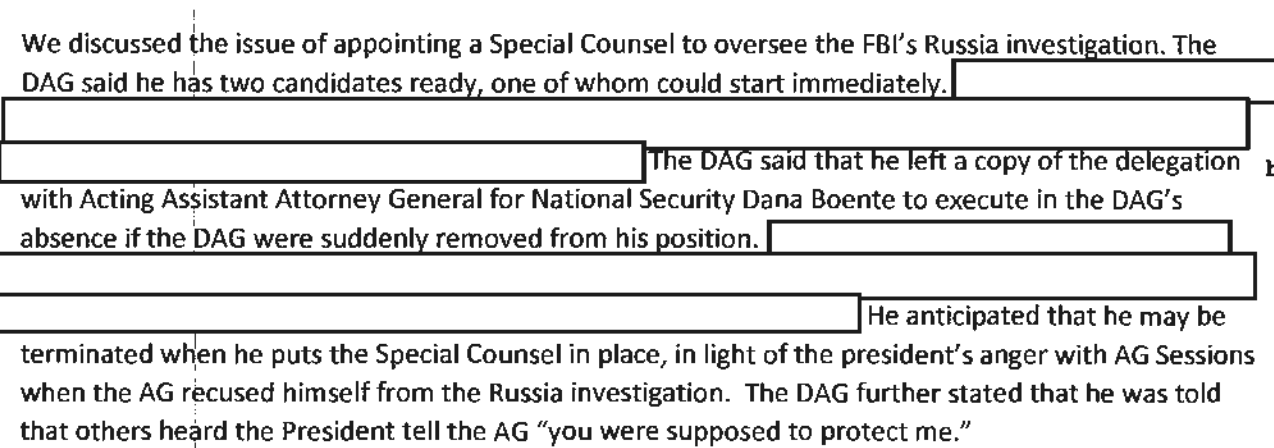
Just half an hour earlier, at 12:30 PM, Andrew McCabe had explained to Rod Rosenstein that he had opened an investigation into Donald Trump. The two then discussed Rosenstein’s thoughts about appointing a special prosecutor. Rosenstein said he was choosing between two candidates, one (who must be Mueller) who could start immediately.

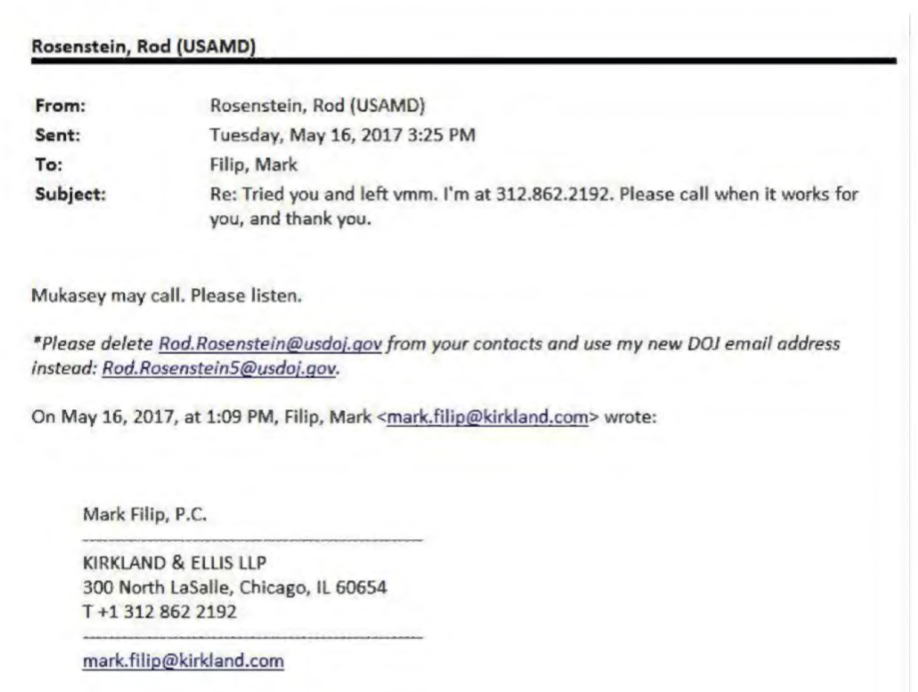
At 1:09, former Deputy Attorney General Mark Filip (and Bill Barr colleague) called Rosenstein from his Kirkland and Ellis phone, left a message, and asked Rosenstein to call him.

At 3:25, Rosenstein wrote back and told him “Mukasey might call.” It’s unclear whether this is Marc or Michael Mukasey, but it doesn’t much matter, because Michael was already representing Zarrab and Marc was very very close to Giuliani.

In other words, within hours after Erdogan met Trump at the White House and asked for Zarrab’s release, someone effectively representing Zarrab appeared to be in touch with Rosenstein, who then suggested that whichever Mukasey it was call Filip.

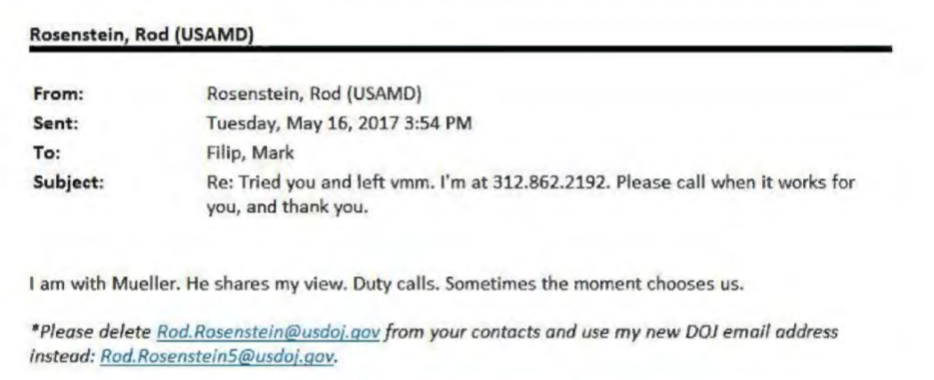
The thing is, by all appearances, this Mukasey call pertained to question about hiring a Special Counsel. That’s because shortly thereafter, Rosenstein writes Filip back and tells him he’s going with Mueller (which suggests Filip may have been his other candidate).

If all that’s right, it suggests one of Zarrab’s lawyers may have weighed in on the Special Counsel decision just minutes after Erdogan requested Trump release him and (simultaneously) a key McCabe-Rosenstein meeting.

That’s not all that surprising. After all, the Mike Flynn investigation had already developed to include at least two of four strands, the lies about Russia and the lies about Turkey.

But then Rosenstein chose to appoint Mueller, not his other choice (who may have been Filip).

From that moment, Republicans were pushing the Bill Barr line. And Bill Barr is now in charge (and was, for the closure of the Mueller investigation). And that push may have had as much to do with Turkey as it did Russia.

Share this entry

DOJ Confirms that Trump’s Anti-Biden Propagandists Were in the Employ of a Russian

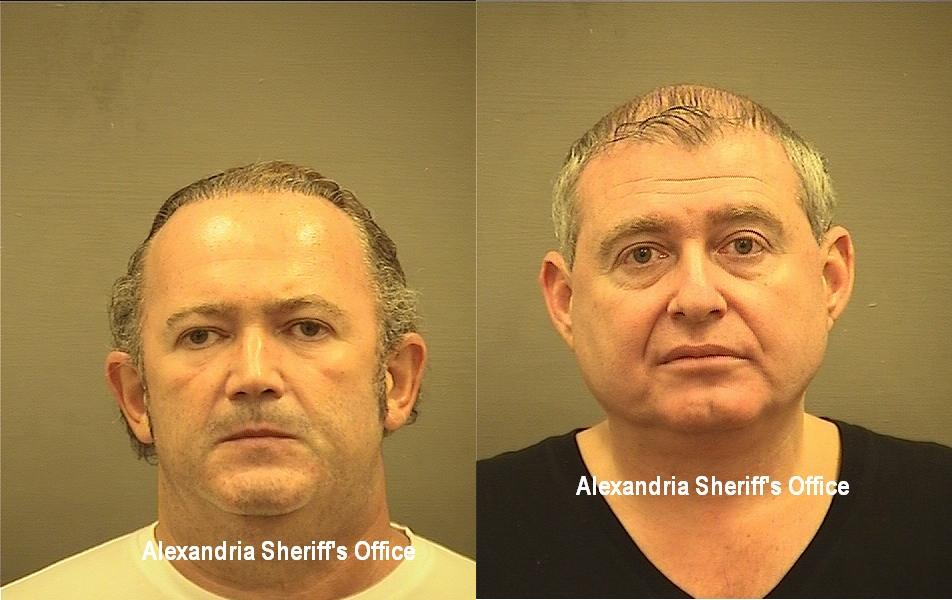
Lev Parnas and Igor Fruman were arrested last night as they tried to flee the country in advance of Congressional subpoenas for their testimony. These are the men who, their recently hired attorney, former Trump personal attorney John Dowd, described how intertwined their actions were with the President’s in an effort to excuse them from testifying in the House impeachment inquiry.

Messrs. Parnas and Fruman assisted Mr. Giuliani in connection with his representation of President Trump. Mr. Parnas and Mr. Fruman have also been represented by Mr. Giuliani in connection with their personal and business affairs. They also assisted Joseph DiGenova and Victoria Toensing in their law practice. Thus, certain information you seek in your September 30, 2019, letter is protected by the attorney-client, attorney work product and other privileges.

The indictment charging Parnas and Fruman with multiple counts of conspiracy lays out how they pursued policies pushed by a Ukrainian politician (and, not coincidentally, Trump), in part by getting Congressman Pete Sessions’ help.

[T]hese contributions were made for the purpose of gaining influence with politicians so as to advance their own personal financial interests and the political interests of Ukrainian government officials, including at least one Ukrainian government official with whom they were working. For example, in or about May and June 2018, PARNAS and FRUMAN committed to raise $20,000 or more for a then-sitting U.S. Congressman [Sessions], who had also been the beneficiary of approximately $3 million in independent expenditures by [one of the PACs they ran] during the 2018 election cycle. PARNAS and FRUMAN had met [Sessions] at an event sponsored by an independent expenditure committee to which FRUMAN had recently made substantial contribution. During the 2018 election cycle, [Sessions] had been the beneficiary of approximately $3 million in independent expenditures by [their PAC]. At and around the same time PARNAS and FRUMAN committed to raising those funds for [Sessions], PARNAS met with [Sessions] and sought [his] assistance in causing the U.S. Government to remove or recall the then-U.S. Ambassador to Ukraine []. PARNAS’s efforts to remove the Ambassador were conducted, at least in part, at the request of one or more Ukrainian government officials.

This, of course, is the recall of Marie Yovanovitch, that Trump discussed in his quid pro quo call with Volodymyr Zelensky.

What the indictment is less clear about is who the Russian bankrolling all this is. A key part of Parnas and Fruman’s crime is that they were laundering funds for “a foreign national Russian citizen and businessman.”

From in or about June 2018 through April 2019, LEV PARNAS, IGOR FRUMAN, DAVID CORREIA, and ANDREY KUKUSHKIN, the defendants, and others known and unknown, conspired to make political donations — funded by Foreign National-1 [the Russian] — to politicians and candidates for federal and State office to gain influence with candidates as to policies that would benefit a future business venture.

Putting together the Dowd letter and the indictment, it becomes clear that the John Solomon propaganda that Trump was pushing (and which Rudy sent to Mike Pompeo’s State Department as part of the effort to get rid of Yovanovitch and which Lindsey Graham just invited Rudy to come present to the Senate Judiciary Committee) was funded by an as yet unnamed Russian.

It was only a matter of time before Trump was implicated in ConFraudUs with Russia.

Update: Now add this passage from Trump’s call to Zelensky, and it becomes hard to see how Trump is not implicated in the charged conspiracy.

President Zelenskyy: Yes it is. very important for me and everything that you just mentioned earlier. For me as a President, it is very important and we are open for any future cooperation. We are ready to open a new page on cooperation in relations between the United States and Ukraine. For that purpose, I just recalled our ambassador from United States and he will be replaced by a very competent and very experienced ambassador who will work hard on making sure that our two nations are getting closer. I would also like and hope to see him having your trust and your confidence and  have personal relations with you so we can cooperate even more so. I will personally tell you that one of my assistants spoke with Mr. Giuliani just recently and we are hoping very much that Mr. Giuliani will be able to travel to Ukraine and we will meet once he comes to Ukraine. I just wanted to assure you once again that you have nobody but friends around us. I will make sure that I surround myself with the best and most experienced people. I also wanted to tell you that we are friends. We are great friends and you Mr. President have friends in our country so we can continue our strategic partnership. I also plan to surround myself with great people and in addition to that investigation [into the source of the Russian investigation], I guarantee as the President of Ukraine that all the investigations will be done openly and candidly. That I can assure you.

The Pre·sident: Good because I heard you had a prosecutor who was very good and he was shut down and that’s really unfair. A lot of people are talking about that, the way they shut your very good prosecutor down and you had some very bad people involved. Mr. Giuliani is a highly respected man. He was the mayor of New York Ci:ty, a great mayor, and I would like him to call you. I will ask him to call you along with the Attorney General. Rudy very much knows what’s happening and he is a very capable guy. If you could speak to him that would be great. The former ambassador from the United States, the woman, was bad news and the people she was dealing with in the Ukraine were bad news so I just want to let you know that. The otter thing, There’s a lot of. talk about Biden’s son, that Biden stopped the prosecution and a lot of people want to find out about that so whatever you can do with the Attorney General would be great. Biden went around bragging that he stopped the prosecution so if you can look into it … It sounds horrible to me.

President Zelenskyy: I wanted to tell ·you about the prosecutor. First of all I understand and I’m knowledgable about the situation. Since we have won· the absolute majority in our Parliament, the next prosecutor general will be 100% my person, my candidate, who will be approved, by the parliament and will start as a new prosecutor in September. He or she will look into the situation, specifically to the company that you mentioned in this issue. The issue of the investigation of the case is actually the issue of making sure to restore the honesty so we will take care of that and will work on the investigation of the case. On top of that, I would kindly ask you if you have any additional information that you can provide to us, it would be very helpful for the investigation to make sure that we administer justice in our country with regard to the Ambassador to the United States from Ukraine as far as I recall her name was Ivanovich. It was great that you were the first one. who told me that she was a bad ambassador because I agree with you 100%. Her attitude towards me was far from the best as she admired the previous President and she was on his side. She would not accept me as a new President well enough.

The President: Well, she’s going to go through some things.

At a minimum, this makes it clear that the withdrawal of Yovanovitch — which was done with the involvement of Rudy and Parnas –was tied up in the quid pro quo extorted on that call. Indeed, Trump’s suggestion she was “going to go through some things” suggests far worse.

But it is also at least likely that one of the two prosecutors Rudy was pitching was the Ukrainian involved mentioned elsewhere in this indictment.

All of which provides substantial evidence that the quid pro quo Trump engaged in on July 24 — the day after Mueller testified before Congress — is just a continuation of the conspiracy charged in the Parnas and Fruman indictment.

Share this entry

DOJ Suddenly Decides It Can Share the McCabe, Comey 302s with Congress

After DOJ asserted to DC Chief Judge Beryl Howell that US v. Nixon would be decided differently today, the judge instructed the parties fighting over whether DOJ will share the grand jury materials from the Mueller investigation with Congress to get busy. She set of bunch of short deadlines to determine the validity of DOJ’s claims to secrecy. As part of that, she had DOJ explain which FBI 302s (interview reports) it had shared of those the House Judiciary Committee requested, then had HJC fact check that list.

According to HJC, DOJ’s declaration alerted them, for the first time, that some of the redactions in 302s were made to protect “Executive Branch confidentiality,” a claim they’ll move to challenge.

Although DOJ discussed the bases for redaction in its Supplemental Submission and at the October 8, 2019 hearing, see DOJ Supp. Sub. ¶ 4; Hr’g Tr. 48-49 (Oct. 8, 2019), none of the bases for redactions are listed or otherwise indicated on the FBI-302 reports reviewed by the Committee. Instead, portions of the FBI-302 reports are simply blacked out without any explanation. During the Committee’s on-site reviews of the FBI-302 reports and in calls between Committee and DOJ officials, the Committee has repeatedly requested that DOJ specifically identify the complete set of bases for its redactions. The Committee still has not received this information as to any of the FBI-302 reports it has reviewed. While the Committee is generally aware that there were redactions for personally identifiable information, until the discussion during yesterday’s hearing and in DOJ’s Supplemental Submission, the Committee was unaware, for example, that the bases for redactions included either “Executive Branch confidentiality interests,” DOJ Supp. Sub. ¶ 4, or “presidential communications,” Hr’g Tr. 48:19- 20 (Oct. 8, 2019).

The more interesting revelation from the exchange, however, pertains to whether or not DOJ was going to supply all 302s, and which ones they might suppress. As DOJ explains, it has given HJC 302s for 17  of the 33 people they asked for (though the Rob Porter and Uttam Dhillon 302s were mostly redacted):

The Committee requested FBI-302s for 33 individuals. To date the Department has provided access to the FBI-302s of 17 of those individuals, several of whom had multiple interviews. Those individuals are (in alphabetical order): (1) Chris Christie, (2) Michael Cohen (six separate FBI-302s); (3) Rick Dearborn; (4) Uttam Dhillon; (5) John Kelly; (6) Jared Kushner; (7) Cory Lewandowski; (8) Paul Manafort (seven separate FBI-302s); (9) Mary McCord; (10) K.T. McFarland (five separate FBI-302s); (11) Stephen Miller; (12) Rob Porter (two separate FBI-302s); (13) Rod Rosenstein; (14) Christopher Ruddy; (15) Sarah Sanders; (16) Sean Spicer; (17) Sally Yates.

But it has thus far withheld 302s from a group of others.

The Department currently anticipates making the remaining FBI-302’s available under the agreed upon terms as processing is completed, so long as they do not adversely impact ongoing investigations and cases and subject to redaction and potential withholding in order to protect Executive Branch confidentiality interests. These include, in alphabetical order (1) Stephen Bannon; (2) Dana Boente; (3) James Burnham; (4) James Comey; (5) Annie Donaldson; (6) John Eisenberg; (7) Michael Flynn; (8) Rick Gates; (9) Hope Hicks; (10) Jody Hunt; (11) Andrew McCabe; (12) Don McGahn; (13) Reince Priebus; (14) James Rybicki; (15) Jeff Sessions. In addition, the Committee requested the FBI-302 for the counsel to Michael Flynn, which also has not yet been processed.

It’s an interesting list to withhold.

Hicks, of course, was privy to a great deal (including Trump’s effort to lie about the June 9 meeting), and her testimony about certain communications during the campaign was actually fairly revealing.

At least two of these may be withheld for the pendency of the Roger Stone trial; both Steve Bannon and Rick Gates will be witnesses, and Mike Flynn’s discussions of WikiLeaks may come up as well.

These 302s (and Dhillon’s heavily redacted one) cover virtually all of the White House’s side of discussions not to fire Mike Flynn right away after discovering he lied about his call with Sergey Kislyak: James Burnham, John Eisenberg, Don McGahn, and Reince Priebus, and of course Flynn himself, were all key players in that. Of course, Eisenberg (who’s the lawyer who decided to hide the records on Trump’s call to Volodymyr Zelensky) was involved in other acts that might indicate obstruction, including advising KT McFarland not to create a false record about what Flynn said. And McGahn was involved in much else (and might even have been asked about Stone’s campaign finance issues, which McGahn represented him on, and the awareness of the Trump campaign about will be an issue at Stone’s trial). But I find it acutely interesting that DOJ is withholding a bunch of records that will make it clear how damning Trump’s reluctance to fire Flynn was, even as Flynn attempts a propaganda driven effort to give Trump an excuse to pardon him.

Then there are the 302s pertaining to the recusal of Jeff Sessions and firing of Jim Comey (and immediate pressure on Andrew McCabe). Those include Comey himself, McCabe, Rybicki, Hunt, Sessions, and Dana Boente. The fact that DOJ has been withholding these (and it’s suggestion that there are ongoing investigations) is really sketchy: it suggests that DOJ may have been withholding really damning 302s from Congress so it can decide whether to indict McCabe and — presumably — wait for DOJ IG to finish its investigation of the FISA orders some of these men approved. In other words, DOJ has been releasing one after another damning claim against Comey and McCabe, but withholding evidence about why they might be targeted.

It’s also noteworthy that Boente and McGahn’s memory regarding an effort McGahn made to shut down the Russian investigation is one of the greatest conflicts of testimony in the entire Mueller Report.

The 302s DOJ has been withholding also happens to include 302s of current DOJ officials. Boente is the FBI General Counsel. More alarmingly, Jody Hunt runs the Civil Division and Burnham is his Deputy. These are the men directing the DOJ effort to make breathtaking claims about impeachment, and they’re hiding their own actions in the investigation about which Congress is considering impeachment.

But, having been asked by Howell what the state of affairs is, DOJ has now decided that they’re going to turn over 302s they previously had suggested they might withhold. HJC expressed some surprise about the sudden change of plans.

With respect to the outstanding FBI-302 reports, the Committee was surprised but encouraged by DOJ’s statement in its supplemental filing that it “currently anticipates making the remaining FBI-302s available.” DOJ Supp. Sub. ¶ 5. The Committee had previously understood from its recent communications with DOJ that DOJ’s production was nearing completion and that there were only a limited number of remaining documents that DOJ would disclose.

It will be interesting if and when HJC obtains these records to see how DOJ tried to protect itself.

Update: I’m reminded of two things. First, as I copied out this URL, I recalled that Turkey, along with Russia, would have known that he lied about his calls with Sergey Kislyak.

Also, in the government’s most recently filing in the Mike Flynn case, they revealed that he had not been in possession of the interview reports from between the time he was initially interviewed and the time he pled guilty.

Based on filings and assertions made by the defendant’s new counsel, the government anticipates that the defendant’s cooperation and candor with the government will be contested issues for the Court to consider at sentencing. Accordingly, the government will provide the defendant with the reports of his post-January 24, 2017 interviews. The government notes that the defendant had counsel present at all such interviews.

This suggests that the government was withholding reports that would make it clear that Flynn continued to lie, even after he lawyered up.

Share this entry

The Press Gets Utterly Snookered on the White House Rebranding of the Same Old Unrelenting Obstruction of Congressional Prerogatives

Yesterday, the White House sent a letter to Nancy Pelosi and just some of the Committee Chairs conducting parts of an impeachment inquiry into the President, purporting to refuse to participate in that impeachment inquiry. Since then, there has been a lot of shocked coverage about how intemperate the letter is, with particular focus on the fact that White House Counsel, Pat Cipollone, used to be considered a serious lawyer. There has been some attempt to analyze the letter as if it is a legal document and not instead the President’s rants packaged up in Times Roman and signed by one of his employees. A number of outlets have thrown entire reporting teams to do insipid horse race coverage of the letter, as if this is one giant game, maybe with nifty commercials on during halftime.

None I’ve seen have described the letter as what it is: an attempt to rebrand the same old outright obstruction that the White House has pursued since January.

The tell — for those teams of well-compensated journalists treating this as a factual document — might have been the addressees. While the letter got sent to Adam Schiff, Eliot Engel, and Elijah Cummings, it did not get sent to Jerry Nadler, who has been pursuing an impeachment inquiry of sorts since the Mueller Report came out. The White House knows Nadler is also part of the impeachment inquiry, because even as the White House was finalizing the letter, Trump’s DOJ was in DC Chief Judge Beryl Howell’s courtroom fighting a House Judiciary request for materials for the impeachment inquiry. In the hearing, DOJ literally argued that the Supreme Court’s 8-0 US v. Nixon was wrongly decided.

Howell picked up on that point by pressing DOJ to say whether then-U.S. District Court Chief Judge John Sirica was wrong in 1974 to let Congress access a detailed “road map” of the Watergate grand jury materials as it considered President Richard Nixon’s impeachment.

Shapiro argued that if the same Watergate road map arose today, there’d be a “different result” because the law has changed since 1974. She said the judge wouldn’t be able to do the same thing absent changes to the grand jury rules and statutes.

Howell sounded skeptical. “Wow. OK,” she replied.

DOJ also argued that Congress would have to pass a law to enshrine the principle that this binding Supreme Court precedent already made the law of the land.

In the HJC branch of the impeachment inquiry, the few credible claims made in yesterday’s letter — such as that Congress is conducting the inquiry in secret without the ability to cross-examine witnesses or have Executive Branch lawyers present — are proven utterly false. And with the claims made in yesterday’s hearing, the Executive demonstrated that they will obstruct even measured requests and negotiations for testimony.

The Trump White House obstructed normal Congressional oversight by absolutely refusing to cooperate.

The Trump White House obstructed an impeachment inquiry focused on requests and voluntary participation.

The Trump White House obstructed an impeachment inquiry where subpoenas were filed.

The Trump White House obstructed an impeachment inquiry relying on whistleblowers who aren’t parties to the White House omertà.

The Trump White House obstructed what numerous judges have made clear are reasonable requests from a co-equal branch of government.

Nothing in the White House’s conduct changed yesterday. Not a single thing. And any journalist who treats this as a new development should trade in her notebooks or maybe move to covering football where such reporting is appropriate.

It is, however, a rebranding of the same old unrelenting obstruction, an effort to relaunch the same policy of unremitting obstruction under an even more intransigent and extreme marketing pitch.

And that — the need to rebrand the same old obstruction — might be worthy topic of news coverage. Why the White House feels the need to scream louder and pound the table more aggressively is a subject for reporting. But to cover it, you’d go to people like Mitt Romney and Susan Collins, who already seem to be preparing to explain votes against the President. You even go to people like Lindsey Graham, who is doing ridiculous things to sustain Rudy Giuliani’s hoaxes in the Senate Judiciary Committee — but who has condemned the principle of making the country dramatically less safe for whimsical personal benefit in Syria. Or you go to Richard Burr, who quietly released a report making it clear Russia took affirmative efforts to elect Trump in 2016.

This week, Trump looked at the first few Republicans getting weak in the knees and his response was to double down on the same old policies, while rolling out a campaign trying to persuade those weak-kneed members of Congress who are contemplating the import of our Constitution not to do so.

The President’s former lawyer testified earlier this year, under oath, that this has always been a branding opportunity to Donald Trump.

Donald Trump is a man who ran for office to make his brand great, not to make our country great. He had no desire or intention to lead this nation – only to market himself and to build his wealth and power. Mr. Trump would often say, this campaign was going to be the “greatest infomercial in political history.”

His latest attempt to cajole Republican loyalty is no different. It’s just a rebranding of the same intransigence. Treating it as anything but a rebranding is organized forgetting of what has taken place for the last nine months, and journalists should know better.

Share this entry