Emmet Sullivan Just Learning of Sidney Powell’s Bait-and-Switch

As I noted the other day, the filing Sidney Powell submitted last week, while called a “reply” to the government’s response, was instead a brand new argument that her client should have his entire conviction thrown out, complete with brand new bullshit claims.

Last night Sidney Powell submitted what procedurally is called her “reply” brief in a bid to compel Brady production. Even if her object were to obtain Brady, this is best thought as her opening bid, as it for the first time she presents this argument. But on page 2, she admits she’s not actually seeking Brady (which makes me wonder whether this entire brief is sanctionable), but instead is seeking to have her client’s multiple guilty pleas dismissed.

The government works hard to persuade this Court that the scope of its discovery obligation is limited to facts relating to punishment for the crime to which Mr. Flynn pleaded guilty. However, the evidence already produced or in the public record reveals far larger issues are at play: namely, the integrity of our criminal justice system and public confidence in what used to be our premier law enforcement institution.

Judge Emmet Sullivan may not have started reading it yet — or maybe he was just impressed with the gaslighting — because yesterday he canceled the November 7 hearing where everyone was going to have an intriguing argument about whether his standing Brady order includes Giglio information impeaching government witnesses like Peter Strzok.

MINUTE ORDER as to MICHAEL T. FLYNN. In view of the parties’ comprehensive briefing concerning 109 Defendant’s Motion to Compel Production of Brady Material, the Court cancels the motion hearing previously scheduled for November 7, 2019. Signed by Judge Emmet G. Sullivan on 10/28/2019.

The government, unsurprisingly, did not miss what I laid out. They responded to Sullivan’s order noting that Flynn’s reply wasn’t a reply, but an entire new request to have his conviction thrown out.

This “Reply,” however, seeks new relief and makes new claims, based on new arguments and new information. In an extraordinary reversal, the defendant now claims that he is innocent of the criminal charge in this case. See, e.g., Reply at 2 (“When the Director of the FBI, and a group of his close associates, plot to set up an innocent man and create a crime . . . .”). For the first time, the defendant represents to this Court that he “was honest with the agents [on January 24, 2017] to the best of his recollection at the time.” Reply at 23. He makes this claim despite having admitted his guilt, under oath, before two federal judges (including this Court). The defendant also argues—based almost entirely on evidence previously provided in discovery—that the government engaged in “conduct so shocking to the conscience and so inimical to our system of justice that it requires the dismissal of the charges [sic] for outrageous government conduct.” Reply at 2. The Reply then seeks a new category of relief, that “this Court . . . dismiss the entire prosecution for outrageous government misconduct.”1 Reply at 32.

They went on to note just some of the new requests and claims Flynn made.

To the extent the defendant refers to potential Brady material, the subject of the original motion, he raises numerous arguments and claims for the first time in his Reply. For example, he asserts, inter alia, that the government had an obligation to provide Brady material to him prior to charging him in a criminal case (Reply at 4, 18-20); that the government suppressed the “original 302” of his January 24, 2017 interview with the Federal Bureau of Investigation (“January 24 interview”) (Reply at 23-24); that the government fabricated certain January 24 interview notes and reports documenting his false statements (Reply at 23-24); that the government suppressed text messages that “would have made a material difference” to the defendant (Reply at 6); that the defendant’s false statements were not material (Reply at 27-28); that the defendant’s attorneys were acting under an “intractable conflict of interest,” which the government exploited to extract a guilty plea (Reply at 17-18); and that the “FBI had no factual or legal basis for a criminal investigation” (Reply at 14-16). Each new argument or claim is unsupported by fact or law.

At the end, they made it clear what Sullivan’s obvious response to such a filing should be: an order that Powell submit her request for new relief — that Flynn have his conviction thrown out — as a separate motion or that he simply ignore all of Powell’s new BS.

In light of this minute order, it may be that the Court intends to strike any arguments or claims raised for the first time by the defendant in his Reply. And it may be that the Court plans to require the defendant to raise any new claims for relief in a properly pled motion to which the government can respond fully.

Sullivan responded by agreeing to let the government file a surreply, with Flynn granted a response (though warned, this time, not to introduce any new arguments).

MINUTE ORDER as to MICHAEL T. FLYNN. In view of [131] Government’s Notice of Claims Raised for the First Time in Reply, the government is hereby DIRECTED to file a surreply by no later than 12:00 PM on November 1, 2019. The surreply shall address the new relief, claims, arguments, and information raised in Defendant’s Reply Brief, ECF No. [129-2]. Mr. Flynn is hereby DIRECTED to file a sur-surreply by no later than 12:00 PM on November 4, 2019, and the Court shall strike any new issues raised in the sur-surreply. No further pleadings concerning Defendant’s Motion to Compel Production of Brady Material, ECF No. [109], shall be filed after the sur-surreply.

To be honest, Powell has already won the interim battle, because Sullivan has neither simply ignored her new request and claims nor told her to file a new motion, and instead has ordered the government to reply not just to the new Brady requests, but the bid to have the prosecution thrown out as part of their surreply.

That suggests Powell may well have wowed Sullivan with her ploy.

That said, Powell is in a precarious place. Her own brief accuses her client of lying in the January 24, 2017 FBI interview (albeit about a non-charged topic). Her Exhibit 15 makes it clear that the government provided Flynn with everything that was Brady information (as distinct from 5 year old records, some of the inculpatory, from DIA, or the Joseph Mifsud phones that DOJ has officially informed her are not helpful to Flynn) three days before Flynn pled guilty under oath to Sullivan last December, something Sullivan himself noted in the last hearing. One of her new claims — that Rob Kelner was too conflicted to advise Flynn to plead guilty — flies in the face of Sullivan’s own colloquy last year.

That said, Sullivan has broad leeway to decide he means his standing order on Brady will include Giglio, and that’s where Powell may well succeed.

Share this entry

How Sidney Powell Misrepresents Her Evidence in Her Fake Brady Motion

In this post, I laid out how Sidney Powell used what should have been a reply in her effort to obtain what she called Brady information to instead lay out, for the first time, her argument about how Flynn was abusively caught in his own acts by mean FBI Agents out to get him, and so should have the two guilty pleas he made under oath thrown out. Powell also complains about a slew of things that happen in most FBI investigations, and pretends they’re specifically abusive when they happen with her client.

In this post, I’d like to unpack what Powell does with her so-called evidence, 16 exhibits purportedly included to support her case, but also largely provided to rile up the frothy right.

Virtually everything she claims — with the possible exception that Flynn’s 302 says he acknowledged calling Sergey Kislyak 4-5 times on December 29, 2016, but actually said he didn’t remember that– is not backed by her evidence. In several cases, she presents evidence that undermines her own claims. She supports her most central claim — that the FBI Agents introduced a claim about Flynn getting a response on UN sanctions — by arbitrarily cutting up notes and hiding the continuity of notes that in fact back the Agents.

Exhibit 1: A timeline

Exhibit 1 is a timeline that purports to show how the Deep State was out to get Flynn and how all the people involved in Flynn’s prosecution allegedly involved in abuse. Powell uses the timeline to suggest all the events that happened at DOJ and FBI over a two year was a focused effort to get her client and his boss.

The real evidence the government had long suppressed caused a cavalcade of major events—many within mere days of Mr. Flynn’s plea—and all unknown to him before it. Lisa Page, Special Counsel to Deputy Director McCabe, resigned; she had edited Mr. Flynn’s 302 and was part of the small, high-level group that strategically planned his ambush. Lead Agent Peter Strzok was demoted from the Mueller investigation and ultimately fired. Strzok, who had met extensively with McCabe and the high-level, small group, was primarily responsible for creating the only basis for the charge alleged against Flynn. [emphasis original]

But the timeline is not “evidence” at all. For example, she includes a slew of events that we know don’t relate to her narrative, but which she claims do, including:

  • Andrew McCabe’s firing for (allegedly) lying to the Inspector General about leaking information that confirmed a criminal investigation into the Clinton Foundation during the campaign
  • Lisa Page’s departure from Mueller’s team, which texts to Strzok that Powell chooses not to include makes clear was planned from the time she joined Mueller’s team
  • Rachel Brand’s resignation (as well as the career moves of a bunch of other people that likely don’t relate to Flynn, but are probably best explained by Christopher Wray bringing in his own team)

The timeline includes notable gaps including:

  • President Obama’s warning to Trump not to hire Mike Flynn, based off issues that did not relate to Trump
  • Elijah Cummings’ letter to Mike Pence about Flynn’s problematic meetings with Turkey, which explains the urgency behind DOJ’s FARA questions
  • Mention of the December 23 and 31, 2016 calls from Kislyak to Flynn, which he also lied about; the December 23 call is utterly central to one of Powell’s key claims against the FBI Agents
  • Details around White House requests in early 2017 to see the information on Flynn, which explains some of the texts (indicating what a challenge it was to investigate Flynn and concerns about documenting his interview before he left) Powell elsewhere says are damning
  • The John Dowd call to Rob Kelner pressuring him not to cooperate

The timeline includes evidence that conflicts with Sidney Powell’s argument, including:

  • A quote from Strzok making it clear that in an unfiltered text to Page, he believed Flynn had lied
  • A description of how Rudolph Contreras recused from the Flynn case as soon as it would have become clear to him that Strzok was involved
  • A 302 from Lisa Page undermining her claim that there were “many” meetings to strategize on Flynn’s interview

Exhibit 2: Cherry-picked Strzok-Page texts

Exhibit 2 is a cherry-picked selection of texts from Peter Strzok and Lisa Page.

For example, Powell claims,

The belatedly-disclosed Strzok-Page texts make clear that the agents left the interview with a firm conviction Mr. Flynn was being honest, and they maintained that conviction despite strong expressions of disbelief and cries of “bullshit” from their colleagues.

But one of the texts she includes quotes Strzok describing his, “excitement knowing we had just heard him denying it all, knowing we’d have to pivot into asking.” That comment actually confirms that even in an unguarded moment, there was no doubt in Strzok’s mind that Flynn had lied about the events.

She claims that a text that very obviously pertains to Strzok’s ongoing efforts to pursue leakers — including leakers who harm Trump associates — and suggests it has something to do with animus against Flynn.

April 20, 2017, Strzok texts Page: “I had literally just gone to find this phone to tell you I want to talk to you about media leak strategy with DOJ before you go.” Ex. 2.

This text is instead proof that, rather than being part of a plot to leak information to harm Trump associates, Strzok and Page continued to pursue all leakers, including those damaging Trump associates.

Significantly, Powell does not submit a single text that shows animus towards Flynn personally, as opposed to Trump. Indeed, she includes a text discussing this article on how Trump picked Pence as a running mate; it mentions Flynn, but neither Page nor Strzok mention that (or any concern that he might have picked someone who was already regarded a counterintelligence concern).

Exhibit 3: Cherry-picked Comey memos

Exhibit 3 are two of Comey’s memos. I don’t think Powell ever gets around to using Comey’s first memo as proof FBI was using the briefing about the dossier to see how Trump would react (though the rest of her brief is consistent with that). Instead, she cites to the memos for two purposes, neither of which it supports. First, she uses it to make much of the fact that Comey briefed Trump on the dossier the day after he met with Obama’s National Security advisors.

Then Director Comey had briefed the President-Elect about these “salacious and unverified” allegations on January 6, 2017, a day after meeting in the Oval Office with President Obama, Vice-President Biden, Acting Attorney General Sally Yates, Susan Rice, James Clapper, and John Brennan. Ex. 3.

But of course, the timing has nothing to do with the dossier and everything to do with the fact that Comey, Clapper, and Brennan were briefing Trump on the same thing they briefed Obama on the day before: the preliminary results of the Intelligence Community Assessment. It’s evidence they were treating Trump as they should the incoming president, something that’s backed by other evidence.

She then uses the Comey memos (plus two Strzok 302s below) to support a footnote where Powell deliberately conflates what it takes to open a counterintelligence investigation (which, even ignoring how Powell claims one can only open an investigation if one has proof beyond a reasonable doubt about someone, can also be opened if someone is being targeted by foreign intelligence services) and what it takes to charge someone.

Under federal law, to establish that an American is acting as an agent of a foreign power, the government must show that the American is purposefully engaging in clandestine activities on behalf of a foreign power, and that it is probable that these activities violate federal criminal law. See FISA, Title 50, U.S. Code, Section 1801(b)(2). Mr. Comey and Mr. McCabe publicly admitted that in the summer of 2016, they took it upon themselves to single out four individuals associated with the Trump campaign for investigation. Admittedly, the FBI had no evidence that any of the four had committed a crime—much less that they “knowingly engage[d] in clandestine intelligence gathering activities for or on behalf of a foreign power.” Id; see Ex. 3.

The memo in no way supports the passage.

Powell unsurprisingly doesn’t include the two Comey memos that hurt her client’s claim. The January 27 memo describes Trump telling the FBI Director that, “he has serious reservations about Mike Flynn’s judgement,” which would seem to support FBI’s decisions to treat the Flynn matter seriously. In the February 8 one, Comey describes Reince Priebus asking if FBI has a FISA order targeting Flynn, something that would totally justify the FBI’s concerns about how they were dealing with and documenting an investigation of the National Security Advisor that Powell makes much of.

Exhibit 4: CNN article

Exhibit 4 is a CNN article quoting Strzok-Page texts where Page says the release of the Steele dossier may provide pretext to interview people, which is a clear reference to George Papadopoulos (everything in Steele about Flynn is OSINT). It also describes Strzok to be obviously aggravated by all the leaking going on, as well as discussions about how FBI tried to walk back a problematic NYT article that doesn’t mention Flynn, but instead focused on Paul Manafort and Roger Stone.

Exhibit 5: Peter Strzok’s 302 about Sara Carter and John Solomon’s propaganda

Exhibit 5 is a Peter Strzok 302 that Powell purports to include for what she claims is a quote from it.

In the next two weeks, there were “many meetings” between Strzok and McCabe to discuss “whether to interview [] National Security Advisor Michael Flynn and if so, what interview strategies to use.” Ex. 5.

Except that’s an egregious misquote of what the 302 actually says, which is,

I have attended many meetings with DD McCabe regarding Russian influence investigations, including meetings which discussed whether to interview former National Security Advisor Michael Flynn and if so, what interview strategies to use.

The “many” here refers to meetings about Russian influence generally, just a subset of those many meetings relate to Flynn. Nor does the 302 reflect that all those meetings happened in the two weeks before Flynn’s interview.

Powell also uses this 302 to claim that “they all knew” they had no basis to open the CI exhibit, as noted above. The only way this could be used to support the case is to take allegations included in a Sara Carter/John Solomon report claiming bias which (per the government’s last filing) was repeatedly debunked after this time, as truthful, even though Strzok says repeatedly in the 302 they’re not.

Exhibit 6: Peter’s Strzok’s 302 on his own role in the investigation

Exhibit 6 is the 302 recording a July 19, 2017 interview of Strzok describing his role in starting the investigation. Powell uses it, rather than “a seven-line summary of Ms. Yates statement,” they received in discovery, to support a claim about why Sally Yates was angry that the FBI interviewed Flynn.

Comey and McCabe were executing their own agenda—not investigating a crime. This is why, in Brady evidence still suppressed, Deputy Attorney General Sally Yates candidly opined that the interview “was problematic” and “it was not always clear what the FBI was doing to investigate Flynn.”8 This is also why Strzok admitted that Yates “was not happy” to learn of the interview and PDAG Axelrod argued with FBI General Counsel James Baker about the FBI’s unilateral decision to interview Flynn. Ex. 6.

To prove she needed the full Yates interview, Powell would need to describe what’s inadequate in the Yates summary, but she chooses not to.

Powell also uses this 302 to support the claim that “they all knew” they had no basis for a counterintelligence investigation, which it doesn’t support.

The other things that Powell uses this exhibit to prove is that the FBI — as it does for all witnesses!!!! — tried to stage the interview to be as useful as possible.

They purposely did not tell him they were investigating him and strategized at length to avoid raising any concerns. Ex. 6 (“Flynn was unguarded and clearly saw the FBI agents as allies.”).

[snip]

The agents did three briefings the day of the interview. They reported he had a sure demeanor, and he was telling the truth or believed he was—even though he did not remember it all. Ex. 6.

[snip]

” They purposely did not tell him they were investigating him and strategized at length to avoid raising any concerns. Ex. 6 (“Flynn was unguarded and clearly saw the FBI agents as allies.”).

Powell slightly misrepresents this, describing the FBI agents as believing that Flynn was telling the truth instead of saying, “both had the impression at the time that Flynn was not lying or did not think he was lying,” and she leaves out key parts of the rest of the description, including that he “did not give any indicators of deception,” which changes the meaning somewhat. In general, however, the description of how FBI planned the interview doesn’t prove bias at all on the part of the FBI; it proves they treated Flynn like they treat everyone.

Exhibit 7: Two pages of the Steele dossier

Exhibit 7 is the two pages of the Steele dossier which include the sole reference in it to Flynn.

Kremlin engaging with several high profile US players, including STEIN, PAGE, and (former DIA Director Michael Flynn), and funding their recent visits to Moscow.

[snip]

Speaking separately, also in early August 2016, a Kremlin official involved in US relations commented on aspects of the Russian operation to date. Its goals had been threefold — asking sympathetic US actors how Moscow could help them; gathering relevant intelligence; and creating and disseminating compromising information (“kompromat”). This had involved the Kremlin supporting various US political figures, including funding indirectly their recent visits to Moscow. S/he named a delegation from Lyndon LAROUCHE; presidential candidate JILL STEIN of the Green Party; TRUMP foreign policy adviser Carter PAGE; and former DIA Director Michael Flynn, in this regard and as successful in terms of perceived outcomes.

According to Powell’s own theory, the RT event took place long after the US government came to be concerned about Flynn as a CI threat, and according to her own claims, Flynn was already on Trump’s campaign at this time, so the FBI would have been reviewing these publicly known facts in real time. And while the Kremlin only indirectly funded these trips, both the Page and the Stein/Flynn trips were paid for, albeit by cut-outs. This is actually an instance where the Steele dossier only repeats generally true, OSINT facts.

Nevertheless, Powell uses it to misrepresent both the timing of Nellie Ohr’s research on Flynn (most of her research was done in 2015 and early 2016, and so was funded by Paul Singer) and why her spouse shared it with the FBI (to help them vet the dossier).

It was only much later the defense learned what the FBI already knew: This document had been bought and paid for by the Clinton campaign and the DNC. Both the FBI and Fusion GPS hired former British spy Christopher Steele. Fusion GPS was on the Clinton payroll, and it also hired Nellie Ohr—a Russia specialist with CIA ties whose husband Bruce was the fourth highestranking official in DOJ. Ms. Ohr was researching Mr. Flynn also, and his name appears twice in the “Steele dossier.” Ms. Ohr and Steele funneled their “work” through Bruce Ohr in a backchannel to the FBI, long after the FBI fired Steele for lying. Ex. 7;

Powell also uses it to demand a letter from MI6 on Steele that the NYT recently reported said that Steele was honest, but displayed questionable judgement (of the sort that might lead him to trust Oleg Deripaska).

Mr. Horowitz has asked witnesses about an assessment of Mr. Steele that MI6, the British spy agency, provided to the F.B.I. after bureau officials received his dossier on Mr. Trump in September 2016. MI6 officials said Mr. Steele, a Russia expert, was honest and persistent but sometimes showed questionable judgment in pursuing targets that others viewed as a waste of time, two people familiar with the assessment said.

Whatever Carter Page’s possible beef with the dossier, all the dossier does on Flynn is report what the FBI was (even according to Powell’s claims) already reviewing with Flynn. And a letter saying that MI6 thought Steele was honest is not going to change that.

Exhibit 8: Not-Comey’s description of Comey’s action

Exhibit 8 is Josh Campbell’s description of how Comey decided to send FBI Agents to interview Flynn without going through the White House Counsel (which Andrew McCabe nevertheless gave Flynn the opportunity to ask to do).

The government did not disclose this to Mr. Flynn until after Mr. Comey bragged about his breach on national television—not because Mr. Van Grack was complying with this Court’s order. This short video (https://www.youtube.com/watch?v=NxNhjFrjXqI) reveals Mr. Comey’s deliberate disregard for DOJ and FBI rules. In fact, Mr. Van Grack only disclosed a bland summary four days after Comey gloated about it on national television to a laughing audience— four days before Mr. Flynn’s scheduled sentencing, and because this Court entered its minute order of December 12, 2017. Dkt. 10. Mr. Flynn seeks disclosure of the full report of Mr. Comey’s conduct, any memos, notes, and 302s documenting his decision, which was admittedly the subject of “many intensive discussions” within the FBI. There must be at least notes of several others, including Comey’s Special Assistant Mr. Campbell, that document the efforts directed against Mr. Flynn. Ex. 8;

Powell uses Campbell’s description, which includes the line “screw it,” rather than a transcript of Comey’s statements that she links, which are far less inflammatory, presumably to assume that Campbell must have taken official notes of the many conversations he claims happened.

But this exhibit, like all the others on how FBI tried to optimize this interview, only shows that the FBI treated Flynn like they’d treat anyone.

Exhibits 9 and 10: Joseph Pientka and Strzok’s notes

Exhibits 9 and 10 are the notes that Joe Pientka and Strzok made, respectively, about the Flynn interview. This is the core of any legitimate argument Powell has, though here, as elsewhere, part of what she’s complaining about is normal FBI process where two Agents do an interview and then write up a 302.

Only the junior agent was taking notes during the interview. Strzok’s 302 of July 2017 says that he was handling the interview and his partner was taking notes. A 302 is to be written into Sentinel within five days. Notes are to be signed and dated by the notetaker. Inexplicably, we have two sets of notes with significant redactions—neither of which is signed and dated as required. Exs. 9, 10. Agent Strzok’s notes are far more detailed, lengthy, and written in a way that would not appear to be physically possible to write in a contemporaneous, casual setting. Ex. 10.

Powell’s claims that these notes weren’t dated or signed might have merit, though given that virtually all of her claims misrepresent key details, it’s hard to tell, especially with the way she presents the notes in screen caps followed by transcriptions.

She makes two other substantive claims about the notes. First, she claims that the notes (plus a copy showing changes made on February 10, which is Exhibit 11) falsely claim that Flynn stated that he did not ask for any specific action regarding the UN vote on Egypt’s resolution on illegal Israeli settlements.

Overnight, the most important substantive changes were made to the Flynn 302. Those changes added an unequivocal statement that “FLYNN stated he did not”—in response to whether Mr. Flynn had asked Kislyak to vote in a certain manner or slow down the UN vote. This is a deceptive manipulation because, as the notes of the agents show, Mr. Flynn was not even sure he had spoken to Russia/Kislyak on this issue. He had talked to dozens of countries. Exs. 9, 10, 11.

[snip]

Whatever Mr. Flynn said to anyone regarding the UN issues had nothing to do with the FBI’s alleged “investigation” about the 2016 election and could not be the basis for false statements “material” to that issue. According to the notes, he was not even sure he had spoken to Kislyak on that issue. Exs. 9, 10.

Perhaps Sidney Powell is this dumb, or perhaps she just thinks Emmet Sullivan is, but this is thoroughly dishonest. What Pientka’s notes show is that when Flynn was asked to offer up what contacts he had had with Kislyak, he described the following ones post-election:

  • A condolence call after Russia’s Ambassador to Turkey was killed on December 19, which Flynn described as happening “before Xmas, Mid-December day after assassination”
  • A condolence call after Russia’s military band crashed in Syria on Christmas Day
  • A single call on December 29

Then, when the Agents cue him again, he admits to:

  • The in-person Trump Tower meeting about setting up a back channel around December 1

Then, when asked about the UN vote, Flynn starts by saying, “that’s a good reminder,” then admits to calls with others, makes representations generally about all his calls regarding the UN vote where he claims he only asked about people’s positions, not to abstain, then ends by saying “Appreciate you reminding me that was another convo.” In context, that probably records — and at the very least is consistent with — an admission he spoke with Russia among his UN calls. And given his description of it occurring “Maybe Thurs-Fri prior to Xmas,” he dates it to December 22 or 23, when he claims his call was offering condolences for the assassination. (Powell splits these two up in Pientka’s notes, as she also does with the same exchange in Strzok’s notes, but the flow is clear; this is clearer in the full version of Strzok’s notes submitted with Exhibit 16)
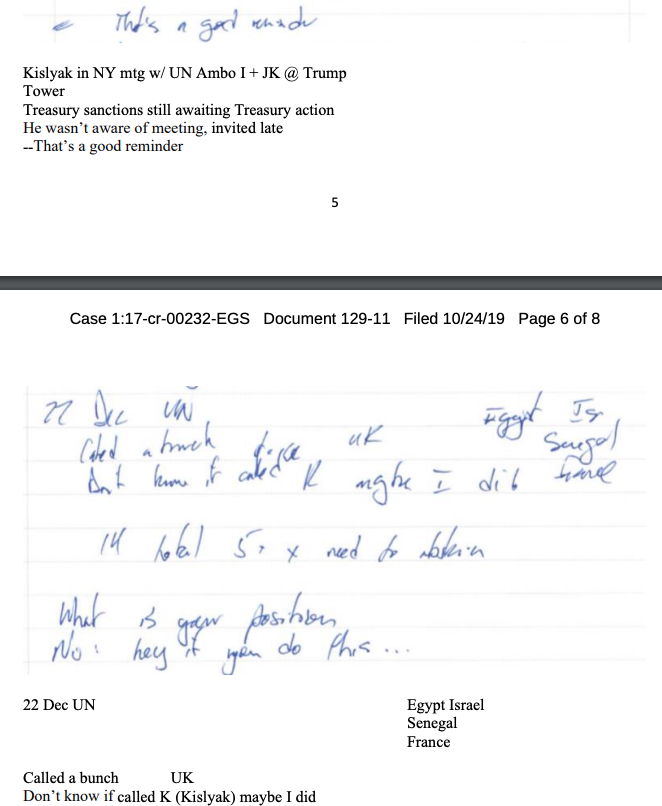
Furthermore, Powell claims that “he talked to dozens of countries,” which she pulls from his comment about his general interactions with other countries. The notes make clear that he instead said he “talked to a bunch” of countries. It’s clear that Powell’s claim he spoke to “dozens” is false in any case, because Flynn was talking about the UNSC, on which there are just 15 members, and Flynn described how those numbers worked out — and the need to get just 5 to abstain — for the Agents.

In other words, what the notes actually show is Flynn lying about his reason for the call, being given an opportunity to fix the lie about the subject of the call, then making claims that would apply to all his UN calls (including the Russian one) that were themselves false.

In short, the notes actually appear to back the Agents.

Exhibit 11: Redline of 302

Exhibit 11 is a redline of Flynn’s 302 which, in Powell’s theory, was changed on February 10, after the press reported that Flynn didn’t speak about sanctions (as if the FBI would respond to press reports on something they already knew to be a lie), to make it more damning.

She’s concerned about two changes made in this section pertaining to the UN vote.
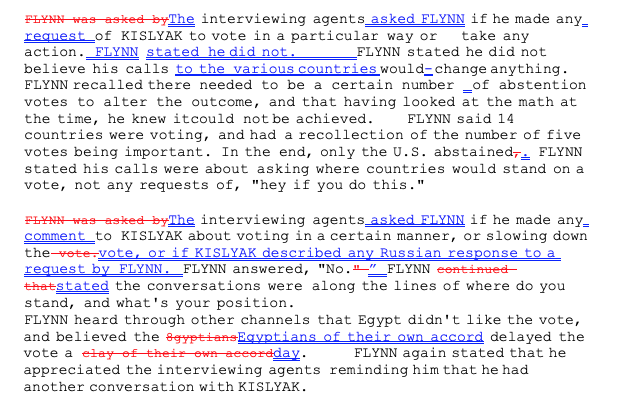
This section is the basis of the most inflammatory claim Powell made.

Those changes added an unequivocal statement that “FLYNN stated he did not”—in response to whether Mr. Flynn had asked Kislyak to vote in a certain manner or slow down the UN vote. This is a deceptive manipulation because, as the notes of the agents show, Mr. Flynn was not even sure he had spoken to Russia/Kislyak on this issue. He had talked to dozens of countries. Exs. 9, 10, 11.

Second, they added: “or if KISLYAK described any Russian response to a request by FLYNN.” That question and answer do not appear in the notes, yet it was made into a criminal offense. The typed version of the highly unusual “deliberative” 302 by that date already included an entire section from whole cloth that also serves as a criminal charge in the Information and purported factual basis regarding “Russia’s response” to any request by Flynn. The draft also shows that the agents moved a sentence to make it seem to be an answer to a question it was not. Exs. 9, 10, 11

As shown above, because Flynn’s comments about his asks regarding the UN vote apply to all the countries in question, it would apply to the Russian one as well.

But as shown, the only way Powell can sustain this claim is to separate Flynn saying three things that are clearly all about the same topic into three different sections of her transcription:

  • That’s a great reminder
  • No hey if you do this
  • Appreciate you reminding me that was another convo
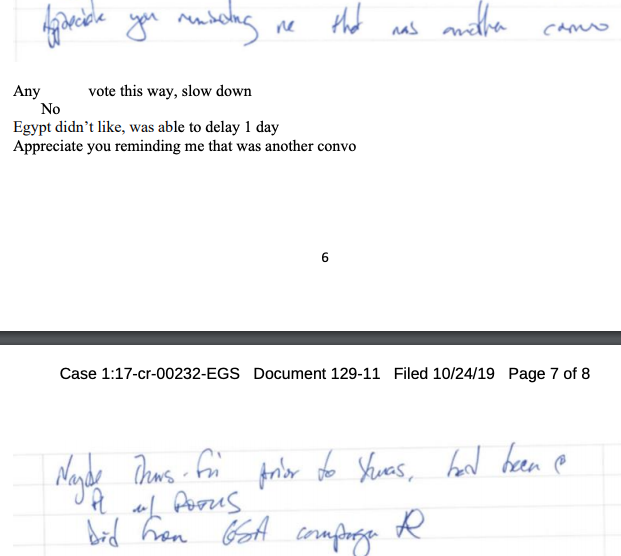
The “Appreciate you reminding me that was another convo” certainly is consistent with the December 23 call Kislyak made to say they weren’t going to abstain, because Flynn talks about it happening the Thurs-Fri before Xmas, which would be consistent with the ask on Thursday, December 22 and the response on Friday, December 23.

Note, too, that the charge that Flynn lied about getting a response from Russia would also apply to whether Flynn acknowledged getting a response back from Kislyak after the December 29 call. As she did with the UN notes, she splits these up too, so separates where Pientka notes “no recollection of that” from where he records Flynn saying, “Nothing long drawn out don’t do something.” Her transcription of “RePP?” and “I don’t, the conversation was on” doesn’t account for the possibility that this is a question — with question mark included — about Russia’s response.

Powell makes a more credible argument about the Agents recording that Flynn affirmatively stated he made 4-5 calls to Kislyak on December 29

Notes by both agents state that Mr. Flynn does not remember making four to five calls to Ambassador Kislyak from the Dominican Republic, where he was on vacation, but that if he did so, it was because phone service was poor and he kept getting dropped. “I don’t remember making 4-5 calls. If I did lousy place to call.” The final 302 states the opposite: “Flynn remembered making four to five calls that day about this issue, but that the Dominican Republic was a difficult place to make a call as he kept having connectivity issues.” Ex. 11. This dramatically demonstrates the wrongheadedness of allowing a 302 to create a federal felony.

But this issue is not an editing one, as the draft doesn’t change on this point.

More importantly, it’s not — as the UN question is — a charged lie.

Powell is right that the problem with charging false statements off a 302 is that the editing process is human, but that doesn’t change that the notes clearly back that Flynn told numerous material lies in his interview, and she doesn’t actually claim he didn’t.

Exhibit 12: Lisa Page rebuts Powell’s claim of “many” meetings to strategize Flynn’s interview

Exhibit 12 is a 302 with Lisa Page that, among other things, proves that contrary to claims the frothy right has made about Mueller’s team not checking about Strzok bias affecting the impact of the Flynn interview, Mueller’s team instead interviewed Page to check just that.

The 302 also disproves Powell’s claim that Strzok claimed he had attended “many” meetings about how to handle the Flynn interview. As reflected in Page’s telling, there was a meeting the night before, and one after the interview.

Powell doesn’t reveal that this 302 damages her story in key ways. Instead, she seems to include it to substantiate this claim:

Lisa Page, Special Counsel to Deputy Director McCabe, resigned; she had edited Mr. Flynn’s 302 and was part of the small, high-level group that strategically planned his ambush.

But she doesn’t actually cite the exhibit here. Nor does she in a later reference to Page editing the 302.

And for his third production, it gave the defense two pages on October 4, 2018. These go precisely to the issue of McCabe’s Special Counsel Lisa Page editing the Flynn 302. Ex. 2.

But in the second instance, the 302 actually shows that Brandon Van Grack provided Flynn texts reflecting Page editing Flynn’s 302 even before they had interviewed her (on October 25) to understand what they meant. That is, this detail shows how responsive Van Grack was, not that he was slow in turning things over.

In short, there’s no basis to believe Page altered the 302. Her edits, if they were actually incorporated, went through Bill Priestap, not Strzok. And she told the FBI that she would often edit things he wrote for grammar.

But unlike the frothy right, which has been harping on this point all weekend, Sullivan may never refer to that 302, because Powell didn’t appear to cite it.

Exhibit 13: WaPo reports on the Strzok-Page texts

Exhibit 13 is a WaPo report describing that Mueller reassigned Strzok in the wake of the discovery of his texts with Page. Powell provides this to substantiate a theory that Mueller’s prosecutors were pressuring Flynn to plead guilty knowing this would come out.

Not only did Mr. Van Grack not disclose a single text message before Mr. Flynn agreed to plead guilty, but Special Counsel apparently managed to control the press on the issue until the plea was entered on December 1, 2017, in Judge Contreras’s court. It defies credulity to suggest that it was only unlucky for Mr. Flynn that the story broke the very next day. Part of the evidence we request includes communications between the press and SCO, which will likely establish that Special Counsel intensified pressure on Mr. Flynn to plead immediately while it was pressuring the press not to explode the truth that destroyed the entire case. Karoun Demirjian, Top FBI official assigned to Mueller’s Russia probe said to have been removed after sending anti-Trump texts, THE WASH. POST (Dec. 2, 2017), https://www.washingtonpost.com/world/national-security/two-senior-fbiofficials-on-clinton-trump-probes-exchanged-politically-charged-texts-disparagingtrump/2017/12/02/9846421c-d707-11e7-a986-d0a9770d9a3e_story.html; MTC 11; Ex. 13.

Unfortunately for Powell, that doesn’t change the fact that according to her own timeline, Van Grack had already disclosed this three days earlier, and that the reason the texts came out is because Rod Rosenstein okayed their release in probable violation of the Privacy Act, something that Mueller’s team probably had no way of anticipating.

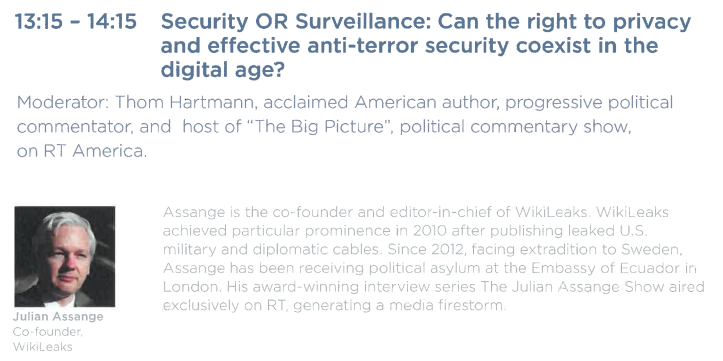
Exhibit 14: The InfoWars event Flynn co-headlined with Ray McGovern and Julian Assange

Exhibit 14 consists of materials from Flynn’s speaker’s bureau, which Powell submits to show that those events were solidly in the mainstream (which is absolutely true of the Kaspersky event).

Mr. McCabe pointed to Mr. Flynn’s “very public interactions with Vladimir Putin and other Russians.” These “interactions” seem to have arisen from the work of CIA/FBI operatives Stefan Halper and Joseph Mifsud, and bookings made by Mr. Flynn’s American speakers’ bureau, Leading Authorities (which books engagements for countless former government officials and prominent people). Leading Authorities booked him for three events with “Russian connections”: one in Moscow for RT and two in Washington. All were well attended by prominent persons from around the world because of the important issues discussed and the presence of other recognized experts on the programs. See Ex. 14; MTC 4, 16.

Yet among the other things these materials reveal are that the RT event featured Oliver Stone and Max Blumenthal on InfoWars (at a time when Russia had already kicked off its 2016 InfoWar against Putin).
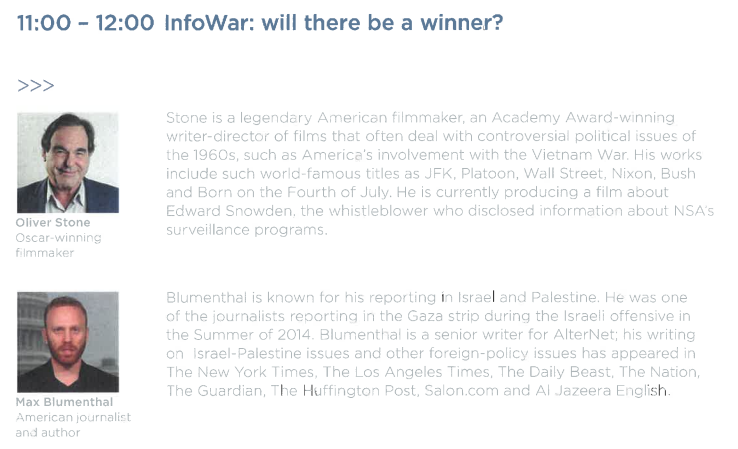
It also featured Julian Assange and Ray McGovern on a panel about security and surveillance.
His talk to Volga-Dnepr Airlines was not recorded or open to the media.
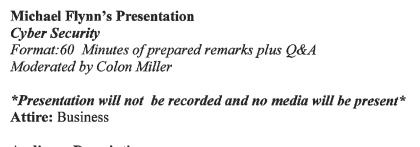
The RT materials, while already broadly public, are especially damning, as they effectively show that Russia orchestrated his appearance, right alongside Putin, at the same event which a bunch of people who would later be part of the effort to deny Russia’s role in this infowar. A number of these people have been friends of mine (though they’re also among the people who’ve attacked me most baselessly once I started saying publicly that Russia did the hack), but they’re in no way the best experts to talk about infowars or how to balance privacy and counterterrorism.

Exhibit 15: Proof that Mueller’s team provided discovery before Flynn pled guilty a second time before Sullivan

Exhibit 15 is another timeline, this one providing the dates — but not the substance — of what Mueller provided in discovery in response to Emmet Sullivan’s order (note: it also gets at least some of the dates wrong, even as compared to her other timeline).

Powell claims in her brief that Flynn didn’t get all this material before he pled guilty the first time.

Neither Mr. Flynn nor his former counsel had any of these documents or knowledge of the plethora of information discussed above when Mr. Flynn entered his plea.

But Powell’s own timeline shows that every installment of the government’s production save one preceded the date last year when Flynn pled guilty again to Emmet Sullivan.

The exception is material handed over on August 16 of this year that relates to Flynn’s time at DIA which (given that it dates to at least two years before he committed the crimes in question) cannot be relevant to his crimes. Indeed, the government says that some of it is inculpatory.

Request #15: The government is not aware of any information in possession of the Defense Intelligence Agency that is favorable and material to sentencing, including the information that the government provided on August 16, 2019. Specifically, the information of which the government is aware, including that August 16 production, is either inculpatory or has no relevance to the defendant’s false statements to the FBI on January 24, 2017, or to the FARA Unit.

In short, Powell’s own timeline shows that the government complied with Sullivan’s standing order before Flynn pled guilty before Sullivan.

Exhibit 16: The handwriting analysis that doesn’t even try to disprove Strzok

Finally, there is Exhibit 16, a declaration from a handwriting analyst. Powell includes it to substantiate a demand for Strzok’s original notes of his interview with Flynn to investigate an “anomaly” that she doesn’t describe (making this request moot from a Brady standpoint).

Agent Strzok’s notes are far more detailed, lengthy, and written in a way that would not appear to be physically possible to write in a contemporaneous, casual setting. Ex. 10. The defense requests production of the actual, original notes, and handwriting samples of Strzok of contemporaneous and non-contemporaneous notes to evaluate another anomaly that further calls into question the entire effort by the FBI to manipulate and set up Mr. Flynn, and its report of that interview. Ex. 16.

But as her expert lays out, getting Strzok’s original notes would not be enough, because he would also need a baseline of how Strzok takes notes.

If additional comparable6 notations of Agent Strzok written under similar conditions could be obtained and submitted for analysis, it may be possible to determine whether the (Q-1) notations were prepared as purported. In consideration of both the observations made, as well as limitations present, further analysis of the original evidence would likely be necessary to support any definitive conclusions in this matter.

Ultimately, her expert says he can’t make any conclusions about whether the notes were “written during the course of the January 24th interview, or prepared at a subsequent time period.”

Based upon the inherent limitations arising from the examination of non-original evidence, compounded with the lack of any known comparison handwritten notations of Agent Peter Strzok (i.e., other non-contested handwritten notations prepared under like conditions), it has been determined that no conclusion can be rendered as to whether the submitted (Q-1) notations were written during the course of the January 24th interview, or prepared at a subsequent time period.

But as Powell makes clear in the very same paragraph where she makes this demand, no one claimed that Strzok wrote these notes during the interview. Only Pientka’s notes were taken during the interview (which is, again, one of those potentially bad things that is normal for FBI interviews that Powell thinks shouldn’t happen with her client).

Only the junior agent was taking notes during the interview. Strzok’s 302 of July 2017 says that he was handling the interview and his partner was taking notes.

So Powell uses this expert to claim she needs the original of Strzok’s notes to prove that he wrote them at a time he didn’t write them.

Which sounds like the definition of sanctionably frivolous behavior.

Share this entry

Sidney Powell Accuses Mike Flynn of Lying to the FBI on January 24, 2017

I’m starting my deep dive into the case Sidney Powell tries to make to convince Emmet Sullivan to throw out the guilty pleas Mike Flynn pled to twice (in this post, I laid out how she used a “reply” brief demanding Brady material to make an opening argument in a bid to get the case thrown out).

But in starting my deep dive, I didn’t get two lines into her exhibits before I realized that Sidney Powell, in documents submitted to the court, accused her client of lying to the FBI on January 24, 2017, precisely the crime she says he shouldn’t be held accountable for. At issue is the timeline she created to suggest every single event that happened at FBI between 2016 and 2018 was part of a plot to get her client. The second entry, which describes how Trump accepted the GOP nomination around the same time Lisa Page and Peter Strzok said two bad things about Trump (but not about Flynn), says that Flynn joined the campaign in 2015, though she claims not to know the date.

By setting the date when Flynn joined the campaign to sometime vaguely in 2015, it suggests the government’s interest in his actions leading up to and during the RT Gala in Moscow in December 2015 were part of general animus direct at Trump, and not a legitimate counterintelligence concern about a former General being paid by a foreign propaganda outlet to eat dinner with Vladimir Putin.

Except that detail — that he was already part of the campaign in 2015 — conflicts with something he told the FBI on January 24, 2017: that he wasn’t really part of the Trump campaign yet when, after his former counterpart at GRU, Igor Sergun, died unexpectedly on January 3, 2016, he called Sergey Kislyak to offer condolences.

Back in January 2017, Flynn would have had good reason to distance this call from Trump, because if it happened while he was part of the campaign, it would suggest he and Russia were in discussions even before Russia started stealing emails from Hillary Clinton and the Democrats.

Of particular note, the two other calls he claimed, in his interview with the FBI, were condolence calls actually weren’t, at least not primarily. On those, he was instead discussing policy issues.

But now Sidney Powell, Flynn’s own lawyer, says that’s not true, that he was already part of the campaign when he made this call.

It remains to be seen whether this Powell gambit will work. But accusing her client of lying to the FBI seems like an odd way to prove that only people who have an animus against Flynn would accuse him of lying to the FBI.

Share this entry
Horowitz

DOJ’s Inspector General (and 70 Colleagues) Says DOJ’s Lawyers Fucked Up

On Tuesday, the Council of Inspectors General on Integrity and Efficiency just sent OLC head Steve Engel a scathing letter criticizing his opinion that Acting Director of National Intelligence Joseph Maguire could not share the whistleblower complaint about President Trump’s July 25 phone call with Volodymyr with Congress. Generally, its content says about what you’d think:

  • ICIG was right to complain about OLC’s decision in a September 17 letter
  • ICIG was about DNI’s jurisdiction over federal elections and classification of information
  • OLC’s opinion could impair whistleblowing
  • OLC’s opinion deviates from Congressional intent on IC statutes, as backed by both Chuck Grassley and Mark Warner
  • OLC did not raise any valid constitutional concern, but instead simply substituted its judgment for the ICIG’s

But I’m more interested in what it means that CIGIE’s Chair, Michael Horowitz, wrote it. Horowitz also happens to be DOJ’s Inspector General, the same guy Bill Barr has loaded up with investigations designed to take down Trump’s critics, someone whom the frothy right has invested a lot of their respect.

Don’t get me wrong. I’m sure Horowitz would have written the letter in any case, even if he weren’t DOJ IG. He’s a fierce protector of IG prerogatives, which is one reason why he’s the Chair.

Horowitz is also a brilliant tactician who has used his positions–both as DOJ IG and as CIGIE head–to assert his authority. Just as one very key example, after a several year fight with FBI, he managed to get broad access to FBI’s files for IG investigations. In another example, he managed to investigate lawyer Jim Comey (in his administrative role) even though generally such investigations get done by DOJ’s Office of Professional Responsibility.

And I view this letter, in addition to being a very public and powerful stand on an important principle, as a tactic. One thing the letter does, for example, is lay out that a top DOJ lawyer violated Congress’ intent on how Inspectors General are supposed to work. That’s the kind of thing that — if my years of watching Horowitz are any indication — we may hear the next time Horowitz testifies about his work and the scope of DOJ’s IG, which is limited in ways that other IGs aren’t.

More interesting, given the abundant proof that DOJ worked hard to avoid connecting the dots on this complaint, is Horowitz’s footnote noting that DOJ and FBI have responsibilities to investigation interference in our elections seems

The fact that other parts of the government, such as the Federal Bureau of Investigation and the Department of Justice, also have responsibilities in this area does not divest the DNI of such duties as a matter of law or practice.

Horowitz may not have the authority to investigate Steve Engel, but he does have the authority to investigate the people who found ways not to investigate this complaint competently, and his concern on OLC may reflect a concern on what else happened at DOJ.

Horowitz also maps out broad authority for ICIG to continue to investigating both the allegation itself and (importantly), the misuse of the Top Secret server to hide other problematic call transcripts.

These responsibilities support the ICIG’s conclusion that the protection of federal elections from foreign interference is squarely within the DNI’s “operations”. The legal authorities cited in his letter also support the ICIG’s determination that the whistleblower raised a claim of a serious or flagrant problem that relates to an intelligence activity within the DNI’s jurisdiction. It surely cannot be the case that the DNI has responsibilities related to foreign election interference but is prohibited from reviewing the cause of any such alleged interference.

We further note that the DNI has jurisdiction over the handling of classified and other sensitive information. As a result, the whistleblower’s allegation that certain officials may have misused an intelligence system also raises an additional claim of a serious or flagrant problem that relates to the operations of the DNI and therefore may properly be considered an urgent concern under the statute.

We actually don’t know whether ICIG has continued to investigate this issue. But Horowitz lays out the case that he has the authority to.

Finally, Horowitz focuses on the delay that OLC’s opinion had, preventing Congress from learning about the complaint by September 2 (when, by law, they should have received the whistleblower complaint).

As Congress has done in every other whistleblower law passed since 1978, it entrusted IGs to play a central role in the evaluation of the information provided. Specifically, the ICWPA requires an IG to make within 14 days a factual determination as to whether an alleged urgent concern provided to the IG “appears credible.” If the IG determines that the allegation appears credible, which necessarily includes a determination by the IG that it involves an “urgent concern,” the IG is required to forward the allegation to the head of the agency and the agency head “shall” forward it to Congress within 7 days “with any comments.” The ICWPA’s use of the word “shall” makes it clear that the statute does not authorize the agency head, or any other party for that matter, to review or second-guess an IG’s good faith determination that a complaint meets the ICWPA’s statutory language.

Congress only received the complaint on September 25, an illegal delay of 23 days, during which time Trump released the withheld funds and had a meeting with a much-weakened Zelensky, to say nothing of whatever meetings Rudy and Bill Barr had in the interim. While it’s unlikely to happen, Horowitz’s language at least lays out the clear impact of Engel’s opinion in obstructing Congress’ ability to be able to deal with this issue in timely fashion.

Thus far, the American public has had little success at disciplining OLC lawyers for the bullshit they cause (though even courts are inching closer to doing so). This letter seems, to me, like the first step in an attempt by Horowitz to be able to do so.

Share this entry

13 Routine Aspects of FBI Investigations Sidney Powell Says Should Not Be Used with Mike Flynn

Last night Sidney Powell submitted what procedurally is called her “reply” brief in a bid to compel Brady production. Even if her object were to obtain Brady, this is best thought as her opening bid, as it for the first time she presents this argument. But on page 2, she admits she’s not actually seeking Brady (which makes me wonder whether this entire brief is sanctionable), but instead is seeking to have her client’s multiple guilty pleas dismissed.

The government works hard to persuade this Court that the scope of its discovery obligation is limited to facts relating to punishment for the crime to which Mr. Flynn pleaded guilty. However, the evidence already produced or in the public record reveals far larger issues are at play: namely, the integrity of our criminal justice system and public confidence in what used to be our premier law enforcement institution.

To make her case that her client — who, she herself emphasizes, served for 30 years as an intelligence officer and so was no spring chicken about the ways of the world — nevertheless got duped by evil FBI officers attempting to entrap him by his own actions, Powell attacks the following utterly routine parts of FBI investigations:

  1. People who know things relevant to an investigation are interviewed by FBI Agents, working in twos, who then write up a 302
  2. The FBI doesn’t tape non-custodial interviews, though probably should record more than they do, as 302s can be dodgy
  3. FBI Agents often don’t take notes while they’re interviewing someone, because that distracts from the interview
  4. The FBI would prefer to talk to witnesses — all witnesses! — without lawyers present
  5. FBI will prepare for interviews to ensure they are as useful as possible
  6. FBI often watches how suspects respond to learning about potential criminal evidence against them
  7. Prosecutors try to get suspects to plead guilty by showing them some, but not the most sensitive, damning information they have about them
  8. The FBI usually doesn’t tell people it is investigating that it is investigating them
  9. The FBI is allowed to open investigations when they obtain evidence that might indicate a crime — they don’t have to wait until they have evidence that proves beyond reasonable doubt someone is guilty before they try to collect evidence to try to figure out whether a crime has been committed and if so by whom
  10. People considering pleading guilty meet with prosecutors before doing so to lay out what evidence they’ll be willing to share for a lenient plea deal
  11. Even for cases that may one day end up in Emmet Sullivan’s court, suspects don’t get to review all the evidence the government has against them before they’re charged and even in Sullivan’s court, defendants only get to review the evidence that would be helpful to their defense (or sentencing) pertaining to the crimes in question, not other bad deeds
  12. When the FBI thinks a hostile foreign country is trying to interfere with the United States, it investigates
  13. People who work at DOJ work with other people who work at DOJ

Effectively, Powell’s argument is that none of these very routine things that happen with every single FBI investigation should have happened with an investigation of her client. She has a point that some of them — especially the way FBI writes up 302s — should be fixed. But that doesn’t mean her client is anymore innocent than any of the thousands of other defendants treated similarly.

There’s a ton more that I’ll do in a follow-up post, virtually all of which is misleading but which, because she waited to submit this until her reply brief, the government will need to ask for permission to lay out as false.

She makes just two interesting arguments of merit. First, she argues that Rob Kelner was conflicted when he advised Flynn to plead guilty in 2017.

The government fails to acknowledge, however, that Covington & Burling was the very firm that Mr. Flynn paid more than $1 million to investigate, prepare, and then defend the FARA registration in response to NSD/FARA section’s and David Laufman’s demands. See n.9 supra. By August 2017, when the government threatened Mr. Flynn with criminal charges related to the same FARA registration, former counsel were immediately caught in the vice of an intractable conflict of interest that they never escaped until Flynn engaged new counsel. By no later than August 2017, the conflict between Mr. Flynn and his former lawyers was non-consentable and not subject to waiver. Even if Mr. Flynn had been fully informed in writing of the conflict at that time, the lawyers were obligated to withdraw from the representation without regard to his wishes.

Some conflicts of interest are so likely to interfere with the effectiveness of counsel, and so destructive of the fairness of the proceeding, that courts must prophylactically override a defendant’s proffered waiver of the right to conflict-free counsel.

This is a point I raised the day after Flynn’s original sentencing hearing, which is proof that Emmet Sullivan had an opportunity to raise the conflict issue when he accepted Flynn’s second guilty plea. He did not, even while making damn sure that Kelner’s advice had been adequate.

Since that time, the government has alleged that Flynn lied to Kelner, which would eliminate any possible conflict, because Kelner advised Flynn based off what he told him.

Moreover, the issue of whether Flynn’s counsel was conflicted is utterly irrelevant to any questions about Brady, and so irrelevant to the stated purpose of this motion.

She also argues that precedent holds that Giglio is included in Brady.

The government dismisses its duty to produce impeachment evidence in a single sentence, claiming the Supreme Court has held its Brady obligation “does not extend to impeachment evidence.” United States v. Ruiz, 536 U.S. 622 (2002); Gov. Reply Brief, 7, Oct. 1, 2019. But Ruiz did not overrule Giglio v. United States, 405 U.S. 150, 154 (1972) (“When the ‘reliability of a given witness may well be determinative of guilt or innocence,’ nondisclosure of evidence affecting credibility falls within the general rule [of Brady.]”), and Bagley, 473 U.S. at 676-77 (stating emphatically “[t]his Court has rejected any such distinction between impeachment evidence and exculpatory evidence”). Both hold that impeachment evidence is encompassed within Brady, and no court has held that Ruiz radically altered the Brady/Giglio landscape. Rather, Ruiz focused on the voluntariness of the plea, and there was not even an allegation that any information was withheld.

This Circuit applies the Giglio and Bagley standard that “‘impeachment evidence . . . as well as exculpatory evidence falls within the Brady rule.’” In re Sealed Case No. 99-3096 (Brady Obligations), 185 F.3d 887, 892 (D.C. Cir. 1999) (quoting Bagley, 473 U.S. at 676). This is because “evidence that impeaches the [government’s witnesses] is almost invariably ‘favorable’ to the accused, because by making the government’s case less credible it enhances the defendant’s” case. 185 F.3d at 893. When impeachment evidence is exculpatory, as noted in Giglio and Bagley, it is Brady like any other. McCann v. Mangialardi, 337 F.3d 782, 787 (7th Cir. 2003). The government cannot be the “architect of a proceeding that does not comport with standards of justice.” Brady, 373 U.S. at 88.

Even if she’s reading these precedents correctly, they’re irrelevant to the issue at hand: how Sullivan interprets his own Brady order to incorporate Giglio or not, since Flynn had waived rights to discovery by the time he pled guilty. And since that’s not entirely clear, there is little chance she’ll get Sullivan to sanction the prosecutors, which is one thing Powell wants. Plus, much of what Powell presents — including that Strzok believed Flynn showed no indices of lying — actually undermines her arguments that this stuff impeaches Peter Strzok or others. Still, I expect a rigorous discussion on how these precedents apply when Sullivan reviews this stuff on November 7.

There are two other details about this filing of acute interest. First, Powell notes that DOJ is still refusing to disclose a January 30 memo saying that they did not believe Flynn was an Agent of Russia. Mueller said Flynn’s ties were still being very actively investigated this summer. The line in the Mueller Report that addresses his ties to Russia is redacted. There may be a reason why DOJ is withholding that, one that Powell should give some consideration to.

Also, in a recent filing, the government revealed that there were interviews with Flynn that took place after January 24, at which (they claim) he continued to lie.

Based on filings and assertions made by the defendant’s new counsel, the government anticipates that the defendant’s cooperation and candor with the government will be contested issues for the Court to consider at sentencing. Accordingly, the government will provide the defendant with the reports of his post-January 24, 2017 interviews. The government notes that the defendant had counsel present at all such interviews.

If he did, in fact, lie in these, any one of them could be turned into a False Statements charge quite easily. And they would demonstrate that all her complaints about the January 24 302 are misplaced.

Curiously, Powell doesn’t mention the existence of these 302s in her rant.

Ultimately, though, her main argument is that Mike Flynn should not have been investigated the way the FBI investigates people. I’m not sure that’s going to get her what she wants.

Share this entry

Main Justice Now Looking for the Evidence in Plain Sight They Ignored in August

Along with more background about Rudy Giuliani’s legal troubles, Politico reports that Main Justice is now getting more involved in SDNY’s investigation of Rudy’s sleazy influence peddling.

According to a person close to the investigation, DOJ’s criminal division and SDNY have been pressed to more proactively work together in light of public confusion surrounding the department’s past statements on the campaign finance non-charging decision and the Giuliani meeting. This “happens all the time at DOJ, just usually not in such a high-profile case,” the person said. “It will lead to a natural decision to bring the resources together and to make sure they act at least in parallel and probably in coordination and not antagonistic to each other.”

A DOJ spokesperson declined to comment when asked about SDNY and the criminal division working in tandem.

A move to bring department headquarters — “Main Justice” as its widely known — deeper into the Giuliani probe is causing heartburn at SDNY, which is widely known for its autonomy and reputation as the “Sovereign District of New York.”

“You lose a certain amount of nimbleness and a certain amount of independence because now you are answering to someone above you,” explained a former senior SDNY official who said there’s “no way that Main Justice is not involved.”

As the quote from SDNY makes clear, this is probably partly an attempt by Bill Barr and Brian Benczkowski to limit the damage that the Lev Parnas and Igor Fruman prosecution can do to the President, even though it’s crystal clear their crimes tie to the extortion the President was engaged in on his July 25 call with Volodymyr Zelensky. The focus on Rudy suggests he may be the scapegoat, who must be aggressively prosecuted as a way to avoid prosecuting the President, which probably explains why the man who, 18 months ago, was brokering a pardon to keep Michael Cohen silent, is now publicly campaigning for his own pardon.

But Main Justice’s bigfooting into SDNY probably serves another purpose: it helps Benczkowski and others avoid obstruction charges for actions they took to ensure that the August assessment of the whistleblower complaint wouldn’t discover the obvious ties between the crimes that SDNY was about to charge and the President’s behavior.

As I have laid out, if the people at Main Justice had followed the protocols put into place after 9/11 — which includes a search of FBI’s existing holdings every time it gets a tip, particularly if the tip might indicate a tie to national security, as this one did — they would have found all the evidence of an influence campaign in DOJ’s possession.

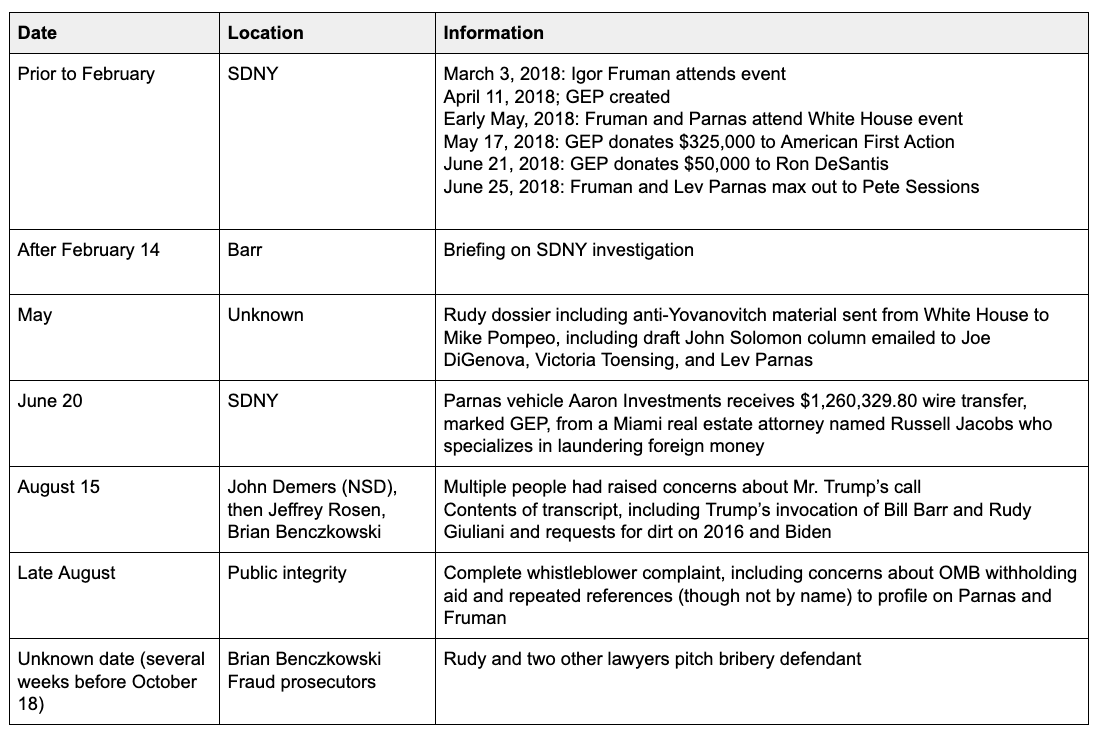
At the time DOJ reviewed the whistleblower complaint, DOJ knew:

  • Lev Parnas and Igor Fruman were funded by big money from a lawyer who specializes in laundering money through real estate for foreigners
  • They were spending those funds, via a shell company, to make big donations to Republicans (including $325,000 to Trump’s SuperPAC)
  • Those donations were tied to specific asks about Ukraine
  • Rudy was working with Parnas and Fruman to share disinformation with multiple parts of government
  • One goal of that disinformation — a successful one — was to get Marie Yovanovitch recalled

A search on Rudy’s name (or that of Parnas and Fruman, who were not named in the complaint but were included by multiple references in it to a profile on their operation), DOJ would have found all of this evidence, making it impossible to render the verdict — that no crime had been committed — that DOJ did. There’s simply no way a marginally competent assessment could have rendered that verdict.

And finding that evidence would have made it clear that Trump’s mention of Rudy’s shenanigans and Yovanovitch on the call tie his extortion to the crime SDNY was investigating (and has now charged).

Since that is public and obvious to anyone who knows how FBI is supposed to work, Main Justice has no choice but to show some interest in these crimes now or risk being part of the conspiracy.

Which is why DOJ is now telling Politico that the things they’ve previously said (which I’ve used to show that they affirmatively avoided connecting the dots in August) didn’t really mean what they obviously did mean at the time.

Additional attention to these issues has come from DOJ headquarters, which in August was tasked with examining Trump’s phone call asking Ukrainian President Volodymyr Zelensky to dig up dirt on the American leader’s political rivals. A statement released by DOJ spokeswoman Kerri Kupec in late September said the department’s criminal division reviewed the official record of the call “and determined, based on the facts and applicable law, that there was no campaign finance violation and that no further action was warranted.”

“All relevant components of the department agreed with this legal conclusion, and the department has concluded the matter,” Kupec said at the time.

A senior Justice Department official who spoke on condition of anonymity said Kupec’s Sept. 25 statement was limited to the campaign finance issue raised by a referral from the Intelligence Community Inspector General and was not intended to rule in or out the possibility of Justice officials examining any other legal issues related to the Trump-Zelensky call, if warranted.

If I were HJC, I’d submit a document request around the actions (not) taken in August — including DOJ’s failure to share the whistleblower complaint with the FEC, the same kind of conspiracy to prevent FEC from doing its job that the Russian trolls and Parnas and Fruman are being prosecuted for — and ask Michael Horowitz to review them. Because the efforts Main Justice is making now cannot undo the actions taken and not taken in August to prevent a thorough investigation of that complaint.

Share this entry

What Durham Might Be Looking At

Last night, the NYT and other outlets reported that the Durham probe has become a criminal investigation. While no outlets have reported precisely what crime Durham might be investigating, the news comes amid other news that may provide a clue. (I’m posting this without links for now, but will go back and try to add links later.)

Thus far, only a coerced Ukraine has fueled the foreign conspiracy theories

George Papadopoulos has been tweeting that his conspiracies will soon prove true. But thus far, other countries disagree. Multiple outlets have reported that Italy told the US that they had no ties to George Mifsud. Australia has said that the US has mischaracterized what Alexander Downer did, implying that he simply documented something suspicious (Papadopoulos bragging that Russia would help Trump) that was later shared with the FBI. The UK has said they have nothing more to share beyond what they shared in 2016, a memo stating that Christopher Steele was honest and persistent if a little too inclined to chase sources (like Oleg Deripaska) who weren’t worthwhile.

The one thing that Bill Barr’s field trips have come up with so far are dated Mifsud phones.

In short, aside from the corrupt oligarch-backed former Ukrainian prosecutors, no foreign country is backing Papadopoulos’ theories.

Horowitz announces he’s still working on the FISA IG Report, which will be lightly classified

The timing of the Durham investigation becoming a criminal probe coincides with Michael Horowitz’s announcement, to Congress, that he’s still working on the FISA IG Report, but that it will just be lightly redacted. It’s possible, then, that he made a criminal referral out of the report, and Durham is investigating that.

I can’t think of any genuinely criminal behavior that I expect to see in the report, unless Horowitz refers either Glenn Simpson or Christopher Steele for false statements, the former to Congress and the latter in court filings.

If Horowitz’s report is broader than that, however, it might include other referred conduct, such as the leak of either the existence of a transcript between Mike Flynn and Sergei Kislyak (which Sidney Powell has alternately claim came from someone at Office of Net Assessment or James Clapper, the latter of whom is an Original Classification Authority) or that Jim Comey briefed Trump on the Steele dossier (a reference in Powell’s latest suggests she thinks Josh Campbell is the source).

Clearly, Durham is examining several circumstances of how Stzok opened the investigation, such as that (because they wanted to act quickly in the wake of the publication of the WikiLeaks emails) he opened it on a weekend, and signed the authorization himself. Recent reports say he has expanded his scope to include events that preceded Mueller’s appointment, meaning he’s clearly looking at events in early 2017.

Sidney Powell insists, again, her expert intelligence officer client got duped

As I’ll note in a follow-up, Sidney Powell has submitted her latest filing arguing that Mike Flynn should be let free as an honest child. In some ways, it’s a less ridiculous filing than her past efforts, as she actually gets around to making allegations. Effectively, she is submitting her opening brief as the reply, perhaps in a concerted effort to prevent the government from pointing out all the gaping holes in it.

Ultimately, it sill comes down to a claim that poor Mike Flynn, who all agree is an accomplished liar, couldn’t handle an FBI interview without lying and lying and lying.

And as part of that, Powell submits more information proving that, whatever Strzok’s alleged animus towards Trump, he still treated Flynn with almost too much respect.

In short, there may be real crimes he’s investigating, or reconsidering past charging decisions, especially leaks.

But at least thus far, Durham has spent six months without corroborating the main conspiracy theories about the investigation.

Share this entry

How Trump Put Volodymyr Zelensky in a Public Box, After All

Some weeks ago, I predicted museums would one day display a copy of John Dowd’s letter describing how Lev Parnas and Igor Fruman — who was arraigned the other day, with the latter being represented by Paul Manafort’s lawyer in his NY State case — were in a nest of ethically ridiculous conflicts with Rudy Giuliani, the President, and Dmitry Firtash’s lawyers. Another document that will be displayed as a key record of history, I think, is William Taylor’s statement to Congress Monday, which WaPo managed to obtain and republish.

The whole thing is worthwhile. But I want to pay particular attention to what Taylor said about Trump’s demand that Volodymyr Zelensky state on the record his willingness to investigate the 2016 election and Joe Biden, because it changes the import of Trump’s decision to release the call transcript.

As Taylor describes it, he first learned of Trump’s demands regarding investigations on June 27, when Gordon Sondland told him about it. The next day, Sondland went to some lengths to prevent any contemporaneous transcript of a call with Zelensky, at which Sondland explained Trump wanted “cooperation on investigations to ‘get to the bottom of things'” (a line Trump would use in the July 25 call). Taylor would learn on July 19 that at a July 10 meeting (the one after which John Bolton accused Mick Mulvaney and Volker of setting up a drug deal), Sondland tied “investigations” to an Oval Office meeting with Trump. The same day he learned that, Sondland participated in a 3-way WhatsApp chat where Volker said that on an upcoming call, Zelensky should “say that he will help investigation–and address any specific personnel issues–if there are any” (another line that would appear in the July 25 call, this time parroted, though not as exactly, by Zelensky). The next day, Sondland told Taylor he had scripted Zelensky to say, “I will leave no stone unturned” on investigations (this particular line did not make it into the final call).

All that scripting (as well as more scripting from Sondland for Trump immediately beforehand) happened before the July 25 call.

In the call that Zelensky surely expected would remain private, he repeated much of what the back channel advisors had cued him to say. In addition to scolding Europe for not supporting Ukraine as well as the United States and providing assurances that he would and already had made personnel changes Trump wanted to see, Zelensky repeatedly agreed to cooperate on investigations.

I also plan to surround myself with great people and in addition to that investigation, I guarantee as the President of Ukraine that all the investigations.will be done openly and candidly. That I can assure you.

[snip]

I wanted to tell ·you about the prosecutor. First of all I understand arid I’m knowledgeable about the situation. Since we have won the absolute majority in our Parliament; the next prosecutor general will be 100% my person, my candidate, who will be approved, by the parliament and will start as a new prosecutor in September. He or she will look. into the situation, specifically to the company that you mentioned in this issue. The issue of the investigation of the case is actually the issue of making sure to restore the honesty so we will take care of that and will work on the investigation of the case. On top of that, I would kindly ask you if you have any additional information that you can provide to us, it would be very helpful for the investigation to make sure that we administer justice in our country with regard to the Ambassador to the United States from Ukraine as far as I recall her name was Ivanovitch. It was great that you were the first one who told me that she was a bad ambassador because I agree with you 100%.

[snip]

I also wanted to thank you for your invitation to visit the United States, specifically Washington DC. On the other hand, I also wanted to ensure you that we will be very serious about the case and will work on the investigation.

These assurances came in response to clear demands from Trump. First he asked for an investigation into 2016.

I would like you to do us a favor though because our country has been through a lot and Ukraine knows a lot about it. I would like you to find out what happened with this whole situation with Ukraine, they say Crowdstrike … I guess you have one of your wealthy people… The server, they say Ukraine has it. There are a lot of things that went on, the whole situation. I think you are surrounding yourself with some of the same people. I would like to have the Attorney General call you or your people and I would like you to get to the bottom of it. As you saw yesterday, that whole nonsense ended with a very poor performance by a man named Robert Mueller, an incompetent performance, but they say a lot of it started with Ukraine. Whatever you can do, it’s very important that you do it if that’s possible.

Then he made several demands that Zelensky investigate Biden.

The other thing, There’s a lot of talk about Biden’s son, that Biden stopped the prosecution and a lot of people want to find out about that so whatever you can do with the Attorney General would be great. Biden went around bragging that he stopped the prosecution so if you can look into it … It sounds horrible to me.

He then seems to demand that Zelensky reinstate Viktor Shokin, the corrupt prosecutor Biden (and much of international community) called to be fired.

I will have Mr. Giuliani give you a call and I am. also going to have Attorney General Barr call and we will get to the bottom of it. I’m sure you will figure it out. I heard the prosecutor was treated very badly and he was a very fair prosecutor so good luck with everything.

In the following weeks, as Trump’s Attorney General made at least four efforts to cover up a whistleblower complaint about this call, Trump made increasingly alarming (to Taylor) demands from Zelensky, even after he had provided the assurances he thought Trump wanted in this private call.

On August 16 — by which point DOJ had learned of the outlines of the whistleblower complaint from John Demers’ review of the transcript — Taylor learned that Andriy Yermak wanted to ask DOJ to make a formal request that Ukraine investigate Burisma (and, presumably, Hunter Biden).

Then, on September 1, after DOJ had already received the formal whistleblower complaint and as the risk of security cooperation initially withheld in mid-July would become permanent, Mike Pence refused to release it, instead renewing a request that Ukraine “do more to fight corruption.” Taylor also learned that Sondland had told Yermak that security assistance would not be released until Zelensky “committed to pursue the Burisma investigation.”  That’s when Sondland told Taylor that,

President Trump had told him that he wants President Zelenskyy to state publicly that Ukraine will investigate Burisma and alleged Ukrainian interference in the 2016 U.S. election.

Ambassador Sondland also tole me that he now recognized that he had made a mistake by earlier telling the Ukrainian officials to whom he spoke that a White House meeting with President Zelenskyy was dependent on a public announcement of investigations–in fact, Ambassador Sondland said, “everything” was dependent on such an announcement, including security assistance. He said that President Trump wanted President Zelenskyy “in a public box” by making a public statement about ordering such investigations.

That was one day before Acting Director of National Intelligence Joseph Maguire should have transmitted the whistleblower complaint to Congress. It was two days before OLC would write a memo, which it overclassified as Top Secret, claiming Maguire could ignore the law and withhold the complaint.

On September 8, Taylor would learn that even after (on Taylor’s request) Sondland tried to push back on Trump’s demands for a public statement from Zelensky, Trump sustained them, and so Sondland passed on that demand.

He said he had talked to President Trump as I had suggested a week earlier, but that President Trump was adamant that President Zelenskyy, himself, had to “clear things up and do it in public.” President Trump said it was not a “quid pro quo.” Ambassador Sondland said that he had talked to President Zelenskyy and Mr. Yermak and told them that, although this was no a quid pro quo, if President Zelenskyy did not “clear things up” in public, we would be at a “stalemate.” I understood a “stalemate” to mean that Ukraine would not receive the much-needed military assistance. Ambassador Sondland said that this conversation concluded with President Zelenskyy agreeing ot make a public statement in an interview with CNN.

[snip]

Ambassador Sondland tried to explain to me that President Trump is a businessman. When a businessman is about to sign a check to someone who owes him something, the businessman asks that person to pay up before signing the check.

Taylor, of course, immediately saw the game and laid a record. “nightmare is they give the interview and don’t get the security assistance. The Russians love it.”

Taylor, apparently without even knowing about the brewing fight over the whistleblower complaint, sent a text the next day, September 9, making it clear he understood this to be a quid pro quo. “I think it’s crazy to withhold security assistance for help with a political campaign.”

That same day, after three bipartisan Congressional requests had already been made to release the assistance, the Committees on Intelligence, Foreign Affairs, and Oversight wrote to the White House requesting documents related to “the actual or potential suspension of security assistance to Ukraine,” (which would heighten the impoundment risk).  And the next, September 10, Adam Schiff sent the first letter making it clear he knew of the whistleblower complaint DOJ was so actively suppressing.

On September 11, Trump released the funds.

Taylor spent the next several days trying to get assurances from Ukrainians that they would not follow through on the CNN interview they had agreed to, which Oleksandr Danyliuk agreed to on September 13.

And that’s where everyone seems to believe it ended, with Taylor managing to prevent Trump from getting what he wanted, a public announcement from Zelensky that he would carry out Trump’s dirty work, but was doing so willingly.

But that’s an entirely incorrect understanding of what happened. Indeed, Taylor alludes to as much when he describes what happened when Trump — under gathering pressure about the complaint — chose to release the transcript of the call. As Taylor described, it happened as Zelensky went into his meeting with Trump at the UN, and Ukraine got no notice Trump was going to do so.

On September 25, at the UN General Assmebly session in New York City, President Trump met President Zelenskyy face-to-face. He also released the transcript of the July 25 call. The United Staes gave the Ukrainians virtually no notice of the release, and they were livid.

While they were at the UN, Danyliuk, who’d been central to these negotiations, got fired.

The first question at the joint presser after their meeting was about the call, and Zelensky had little choice but to claim, dishonestly, that Trump had put no pressure on him.

We had good phone call. It was normal. We spoke about many things. I think, and you read it, that nobody pushed, pushed me.

By staging it that way — by responding to Congressional demands the way he did — Trump got what he wanted in the first place, and got it in a way that got far more publicity than a CNN interview. By putting Zelensky in this position, Zelensky had not choice but to agree that both the investigations Trump wanted — into 2016 and 2020 — were legitimate investigations and not, themselves, abject corruption.

Corrupt hacks like Trump and Putin make great efforts to undermine any claim that others — the West, the pre-Trump — have greater moral standing than they do. And by ensuring that within months after taking power, someone who won on a platform of reform was publicly humiliated into embracing corruption, it normalizes corruption and undercuts Zelensky’s independent base of authority.

And it was not just Zelensky that Trump displayed as a corrupt hack, either. Bill Barr has spent the last month denying that his own corrupt effort to undermine the Barr investigation had any tie to this call and the President’s extortion. With Barr, it likely doesn’t matter. He would have happily done that anyway. Barr’s effort aims to do precisely what Trump did in that presser, to paint a legitimate investigation into Russian organized crime as, itself, corrupt, all the while undermining the rule of law in this country. But by implicating Barr in his extortion attempt, Trump eliminated Barr’s ability to distance himself from the larger corrupt enterprise.

This was not, as many people imagine, about getting Zelensky to led credence to the claims about Biden, though that’s a side benefit. It was about upending the very notion of corruption.

And Trump got that, without even needing that CNN interview.

Share this entry

If the AG Is Involved in a Foreign Influence Operation, Does He Have to Register with Himself?

Way at the end of a CNN story on Rudy Giuliani’s grifters, Lev Parnas and Igor Fruman, this bombshell appears:

Two weeks ago when they were arrested, Parnas and Fruman were preparing to fly to Vienna, Austria, to meet Giuliani and another key figure in the impeachment investigation, Ukraine’s former prosecutor general Viktor Shokin, according to four sources familiar with their trip. Shokin is the same Ukrainian official who former Vice President Joe Biden — along with other Western leaders — had pushed to have removed over concerns he wasn’t prosecuting corruption.

While questions in Washington swirl around Shokin’s role in this controversy, Giuliani, Parnas, Fruman had specific plans for the former Ukrainian official up until the day of their arrest. According to those four sources, they told others they were headed to Vienna to help with a planned interview the next day: Shokin, they said, was scheduled to do an interview from the Austrian capital with Sean Hannity.

Through a spokesperson, Hannity said that “we never reveal our sources, potential sources, or persons they may or may not request to interview. Sean Hannity takes the first amendment seriously.”

The bullshit about how the First Amendment is why he’s not revealing his “potential source” who the TV star would have interviewed on TV got added overnight.

The news that Hannity was only saved from being a part of this influence operation by the arrest of two of its key players is news enough. But it dramatically changes the import of this news — that the night before this interview was scheduled, and after meeting with SDNY that same day, and probably after the grifters had been arrested as they tried to leave the country, the Attorney General of the United States had a meeting with Rupert Murdoch at the latter’s home.

Attorney General William P. Barr met privately Wednesday evening with Rupert Murdoch, the media mogul who is one of President Trump’s frequent confidants but whose Fox News is viewed by the president as more hostile toward him than it used to be.

The meeting was held at Mr. Murdoch’s home in New York, according to someone familiar with it. It was unclear if anyone else attended or what was discussed. Aides to both Mr. Murdoch and Mr. Barr declined requests for comment on the meeting.

So the presumed schedule for the players looks like this:

Lunch: Rudy meets with the grifters across the street from DOJ

Before the arrest: Barr informed they would be arrested (he met with SDNY that day)

Roughly 6:30: SDNY has the grifters as they prepare to fly to Vienna using one way tickets

After the arrest: Barr meets privately with Sean Hannity’s boss

This story from Parnas and Fruman’s arraignment yesterday revealed that SDNY has been monitoring twelve different phone lines.

Assistant U.S. Attorney Rebekah Donaleski told Oetken that evidence in the case that will need to be turned over to the defense was “quite voluminous.” She mentioned about 50 bank accounts and more than a dozen cell phones that were monitored in some fashion, as well as search warrants and subpoenas.

Admittedly, this number is across four different defendants (thus far), but twelve is a lot, and that word, “monitor” sure sounds like wiretapping. Which may be why Rudy is finally shopping for a defense attorney.

Wiretaps might be the kind of thing SDNY would brief Barr on if he met with prosecutors the day of the arrest. Prosecutors might also tell Barr what kind of high profile people had been caught up on the grifters’ encrypted texts, as Hannity was with Paul Manafort. In either case, it is virtually certain that Hannity was caught in the surveillance of the grifters, even if contacts between him and Rudy weren’t already obtained.

It looks bad, but given how much Barr has mainlined Fox propaganda over the last two decades, it wouldn’t be surprising if Barr attempted to protect the propaganda channels’ top entertainer.

All of which leads me back to something else: the Attorney General’s very narrow denials that he was pursuing Ukrainian dirt in the wake of the release of the Trump-Zelensky call on September 25.

At the end of August, when two top intelligence officials asked a Justice Department lawyer whether a whistle-blower’s complaint should be forwarded to Congress, they were told no, Attorney General William P. Barr and his department could handle the criminal referral against the president of the United States.

About four weeks later, the department rendered its judgment: President Trump had not violated campaign finance laws when he urged Ukraine’s president to work with Mr. Barr to investigate a political rival, former Vice President Joseph R. Biden Jr.

[snip]

The rough transcript showed that Mr. Trump believes he has that man. In a single sentence during the call with Ukraine’s leader, Mr. Trump said that he would have Rudolph W. Giuliani, his personal lawyer, and Mr. Barr reach out to help further an investigation of Mr. Biden and his younger son, Hunter Biden, who had served on the board of a Ukrainian corporation.

“I will have Mr. Giuliani give you a call, and I am also going to have Attorney General Barr call, and we will get to the bottom of it,” Mr. Trump said.

A Justice Department official said that Mr. Barr had no knowledge of the call until the director of national intelligence and the intelligence community’s inspector general sent the department the whistle-blower’s criminal referral late last month, and that Mr. Trump has not spoken with the attorney general “about having Ukraine investigate anything relating to former Vice President Biden or his son.”

Mr. Trump has not asked Mr. Barr to contact Ukraine for any reason, Mr. Barr has not communicated with Ukraine on any topic, and Mr. Barr has not spoken with Mr. Giuliani about the president’s phone call “or anything relating to Ukraine,” a Justice Department spokeswoman, Kerri Kupec, said in a statement.

[snip]

But Mr. Barr is also closely overseeing a review of the intelligence community’s decision to start a counterintelligence investigation into the Trump campaign during the 2016 election, which is being led by John Durham, the United States attorney in Connecticut. As part of that review, Mr. Durham is exploring what role, if any, a number of countries including Ukraine played in the investigation of the Trump campaign.

“While the attorney general has yet to contact Ukraine in connection with this investigation, certain Ukrainians who are not members of the government have volunteered information to Mr. Durham, which he is evaluating,” Ms. Kupec said.

According to DOJ, the following is true (or was true, as of September 25):

  • Barr had no knowledge of the call until Joseph Maguire sent the whistleblower complaint “late last month” (subsequent reporting probably moves that date back to when John Demers reviewed the transcript on August 15, and not knowing about the call is not the same thing as not knowing about the extortion attempt)
  • Trump has not spoken to Barr “about having Ukraine investigate anything relating to former Vice President Biden or his son,” which doesn’t exclude Trump asking Barr to investigate 2016, which is what the transcript more directly references
  • Trump has not asked Mr. Barr to contact Ukraine for any reason, nor has Barr communicated with Ukraine (multiple reports have noted that Barr’s wild goose chase has largely bypassed official legal request channels, which would present problems regarding the admissibility of any evidence he receives, but also would be consistent with the public reporting that he is pursuing Ukrainian dirt outside of official channels)
  • Barr has not spoken with Rudy about the call “or anything relating to Ukraine,” which doesn’t address whether he has addressed other sources of disinformation with Rudy, nor does it say whether Barr has communicated to Rudy via other channels or received a dossier of disinformation on Ukraine, sent by Rudy on White House stationary, as Pompeo did
  • Certain Ukrainians who are not members of the government have volunteered information to Mr. Durham, which he is evaluating;” this does not exclude Barr speaking to these same Ukrainians, as Barr has been with so many other parts of his wild goose chase, nor does it exclude Barr learning of the Ukrainians when he took a meeting with Joseph DiGenova and Victoria Toensing to discuss the Ukrainian oligarch whose bid to beat a bribery charge involves disinformation created by Viktor Shokin, the guy Hannity was going to interview

Given this narrow denial, it would be more likely than not that Barr knew of Firtash’s effort to use Shokin’s claim that he was unfairly targeted and encouraged John Durham to reach out to Shokin, to say nothing of several other pieces of disinformation Rudy has been floating.

What is absolutely certain, though, is that DOJ’s narrow denial in no way denies that Barr’s wild goose chase has incorporated materials that Rudy obtained as a result of the extortion attempt with Ukraine.

Indeed, back in the halcyon days before the grifters were arrested, frothy right wingers — up to and including close Rudy associate Michael Mukasey — keyed on DOJ’s confirmation that Durham was reviewing materials from Ukraine, as if that validated Rudy’s efforts. Back before Parnas and Fruman were arrested, the frothy right boasted that Durham had received these Ukrainian “leads.”

Which may be why Bill Barr’s DOJ did two things — consider the call transcript, and not the full whistleblower complaint, as the referral, and not forward the complaint to FEC as required under a standing MOU — that prevented others from identifying the ties between Parnas and Fruman (whom DOJ has repeatedly said Barr knew were being investigated) and the President’s July 25 call. To say nothing of the way his OLC treated his implication by the call as Top Secret, even though the White House itself considered it less classified.

Already, we have three solid pieces of evidence that Bill Barr’s DOJ engaged in a cover-up in a failed attempt to prevent anyone from tying the Parnas and Fruman influence campaign, his own wild goose chase, and the President’s extortion of Ukraine together.

But if Barr shared information learned about an ongoing investigation to prevent Hannity from embarrassment or even legal jeopardy, that would be a far more significant step.

Update: In the wake of Mick Mulvaney’s confirmation that Trump withheld duly appropriated funding from Ukraine to coerce it to cooperate in the Durham investigation, three different outlets did articles on what Durham is up to (NYT, NBC, CNN). Although all three provided new details on the investigation generally, none provided details describing from which Ukrainians Durham has received information.

Share this entry

GOP Republicans Stage Brooks Brothers Riot 2.0 to Emasculate Their Own Power of the Purse

Twenty-some Republican Congressmen (and a few women) are staging a repeat Brooks Brother riot to stall the ongoing impeachment proceeding. I’ll post a picture if I find an open source one, but the riot is being led by Matt Gaetz and includes, among others:

  • Minority Whip Steve Scalise
  • Steve King
  • Louie Gohmert
  • Andy Biggs
  • Bradley Byrne
  • Mark Walker
  • Mo Brooks
  • Debbie Lesko
  • Alex Mooney
  • Michael Waltz

Some of the members stormed into the House SCIF with their cell phones, which is a violation of strict rules and may degrade the effectiveness of the SCIF. Reportedly, Republican Mike Conaway of Texas has started collecting the electronics of his colleagues.

The riot has delayed the testimony of Deputy Assistant Secretary of Defense Laura Cooper.

That’s significant–symbolic even. That’s because Cooper is expected to testify on DOD’s response to Trump’s illegal refusal to withhold funds duly appropriated by Congress.

House panels leading the impeachment inquiry are set to hear Wednesday from a Pentagon official responsible for policy toward Ukraine, who is expected to testify about the delay in nearly $400 million in security assistance to the country.

Laura Cooper, deputy assistant secretary of defense for Russia, Ukraine, and Eurasia, will be the first Defense Department official to testify before investigators, who have largely heard from State Department officials so far in the investigation. Ms. Cooper arrived at the Capitol on Wednesday morning.

The hold on the aid to Ukraine is at the center of the House’s impeachment inquiry into whether President Trump conditioned the funding for Ukraine on his request to Ukranian President Volodymyr Zelensky that Ukraine investigate former Vice President Joe Biden, and his son, Hunter Biden, as well as alleged Ukrainian interference in the 2016 U.S. election.

The White House’s hold on military aid to Ukraine this summer set off alarms at the Pentagon, according to people familiar with the matter. Ms. Cooper’s exact role in the Defense Department’s effort to push back on the hold on the money, which was ultimately released in mid-September, isn’t known.

After the White House communicated the hold to the Defense and State Departments in July, the Pentagon conducted an internal review of the legality of the hold, according to three people familiar with the matter. Pentagon officials argued that the administration couldn’t block money approved by Congress, delivering their analysis to career White House budget office officials at a July meeting, according to two of the people and another person familiar with the matter.

In short, a bunch of Republican Congressmen (and a handful of women) are staging a faux riot in order to prevent DOD from telling Congress how the White House prevented them from following the law that prohibits the White House from withholding funds without a good reason that they share with Congress.

As I’ve said, even these people’s former colleague, Chief of Staff Mick Mulvaney, has admitted this is a crime.

I know this entire inquiry has stirred up a lot of partisan bickering. But it is stunning that Republicans in Congress, including Minority Whip Steve Scalise, are so desperate to protect Trump that they are trying to prevent Congress from asserting its power of the purse.

There could be no more symbolic self-emasculation than this faux riot. And yet, these members of Congress apparently are willing to trade away their own power like this.

Update: According to a press release released yesterday, here’s who was part of the Brooks Brothers The Farce. Those marked with asterisks are on committees conducting the inquiry, so they’re basically complaining about a process they’re a part of. Those marked with checks were around in 2017 and voted for a rule holding that such protests on the House floor (to say nothing of inside HPSCI’s SCIF) were a violation of House Rules.

  1. Matt Gaetz√
  2. Steve Scalise√
  3. Brian Babin√
  4. Andy Biggs√
  5. Mo Brooks√
  6. Ken Buck√*
  7. Bradley Byrne
  8. Buddy Carter√
  9. Ben Cline
  10. Jeff Duncan√
  11. Drew Ferguson√
  12. Russ Fulcher
  13. Louie Gohmert√
  14. Paul Gosar√*
  15. Mark Green*
  16. Vicky Hartzler√
  17. Kevin Hern
  18. Jody Hice√*
  19. Duncan Hunter√
  20. Bill Johnson√
  21. Jim Jordan√*
  22. Fred Keller*
  23. Steve King√
  24. Debbie Lesko
  25. Carol Miller*
  26. Alex Mooney√
  27. Markwayne Mullin√
  28. Ralph Norman*
  29. Mark Walker√
  30. Mark Meadows√*
  31. Greg Murphy
  32. Peter Olson√
  33. Gary Palmer√
  34. Scott Perry√*
  35. David Rouzer√
  36. Ross Spano
  37. Michael Waltz
  38. Steve Watkins
  39. Randy Weber√
  40. Ron Wright*
  41. Lee Zeldin√*

Also note that the rules Adam Schiff is using for this inquiry are similar to the rules that Mark Meadows used for the investigation of the Russian investigation that he, Gaetz,  Jordan, and Gowdy did last year.

Update: Fixed the gender references as there are a few women who participated.

Share this entry