The WikiLeaks Conspiracy: The Government Prepares to Argue WikiLeaks Has Always Been an Organized Crime Syndicate

Last June, I ran into some folks who remain very close to Julian Assange. One of them scheduled dinner with me solely to scold me for writing honestly about the things that WikiLeaks had done in the past three years rather than focusing exclusively on the EDVA Espionage indictment charging Assange for things he did almost a decade ago.

The person complained that my factual reporting on 2016 election and — especially — the Vault 7 leak (I think this was the offending post) would undercut whatever unanimity there was among journalists (unanimity that I joined) that the existing charges against Assange were a dangerous precedent for actual journalists. Reporting true details about shitty things Assange had done in recent years on my humble little blog, it was claimed, would dangerously and singlehandedly undercut Assange’s defense.

No, I did not much appreciate the irony of being criticized for accurate reporting by someone purportedly defending journalism.

But I also thought the concerted effort to suppress what Assange had done recently, while perhaps necessary to generate the statements of support from journalists that were forthcoming, was short-sighted, because it misrepresents what Assange is actually facing. The grand jury in EDVA remains (as far as we know) active. The government specifically said, in June, that it needed Chelsea Manning’s testimony for subjects or charges not yet charged and said such charges were not time barred (as would be true of any ongoing conspiracy).

As the government’s ex parte submissions reflect, Manning’s testimony remains relevant and essential to an ongoing investigation into charges or targets that are not included in the superseding indictment. See Gov’t’s Ex Parte Mem. (May 23, 2019). The offenses that remain under investigation are not time barred, see id., and the submission of the government’s extradition request in the Assange case does not preclude future charges based on those offenses, see Gov’t’s Supplement to Ex Parte Mem. (June 14, 2019).

Since then, Jeremy Hammond has joined Manning in believing he can wait out whatever EDVA has in store.

Most of all, Joshua Schulte’s prosecution for the Vault 7 leak — a leak almost no WikiLeaks supporters I know will offer an enthusiastic defense of — kept chugging along. In recent weeks, Schulte has submitted a number of questionable filings claiming the dog ate his homework so he can’t be prepared in time for his trial:

  • The attorney appointed after defense attorneys said they needed one more attorney to prep for trial in time said he couldn’t prep for trial in time, but can’t talk about why not until he’s done with a week-long vacation
  • The government’s (admittedly long) motion in limine repeating details the government disclosed several times before took the defense by surprise
  • The defense can’t make a constitutional challenge to CIPA generally until the judge rules on CIPA specifically (this is the one arguably reasonable request)
  • The defense had no idea the government wasn’t claiming Schulte downloaded a terabyte of data onto a thumb drive that can’t hold that terabyte even though the government told the defense that a year ago and then again in November

But as of now, Schulte’s trial is due to start on January 13, a month and a half before Assange’s first substantive extradition hearing starting on February 25.

And at that trial, the government is preparing to argue that Schulte intended to harm the United States when he leaked these files to WikiLeaks, a stronger level of mens rea than needed to prove guilt under the Espionage Act (normally the government aims to prove someone should have known it could cause harm, relying on their Non-Disclosure Agreements to establish that), and one the government has, in other places, described as the difference between being a leaker and a spy.

To make that argument, the government is preparing to situate Schulte’s leaks in the context of prior WikiLeaks releases, in a move that looks conspicuously like the kind of ongoing conspiracy indictment one might expect to come out of the WikiLeaks grand jury, one that builds off some aspects of the existing Assange indictment.

In a motion opposing Schulte’s effort to disqualify Paul Rosenzweig as an expert witness (see this post for background), the government lays out some of the things it plans to have Rosenzweig explain to the jury. Some of this is dangerous criminalization of security, most notably tying WikiLeaks’ endorsement of Tor and Tails to Schulte’s own use of it.

But some of it fleshes out the scope the government laid out when it first requested to call Rosenzweig.

The Government recognizes the need to avoid undue prejudice, and will therefore limit Mr. Rosenzweig’s testimony to prior WikiLeaks leaks that have a direct relationship with particular aspects of the conduct relevant to this case, for example by linking specific harms caused by WikiLeaks in the past to Schulte’s own statements of his intent to cause similar harms to the United States or conduct. Those leaks include (i) the 2010 disclosure of documents provided to WikiLeaks illegally by Chelsea Manning; (ii) the 2010 disclosure of U.S. diplomatic cables; (iii) the 2012 disclosure of files stolen from the intelligence firm Stratfor; and (iv) the 2016 disclosure of emails stolen from a server operated by the Democratic National Committee.

For example, it will tie WikiLeaks’ failure to redact the identities of US sources in Chelsea Manning’s leaks — something charged in counts 15 through 17 of Assange’s indictment — to Schulte’s behavior. It sounds like Rosenzweig will explain something I’ve alluded to: WikiLeaks apparently left the names of some of Schulte’s colleagues unredacted, which given WikiLeaks’ big show of redacting the files could only have been intentional and would have required coordination with Schulte to do.

Mr. Rosenzweig will testify that WikiLeaks does not typically redact the information that it publicly discloses (even when that information may reveal confidential sources). The Government will introduce evidence, however, that the Classified Information was purportedly redacted when posted online. Mr. Rosenzweig’s testimony will help the jury understand the significance of WikiLeaks’ unique claim to have redacted the Classified Information, including, for example, the period of delay between when Schulte disclosed the Classified Information to WikiLeaks (in or about the spring of 2016) and when WikiLeaks first announced that it would begin to disclose the Classified Information (in or about the spring of 2017). [my emphasis]

One reason Assange made a show of redacting the identities was because he was attempting to extort a pardon at the time, so he had to appear willing to negotiate with DOJ. But it seems likely Rosenzweig will explain that that was just a show and that even as WikiLeaks was making that show it was also ensuring that other CIA SysAdmins might be targeted by foreign governments.

Likewise, Rosenzweig will tie the embarrassment caused by Manning’s releases to Schulte’s own intent to cause damage with his self-described Information War against the US.

The Government intends to introduce evidence (including his statements) of Schulte’s knowledge of Manning’s leak and the need for the U.S. government to maintain secrecy over certain information. Furthermore, the Government also plans to introduce evidence of how Schulte, from the Metropolitan Correctional Center (the “MCC”), declared an “information war” against the United States, pursuant to which he intended to publicly disclose classified information and misinformation, including through WikiLeaks (such as the Fake FBI Document), for the purpose of destroying the United States’ “diplomatic relationships,” and encouraged other U.S. government employees to disclose confidential information to WikiLeaks. Mr. Rosenzweig will explain to the jury generally information other leakers have transmitted to WikiLeaks that the organization published and how foreign governments reacted negatively to WikiLeaks’ disclosure of that information—leading, for example, to the highly-publicized resignation of the U.S. Ambassador to Mexico.

Effectively, the government will argue that if you want to conduct an Information War on the US, you choose to leak to WikiLeaks and ensure it will be as damaging as possible. Whatever the circumstances of Manning’s leaks, this uses Schulte’s stated desire to damage the US to retroactively taint what WikiLeaks has claimed in the past was mere journalistic exposure of wrong-doing. That doesn’t necessarily change the First Amendment danger in charging Assange. But it surely attempts to undercut WikiLeaks’ brand as a journalistic entity.

Most interestingly, the government will point to a claim Schulte made to a journalist while writing from jail (one that is plausible given some of his past public postings, but if true, is an unfathomable indictment of CIA’s vetting process) that he once belonged to Anonymous. Rosenzweig will tie this to Anonymous’ decisions to leak the Stratfor cables to WikiLeaks in 2012.

As described in the Government Motions in Limine, in encrypted communications from one of the Contraband Cellphones, Schulte (posing as a third person) stated that he had previously been a member of Anonymous, a group of online hacker activists. Mr. Rosenzweig will testify about how, in 2012, Anonymous and WikiLeaks worked together to release information from a private U.S. intelligence firm.

Of course, Anonymous didn’t just leak the Stratfor cables to WikiLeaks. They also shared files stolen during the Arab Spring and the Syria files. The latter leak provides one of the earliest indicators where the process by which WikiLeaks obtained files may have involvement of Russia, because somehow a file that would have been very damning for Russia never got published. But both would make the story the US wants to tell more complex (though still potentially consistent).

In any case, the focus on Stratfor may explain why the government is holding Jeremy Hammond in contempt to try to get him to testify in the EDVA grand jury, particularly if the government has reason to believe that Schulte was part of that hack.

Finally, the government will use Rosenzweig to explain how, in the wake of the DNC leak and at a time he was in a huff at his CIA bosses again, Schulte did … something in August 2016.

The Government intends to introduce evidence that Schulte transmitted the Classified Information to WikiLeaks in the spring of 2016, that WikiLeaks did not begin to disclose the Classified Information until March 2017, that Schulte was angry with CIA management in August 2016 over a performance review he received, that Schulte’s protective order against Employee-1 was vacated in August 2016, and that, around that same time (i.e., in August 2016), Schulte began to conduct extensive research online about WikiLeaks. The Government intends to offer evidence relating to those searches, including the specific queries Schulte conducted. Schulte has argued in his writings that his August 2016 research was related to WikiLeaks’ August 2016 disclosure of information stolen from a Democratic National Committee server (the “DNC Leak”). Mr. Rosenzweig will testify about the DNC Leak, including the type of information that WikiLeaks actually disclosed in connection with that leak, which will demonstrate why Schulte’s WikiLeaksrelated searches include queries that had nothing to do with the DNC Leak

Side note: Part of the media blitz Assange did in the wake of the DNC leaks included a claim to Chuck Todd that if WikiLeaks ever received information from US intelligence, they would publish it.

Well, it’s a meta story. If you’re asking would we accept information from U.S. intelligence that we had verified to be completely accurate, and would we publish that, and would we protect our sources in U.S. intelligence, the answer is yes, of course we would.

No one else would have, but Schulte would presumably have recognized this as a nod to him, reassurance provided on heavily watched TV that WikiLeaks was progressing towards releasing the files Schulte had leaked. Which is why the likelihood that Schulte also stole a single file reflecting CIA collecting information on who might win the 2012 French presidential election, which WikiLeaks subsequently falsely portrayed as proof that CIA had infiltrated political parties in France rather than asked well-placed sources for readily available information, is of particular interest.

The government, however, is going to point to other Google searches by Schulte from August 2016 that lump Edward Snowden and Shadow Brokers in with WikiLeaks.

For example, in addition to searching for information about WikiLeaks and Julian Assange, its primary leader, Schulte also conducted searches using the search terms “narcissist snowden,” “wikileaks code,” “wikileaks 2017,” “shadow brokers,” and “shadow broker’s auction bitcoin.” “Snowden” was presumably a reference to Edward Snowden, the former NSA contractor who disclosed information about a purported NSA surveillance program, and “Shadow Brokers” was a reference to a group of hackers who disclosed online computer code that they purportedly obtained from the NSA, beginning in or about August 2016.

I have long wondered whether Vault 7 was not a free-standing leak but instead part of the Shadow Brokers operation.  This seems to suggest the government knows they are. If that’s right, it would suggest that in the period when the government was trying to figure out precisely what Russia had done in 2016, both the NSA and CIA’s ability to spy on Russia (and other countries) would have been been deliberately burnt to the ground. And if Schulte knowingly participated in that — in an effort to ensure that the US would struggle to even learn what Russia had done in 2016 — it would explain why they’re planning on arguing he is more of a spy than a leaker.

Which would, in turn, explain why they took the first steps towards arresting Assange as FBI started putting together the evidence needed to charge Schulte on these leaks in 2017.

Let me be clear: I’m not saying I’m sure they’ll fill all these details in a superseding Assange indictment (though the government said it could not provide Assange the underlying evidence even for the 2010 charges until around Christmas — at which point Schulte will have gone through the CIPA process of declassifying classified information for use in his defense, and they could add charges at least until the February 25 hearing). It may still be that the government won’t want to get into the level of classified detail they’d need to to flesh out that case, particularly if they can’t coerce Manning and Hammond to cooperate.

I’m also not making a normative judgment that this eliminates the very real problems with the way Assange is charged now. Without seeing the government’s case, it’s too soon to tell.

What I’m trying to do is lay out what the government seems to be preparing to argue about WikiLeaks in the Schulte case. No doubt this will get me invited for another stern scolding at dinner, but it’s time to stop pretending Assange is being prosecuted for the understanding of WikiLeaks that existed in 2010. By all means, people can and will still defend Assange for taking on an imperialist America. For much of the world (though presumably not among any Five Eyes governments, including Assange’s home country), that still makes him an important dissident taking on a superpower. There is some merit to that stance, but it also requires arguing that superpowers shouldn’t have democratic elections.

But the government is preparing to argue that, after helping Russia tamper in America’s election, WikiLeaks deliberately burned some of CIA’s collection abilities to the ground, making it harder for the US to figure out how Russia did so. The government is preparing to argue that such actions are consistent with what WikiLeaks has been up to since 2010.

I’ve been expecting we might see an indictment alleging WikiLeaks and its associates were and remain engaged in an ongoing conspiracy (a possibility that, if Manning and Hammond’s lawyers haven’t warned them about, they are being utterly negligent, because the government could well argue that obstructing this investigation by refusing to provide immunized testimony is an overt act furthering the conspiracy).

The citations the government has used to justify Rosenzweig’s testimony are heavily focused on terrorism and mob cases (United States v. Farhane and United States v. Mustafa, which are al Qaeda cases; United States v. El Gammal, which is an ISIL one, and United States v. Rahimi, the self-radicalized Chelsea bomber; United States v. Lombardozzi and United States v. Locascio which are Gambino cases, United States v. Amuso, a Lucchese case), including one RICO case. That’s undoubtedly why Schulte’s lawyers really want Rosenzweig’s testimony excluded, to avoid having WikiLeaks treated like an organized crime syndicate.

But if the government is preparing to claim that WikiLeaks worked with Schulte not only to obtain files it tried to use to extort a pardon but then released them in a way that would hurt America’s efforts to respond to Russia’s 2016 operation, that’s a pretty compelling analogy.

Update: After comments from Stefania Maurizi, I’ve rephrased how I described what happened with the Syria Files. I want to be clear the statement in the post was not based on what I’ve been told by reliable sources about the process by which those files got shared with WikiLeaks.

As I disclosed last year, I provided information to the FBI on issues related to the Mueller investigation, so I’m going to include disclosure statements on Mueller investigation posts from here on out. I will include the disclosure whether or not the stuff I shared with the FBI pertains to the subject of the post. 

Share this entry

Joshua Schulte: The Alleged Vault 7 and CIA Election Spying Leaker?

I’m preparing a post showing that the government is preparing to lay out WikiLeaks as a decade-long ongoing conspiracy (whether or not they’re planning on charging anyone with that).

Before I do, I wanted to correct an error I’ve made throughout my coverage of accused Vault 7 source Joshua Schulte. That’s how I’ve always referred to him, as the guy who stole CIA’s hacking tools and leaked them all to WikiLeaks.

But that’s almost certainly not all the government believes he leaked.

Weeks before the actual Vault 7 leak, remember, WikiLeaks published a one-off file purporting to show CIA “espionage” on the 2012 French election. It purported to show that CIA had conducted both SIGINT and HUMINT on France’s political parties, with an emphasis on the left and the right.

All major French political parties were targeted for infiltration by the CIA’s human (“HUMINT”) and electronic (“SIGINT”) spies in the seven months leading up to France’s 2012 presidential election. The revelations are contained within three CIA tasking orders published today by WikiLeaks as context for its forth coming CIA Vault 7 series. Named specifically as targets are the French Socialist Party (PS), the National Front (FN) and Union for a Popular Movement (UMP) together with current President Francois Hollande, then President Nicolas Sarkozy, current round one presidential front runner Marine Le Pen, and former presidential candidates Martine Aubry and Dominique Strauss-Khan.

But what the document actually showed is analysis of what might happen in the upcoming election, with some questions to ask, but questions that could easily be answered by wandering around the campus of Science Po, and would likely not be answered by infiltrating a campaign.

Nevertheless, in the wake of the Russian hack of the US, critics of America who took note of this thoroughly uninteresting document might misrepresent it as proving that the US still does what Russia did, even to our close allies.

WikiLeaks, significantly, claimed that this document provided context for the upcoming Vault 7 drop, even though it did no such thing.

The document, which as I said, the government likely will argue also came from Schulte, is significant for two reasons.

According to several documents in his case, he stole the Vault 7 files in May 2016, in a fit of anger over not getting his way.

But then, in August 2016, he started searching on WikiLeaks.

Around this time, Schulte also began regularly to search for information about WikiLeaks. In the approximately six years leading to August 2016, Schulte had conducted one Google search for WikiLeaks. Beginning on or about August 4, 2016 (approximately three months after he stole the Classified Information), Schulte conducted numerous Google searches for WikiLeaks and related terms and visited hundreds of pages that appear to have resulted from those searches.

Also in August 2016, he researched how to use throwaway emails and how to use Tails again.

It seems likely the government believes — though may not have proof — that the French election file also came from Schulte, but that he stole it in August, after WikiLeaks had released the DNC emails. If so, it seems that this file was something Schulte stole to help WikiLeaks justify its DNC dump. Perhaps even, as some files charged in the Assange indictment, this was something WikiLeaks requested.

The government is going to show that Schulte was closely involved in the way WikiLeaks released the Vault 7 files. And WikiLeaks and Schulte continued to cooperate closely after that. But it also now seems clear they plan to argue that Schulte stole files precisely to make WikiLeaks’ 2016 cooperation with Russia look less damning.

Share this entry

DOJ Flips the Lawfare on Its Head in Russian Troll Case

In part because Judge Dabney Friedrich has only recently attempted to impose some control on the case, the prosecution against the Russian troll company Concord Management waddles slowly towards a scheduled trial date of April 6, 2020. As it has throughout this process, Concord continues to make trollish arguments to gum up the prosecution. Of particular note, it continues its efforts to use the prosecution to obtain as much information as it can, including information about intelligence the government has on Concord as well as on the victims.

Don’t get me wrong. That is their right, and one of the dangers of indicting corporate entities for this kind of crime.

But the government just gave Concord a bit of its own medicine. On Tuesday, it moved to obtain an early trial subpoena to serve on Concord. It seeks information on Concord’s communications with the Internet Research Agency, other shell companies, and a list of co-conspirators. Perhaps most concerning, for Concord’s sometime owner Yevgeniy Prigozhin, it asks for his calendar from January 2014 through February 2018, a calendar that — if it’s accurate — likely includes Vladimir Putin.

Calendar entries for Yevgeniy Prigozhin for the time period January 1, 2014 to February 1, 2018.

The motion uses precisely the legal fact that allowed Concord to respond to this indictment with no risk to any biological person against it, arguing that because it is a corporation it has no Fifth Amendment privilege.

Moreover, even though it is a defendant, Concord cannot avoid responding to a trial subpoena requesting the production of records under the Fifth Amendment because corporations have no privilege against self-incrimination. Braswell v. United States, 487 U.S. 99, 102 (1988).

Understand, the government almost certainly has versions of all the things it asks for on the list. But assuming Friedrich approves the subpoena, Concord will be required to submit its own version of these documents, which the government might be able to prove to be false (adding to Concord’s legal jeopardy and putting Concord’s American lawyers on the hook). It’s also likely the government is forcing Concord to do its own parallel construction.

It’s a subtle move, but one that may shift how this proceeds going forward.

Share this entry

Speaker Pelosi Goes from Slow-Walking to Sprinting

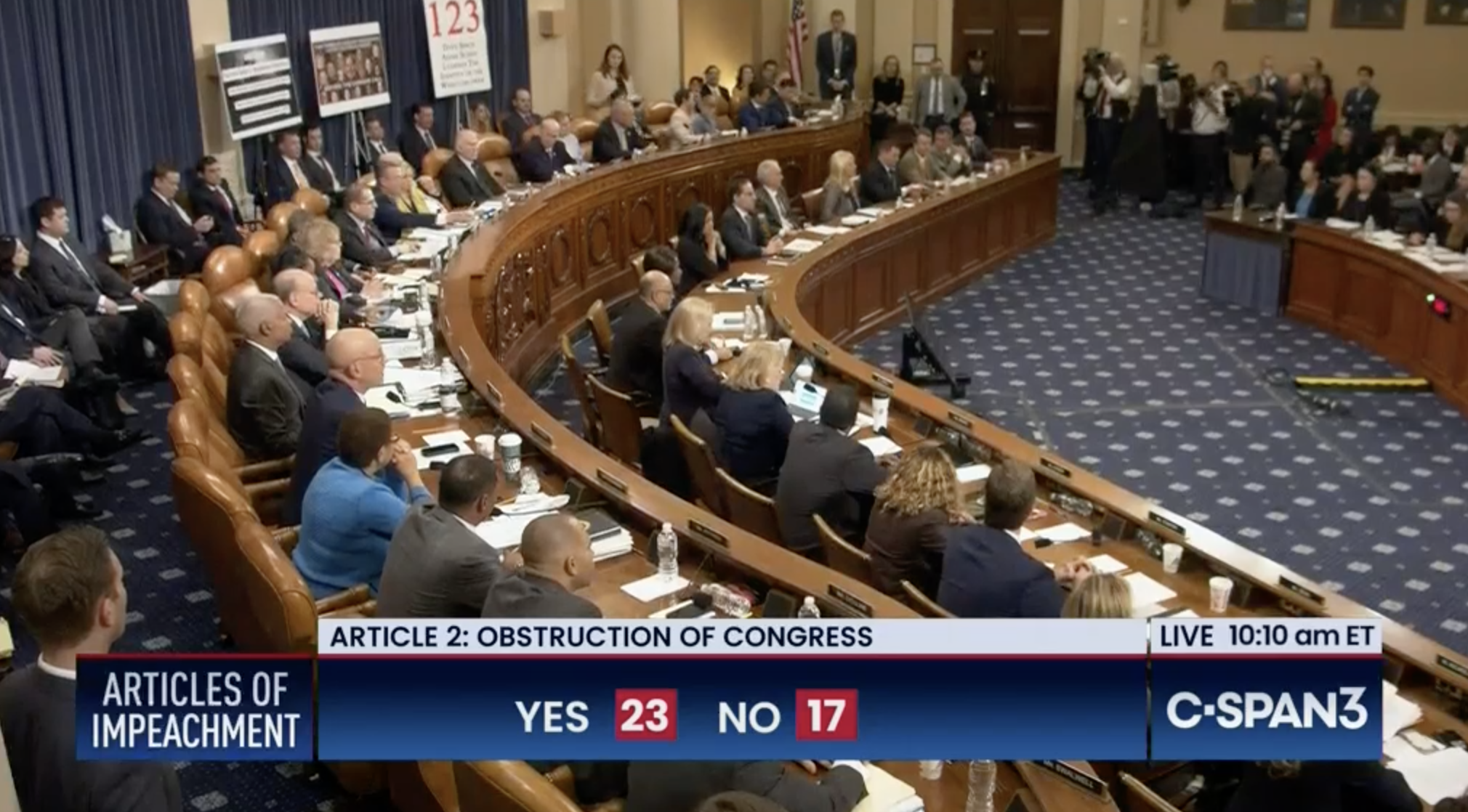
This morning, Nancy Pelosi announced she’s asking Jerry Nadler and Adam Schiff to draw up articles of impeachment against Donald Trump.

Both reports on scheduling from members of HJC and Congress generally as well as reporting from CNN suggest Pelosi intends a very quick schedule for this process: articles drawn up this weekend, a vote in HJC next week, then a full vote before Christmas.

This is a mistake, in my opinion. I think Pelosi should bump this schedule out to early February. I say this not out of any fondness for delay, but because several things will or are likely to happen in the interim that would make impeachment more thorough.

The first is a ruling on Don McGahn’s testimony. I think the case on impeaching Trump for obstructing the Mueller investigation should most importantly focus on his abuse of the pardon power, not least because preventing a Trump pardon may give Paul Manafort and Roger Stone reason to grow more chatty. But McGahn’s testimony, describing how Trump asked him to falsify a record to cover up the fact that the President asked him to get Mueller fired in summer 2017, would be important for other reasons. Jonathan Turley cited McGahn’s testimony, for example, as the clearest case in the Mueller Report supporting impeachment (though of course he claims it doesn’t reach the level of abuse that Turley claimed lying about a consensual blowjob did back when Clinton did it). It would also be powerful to have a key player in Republican politics — they guy helped Trump stack the courts — play a key role in his impeachment.

While there’s little hope the Democrats could force the testimony of the key witnesses in the Ukraine investigation (including McGahn’s one-time deputy, John Eisenberg) without long delay, they’re more likely to get a ruling requiring McGahn’s testimony.

Then there’s the high likelihood of a superseding indictment in the Lev Parnas case. At a hearing Monday, prosecutors made it clear they’re very likely to supersede the current indictment against Rudy Giuliani’s grifters, possibly including other targets of the probe.

Prosecutor Zolkind signaled that a grand jury would probably level more charges.

“We think a superseding indictment is likely, but no decision has been made, certainly,” Zolkind said.

Repeatedly emphasizing that the government’s investigation is ongoing, the prosecutor referred obliquely to possible other targets by explaining that redactions on search warrants do not relate to the charged case. Zolkind also explained that disclosing witness statements prematurely could risk compromising the probe.

While the judge in the case, Paul Oetken, signaled his willingness to share information from this probe with impeachment investigators, and Parnas and his lawyers indicated that they’d like to comply with HPSCI’s subpoena (probably in an attempt to leverage immunity), that may take some time, perhaps two months. But I think any evidence from this case will be stronger if it comes with a grand jury indictment alleging that more of the underlying activities in this grift were probably a crime.

The next hearing in this case is February 3. That’s why I think Pelosi should hold off on until February.

Those are just two of the reasons I think Pelosi should slow things down a bit — at least on the vote in the entire House — to allow other pieces to fall into place.

Share this entry

Republican Complaints about Phone Records Back Democratic Impeachment Case

Way back in 2001, Victoria Toensing wrote an article justifying the subpoena of phone records of her future client, John Solomon, to find out who leaked details to him that Democratic Senator Robert Torricelli had been picked up on a wiretap of a mob figure. In it, she justified serving limited subpoenas, approved by Robert Mueller, on a third party carrier to find out who had committed a crime. She emphasized there was nothing political about the subpoena of Solomon’s phone records.

By ensuring that journalists not be subpoenaed every time they possess evidence, the department was demonstrating its respect for the press’s constitutional role.

The guidelines set down specific conditions that must be met before a subpoena can be issued for a reporter’s telephone records: There must be reasonable grounds to believe a crime has been committed; the information sought must be essential to a successful investigation; the subpoena must be narrowly drawn; all reasonable alternative steps must have been pursued, and the attorney general must approve the decision. The department has 90 days to notify the reporter of a subpoena to a third party, such as a telephone company.

Were those conditions met in Solomon’s case? Clearly, yes. His articles state that wiretap information was disclosed. The subpoena was limited, asking for home phone records for a period of six days, May 2 through 7. The U.S. attorney, Mary Jo White, certified that all alternative steps had been taken. Then-Acting Deputy Attorney General Robert S. Mueller III (now the FBI director) approved the subpoena — Ashcroft having recused himself. Solomon received his timely notice.

There is one other guideline factor: whether negotiations are required with the reporter before a subpoena is issued. The AP has argued — incorrectly — that the guidelines were violated because there were no negotiations. But negotiations are mandated only when the subpoena goes directly “to the reporter.” The guidelines do not require them if the subpoena is to a third party and the department concludes negotiations might be detrimental to the investigation.

Eighteen years later, Toensing is outraged that her own phone records were collected by the constitutionally appropriate authority in the investigation of multiple crimes.

A table of the April call records described in the report suggests the subpoena apparently targeted Lev Parnas — someone already indicted for crimes related to this investigation — and Rudy Giuliani — who’s a subject of that same investigation. (h/t Kelly for the table)

Nevertheless, in addition to Toensing and Solomon, the subpoena obtained records showing calls with Devin Nunes, several of the staffers most involved in sowing conspiracy theories, and numbers believed to involve the President (who is the subject of this investigation).

Nunes, of course, has made several efforts in recent years to expand the government’s collection of metadata in national security investigations, which this is. Trump also has favored continued, aggressive use of metadata collection in national security contexts.

The apparent fact that Schiff obtained all these records by targeting two suspected criminals hasn’t comforted the GOP, which is trying to claim that he violated the law or norms in issuing a subpoena.

One particularly delectable version of such complaints comes from Byron York. For some inconceivable reason, York decided to contact John Yoo — who, on multiple occasions in the year after Toensing wrote her column justifying a subpoena, wrote legal memos authorizing efforts to collect all phone records in the US with no legal process. York asked Yoo about whether subpoenaing AT&T for the phone records of two people as part of an impeachment investigation was proper.

John Yoo expressed a heretofore unknown respect for privacy. Even while he admitted that this presents no attorney-client problems, he suggested it would be proper for the White House to try to pre-empt any such subpoena.

There is certainly a constitutional privacy issue here, but I don’t think an attorney-client privilege issue. The attorney-client privilege covers the substance of the communication, but it doesn’t protect the fact that a communication took place.

For example, when one party to a lawsuit has to hand over documents to the other party, it can redact the content of the document if it is attorney-client privileged or withhold the document itself, but not the fact of the document’s existence (there is usually a log created that sets out the from, to, date information, etc.).

That is a separate question from whether Giuliani and Nunes had any constitutional rights violated by the House when it obtained these records. I am surprised that Giuliani and the White House did not think this would come up and sue their telecom providers to prevent them from obeying any demands from the House for their calling records.

York then quotes a policy from Reporters Committee for Freedom of the Press that shows this subpoena — which did not target Solomon — does not fall under RCFP’s stated concern for subpoenas used to find out a journalist’s sources.

Courts…have begun to recognize that subpoenas issued to non-media entities that hold a reporter’s telephone records, credit card transactions or similar material may threaten editorial autonomy, and the courts may apply the reporter’s privilege if the records are being subpoenaed in order to discover a reporter’s confidential sources.

The subpoena didn’t discover Solomon’s sources; it just demonstrated Parnas and Rudy’s outlets.

Most remarkable of all, York quotes Rudy providing direct evidence supporting impeachment.

Schiff, Pelosi, Nadler have trashed the U.S. Constitution and are enabled by a pathetic fawning press. They have proceeded without respect for attorney-client privilege, including threats of contempt and imprisonment.

Here’s the thing. Either Rudy Giuliani was acting as a person the President appointed to pursue the foreign policy of the United States — something Republicans have, at times, argued in their attempts to defend the President.

Or, Rudy was acting as the President’s personal lawyer. Here, he asserts he was acting as the President’s lawyer. If that’s the case — and Rudy says it was — it confirms a key allegation made by Democrats: that Trump demanded concessions from Ukraine purely for his own personal benefit.

As Yoo notes, Rudy (and Jay Sekulow and Toensing) would not have an attorney-client claim over metadata in any case. But Rudy nevertheless claims Trump’s privilege has been implicated in these call records.

With that claim, he confirms that his client violated his oath of office.

Share this entry

Bill Barr Apparently Threatens to Withdraw FBI Protection from Donald Trump

The Attorney General gave another intemperate speech last night. In it, he said that those who disrespect law enforcement deserve to have the protection offered by law enforcement withdrawn.

But I think today, American people have to focus on something else, which is the sacrifice and the service that is given by our law enforcement officers. And they have to start showing, more than they do, the respect and support that law enforcement deserves ― and if communities don’t give that support and respect, they might find themselves without the police protection they need.

HuffPo asked who he meant to include in this comment, but DOJ refused to answer.

So I guess we should just assume Barr means to target his comments at the most visible critic of policing powers in the country, Donald Trump, who routinely attacks law enforcement on his high follower Twitter account. That would suggest that the Attorney General just threatened to withdraw the protection of the FBI from the President, his family, and all his flunkies last night.

Bill Barr and I totally disagree on policing, so it’s no surprise we disagree here. I think the FBI should continue to protect Trump and his associates, even while they investigate some of them for their criminal behavior. I think it’s a rash threat, on Barr’s part, to withdraw that support simply because Trump doesn’t like being investigated like any other suspected criminals.

Ah well. At least Barr has moved on from excusing Trump’s criminal behavior by rewriting the sworn record about what, precisely, frustrated Trump about being criminally investigated.

Share this entry

George Nader’s Equal Opportunity Foreign Influence Peddling

George Nader was just indicted again, this time in a straw donor conspiracy involving Allied Wallet CEO Ahmad “Andy” Khawaja and a bunch of other people.

A federal grand jury in the District of Columbia indicted Ahmad “Andy” Khawaja, 48, of Los Angeles, California, on Nov. 7, 2019, along with George Nader, Roy Boulos, Rudy Dekermenjian, Mohammad “Moe” Diab, Rani El-Saadi, Stevan Hill and Thayne Whipple. The 53 count indictment charges Khawaja with two counts of conspiracy, three counts of making conduit contributions, three counts of causing excessive contributions, 13 counts of making false statements, 13 counts of causing false records to be filed, and one count of obstruction of a federal grand jury investigation. Nader is charged with conspiring with Khawaja to make conduit campaign contributions, and related offenses. Boulos, Dekermenjian, Diab, El-Saadi, Hill, and Whipple are charged with conspiring with Khawaja and each other to make conduit campaign contributions and conceal excessive contributions, and related offenses.

According to the indictment, from March 2016 through January 2017, Khawaja conspired with Nader to conceal the source of more than $3.5 million in campaign contributions, directed to political committees associated with a candidate for President of the United States in the 2016 election. By design, these contributions appeared to be in the names of Khawaja, his wife, and his company. In reality, they allegedly were funded by Nader. Khawaja and Nader allegedly made these contributions in an effort to gain influence with high-level political figures, including the candidate.

The primary recipient of all this cash was Hillary, not Trump, leading some partisans to worry that this represents Bill Barr further politicizing DOJ.

That’s a stupid stance to begin with. The purpose of this straw contribution scheme was to allow foreigners — in this case, almost certainly Mohammed bin Zayed — to influence our elections. This is the same kind of conspiracy that Lev Parnas and Igor Fruman were indicted for. And all Americans should hope that this kind of foreign influence peddling gets identified and aggressively prosecuted.

But there are a number of reasons why it’s probably not a partisan focus. Indeed, it may be one step in a process to hold Nader accountable for the influence peddling he did with Trump.

During 2016, Nader was working both sides of the aisle. That’s a detail included in the Mueller Report.

That suggests someone — probably MbZ — was buying access to both candidates, to cover any eventuality. Mueller obviously focused on the Russian aspect of it, but the primary benefactor of all this influence peddling was surely Nader’s primary patron, MbZ.

Nader’s lawyer seem to have known this (and possibly other) charges were coming, because they asked Chief DC Judge Beryl Howell for access to his grand jury transcripts, which she ordered DOJ to provide him back in October. (DOJ had tried to prevent this because he was asked about multiple other ongoing investigations.)  It seemed that Nader’s lawyers wanted the transcripts — appropriately — to understand the full scope of the testimony for which he had been immunized by Mueller. The assertion that Nader was working both sides cite one FBI interview and a (redacted) grand jury appearance, so obviously some of his efforts to cultivate Democrats came up during Mueller’s investigation.

But undoubtedly the primary focus of Mueller’s questions was on Trump.

The indictment hasn’t yet been posted, but it sounds like it either charges — or sets up charges — for Nader being a foreign agent, because it references Nader reporting back on his efforts to gain access to politicians, a key feature of foreign agent (of either variety — FARA or 951) charges.

As Khawaja and Nader arranged these payments, Nader allegedly reported to an official from a foreign government about his efforts to gain influence.

Again, it may be that Mueller couldn’t develop that case because he granted Nader immunity for his testimony.

But it’s also possible that Nader remained exposed for such charges for his Democratic influence peddling.

If DOJ had to use Nader’s bipartisan influence peddling to hold him accountable for being a key vector for foreign influence in our elections, I’ll take it.

Share this entry

Are Kulyk, Lutsenko, and Shokin the Three Ukrainians that Show Bill Barr Is Part of the Conspiracy?

As part of DOJ’s extensive efforts to obstruct any investigation into Trump’s role in the Ukrainian conspiracy, they have made narrow denials that Bill Barr had an active role in the investigation in the wake of the July 25 call, while admitting that three Ukrainians volunteered information to John Durham.

“A Department of Justice team led by U.S. Attorney John Durham is separately exploring the extent to which a number of countries, including Ukraine, played a role in the counterintelligence investigation directed at the Trump campaign during the 2016 election,” DOJ spokeswoman Kerri Kupec said Wednesday. “While the Attorney General has yet to contact Ukraine in connection with this investigation, certain Ukrainians who are not members of the government have volunteered information to Mr. Durham, which he is evaluating.”

DOJ made that statement on September 25. Yet no reporter has yet obtained the names of the three Ukrainians who offered information to John Durham.

There’s a possible clue in the Impeachment Report released by HPSCI today. It describes three Ukrainians — Yuriy Lutsenko, Viktor Shokin, and Konstantin Kulyk — retaining Victoria Toensing back in April.

Beginning in mid-April, Ms. Toensing signed retainer agreements between diGenova & Toensing LLP and Mr. Lutsenko, Mr. Kulyk, and Mr. Shokin—all of whom feature in Mr. Solomon’s opinion pieces.81 In these retainer agreements, the firm agreed to represent Mr. Lutsenko and Mr. Kulyk in meetings with U.S. officials regarding alleged “evidence” of Ukrainian interference in the 2016 U.S. elections, and to represent Mr. Shokin “for the purpose of collecting evidence regarding his March 2016 firing as Prosecutor General of Ukraine and the role of Vice President Biden in such firing, and presenting such evidence to U.S. and foreign authorities.”82 On July 25, President Trump would personally press President Zelensky to investigate these very same matters.

While Kulyk is (or was) technically still part of the Ukrainian government at this time — he is reportedly being fired in Volodymyr Zelensky’s efforts to clean up Ukraine’s prosecutors office — Rudy always cites three people to support his conspiracy theories about Ukraine.

If these three men already have shared information with Durham, it would be proof that the investigation is about collecting disinformation, not evidence.

Which is probably part of the reason Barr is claiming to doubt the outcome of the IG investigation. Because without any predicate for an investigation into the origin of the investigation into Trump, it becomes clear that it’s nothing but the use of DOJ resources to further a conspiracy to help Donald Trump get reelected.

Share this entry

The Republican Pre-Buttal Spins Republican and Non-Partisan Facts as a Democratic Plot

I’ll have a bit more to say about the Republican pre-buttal to the HPSCI Impeachment Report put out last night. But a good summary of the report looks like this:

  1. Democrat Democrat Democrat Democrat Democrat Democrat Democrat Democrat Democrat Democrat
  2. Democrat Democrat Democrat Democrat Democrat Democrat Democrat Democrat Democrat Democrat
  3. Democrat Democrat Democrat Democrat Democrat Democrat Democrat Democrat Democrat Democrat
  4. Democrat Democrat Democrat Democrat Democrat Democrat Democrat Democrat Democrat Democrat
  5. Democrat Democrat Democrat Democrat Democrat Democrat Democrat Democrat Democrat Democrat
  6. Democrat Democrat Democrat Democrat Democrat Democrat Democrat Democrat Democrat Democrat
  7. Democrat Democrat Democrat Democrat Democrat Democrat Democrat Democrat Democrat Democrat
  8. Democrat Democrat Democrat Democrat Democrat Democrat Democrat Democrat Democrat Democrat
  9. Democrat Democrat Democrat Democrat Democrat Democrat Democrat Democrat Democrat Democrat
  10. Democrat Democrat Democrat Democrat Democrat Democrat Democrat Democrat Democrat Democrat
  11. Democrat Democrat Democrat Democrat Democrat Democrat Democrat Democrat Democrat Democrat
  12. Democrat Democrat Democrat Democrat Democrat Democrat Democrat Democrat Democrat Democrat
  13. Democrat Democrat Democrat Democrat Democrat Democrat Democrat Democrat Democrat Democrat
  14. Democrat Democrat Democrat Democrat Democrat Democrat Democrat Democrat Democrat Democrat
  15. Democrat Democrat Democrat Democrat Democrat Democrat Democrat Democrat Democrat Democrat
  16. Democrat Democrat Democrat Democrat Democrat Democrat Democrat Democrat Democrat Democrat
  17. Democrat Democrat Democrat Democrat Democrat Democrat Democrat Democrat Democrat Democrat
  18. Democrat Democrat Democrat Democrat Democrat Democrat Democrat Democrat Democrat Democrat
  19. Democrat Democrat Democrat Democrat Democrat Democrat Democrat Democrat Democrat Democrat
  20. Democrat Democrat Democrat Democrat Democrat Democrat Democrat Democrat Democrat Democrat
  21. Democrat Democrat Democrat Democrat Democrat Democrat Democrat Democrat Democrat Democrat
  22. Democrat Democrat Democrat Democrat Democrat Democrat Democrat Democrat Democrat Democrat
  23. Democrat Democrat Democrat Democrat Democrat Democrat

The report uses the word “Democrat” 226 times, all part of a ploy to suggest that facts presented in the impeachment hearing were a partisan plot.

It fails to acknowledge, however, that zero of the witnesses who testified were Democrats. Two (Jennifer Williams and Tim Morrison) testified they were partisan Republicans. Gordon Sondland didn’t testify to the point (indeed, in his statement he highlighted his past work with Democrats), but he got his position by dumping $1 million into Trump’s inauguration. The rest testified to being non-partisan.

Three of the witnesses — Kurt Volker, Morrison, and Sondland — were Republican witnesses. The testimony of the three of them, plus that of Bill Taylor, fully substantiates that Trump demanded investigations before he’d release aid to Ukraine.

The facts presented in the impeachment inquiry are not Democratic claims. They are non-partisan or Republican facts.

But in the Republican party in 2019, every fact that is damning to Donald Trump — even those shared by Republicans — is treated as a partisan conspiracy.

Share this entry

The Trump-John Solomon Attempts to Blame Others for the Vault 7 Leak

As I noted some weeks ago, there was a detail revealed in the Roger Stone trial that cast Donald Trump’s answers to Robert Mueller in significant new light. It wasn’t the evidence that Trump lied when he said he could not recall talking to his rat-fucker about WikiLeaks; there was already far more compelling evidence that Trump lied under oath to Mueller. Rather, it was the evidence that Trump may have lied when he said he didn’t recall discussing pardoning Julian Assange.

The trial revealed discussions on a pardon involving Stone were more extensive than previously known. Even before the election, Randy Credico interspersed his responses to Stone’s demands for information about Assange’s plans with a push for Trump to give Assange asylum.

It was previously known that Credico and Stone continued to discuss their shared support for an Assange pardon into 2018. The new information on this topic revealed at trial was that Credico introduced Margaret Kunstler to Stone in late December 2016 in pursuit of a pardon.

Given how that makes any pardon for Assange look much more like payoff for help getting elected, I wanted to pull together evidence about how Trump and others responded to the Vault 7 leak in early 2017 and afterwards. What follows is speculative. But the significance of it is bolstered by the fact that Trump’s favorite propagandist, John Solomon, has a role.

Back in early January 2017, the lawyer that Assange shared with Oleg Deripaska and Christopher Steele, Adam Waldman, reached out to DOJ organized crime official Bruce Ohr to broker information from Assange about the CIA hacking files he was preparing to release; Assange never committed to holding the release, but he did offer to make redactions.  Waldman met in person with Ohr on February 3. That same day, Waldman reached out to David Laufman, the head of counterintelligence at the time, presumably off a referral from Ohr. The next day, Assange first pitched Vault 7, effectively giving Waldman more leverage to make a deal with DOJ.

At the same time, Waldman started reaching out to Mark Warner, ultimately discussing possible testimony to SSCI with all his clients — Steele, Deripaska, and Assange. In his discussions about Assange with Warner on February 16, Waldman claimed he was trying to protect Democrats, as if a damaging leak would hurt just one or the other party.

Just two days later, however, Warner broke off that part of discussions with Waldman on instructions from Jim Comey. Ultimately, the frothy right would slam Comey for making this call, complaining that he disrupted, “constructive, principled discussions with DOJ that occurred over nearly two months.” By the time of Comey’s call, however, CIA was already conducting their own internal investigation and  had a pretty good idea that Joshua Schulte had leaked the documents.

On March 7, WikiLeaks released the first of a long series of dumps pertaining to CIA’s hacking tools. While WikiLeaks claimed to have redacted damaging information, within days the FBI and CIA identified that WikiLeaks had actually left damaging information that would have required inside information to know to leave in the files (that is, communications with the source, possibly directly with Schulte).

On March 9, Donald Trump called Jim Comey — the single communication he had with Comey that (at least on the surface) did not relate to the Russian investigation — to ask about ” our, an ongoing intelligence investigation,” per later Comey testimony.

On March 9, 2017, Comey had a secure one-on-one telephone call with President Trump. Comey told the OIG that the secure telephone call was “only business,” and that there was “nothing untoward” about the call, other than it was “unusual for the President to call the Director directly.” Comey said he did not prepare a memo to document this call with the President, but said he had [Jim] Rybicki arrange a secure call to Attorney General Sessions immediately afterwards to inform the Attorney General about the telephone call from the President in an effort “to keep the Attorney General in the chain of command between [Comey] and the President.”

I haven’t confirmed that this pertained to Schulte, though the timing suggests it’s a high likelihood.

Even after the first release, David Laufman made some kind of counteroffer to Waldman in mid-March (these files come from Solomon, so can be assumed to be missing key parts).

But then, days later, the FBI obtained the first warrants targeting Joshua Schulte, obtaining a covert search warrant and a warrant for his Google account on March 13. When the FBI arrived at Schulte’s apartment to search it, however, they discovered so many devices they decided they could not conduct the search covertly (they were under a time crunch, because Schulte had a plane ticket for Mexico on March 16). So overnight on March 14, they obtained an overt search warrant.

Mid-day on what appears to be the same day FBI prepared to search Schulte’s apartment, Tucker Carlson accompanied Trump on a trip to Detroit. During the interview, Tucker challenges Trump, asking why he claimed — 11 days earlier — that Obama had “tapped” Trump Tower without offering proof, Trump blurted out that the CIA was hacked during the Obama Administration.

Tucker: On March 4, 6:35 in the morning, you’re down in Florida, and you tweet, the former Administration wiretapped me, surveilled me, at Trump Tower during the last election. Um, how did you find out? You said, I just found out. How did you learn that?

Trump: I’ve been reading about things. I read in, I think it was January 20th, a NYT article, they were talking about wiretapping. There was an article, I think they used that exact term. I read other things. I watched your friend Bret Baier, the day previous, where he was talking about certain very complex sets of things happening, and wiretapping. I said, wait a minute, there’s a lot of wiretapping being talked about. I’ve been seeing a lot of things. Now, for the most part I’m not going to discuss it because we have it before the committee, and we will be submitting things before the committee very soon, that hasn’t been submitted as of yet. But it’s potentially a very serious situation.

Tucker: So 51,000 people retweeted that, so a lot of people thought that was plausible, they believe you, you’re the president. You’re in charge of the agencies, every intelligence agency reports to you. Why not immediately go to them and gather evidence to support that?

Trump: Because I don’t want to do anything that’s going to violate any strength of an agency. You know we have enough problems. And by the way, with the CIA, I just want people to know, the CIA was hacked and a lot of things taken. That was during the Obama years. That was not during, us, that was during the Obama situation. Mike Pompeo is there now, doing a fantastic job. But we will be submitting certain things, and I will be perhaps speaking about this next week. But it’s right now before the Committee, and I think I want to leave it at that. I have a lot of confidence in the committee.

The search on Schulte did not end until hours after this interview was broadcast. After it was broadcast, but before FBI had confiscated Schulte’s passport, he had gone to his office at Bloomberg to access his computer there. That means, Trump provided non-public information that — because it would have made it clear to Schulte that FBI knew the hacking tools had been stolen under Obama — might have confirmed Schulte’s suspicions that he was the target.

WikiLeaks released a second dump two weeks after the first, on March 23. Then Waldman made a proffer on March 28, offering to discuss Russian infiltration of WikiLeaks and ways to mitigate the damage from Vault 7 for safe passage to the US (and possibly immunity, though that may have been only for that discussion). Laufman couldn’t make sense of the demand for “safe passage,” and asked for clarity, which he appears never to have gotten.

Then on April 7, with the third dump and Mike Pompeo’s subsequent naming of Vault 7 as a hostile non-state actor, the negotiations with Laufman may have ceased. Thus ended what appears to be Assange’s efforts to leverage the CIA’s hacking tools and a false show of reasonableness to obtain a way out of the embassy.

To be fair, Trump didn’t successfully undermine the entire Schulte investigation; he was probably just blabbing his mouth. Unsurprisingly, DOJ refused to grant the expansive concessions Assange was demanding.

But there are a few details of these events of particular interest.

First, Trump’s public comments seem to perfectly parrot what Waldman was saying back in February. Both asserted, ridiculously, that Democrats were uniquely to blame for the theft of CIA’s hacking tools and Trump used that fact almost gleefully, to absolve himself of any concern about the leak.

Similarly, because Jim Comey intervened (presumably to preserve the integrity of at least the investigation into Vault 7 but possibly more), someone teed up John Solomon to blame Comey for the leak the week after Schulte was eventually charged for it. Specifically, Solomon “blames” Comey for not agreeing to free Assange temporarily back in early 2017.

Some of the characters are household names, thanks to the Russia scandal: James Comey, fired FBI director. Sen. Mark Warner (D-Va.), vice chairman of the Senate Intelligence Committee. Department of Justice (DOJ) official Bruce Ohr. Julian Assange, grand master of WikiLeaks. And American attorney Adam Waldman, who has a Forrest Gump-like penchant for showing up in major cases of intrigue.

Each played a role in the early days of the Trump administration to try to get Assange to agree to “risk mitigation” — essentially, limiting some classified CIA information he might release in the future.

The effort resulted in the drafting of a limited immunity deal that might have temporarily freed the WikiLeaks founder from a London embassy where he has been exiled for years, according to interviews and a trove of internal DOJ documents turned over to Senate investigators.

But an unexpected intervention by Comey — relayed through Warner — soured the negotiations, multiple sources tell me. Assange eventually unleashed a series of leaks that U.S. officials say damaged their cyber warfare capabilities for a long time to come.

John Solomon has been the go-to defense propagandist for Trump from the start. This article is an outlier for its topic. Nevertheless, someone loaded Solomon up with documents to selectively release to fit a particular narrative, which attests to the perceived import of it.

Again, some of this is speculative. But tied to the fact that pardon discussions with Trump may have gone further than previously known, it provides a curious pattern, where Trump responded to the most damaging breach in CIA’s history by instead looking for partisan advantage.

Update: According to a Jim Comey 302 newly liberated by BuzzFeed, he diverted into ODNI to call Trump regarding the March 9 call. (PDF 248)

Note that nothing was withheld for classification reasons, though the call was clearly Top Secret when it occurred. That limits the possible topic still further (though by no means confirms that it is Schulte).

Timeline (all dates 2017)

January 12: Bruce Ohr considers Waldman’s offer

February 3: Laufman reaches out to Waldman

February 4: Wikileaks first pitches Vault 7

February 6: Steele tells Ohr that Oleg Deripaska is upset at being treated like a criminal

February 14: Steele probably shares more information on his relationship with Deripaska

February 15: Waldman reaches out to Warner

February 16: Waldman issues extortion threat against Democrats

February 17: Warner says he’s got important call (with Comey), relays stand down order

March 7: Wikileaks releases first Vault 7 documents

March 9: Trump asks Jim Comey about an intelligence investigation

March 13: Covert search warrant on Schulte’s home and Google account

March 14: FBI obtains overt search warrant for Schulte’s home

Mid-March: Waldman contacts Laufman, suggests Assange is interested

March 15, mid-day: During Tucker Carlson interview, Trump reveals non-public information about Vault 7 leak

March 15: FBI interviews Schulte several times as part of first interview

March 15, 9PM: Probable first airing of Carlson interview

March 16: Adam Schiff warns against Trump leaking about Vault 7

March 20, 2017: Search on Schulte (including of cell phone, from which passwords to his desktop obtained)

March 23: Second Vault 7 release

March 28: Safe passage offer not including details about hack

March 31: Third Vault 7 release

April 5: Laufman asks whether Assange wants safe passage into London or to the US

April 7: Wikileaks posts third dump, which Solomon suggests was the precipitating leak for Mike Pompeo’s declaration of Wikileaks as non-state intelligence service (these are weekly dumps by this point)

Share this entry