Tyler Lemons Caught Jack Eckenrode Committing a Capstone Crime

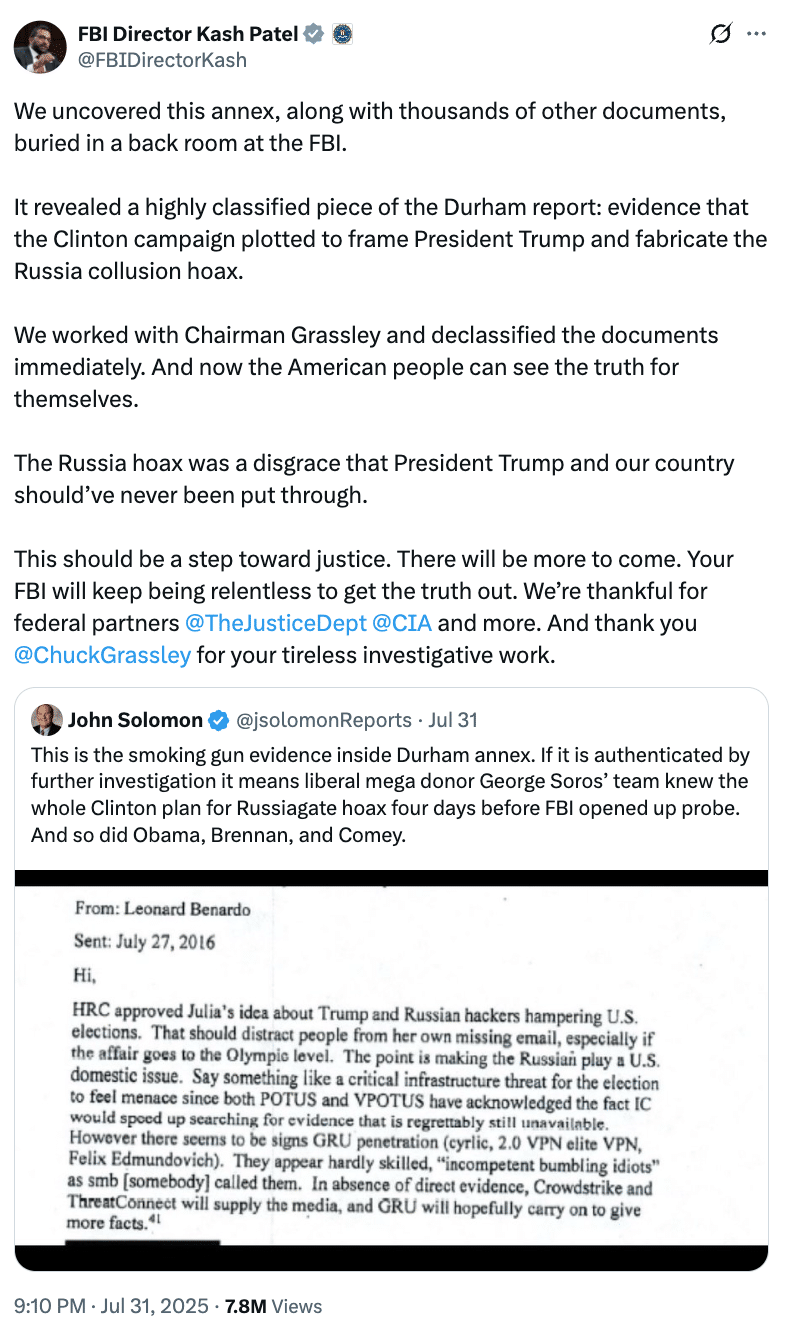
Back in July, in the wake of Trump’s struggles to distract from his own Epstein cover-up and as if in response to Tulsi Gabbard’s wild rants about the Intelligence Community Assessment, the FBI Director posted this tweet, RTing an inflammatory tweet from a propagandist who has been central to Kash’s disinformation about the Russian investigation.

Buried in a back room at the FBI, Kash claimed, was what John Solomon called “the smoking gun evidence … [i]f it is authenticated.”

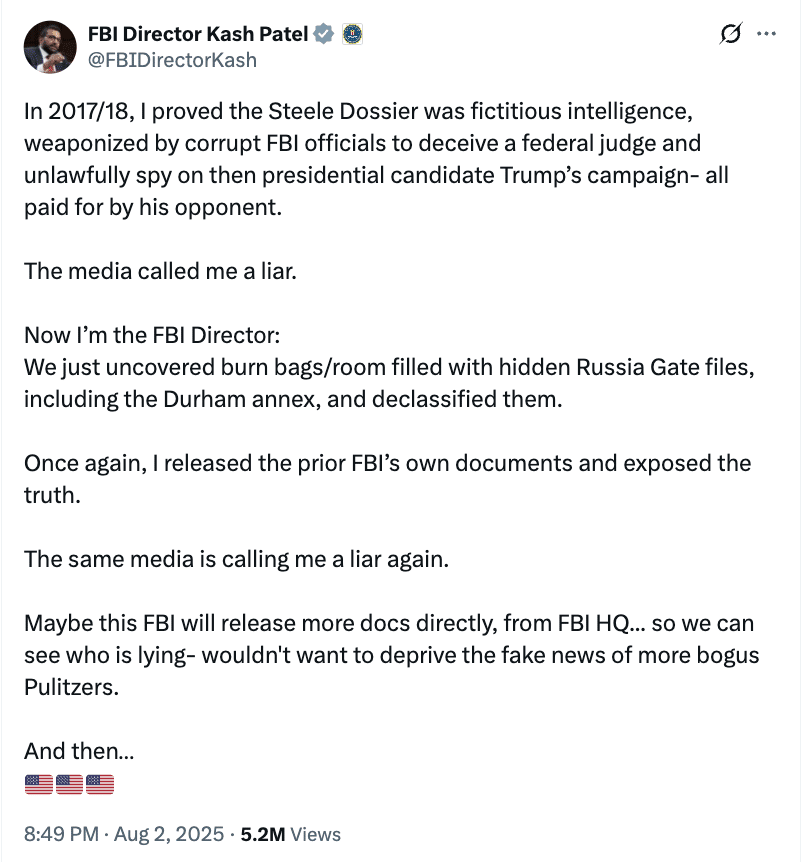
Days later, Kash referenced these files again, explicitly tying his campaign to supplant the Steele dossier for the actual Russian investigation with his role, as FBI Director, now focusing on “uncovered burn bags/room filled with hidden Russia Gate files, including the Durham annex.”

It took just a matter of days for me and Charlie Savage to figure out that four years earlier, John Durham had not just not authenticated John Solomon’s “smoking gun,” but he had in fact concluded that the very email Solomon called a smoking gun was instead, “a composite of several emails.”

That is — a fabrication.

After the release of the Durham annex revealed that Kash — and John Durham and John Durham’s lead investigator Jack Eckenrode, along with John Ratcliffe — had been chasing Russian disinformation, Kash got even more desperate, clinging to Sean Davis propaganda in an attempt to rebut a plain reading of the Durham annex.

The FBI Director just endorsed the ignorant ravings of a long-discredited propagandist, Sean Davis, attempting to debunk the NYT’s factual reporting that the letters on which the entire conspiracy the frothy right has been chasing for years “were probably manufactured.”

Kash needs Davis to be right, because if he’s not, it exposes Kash as someone too stupid to understand he has been chasing Russian disinformation for years. Kash needs Davis to be right, because Kash just declassified this annex thinking it would help his boss distract from the Epstein scandal that him himself stoked, when in fact it shows that Russian spies have been laughing their ass off at everyone involved for nine years (which I’ll come back to).

The truth is, Kash has been chasing documents as self-evidently problematic as the Steele dossier all that time.

He has proven an easy mark.

That’s what we saw in real time. We also saw in the classified annex both that Durham, along with his chief investigator, Jack Eckenrode, tried to hide the evidence that they had been chasing Russian disinformation for years — indeed, continued to chase Russian disinformation for two years after obtaining confirmation they were doing that. Then Tulsi Gabbard and Chuck Grassley tried to hide that Durham had tried to hide that.

It became clear that John Durham and his lead investigator Jack Eckenrode had committed the very crime that Durham claimed he was investigating when he chased Russian disinformation for four years, which he described this way:

(i) knew the Clinton campaign intended to falsely accuse its opponent with specific information or allegations, (ii) intentionally disregarded a particular civil right of a particular person (such as the right to be free of unreasonable searches or seizures), and (iii) then intentionally aided that effort by taking investigative steps based on those allegations while knowing that they were false.

From the moment John Durham and his lead investigator Jack Eckenrode persisted in falsely accusing Hillary of framing Donald Trump and used that false accusation to take investigative steps like obtaining warrants, they were (in their model) conspiring against rights under 18 USC 241.

18 USC 241 happens to be the crime that the frothers claim they are pursuing against Comey and everyone else right now.

About a month after Kash first rejoiced about the opportunity to commit the crime Durham had chased, we learned that Jack Eckenrode — shockingly!! — had been invited back to commit the same crime some more. NYT since updated on how, little more than a month after Todd Gilbert was confirmed as US Attorney in WDVA and asked to oversee this investigation, he left under pressure.

That’s background to these two exhibits that prosecutors included in the government’s response to Comey’s vindictive prosecution motion.

Start with the opening memo for an investigation into whether someone deliberately put a bunch of documents in burn bags but … didn’t burn them, the precipitating event that Kash boasted about on July 31. In fact, those burn bags were discovered in April, and they were discovered in FBI Headquarters, not WDVA, where Kash and Bondi stashed the investigation. And the likely explanation for the documents is that senior FBI people were clearing out their offices to make way for … Kash Patel.

On or about April 15, 2025, the Director’s Advisory Team was informed of the unusual discovery of highly classified and sensitive documents found inside five “burn bags” located in Room 9582, a certified Sensitive Compartmented Information Facility (SCIF) at the FBI Headquarters building in Washington, DC.

A cursory inventory of the 9582 SCIF revealed the existence of classified documents, including documents believed to be official records, inside “burn bags” which appeared to have been placed in the SCIF around the timeframe of the 2025 presidential inauguration – Friday, January 17, 2025 through Wednesday, January 22, 2025. A brief review of the contents of the “burn bags” revealed that some of the documents left behind may have come from a collection of records held by certain unidentified senior government officials at FBI Headquarters.

What really set Kash off, it seems clear, is that — seemingly amid a bunch of files relating to the Special Counsel investigations that happened during the Biden Administration — was the document at the heart of Durham’s criminal investigation building on Russian disinformation, a document potentially referring to the fabrications Russian spies made.

Among the records found were many related to the FBI’s Mar-a-Lago search, the January 06 capitol breach, the Crossfire Hurricane investigation, as well as a copy of the Classified Appendix to the John Durham Special Counsel investigation. Moreover, an additional record discovered as part of this management review process was an original referral by the Central Intelligence Agency (CIA) to former FBI Director James Comey, known as a Counterintelligence Operational Lead (CIOL). This CIOL, believed to have been missing for several years, was dated September 07, 2016 and contained certain intelligence related to the 2016 U.S. presidential election campaign. The CIOL was found in a storage closet adjacent to the Director’s office and was subsequently transported to the 9582 SCIF. Former Director Comey previously testified before the Senate Judiciary Committee that he was unfamiliar with this CIOL as well as its related intelligence. [my emphasis]

Now, there are already several flashing lights here. 🚨🚨🚨 [Sorry Rayne!]

You cannot have Jack Eckenrode anywhere near the criminal investigation into a document he chased for years. He has more incentive to hide the Durham annex showing that he committed the very crime he was investigating than Comey (or anyone close to him) has to hide the CIOL. In any case, this still seems to fall well short of proof that the FBI actually received it. This opening memo describes that the people who are supposed to catalog such things did not, and if they found it after the fact, it would raise real questions if Eckenrode planted it.

Worse still, the opening memo for this investigation misrepresents Comey’s testimony from the hearing.

Lindsey: Do you recall getting an inquiry from the CI, excuse me, the intelligence community in September, 2016, about a concern that the Clinton campaign was going to create a scandal regarding Trump and Russia? Mr. Comey: I do not.

Senator Graham: You don’t remember getting a investigatory lead from the intelligence community, hang on a second … Let me find my document here.

Speaker 3: There it is.

Senator Graham: September the Seventh, 2016, the US intelligence officials forwarded an investigative referral to FBI Director James Comey and Assistant Director of Counterintelligence Peter Strzok regarding US presidential candidate Hillary Clinton’s approval of a plan concerning US presidential candidate Donald Trump and Russian hackers hampering US elections as a means of distracting the public from her use of a private email server. You don’t remember getting that or being talk, that doesn’t …

Mr. Comey: That doesn’t ring any bells with me.

[snip]

Senator Graham: Did you have a duty to look at any allegations regarding Clinton in Russia?

Mr. Comey: I don’t know what you mean. Senator Graham: Well, you say you had a duty to look at allegations about the Trump campaign being involved with the Russians. You’ve got a letter now from Radcliffe saying that there was a, they intercepted information about an effort in July where Hillary Clinton approved an effort to link Trump to Russia or the mob. Did you have an investigation look and see if whether that was true?

Mr. Comey: I can’t answer that. I’ve read Mr. Radcliffe’s letter, which frankly I have trouble understanding.

That’s true, in part, because Graham misrepresented what the CIOL was. As it explains, the memo only served to provide the kinds of information that the CIA was finding in SVR documents obtained from the Dutch. It was not a request for the FBI to conduct an investigation, but right wingers have treated it as such for years.

The redaction in the pertinent paragraph, which seems to be a reference to Guccifer 2.0, likely obscures the entire meaning of the paragraph, to say nothing of the redaction of the other paragraphs. More importantly, there was no discussion at the hearing of what Comey would have understood this to belong to: the larger set of SVR documents that the FBI had deemed objectively false much earlier in the year.

In other words, that reference in the opening document shows that this entire investigation was predicated on a false claim about Comey — it represents Eckenrode’s false belief about Comey, not the actual transcript (remember, Loaner AUSA Tyler Lemons hid this transcript as an exhibit in his response to Comey’s selective prosecution bid).

And the Jim Comey notes that Lemons insinuates undercut Comey’s claims about receiving the CIOL on September 7, 2016 only serve to underscore this point.

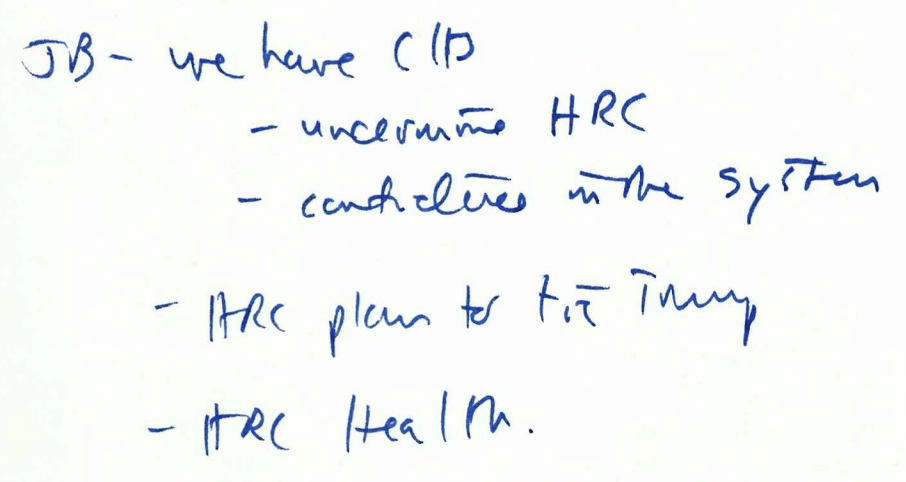
The discovery of the handwritten notes is relevant considering the defendant’s prior testimony on September 30, 2020. Of note, during that hearing, the defendant was questioned by Senator Graham of South Carolina and Senator Hawley of Missouri. See Gov. Ex. 14. The questions focused on whether the defendant remembered “being taught” of “U.S. presidential candidate Hillary Clinton’s approval of a plan concerning U.S. presidential candidate Donald Trump and Russian hackers hampering U.S. elections as a means of distracting the public from her use of a private email server.” See id. The defendant responded by stating that “it doesn’t ring any bells with me” and “I don’t know what that refers to” and “I don’t remember receiving anything that is described in that letter.” See id. at 1 and 5. Despite this testimony, the defendant’s handwritten notes dated September 26, 2016, read: “HRC plan to tie Trump.” See Gov. Ex. 13 (Defendant’s handwritten notes).

These notes are more consistent with the SVR files being disinformation, rather than the truth right wingers have adopted it as.

More importantly, there’s no reason for Comey to be briefed (possibly by John Brennan) on a topic on September 26 if he received information about it 19 days earlier.

That is, these notes appear to be Comey writing down the reference, understanding it to be part of an attack on Hillary, weeks after Republicans want to catch him receiving a memo.

The part about prosecutors and FBI agents reading these notes in the least sensical way possible is not a crime.

What is a crime, though, is using Russian disinformation you know to be Russian disinformation (and Comey appears to have believed was disinformation) to obtain a criminal indictment.

And it appears that Lindsey Halligan tried to do that — but got no-billed.

Further, according to the transcript from the hearing on Wednesday, Comey’s team read Tyler Lemons’ response to Comey’s vindictive prosecution claim the same way I did:

As for the 18 USC 1505 charge, prosecutors will need to prove that Comey told lies that were intentional that impeded that investigation. Because of the scope of the hearing (and therefore the investigation), they can’t argue the two Hillary stories are material. Comey was aware of the scope of the hearing and Hillary wasn’t part of it.

There’s no way they can argue that Comey should have admitted asking Richman to serve as an anonymous source for the May 2017 story impeded the Senate investigation, because he had admitted that years earlier!!

That leaves just the Lindsey Graham question, which was specifically about whether Comey remembered the CIA referral, dated September 7, that Kash Patel had recently released in redacted — and therefore likely hopelessly misleading — form. As the transcript Lemons buries in an exhibit makes clear, the question — the one the grand jury no-billed — was not whether Comey was briefed; it was whether he recalls getting the document itself (Lindsey misstates what this document even was).

On Wednesday, Pat Fitzgerald expressed serious concern that “the government is expanding its case, we believe, to include the conduct that was no true billed in Count One as part of its proof of Count Two.”

And on top of that, Your Honor, I think there’s another motion coming from us, in light of some disclosures that were made Monday, where we think that the government is expanding its case, we believe, to include the conduct that was no true billed in Count One as part of its proof of Count Two, which raises serious issues for us. So we’ll do everything we can, but to do all that while getting Mr. Comey access to materials…

As I’ve said, this is the founding document of their conspiracy theories.

On Wednesday, Lemons didn’t raise an objection when Magistrate Judge William Fitzpatrick first said he was going to order DOJ to turn over grand jury transcripts, suggesting Lemons may have no fear Miles Starr presented privileged information to the jury.

By the end of day yesterday, he did have an objection. Michael Nachmanoff has bumped the whole grand jury question back to Fitzpatrick, so I expect Patrick Fitz (sorry, bad joke!) will get to test this theory shortly.

But that — relying on a no-billed charge for the obstruction charge — is not the only problem with chasing the Clinton Plan disinformation that John Durham debunked.

The far graver problem is it means Miles Starr is a witness to, if not a co-conspirator to, Jack Eckenrode (and FBI Director Kash Patel) committing a crime, precisely the crime they’re chasing.

Four years ago, Jack Eckenrode concluded this stuff was a Russian fabrication, the very thing they claim about the Steele dossier.

And then, Jack Eckenrode got an indictment for it anyway.

Share this entry

Jim Comey and the Crown Jewels of the Fevered Conspiracy against Rights Conspiracy

For a number of reasons, I’m not as convinced as others that right wing blowhard Mike Davis’ insinuation that a grand jury scheduled to be seated in Fort Pierce, FL, in January would serve the purpose of stitching together all his feverish conspiracy theories into a conspiracy against Trump’s rights case.

What if Mike Davis is telling the truth, for once?

But this post assumes that his comments do reflect inside knowledge.

That is, this post considers the likelihood that someone — Jack Eckenrode would be part of that team, possibly Deputy FBI Director Andrew Bailey, who was installed in September but has been unseen aside from comments on public corruption a few days ago — has a plan to pull together the investigative work done in various places, to present it to a grand jury in Trump’s current residence, under a theory that some group of meanies have been conspiring against Trump for a decade.

For example, the 302 reports of interviews tied to a WDVA investigation, conducted in attorneys’ offices, might be presented in January to the SDFL grand jury.

[A] host of former F.B.I. officials voluntarily sat for interviews, according to people familiar with the matter.

Witnesses in the case were questioned by a combination of civil lawyers — not criminal prosecutors — from the Western District of Virginia, as well as criminal prosecutors from the neighboring Eastern District of Virginia and F.B.I. agents. To reassure witnesses that they were not targets of the investigation, witnesses were allowed to be interviewed at their lawyers’ offices, rather than at government buildings.

The specious referral of John Brennan for lying? Sent to Florida as part of a claim it was a conspiracy to harm poor Donald Trump. Tulsi Gabbard’s inability to distinguish the DNC server from voting machines? Off to Florida, as if it were credible.

And, importantly, whatever material prosecutors obtained by using the frivolous EDVA Jim Comey prosecution as a pretext? Sent to Florida to be presented to a different grand jury in January to support a conspiracy indictment.

The attorney-client breach hints that the risk goes beyond this indictment

The need to assume that something like that is happening (wherever it might be located) is, I think, a better explanation for some of the motions Jim Comey filed than Ben Wittes’ theory that Comey is just stacking up ways to get this indictment dismissed.

It’s certainly possible that when Lindsey Halligan first rolled out one failed and one successful indictment, Comey and Patrick Fitzgerald thought this would be easy to defeat. This particular indictment, obtained by someone playacting as US Attorney, should be.

But almost immediately, the loaner AUSAs started trying to dick around, first trying to buy an extra week on discovery because Comey planned to submit two rounds of pretrial motions, then demanding that Comey have sharply limited access to the discovery.

More alarming still, on October 10, before handing over any discovery, prosecutors started pressuring Comey to adopt a filter protocol so they could access content seized from Dan Richman in 2020. When they submitted a request for such a filter team on October 13, they did not disclose — not publicly, at least — that the primary investigators on the team had already peeked at the privileged material. When they tried to accelerate that request for a filter team on October 19, they falsely claimed that Comey’s decision to share a memo about Donald Trump’s misconduct in 2017 implicated Fitzgerald in leaking classified information: “the defendant used current lead defense counsel to improperly disclose classified information.”

It’s not clear when prosecutors first told Comey that investigators had accessed his attorney-client privileged content, but the first time Comey’s team mentioned it (in redacted form) was in their response to that bid to accelerate the process of a filter team on October 20, almost a month after the indictment. Judge Nachmanoff’s order denying the government’s request to accelerate the process revealed some of what Comey had described under seal (making at least the first Comey filing a judicial record under Fourth Circuit law that someone could petition to liberate).

He also states that the underlying warrants were “obtained by prosecutors in a different district more than five years ago[,] in an investigation that closed without criminal charges[,] and [] authorized the seizure of evidence related to separate offenses that are not charged here.” Id. at 2. And, there is “reason to believe that the two principal FBI investigators may already have been tainted by exposure” to privileged information. Id. at 3.

When prosecutors filed that bid to accelerate getting access to Comey’s privileged communications, when they claimed that Fitzgerald committed a crime by receiving unclassified CYA memos documenting Trump’s misconduct from Comey (hinting that they want to access Comey’s privileged material by invoking a crime-fraud exception), it became clear this prosecution was just one prong of the larger witch hunt. And whenever it was that prosecutors first alerted Comey that they had snooped in his privileged communications, the claim that sharing unclassified memos documenting Trump’s misconduct was criminal was also the first hint that this “spill” was not an accident.

Indeed, the repeated invocation by the loaner prosecutors of Fed. R. Evid. 502(d) to suggest that a waiver of privilege here, in the EDVA case, would not waive privilege somewhere else (which is the opposite of how they’re treating material seized from Dan Richman — they’re treating his successful invocation of privilege five years ago as waiver here)…

Fed. R. Evid. 502(d) (providing that a court may “order that [a] privilege or protection is not waived by disclosure connected with the litigation pending before the court — in which event the disclosure is also not a waiver in any other federal or state proceeding.”)

…. May be a confession in the opposite world of Trump’s DOJ that they’ve already gotten access via a claim of crime-fraud exception somewhere else and need a waiver here to introduce it at trial.

Someone helped themselves to this content (possibly with the assistance of a Trump-installed judge), and that someone seems to imagine it was a crime for Jim Comey to reveal Trump’s misconduct in 2017, an act that is not directly implicated in either the existing charges or the no-billed one but would be foundational to the fever dreams of a conspiracy against rights case.

The intersecting investigations

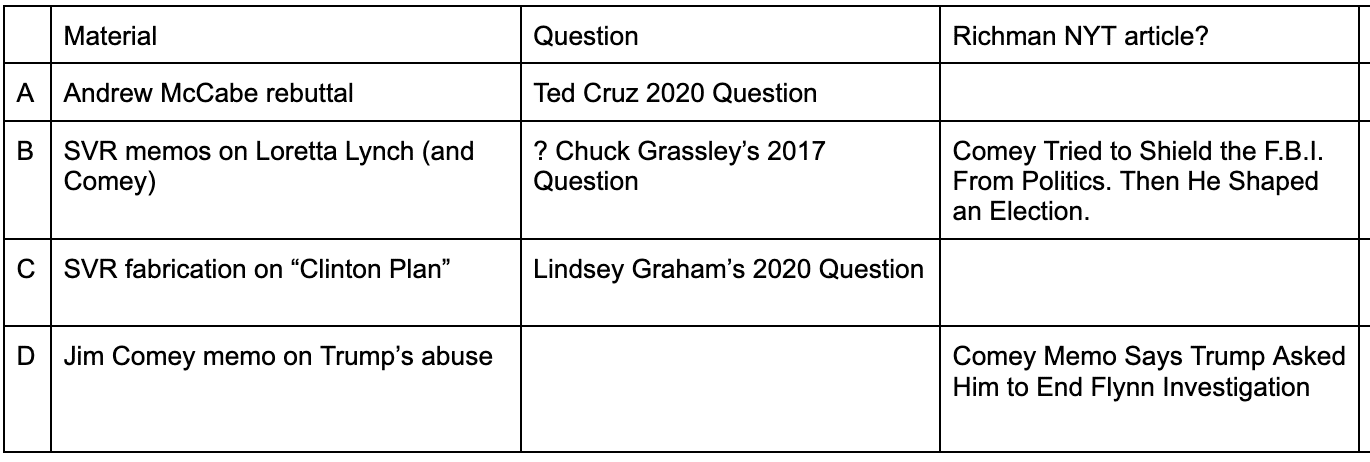
This is probably a good time to review all the investigations Republicans are drawing on here, which I’ve summarized in this table (I’m just including DOJ and DOJ IG investigations; there are also some Congressional investigations that generally were riddled with logical and evidentiary problems).

There are three Senate exchanges with Comey at issue in his prosecution.

First, there’s the questions Chuck Grassley asked on May 3, 2017 that Ted Cruz invoked when he asked the questions at issue in the indictment.

SEN. GRASSLEY: Director Comey, have you ever been an anonymous source in news reports about matters relating to the Trump investigation or the Clinton investigation?

MR. COMEY: Never.

SEN. GRASSLEY: Question two on [sic] relatively related, have you ever authorized someone else at the FBI to be an anonymous source in news reports about the Trump investigation or the Clinton investigation?

MR. COMEY: No.

By context, this was a general question (and as such it could include Item B in the table). Grassley probably imagined it included questions like, Did Comey (or anyone he authorized) leak details of his briefing to Trump about the Steele dossier? Did Comey (or anyone he authorized) leak details on the intercepts capturing Mike Flynn undermining sanctions? Did Comey (or anyone he authorized) leak details about the Clinton investigation, possibly including the Russian disinformation that led him to make the prosecutorial decision on it.

One thing Chuck Grassley’s question could not have referred to were the memos documenting Trump’s misconduct, Item D, because Comey only shared them with Dan Richman after Trump fired Comey on May 9, six days later. Even if Comey did authorize Richman to share them (he did, but the terms on which he did so are likely contested), he had not shared them yet, when he answered this question. Per the IG Report on this topic, Comey shared the memos first with Fitzgerald on May 14, 11 days after Grassley’s question, then shared just one memo with Richman on May 16, two days later, the NYT story on the memo came out that day, May 16.

Then there’s Andrew McCabe’s rebuttal of details about the Clinton Foundation, which was the explicit topic of Ted Cruz’ questions on September 30, 2020 and the alleged lie charged (but miscited) in the indictment.

SEN. CRUZ: On May 3, 2017 in this committee, Chairman Grassley asked you point blank “have you ever been an anonymous source in news reports about matters relating to the Trump investigation or the Clinton investigation?” You responded under oath “never.” He then asked you “have you ever authorized someone else at the FBI to be an anonymous source in news reports about the Trump investigation or the Clinton administration.” You responded again under oath, “no.” Now, as you know, Mr. McCabe, who works for you, has publicly and repeatedly stated that he leaked information to The Wall Street Journal and that you were directly aware of it and that you directly authorized it. Now, what Mr. McCabe is saying and what you testified to this committee cannot both be true; one or the other is false. Who’s telling the truth?

MR. COMEY: I can only speak to my testimony. I stand by what, the testimony you summarized that I gave in May of 2017.

SEN. CRUZ: So, your testimony is you’ve never authorized anyone to leak. And Mr. McCabe when if he says contrary is not telling the truth, is that correct?

MR. COMEY: Again, I’m not going to characterize Andy’s testimony, but mine is the same today. [my emphasis]

A footnote in Comey’s literal truth motion describes the agreed-upon scope of the September 30, 2020 hearing, which included neither the Clinton email nor the Clinton Foundation investigation, so Cruz’ question, to the extent it pertained to McCabe, was fundamentally out of scope for the hearing and therefore could not be claimed to be addressing material to the topics of the hearing.

1 Before the hearing, the committee agreed that it would be limited to four specific topics: (i) “Crossfire Hurricane,” (ii) the December 2019 Department of Justice Inspector General report’s “Review of Four FISA Applications and Other Aspects of the FBI’s Crossfire Hurricane Investigation,” (iii) the Carter Page FISA applications, and (iv) Christopher Steele’s source network and primary sub-source.

If this ever gets to trial there will be about fifty ways to prove that Comey’s answer to this question could not be material to what the Senate imagined it was doing.

But to use Cruz’ poorly worded questions to charge Comey, Halligan applied it to the Dan Richman stuff.

Since Halligan claims this about Hillary (which, again, was not material to the hearing), she must be applying it to Item B, the only one of these items known to include both Richman and Hillary, the SVR memos claiming that Loretta Lynch was helping Democrats deal with the Hillary investigation (and also claiming that Jim Comey was going to make the Hillary investigation right up until election day, which he in fact did).

Even then, there’s a problem for both known stories attributed to Richman. For the earlier one — the one that could be included in the scope of Grassley’s question and which is the most obvious story addressed in the indictment — Richman was not anonymous. Mike Schmidt quoted him three times in that story.

“Jim sees his role as apolitical and independent,” said Daniel C. Richman, a longtime confidant and friend of Mr. Comey’s. “The F.B.I. director, even as he reports to the attorney general, often has to stand apart from his boss.”

[snip]

Confidants like Mr. Richman say he was constrained by circumstance while “navigating waters in which every move has political consequences.”

[snip]

Mr. Richman sees no conflict, but rather “a consistent pattern of someone trying to act with independence and integrity, but within established channels.”

“His approach to the Russia investigation fits this pattern,” he added.

Richman was anonymous in the Comey memo story, but he was also no longer at the FBI when he shared it.

Finally, there’s the question Lindsey Graham asked on September 30, 2020, which was the subject of the failed charge in the no-billed indictment, Item C.

Lindsey: Do you recall getting an inquiry from the CI, excuse me, the intelligence community in September, 2016, about a concern that the Clinton campaign was going to create a scandal regarding Trump and Russia? Mr. Comey: I do not.

Senator Graham: You don’t remember getting a investigatory lead from the intelligence community, hang on a second … Let me find my document here.

Speaker 3: There it is.

Senator Graham: September the Seventh, 2016, the US intelligence officials forwarded an investigative referral to FBI Director James Comey and Assistant Director of Counterintelligence Peter Strzok regarding US presidential candidate Hillary Clinton’s approval of a plan concerning US presidential candidate Donald Trump and Russian hackers hampering US elections as a means of distracting the public from her use of a private email server. You don’t remember getting that or being talk, that doesn’t …

Mr. Comey: That doesn’t ring any bells with me.

[snip]

Senator Graham: Did you have a duty to look at any allegations regarding Clinton in Russia?

Mr. Comey: I don’t know what you mean. Senator Graham: Well, you say you had a duty to look at allegations about the Trump campaign being involved with the Russians. You’ve got a letter now from Radcliffe saying that there was a, they intercepted information about an effort in July where Hillary Clinton approved an effort to link Trump to Russia or the mob. Did you have an investigation look and see if whether that was true?

Mr. Comey: I can’t answer that. I’ve read Mr. Radcliffe’s letter, which frankly I have trouble understanding.

This question was based off the redacted version of a CIA memo addressed to, but not provably sent to the FBI, in 2016. The redaction almost certainly hides critical details about the memo to say nothing of details that should have led everyone to realize they were based on an SVR fabrication. As such, Graham’s question asked Comey not about the memo as it would have been perceived if it actually were received by FBI in 2016 (something John Durham was never able to prove), but a memo that Kash Patel retconned after the fact. Even if FBI did receive the memo, Comey would not recognize it as Graham described it.

This, along with Comey’s decision to share his CYA memos, which led to the appointment of Robert Mueller as Special Counsel, are the crown jewels of the fevered conspiracy against rights conspiracy theory.

Right wingers claim to believe that the FBI had reason to know that Hillary wanted to frame Donald Trump in 2016, and so when “she” shared information with the FBI — the Steele dossier and the Alfa Bank anomalies, though Hillary didn’t share the Steele dossier and affirmatively did not authorize sharing the Alfa Bank anomalies — the FBI should not have investigated them (which, in the case of Alfa Bank, they barely did, because they assumed Hillary was trying to frame Trump!). Right wingers claim to believe that the Steele dossier was central to the investigation of Donald Trump and the claim that Russia wanted to help Trump get elected. And they claim to believe Comey broke the law by sharing his own CYA memo of Trump. None of that is true. But that’s now become an object of faith in the cult of Donald Trump. And that’s why this investigation into Comey is critical to any investigation going on somewhere else.

Lindsey Halligan did not, overtly, charge either one of those things — the inaccurately redacted reference to an SVR fabricated memo alleging a Clinton Plan or Richman’s anonymous sharing of the Comey memos with Mike Schmidt. But that is why the vague language in Count Two of the existing indictment — and the loaner AUSAs’ claim that sharing the memo was a crime — is such a problem.

On or about September 30,2020, in the Eastern District ofVirginia, the defendant, JAMES B. COMEY JR. did corruptly endeavor to influence, obstruct and impede the due and proper exercise of the power of inquiry under which an investigation was being had before the Senate Judiciary Committee by making false and misleading statements before that committee.

Halligan couldn’t get the jury to indict Comey for the Lindsey Graham question. But the Lindsey Graham question was material to the topic of the hearing, and central to the fever dream. So it’s possible she used the charged alleged lie about Andy McCabe that Halligan is already overtly applying to Dan Richman as a way to get the grand jury to approve an obstruction case that would feed the fever dream.

That is, referring back to my table above, it’s likely Halligan used an out-of-scope question about Item A to charge Item B so as to create a prosecution for Items C and D.

Comey’s motions are necessary to this case, but also serve to stave off more

All that makes clear why two of the motions Comey filed Thursday are necessary. One — a motion to dismiss based on literal truth — arises from the shoddiness of the questions Ted Cruz asked; it was the only one that Fitzgerald mentioned at the arraignment.

The two others — one asking to obtain grand jury transcripts and another asking for a Bill of Particulars — are necessary to pin down whether the charged lie (which by description should be Item B on the table, even though Richman was not anonymous in the story in question) are actually what she got a grand jury to indict, whether that is the basis for the obstruction charge, and whether what Halligan said in the grand jury matches what the loaner AUSAs (who took several days before they’d even tell Comey who the people referred to in the indictment were) imagine they’ll present to a jury at trial.

Here’s how Comey describes the possibility of head fakes at trial in the Bill of Particulars motion.

Count Two charges Mr. Comey with “making false and misleading statements” at a four-hour hearing in which he was questioned on topics ranging from the FBI’s Crossfire Hurricane investigation, to the investigation into Hillary Clinton’s alleged mishandling of classified information, to white supremacist activities in the United States. Under the indictment as written, the government could wait until trial to specifically allege that any one, or several, of Mr. Comey’s statements over a four-hour hearing forms the basis for its prosecution. The government could also wait until trial to select any topic of investigation covered at the hearing as the one Mr. Comey allegedly endeavored to obstruct, and unfairly surprise Mr. Comey.

And here’s how he raised it in his bid to get grand jury transcripts.

Disclosure of the grand jury materials is also required to ensure that the government does not seek to try Mr. Comey for alleged false or misleading statements that differ from those on which the grand jury was asked to indict. See Russell v. United States, 369 U.S. 749, 765 (1962).

But there’s also the possibility that to pull off this trick — using an out-of-scope question about Item A to charge Item B — Halligan relied on privileged content.

When DOJ investigated Richman from 2019 to 2021 as the source for Mike Schmidt, they never found proof that Comey authorized him to share that information, details of the SVR content making false claims about the investigation into Hillary Clinton. But when DOJ IG investigated Comey in 2019 about his memos, he told them that he authorized Richman to share the memo about Trump.

May 14, 2017

Comey sends scanned copies of Memos 2, 4, 6, and 7 from his personal email account to the personal email account of one of his attorneys, Patrick Fitzgerald. Before sending, Comey redacts the second paragraph from Memo 7 involving foreign affairs because Comey deems it irrelevant. On May 17 Fitzgerald forwards these four Memos to Comey’s other attorneys, David Kelley and Richman.

May 16, 2017

Comey sends a digital photograph of Memo 4 (describing the meeting in which Comey wrote that President Trump made the statement about “letting Flynn go”) to Richman via text message from Comey’s personal phone. Comey asks Richman to share the contents, but not the Memo itself, with a specific reporter for The New York Times. Comey’s stated purpose is to cause the appointment of a Special Counsel to ensure that any tape recordings that may exist of his conversations with President Trump are not destroyed. Richman conveys the substance of Memo 4 to the reporter. The New York Times publishes an article entitled “Comey Memo Says Trump Asked Him to End Flynn Investigation.”

So there are communications between Comey and Richman (and possibly Fitzgerald) from May 2017 authorizing him to share information with Mike Schmidt. They’re almost certainly in the batch of stuff Richman said was privileged in 2020.

And that’s the kind of thing that might lead a grand jury to believe that Comey authorized Richman’s earlier conversations with Schmidt. Neither would match the details of Cruz’ question. Richman was still at the FBI when he was the source for Item B, but not anonymous. Richman was anonymous when he was the source for Item D, but he was no longer at the FBI (in any case, Comey notes in his literal truth motion that Richman “was a Special Government Employee living fulltime in New York”). But you could see how grand jurors might get that confused. Or, you could see how someone already breaking every rule of legal ethics would wildly conflate all of that.

And that’s part of what Comey is pursuing with his bid to obtain the grand jury transcripts: he suggests that Special Agent Miles Starr may have accessed attorney-client information before presenting to the grand jury.

[T]he agent who served as a witness in the proceedings may have been exposed to Mr. Comey’s privileged communications with his attorneys and thus may have conveyed that information to the grand jury.

Redacted passages describe that that same day he likely presented to the grand jury, FBI Agent Miles Starr, “alerted the FBI Office of the General Counsel” something redacted “involving Mr. Comey and his attorneys,” which suggests — Comey argues — that Starr was apparently aware “of his potential exposure to privileged material” when serving “as a witness presenting evidence to the grand jury in this case.”  Which, in turn, supports Comey’s hypothesis that Starr used privileged information to get the indictment.

Third, the record suggests that an FBI agent who testified before the grand jury was potentially tainted by privileged communications between Mr. Comey and his attorneys, one of whom was likely Mr. Richman, yet the agent still proceeded to testify in front of the grand jury. There is thus a serious concern that the grand jury may have improperly relied on privileged information.

[snip]

That information apparently related to certain attorneys for Mr. Comey, including Mr. Richman. See id. Nevertheless, the agent testified before the grand jury that same day, and given the content of the resulting indictment, it is clear that his testimony must have referenced Mr. Comey’s interactions and communications with Mr. Richman. This created a high risk that privileged information was presented to the grand jury by a tainted case agent.

If that were true — if Starr relied on information obtained without a warrant specific to the crimes under investigation — then Comey would have a Fourth Amendment challenge to the entire thing.

Fighting a battle in December to win a fight in October

Comey has a clear need for more clarity about whether they’re going to pull a headfake. But one reason I suspect this is not the only reason to seek that clarity has to do with timing.

Consider this comment in his request for grand jury materials, which argues he needs the grand jury materials to adjudicate his vindictive prosecution motion (just a page and a half of which asks for discovery).

For similar reasons, disclosure of the grand jury materials is reasonably calculated to provide additional support for Mr. Comey’s argument that he would not have been prosecuted but for President Trump’s animus toward Mr. Comey, including because of his protected speech. See generally Mot. to Dismiss Indictment Based on Vindictive & Selective Prosecution, ECF No. 59. Objective evidence establishes that the President harbors such animus—he has spent the last eight years publicly attacking Mr. Comey’s speech and character and calling for Mr. Comey to be prosecuted. See id. at 4-8. The record also shows that President Trump “prevailed upon [Ms. Halligan] to bring the charges . . . such that [she] could be considered a ‘stalking horse.’” See id. at 21-22 (citing United States v. Sanders, 211 F.3d 711, 717 (2d Cir. 2000)). In turn, the government’s manipulation of the prosecutorial process, including its repudiation of the views of every career prosecutor who assessed the case, makes clear that Mr. Comey would not have been prosecuted but for President Trump’s animus. Id. at 22-26.

Although dismissal of the indictment is warranted on the record as it stands, disclosure of the grand jury materials would bolster Mr. Comey’s arguments. Having served as his personal attorney and as a White House Official, Ms. Halligan has a close, longstanding relationship with President Trump. Id. at 11-12. And even though Ms. Halligan lacks prosecutorial experience, President Trump appointed her for the specific purpose of bringing this prosecution against Mr. Comey and other perceived political opponents. Id. at 23-24. Accordingly, there is a substantial risk that during her presentation to the grand jury, Ms. Halligan made statements that would support Mr. Comey’s motion to dismiss. Such “irregularities in the grand jury proceedings” would “create a basis for dismissal of the indictment” and thus warrant disclosure of the grand jury materials. Nguyen, 314 F. Supp. at 616 (citations omitted).

According to the current schedule, the hearing on this motion will be November 19. The request for grand jury transcripts won’t be fully briefed until one day later, and the hearing for it will take place after a Thankgiving break, on December 9.

This case could be — is likely to be, at least based on a disqualification of Lindsey Halligan — over by December 9.

Similarly, Comey asks for a Bill of Particulars to help wade through both the discovery he got and the stuff he did not get.

The discovery produced to date does not “fairly apprise [Mr. Comey] of the charges against him so that he may adequately prepare a defense and avoid surprise at trial.” Sampson, 448 F. Supp. 2d at 696 (cleaned up). The government produced voluminous discovery that includes some, but not all, documents from multiple different FBI investigations involving multiple districts.

[snip]

A bill of particulars can also be necessary to allow the defendant to request materials under, and the court to monitor the government’s compliance with, Brady v. Maryland, 373 U.S. 83 (1963), and its progeny. See United States v. Trie, 21 F. Supp. 2d 7, 25 (D.D.C. 1998) (noting that the scope of the government’s Brady obligations could be determined “once it has provided the bill of particulars”).

[snip]

Accordingly, without knowing whether, and how, Mr. Richman allegedly acted as an anonymous source, Mr. Comey cannot ascertain whether the government has fulfilled its obligations under Brady. See Trie, 21 F. Supp. 2d at 26. For example, if the government contends that Mr. Richman acted as an anonymous source in the articles that were the subject of the “Arctic Haze” investigation, the defense would request that entire investigative file (which has not been produced), as well as information about all other individuals the government identified as possible sources of information (which has also not been produced). 5 Such materials would enable the defense to demonstrate—as government investigators previously found, see Mot. to Dismiss Indictment Based on Vindictive & Selective Prosecution, ECF No. 59 at 9-10—that there was insufficient evidence to believe that Mr. Richman was the source of that information. By contrast, if instead the government contends that Mr. Richman was authorized to act as a source in a different article, the defense could tailor both its Brady requests and trial defense accordingly. The defense should not be required to dig through tens of thousands of pages of incomplete discovery to guess at what it is defending against—only to be sandbagged by the government at trial.

Comey’s point about the Arctic Haze investigation is of particular note, given that DOJ chose only to pursue potential sources who would protect Comey, not those who would not, and Richman claimed that Mike Schmidt, who wrote that article with several other journalists, already knew a bunch about the SVR documents before asking him about it.

After discussing the status of investigative leads and resources available with the U.S. Attorney’s Office and Department of Justice’s National Security Division (DOJ NSD), the FBI investigative team was directed to interview only those officials who might have had a motive to protect Comey. Therefore, the FBI only interviewed eight of these officials who consisted mainly of former FBI officials.

Given a delay in Fitzgerald getting clearance, a Bill of Particulars might help him make the case to unseal classified information he won’t delay until that time. But any Brady violations discovered after getting one, if this motion succeeds, would also come after this case might be over.

But what these filings may do — especially the grand jury one — is affect several things going on, starting this week.

As noted, Judge Cameron McGowen Currie has ordered the government to give her the transcripts from both grand juries by tomorrow.

The undersigned has been appointed to hear this motion and finds it necessary to determine the extent of the indictment signer’s involvement in the gra.nd jury proceedings. Accordingly, the Government is directed to submit, no later than Monday, November 3, 2025, at 5:00 pm, for in camera review, all documents relating to the indictment signer’s participation in the grand jury proceedings, along with complete grand jury transcripts.

It’s genuinely unclear why she needs them, but it’s possible that by laying out Comey’s concern about privileged material in the grand jury, that will affect Judge Currie’s review.

Comey noted that Currie had already asked for these transcripts (which Nachmanoff surely noticed, since she did so in his docket).

Indeed, Judge Currie has already ordered the government to produce for in camera review “all documents relating to the indictment signer’s participation in the grand jury proceedings, along with complete grand jury transcripts.” ECF No. 95. Mr. Comey has argued that if Ms. Halligan alone secured and signed the indictment, dismissal would be required because she was unlawfully appointed.

Comey will not prevail on his motion for the grand jury transcripts until after the vindictive prosecution motion is briefed. But there’s nothing to stop Nachmanoff from making the same request that Currie did, to receive the transcripts for in chambers review. Similarly, there’s nothing to prevent William Fitzpatrick, the Magistrate Judge who’ll hold a hearing on the privilege question this Wednesday, to do the same.

But there’s one other way to think about this. If this prosecution continues as scheduled (as noted, Comey just asked for a delay in the CIPA schedule until Fitzgerald is cleared, which makes that a very big if), then the trial would happen — to much media attention — one week before this grand jury is seated in January.

Prosecutors are currently trying to preserve asymmetry in knowledge, withholding parts of these investigative files and remaining coy about how they snuck a peek in his privileged communications.

But on top of the necessary information these motions would give him to prepare for trial, they also erode that asymmetry, in ways that may help defeat not just this prosecution, but the larger fever dream one.

Relevant links

DOJ IG Investigation into McCabe

DOJ IG Investigation into Hillary’s email and Classified Annex

DOJ IG Investigation into Comey’s Memos

Durham Report and Classified Annex

Redacted memo about “Clinton Plan”

Arctic Haze Investigation Documents

NYT, April 22, 2017: Comey Tried to Shield the F.B.I. From Politics. Then He Shaped an Election.

NYT, May 2016: Comey Memo Says Trump Asked Him to End Flynn Investigation

Timeline

September 25: Indictment

September 29: Guidance from FBI OGC regarding those exposed to tainted information

October 8: Arraignment; Comey signs but government does not return discovery order

October 13: Government moves for a filter protocol

October 15: Government first informs Comey the false statements charge is about Dan Richman and Hillary Clinton

October 19: Request to accelerate privilege review

October 20:

October 27:

October 28: Judge Cameron McGowan Currie orders prosecutors to submit: “all documents relating to the indictment signer’s participation in the grand jury proceedings, along with complete grand jury transcripts”

October 29:

  • Judge Nachmanoff orders Magistrate Judge William Fitzpatrick to preside over filter review questions
  • Classified material delivered to SCIF; Fitzgerald can access just one-third of material

October 30:

November 2: Reply to motion for filter protocol

November 3:

  • Responses to first motions due
  • Grand jury transcripts due to Judge Currie

November 5: Filter review hearing before Magistrate Judge Fitzpatrick

November 10: Reply to first motions due

November 13:

  • Responses to second motions due
  • Motion hearing on motion to disqualify

November 19: Motions hearing for first motions

November 20: Reply to second motions due

December 4: Fitzgerald to be fully cleared, permitting his first full review of classified evidence

December 9: Motion hearing for second motions

December 18: Proposed new CIPA deadline

January 5: Jury trial

January 12: Fort Pierce grand jury convenes

Share this entry

Kash’s “lockbox in a vault…in a cyber place where no one can see or search these files”

There were two competing letters published yesterday designed to frame Kash Patel’s efforts to frame Democrats with being mean to Donald Trump, for which (the NYT reports) Trump wants to be paid $230 million. They are:

I’m a well-established critic of Lanny Breuer, but the letter is substantive and direct. After mocking Josh Hawley’s claim that he was “tapped,” the letter shows how toll records have been used in various other investigations:

  • The Robert Hur investigation of Joe Biden.
  • Charging documents in five different investigations charged since Kash has become FBI Director.
  • In leak investigations, targeting Adam Schiff, Eric Swalwell, and staffers (including Kash Patel).
  • The Robert Menendez investigation.

But all that’s just set up for this passage, mocking Kash for his claim, made on Sean Hannity’s show while he was wearing a ridiculous jacket, that Jack Smith was trying to hide his use of toll records in a “lockbox in a vault, and then put that vault in a cyber place where no one can see or search these files.”

[T]here is simply no support for FBI Director Patel’s recent assertion that Mr. Smith hid the toll records information so that “no one would find it,” or that Mr. Smith put the toll records in a “lockbox in a vault, and then put that vault in a cyber place where no one can see or search these files.”9 It is not clear what cyber place in a vault in a lockbox Director Patel is describing, but Mr. Smith’s use of these records is inconsistent with someone who was trying to conceal them. Paragraph 119 of the August 1, 2023 indictment describes some of the calls that were made to U.S. Senators on January 6, 2021, and footnote 132 of Volume 1 of the Special Counsel Report refers to the use of toll records in the investigation. Moreover, the precise records at issue were produced in discovery to President Trump’s personal lawyers, some of whom now serve in senior positions within the Department of Justice.

9 HANNITY: Patel: “We’re Just Warming Up” in Investigation of Alleged Tracking of GOP Senators, Fox News (Oct. 7, 2025), https://www.foxnews.com/video/6382234662112.

Even without this letter, sentient beings were able to point to the place in the indictment and the Jack Smith report where these toll records were described. And, as the letter notes, Trump’s attorneys — including Todd Blanche — got discovery on those toll records years ago, but did not challenge their use in a criminal case.

All this was quite clear to sentient beings. But not the staffers exploiting Chuck Grassley’s diminished capacities to make a stink about something very ordinary.

By comparison, the Jordan letter is shoddy even by his standards.

The ostensible purpose is to refer John Brennan to DOJ (but, significantly, not FBI) for testimony Brennan gave — in a hearing about the letter truthfully saying a bunch of spooks thought the Hunter Biden laptop had the hallmarks of a Russian information op — that mentioned the Steele dossier in passing. This may be an effort to predicate a case in DC after the case in Philly has stalled, but anyone aware of the law would question how comments about the Steele dossier were material to a hearing about the Hunter Biden letter, a point that Brennan even made at the time: “I don’t see any relevance to the Hunter Biden laptop issue now,” as quoted in Jordan’s letter.

More importantly, the letter appears to be an effort to launder debunked propaganda Kash Patel did years ago through Congress back into an investigation led by Kash Patel, something I’ve addressed in the past.

The key paragraph makes a number of claims, some of which are fabrications (and therefore commit the crime that Jim Jordan is referring), others of which are misrepresentations of prior reports that were themselves propaganda.

On January 6, 2017, the CIA, Federal Bureau of Investigation (FBI), and National Security Agency published a declassified version of an Intelligence Community Assessment (ICA) titled Assessing Russian Activities and Intentions in Recent US Elections. 3 The ICA stated, among other things, that Russia “developed a clear preference” for President Trump and “aspired to help” him win the election.4 This conclusion—now known to be false—was based in part on the Steele dossier, which “was referenced in the ICA main body text, and further detailed in a two-page ICA annex.”5 The Steele dossier was a series of reports containing baseless accusations concerning President Trump’s ties to Russia compiled and delivered to the FBI in 2016 by former British intelligence agent Christopher Steele.6 Subsequent investigations confirmed that the Clinton campaign and the DNC paid Steele via the law firm Perkins Coie and opposition research firm Fusion GPS to provide derogatory information about Trump’s purported ties to Russia, which resulted in the discredited dossier.7 In July 2025, the Trump Administration declassified numerous documents showing that the ICA’s main findings were false and that the Obama Administration knowingly fabricated the findings for the purpose of undermining the Trump Administration.8

3 OFF. OF THE DIR. OF NAT’L INTEL., ASSESSING RUSSIAN ACTIVITIES AND INTENTIONS IN RECENT US ELECTIONS (Jan. 6, 2017) [hereinafter “Russian Interference ICA”].

4 Id. at 1.

5 MAJORITY STAFF REPORT, H. PERM. SELECT COMM. ON INTEL., 116TH CONG., OVERSIGHT INVESTIGATION & REFERRAL: THE INTELLIGENCE COMMUNITY ASSESSMENT (ICA) “RUSSIA’S INFLUENCE CAMPAIGN TARGETING THE 2016 US PRESIDENTIAL ELECTION,” at 23 (2020) [hereinafter “HPSCI Report”].

6 See JOHN H. DURHAM, U.S. DEP’T OF JUST., OFF. OF SPECIAL COUNS., REPORT ON MATTERS RELATED TO INTELLIGENCE ACTIVITIES AND INVESTIGATIONS ARISING OUT OF THE 2016 PRESIDENTIAL CAMPAIGNS, at 11-12, 109-117 (2023) [hereinafter “Durham Report”].

7 See id. at 109-117; HPSCI Report, supra note 5, at 22-32; U.S. DEP’T OF JUST., OFF. OF THE INSPECTOR GEN., REVIEW OF FOUR FISA APPLICATIONS AND OTHER ASPECTS OF THE FBI’S CROSSFIRE HURRICANE INVESTIGATION, at v-xii (2019); Memorandum from HPSCI Majority Staff to HPSCI Majority Members, Re: Foreign Intelligence Surveillance Act Abuses at the Department of Justice and the Federal Bureau of Investigation (Jan. 18, 2018).

8 Sarah Bedford & Kaelan Deese, Russiagate definitive timeline: How new intelligence documents fit in, WASH. EXAM’R (July 26, 2025). [my emphasis]

The key claim in here — that what Jordan falsely says is the key claim of 2017 Intelligence Community Assessment, which he describes as, “that Russia ‘developed a clear preference’ for President Trump and ‘aspired to help’ him win the election,” is based on the Steele dossier — is based off two reports Kash substantially wrote (marked in blue). Never mind that it is only the key claim of the Intelligence Community Assessment if you have the thin skin of a Narcissist, never mind that any dispute is about how much evidence there was before discovering the June 9 meetings or Paul Manafort’s sharing of campaign information with Russian spies. That key claim had nothing to do with the subsequent investigation of Trump, which investigation had already been set into motion by Mike Flynn’s shitty OpSec.

But as I wrote extensively,  the one dated 2020, showing that Congressional Republicans packaged up older claims and Russian spycraft after the Mueller Report definitively showed the Russia did prefer Trump and Trump did welcome that help, is an attempt to create a time machine to go back to the halcyon time before we knew all that.

Jordan, perhaps wisely, doesn’t try to lay out how all this fits together. He outsources it to a right wing propaganda outlet, outsourcing to them their credulity about the time machine effect going on.

Jim Jordan lied, shamelessly, when he alleged that that claim was shown to be false. And he lied, shamelessly, when he said that a report that affirmatively did not incorporate intelligence from the Steele dossier, choosing instead to only link it and specifically say it was not incorporated into analytical work (which backs Brennan, not Jordan), instead relied on the dossier.

This conclusion—now known to be false—was based in part on the Steele dossier, which “was referenced in the ICA main body text, and further detailed in a two-page ICA annex.”

If the intimation that Kash Patel’s hand-picked investigators breached Jim Comey’s attorney-client privilege in service of this conspiracy bears out, it only adds to the list of corrupt and possibly illegal things Kash has done in pursuit of this witch hunt. And that’s before you consider all the cops and prosecutors that get fired along the way.

Kash Patel may well be in a race against time. He needs to package up things before Comey gets them all thrown out before Andrew Bailey becomes eligible to act as FBI Director bypassing confirmation, in mid-December.

Links

A Dossier Steal: HPSCI Expertly Discloses Their Own Shoddy Cover-Up

Think of the HPSCI Report as a Time Machine to Launder Donald Trump’s Russia Russia Russia Claims

Tulsi Gabbard and John Ratcliffe Reveal Putin “Was Counting on” a Trump Win

Tulsi Gabbard Teams Up with Russian Spies to Wiretap and Unmask Hillary Clinton

The Secrets about Russia’s Influence Operation that Tulsi Gabbard Is Still Keeping from Us

Tulsi Gabbard Accuses Kash Patel of Covering Up for the Obama Deep State


Share this entry

A Summary of Kash Patel’s Disqualifications to Lead FBI

I expect Kash Patel will be confirmed; I even expect that Democrats on the Senate Judiciary Committee will be utterly feckless in Kash’s confirmation hearing tomorrow.

Nevertheless I wanted to summarize his disqualifications.

Kash got where he is by substituting the Steele dossier for the real Russian investigation, which was instrumental in Trump’s success at minimizing the damage of one after another Trump associate lying about what really happened in 2016.

Kash gets a lot of credit for the Nunes Memo, with many right wingers claiming that the Horowitz Report vindicated it.

It didn’t. As I showed, both the Nunes Memo and the Schiff Memo got things right and got things wrong; mostly they just spoke past each other, which was fundamentally based on that substitution of the Steele dossier for the real Russian investigation.

Nevertheless, one of Kash’s lasting gripes (against Robert Hur) has to do with efforts to limit how much Kash was releasing at the time.

Kash did more than that as a House staffer, though. He continued to chase his conspiracy theories as Congress turned to criminalizing Hillary Clinton. He’s actually the staffer who asked the question that set up Michael Sussmann for a failed prosecution years later. He set up what would later become the Durham investigation — a four year effort to criminalize being victimized by a hostile nation-state.

And then, after Durham filed a wildly misleading court filing misrepresenting the discovery by some Georgia Tech researchers that someone was using a YotaPhone inside the Executive Office of the Presidency during the Obama term, Kash sent out a letter outright lying about the claims.

The whole thing is riddled with lies, but ultimately it amounts to a conflation of the Obama-era discovery with the discovery of the ties between a marketing server, Alfa Bank, and a Spectrum Health server. Kash’s letter was the final step before Trump jumped on the lies and called for Sussmann’s execution. Kash is a key cog in the way Trump has elicited threats against others.

Kash also paid a lot of former FBI agents who were disgruntled about having to investigate Trump supporters.

And when news of the discovery that boxes of documents that Trump had returned had classified documents in them, Kash invented a claim that Trump had declassified all those documents.

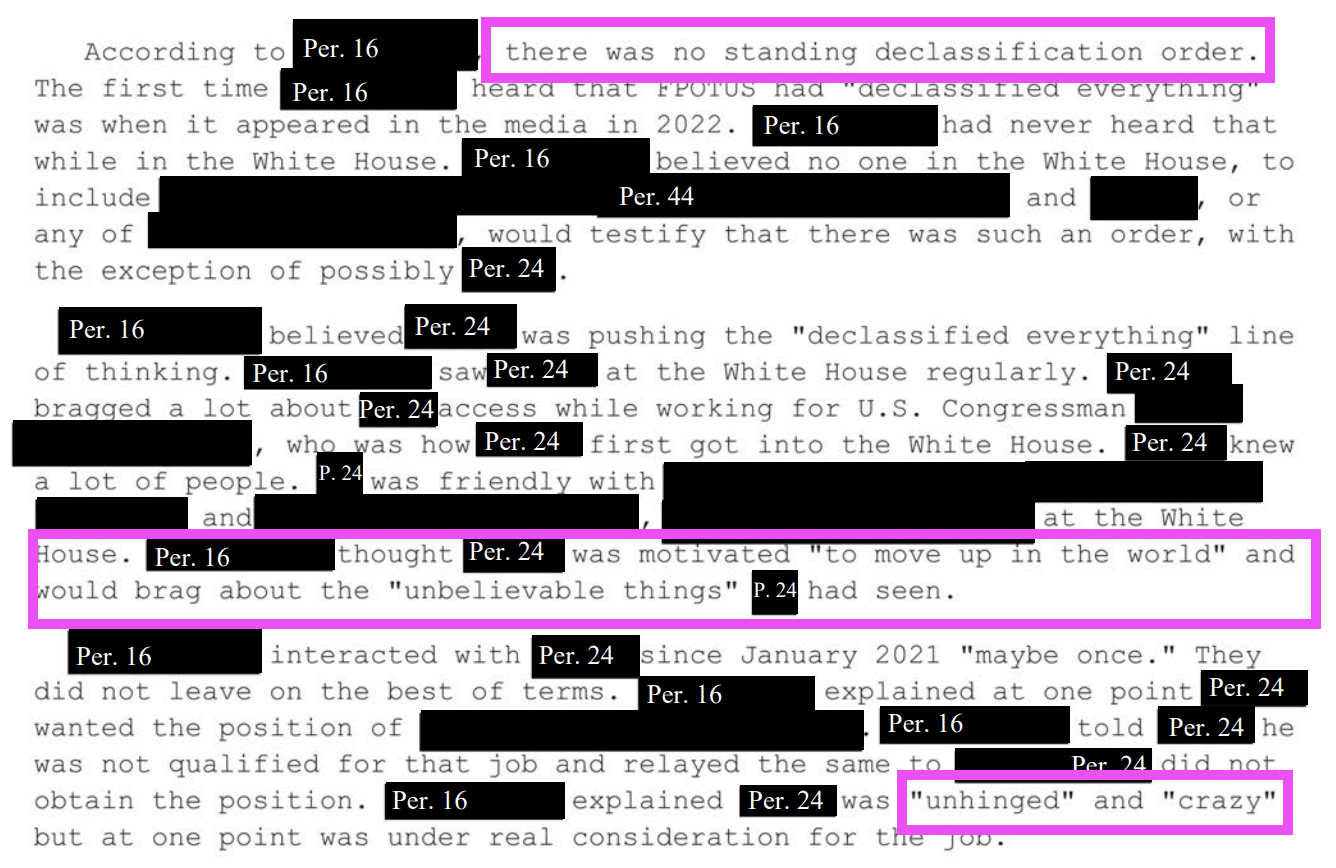
At least one Jack Smith witness — someone with the potty mouth of Eric Herschmann — disputes any claim there was a standing order to declassify documents. That witness described someone “unhinged” and “crazy” who first got access to the White House through the Member of Congress he worked for, who started the “declassified everything” claim when it first started appearing in the media, which is when Kash Patel made the claim.

Jack Smith described what happened next. When investigators subpoenaed Kash to test his claims that Trump had this standing order, Kash tried to delay compliance indefinitely by hiring a lawyer already busy defending a January 6 seditionist. When the aspiring FBI Director did first testify, Kash pled the Fifth repeatedly.

On Monday, September 19, 2022, the FBI personally served witness Kashyap “Kash” Patel with a grand jury subpoena, commanding him to appear on September 29, 2022. Prior to engaging with counsel, Patel contacted government counsel on Friday, September 23, 2022, to request a two-week extension. The government agreed to that extension and set his appearance for October 13, 2022. Thereafter, [Stan] Woodward contacted government counsel on September 27, 2022, explaining that he had just begun a lengthy jury trial–United States v. Rhodes et a., No. 22-cr-15 (D.D.C.)–but that Patel had retained him. On September 30, 2022, Woodward request an addition indefinite extension of Patel’s grand jury appearance until some point after the Rhodes trial concluded. (Ultimately, the verdict in the trial was not returned until November 29, 2022, approximately six weeks after Patel’s already-postponed appearance date of October 13, 2022.) The government was unwilling to consent to the indefinite extension that Woodward sought. Woodward, for his part, declined various alternatives offered by the government, including scheduling Patel’s grand jury appearance for Friday afternoons, when the Rhodes trial was not sitting, and a voluntary interview by prosecutors and agents over a weekend.

On October 7, 2022, Patel (through Woodward) filed a motion to quash his grand jury appearance, arguing that requiring Patel to appeal pursuant to the grand jury’s subpoena would violate his constitutional rights by depriving him of his counsel of choice, i.e., Woodward, who was occupied with a jury trial elsewhere in the courthouse. The Court denied the motion to quash on October 11, 2022, see In re Grand Jury No. 22-03 Subpoena 63-13, No. 22-gj-41, Minute Order (Oct. 11, 2022), and required Patel to appear as scheduled on October 13. See id. (“Mr Patel requests a delay of some unspecified time period in his testimony because his counsel, Stanley Woodward, will be engaged in the United States v. Rhodes trial, Case No. 22-cr-15, scheduled to last several weeks, with no promises as to when his counsel will still have time available. Mr. Patel retained Mr. Woodward on the attorney’s first day of jury selection in Rhodes when such circumstance made fully apparent that counsel would be unavailable during Mr. Patel’s scheduled grand jury testimony. In addition, the government has already demonstrated flexibility in meeting Patel’s scheduling needs . . . . Testifying before a grand jury is not a game of find-or-seek-a-better-time or catch-me-if-you-can, and a witness cannot indefinitely delay a proceeding based on his counsel’s convenience. . . .”).

Patel appeared before the grand jury on October 13, 2022, where he repeatedly declined to answer questions on the basis of the rights afforded to him by the Fifth Amendment. Thereafter, the government moved to compel Patel’s testimony. The Court granted the government’s motion to compel, contingent on the government offering statutory immunity. [my emphasis]

Aileen Cannon has buried any description of what Kash said when compelled to testify. This nomination should be held until any discussion of Patel in the Jack Smith report is released (but thus far Dick Durbin has shown no interest in doing so; DOJ just dropped their appeal).

But it should never be passed, because Kash is a menace. In his repeated efforts to falsely claim that January 6 defendants were treated any worse than any other mostly-violent pretrial detainees during the COVID period, he suggested that the people detained for assaulting cops were being mistreated.

As I have shown (and Bulwark did before me) Kash’s cheerleading for January 6 defendants amounts to arguing that someone accused of assaulting cops who grabs a gun when his probation officers show up should not then be jailed, nor should someone who directly threatened members of Congress, called on a mob to grab their weapons, and then assaulted cops.

Kash Patel will do and say anything to protect Trump and his flunkies — up to and including risking the safety of members of Congress.

Such a person would not serve as Director of FBI. He would serve as a means to turn government against Trump’s adversaries.

Share this entry

Gravity and Trump’s Conspiracy Cabinet

This paragraph, describing the role that aspiring FBI Director Kash Patel played in Trump’s video collaboration with a bunch of mostly-violent Jan6ers, appears about two thirds of the way through a very good NYT review of how Trump has rewritten the history of January 6.

Mr. Trump recorded his contribution at his Mar-a-Lago residence in Florida, while the choir was recorded with a phone in the Washington jail. The song — a fund-raising effort that the Trump loyalist Kash Patel, now the president-elect’s nominee to head the F.B.I., helped produce — concludes with a defiant echo of the “U.S.A.!” chants that resounded during the Jan. 6 attack.

Kash Patel has been central to the success of Trump’s repackaging of his own crimes as grievance from the start.

And I’ve been trying to figure out how that’ll work as I contemplate what I think of as Trump’s Conspiracy Cabinet.

I’ve been thinking of his nominations as a combination of a highly competent Christian nationalist core (led by Stephen Miller and Russ Vought), largely filled out with people who’ll be in the business of graft and other kinds of corruption — whether for their own benefit or Trump’s. But the most unpredictable element is how Trump plans to fill government with embodiments of the conspiracies that have become central to his movement.

That’s most evident in virtually of Trump’s health-related appointments, starting with Bobby Kennedy (who might yet lose his confirmation battle). I don’t, for a second, believe the claim from someone adjacent to Roger Stone that Trump picked RFK and Tulsi Gabbard as a way to tap into a realignment of Democrats. Rather, Trump had to appoint them to keep the likes of Matthew Livelsberger , who invoked RFK in his manifesto, engaged, no matter the cost. And so after having presided over a heroic rush to develop a COVID vaccine in his first term, Trump will hand over America’s scientific crown jewels to people who don’t believe in science.

What will happen when these conspiracists confront the immutable laws of science? What will happen when gravity hits?

And how many children will die as a result?

The damage that Tulsi will be able to do (again, her confirmation is not assured) at National Intelligence is more measurable. US intelligence has been politicized for years. Forever. Such politicization as often as not cause self-perpetuating scandal cycles. And if not, Bad Things will likely result that will harm the US and lead to avoidable catastrophes that Trump should own.

It’s the damage posed by Kash’s likely installation at FBI — he has a better shot at confirmation than either RFK or Tulsi — that I can’t fully grok.

Back in the halcyon days of the Durham investigation, I came to believe that gravity would defeat these grievance myths, would defeat the kinds of conspiracies Kash sows, too. Even with Durham, Kash helped facilitate the false claims Durham spun out of theories of conspiracy hung on two false statements indictments. A key prong of the Sussmann prosecution — into what he said to the CIA in January 2017 — arose out of a question Kash somehow knew to ask on December 18, 2017. Then, after Durham deliberately misrepresented legitimate intelligence that Georgia Tech discovered dating to the Obama Administration to insinuate that Trump had been spied on, Kash made a number of unhinged claims to expand on Durham’s already false claim.

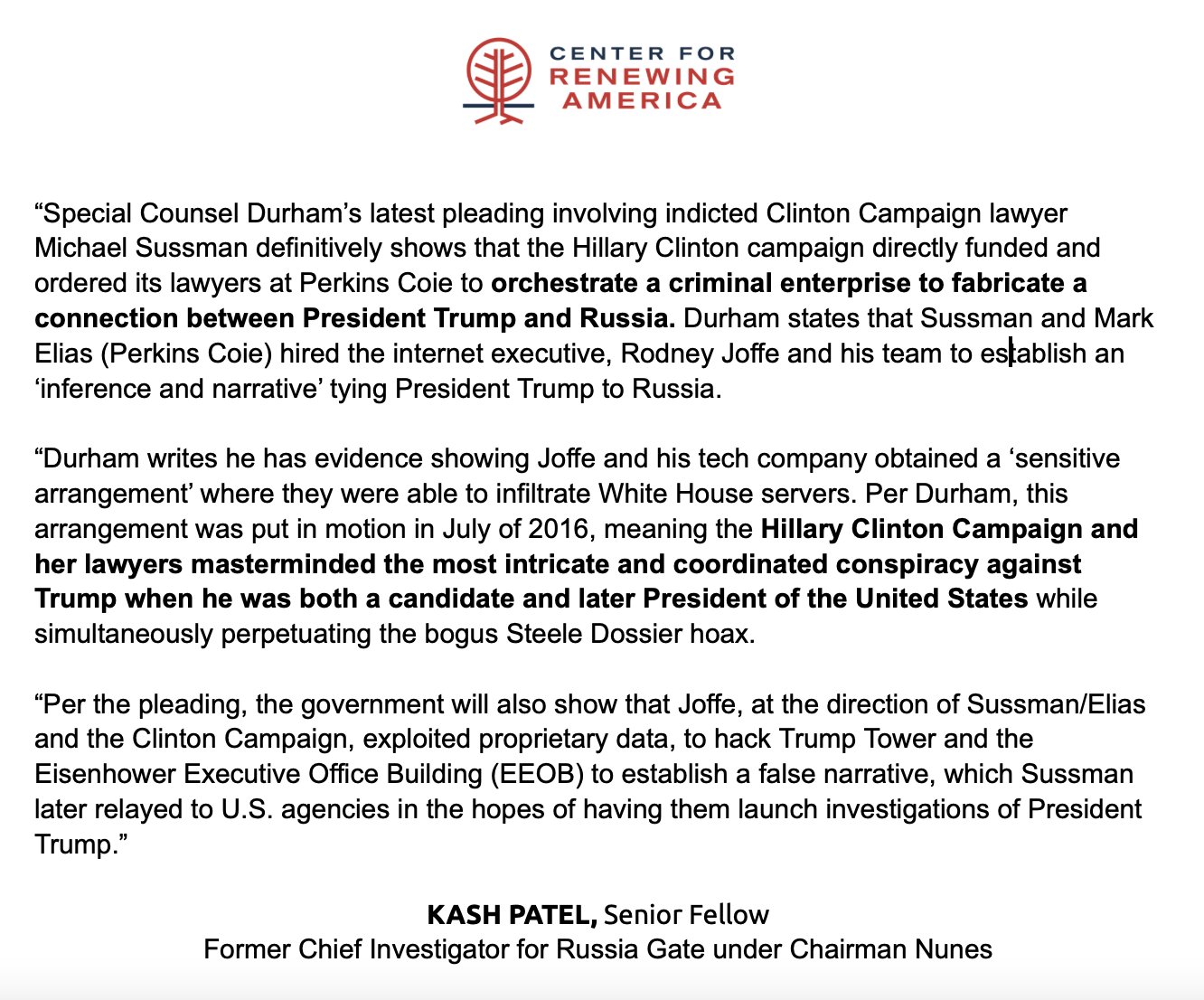
But the oddest statement came from “Former Chief Investigator for Russia Gate [sic]” and current key witness to an attempted coup, Kash Patel, sent out by the fake Think Tank that hosts some of the former Trumpsters most instrumental in covering up for Trump corruption.

Taken literally (which one should not do because it is riddled with false claims), the statement is a confession by Kash that he knew of what others are calling “spying” on Trump and did nothing to protect the President.

Let’s start, though, by cataloguing the false claims made by a man who played a key role in US national security for the entirety of the Trump Administration.

First, he claims that the Hillary Campaign, “ordered … lawyers at Perkins Coie to orchestrate a criminal enterprise to fabricate a connection between President Trump and Russia.” Thus far, Durham has made no claims about any orders coming from the Hillary Campaign (and the claim that there were such orders conflicts with testimony that Kash himself elicited as a Congressional staffer). The filing in question even suggests Perkins Coie may be upset about what Sussmann is alleged to have done.

Latham – through its prior representation of Law Firm-1 – likely possesses confidential knowledge about Law Firm-1’s role in, and views concerning, the defendant’s past activities.

In fact, in one of the first of a series of embarrassing confessions in this prosecution, Durham had to admit that Sussmann wasn’t coordinating directly with the Campaign, as alleged in the indictment.

Kash then claims that “Durham states that Sussmann and Marc Elias (Perkins Coie) … hired .. Rodney Joffe … to establish an ‘inference and narrative’ tying President Trump to Russia.” That’s false. The indictment says the opposite: Joffe was paying Perkins Coie, not the other way around. Indeed, Durham emphasized that Joffe’s company was paying Perkins Coie a lot of money.  And in fact, Durham shows that the information-sharing also went the other way. Joffe put it together and brought it to Perkins Coie. Joffe paid Perkins Coie and Joffe brought this information to them.

Kash then claims that “Durham writes that he has evidence showing Joffe and his company were able to infiltrate White House servers.” Kash accuses the Hillary Campaign of “mastermind[ing] the most intricate and coordinated conspiracy against Trump when he was both a candidate and later President.” This betrays either real deceit, or ignorance about the most basic building blocks of the Internet, because nowhere does Durham claim that Joffe “infiltrated” any servers. Durham, who himself made some embarrassing technical errors in his filing, emphasizes that this is about DNS traffic. And while he does reveal that Joffe “maintain[ed] servers for the EOP,” that’s not infiltrating. These claims amount to a former AUSA (albeit one famously berated by a judge for his “ineptitude” and “spying”) accusing a conspiracy where none has been charged, at least not yet. Plus, if Joffe did what Kash claims starting in July 2016, as Kash claims, then Barack Obama would be the one with a complaint, not Trump.

Finally, Kash outright claims as fact that Joffe “exploited proprietary data, to hack Trump Tower and the Eisenhower Executive Office Building.” This claim is not substantiated by anything Durham has said and smacks of the same kind of conspiracy theorizing Louise Mensch once engaged in. Only, in this case, Kash is accusing someone who has not been charged with any crime — indeed, a five year statute of limitation on this stuff would have expired this week — of committing a crime. Again: a former AUSA, however inept, should know the legal risk of doing that.

Curiously, Kash specifies that the White House addresses involved were in the Eisenhower Executive Office Building. That could well be true, but Durham only claims they were associated with EOP, and as someone who worked there, Kash should know that one is a physical structure and the other is a bureaucratic designation. But to the extent Kash (who has flubbed basic Internet details already) believes this amounted to hacking the EOP, it is based off non-public data.

So, like I said, the piece is riddled with false claims, but with two claims that go beyond anything Durham has said.

This one-two punch — first Durham misrepresenting evidentiary claims and then Kash spinning Durham’s misrepresentations free of all mooring — resulted in Trump making death threats targeting Sussmann and an entire campaign targeting Rodney Joffe.

But in the end, even though Durham’s lawyers repeatedly defied Judge Christopher Cooper’s orders, they ultimately mostly failed to present the theory of conspiracy they had about Sussmann’s alleged false statement. Sussmann, after paying superb lawyers a bunch of money, having his career disrupted, and facing death threats ginned up by the former President, was acquitted.

The process worked, but not before a great many people’s lives were upended, irrevocably.

So even though only NYT joined me, in exposing the degree to which a theory of conspiracy, and not any real evidence, lay behind Durham’s insinuations of guilt, even though the legacy media chased Durham’s theory of conspiracy hook line and sinker, I at least believed that the system would work.

The Hunter Biden prosecution has disabused me of that faith. Between the fact that Hunter really did evade taxes — the presence of a crime that could substitute for all the unsubstantiated claims about him — and the way a multi-year revenge porn campaign solidified the legacy media belief he was too icky for due process, prosecutors continue to make outlandish claims with little pushback, much less curiosity about why a witness to a crime is overseeing the investigation into it.

As FBI Director Kash will have the ability to do what he did in advance of the Sussmann hearing, find some nugget, tangential to any topic at hand, on which to hand a larger conspiracy theory.

Amid all the focus on Trump naming his defense team to run DOJ, there has been little focus on the fact that Emil Bove, whom he named to PADAG (even though the position doesn’t require confirmation and once confirmed as DAG, Todd Blanche could presumably put anyone he wants in the position), presided over a serious discovery violation scandal at SDNY, which forced him out of DOJ. If judges continue to hold DOJ to already weak discovery requirements, due process might survive. But if DOJ institutionally permits prosecutors to ignore their ethical guidelines, it will become far, far easier to frame defendants.

And the press has simply stopped reporting on due process, choosing instead to chase whatever dick pics propagandists unpack in front of them.

Kash Patel earned his nomination to be FBI Director by being the self-described wizard of Trump’s grievance myth. He has done such a tremendous job spinning that myth that even some good faith Republican Senators believe that myth as true.

And while I’m sure that gravity will eventually catch up to RFK Jr, as it did in Samoa, while I have every expectation to continue doing what I do, if only to witness further assaults on due process, I’m far less sanguine about gravity’s effect on a Kash-run Bureau.

Share this entry

Judge Merchan’s Half Baby

Judge Merchan has rejected Trump’s challenges to his conviction in the New York hush money case and scheduled a sentencing for January 10. But he has intimated he will sentence Trump to an unconditional discharge — meaning he won’t serve a jail sentence or probation.

In my opinion, this is a tactical decision and like every other legal decision about Donald Trump, unsatisfying and inadequate.

I think Merchan is trying to affirm the import of the jury’s guilty verdict, while daring Trump to ask for more.

The tradeoff I think Merchan is making is that by giving Trump nothing tangible to lose except his claim to innocence, he nevertheless situates the case in such a way that Trump can appeal.

But Merchan did so while weighing the record in favor of judicial independence.

After affirming the seriousness of Trump’s crime and the evidence against Trump (the first of ten “Clayton Factors” Merchan was obliged to consider given Trump’s request he just make the case go away), Merchan next addressed Trump’s claim that his contributions to society say he should escape punishment.

Merchan used that factor to discuss Trump’s attacks on Courts and Rule of Law. Among the items Merchan listed was the need to gag Trump; he noted, too, that even the Supreme Court backed his decision.

Defendant argues that his “contributions to this City and the Nation are too numerous to count,” and concludes his argument under this section by referencing two NY Supreme Court cases which are entirely distinguishable.T Defendant’s Motion at pg. 59. This Court agrees that Defendant served his country as President and will do so again in a matter of weeks. However, that service is but one of the considerations to weigh under this factor.

Despite Defendant’s unrelenting and unsubstantiated attacks against the integrity and legitimacy of this process, individual prosecutors, witnesses and the Rule of Law, this Court has refrained from commenting thereon unless required to do so as when ruling on motions for contempt of court. However, Defendant, by virtue of the instant motion, directly asks this Court to consider his character as a basis to vacate the jury verdict, and this Court must do so in accordance with the requirements of CPL section 210.40(1)(d).

Defendant’s disdain for the Third Branch of government, whether state or federal, in New York or elsewhere, is a matter of public record. Indeed, Defendant has gone to great lengths to broadcast on social media and other forums his lack of respect for judges, juries, grand juries and the justice system as a whole. See People’s Response at Section IV. C. In the case at bar, despite repeated admonitions, this Court was left with no choice but to find the Defendant guilty of 10 counts of Contempt fot his repeated violations of this Court’s Order Restricting Extrajudicial Statements (“Statements Order”), findings which by definition mean that Defendant willingly ignored the lawful mandates of this Court. An Order which Defendant continues to attack as “unlawful” and “unconstitutional,” despite the fact that it has been challenged and upheld by the Appellate Division First Department and the New York Court of Appeals, no less than eight times. Indeed, as Defendant must surely know, the same Order was left undisturbed by the United States Supreme Court on December 9,2024. [citation]. Yet Defendant continues to undermine its legitimacy, in posts to his millions of followers. Indeed, this is not the only instance in which Defendant has been held in contempt or sanctioned by a Court.8 Defendant’s character and history vis-a-vis the Rule of Law and the Third Branch of government must be analyzed under this factor in direct relation to the result he seeks, and in that vein, it does not weigh in his favor.

8 For example, Defendant has been held in contempt by courts within this jurisdiction and sanctioned by others. People of the State of New York v. The Trump Organizotion, Inc., No. 451G851202O [citation] (“Frivolous lawsuits should not be used as a vehicle for fundraising or fodder for rallies or social media. Mr. Trump is using the courts as a stage set for political theater and grievance. This behavior interferes with the ability of the judiciary to perform its constitutional duty) [my emphasis]

Trump claimed he was too important to sentence. Judge Merchan responded that Trump has undermined the Courts at every level.

And then he noted that the Supreme Court had backed him, Merchan, in defending the sanctity of his court.

That’s not the only legal issue Merchan highlighted as important. Merchan also noted Trump’s claim to President-elect or retroactive immunity.

Defendant presents this Court with the novel theory of President-elect immunity as it applies to [citation], arguing that such immunity presents a “legal impediment to conviction.” For the reasons stated above, this Court remains unpersuaded that President-elect immunity is the law and thus, neither that doctrine, nor the Supremacy Clause or Presidential Transition Act present a legal impediment to imposition of sentence. Alternatively, Defendant seeks, in essence, a form of retroactive immunity. Both of these theories are briefly addressed below.

Essentially, what Defendant asks this Court to do is to create, or at least tecognize, two types of Presidential immunity, then select one as grounds to dismiss the instant matter. First, Defendant seeks application of “President-elect immunity,” which presumably implicates all actions of a President-elect before taking the oath of office. Thus, he argues that since no sitting President can be the subject of any stage of a criminal proceeding, so too should a President-elect be afforded the same protections. Defendant’s Motion at pg. 35. Second, as the People characterize in their Response, Defendant seeks an action by the Court akin to a “retroactive” form of Presidential immunity, thus giving a defendant the ability to nullify verdicts lawfully rendered prior to a defendant being elected President by virtue of being elected President. It would be an abuse of discretion for this Court to create, or recognize, either of these two new forms of Presidential immunity in the absence of legal authority. The Defendant has presented no valid argument to convince this Cout otherwise. Binding precedent does not provide that an individual, upon becoming President, can retroactively dismiss or vacate prior criminal acts not does it grant blanket Presidential-elect immunity. This Court is therefore forbidden from recognizing either form of immunity.

Merchan is right: these are garbage theories. Theories that even most of SCOTUS would reject.

And that may be why Merchan adopted his wildly unsatisfying approach to sentencing. First, he rejected Alvin Bragg’s bid for an Alabama Rule because it would not permit Trump ability to appeal — to appeal his retroactive immunity claims, to appeal his claim about judicial prerogatives. Similarly, Merchan declined to just hold the sentence in abeyance unless he was unable to sentence Trump.

This Court has considered and now rejects the People’s suggestion that it adopt the “Alabama Rule” which would preserve the jury verdict while terminating the proceedings as such a remedy would deny Defendant the pathway he needs to exhaust hrs appellate rights.

The Court has also considered the People’s alternative proposal of holding sentence in abeyance until such time as Defendant completes his term of Office and finds it less desirable than imposing sentence prior to January 20, 2025. The reasons are obvious. However, if the Court is unable to impose sentence before Defendant takes his oath of office, then this may become the only viable option.

And after telling Trump the only way he would just hold the sentence in abeyance is if he were not able to sentence him before his term, Merchan informed him that he’s inclined to given him a sentence of unconditional discharge, in part so Trump can appeal.

a sentence of an unconditional discharge appears to be the most viable solution to ensure finality and allow Defendant to pursue his appellate options.

Merchan is giving Trump a choice: Show up — even by video — and be sentenced as an adjudged fraudster — with the expectation that he won’t go to jail and if he wants to appeal things like his retroactive immunity and bad character he can do so. Or he can no show.

In which case the sentence will hang over his head for the entirety of his presidency.

None of this is satisfying.

But Judge Merchan seems to have carved out a little corner of rule of law — retroactive immunity and the judicial contempt on which even this SCOTUS has already upheld Merchan — that Trump can test before the Supreme Court. If Trump wants to take those chances, he can have an unconditional discharge precisely so he can make that appeal.

Or he can have the sentence hanging over his head for his entire term.

Share this entry

Cotton Swabs and Grievance Myths: Do Not Invite Republicans to Express Support for Kash Patel’s Witch Hunts

I want to elaborate on some points I made in a Bluesky exchange I had with Greg Sargent about his post on the Barry Loudermilk report referring Liz Cheney for investigation yesterday. It was, I hope, a civil and substantive exchange (multiple people have mentioned it since), and for that I want to thank Sargent.

But I wanted to explain some points I tried making at more length.

Sargent’s post noted — and he’s right — that Trump’s embrace of Loudermilk’s report discredits false assurances Senate Republicans have offered that Kash Patel won’t pursue political witch hunts if confirmed as FBI Director.

Barely moments after Donald Trump announced that he’d chosen loyalist Kash Patel as FBI director, Republicans stampeded forth to insist that this in no way means Trump will unleash law enforcement on his enemies, even though Trump himself has threatened to do so. Senator John Cornyn suggested such threats were only for “public consumption.” Senator Rick Scott said Trump is “not gonna do it.” And Representative Dan Meuser scoffed that the very idea is “nonsense.”

These lawmakers should take a moment to consult Trump’s Truth Social feed. At 3:11 a.m. on Wednesday, demonstrating characteristic emotional balance, Trump posted this reaction to a new report from a House subcommittee chaired by GOP Representative Barry Loudermilk, which recommends that the FBI investigate former GOP Representative Liz Cheney over her role in the House’s January 6 inquiry:

Liz Cheney could be in a lot of trouble based on the evidence obtained by the subcommittee, which states that “numerous federal laws were likely broken by Liz Cheney, and these violations should be investigated by the FBI.” Thank you to Congressman Barry Loudermilk on a job well done.

Note the trademark mobspeak here: Cheney could be in a lot of trouble for federal lawbreaking, Trump declares, as if he’s merely a passive observer remarking on the danger she faces, rather than someone who will control the nation’s sprawling federal law enforcement apparatus in just over a month. Trump has been raging at Cheney for years and has amplified suggestions that she should face televised military tribunals.

Now, in a dark turn in this whole farcical saga, Trump is pretending that House Republicans have given him a legitimate basis for prosecuting Cheney, when in fact their claims were cooked up in bad faith for precisely that purpose.

Sargent argues that the press should “hound[ GOP Senators] mercilessly” on whether they’ll still support Kash after Trump’s endorsement of Loudermilk’s report.

Trump’s veiled threat toward Cheney should prompt the press to revisit those reassurances from Republicans. GOP senators should be hounded mercilessly by reporters on whether they’ll knowingly support Patel now that Trump has made the corrupt reality of the situation so inescapably, alarmingly clear.

If we lived in a world where Republican hypocrisy could be shamed, where journalists had the skill to manage such an exchange, that would be worthwhile.

We don’t live in that world.

Trying to budge Republicans from their reassurances would backfire.

Here’s why.

First, consider the utter incompetence of most journalists this side of Mehdi Hasan to handle such an exchange.

I’ve been tracking a right wing technique I’ve dubbed “Cotton swabs” (because Tom Cotton is a skilled practitioner in the technique). In it, when Republicans get asked these kind of gotcha questions by Manu Raju in the hallway or by Kristen Welker on a Sunday show, they instead flip the gotcha on its head, using it as an opportunity to air unrebutted propaganda. And the journalist is left as a discredited prop in Trump’s assault on the press.

For example, when Welker recently asked Trump if he would, in the interest of unifying the country, concede he lost the 2020 election, Trump not only refused to concede he lost, but he used the question to blame Biden that the country was divided, and then — with absolutely no pushback from Welker — lied about Joe Biden weaponizing DOJ to go after him, Trump. (The exchange introduced precisely the same kind of false reassurance that Sargent called out.)

KRISTEN WELKER:

Yes. And sir, I don’t have to tell you this, because you’ve talked about it. It comes at a time when the country is deeply divided, and now you’re going to be leading this country for the next four years. For the sake of unifying this country, will you concede the 2020 election and turn the page on that chapter?

PRESIDENT-ELECT DONALD TRUMP:

No. No, why would I do that? But let me just tell you —

KRISTEN WELKER:

You won’t ever concede —

PRESIDENT-ELECT DONALD TRUMP:

– when you say the country is deeply divided, I’m not the president. Joe Biden is the president.

KRISTEN WELKER:

But you’re going to be the president.

PRESIDENT-ELECT DONALD TRUMP:

No, no. I’m not the president. So when you say it’s deeply divided, I agree. But Biden’s the president, I’m not. And he has been a divider. And you know where he divided it more than anything else, and it probably backfired on him. I think definitely is weaponization. When he weaponized the Justice Department and he went after his political opponent, me. He went after his political opponent violently because he knew he couldn’t beat him. And I think it really was a bad thing, and it really divided our country.

So instead of giving the harmless concession she invited, that Trump lost to Joe Biden in 2020, Trump instead hijacked Welker’s platform to lie about being a victim. She asked for something to support unity. He stoked division more, blaming the polarization of the country on Biden. Then he made false claims of grievance.

It had exactly opposite effect Welker imagined. And in the fact check NBC did after the interview? Trump’s lie about Biden weaponizing DOJ went unmentioned.

NBC treated it, a brazen lie, as if it were true.

If you want to know how Trump got elected even after being charged in two federal indictments, you might start with the way that every legacy media outlet lets lies like this go uncontested.* Always. Trump never gets fact checked on his false claims about the federal investigations into his attempted coup and stolen documents.

As a result, even newsies who watch mainstream Sunday shows might be forgiven for believing the cases against Trump were ginned up, to say nothing of the judges and lawyers, from Aileen Cannon to Bill Barr to Sam Alito, who instead pickle their brains with the propaganda on Fox News.

If journalists don’t fact check these false claims, where would voters learn differently? Where would your average voter learn that the investigations against Trump were just?

Sometimes Cotton swabs involve speaking over the questioner (a favorite technique of JD Vance [see update below for an example] and Marco Rubio). Sometimes it involves flipping the entire premise of the question. It always involves, first, a shameless refusal to disavow the outrageous Trump practice or statement. As such, these are performative moments of obeisance, reinforcing Trump’s power and the assault on truth he demands.

And on questions regarding Trump’s troubled relationship with rule of law, it always involves false claims about past DOJ practice, either denials he politicized DOJ or false claims it was politicized against him. Sometimes both!

Trump and his allies have used Cotton swabs to sneak hundreds — probably thousands — of false claims that he, and not his adversaries, was a victim of politicized prosecution onto purportedly factual news outlets with no pushback.

None.

Indeed, at least one of the underlying examples of Republicans giving reassurances about Kash that Sargent cited was itself a Cotton swab. Rick Scott didn’t just say that Trump wouldn’t launch investigations in his second term, the part Sargent quoted, he premised his answer on a false claim that Trump didn’t do so in his first term (a very common claim among Trump’s most loyal allies).

“He didn’t do it the first time. He’s not gonna do it this time,” Scott said. (Trump actually did press for prosecutions of his enemies during his first term, such as by publicly musing there should be probes of former Democratic presidential candidate Hillary Clinton, and he also pushed for a criminal investigation into a previous investigation of his 2016 campaign.)

Even with Arthur Delaney’s fact check (a rarity in the reporting of Cotton swabs), HuffPo didn’t note that Trump did more than simply demand investigations of his adversaries, he got them. A key prong of the John Durham investigation chased possible Russian disinformation exacerbated by Durham’s own fabrications to criminalize Hillary’s use of oppo research. And both Durham’s indictments presented dodgy false statement accusations as conspiracies extending to the Hillary campaign. Trump’s DOJ set up a side channel via which Biden was framed — a false allegation used to ratchet up felony charges against his son. And there’s a long line of investigations — IRS audits, DOJ IG investigations used to fire people without due process, US Attorneys ordered to pursue special investigations (including another one targeting Hillary) — that targeted Trump’s enemies.

Trump’s administration targeted his enemies all the time, via a variety of means. And yet that gets buried in the HuffPo report. What should have been an opportunity to debunk Scott’s premise was, even from a diligent journalist, an exchange that still obscured how systematically Trump politicized rule of law in his first term.

And these Cotton swabs are part of a larger process, the extended con via which Trump has gotten Republicans to hate rule of law that LOLGOP and I have been tracing in the Ball of Thread podcast. Rather than treating the Russian investigation as a welcome review of four associates all of whom were monetizing their access to Trump with foreign countries, he instead latched onto false claims he was wiretapped, making himself a victim. With the help of Kash Patel, Trump substituted the Steele dossier for the real substance of the Russian investigation, convincing most Republicans that the investigation started not from the Trump campaign’s foreknowledge of the Russian attack on Hillary, but instead from Hillary’s attempt to understand Trump’s unabashed Russian ties — that oppo research Durham would criminalize. Trump then turned on the FBI, claiming that a bunch of people who were just trying to protect the country from an attack by a hostile country were instead targeting him personally; the myth that FBI targeted him is precisely what John Cornyn internalized when he attributed his support for Kash because Kash planned, “to restore the FBI to its former reputation as a nonpartisan, no political institution, and he told me he agreed” (also part of the Delaney story). Via both his own propaganda and the Durham investigation designed to flip the script on Hillary, Bill Barr reinforced that myth of Trump grievance. And all that while the entire Republican party responded to Trump’s extortion of Ukraine by relentlessly pursuing Joe Biden’s kid to the exclusion of pursuing policy, using a fabricated bribery allegation to ratchet things up before their rematch. Think about that! Trump dodged his first impeachment by ginning up a politicized investigation of Biden and his kid, and that entire process has been memory holed!

Gone!

Poof!

And while LOLGOP and I still have several episodes to do, it is no accident that the same team that turned a hard drive of Hunter’s dick pics — a relentless campaign of revenge porn — into yet another claim that poor Donald Trump was the victim, it is no accident that that very same team turned immediately to using the Big Lie to attack the foundations of American democracy. And Trump did it again when he beat the second (impeachment) and third (criminal indictment) attempts to hold him accountable. The price of admission in today’s GOP is these moments of performed fealty, the willingness to use legitimate questions about the politicized justice Kash has promised to instead publicly adopt Trump’s false claims that he is a victim.

The entire GOP is currently built around this myth of grievance. It gets reinforced with every Cotton swab. It was Trump’s platform during the election. It was the lie he used to make a bunch of disaffected Americans believe they had something in common with a billionaire grifting off their vulnerabilities.

This is the core of Trump’s super power, the claims of grievance he manufactures to justify his assault on rule of law.

The last thing you should want is for journalists to rush out to give Republican Senators yet another opportunity to perform their obeisance to Trump and his false myths of grievance, because all it will do is reinforce the polarization Trump thrives on and do further damage to truth and rule of law.

If we’re going to break this spell, we need to go about it a different way, some of which Sargent and I also discussed with respect to Kash, some of which I laid out in an earlier post responding to something Sargent wrote.

You are not going to defeat a Kash Patel or Pam Bondi nomination by asking for promises about political investigations. As I noted in that earlier post, Democrats (and even Lindsey Graham) attempted that approach with Bill Barr, and he proceeded directly from his confirmation to turn DOJ into a propaganda factory, down to the fabricated bribery allegation against Joe Biden.

Leave the direct assault on Kash to Olivia Troye (if she remains willing), to whom Kash already provided opportunity to talk not about his past role in abusing rule of law for Trump, but instead about how he lied to the people who relied on him, up to and including Mike Pence. Troye gives Republicans reason to oppose Kash because he has harmed Republicans. If you instead focus on Kash’s past and promised politicization, you’ll just trigger more obeisance to Trump’s myth of grievance.

Luckily, with Kash, there are other ways to get at this.

The question that kicked off the entire exchange between Sargent and me, for example, was about Speech and Debate, which should protect Liz Cheney from any scrutiny even if the false claims alleged in the Loudermilk report were true. Raising the Loudermilk referral as a question about Speech and Debate has the advantage of addressing the one area that has gotten Republicans to stand up to Trump, their own prerogatives (for example, by defending advice and consent on nominations). Questions about Speech and Debate would provide cause to raise the opinion — written by Trump appointee Neomi Rao, with a concurrence from former Trump White House Counsel Greg Katsas — that extended Speech and Debate protection to Scott Perry’s plotting on the Big Lie and affirmed its application in less formal situations than Liz Cheney’s communication with Cassidy Hutchinson at the core of Loudermilk’s report.

The district court, however, incorrectly withheld the privilege from communications between Representative Perry and other Members about the 2020 election certification vote and a vote on proposed election reform legislation.

Does Kash know better than Neomi Rao about Liz Cheney’s immunity from this kind of investigation, he should be asked (whether Rao or Kash is a bigger nutball is admittedly a close question, but one that can sow some useful discomfort). Questions to Kash about whether Speech and Debate defeats Loudermilk’s referral would have a very different valence than questions about politicization, because they would carry with them the implication that if Kash can investigate Liz Cheney and Adam Schiff, Mitch McConnell will be next.

Plus, they provide cause to focus on something Senators should address anyway: Kash’s lawsuit against DOJ for his own subpoena. In addition to claiming that the subpoena targeting him and others (including Adam Schiff, though he neglected to mention that) was “a chilling attempt to surveil the person leading the Legislative Branch’s investigation into the Department of Justice’s conduct,” something also included in the scope of the January 6 Committee, Kash also made preposterous claims about the standard for subpoenas (which is why it was dismissed unceremoniously in September).

Even Kash’s legally illiterate claims won’t disqualify him with Republican Senators, but raising them gets him on the record as to his understanding of the law before he signs a bunch of orders adopting wildly different standards targeting Trump’s adversaries. Kash has made expansive claims about privacy rights and right of redress against the federal government. Fine. Let’s make aspiring FBI Director Kash Patel adhere to that standard.

But they also provide a way to point out that Kash’s targets actually aren’t Trump’s targets. Many of those on his enemies list, for example, are people, like Rod Rosenstein (the real target of Kash’s lawsuit) against whom he’s got a grudge. Trump and GOP Republicans don’t give a damn if Kash pursues Trump’s enemies. Either they’re too cynical to care, or they believe — or have to feign that they believe — that Trump’s enemies have it coming. But if Kash turns the FBI into his own personal fiefdom? Too many Republicans have been at odds with Kash to abide by that.

Finally, there’s the point I made about the Loudermilk report, after actually taking the time to read it (which no one else seems to have done). In the 39 pages of his report dedicated to DOD’s inaction, Loudermilk gets vanishingly close to accusing then Acting Secretary of Defense Christopher Miller of criminal insubordination for not deploying 10,000 members of the National Guard on January 6.

President Trump instructed the highest-ranking Pentagon official to use any and all military assets to ensure safety three days prior to January 6, 2021. The Acting Secretary of Defense concedes that external variables, such as the “Twitter sphere”, accusations of being a “Trump crony” and Representative Cheney’s Op-Ed, weighed on his mind as he determined how and whether to employ the National Guard on January 6, 2021. During this period of time, Acting Secretary Miller published his January 4 memo, with significant restrictions and control measures on the DCNG.

To date, no investigation or disciplinary action has taken place against Acting Secretary of Defense Miller for his failure to follow directives from the sitting Commander-in-Chief on January 3, 2021.

Loudermilk sources this accusation in DOD IG’s own investigation of their inaction for some very good reasons. First, the January 6 Committee revealed that what really happened is that a bunch of Trump loyalists, up to and including Mark Meadows, scoffed at the notion that Trump would march to the Capitol protected by 10,000 National Guard troops. More importantly, Kash Patel’s claims about his own involvement in this process put him right there at Miller’s side, part of the same insubordinate inaction. That’s a fiction Loudermilk needed to spin. It’s a fiction even more outrageous than his referral of Liz Cheney.

But it’s also a referral that implicates Trump’s pick for FBI Director personally. Did Kash fail the President? Or did he instead join everyone else in recognizing what it would mean for Trump to march to the Capitol?

A damn good question for a confirmation hearing.

Kash Patel’s own big mouth, past actions, and wacky legal claims provide ample material to create friction between him and Senate Republicans guarding their own prerogatives. That’s almost certainly not enough to sink his nomination, though it would be more effective than inviting Republicans to reaffirm their belief in Trump’s grievance myth. But questions about such topics may provide better material going forward to box him in.

About one thing I’m certain, though: you will get nowhere if you make this a loyalty contest. You will get nowhere if you keep framing this as an opportunity for Republicans to either reaffirm that loyalty oath, even if it entails a direct assault on rule of law, or invite an attack on themselves personally.

Virtually all GOP Senators will find a way to back Trump and his assault on rule of law. Every single time.

And given the inept media we’ve got right now, it will serve only to do more damage, reinforcing Trump’s conceit that the law is just a matter of political loyalty.

Do not give Republicans an opportunity to condemn or endorse Kash Patel’s witch hunt against Trump’s enemies. It’s the quickest way to ensure they remain unified in supporting him.


*The night after I wrote this, I woke up and remembered that CNN’s Daniel Dale had written a fairly extensive fact check about Trump going after his adversaries. The exchange with Martha Raddatz he responded to was a good example of how JD Vance talks over people to deliver his Cotton swabs, filibustering to prevent any rebuttal.

RADDATZ: Would Donald Trump go after his political opponents?

VANCE: No —

RADDATZ: He suggested that in the past.

VANCE: Martha, he was president for four years and he didn’t go after his political opponents.

You know who did go after her political opponents? Kamala Harris, who has tried to arrest everything from pro-life activists to her political opponents —

(CROSSTALK)

RADDATZ: He said those people who cheated would be prosecuted.

VANCE: — and used the Department of Justice as a weapon against people — well, he said that people who violated our election laws will be prosecuted. I think that’s the administration of law. He didn’t say people are going to go to jail because they disagree with me. That is, in fact, been the administration and the policy of Kamala Harris, Martha.

Look, under the last three-and-a-half years, we have seen politically-motivated after politically-motivated prosecution. I’d like us to just get back to a system of law and order where we try to arrest people when they break the law, not because they disagree with the prevailing opinion of the day, and there’s a fundamental difference here between Donald Trump and Kamala Harris. Donald Trump may agree — agree or disagree on a particular issue, but he will fight for your right to speak your mind without the government trying to silence you.

Kamala Harris is explicitly —

RADDATZ: Senator Vance, I —

(CROSSTALK)

VANCE: — censorship of folks who disagree with her.

RADDATZ: I want to go back to Donald Trump.

(CROSSTALK)

In response to Dale’s fact check, Trump’s campaign accused the media of a double standard because DOJ hadn’t indicted Biden or Hillary for their non-crimes.

Trump made extensive behind-the-scenes efforts to get his political opponents charged with crimes. But you don’t have to rely on investigative reporting or the memoirs of former administration officials to know that Trump went after political opponents as president.

He often went after them in public, too.

As CNN reporter Marshall Cohen has noted, there is a long list of political opponents whom Trump publicly called for the Justice Department and others to investigate or prosecute. The list includes not only 2016 election opponent Hillary Clinton and 2020 election opponent Joe Biden but also Biden’s son Hunter BidenDemocratic former Secretary of State John KerryTrump’s former national security advisor turned critic John BoltonDemocratic former President Barack Obamaunspecified Obama administration officialsthe anonymous author of a New York Times op-ed by a Trump administration official critical of TrumpMSNBC host and Trump critic Joe Scarboroughformer FBI director turned Trump critic James Comeyother former FBI officialsformer British spy Christopher Steele (the author of a controversial dossier of allegations against Trump), and various congressional Democrats – including former House Speaker Nancy PelosiRep. Adam Schiff of CaliforniaRep. Ilhan Omar of Minnesota, Sen. Richard Blumenthal of Connecticut, and Sen. Mark Warner of Virginia.

Asked for comment for this article on Monday, Vance spokesperson Taylor Van Kirk accused the media of having a biased “double standard” and said “it is indisputable that under Kamala Harris and Joe Biden’s DOJ, the Republican nominee for president was targeted and indicted, while under President Trump, nothing like that ever transpired against either of the Democrats he faced off with in 2016 or 2020.”

But that wasn’t for a lack of Trump trying.

Trump repeatedly pressured the Justice Department as president to prosecute both Clinton and Biden, in addition to trying to get foreign countries to investigate Biden. That the Trump-era Justice Department declined to charge Clinton and Biden doesn’t mean it’s true that Trump didn’t “go after” them or others. (In fact, Trump literally said in 2017 that he wanted the department to be “going after” Clinton.) [my emphasis]

But even Dale, the best in the business, made no mention of how aggressively Durham investigated Hillary and her campaign and ignored that the Brady side channel led directly to the elevation of Alexander Smirnov’s attempt to frame Joe Biden, which had a role in David Weiss’ elevation as Special Counsel, which led to the felony conviction of Hunter [Dale relies heavily on CNN’s Marshall Cohen, who got the Durham investigation wildly wrong].

In 2019, Barr satisfied Trump’s investigate-the-investigators demand by tasking a federal prosecutor to help investigate the origins of the FBI’s probe related to Russia and the 2016 election. In late 2020, with about three months left in Trump’s presidency, Barr gave that prosecutor, John Durham, the status of special counsel.

And in early 2020, Barr tasked a different federal prosecutor with taking in information from members of the public, notably including then-Trump lawyer Rudy Giuliani, related to allegations about the Bidens and Ukraine, which had been a subject of Trump’s public and private focus.

Share this entry

The Myths of Bluebeard and Orangeskin

[NB: check the byline, thanks. /~Rayne]

I have been tamping down my disgust for the last four weeks, just as many of you have.

I’m completely disgusted with talking head punditry blaming everyone but themselves, including Democrats and Democratic Party-wannabes who decided after the election that it was a good time to kick minority groups and blame them, or turned stupid before the camera and insist the barrier to winning was something facts say it wasn’t.

But I have a specially level of revulsion allocated for – brace yourself, it’s not about some of you personally – white women.

53% of white American women have voted for Donald the adjudicated rapist Trump not once, not twice, but three fucking times – in 2016, in 2020, and yet again in 2024.

For some it was about financial issues like taxes – I earned this, I’ve got mine, fuck you, they voted, wanting Trump to ensure their rank in the economic pecking order was conserved.

For others it was about race and/or misogyny. Internalized oppression makes these voters believe they are somehow exempt from the oppression when they are only a future victim.

In a handful of states it’s clear reproductive rights were important to this bloc of voters because they voted against abortion restrictions. And yet they still voted for Trump.

Trump’s claims that he would leave abortion to states to decide apparently convinced them they could have things both ways. They could belong to the cult of Trump and white patriarchal supremacy and still retain their reproductive rights.

What poppycock. Trump had already made the biggest move possible to eliminate their rights at federal level by ensuring the Roberts’ Supreme Court would undermine them.

It’s infuriating and yet somehow predictable.

This cognitive dissonance in women is the stuff of myth, the kind of behavior we’ve been warned about in stories nearly a millennia old.

We’re watching once again the unfolding myth of Bluebeard.

~ ~ ~

Here’s the tl;dr version of the Bluebeard myth from Simple Wikipedia:

A rich man has a blue beard which frightens young women. He has been married several times but no one knows what has happened to his wives. He woos two young sisters in the neighborhood but neither are inclined to consider marriage. He treats them to a lavish time in his country house. The younger sister decides to marry him. Shortly after the wedding (and before he travels to a far land on business), Bluebeard gives his wife the keys to his house. One key opens a door to a distant room. He forbids her to enter this room. He leaves and his wife opens the door to the forbidden room. Here she finds Bluebeard’s former wives, all dead and lying on a floor covered with blood. She drops the key. It is magic and becomes stained with blood that cannot be washed away. Bluebeard returns. He discovers the blood-stained key and knows his wife has disobeyed his order. He tells her she will take her place among the dead. He grants her a few minutes to pray. She calls her sister Anne and asks her to go to the top of the tower to see if her brothers are on the road. After several tense moments, Anne reports seeing the men approaching. Bluebeard raises a cutlass to decapitate his wife. Her brothers burst into the room. They kill Bluebeard. Their sister is safe.

I’m not going to write out the full Bluebeard myth here. I’m going to trust readers to do their homework reading the original, more complex Wikipedia entry and possibly the Charles Perrault version available for free at Project Gutenberg.

There are many versions of this myth across languages, countries, and cultures. It has been adapted in contemporary culture repeatedly. In other words, humans have been telling a story in which the same familiar elements have occurred because humans universally find it relatable across history and now.

We’ve even begun discussion of universal liberation and the enslavement of fully-conscious AI “women” to serve Bluebeardian men, as in writer/director Alex Garland’s Ex Machina (2015).

It should not be difficult to see the parallels between Bluebeard and Trump – the multiple silenced wives, the naïve woman/women who yield to promises of wealth and pleasure, the unpleasantness of discovering the truth beneath the promises, the mortal price to be paid.

Nor should it be difficult to see the meta layer of this myth, where wealthy men feel entitled to demand subordination by women including the suppression of knowledge and therefore consent. To slip this leash is to suffer loss unless rescued at the last moment. That rescue is the only thing separating the bride from the corpses of sister brides.

The biggest single variant between versions of the Bluebeard myth is the means of rescue. A sister or sisters, brother or brothers, or a mother figure steps in at the very last moment to save the final girl.

Unfortunately, the parallel here is that they believe naively they will always be the lucky final girl; in truth we as societal siblings are always the rescuers.

We did a shit job three elections in a row, mostly because we assumed the victim(s) were fully informed and aware of the danger, failing to reach them at a level mythic stories connect. Many were fully informed and blithely voted for Trump because he said he would leave reproductive rights to the states.

Like the last bride in Bluebeard’s myth, they may have been amply informed of the manifold deaths of previous wives yet plunged ahead into marriage believing they were somehow immune.

What if the victim(s) refuse efforts to save them?

~ ~ ~

Three women married Trump, two of whom should have known better. More women were involved with him consensually; they, too should have known better.

Note status of consent here – some girls and women were forced to be involved with Trump without their consent, from minors at the Miss Teen USA pageant to E. Jean Carroll. Don’t confuse these persons with the former. Many of them fought in some way not to be involved with Trump, informing more women about his nature as they did so, clawing back against his efforts to stuff them in his bloody oubliette by way of SLAPP suits and other forms of legal harassment.

The women who voted for Trump three times are among those who expressed their consent at the ballot box. They agreed to what he offered them as a candidate.

Like the younger sister who heard all the rumors about Bluebeard, who may have been warned by mother and sisters against him, they went ahead and consented to Trump as president.

The only thing which gave Bluebeard’s final wife pause was her own discovery in the personal pursuit of information. In many versions of the myth she is merely overwhelmed by her own curiosity about the forbidden. In other versions she is upset about being denied access to what is hers by rights as his wife. Whatever it is that drives her, it is she who must put the key into the lock, she who makes the discovery of the many corpses, she who in terror drops the key and eventually exposes her intransigence to Bluebeard.

It is she who must be threatened for her failure to obey and she who must face the intense fear of death.

She will seek her ready rescuers only after she has been confronted with the reality of Bluebeard’s immense monstrousness and his intent to kill her.

In short, the 53% of white women who voted for Trump will only realize the enormity of their mistake when he threatens them personally at immense personal cost.

They will ask us for help once they are fully aware of the immediate danger to themselves and loved ones – not before then.

Or as Adrian Bott as @Cavalorn tweeted so elegantly on the dead bird app back in 2015,

‘I never thought leopards would eat MY face,’ sobs woman who voted for the Leopards Eating People’s Faces Party.

So very prescient that he used a woman as a face-eaten victim.

Until a substantive number of these 53% of white women voters actually lose their faces so to say, they will not reach out for aid.

~ ~ ~

You may be depressed now. You may already be angry. But you must be prepared for the day that last bride, the final girl, the blundering substantive number of white women Trump voters emerge from their privileged state of heedless unawareness – unwokeness, dare I say – holding out a bloody key of knowledge asking frantically to be saved.

Because you’re going to have to be ready to save her sorry stupid ass in order to save us all.

If this wasn’t true humans wouldn’t be telling this story over and over so many times in so many ways, both as a warning to the women who need to be informed, and as a reminder to the rescuers they will be needed if Bluebeard is to be stopped from taking yet more victims.

Furthermore, you need to prepare yourself to tell your children and grandchildren about the myth of Bluebeard.

Now with Orangeskin.

Share this entry

Kash Patel’s Bullets

Since Tim Miller posted it, I haven’t been able to stop looking at Kash Patel’s enemies list.

It’s not that Kash has an enemies list — though that’s an alarming accessory in an FBI nominee.

It’s the nature of the list, both the physical nature of it, but also its composition (the latter of which Philip Bump also discussed).

First, it’s dated — even more dated than it probably had to be for its September 2023 publication date. The most recent villain on the list may be Cassidy Hutchinson, who became a villain in June 2022. Jay Bratt, who became a personal villain to Kash when compelling his testimony in Trump’s stolen documents case no later than November 2022, is not on the list. Nina Jankowicz is on the list. She became a villain around the same time Hutchinson did: when the Biden Administration briefly tried to do something about disinformation until right wingers misrepresented some things she had said about Christopher Steele and the Hunter Biden laptop, which led her to resign and the effort to crash by July 2022. The description of James Baker as the former Deputy General Counsel of Twitter reflects Elon Musk’s firing of him for trying to maintain the privacy of records from Matt Taibbi et al; but Baker may be there as one of Kash’s Durham villains, because other Twitter File villains — most notably Yoel Roth — don’t appear on the list, nor any of the other disinformation experts who’ve been targeted non-stop since the Twitter Files.

Then there are the organizational characteristics. Hutchinson, like Michael Atkinson and Joe Biden, above, as well as Jim Comey, Crossfire Hurricane FBI Agent Curtis Heide, have bullets betraying some formatting problem, as if Kash added a bunch of people to an existing list. “Oh, and that Joe Biden guy! He’s a villain too!” as if he had to delay admitting that Biden was actually President (though Kamala Harris’ bullet is formatted like everyone else’s).

That’s not Kash’s most serious organizational problem. He claims the list is “alphabetical by last name.” But Joe Biden, with his funny bullet, comes after Stephen Boyd. Heide, another funny bullet, comes after Fiona Hill. Charles Kupperman comes after Loretta Lynch. And Alexander Vindman appears between Andrew Weissmann and Christopher Wray.

How are you going to systematically work through your enemies list if you can’t even alphabetize them properly?

Finally, Kash notes that his list is not exhaustive:

It does not include other corrupt actors of the first order such as … members of Fusion GPS or Perkins Coie…

But he’s wrong about that. The list includes Nellie Ohr primarily because she was an “Independent Contract [sic] for Fusion GPS.” And it includes Michael Sussmann as a “former partner at Perkins Coie.” The only other worthy villain for someone like Kash who had been at Perkins Coie — Republican nemesis Marc Elias — left Perkins Coie even before Sussmann did.

This list evinces a mind that struggles with basic structures, not an evil mastermind ready to hit the ground running.

That doesn’t mean it’s not dangerous.

The fact that this sloppily organized list is two years old suggests one of the problems with attempting to forestall Trump and Kash’s vengeance by pardoning the people on the existing enemies list. These are yesterday’s enemies, and Trump’s minions have no limit on their ability to find new ones.

Just yesterday, after all, Kash demonstrated the point. Jesse Binnall threatened to sue Olivia Troye for calling Kash a liar.

On December 2, 2024, you appeared as a live guest on MSNBC and made several false and defamatory statements about Mr. Patel. These comments include that Mr. Patel would “lie about intelligence” and would “lie about making things up on operations” to the point where Mr. Patel “put the lives of Navy Seals at risk when it came to Nigeria,” and that Mr. Patel was even misinforming Vice President Mike Pence.

This is a complete fabrication, and you know it is false by virtue of your former position in the White House.

Mark Zaid, who is already representing Troye in a lawsuit filed by Ric Grenell, has a fundraiser to support what is no doubt going to be booming business going ahead.

On the one hand, this demonstrates that Kash will simply add new enemies to an ever evolving mis-alphabetized list, targeting each new person who tells the truth about him.  Like the campaigns targeting disinformation that didn’t make Kash’s book, this assault on enemies is an assault on the truth.

Those not on a list focused on Crossfire Hurricane and Trump’s first impeachment are not safe.

Nor can criminal pardons protect targets (and in some ways would be counterproductive) in the face of efforts to harass critics, because these people will sue make-believe cows just to harass a critic.

At the same time, consider how stupid it is to target Troye in this way if you’re an aspiring J Edgar Hoover. In two months, Kash may well have the ability to target Troye with government sanction. Instead of waiting, Troye’s comments will benefit from the Streisand Effect. Since she stands by her claims, Troye may get more opportunities to explain how Kash lied to Mike Pence, to the press, and possibly even to the Senate Judiciary Committee.

Plus, there are at least a few Republican Senators who likely know and trust Troye more than they do Kash, so he has added surface area for attack in his own confirmation process.

And if Kash tries to target Troye if and when he does have the power to do so legally, it’ll be an immediate red flag for judges that the FBI — the entire FBI — is not to be trusted.

Don’t get me wrong. If Kash can get confirmed, he’ll supervise 35,000 people, almost all of whom would be able to alphabetize his enemies list and a good chunk of whom would be able — even with FBI’s notoriously archaic computer systems — to automate them. That’s what they do. That’s the danger of putting a guy with an enemies list in charge of the Bureau.

But there’s so much about this list that betrays a guy obsessed with reliving his best moment, a guy who used Congress’ oversight infrastructure to trick the world into supplanting the real Russian investigation with the Steele dossier.

Back in his heyday, Kash’s Nunes memo served simply to project, to obscure the legitimate basis for the Russian investigation. Kash succeeded in telling the origin myth Trump needed from which he has spun all the polarization that followed.

But now, he’s just playing a frantic whack-a-mole, striking at anything or anyone that might speak the truth.

That’s incredibly dangerous. The arbitrary nature is, itself, part of the intended terror.

But it’s also the cry of a guy who doesn’t understand what he’s looking at.

Update: This description of Kash’s book (which I’m hoping to avoid reading) is utterly consistent with this enemies list.

But a truth starts to dawn as Patel unleashes on the FBI: He doesn’t know a lot about it. He hasn’t worked in it, experiencing it only at arms length as an aide of Nunes’s, and viewing it through a prism of deceit of his own choosing.

That is, Kash has to invent a Deep State, but it bears little resemblance to the real thing.

Update: After standing by her comments, Troye offers to testify at Kash’s confirmation hearing.

Share this entry

David Weiss Dons His “Let’s Go Brandon” Frame

In a bid to defeat a motion in limine from Alexander Smirnov prohibiting mention of his nine lawfully owned guns, David Weiss’ prosecutors revealed that they only want to use the guns, if necessary, to prove ownership of other things found in a search of Smirnov’s home, including an anti-Biden hat.

On February 21, 2024, after securing a search warrant signed by United States Magistrate Judge Brenda Weksler, FBI agents executed a search of the defendant’s residence in Las Vegas. During the search, agents found nine firearms. Agents also found other items, including electronic devices, and other evidence, such as a hat emblazoned with an anti-Public Official 1 euphemism. These items are directly relevant to the charges in this case. For example, the government plans to introduce communications found on the defendant’s electronic devices that similarly evidence bias again Public Official 1. And the hat seized from his residence demonstrate the same bias, which bears on the defendant’s motive in providing the FBI with false derogatory information about Public Official 1, who was a candidate for President of the United States, in the months leading up to the 2020 election.

On one level, by all means, show us Alexander Smirnov’s Let’s Go Brandon hat! It’ll work wonders in Los Angeles!

On another level, I can’t help but think that David Weiss’ team has just given Smirnov (who might well get a pardon anyway after Trump is inaugurated) a case for selective prosecution.

Smirnov, recall, is accused of lying to the FBI and in so doing causing the filing of a false report.

But these very same prosecutors — Derek Hines and Leo Wise — were in the last year faced with witnesses with an anti-Biden bias, the guy who sold Hunter Biden a gun in 2018 and the Delaware cop who first spoke to the gun shop owners, the former of whom (according to a filing from Abbe Lowell) similarly caused a false document to be filed, the gun purchase form to which his staffer belatedly added a claim that Hunter had provided a second form of ID when he purchased the gun. Hines and Wise have not charged those people, even though they reportedly sent WhatsApp texts during the 2020 election in an effort to publicize the gun purchase, the same kind of biased messages that Hines and Wise intend to submit to prove their case against Smirnov.

It also reveals a now-exposed attempt by the gun store to fabricate a false narrative about the gun sale. Palimere said the addition of the seller transaction serial number (“5,653”) may have been added on October 26, 2018. (TAB 4, Palimere FD-302 at 4). He said the vehicle registration reference was added in 2021. Yet, the government provided WhatsApp communications from October 2020 and February 2021 between Palimere, friends of his, and then-Delaware state trooper Vincent Clemons3 (see TABs 6 – 6C), all of which refer to the form, a plan to send it to others, needing to get their stories straight about what occurred in 2020, and wanting the gun sale issue and the form exposed during the Presidential campaign.

3 Not to be lost is the fact that Clemons was the Delaware State Police officer who first arrived at Janssens’ grocery store on October 23, 2018 when Hallie Biden threw a bag containing the handgun into a trash can in front of the store. It was Clemons who took statements about the handgun from both Hallie and Hunter Biden and was part of filling out an official police report on the issue. Two years later, he is in the communications with Palimere about the Form 4473, one of which states: “Yep your side is simple – Hunter bought a gun from you, he filled out the proper forms and the Feds approved him for a purchase.” (emphasis added). Palimere later responded, “I’ll keep it short and sweet as well: Hunter bought a gun. The police visited me asking for verification of the purchase and that’s all I can recall from that day. It was over 2 years ago.” (TAB 6B, 10/26/20 Palimere-Clemons Texts at 4, 6.) The reference to filling out the “proper forms” is not lost on defense counsel given what transpired thereafter. And, despite the importance of Clemons (e.g., the person who actually took the statements), the Special Counsel is foregoing him as a witness to call two other Delaware officers instead.

I’m at a loss to imagine how Hines and Wise would distinguish the doctored gun form from the FD-1023 from Smirnov they claim is false. Both were an effort to criminalize the Biden family during the 2020 election. If anything, the retroactively doctored gun purchase form was more dangerous. And yet Hines and Wise charged Smirnov but didn’t charge the gun shop owner. Indeed, they successfully buried precisely the kind of texts showing bias they want to use against Smirnov.

This apparent double standard regarding doctored forms comes even as prosecutors are trying to prevent Smirnov from invoking Hunter’s failed plea hearing to claim (falsely) that Hunter got a sweetheart plea deal. In a filing signed by Wise, prosecutors claim that Smirnov was not mentioned at Hunter’s failed plea hearing, and so he would have no evidentiary reason to rely on the transcript.

[C]ontrary to the defendant’s representation, in the 110 pages of transcript attached to his motion, there is not a single reference to (1) the defendant or this prosecution, (2) “the sitting President,” (3) any accusations against the defendant, (4) the defendant’s “loyal service” to the FBI, or (5) that the defendant was a “Russian Spy.”

I asked Weiss’ spox whether Leo Wise was really claiming that Smirnov went unmentioned. “We will decline to comment beyond our statements and filings in court,” he replied.

But when Leo Wise responded to Judge Maryellen Noreika that, yes, even though Hunter Biden had been assured a month earlier there was no ongoing investigation, that there was in fact was an ongoing investigation,

THE COURT: All right. So you said there might be additional charges. Are you at liberty to tell us what you’re thinking those might be or is that just a hypothetical that there might be?

MR. WISE: It was a hypothetical response to your question.

THE COURT: Is there an ongoing investigation here?

MR. WISE: There is.

THE COURT: May I ask then why if there is we’re doing this piecemeal?

MR. WISE: Your Honor may ask, but I’m not in a position where I can say.

And then said he could still charge FARA violations,

MR. WISE: So I can tell you what I think we can’t charge. I can’t tell you what the ongoing investigation is. So, for instance, I think based on the terms of the agreement, we cannot bring tax evasion charges for the years described in the factual statement to the Plea Agreement. And I think we cannot bring for the firearms charges based on the firearm identified in the factual statement to the Diversion Agreement.

THE COURT: All right. So there are references to foreign companies, for example, in the facts section. Could the government bring a charge under the Foreign Agents Registration Act?

MR. WISE: Yes.

And then got Special Counsel status that would only be required if Weiss were pursuing something implicating Joe Biden — like Smirnov’s bribery claim — he almost certainly was invoking Alexander Smirnov.

Wise made that claim even while Smirnov was still fighting to obtain material on David Weiss’ decision to chase the Smirnov allegation (there was a hearing on this yesterday, but nothing is docketed on it yet).

The Defendant requested communication related to the request that U.S. Attorney David Weiss’s team “assist” with “an investigation of allegations” related to the FD-1023. The government refuses to produce this material and ignores that fact that the government chose to include the following language in the Indictment: “In July 2023, the FBI requested that the U.S. Attorney’s Office for the District of Delaware assist the FBI in an investigation of allegations related to the 2020 1023. At that time, the United States Attorney’s Office for the District of Delaware was handling an investigation and prosecution of Businessperson 1.” Accordingly, not only did the government, in its Indictment, place the communications at issue, it is clear that the communication are relevant and discoverable. This request has been outstanding since March 5, 2024.

And the apparent double standard comes as Smirnov is attempting to put the conduct of Smirnov’s FBI handler — the guy who didn’t take alarm when Smirnov sent him already debunked Fox News disinformation — at issue.

The dispute over the handler’s conduct is taking two forms. First, prosecutors are trying to exclude Smirnov’s expert witness Gregory Scott Rogers, a former FBI agent who would testify to errors that Smirnov’s handler made. They’re also trying to exclude the content of three reports on the handling of Smirnov.

It has, predictably, declined into a display of prosecutorial dickishness.

In their motion to exclude Rogers, for example, the same prosecutorial team who claimed sawdust was cocaine made much of the that Smirnov’s expert witness said “upmost” instead of “utmost.”

Next, the disclosure states, “A CHS providing the type and amount of information provided by Smirnov should be handled with the upmost [sic.] diligence.” Disclosure at 5. According to Merriam-Webster, “upmost is frequently used as a mistaken spelling of utmost in its adjective and noun forms.” https://www.merriamwebster.com/grammar/utmost-vs-upmostdifference#:~:text=In%20its%20dictionary%20sense%2C%20upmost,its%20adjective% 20and%20noun%20forms (last viewed by author on November 1, 2024). The government assumes that Rogers meant to say “utmost,” but the fact that he can’t even produce an error free disclosure speaks to the quality of his proposed testimony. In any event, like his opinion that the defendant was “poorly handled,” his opinion that the defendant should have been handled with the “upmost diligence” is also undefined. So what does “upmost diligence” mean? The disclosure doesn’t tell us.

Of course, these prosecutors aren’t above making their own typos, as when a filing signed by Leo Wise uses “again” instead of “against.”

For example, the government plans to introduce communications found on the defendant’s electronic devices that similarly evidence bias again Public Official 1.

Yet they want to treat far more significant errors made by Smirnov’s handler as “essentially ministerial errors.”

Among the errors documented in the Source Reports include getting Smirnov’s name and birth country wrong.

The reports are also critical to the defense, including based on the anticipated testimony of the Defendant’s noticed expert. For example, in the February 13,2013, Field Office Annual Source Report, FOASR, the following deficiencies were noted:

1. The Handler failed to give the CHS extraterritorial travel admonishments;

2. The Handler allowed the CHS to conduct otherwise illegal activity, OIA, outside of approved time periods;

3. The Handler documented the CHS’s true name in the wrong CHS subfile;

4. The Handler placed an unrelated CHS’s NCIC record in this CHS’s file;

5. The Handler identified the wrong country of birth for this CHS in his file;

6. The Handler failed to document appropriate receipts for payments to the CHS;

7. CHS was allowed to conduct personal international travel without appropriate approval and documentation in his file.

In a later Standard Validation Report covering 2013-2021 it was noted:

1. HA continued to fail to appropriately obtain approval and document CHS’s international travel;

2. Derogatory information reported about the CHS and more unreported/undocumented otherwise illegal activity, OIA.

In the Source Validation Report for the period March, 2021-November, 2023 FBIHQ recommended that FBI Seattle, the office where the HA had transferred to from FBI San Francisco in 2019 and brought Smirnov’s file with him, stop operating the CHS noting that they believed that the CHS was no longer fully under the HA’s control, may be committing unauthorized illegal activity, UIA, and concern that the media’s reporting of the CHS’s information concerning the Biden family’s influence peddling in Ukraine would vitiate his ability to continue to function as a CHS. In that same document, it was recommended that CHS be polygraphed. Based upon the records provided by the government, it does not appear that a polygraph of Mr. Smirnov was ever scheduled or conducted.

Smirnov claims he can prove that he said and did things with his handler that did not get documented. If he can prove that, then it’s going to be hard for prosecutors to prove that Smirnov’s claims are lies rather than that the FBI agent fucked up.

That said, there’s something more interesting about the validation reports on Smirnov: They go through November 2023 and still treat him as a viable informant. November is when, on November 7, David Weiss said the Brady side channel would only appear in his final report. November is when, on November 15, Abbe Lowell asked for discovery on the side channel. And November is when, on November 16, CNN reported that the FBI had dropped its pursuit of FARA and bribery allegations.

Smirnov’s lawyers are right there’s a tie between how Hunter Biden was treated and why he was charged. But they’ve got the emphasis wrong.

All the evidence suggests that prosecutors had to charge him or risk their Hunter Biden case too.

Filings

September 26: Smirnov motion to continue

September 27: Weiss response on motion to continue

October 14: Smirnov warns of motion to compel

October 15: Judge Otis Wright denies continuance

October 28: Government response to discovery

October 31: Smirnov reply on discovery

October 31: Smirnov motions in limine

November 1: Government motions in limine

November 4: Renewed bid to continue trial based on delayed discovery

November 5: Motion to dismiss for discovery violations

November 5: Opposition to renewed bid to continue

November 8: Judge Wright denies motion to compel

November 12: Response to motion to dismiss on discovery violations

November 15: Defense response to motions in limine

October 31: Government response to motions in limine

Share this entry