Won’t Doubling Down on Paul Manafort Being a Traitor Make Him More Likely To Flip?

Here is the full substance of what Steve Bannon said about the June 9, 2016 meeting between Don Jr, Jared Kushner, and Paul Manafort.

“The chance that Don Jr. did not walk these jumos up to his father’s office on the twenty-sixth floor is zero,” said an astonished and derisive Bannon, not long after the meeting was revealed.

“The three senior guys in the campaign,” an incredulous Bannon went on, “thought it was a good idea to meet with a foreign government inside Trump Tower in the conference room on the twenty-fifth floor—with no lawyers. They didn’t have any lawyers. Even if you thought that this was not treasonous, or unpatriotic, or bad shit, and I happen to think it’s all of that, you should have called the FBI immediately. Even if you didn’t think to do that, and you’re totally amoral, and you wanted that information, you do it in a Holiday Inn in Manchester, New Hampshire, with your lawyers who meet with these people and go through everything and then they verbally come and tell another lawyer in a cut-out, and if you’ve got something, then you figure out how to dump it down to Breitbart or something like that, or maybe some other more legitimate publication. You never see it, you never know it, because you don’t need to. . . . But that’s the brain trust that they had.”

I’ll return, at some point, to this formulation, which complains more about how Don Jr took this meeting with Russian figures than that they didn’t involve cut-outs to maintain plausible deniability.

But for the moment, I want to look at the substance of Bannon’s non-apology apology.

Threatened with being cut off from the Mercer family wingnut welfare, Bannon has offered this peace offering (you can click through to see how he boasts of his own importance in his obsequious comments on Trump):

  • “Donald Trump, Jr. is both a patriot and a good man. He has been relentless in his advocacy for his father and the agenda that has helped turn our country around.”

[snip]

  • “My comments about the meeting with Russian nationals came from my life experiences as a Naval officer stationed aboard a destroyer whose main mission was to hunt Soviet submarines to my time at the Pentagon during the Reagan years when our focus was the defeat of ‘the evil empire’ and to making films about Reagan’s war against the Soviets and Hillary Clinton’s involvement in selling uranium to them.”
  • “My comments were aimed at Paul Manafort, a seasoned campaign professional with experience and knowledge of how the Russians operate. He should have known they are duplicitous, cunning and not our friends. To reiterate, those comments were not aimed at Don Jr.”
  • “Everything I have to say about the ridiculous nature of the Russian ‘collusion’ investigation I said on my 60 Minutes interview. There was no collusion and the investigation is a witch hunt.”
  • “I regret that my delay in responding to the inaccurate reporting regarding Don Jr has diverted attention from the president’s historical accomplishments in the first year of his presidency.”

The statement is notable for the utter silence on Jared Kushner, a rivalry with whom is the chief source of animus for Bannon. Bannon appears willing only to suck up to Trump Senior and Junior, not the “globalist” son-in-law.

Bannon pretends that the reporting about his comments on Jr were inaccurate. Lordy, that sounds like an invitation to Michael Wolff to release the tapes he claims he has of his Bannon interviews.

Bannon nods to his 60 Minutes interview, which he did in fact say was a waste of time. But he also allegedly said firing Comey was the stupidest decision in modern politics, because it led to the Mueller investigation, with its expanded scope. That suggests he thinks Mueller will find things, which is consistent with the other Bannon statements reported by Wolff, that he believes Mueller will find evidence of money laundering, that the path to Trump “goes through Deutsche Bank and all the Kushner stuff.”

Bannon invokes his Navy experience as a way, I guess, to explain why he used the word treasonous — to suggest he was speaking like a jingoist rather than someone with awareness of what a treason charge requires.

Which leaves us with his comments about Manafort. Given his walk-back of his comments about Jr and his stubborn silence on Kushner, Bannon suggests that Manafort should have known better. While, here, Bannon suggests Manafort should have told the neophyte global businessmen who also attended the meeting how duplicitous the Russians are (which is curious, because the Trump and Russian participants in the meeting keep pretending they’re all telling the same true story about the meeting, evidence that this is a cover story notwithstanding).

Savvy Paul Manafort, who got hired to work for the campaign for free and who took that position, apparently, to pay off a favor if not $19 million to Russian oligarch Oleg Deripaska, Paul Manafort whose reputation of working with such thuggish types goes back years, Steven Bannon blames Manafort (who didn’t set up the meeting) for not carrying out the meeting with more plausible deniability.

It doesn’t make sense.

It doesn’t make sense, given the known events surrounding the meeting.

But it also doesn’t make sense, if Bannon’s goal is to fix the damage his comments have done. Because, by issuing a statement that you believe will be acceptable to Trump that effectively calls Manafort a traitor — those other young men aren’t traitors but that savvy businessman we had working for free is — you make it more likely he’ll flip on Trump. You make it more likely that Manafort does precisely the thing that will bring down the whole scheme.

Maybe that’s actually Bannon’s intent?

Share this entry

Did The Most Senior White House Official Lie to the NYT about the Content of the Comey Firing Letter?

One week after conducting a “surprise” interview set up by Trump ally Christopher Ruddy (for which he was widely criticized), Mike Schmidt has a widely hailed story describing the evidence supporting an obstruction charges against Donald Trump.

Or maybe against Attorney General Jeff Sessions.

Most interestingly, it suggests that several days after Trump attacked Jeff Sessions while watching Jim Comey’s May 3 testimony to Congress, Sessions sent an aide to Congress to try to gin up a series of damning stories about Comey.

White House aides gave updates to Mr. Trump throughout, informing him of Mr. Comey’s refusal to publicly clear him. Mr. Trump unloaded on Mr. Sessions, who was at the White House that day. He criticized him for recusing himself from the Russia investigation, questioned his loyalty, and said he wanted to get rid of Mr. Comey.

[snip]

Two days after Mr. Comey’s testimony, an aide to Mr. Sessions approached a Capitol Hill staff member asking whether the staffer had any derogatory information about the F.B.I. director. The attorney general wanted one negative article a day in the news media about Mr. Comey, according to a person with knowledge of the meeting.

A Justice Department spokeswoman said the incident did not occur. “This did not happen and would not happen,” said the spokeswoman, Sarah Isgur Flores. “Plain and simple.”

Hmmm. I don’t think Sessions has honored his recusal.

He may have also ordered up Rod Rosenstein to suggest Comey needed firing.

Earlier that day, Rod J. Rosenstein, the deputy attorney general, had pulled one of Mr. McGahn’s deputies aside after a meeting at the Justice Department. Mr. Rosenstein told the aide that top White House and Justice Department lawyers needed to discuss Mr. Comey’s future. It is unclear whether this conversation was related to the effort to dig up dirt on Mr. Comey.

The following weekend, Trump went to Bedminster to have Stephen Miller write up a letter firing Comey. It’s this detail I’m most interested in.

In interviews with The Times, White House officials have said the letter contained no references to Russia or the F.B.I.’s investigation. According to two people who have read it, however, the letter’s first sentence said the Russia investigation had been “fabricated and politically motivated.” [my emphasis]

Remember, Schmidt has just had a rather celebrated interview with one particular White House official. Er, The White House Official. Half of the off-the-record comments omitted from the NYT transcript of the interview clearly pertain to the Russian investigation.

TRUMP: Everybody knows the answer already. There was no collusion. None whatsoever.

_________

TRUMP: Maybe I’ll just say a little bit of a [inaudible]. I’ve always found Paul Manafort to be a very nice man. And I found him to be an honorable person. Paul only worked for me for a few months. Paul worked for Ronald Reagan. His firm worked for John McCain, worked for Bob Dole, worked for many Republicans for far longer than he worked for me. And you’re talking about what Paul was many years ago before I ever heard of him. He worked for me for — what was it, three and a half months?

[snip]

TRUMP: What I’ve done is, I have absolute right to do what I want to do with the Justice Department. But for purposes of hopefully thinking I’m going to be treated fairly, I’ve stayed uninvolved with this particular matter.

_________

TRUMP: For purposes of the Justice Department, I watched Alan Dershowitz the other day, who by the way, says I, says this is a ridiculous —

SCHMIDT: He’s been very good to you.

TRUMP: He’s been amazing. And he’s a liberal Democrat. I don’t know him. He’s a liberal Democrat. I watched Alan Dershowitz the other day, he said, No. 1, there is no collusion, No. 2, collusion is not a crime, but even if it was a crime, there was no collusion. And he said that very strongly. He said there was no collusion. And he has studied this thing very closely. I’ve seen him a number of times. There is no collusion, and even if there was, it’s not a crime. But there’s no collusion. I don’t even say [inaudible]. I don’t even go that far.

_________

TRUMP: So for the purposes of what’s going on with this phony Russian deal, which, by the way, you’ve heard me say it, is only an excuse for losing an election that they should have won, because it’s very hard for a Republican to win the Electoral College. O.K.?

This last break in the transcript picks up right where the information these White House officials lying to the NYT leave off: with the claim that this is a “fabricated and politically motivated” investigation.

Particularly given that Schmidt has been working this aspect of the story for months, what are the chances that the most senior White House official lied to Schmidt about what he had written to justify firing Jim Comey?

Share this entry

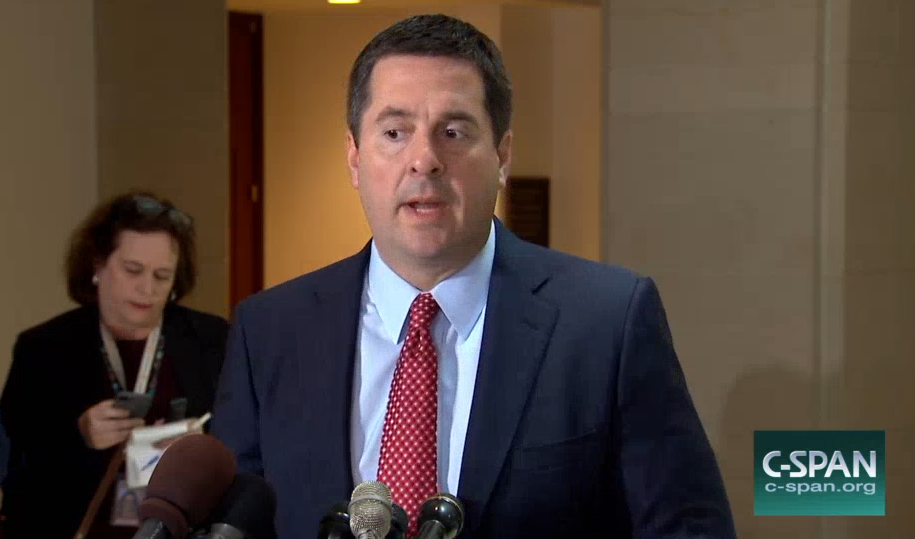
Reminder: The Guy Killing the HPSCI Investigation Was Part of Trump’s Troubled Transition Team

Over the weekend, the WaPo had an article on all the things Devin Nunes is doing to kill the House Intelligence Committee investigation into Trump’s cooperation with Russia during the election. It started like this:

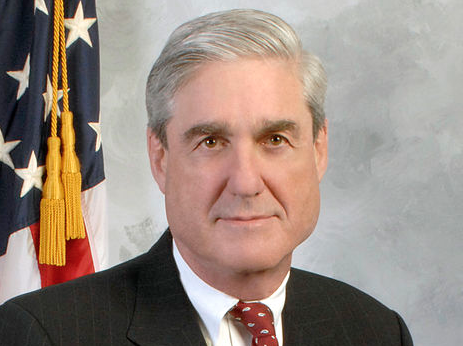
Rep. Devin Nunes, once sidelined by an ethics inquiry from leading the House Intelligence Committee’s Russia probe, is reasserting the full authority of his position as chairman just as the GOP appears poised to challenge special counsel Robert S. Mueller III’s investigation of possible coordination between the Trump campaign and Russian officials.

The California Republican was cleared in December of allegations he improperly disclosed classified information while accusing the Obama administration of exposing the identities of Trump affiliates on surveillance reports. Since clearing his name, Nunes has stepped up his attacks on Mueller’s team and the law enforcement agencies around it, including convening a group of Intelligence Committee Republicans to draft a likely report on “corruption” among the investigators working for the special counsel.

And ended like this:

Nunes, meanwhile, appears to have made up his mind about the House Intelligence Committee probe into the allegations surrounding Trump and Russia, expressing his convictions in an interview with Fox News.

“We have no evidence of Russia collusion between the Trump campaign” and Russia, Nunes said.

I’ll save you the click and answer the question you should be asking: did this 1400 word article on Nunes’ attempts to kill his committee’s investigation make any mention of the fact that Nunes served on Trump’s Transition Team?

The answer, as it so routinely has been when people treat Nunes’ opinion about whether there was “collusion” between the Trump campaign and Russia as a credible opinion, is no. No, the WaPo didn’t think it relevant to mention that Nunes was a key figure in the transition process that has since become a close focus of the Mueller investigation. Indeed, Nunes was involved in both efforts to shield members of Congress and Transition officials when they do Bibi Netanyahu’s bidding. And if he didn’t use his Congressional email address during the transition (in which case Mueller would probably give it great deference), he might well be among the 13 officials whose emails Mueller’s team obtained from GSA, which has been the latest panic that Nunes has fed.

In short, Nunes was in the thick of things, and he should no more be treated as a credible judge of whether there was collusion going on in the casino than Mike Flynn Jr or Don Jr or Trump himself. While I don’t imagine Nunes is in any legal difficulty, he was nevertheless part of efforts to hijack US policy before Trump became President and some of his obstruction since then has served to distract attention that the Transition Team did so.

And it’s not just WaPo’s news page that seems to have ignored this detail. So has Greg Sargent, in a piece assessing the likelihood HPSCI Democrats would do their own report laying out all the ways Nunes obstructed a legitimate inquiry. You’d think you’d point those two points together: that Nunes obstructed the inquiry because he’s tangentially a subject of it.

This should be a really basic thing: Nunes may have been cleared of leaking. But he is still making key decisions on an investigation into actions targeting an organization he participated in. Naming HPSCI Chair Nunes to his Transition Team might be the most competent aspect of Trump’s cover-up, by far.

That’s the story here.

Share this entry

Speech and Email Release: The Three Public Statement Signals Tied to Russia’s Dirt-as-Emails

In this post I did a timeline of all the known George Papadopoulos communications. The timeline made something clear: on two occasions, Papadopoulos alerted Ivan Timofeev to something in a Trump speech. On each occasion, something happened with emails. And there may actually be a third instance of Papadopoulos signaling to his handler.

April 26 notice of emails precedes Trump’s April 27 speech including a “signal to meet”

First, on April 26, 2016, over breakfast London time, he learned the Russians had thousands of email as dirt on Hillary Clinton.

On or about April 26, 2016, defendant PAPADOPOULOS met the Professor for breakfast at a London hotel. During this meeting, the Professor told defendant PAPADOPOULOS that hehadjust returned from a trip to Moscow where he had met with high level Russian government officials. The Professor told defendant PAPADOPOULOS that on that trip he(the Professor) learned that the Russians had obtained “dirt” on then-candidate Clinton. The Professor told defendant PAPADOPOULOS, as defendant PAPADOPOULOS later described to the FBI, that “They [the Russians] have dirt on her”; “the Russians had emails of Clinton”; “they have thousands of emails.”

The next day he discusses his outreach to Russians with both Stephen Miller and Corey Lewandowski. He emails Miller to say he “Ha[s] some interesting messages coming in from Moscow about a trip when the time is right.” And he emails Lewandowski, apparently asking to speak by phone, “to discuss Russia’s interest in hosting Mr. Trump. Have been receiving a lot of calls over the last month about Putin wanting to host him and the team when the time is right.”

That all happened while Papadopoulos was helping draft Trump’s first speech, in which Trump said,

We desire to live peacefully and in friendship with Russia and China. We have serious differences with these two nations, and must regard them with open eyes, but we are not bound to be adversaries. We should seek common ground based on shared interests.

Russia, for instance, has also seen the horror of Islamic terrorism. I believe an easing of tensions, and improved relations with Russia from a position of strength only is possible, absolutely possible. Common sense says this cycle, this horrible cycle of hostility must end and ideally will end soon. Good for both countries.

Some say the Russians won’t be reasonable. I intend to find out. If we can’t make a deal under my administration, a deal that’s great — not good, great — for America, but also good for Russia, then we will quickly walk from the table. It’s as simple as that. We’re going to find out.

As the NYT revealed the other day, Papadopoulos helped draft that speech, and he told Timofeev that it was the “signal to meet.”

Papadopoulos was trusted enough to edit the outline of Mr. Trump’s first major foreign policy speech on April 27, an address in which the candidate said it was possible to improve relations with Russia. Mr. Papadopoulos flagged the speech to his newfound Russia contacts, telling Mr. Timofeev that it should be taken as “the signal to meet.”

So the Russians mentioned emails, and the next day Papadopoulos delivered a speech that signaled (at least according to Papadopoulos, who at times oversold these things) Trump’s interest in meeting.

July 21 RNC speech precedes the WikiLeaks dump

A second coincidence comes in July. On July 21, a week after Papadopoulos informed Timofeev that a ““meeting for August or September in the UK (London) with me and my national chairman” had been approved, he then messages Timofeev the day of Trump’s RNC speech, saying, “How are things [Timofeev]? Keep an eye on the speech tonight. Should be good.” This message is one of the ones he tried to destroy by nuking his Facebook account after his second interview with the FBI last February.

Trump’s RNC speech included no mention of Russia. But it did include an indictment of Hillary’s actions as Secretary of State, focusing on a number of the issues that lay behind Putin’s loathing of Hillary.

Another humiliation came when president Obama drew a red line in Syria – and the whole world knew it meant nothing.

In Libya, our consulate – the symbol of American prestige around the globe – was brought down in flames. America is far less safe – and the world is far less stable – than when Obama made the decision to put Hillary Clinton in charge of America’s foreign policy.

I am certain it is a decision he truly regrets. Her bad instincts and her bad judgment – something pointed out by Bernie Sanders – are what caused the disasters unfolding today. Let’s review the record. In 2009, pre-Hillary, ISIS was not even on the map.

Libya was cooperating. Egypt was peaceful. Iraq was seeing a reduction in violence. Iran was being choked by sanctions. Syria was under control. After four years of Hillary Clinton, what do we have? ISIS has spread across the region, and the world. Libya is in ruins, and our Ambassador and his staff were left helpless to die at the hands of savage killers. Egypt was turned over to the radical Muslim brotherhood, forcing the military to retake control. Iraq is in chaos.

Iran is on the path to nuclear weapons. Syria is engulfed in a civil war and a refugee crisis that now threatens the West. After fifteen years of wars in the Middle East, after trillions of dollars spent and thousands of lives lost, the situation is worse than it has ever been before.

[snip]

We must abandon the failed policy of nation building and regime change that Hillary Clinton pushed in Iraq, Libya, Egypt and Syria. Instead, we must work with all of our allies who share our goal of destroying ISIS and stamping out Islamic terror.

The focus on Syria is key: remember that Jared Kushner explained his request to Sergei Kislyak for a Russian-run secure back challenge as an effort to cooperate on Syria.

The Ambassador expressed similar sentiments about relations, and then said he especially wanted to address U.S. policy in Syria, and that he wanted to convey information from what he called his “generals.” He said he wanted to provide information that would help inform the new administration. He said the generals could not easily come to the U.S. to convey this information and he asked if there was a secure line in the transition office to conduct a conversation. General Flynn or I explained that there were no such lines. I believed developing a thoughtful approach on Syria was a very high priority given the ongoing humanitarian crisis, and I asked if they had an existing communications channel at his embassy we could use where they would be comfortable transmitting the information they wanted to relay to General Flynn.

So it’s possible the attacks on Hillary’s Syria policy were a signal — as the earlier speech’s call for engagement with Russia apparently was — to Timofeev.

In any case, the next day, WikiLeaks started releasing the DNC emails, just in time to bollox the DNC (though I maintain that forcing the Democrats to finally fire Debbie Wasserman Schultz was a necessary move).

A possible third message?

Which brings us to a possible third signal. Another of the Facebook messages that Papadopoulos attempted to destroy was a link he shared with Timofeev to this interview. Among the other things Papadopoulos says in the interview is that sanctions on Russia have hurt the US.

Q.: Do you agree that the U.S. sanctions against Russia did not help to resolve the crisis in Ukraine?

A.: Sanctions have done little more than to turn Russia towards China as a primary market for Russian goods, services and energy. It is not in the interest of the West to align China and Russia in a geopolitical alliance that can have unpredictable consequences for U.S. interests in the South China Sea, Eastern Mediterranean and Middle East.

[snip]

Q.: Your professional background is related to global energy. Do you agree that European countries should reduce their dependence on Russian energy?

A.: The U.S. and Russia will compete over both the European and Pacific gas markets. This is inevitable. Unfortunately for the U.S., sanctions on Russia have resulted in massive energy deals between Russia and China.

Papadopoulos also poo poos the idea of expanding NATO.

Q.: How do you see the future of NATO? Do you support a further expansion of the alliance? If so, do you think that NATO should take into the account Russia’s concerns regarding this issue?

A.: If NATO is to expand, all new members must spend the required 2% of GDP on defense expenditure. Currently only five members do. Without a common mission that all countries subscribe to, or the pledge that all members spend 2% of GDP on defense, the alliance in its current form is likely not sustainable. The three largest threats NATO will have to combat over the next couple decades will be a rising and belligerent China, radical Islam and a nuclear Iran. Russia can be helpful in mitigating the dangerous consequences of these three forces colliding simultaneously.

Q.: You did not answer the question on whether you would support a possible NATO extension or not. Russia has repeatedly expressed its concerns about NATO’s military infrastructure moving toward Russia’s borders…

A.: We should look at the circumstances. If mutual confidence between our countries exists, then we will better understand the expectations of each other, and we can more accurately define the ‘red lines‘ which cannot be crossed. However, what is happening today between Russia and NATO, and between Russia and the West in general, creates an extremely dangerous and unstable situation in which every incident could become fatal.

An interview with a policy advisor is nowhere near as momentous as a speech from Trump. But by this point — the NYT informs us — Papadopoulos’ interventions were being reviewed closely by the campaign. So it’s likely this was closely vetted.

Papadopoulos shared that link on October 1. Later that week, the John Podesta emails started coming out.

The timing wasn’t dictated by these speeches

Let me make something clear: I’m not saying that the timing of these email releases were dictated by the speeches. Of course they weren’t. They were timed to do maximal damage to the Hillary campaign (not incidentally, in a way that coincided with the “later in the summer” timing Don Jr asked for in his communications with Rob Goldstone).

Rather, I’m saying that Papadopoulos seems to have been signaling Timofeev, and those signals closely mapped to email releases.

And those signals are among the things he tried to destroy.

Share this entry

Oz on Papadopoulos

I want to use this thread to review certain details about recent George Papadopoulos disclosures.

NYT’s sources cannot be exclusively FBI

First, GOPers have suggested that the NYT story disclosing that Papadopoulos got drunk and told the Australian Ambassador, Alexander Downer, that Russians had dirt on Hillary is an FBI attempt to relieve pressure on Mueller by providing a different explanation for the start of the investigation. But that can’t be true, at least not entirely. Here’s how the NYT describes their sources:

four current and former American and foreign officials with direct knowledge of the Australians’ role

That is, at least one (and possibly several) of their sources is a foreign official, presumably Australian. The description of these sources as “officials” could also mean they’re current or former members of Congress.

The story also provides a really odd statement about Papadopoulos’ lawyers’ involvement, saying only that his lawyers declined to provide a statement.

In response to questions, Mr. Papadopoulos’s lawyers declined to provide a statement.

This admits the possibility they said something off the record.

Finally, remember that Papadopoulos’ fiancée told ABC that he had a bigger role in the campaign than Trump defenders have claimed; she also said she had emails to prove it.

Mangiante said Papadopoulos “set up meetings with leaders all over the world” for senior campaign officials. He was “constantly in touch with high-level officials in the campaign,” she added. That included direct communication with now-former senior Trump advisers Steve Bannon and Michael Flynn, Mangiante said, adding that she had seen correspondence supporting the assertion.

[snip]

Mangiante said that while she is eager to offer proof that Papadopoulos was a campaign insider, she has been instructed by attorneys to not provide emails or other possible evidence to reporters.

[snip]

She said she believes he will now have a firm place in history as “the first domino in the Russia investigation.”

If I were an enterprising NYT journalist, I’d certainly try to convince her to offer that proof, especially any proof she had that Papadopoulos was “the first domino” in the investigation — the story offered by the NYT.

So there’s no reason to believe the NYT story comes entirely — or even partially — from the FBI. It likely came from Papadopoulos and Australians, perhaps confirmed by former members of Congress.

Turnbull to Trump: Don’t blame me for the investigation

Meanwhile, the Australians are trying to dodge blame for this story coming out, accusing Americans of leaking Downer’s role.

It is also understood there is now annoyance and frustration in Canberra that the High Commissioner to Britain Alexander Downer has been outed through leaks by US officials as the source of information that played a role in sparking an FBI probe into the Trump campaign’s dealings with Moscow.

Note, Downer is in the process of being replaced as Ambassador to the UK, so he may have some reason to make life difficult for Turnbull, who has a trip to the US scheduled for February. That said, the Age cites several other people, both at CSIS, who appear to have some familiarity with the story who could also be NYT’s sources. And even in a piece trying to blame Americans for this story, it reveals that Ambassador to the US Joe Hockey personally worked with the FBI on this tip.

Aussie sources narrowing in on which emails were discussed?

While I don’t take it to be definitive (because a lot of journalists, even in the US, don’t track these details well enough), the Age claims that Papadopoulos described the emails as “hacked Democratic Party emails.”

In May 2016, Trump campaign adviser George Papadopoulos told Mr Downer over drinks at an upscale London wine bar that the Russians had a dirt file on rival candidate Hillary Clinton in the form of hacked Democratic Party emails.

If that is indeed what Papadopoulos told Downer, it would be a key detail in the case against Trump’s team, because it would mean they likely learned specifically what Russia had hacked and leaked.

Delayed reporting

The Age explains why the Aussies didn’t report the conversation to the FBI right away (though, again, I’m not sure this is meant as definitive).

Downer conveyed the conversation to Canberra via an official cable, though apparently not immediately – perhaps because he did not take the 28-year-old adviser’s claims altogether seriously until the hacked emails were released by Wikileaks in late July.

If this reporting is correct, it suggests the delay came on Downer’s side, with Hockey informing the FBI in timely fashion after Downer submitted his report on an official cable. I’d still like to know why the Guccifer 2.0 releases didn’t elicit any reporting. After all, it’s possible that Downer only reported the conversation when it became clear their wayward citizen, Julian Assange, was acting in a way that might affect the elections.

In a follow-up post I’m going to look at some timing details in the Papadopoulos documents.


Share this entry

NYT Does Not Have the Smoking Gun on Trump Campaign Email Knowledge

The NYT had a complex story today, reporting three things:

  1. The counterintelligence investigation into the Trump campaign followed from a drunken conversation George Papadopoulos had in May 2016 with Aussie Ambassador to the UK, Alexander Downer
  2. Papadopoulos was more influential than Trump’s team has made out
  3. Papadopoulos pitched an April 2016 Trump foreign policy speech as a signal to Russia that Trump would be willing to meet

It’s the first detail that has attracted all the attention. NYT reported it this way:

During a night of heavy drinking at an upscale London bar in May 2016, George Papadopoulos, a young foreign policy adviser to the Trump campaign, made a startling revelation to Australia’s top diplomat in Britain: Russia had political dirt on Hillary Clinton.

About three weeks earlier, Mr. Papadopoulos had been told that Moscow had thousands of emails that would embarrass Mrs. Clinton, apparently stolen in an effort to try to damage her campaign.

Exactly how much Mr. Papadopoulos said that night at the Kensington Wine Rooms with the Australian, Alexander Downer, is unclear. But two months later, when leaked Democratic emails began appearing online, Australian officials passed the information about Mr. Papadopoulos to their American counterparts, according to four current and former American and foreign officials with direct knowledge of the Australians’ role.

[snip]

Not long after, however, he opened up to Mr. Downer, the Australian diplomat, about his contacts with the Russians. It is unclear whether Mr. Downer was fishing for that information that night in May 2016. The meeting at the bar came about because of a series of connections, beginning with an Israeli Embassy official who introduced Mr. Papadopoulos to another Australian diplomat in London.

It is also not clear why, after getting the information in May, the Australian government waited two months to pass it to the F.B.I. In a statement, the Australian Embassy in Washington declined to provide details about the meeting or confirm that it occurred.

NYT’s story does pose a good question: why the Australians didn’t tell the US about this conversation until July, after Wikileaks started releasing DNC emails.

But the few GOPers who have responded to this news raise another question: did the Aussies even know what emails Papadopoulos was talking about?

As I noted in October, we actually don’t know what emails Joseph Misfud was talking about when he told Papadopoulos the Russians had dirt on Hillary. Trumpsters are now suggesting these emails might be those Guccifer 1.0 stole from Hillary, but they could be a range of other emails.

This story would be far more damning if the NYT knew for sure that the emails were ones freshly stolen from DNC, John Podesta, or the Hillary campaign itself, but they don’t.

The uncertainty about what emails Papadopoulos learned about — and revealed to Downer — might explain why the Aussies didn’t tell the US right away. If the Australians didn’t know what emails the Russians had, it might explain their lack of urgency. If the emails were known Guccifer 1.0 emails, it wouldn’t be news. But it doesn’t explain why the Aussies didn’t tell the US in June, when Guccifer 2.0 started releasing documents, but instead waited until their own citizen, Julian Assange, started releasing some on July 22.

All this could be a lot more easily explained if we knew the one detail the NYT admits it didn’t confirm: whether and when Papadopoulos told the campaign that the Russians had emails (and whether he knew which emails the Russians had).

In late April, at a London hotel, Mr. Mifsud told Mr. Papadopoulos that he had just learned from high-level Russian officials in Moscow that the Russians had “dirt” on Mrs. Clinton in the form of “thousands of emails,” according to court documents. Although Russian hackers had been mining data from the Democratic National Committee’s computers for months, that information was not yet public. Even the committee itself did not know.

Whether Mr. Papadopoulos shared that information with anyone else in the campaign is one of many unanswered questions. He was mostly in contact with the campaign over emails. The day after Mr. Mifsud’s revelation about the hacked emails, he told Mr. [Stephen] Miller in an email only that he had “interesting messages coming in from Moscow” about a possible trip. The emails obtained by The Times show no evidence that Mr. Papadopoulos discussed the stolen messages with the campaign.

NYT makes clear Papadopoulos (who was, after all, remote and traveling a lot) primarily communicated via emails. But the emails they obtained (but didn’t share) don’t include any evidence of him telling the campaign about the emails (much less which ones they were).

Which brings us to a point I made in November: when the FBI arrested Papadopoulos in July, they believed he lied to hide whether he told the campaign about the emails, but they de-emphasized that detail in the October plea deal.

[T]he description of the false statements makes the import of them far more clear (import that the Special Counsel seems to want to obscure for now). Papadopoulos lied about the circumstances of his conversations with Mifsud — the FBI appears to have believed when they arrested him in July — as part of a story to explain why, after having heard about dirt in the form of thousands of emails from Hillary, he didn’t tell anyone else on the campaign about them. Laid out like this, it’s clear Papadopoulos was trying to hide both when he learned about the emails (just three days before the DNC did, as it turns out, not much earlier as he seems to have suggested in January), but also how important he took those emails to be (which in his false story, he tied to to a false story about how credible he found Mifsud to be).

FBI found those lies to be significant enough to arrest him over because they obscured whether he had told anyone on the campaign that the Russians had dirt in the form of Hillary emails.

To be sure, nothing in any of the documents released so far answer the questions that Papadopoulos surely spent two months explaining to the FBI: whether he told the campaign (almost certainly yes, or he wouldn’t have lied in the first place) and when (with the big import being on whether that information trickled up to Paul Manafort and Jared Kushner before they attended a meeting on June 9, 2016 in hopes of obtaining such dirt).

I’m sure that’s intentional. You gotta keep everyone else guessing about what Mueller knows.

The NYT’s sources are described as “four current and former American and foreign officials with direct knowledge of the Australians’ role,” though this statement — and a past willingness on behalf of Papadopoulos’ fiancée to provide details and emails — suggests that people close to Papadopoulos cooperated as well: ” Papadopoulos’s lawyers declined to provide a statement.”

The point being, we still don’t have the most important detail of this story: whether Papadopoulos told the campaign about the emails, but more importantly, what the emails were.

Thus far, everyone seems intent on withholding that detail.

Share this entry

What Explains Trump’s Focus on Manafort?

As I noted yesterday on Twitter, the transcript of NYT’s interview with Donald Trump reads like this:

collusion collusion collusion collusion collusion collusion collusion collusion collusion collusion collusion collusion collusion collusion collusion collusion collusion collusion collusion collusion collusion collusion collusion

23 times Trump either denied any evidence of collusion between his campaign and Russia or alleged collusion between Hillary and … I’m not entirely clear who she was supposed to have colluded with.

Whatever else this interview was, it was also a testament to Trump’s continued obsession with trying to deny any guilt.

Which is why I’m so interested in both the form and the singular focus on Trump’s denial of Paul Manafort.

SCHMIDT: What’s your expectation on Mueller? When do you —

TRUMP: I have no expectation. I can only tell you that there is absolutely no collusion. Everybody knows it. And you know who knows it better than anybody? The Democrats. They walk around blinking at each other.

SCHMIDT: But when do you think he’ll be done in regards to you —

TRUMP: I don’t know.

SCHMIDT: But does that bother you?

TRUMP: No, it doesn’t bother me because I hope that he’s going to be fair. I think that he’s going to be fair. And based on that [inaudible]. There’s been no collusion. But I think he’s going to be fair. And if he’s fair — because everybody knows the answer already, Michael. I want you to treat me fairly. O.K.?

SCHMIDT: Believe me. This is —

TRUMP: Everybody knows the answer already. There was no collusion. None whatsoever.

_________

TRUMP: Maybe I’ll just say a little bit of a [inaudible]. I’ve always found Paul Manafort to be a very nice man. And I found him to be an honorable person. Paul only worked for me for a few months. Paul worked for Ronald Reagan. His firm worked for John McCain, worked for Bob Dole, worked for many Republicans for far longer than he worked for me. And you’re talking about what Paul was many years ago before I ever heard of him. He worked for me for — what was it, three and a half months?

SCHMIDT: A very short period of time.

TRUMP: Three and a half months. [Inaudible] So, that’s that. Let’s just say — I think that Bob Mueller will be fair, and everybody knows that there was no collusion.

The interview started with a discussion of Jeff Sessions’ recusal, which led Trump to claim he won because he campaigned better than Hillary, but then Mike Schmidt returned to Russia, which returned Trump to his “no collusion” line.

Then Schmidt permits Trump to go off the record about … something. Then the interview goes back on the record with Trump apparently deciding to offer up details after all. He offers the following defense of Manafort:

  • He’s a nice, honorable man
  • Manafort worked for other Republicans too
  • Manafort didn’t work (on the campaign) for Trump long at all
  • Trump never heard of the man who lived in Trump Tower and had had a firm with Trump’s buddy Roger Stone

Having already had two people flip on him and agree to cooperate with prosecutors, Trump starts by flattering Manafort. He rightly reminds that Manafort has long been tolerated in the Republican party, even after Manafort’s fondness for working with thugs became widely known.

Trump then dismisses any Manafort taint based on time associated with the campaign (three and a half key months of the campaign, during the period when Russians were reaching out to provide dirt), not based on his actions for the campaign.

Finally, by falsely claiming he didn’t know Manafort, Trump absolves himself of any prior taint the lobbyist had.

As I said, I’m interested in this passage not just for Trump’s lame attempt at defending himself, but also that he did so. It’s only Manafort Trump feels the need to defend himself against, not Flynn (whom Trump reportedly is preparing to accuse of lying), not Papadopoulos, and not even Rick Gates (who, after all, hung around the campaign through the transition).

The Daily Beast did do an uninteresting piece suggesting Mueller’s team may get a superseding indictment against Manafort, but it doesn’t even imagine Mueller getting to the guts of the case, perhaps by indicting Manafort based on his ongoing reporting on the campaign to Oleg Deripaska via Konstantin Kilimnik, the latter of whom also served as a go-between in an effort to help Manafort write a self-defensive op-ed. Instead, it imagines only that Manafort will get a superseding indictment on tax charges.

Alternately, Schmidt may have said something during that off the record section that directly raised Manafort. Schmidt’s regular beat is the FBI, not Mar a Lago, so he may know something far more interesting than the Daily Beast does about where Mueller is going.

Whatever the reason, Trump seems far more worried about damage Manafort can do to him right now than any damage Flynn can.

Share this entry

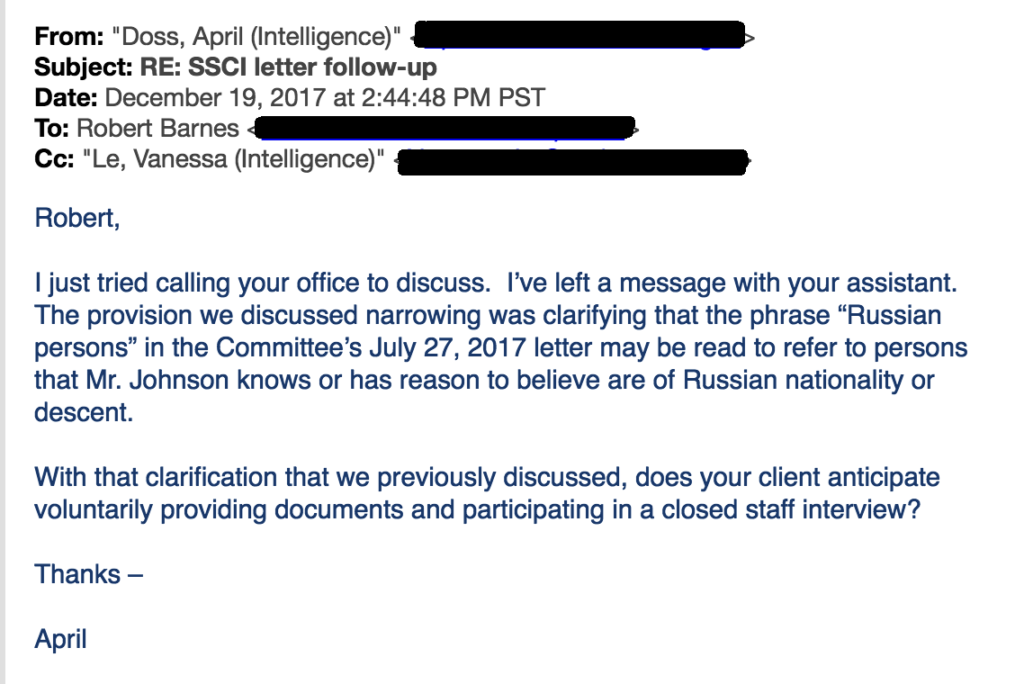
Chuck Johnson’s Narrowed Scope of What a Russian Is Excludes Known Conspirators in Operation

Michael Tracey has a story that purports to show that the Senate Intelligence Committee, in negotiating voluntary cooperation with Chuck Johnson, is criminalizing being Russian.

The Senate committee probing alleged Russian interference in the U.S. political system has deemed anyone “of Russian nationality or Russian descent” relevant to its investigation, according to a document obtained by TYT.

[snip]

On July 27, 2017, Charles C. Johnson, a controversial right-wing media figure, received a letter from Sens. Burr and Warner requesting that he voluntarily provide materials in his possession that are “relevant” to the committee’s investigation. Relevant materials, the letter went on, would include any records of interactions Johnson had with “Russian persons” who were involved in some capacity in the 2016 U.S. elections.

The committee further requested materials related to “Russian persons” who were involved in some capacity in “activities that related in any way to the political election process in the U.S.” Materials may include “documents, emails, text messages, direct messages, calendar appointments, memoranda, [and] notes,” the letter outlined.

Doss’s statement was in response to a request made by Robert Barnes, an attorney for Johnson, for clarification as to the SSCI’s definition of a “Russian person.”

How the committee expects subjects to go about ascertaining whether a person is of “Russian descent” is unclear. “It does indicate that the committee is throwing a rather broad net,” Jonathan Turley, a professor of law at George Washington University, said. “It is exceptionally broad.” In terms of constitutionality, Turley speculated that “most courts would view that as potentially too broad, but not unlawful.”

Johnson played a key role in several known parts of the election operation. In addition to brokering Dana Rohrabacher’s meeting with Julian Assange, all designed to provide some alternative explanation for the DNC hack, Johnson worked with Peter Smith and Weev to try to find the deleted emails from Hillary’s server.

Johnson said he and Smith stayed in touch, discussing “tactics and research” regularly throughout the presidential campaign, and that Smith sought his help tracking down Clinton’s emails. “He wanted me to introduce to him to Bannon, to a few others, and I sort of demurred on some of that,” Johnson said. “I didn’t think his operation was as sophisticated as it needed to be, and I thought it was good to keep the campaign as insulated as possible.”

Instead, Johnson said, he put the word out to a “hidden oppo network” of right-leaning opposition researchers to notify them of the effort. Johnson declined to provide the names of any of the members of this “network,” but he praised Smith’s ambition.

“The magnitude of what he was trying to do was kind of impressive,” Johnson said. “He had people running around Europe, had people talking to Guccifer.” (U.S. intelligence agencies have linked the materials provided by “Guccifer 2.0”—an alias that has taken credit for hacking the Democratic National Committee and communicated with Republican operatives, including Trump confidant Roger Stone—to Russian government hackers.)

Johnson said he also suggested that Smith get in touch with Andrew Auernheimer, a hacker who goes by the alias “Weev” and has collaborated with Johnson in the past. Auernheimer—who was released from federal prison in 2014 after having a conviction for fraud and hacking offenses vacated and subsequently moved to Ukraine—declined to say whether Smith contacted him, citing conditions of his employment that bar him from speaking to the press.

Tracey’s claims are based on this email (and, clearly, cooperation with Johnson).

Except Tracey (and so presumably Johnson) appear to be misrepresenting what is going on.

When SSCI originally asked for Johnson’s cooperation in July, they asked him to provide communications “with Russian persons, or representatives of Russian government, business, or media interest” relating to the 2016 election and any hack related to it.

And while Tracey calls the December follow-up a “clarification,” Doss clearly considers it a “narrowing” of that July description. So the description Tracey finds so outrageous — people of Russian nationality or descent — appears to be a subset of what might be included in the original request.

Moreover, the narrowing might be really detrimental to SSCI’s ability to learn what Johnson was up to when he was seeking out Russian hackers who might have Hillary’s server. Consider just the examples of Karim Baratov or Ike Kaveladze. Both are likely suspects for involvement in the events of 2016. Baratov — the hacker who recently pled guilty to compromising selected Google and Yandex accounts for FSB — is a Canadian citizen born in Kazakhstan. Kaveladze — who works for Aras Agalarov, has past ties to money laundering, and attended the June 9, 2016 meeting — is an American citizen born in Georgia. Neither is ethnically Russian. So if Johnson had any hypothetical interactions with them, he could cabin off those interactions based on this narrowed definition of what counts as a Russian.

To say nothing of Johnson’s interactions with Assange, who is Australian, yet whose ties to Russia are unclear. Effectively, even if Johnson knew that Assange had coordinated with Russia last year, he wouldn’t have to turn over his communications with him, because he’s not himself Russian.

According to Tracey’s piece, Johnson says he won’t cooperate regardless, in spite of his lawyer’s efforts to narrow the scope of any cooperation.

But I find it interesting that his lawyer attempted to narrow any testimony in a fashion that might hide important parts of Johnson’s actions.

Share this entry

Trump Appears to Have Withheld the KT McFarland Email about the “Thrown Election”

This post explains what appears to be the real reason for the fake outrage about Mueller obtaining information from GSA: by doing so, he appears to have obtained proof that the Transition was withholding emails material to the investigation. Go to this post for a more general summary of what we know about the claim. 

Here’s the letter that Trump For America lawyer sent to Congress to cause a big hullabaloo about how Robert Mueller obtained transition period emails. I unpacked it in this Twitter thread and commented on it in an update to this post.

But this passage deserves a separate post, because it seems to go to the heart of why the Republicans are spewing propaganda like this.

Additionally, certain portions of the PTT materials the Special Counsel’s Office obtained from the GSA, including materials that are susceptible to privilege claims, have been leaked to the press by unknown persons. Moreover, the leaked records have been provided to the press without important context and in a manner that appears calculated to inflict maximum reputational damage on the PTT and its personnel, without the inclusion of records showing that PTT personnel acted properly – which in turn forces TFA to make an impossible choice between (a) protecting its legal privileges by keeping its records confidential and (b) waiving its privileges by publicly releasing records that counteract the selective leaks and misguided news reports. In short, since the GSA improperly provided them to the Special Counsel’s Office, the PTT’s privileged materials have not only been reviewed privately by the Special Counsel’s Office without notification to TFA – they have also been misused publicly.

Kory Langhofer is insinuating — without quite risking the claim — that after GSA shared certain emails with Robert Mueller’s office, “unknown persons” leaked them to the press. The insinuation is that Mueller’s team leaked them.

I can think of just one set of emails that fit this description: emails from KT McFarland that provided proof that Mike Flynn lied to the FBI about his conversations with Sergei Kislyak on December 29, 2016. The NYT quoted extensively from them in a December 2 story.

Among other things, McFarland stated in the emails that Russia “has just thrown the U.S.A. election to” Trump.

On Dec. 29, a transition adviser to Mr. Trump, K. T. McFarland, wrote in an email to a colleague that sanctions announced hours before by the Obama administration in retaliation for Russian election meddling were aimed at discrediting Mr. Trump’s victory. The sanctions could also make it much harder for Mr. Trump to ease tensions with Russia, “which has just thrown the U.S.A. election to him,” she wrote in the emails obtained by The Times.

[snip]

Mr. Obama, she wrote, was trying to “box Trump in diplomatically with Russia,” which could limit his options with other countries, including Iran and Syria. “Russia is key that unlocks door,” she wrote.

She also wrote that the sanctions over Russian election meddling were intended to “lure Trump in trap of saying something” in defense of Russia, and were aimed at “discrediting Trump’s victory by saying it was due to Russian interference.”

“If there is a tit-for-tat escalation Trump will have difficulty improving relations with Russia, which has just thrown U.S.A. election to him,” she wrote.

Contrary to Langhofer’s suggestion, NYT made some effort to mitigate the damage of McFarland’s comment seemingly confirming the Trump team knew the election had been stolen, including speaking to a White House lawyer about it.

It is not clear whether Ms. McFarland was saying she believed that the election had in fact been thrown. A White House lawyer said on Friday that she meant only that the Democrats were portraying it that way.

And while NYT’s explanation that they got the emails “from someone who had access to transition team communications” certainly could include Mueller’s team among the culprits, it could also include GSA officials themselves or — even more likely — a former Trump official with a grudge. At least three were CCed on the email in question: Bannon, Priebus, and Spicer.

Mr. Bossert forwarded Ms. McFarland’s Dec. 29 email exchange about the sanctions to six other Trump advisers, including Mr. Flynn; Reince Priebus, who had been named as chief of staff; Stephen K. Bannon, the senior strategist; and Sean Spicer, who would become the press secretary.

In other words, Langhofer uses the leak as an excuse to suggest wrong-doing by Mueller, when other possibilities are far more likely.

But consider the other implication of this: Langhofer is suggesting that this email chain (which included no named active lawyers, nor included Trump directly, though they were written in Trump’s presence at Mar a Lago) is “susceptible to privilege claims.” He is further suggesting that GSA is the only way this email could have been released (ignoring, of course, the Bannon/Priebus/Spicer) options.

If that’s right, then he’s suggesting that Trump was involved in this email chain directly. There’s no reason to believe he was CCed. But since the emails were written from Mar-a-Lago, it’s likely he was consulted in the drafting of the emails.

In addition, Langhofer is also admitting that Trump’s team didn’t release these emails directly — at least not to Congress.

Emails which couldn’t be more central to the point of Mueller’s investigation.

Did the GOP just admit that Trump withheld this email? Because if so, it suggests the “thrown election” comment is far more damning than the NYT laid out.

Update: It’s not clear whether Mueller ever tried to obtain these records via GSA (though it’s possible FBI obtained emails before the inauguration). But this, from the letter, makes it clear at least Congress had made requests, which led TFA to try to take GSA out of the loop even though SCO had a document preservation request.

In order to comply with congressional document production requests, TFA ordered from the GSA electronic copies of all PTT emails and other data. Career GSA staff initially expressed concern that providing copies of PTT emails to TFA might violate a document preservation request that the GSA had received from the Special Counsel’s Office.

Withholding this email from Congress would be particularly problematic, as McFarland testified in conjunction with her now-frozen nomination to be Ambassador to Singapore that she knew nothing about Flynn’s communications with Kislyak. h/t SS

Update: Ah, this explains how Mueller was getting emails: via voluntary production, along with everything the Transition was giving Congress. Which means the email was withheld, and this October subpoena was an attempt to see whether they’d cough it up on their own.

Special counsel Robert Mueller’s team in mid-October issued a subpoena to President Donald Trump’s campaign requesting Russia-related documents from more than a dozen top officials, according to a person familiar with the matter.

The subpoena, which requested documents and emails from the listed campaign officials that reference a set of Russia-related keywords, marked Mr. Mueller’s first official order for information from the campaign, according to the person. The subpoena didn’t compel any officials to testify before Mr. Mueller’s grand jury, the person said.

The subpoena caught the campaign by surprise, the person said. The campaign had previously been voluntarily complying with the special counsel’s requests for information, and had been sharing with Mr. Mueller’s team the documents it provided to congressional committees as part of their probes of Russian interference into the 2016 presidential election.

[snip]

Mueller’s team had previously issued subpoenas individually to several top campaign officials, including former campaign chairman Paul Manafort and former national security adviser Mike Flynn.

[Correction: I’ve been corrected on this passage, which makes it clear this is about campaign emails, not transition ones. But I assume he made parallel requests for all three phases of Trump organization.]

Update: Mueller’s spox, Peter Carr, issued a statement saying, “When we have obtained emails in the course of our ongoing criminal investigation, we have secured either the account owner’s consent or appropriate criminal process.” Given what I’ve laid out here, I actually think “C” may have been the case:

  • Subpoena to Flynn, obtain voluntary compliance for specific things as well as evidence shared with Congress prior to August
  • In August (perhaps after being alerted to withheld documents by Priebus/Spicer/Bannon/Papadopoulos?) obtain emails from GSA, technically the device owners
  • In October, subpoena for Russian-related emails from the same ~13 people
Share this entry

Trump Transition Team Outraged To Be Treated as Transition Team!!

This is a general post on the GOP claim Mueller improperly obtained emails from ~13 Transition officials, updated as new news comes available. This post explains what is really going on: the Transition appears to have withheld emails — including the KT McFarland one referring to the election as having been “thrown” — and Mueller obtained proof they were withholding things. 

Both Fox News and Axios have pieces reflecting the outrage!!! among Trump people that they got asked questions about emails they thought they had hidden from Mueller’s investigation. Axios reveals that Mueller obtained the full contents of 12 accounts (Reuters says 13), one including 7,000 emails, from people on the “political leadership” and “foreign-policy team;” it says it includes “sensitive emails of Jared Kushner.”

Fox reveals that a transition lawyer wrote Congress today claiming that it was unlawful for government employees to turn over emails hosted on government servers for a criminal investigation.

A lawyer for the Trump presidential transition team is accusing Special Counsel Robert Mueller’s office of inappropriately obtaining transition documents as part of its Russia probe, including confidential attorney-client communications and privileged communications.

In a letter obtained by Fox News and sent to House and Senate committees on Saturday, the transition team’s attorney alleges “unlawful conduct” by the career staff at the General Services Administration in handing over transition documents to the special counsel’s office.

Officials familiar with the case argue Mueller could have a problem relating to the 4th Amendment – which protects against unreasonable searches and seizures.

Kory Langhofer, the counsel to Trump for America, wrote in the letter that the the GSA “did not own or control the records in question.”

But, Langhofer says, Mueller’s team has “extensively used the materials in question, including portions that are susceptible to claims of privilege.”

And Axios explains that the Trump people actually sorted through this stuff. “The sources say that transition officials assumed that Mueller would come calling, and had sifted through the emails and separated the ones they considered privileged.”

I’m really looking forward to hearing the full story about this, rather than just this partisan spin. For example, I’m interested in whether Mueller realized via some means (perhaps from someone like Reince Priebus or Sean Spicer — update, or George Papadopoulos) that the White House had withheld stuff that was clearly responsive to his requests, so he used that to ask GSA to turn over the full set.

I’m also interested in how they’ll claim any of this was privileged. The top 13 political and foreign policy people on the Trump team might include (asterisks mark people confirmed to be among those whose accounts were obtained):

  1. Pence
  2. Bannon
  3. Jared*
  4. Flynn*
  5. KT McFarland
  6. Spicer
  7. Priebus
  8. Nunes
  9. Sessions
  10. Seb Gorka
  11. Stephen Miller
  12. Hope Hicks
  13. Ivanka
  14. Don Jr
  15. Rebekah Mercer
  16. Kelly Anne Conway
  17. Rudy Giuliani
  18. Steven Mnuchin
  19. Rick Gates
  20. Corey Lewandowski
  21. Tom Bossert

Just one of those people — Sessions — is a practicing lawyer (and he wasn’t, then), and he wasn’t playing a legal role in the transition (though both Sessions and Nunes may have been using their congressional email, in which case Mueller likely would show far more deference; update: I’ve added Rudy 911 to the list, and he’d obviously qualify as a practicing lawyer). Though I suppose they might have been talking with a lawyer. But I would bet Mueller’s legal whiz, Michael Dreeben, would point to the Clinton White House Counsel precedent and say that transition lawyers don’t get privilege.

Furthermore, Trump wasn’t President yet! This has come up repeatedly in congressional hearings. You don’t get privilege until after you’re president, in part to prevent you from doing things like — say — undermining existing foreign policy efforts of the actually still serving President. So even if these people were repeating things Trump said, it wouldn’t be entitled to privilege yet.

Finally, consider that some of these people were testifying to the grand jury months and months ago. But we’re only seeing this complaint today. That’s probably true for two reasons. One, because Mueller used the emails in question (most notably, the emails between McFarland and Flynn from December 29 where they discussed Russian sanctions) to obtain a guilty plea from Flynn. And, second, because Republicans are pushing to get Trump to fire Mueller.

Update: I’ve added Pence, Don Jr., Ivanka, Hope Hicks, Kelly Anne Conway, Rudy Giuliani, Steven Mnuchin back in here.

Update: Here’s more from Reuters.

Langhofer, the Trump transition team lawyer, wrote in his letter that the GSA’s transfer of materials was discovered on Dec. 12 and 13.

The FBI had requested the materials from GSA staff last Aug. 23, asking for copies of the emails, laptops, cell phones and other materials associated with nine members of the Trump transition team response for national security and policy matters, the letter said.

On Aug. 30, the FBI requested the materials of four additional senior members of the Trump transition team, it said.

The GSA transfer may only have been discovered this week (probably as a result of Congress’ investigation). But the witnesses had to have known these emails went beyond the scope of what the transition turned over. And the request date definitely is late enough for Mueller to have discovered not everything got turned over, perhaps even from George Papadopoulos, who flipped in late July.

Update: One more thing. Remember that there were worries that transition officials were copying files out of a SCIF. That, by itself, would create an Insider Threat concern that would merit FBI obtaining these emails directly.

Update: Here’s a report dated June 15 on a transition lawyer instructing aides and volunteers to save anything relating to Russia, Ukraine, or known targets (Flynn, Manafort, Page, Gates, and Stone).

Update: AP reports that Flynn was (unsurprisingly) among those whose email was obtained.

Update: Here’s the letter. I unpacked it here. It’s a load of — I believe this is the technical term — shite. First, it stakes everything on PTT not being an agency. That doesn’t matter at all for a criminal investigation — Robert Mueller was no FOIAing this stuff. It then later invokes a bunch of privileges (the exception is the attorney client one) that only come with the consequent responsibilities. It then complains that Mueller’s team didn’t use a taint team.

Perhaps the craziest thing is they call for a law that would only permit someone to access such emails for a national security purpose — as if an espionage related investigation isn’t national security purpose!

Update: Chris Geidner got GSA’s side of the story. Turns out they claim the now dead cover up GC didn’t make the agreement the TFA lawyer says he did. In any case, GSA device users agreed their devices could be monitored.

“Beckler never made that commitment,” he said of the claim that any requests for transition records would be routed to the Trump campaign’s counsel.

Specifically, Loewentritt said, “in using our devices,” transition team members were informed that materials “would not be held back in any law enforcement” actions.

Loewentritt read to BuzzFeed News a series of agreements that anyone had to agree to when using GSA materials during the transition, including that there could be monitoring and auditing of devices and that, “Therefore, no expectation of privacy can be assumed.”

Update: Mueller’s spox, Peter Carr, issued a statement saying, “When we have obtained emails in the course of our ongoing criminal investigation, we have secured either the account owner’s consent or appropriate criminal process.”

Share this entry