The Trump Team Strategic Errors: Rockets Instead Bursting In Air

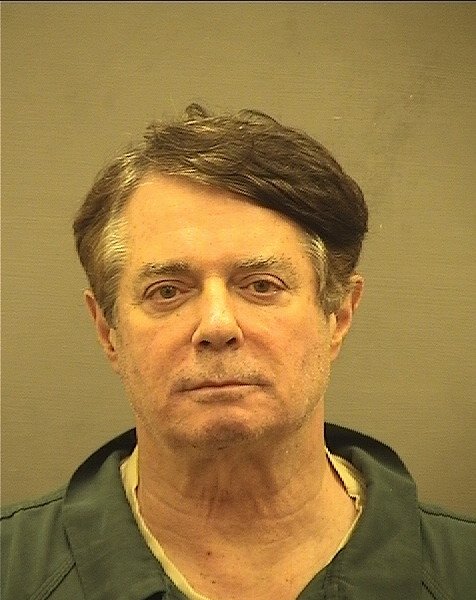
During the winter, when the government was threatening and then did charge Paul Manafort with a bunch of tax fraud charges, he chose not to waive venue, forcing himself into two trials, one in EDVA and one in DC. (Raising the perennial question, who is paying for his legal representation?)

At the time, Josh Gerstein suggested might be seeking to avail himself of EDVA’s famed “rocket docket” which pushes trials through quickly. The thought was perhaps Manafort would have a better result with EDVA’s more conservative jury pool before his DC trial started, which in turn might be a way to discredit the Mueller investigation (something that has always seemed key to any strategy pursuing a pardon).

Manafort’s attorneys’ decision to effectively force some — but not all — of special counsel Robert Mueller’s case against him to northern Virginia baffled many lawyers, since it puts Manafort at risk of two separate trials rather than one. To some, it’s akin to choosing to play Russian Roulette with two bullets in the gun instead of one.

However, because the Alexandria-based federal court’s “rocket docket” is known for providing quick trials, there’s a possibility that Manafort could get to trial on bank and tax fraud charges in Virginia before the Sept. 17 trial date set Wednesday by Judge Amy Berman Jackson in Washington in the original case, now scaled back to focus on money laundering and failure to register as a foreign agent.

That means Manafort has a chance of getting his case before a northern Virginia jury first — a panel more likely to include Trump supporters who may be skeptical of Mueller’s enterprise. Such jurors are likely to be a rarity in Washington.

[snip]

If Manafort could pull off an acquittal in Alexandria or even a hung jury, it could fuel President Donald Trump’s view of the Mueller probe as a prolonged “witch hunt” that is more persecution than prosecution. That would seem certain to lead to calls for Mueller to abandon the D.C. case and might prompt a pardon from Trump or some action to shut down the special counsel’s office altogether.

Even if nothing so dramatic happened, a stumble for Mueller’s team in Virginia and in its first contested trial could raise pressure for prosecutors to be more flexible in negotiating a plea deal.

Not long after at Manafort’s EDVA arraignment before the cantankerous TS Ellis, however, his attorney Kevin Downing admitted that they would prefer either everything move to EDVA, or the EDVA trial go second, after the DC trial still scheduled to start on September 17.

MR. DOWNING: We’re actually thinking trying to get the conspiracy to come here. We’re happy to be here.

[snip]

MR. DOWNING: In this perfect world where I have my rosy glasses on, we were envisioning that we would be trying this case in November following the case in D.C.

THE COURT: You need to go back to the optometrist, because that isn’t going to happen.

MR. DOWNING: Okay.

THE COURT: You’ve got a trial date in September in the District? Mr. Weissmann, this case seems — maybe I’m not familiar with the indictment in D.C., but this case seems less complex than the one in D.C.

MR. WEISSMANN: That’s our view as well. The tax charges, as we mentioned, do largely overlap. But unlike the D.C. case, there are no Foreign Agents Registration Act charges before this Court. And those involve quite an extensive array of evidence and different theories of liability. Here we have what I think are five bank frauds and they are discrete over a two-year period and the discovery has been produced.

THE COURT: All right. Mr. Downing, I’m going to set this matter in July. Now, if in the course of your preparation something comes up that suggests to you that you now have a more persuasive basis for me to consider on a later trial date, I’ll consider it. But for now, 12th of — or not 12th — 10th of July at 10 a.m. with a jury. Also having that earlier deadline is an important — it will focus your minds, everyone’s minds on it and get this matter done.

In July, Manafort used his jailing by Amy Berman Jackson as an excuse to ask for a delay in the EDVA trial.

In a response, the government demonstrated to Ellis that Manafort was still trying to have his desired outcome, to have the DC trial go first.

Manafort can hardly now complain about the order of the trials: he was on notice from the Honorable Amy Berman Jackson, when he elected last winter not to have the proposed tax and bank fraud charges all brought in the D.C. Case, that his decision would likely result in his going to trial in Virginia first. D.C. Case Status Hr’g Tr. (Jan. 16, 2018). That other reasons may account for this application is strongly suggested by a prison call in which Manafort discusses going to trial first in the D.C. Case and contends to the listener (who did not believe the D.C. venue was favorable) that the listener should “think about how it’ll play elsewhere….There is a strategy to it, even in failure, but there’s a hope in it.” Phone Call of Manafort (June 20, 2018), at 4:02-4:39.

The trial went off in July as scheduled, meaning Manafort faced the more traditional of charges first.

Still, getting one trial in EDVA almost worked, with a holdout juror that hung the jury on 10 of 18 charges (though that won’t have that big an effect on sentencing) and lots of good press stemming from Ellis beating up the prosecution, both during Manafort’s challenge to Mueller’s authority and during the trial in general.

Add in the fact that Manafort (again, with his seemingly endless supply of funds to pay defense attorneys) got two bites at key challenges to Mueller’s case in chief — his authority generally, and the search of Manafort’s condo for things including evidence about the June 9 meeting — and the dual trial strategy probably wasn’t a total flop (unless, of course, it means Manafort is running out of money). Along the way, he also got full discovery on what Rick Gates has provided Mueller, presumably including the real goods Gates gave Mueller on the conspiracy with Russia.

But Manafort’s still facing another trial in a less friendly venue before a no-nonsense judge, a trial he seems to have done nothing to prepare for. (WSJ reports the two sides did consider a plea on the DC charges while waiting for the EDVA verdict, to no avail.) And all of Rudy’s squealing about how indictments or even further investigation during the campaign season might be a distraction, Manafort’s trial (one that’s sexier than the EDVA one) will remain a constant focus in the last six weeks before the election.

To be fair, it’s hard to measure how Manafort’s strategy is playing, as it’s not clear what — besides a full pardon — his goals are. Plus, he’s got a shitty hand, no matter how you look at it (except for the seemingly endless supply of defense fund dollars).

But Manafort’s bid for a second trial seems like an even worse strategic decision than Michael Cohen’s bid for a Special Master (which I now admit at least gave Trump and his company an opportunity to undercut any Cohen bid for a plea deal) not least because he’ll be a felon in his DC trial which will in turn make sentencing worse if he is found guilty there.

At least the defense bar is making money.
Share this entry

The Mueller Investigation: What Happens on September 7?

I hesitate to write this post, partly because I think it’s a good idea to dismiss every single thing that Rudy Giuliani says, and partly because we’ve all learned that it is sheer folly to pretend anyone can anticipate what Mueller will do, much less when.

Nevertheless, I wanted to address questions about what might happen in the next two weeks, as we approach the 60-day mark before midterm elections.

Rudy G is wrong about everything

The aforementioned Rudy G, who has been saying that Mueller has to shut down his entire investigation (or even finish up and go home) on September 1 on account of DOJ’s policy against overt investigative action close to an election.

As I said, the policy only prohibits overt acts, and only 60 days before the election. Mueller might argue that it’s entirely irrelevant, given that none of his known targets (save, perhaps, Dana Rohrabacher) are on the ballot. But enough credible journalists have suggested that DOJ is taking this deadline seriously with respect to Trump’s associates (including Michael Cohen in SDNY, where DOJ actually leaks), that it’s probably correct he’ll avoid overt acts in the 60 days before the November 6 election.

But that timeline starts on September 7, not September 1.

Paul Manafort’s stall

One thing we know will dominate the press in that pre-election period is Manafort’s DC trial, scheduled to start on September 17.

Unless he flips.

While I still don’t think he will flip, he is stalling in both his trials. In EDVA, he asked for and got a 30-day deadline to move for an acquittal or mistrial. He may have done so to provide extra time to consider the complaints raised by one juror that others were deliberating before they should have, which Manafort had asked for a mistrial over. If that’s right, juror Paula Duncan’s comments, describing the one holdout and explaining that even she, a Trump supporter, found the case a slam dunk, may persuade Manafort that challenging this trial won’t bring about any other result and may mean he gets convicted on the remaining 10 counts.

In any case, however, by getting 30 days to decide, Manafort moved the deadline from (by my math) September 3 to September 21, when he’s scheduled to be deep into the DC case (and therefore too busy to submit such a motion). It did, however, move the decision date past that September 7 date.

Speaking of the DC case, after getting an extension on the pre-trial statement in that case, Manafort basically punted on many of the substantive issues, effectively saying he’ll provide the required input later.

He may not be flipping, but he’s not prepared to start this trial.

Is it Roger Stone’s time in the barrel?

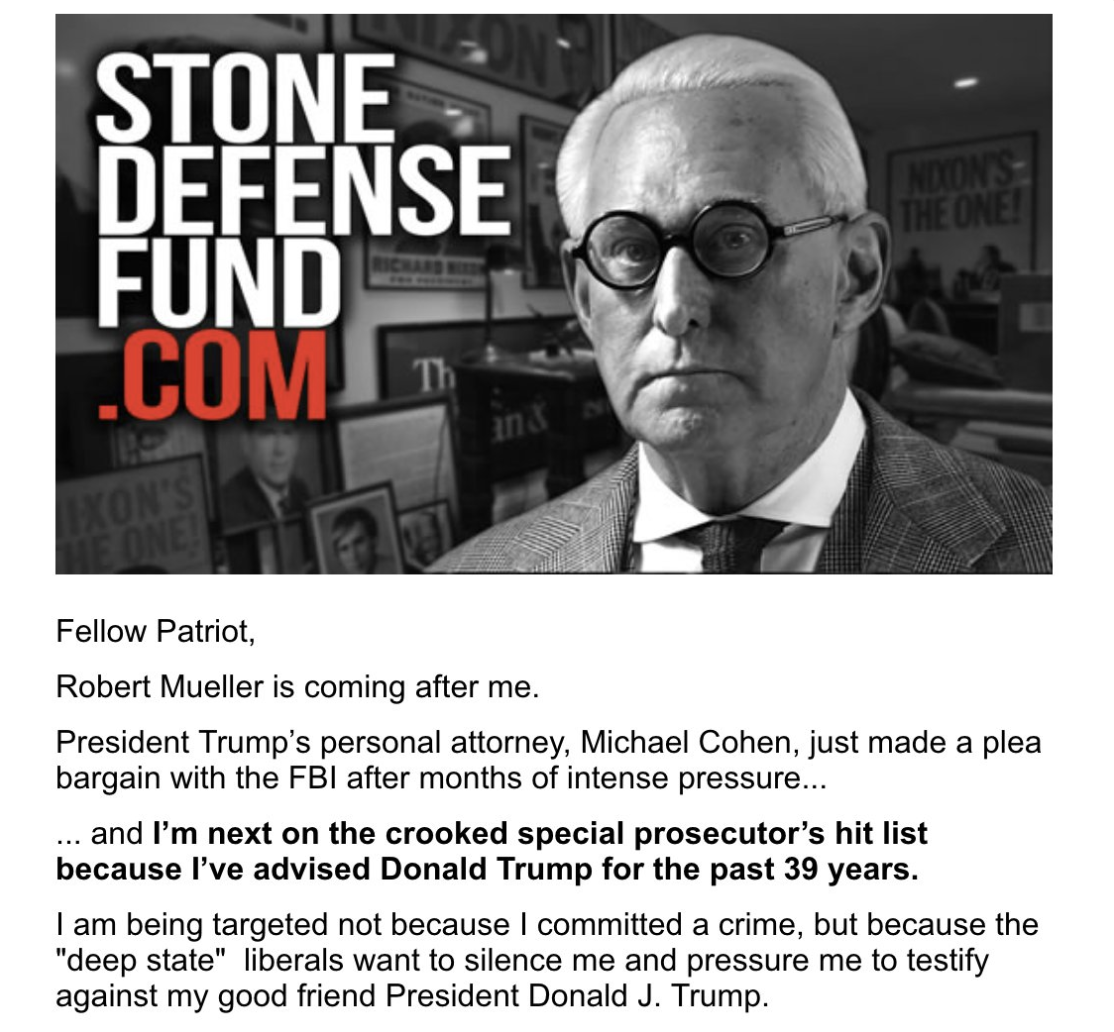
The big question, for me, is whether Mueller has finished his six month effort to put together a Roger Stone indictment.

Tantalizingly, back on August 10, Mueller scheduled Randy Credico to explain to the grand jury how Stone threatened him about his testimony. That appearance is for September 7. Given how far out Mueller scheduled this, I wondered at the time whether Credico was being slated to put the finishing touches on a Stone indictment.

What might prevent Mueller from finalizing Stone’s indictment, however, is Stone associate Andrew Miller, from whom Mueller has been trying to get testimony since May 9. Miller is challenging his grand jury subpoena; he’s due to submit his opening brief in his appeal on September 7. That might mean that Mueller has to wait. But two filings (District, Circuit), the docket in his subpoena challenge, and this CNN report may suggest they can move forward without first getting Miller’s testimony.

Both the Circuit document and CNN provide more details about a May 9 interview with two FBI Agents, with no attorney present (no offense to Miller, but what the fuck kind of self-described libertarian, much less one in Roger Stone’s immediate orbit, agrees to an FBI interview without a lawyer present)?

Mr. Miller was first interviewed by two agents of the Federal Bureau of Investigation who visited him unannounced on or about May 9, 2018, in Saint Louis, MO, where he resides. He was cooperative, answering all their questions for approximately two hours, and at the conclusion of the interview, was handed a subpoena to produce documents and testify as a witness before the grand jury.

CNN describes that’s what poses a perjury concern for Miller with regards to his testimony before the grand jury because of that original interview.

Miller’s case is complicated by the fact that he initially cooperated with the special counsel’s investigation. When FBI agents first approached him in May, he spoke with them at his home in St. Louis for two hours without an attorney.

[snip]

Dearn said in an interview that she was just being “carefully paranoid” and protecting her client from accidentally committing perjury if he testifies and contradicts something he told investigators back in May without a lawyer present.

As the District filing seems to suggest, Miller got not one but two subpoenas (???), just one of which called for document production:

Mr. Miller was served with two subpoenas dated June 5, 2018, both requiring his appearance before the Grand Jury on June 8, but only one of which required that he search and bring with him the documents described in the Attachment to one of the subpoenas. See Exhibits 1 and 2. After a filing a motion to quash on grounds not raised herein, this Court issued a Minute Order on June 18 requiring Mr. Miller’s appearance before the Grand Jury on June 29 and to produce the documents requested as limited by agreement of the parties by June 25.

Miller turned over 100MB of documents on June 25, but shortly thereafter, Mueller prosecutor Aaron Zelinsky asked for more.

Mr. Miller has since complied with that part of the order producing voluminous documents in a file that is 100MB in size to government counsel on Monday, June 25. In her cover email to government counsel, Aaron Zelinsky, Miller’s counsel stated in pertinent part: “Mr. Miller does not waive and hereby preserves all rights he has to object to the subpoena requiring his appearance before the Grand Jury this Friday…and from any continuing duty or obligation to supply additional documents subject to the subpoena.” See Exhibit 6. Nevertheless, Mr. Zelinsky recently informed counsel that he is not satisfied with this production and is unreasonably requesting additional documents from Mr. Miller.

CNN reported that those documents pertained to WikiLeaks and Guccifer 2.0.

After a protracted back and forth between Dearn and Mueller’s team, Miller handed over a tranche of documents. In turn, the government had agreed to limit its search to certain terms such as Stone, WikiLeaks, Julian Assange, Guccifer 2.0, DCLeaks and the Democratic National Committee, according to court filings and interview with attorneys.

So at the very least, Mueller has 100MB of documents that relate to Wikileaks and Guccifer 2.0 (which raises real questions about how Miller can say he knows nothing about the topic), and 2 hours of testimony that Miller may not want to tell the grand jury now that he has lawyers who might help him avoid doing so.

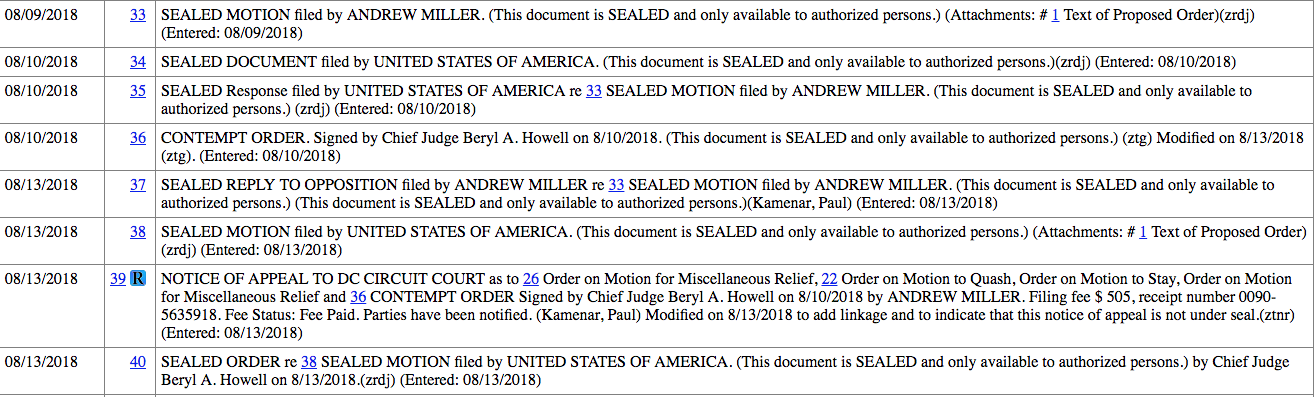
Meanwhile, there are some filings from the end of his District Court docket.

The Circuit document mostly explains what filings 33, 34, 35, and 37 are (though doesn’t explain why Mueller refused to stipulate that Miller be held in contempt): they’re the process by which he was held in contempt and therefore legally positioned to appeal.

6. Because Mr. Miller desired to appeal the order denying his motion, ensuing discussions with Special Counsel to stipulate that Mr. Miller be held in contempt for not appearing on the upcoming appearance before the grand jury on August 10, 2018, and to stay the contempt pending appeal did not succeed.

7. Consequently, two days before his appearance, on the evening of August 8, 2018, counsel emailed government counsel and Judge Howell’s clerk (and on the following morning of August 9, hand-filed with the clerk’s office), a Motion By Witness Andrew Miller To Be Held In Civil Contempt For Refusing To Testify Before The Grand Jury And To Stay Such Order To Permit Him To Appeal It To The U.S. Court Of Appeals For The District Of Columbia Circuit and citing authorities for granting a stay of contempt. ECF No. 33. The government served and a response on the evening of August 9 ( ECF. No. 35) and Mr. Miller served a reply early morning on August 10. ECF No. 37.

8. On August 10, undersigned counsel for Mr. Miller met government counsel at 9:00 a.m. as previously agreed to at the entrance to the grand jury offices, and was advised by government counsel that a motion to show cause was filed shortly before 9:00 a.m. ECF No. 34.

9. Approximately two hours later, the court held the show cause hearing, with the Mr. Miller and local counsel appearing telephonically from Saint Louis, MO.

10. The court granted Mr. Miller’s and the government’s request that he be held in contempt and stayed the order if the notice of appeal were filed by 9:00 a.m. August 14, 2018. ECF No. 36.

That doesn’t explain what Document 38 is, to which Miller didn’t respond, and in response to which Beryl Howell issued an order.

CNN’s description of Miller’s attorney’s concern seems to split his testimony into two topics: Guccifer and Wikileaks, and Stone’s PACs. Miller’s only worried about legal jeopardy in the latter of those two. (For some details on what the legal exposure might pertain to, see this post.)

[Alicia] Dearn was adamant that Miller not be forced to testify to the grand jury about one topic in specific: Stone. She asked that her client be granted immunity, “otherwise he’s going to have to take the Fifth Amendment,” she said in a court hearing in June.

Aaron Zelinsky, one of Mueller’s prosecutors, noted Miller’s lawyer was making two seemingly contradictory arguments: “On the one hand, that the witness knows nothing, has nothing to hide, and has participated in no illegal activity. On the other hand, that there is a Fifth Amendment concern there.”

In the hearing, Dearn said she was concerned Miller would be asked about his finances and transactions related to political action committees he worked on with Stone.

Miller “had absolutely no communication with anybody from Russia or with Guccifer or WikiLeaks,” Dearn said in an interview.

By process of elimination, the only thing she believes her client could get caught up on are questions about his financial entanglements with Stone and his super PAC.

The Circuit document concedes that Miller may be the subject — but not target — of this grand jury investigation.

12. Lest there be any misunderstanding, Mr. Miller was not a “target of grand jury subpoenas” (Concord Mot. at 1), but rather a fact witness or at most a subject of the grand jury; nor was he a “recalcitrant witness.” Id. at 13. As the foregoing background demonstrates, Mr. Miller has been a cooperative witness in this proceeding.

It would be really weird if Miller really did get two subpoenas, and that’s not consistent with the Circuit document. So it may be there were two topics or crimes described in the subpoena: conspiring with Russia, and running a corrupt PAC. And if Miller’s only personally legally exposed in the latter of those, then it’s possible Mueller would treat these differently.

So it’s possible Mueller got what they need to move forward on the main conspiracy case against Stone, while it has to wait on Miller’s own involvement in Stone’s corrupt PACs until after the DC Circuit reviews things.

Other September deadlines

The September 7 timing is interesting for two other reasons. First, that’s also the day that George Papadopoulos — whose plea deal covers his lies and obstuction but not any conspiracy case — is due to be sentenced.

Just 10 days later Mike Flynn (whose plea deal was also limited to his lies) has a status report due, just a 24-day extension off his previous one. That timing suggests he’s about done with his cooperation. Perhaps that shortened time frame is only due to his team’s push to get him back earning money to pay for his lawyers again. Perhaps there’s some other explanation.

Timeline

August 24: Revised deadline for Manafort pre-trial statement — Manafort punted on many issues.

August 28: Hearing in DC Manafort case.

September 3: Current deadline for motions in EDVA Manafort trial

September 4: Brett Kavanaugh confirmation hearings scheduled to begin (projected to last 3-4 days)

September 7: Randy Credico scheduled to testify before grand jury; George Papadopoulos scheduled for sentencing; Andrew Miller brief due before DC Circuit; 60 days before November 6 mid-terms

September 17: DC Manafort trial starts, status report due in Mike Flynn case

September 21: Requested deadline for motions in EDVA Manafort trial

September 28: Government brief due in DC Circuit appeal of Andrew Miller subpoena

October 9: Miller reply due in DC Circuit

November 6: Mid-term election

November 10: Status report due in Rick Gates case

As I disclosed in July, I provided information to the FBI on issues related to the Mueller investigation, so I’m going to include disclosure statements on Mueller investigation posts from here on out. I will include the disclosure whether or not the stuff I shared with the FBI pertains to the subject of the post. 

Share this entry

Andy McCarthy’s Misconception

I was struck, in reading Andy McCarthy’s review of the Michael Cohen and Paul Manafort guilty outcomes last week (in which he measures Trump via a vastly different standard than he once measured Bill Clinton), by this erroneous claim:

The Trump camp continues to stress that Manafort’s case had nothing to do with the original rationale for Mueller’s investigation, “collusion with Russia.” But as we’ve pointed out any number of times, Mueller took over a counterintelligence investigation of Russia’s interference in the 2016 election. Possible Trump-campaign collusion with Russia was just one thread in the larger probe.

The claim that the Trump-campaign “collusion” was just one thread of what Mueller originally took over is false, but utterly critical for McCarthy’s sustained belief that Mueller has not found evidence of a conspiracy between Trump and Russia. While it is true that when Comey confirmed the investigation, he did not specify the structure of the investigation,
I have been authorized by the Department of Justice to confirm that the FBI, as part of our counterintelligence mission, is investigating the Russian government’s efforts to interfere in the 2016 presidential election and that includes investigating the nature of any links between individuals associated with the Trump campaign and the Russian government and whether there was any coordination between the campaign and Russia’s efforts. As with any counterintelligence investigation, this will also include an assessment of whether any crimes were committed.
When Rod Rosenstein appointed Mueller, he described Mueller’s scope to include,
  • any links and/or coordination between the Russian government and individuals associated with the campaign of President Donald Trump; and
  • any matters that arose or may arise directly from the investigation; and
  • any other matters within the scope of 28 C.F.R. § 600.4(a)

Why McCarthy made this error is clear: he uses the existence of and Mueller’s indictments in a broader counterintelligence investigation to sustain his belief that Mueller doesn’t have a “collusion” case against Trump or his associates.

At this point, it does not appear that Mueller has a collusion case against Trump associates. His indictments involving Russian hacking and troll farms do not suggest complicity by the Trump campaign. I also find it hard to believe Mueller sees Manafort as the key to making a case on Trump when Mueller has had Gates — Manafort’s partner — as a cooperator for six months. You have to figure Gates knows whatever Manafort knows about collusion. Yet, since Gates began cooperating with the special counsel, Mueller has filed the charges against Russians that do not implicate Trump, and has transferred those cases to other Justice Department components.

When it comes to the president, I believe the special counsel’s focus is obstruction, not collusion. When it comes to Manafort, I believe the special counsel’s focus is Russia — specifically, Manafort’s longtime connections to Kremlin-connected operatives. Mueller may well be interested in what Manafort can add to his inquiry into the June 2016 Trump Tower meeting (arranged by Donald Trump Jr. in futile hopes of obtaining campaign dirt from Russia on Hillary Clinton). That, however, is not the more serious “collusion” allegation that triggered the Trump thread of the investigation — cyberespionage conspiracy (i.e., Russian hacking of Democratic party emails).

That is, because Mueller indicted trolls and GRU hackers and then spun those prosecutions off to other teams (in the GRU case, back to one of the teams that originally investigated it), it is proof, in McCarthy’s mind, that Mueller isn’t targeting Trump and his associates for conspiring with Russia.

The actual background of the Mueller investigation suggests precisely the opposite. As I noted when Lawfare made precisely the same error in a post on the GRU indictment,

Friday’s indictment is, rather, the result of investigations conducted primarily in San Francisco and Pittsburgh. At the time Comey confirmed the counterintelligence investigation into Trump’s camp and at the time Comey got fired for not shutting the Trump counterintelligence investigation down, those San Francisco and Pittsburgh investigations were totally separate. Those two investigations almost certainly had little if any involvement from Peter Strzok (indeed, they involved a bunch of FBI cyber agents, a division of FBI that Strzok never tired of mocking in his texts to Lisa Page). The DOJ press release from Friday states that explicitly.

This case was investigated with the help of the FBI’s cyber teams in Pittsburgh, Philadelphia and San Francisco and the National Security Division.

Those two investigations (plus the separate one noted in Philadelphia that started later, as I understand it from what a lawyer who represented a witness in that investigation described to me) got moved under the Mueller umbrella sometime in or just before November, and now the GRU officer part of the investigation will be moved back to Pittsburgh where it started, to languish forever like some other nation-state hacker indictments investigated by Western District of Pennsylvania.

Given that both public reporting (starting in February 2017 and extending into November 2017) and Mueller team changes (not to mention my own reporting about the Philadelphia grand jury’s activity in the second half of May 2017 and my own knowledge about where I interviewed and where my interview materials subsequently got moved to) support this narrative, McCarthy (and the Lawfare crowd) might ask why Mueller decided to integrate the cybersecurity parts of the investigation, only to spin the Russian defendants back to other teams once they were indicted?

We can begin to get an answer from the two indictments that — Andy wants to believe — are themselves evidence that Mueller doesn’t have evidence on Trump’s associates but actually are. The Internet Research Agency indictment actually describes three Florida-based Trump campaign officials inconclusively, as if they were either still under investigation or at some legal risk.

On approximately the same day, Defendants and their co-conspirators used the email address of a false U.S. persona, [email protected], to send an email to Campaign Official 1 at that donaldtrump.com email account, which read in part:

Hello [Campaign Official 1], [w]e are organizing a state-wide event in Florida on August, 20 to support Mr. Trump. Let us introduce ourselves first. “Being Patriotic” is a grassroots conservative online movement trying to unite people offline. . . . [W]e gained a huge lot of followers and decided to somehow help Mr. Trump get elected. You know, simple yelling on the Internet is not enough. There should be real action. We organized rallies in New York before. Now we’re focusing on purple states such as Florida.

The email also identified thirteen “confirmed locations” in Florida for the rallies and requested the campaign provide “assistance in each location.”

[snip]

Defendants and their co-conspirators used the false U.S. persona [email protected] account to send an email to Campaign Official 2 at that donaldtrump.com email account.

[snip]

On or about August 20, 2016, Defendants and their co-conspirators used the “Matt Skiber” Facebook account to contact Campaign Official 3.

And while the GRU indictment (on top of key clauses being misread by virtually everyone who has read it) doesn’t use the same convention to describe Roger Stone’s communications with Guccifer 2.0…

On or about August 15, 2016, the Conspirators, posing as Guccifer 2.0, wrote to a person who wasin regular contact with senior members of the presidential campaign of Donald J. Trump, “thank u for writing back . . . do u find anyt[h]ing interesting in the docs i posted?” On or about August 17, 2016, the Conspirators added, “please tell me if i can help u anyhow . . . it would be a great pleasure to me.” On or about September 9, 2016, the Conspirators, again posing as Guccifer 2.0, referred to a stolen DCCC document posted online and asked the person, “what do u think of the info on the turnout model for the democrats entire presidential campaign.” The person responded, “[p]retty standard.”

It pointed to Russia’s response to Donald Trump’s request that they hack Hillary without referring to him one way or another.

For example, on or about July 27, 2016, the Conspirators attempted after hours to spearphish for the first time email accounts at a domain hosted by a thirdparty provider and used by Clinton’s personal office. At or around the same time, they also targeted seventy-six email addresses at the domain for the Clinton Campaign.

What Mueller has done with both of the counterintelligence indictments that McCarthy takes solace in is lay out the Russian side of a conspiracy (and both are charged as conspiracies) with very clear spots into which American co-conspirators may be dropped when Mueller is prepared to do so. (I laid this out at more length in this post.)

Importantly, the fact that some of this investigation started out in other parts of DOJ but then got moved under Mueller make it clear that something came up in the investigation that Mueller and Rosenstein believed required they be moved under Special Counsel when they weren’t there, originally.

Let’s put it this way: Mueller didn’t subsume investigations located elsewhere at DOJ because the Special Counsel needed to be the one to indict a bunch of Russians. He did it to set up the conspiracies that would — that will — later be occupied by Russians and Americans.

As I disclosed in July, I provided information to the FBI on issues related to the Mueller investigation, so I’m going to include disclosure statements on Mueller investigation posts from here on out. I will include the disclosure whether or not the stuff I shared with the FBI pertains to the subject of the post. 

Share this entry

On Use Immunity, Predictions of Doom for the Presidency, and the Voluntary Waiver of Privilege on the Hush Payment Tape

Don’t get me wrong. I think Trump is in a whole heap of trouble (though remember that, wielded in the hands of a competent man or similarly competent advisors, the power of the presidency is an awesome force). I think the SDNY’s investigation of Trump Organization’s involvement in illegal hush payments and NYS’s investigation of the Trump Foundation pose the additional risk that the Trump business empire will collapse as people scrutinize both its legal shenanigans and its debt. And I think that risk will bring Trump to fear US law enforcement as much as he fears Russia (which I suspect could also bankrupt Trump Org if a few key oligarchs put their mind to it).

But I think people are getting slightly ahead of the story when they predict that “The significance of [what they call Weisselberg’s] flip, paired with Cohen’s recent plea deal, cannot be overstated.” That’s true, in part, because Weisselberg got only limited immunity tied to grand jury testimony implicating Michael Cohen.

The person briefed on the deal said that it was narrow in scope, protecting Mr. Weisselberg from self-incrimination in sharing information with prosecutors about Mr. Cohen, Mr. Trump’s former personal lawyer, who pleaded guilty on Tuesday to tax and campaign finance charges. The latter charges stemmed from payments during the campaign to two women who said they had affairs with Mr. Trump. It was not, the person said, a blanket immunity extending beyond the information he shared, and Mr. Weisselberg remains in his job at the Trump Organization.

While his testimony will be damaging to the Trump Org and, probably even more directly, Don Jr, Weisselberg in no way “flipped” on Trump. Indeed, there’s good reason to believe his cooperation may be an attempt to limit the fallout of the investigation of Cohen.

At the risk of proving my most recent post (in which I argued that the push for a Special Master didn’t gain the Trump camp very much) wrong, consider this detail. On July 23, Special Master Barbara Jones informed Judge Kimba Wood that “the parties” had withdrawn their privileged designation for 12 audio files, which she then released to the government.

On July 20, 2018, the parties withdrew their designations of “privileged” as to 12 audio items that were under consideration by the Special Master. Based upon those de-designations, the Special Master released the 12 items to the Government that day.

Those tapes are understood to include the tapes Cohen made in which he discussed the hush payments with Trump.

Two days later after that notice, Michael Cohen released a truncated version of the tape of him telling Trump he had spoken to Weisselberg about buying the rights of the Karen McDougal story, which unsurprisingly immediately preceded the news that prosecutors wanted to speak with Weisselberg.

Now, it may be that Cohen and Trump voluntarily waived privilege on those tapes to provide something to the press to get the titillated by the sex story and distracted from real financial graft. Or it may be that someone has a different plan of hanging out Cohen on the hush payments, limiting damage to Trump Jr and the organization, all in a bid to undercut Cohen’s value in a larger cooperation deal.

Or there may be some other explanation.

That being said, as of right now, the Trump camp is, as far as we know, dealing with three still separate investigations: SDNY, NYS, and Mueller. Don Jr is implicated directly in all of them and they have the possibility to collapse into one (with the added benefit of limiting the value of a Trump pardon of his son). Indeed, according to Vanity Fair, Mueller is very actively putting the squeeze on Junior in the more dangerous of those investigations.

Another theory for what’s motivating Trump’s increasingly unhinged tweets is that Mueller may be closing in on his son Don Jr. “A lot of what Trump is doing is based on the fact [that] Mueller is going after Don Jr.,” a person close to the Trump family told me. “They’re squeezing Don Jr. right now.”

Don Jr.’s lawyer said, “I’m not going to comment.” Another person briefed on the investigation disputed the term “squeeze,” but said the Mueller team continues to ask for documents.

Mueller may not wait for Junior to implicate Dad before he indicts the spawn (certainly, Senior and Rudy G have been laying the groundwork to exonerate Junior for his conspiring with Russians for at least three weeks, so they clearly expect that possibility). And to the extent that Don Jr gets in real legal trouble — something beyond a tax problem they can restate and a campaign finance violation that might be manageable — then Dad might be in real trouble.

But it’s quite possible Weisselberg and the Trump Org found a way to limit the damage of the Cohen investigation, for now, to things that don’t affect the core corruption of the Trump Organization business model, or the conspiracy with Russia to win the election, and along the way limited the damage to Don Jr.

The thing about Trump is there are so many bodies, it may actually take three or four people who know where the different kinds of bodies are buried — Weisselberg plus several others — to bring him down. And thus far, Weisselberg is not telling about most of those bodies.

Update: I’d like to add a point I meant to include before I went to yoga. One thing that’s going on with the hush payment story — one I’ve even seen reporters admit — is that it pertains to issues that reporters can understand. Sex! Scandal! Tax cheats!

Add in the fact that sources are talking here, whereas all the Mueller investigation sources, save those associated with Roger Stone and his band of rat-fuckers, have gone silent (and they were all defense witness sources anyway, and so unlikely to provide the full picture).

There’s nothing wrong with the possibility that reporters will make more of a story that they have sources for and can understand and sell to readers easily. For that reason, too, it may have more immediate impact on Congress, even while I highly doubt Republicans are going to ditch Trump for some hush payments (at least not until he becomes significantly more wounded). But it’s worth noting that some of that may be going on.

And if the focus on these hush payments buys Mueller some times — shifts Trump’s ire from Mueller to Sessions — that’s probably a benefit too.

Share this entry

The Trump Team’s Strategic Errors: Special Master Edition

Between Michael Cohen’s guilty plea and Paul Manafort’s guilty verdict, I’m struck this week by how badly two strategic decisions they made have failed. I’ll return to the issue of Manafort’s “rocket docket” strategy. Here, however, I’d like to note how little Michael Cohen and Donald Trump (AKA Individual-1) gained by fighting to have a special master review the materials seized in the April 9 raid of Cohen’s property.

As you recall, the Southern District of NY planned to use a taint team — basically, a second set of prosecutors — to sort through Cohen’s possessions. But Cohen and (especially) Trump complained about the impropriety of doing so when the President is one of the clients involved. Cohen invented an attorney-client relationship with Sean Hannity.

And after listening to all those arguments,on April 27, Judge Kimba Wood appointed Barbara Jones special master to make privilege determinations. It was definitely the right decision for the legitimacy of the proceeding. It might even have gotten the review done as quickly as SDNY could have done so.

But Trump and Cohen gained very little beyond what will end up being more than half a million dollar bill for their troubles. (Jones’ invoices for labor through the end of July, which are being split 50-50 between the plaintiffs — Cohen, Trump, and Trump Organization — and SDNY, add up to $1,050,022.)

It started on June 4, when Jones issued her first report on the hard copy documents and three devices that were the first things she received. Of the 172 items the plaintiffs tried to claim privilege over, she agreed in just 169 cases. Jones disagreed with the claims about three items (the circumstances with this report are murky, as she later reconsidered one item, and this appears to be the batch of materials from which Cohen and Trump later decided to reverse their privilege claim surrounding 12 recordings).

On June 6, the president’s lawyer, Joanna Hendon, wrote Kimba Wood on behalf of Trump, Cohen, and the Trump Organization, requesting that any challenge to a privilege determination appear under seal and ex parte. The next day the government responded that it had no problem with discussions of the content of documents to be submitted under seal and ex parte, but argued the legal discussions should be public.

There is no reason why the Government and the public should be deprived of access to the balance of the filing — such as the law upon which Cohen and the two Intervenors rely, or their legal analysis to the extent it does not directly describe the substance of the documents in question.

In other words, SDNY argued that if the plaintiffs wanted to fight Jones’ determinations, they would have to show their legal arguments in public.

In a June 8 order, Judge Wood agreed with the government that any legal discussion should be public. In response, the plaintiffs withdrew certain privileged designations, effectively deciding they weren’t willing to challenge Jones’ determinations with legal arguments the public could see.

After Jones amended her June 4 report on June 15, Judge Wood reviewed the substance of what Jones had found, effectively conducting a spot check of her work. Her June 22 order on the matter reveals that Michael Cohen did more consulting of lawyers than consulting as a lawyer.

The Court adopts the Report for the following reasons: 57 of these items are text messages between Plaintiff and his outside counsel, in which Plaintiff requests legal advice from his outside counsel or Plaintiff’s outside counsel provides legal advice; 55 of these items are text messages between Plaintiff and his outside counsel, in which Plaintiff requests legal advice from his outside counsel or Plaintiff’s outside counsel provides legal advice in anticipation of litigation; 22 of these items are email communications or portions of email communications in which Plaintiff receives or requests legal advice from outside counsel; 6 of these items are email communications in which Plaintiff receives or requests legal advice from outside counsel in anticipation of litigation; 7 of these items are email communications between Plaintiff and a client, containing legal advice made in anticipation of litigation; 1 of these items is an email communication in which Plaintiff receives a request to initiate legal representation; 9 of these items are legal memoranda from outside counsel, providing legal advice to Plaintiff or a client of Plaintiff; 1 of these items is a letter from Plaintiff’s outside counsel containing legal 2 of these items are retainer agreements between Plaintiff and outside counsel, containing requests for legal advice10; 1 of these items is a litigation document containing notes for Plaintiff’ s outside counsel, made in anticipation of litigation. The Court has also reviewed the 7 documents that the Special Master recommends withholding from the Government because they are Highly Personal. (ECF No. 81, at 2.) These documents all concern Plaintiffs family affairs and are not relevant to the Government’s investigation. With respect to the above items, the Court ADOPTS the Amended Report. [my emphasis]

That is, in this first batch of documents, even the privileged ones only included 8 files in which Cohen was the lawyer providing advice. The rest involved Cohen getting advice for himself or a client.

On July 2 and July 13, Jones started releasing big chunks of non-privileged items. Almost 2.2 million items were turned over. On July 10, Cohen moved to share all these materials with Guy Petrillo. By this point, Cohen felt he had been abandoned by Trump and was preparing to flip against his client. July 23 is when Jones reported that Cohen and Trump had withdrawn designations of privilege with respect to 12 audio files, which were then released to the government (and began to be leaked on cable shows).

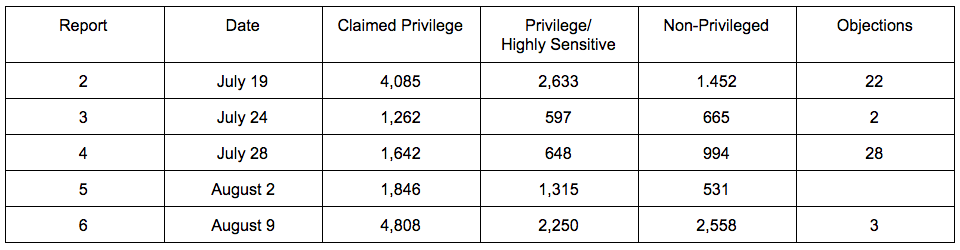
Here are the determinations Barbara Jones described making in reports dated July 19, July 24, July 28, August 2, and August 9. Claimed privilege, here, is what Cohen or Trump or Trump organization claimed. The next two columns show what Jones labeled those files as. The objections are items for which the plaintiffs still argued there was a privilege claim after her recommendations, though they did not fight any of these designations.

In her summary, Jones described that altogether 7,434 items had been deemed privileged. Trump and or Cohen had objected to Jones’ designations with regards to 57 items, but were unwilling to fight to have Wood overrule Jones’ designation if their arguments would be public.

What Jones didn’t mention is that along the way, she had overruled the plaintiffs’ designation of something as privileged or highly sensitive around 6,200 times (these numbers don’t entirely add up, possibly because of overlapping categories).

While Trump and Cohen may have achieved the goal of delay, within 134 days after the raid on his home, Cohen had found a new lawyer and pled guilty to 8 counts. And while it’s not clear whether Jones applied a similar or more stringent standard on privilege claims than SDNY’s privilege team would have, as it was, the Trump people paid half a million dollars to try but fail to keep over 6,200 items out of government hands.

Update, 8/27: Oops! I forgot to add this language from the plea hearing, Prosecutor Andrea Griswold explained this about the evidence.

The proof on these counts at trial would establish that these payments were made in order to ensure that each recipient of the payments did not publicize their stories of alleged affairs with the candidate. This evidence would include:

Records obtained from an April 9, 2018 series of search warrants on Mr. Cohen’s premised, including hard copy documents, seized electronic devices, and audio recordings made by Mr. Cohen.

We would also offer text messages, messages sent over encrypted applications, phone records, and emails.

We would also submit various records produced to us via subpoena, including records from the corporation referenced in the information as Corporation One and records from the media company also referenced in the information.

She makes it clear that the audio recording — apparently the same ones that Cohen and Trump waived privilege over — were part of the evidence on those charges.

Update: Added more punctuation for those of you who thought I’d leave out an Oxford comma.

Share this entry
[Photo: Emily Morter via Unsplash]

Oddly-Timed Story: White House Counsel McGahn’s Call to FCC’s Ajit Pai

[NB: Check the byline — it’s Rayne and some of this post is speculative.]

Maybe it’s something; maybe it’s nothing. But with White House Counsel Don McGahn under so much scrutiny this week, the timing of the story about McGahn’s call to the Federal Communications Commission seems odd.

You may recall I wrote recently (item 2) about the proposed merger of Sinclair Broadcast Group and Tribune Media, a deal which would have created a behemoth reaching at least 72% of U.S. households via local broadcast TV stations. FCC chair Ajit Pai revealed in testimony before the Senate Commerce Committee on Thursday this past week that McGahn had called him about the Sinclair Broadcast Group-Tribune Media merger.

Let’s look at the timeline of events related to this deal:

22-JAN-2017 — Ajit Pai named FCC chair on Trump’s second full day in office.
7-MAR-2017 — Trump nominates Ajit Pai to a second five-year term with the FCC as its chair.

Trump and Pai met at the White House on Monday for a meeting that was closed to the press, although an FCC official said that no pending business before the agency was discussed.

17-MAR-2017 — Rumors surfaced about a Sinclair-Tribune merger.
8-MAY-2017 — Sinclair announced it would buy Tribune; assets would include WGN (Chicago) and WMIL (Milwaukee) radio stations. Tribune newspapers were not included in the deal.
2-OCT-2017 — Senate confirms Pai as FCC chair.
24-OCT-2017 — FCC killed a rule requiring broadcasters to have physical offices in their primary local coverage area. The move was seen as beneficial to Sinclair’s merger as they would not have to change office locations.

16-JUL-2018 — Pai expressed concerns about the merger deal, drafting a Hearing Designated Order (HDO) to place the merger before an administrative judge.
17-JUL-2018 — McGahn called Pai for an update on the Sinclair-Tribune merger.
18-JUL-2018 — FCC signs and issues the HDO.
18-JUL-2018 — House Subcommittee on Communications and Technology announced an FCC oversight hearing for 25-JUL-2018.
24-JUL-2018 — Trump tweets about his disappointment with FCC about the Sinclair-Tribune deal:

So sad and unfair that the FCC wouldn’t approve the Sinclair Broadcast merger with Tribune. This would have been a great and much needed Conservative voice for and of the People. Liberal Fake News NBC and Comcast gets approved, much bigger, but not Sinclair. Disgraceful!

25-JUL-2018 — During House Energy and Commerce Committee FCC oversight hearing, Chairman Frank Pallone asked Pai, “If the President or anyone in the White House discusses or has discussed the Sinclair-Tribune merger with you or anyone at the FCC, will you commit to disclosing that in the public docket? Yes or no?” Pai responded, “Yes, except, Congressman, we have ex parte rules, because this is now a restricted proceeding. We are limited in what information we can receive and what we can put on the record. But consistent with our restricted ex parte rules, we would be happy to accommodate to the extent we can.” (video excerpt)
02-AUG-2018 — Pai did not mention the call from McGahn during an FCC press conference.
09-AUG-2018 — Tribune, not Sinclair, terminated the deal.
16-AUG-2018 — Pai appears before the Senate Commerce, Science and Transportation Committee, disclosing McGahn’s call.
18-AUG-2018 — NYT publishes the first of two pieces on McGahn.
19-AUG-2018 — NYT publishes the second of two pieces on McGahn.
20-AUG-2018 — House Energy and Commerce Committee Chairman Pallone Jr. said McGahn’s call to Pai should have been disclosed the previous week during a hearing before the Senate Commerce, Science and Transportation Committee hearing the previous week. Pallone wants answers about that call.

A couple things stand out immediately. First, Pai parsed responses to the House Energy and Commerce Committee and the Senate Commerce Committee. He was already on thin ice because of his claim a DDoS swamped public comments related to net neutrality but the FCC’s inspector general found Pai to be less than honest about the DDoS.

Second, the story about McGahn calling Pai was published on Thursday afternoon, approaching an advanced news dump zone during August. Why did NYT run not one but two stories about McGahn over the weekend? Why didn’t they wait until Monday? It’s as if somebody realized they needed to get a story out in spite of late summer weekend doldrums.

In this past weekend’s hullabaloo about McGahn’s “cooperation” with Special Counsel’s Office, there was a concerted effort to portray McGahn as serving and protecting the presidency, not Trump. As White House Counsel this is McGahn’s job but the obvious effort to distance McGahn from Trump should be noted.

Which makes me wonder: why did McGahn as White House Counsel, responsible for protecting the presidency, need an update from the chair of the independent FCC on a media merger? Why wouldn’t Commerce Department address this if Trump was curious? Or why wouldn’t Trump act like an ass and bumble a demand for information directly over Twitter as he has before with companies like Boeing?

As Marcy has pointed out, McGahn has extensive background in campaign finance; he was the Trump campaign’s counsel during the 2016 election season. Coincidentally he was counsel when David Smith, CEO of Sinclair Broadcasting Group, told Trump, “We are here to deliver your message.

Sounds like an offer of an unreported in-kind campaign donation to me since there are no reports that Smith or anyone at Sinclair made a similar offer to any other GOP primary candidate or to Hillary Clinton. Sinclair vigorously denied they hadn’t offered equal time when Sinclair’s offer to Trump was reported:

. . .there was a flap when Trump advisor Jared Kushner told a private business luncheon in December that Sinclair executives worked with the campaign to spread pro-Trump messages in Sinclair newscasts, which reach 81 markets in key heartland regions that supported Trump. Sinclair vehemently denied the claim, asserting that it offered equal amounts of air time for in-depth interviews to Trump and his Democratic rival, Hillary Clinton, and that Clinton declined the invitation.

Did McGahn know about and approve this offer?

Pai’s squirrelly behavior about Sinclair-Tribune as well as McGahn’s sudden distancing from Trump cast a different light on David Smith’s so-helpful offer and Sinclair’s mandatory group-wide airing of former White House communications aide Boris Epshteyn’s program — the same Epshteyn who has a history of pro-Russian sentiment. Add these couple line items to the timeline:

25-MAR-2017 — Epshteyn left his role as Special Assistant to The President and Assistant Communications Director for Surrogate Operations, having previously served in Trump campaign communications and as director of communications for Trump inauguration committee.
17-APR-2017 — Sinclair announced Epshteyn joined them as a political analyst.

Conveniently after the rumors emerged about the Sinclair-Tribune merger but before it was formally announced — what a coincidence.

It doesn’t appear Epshteyn was replaced in the White House. Was Epshteyn placed with Sinclair at Trump’s request — not because of Epshteyn’s rumored confrontational approach to Fox News — after having been parked with the White House for two months post-inauguration for the purposes of resume padding?

Is Epshteyn really an independent political analyst or is he still shilling for Trump as an under-cover communications aide on Sinclair’s dime — gaslighting America for Trump’s benefit — given David Smith’s eagerness to deliver Trump’s message? Is Epshteyn really doing advance work for Trump 2020 campaign?

Is this the reason why Sinclair issued a diktat to all its 173 stations that they must read on air a statement about other media outlets’ “fake news,” in order to elevate their content, including Epshteyn’s by contrast, engaging in what NPR’s David Folkenflik called “negative campaigning”?

Is this the reason why Ajit Pai didn’t disclose the call from McGahn and attempted to obstruct access to information about the call behind an HDO that McGahn called not on behalf of the president but on behalf of the Trump 2020 campaign?

Did McGahn help push the two back-to-back NYT articles this weekend to wallpaper over what may have been a Hatch Act violation — using his role as White House Counsel to reach Ajit Pai and press for approval of the Sinclair-Tribune merger to benefit Trump 2020?

Reaching at least 72% of American households from now until Election Day 2020, to push anti-Democratic Party content while collecting data on viewers and shaping voter turnout, might have been adequate motivation to do so if one were working for the Trump campaign — not to mention  McGahn’s legal exposure.

It’d be nice if one of the Congressional committees conducting oversight of the FCC asked Pai more pointed questions about that phone call.

It’d be nice, too, if somebody asked any of the 2016 GOP primary candidates or Hillary Clinton’s campaign team if they received the same offer from Sinclair’s Smith extended to Trump or his proxies (hello, Jared).

And there’s more than one David helming a media empire who needs to answer some questions about their friend Trump.

Share this entry

Trump’s Pecker and His Rat-Fucker’s “Pervy Ted”

According to Michael Cohen’s criminal information, he and David Pecker started conspiring to protect Trump from scandals pertaining to his extramarital affairs and alleged sexual assault starting in August 2015.

In or about August 2015, the Chairman and Chief Executive of Corporation-1 ( “Chairman-1”), in coordination with MICHAEL COHEN, the defendant, and one or more members of the campaign, offered to help deal with negative stories about Individual-l’s relationships with women by, among other things, assisting the campaign in identifying such stories so they could be purchased and their publication avoided. Chairman-1 agreed to keep COHEN apprised of any such negative stories.

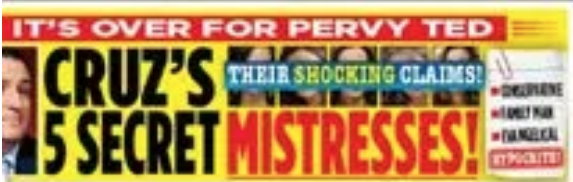
That means Cohen and Pecker were conspiring to help Trump’s electoral chances when Trump’s rat-fucker, Roger Stone, planted a story in Pecker’s pages on March 23, 2016, accusing Ted Cruz, who was running on his Evangelical brand, of having affairs with five different women. (h/t Allen Smith for remembering this incident)

The National Enquirer published an article Wednesday alleging that the Texas senator had five secret mistresses. While it did not identify the alleged mistresses by name, the article included headshots of five women that were pixelated with black bars over their eyes.

The article also quoted Roger Stone, a former Trump adviser who is still close to the real-estate mogul. “These stories have been swirling about Cruz for some time,” Stone said in the National Enquirer. “I believe where there is smoke there is fire. I have to believe this will hurt him with his evangelical Christian supporters.”

Cruz unsurprisingly accused Trump of planting the story. To which Trump claimed he does not surround himself with political hacks … then pretend total innocence.

“And I would note that Mr. Stone is a man who has 50 years of dirty tricks behind him. He’s a man whom a term was coined for copulating with a rodent. Well let me be clear, Donald Trump may be a rat but I have no desire to copulate with him. And this garbage does not belong in politics,” Cruz said.

Trump issued a statement Friday afternoon denying any involvement with the National Enquirer.

“I have no idea whether or not the cover story about Ted Cruz in this week’s issue of the National Enquirer is true or not, but I had absolutely nothing to do with it, did not know about it, and have not, as yet, read it,” Trump said.

“I have nothing to do with the National Enquirer and unlike Lyin’ Ted Cruz I do not surround myself with political hacks and henchman (sic) and then pretend total innocence. Ted Cruz’s problem with the National Enquirer is his and his alone, and while they were right about O.J. Simpson, John Edwards, and many others, I certainly hope they are not right about Lyin’ Ted Cruz,” he added.

The timing of all this is quite interesting for several reasons. First, because Mueller has asked witnesses against Stone about meetings they had with Stone and Rick Gates in the spring, meaning we know the scope of his investigation into Stone extends back into the primary timeframe. The story came out just before Trump formally announced the hiring of Paul Manafort to manage his convention.

More interesting, still, the story came out even as Stone and his ally Pamela Jensen were ramping up attacks on Hillary for Bill’s philandering — the same kind of projection this Enquirer story entailed. The story came weeks after Stone first tweeted out his Stop the Steal campaign. Not long after, Stone started to shift money from his PAC, Committee to Restore America’s Greatness (CRAG in the timeline below), to his 527, Stop the Steal.

February 1, 2016: Pamela Jensen sends out fundraising letter to World Net Daily pushing Kathleen Wiley’s mortgage fundraiser

February 4, 2016: Jensen & Associates loans $2,610 to CRAG

February 10, 2016: Loans from Jensen & Associates repaid

February 19, 2016: Roger Stone tells Alex Jones that Donald Trump has donated to the Kathleen Willey fundraiser, even though it had raised less than $4,000 at that time

March 1, 2016: John Powers Middleton Company donates $150,000 to CRAG

March 6, 2016: First tweet in spring Stop the Steal campaign

March 9, 2016: John Powers Middleton donates $50,000 to CRAG

March 11, 2016: John Powers Middleton donates $25,000 to CRAG

March 14, 2016: John Powers Middleton donates $25,000 to CRAG

March 23, 2016: Ted Cruz National Enquirer smear

March 29, 2016: Trump announces hiring of Paul Manafort

April 6, 2016: Stone (Sarah Rollins) establishes Stop the Steal in same UPS post box as CRAG

April 6, 2016: CRAG gives $50,000 to Stop the Steal

So there’s good reason to believe that Mueller is reviewing Stone’s actions from this time period.

As numerous outlets have reported, prosecutors have given Pecker immunity to testify (at least) about the Cohen matter. The NYT reported that the Enquirer’s Chief Content Officer, Dylan Howard, also keeps a recording device in his office.

Though several people familiar with American Media’s operations have said that the company keeps a strict records policy that ensures that emails are deleted regularly, it is not clear the same held for encrypted communications or recordings; Dylan Howard, the company’s chief content officer, who is also said to be cooperating, was known to have a recording device in his office, according to people familiar with his operations. American Media would not comment.

In court documents filed on Tuesday federal prosecutors cited “encrypted” communications among Mr. Pecker, Mr. Howard and Mr. Cohen regarding the payoff to Stephanie Clifford, the pornographic actress known as Stormy Daniels, who claimed to have had a brief affair with Mr. Trump.

Perhaps the Pecker participation in this conspiracy goes beyond just hush payments?

Share this entry

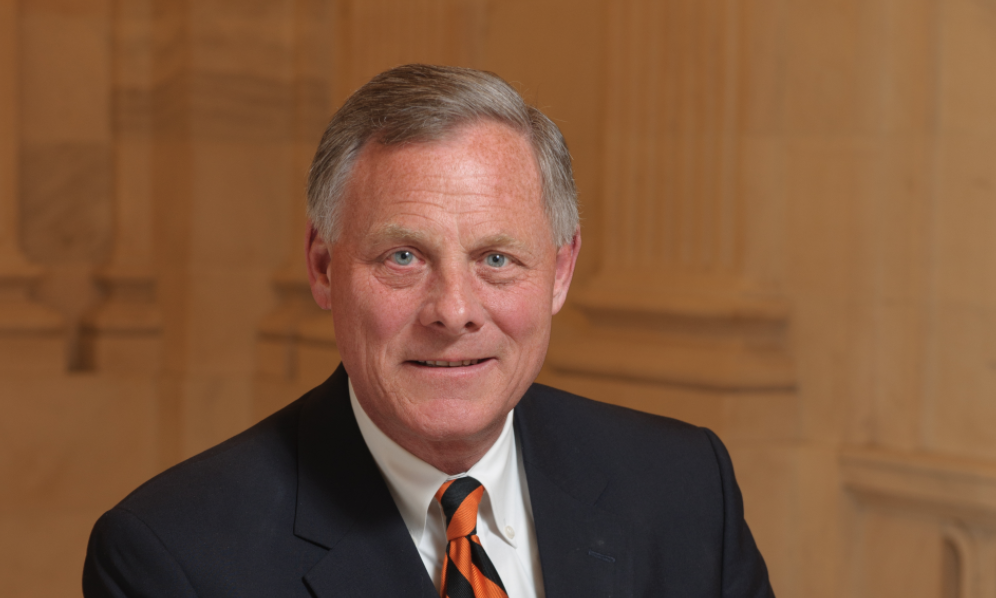
The Problems with Richard Burr’s Claim that SSCI Has No Evidence of Collusion

Fresh off a really testy statement suggesting that he is one of just two acceptable gatekeepers on the question of whether Trump conspired with Russia, Richard Burr made some comments to the AP over the weekend suggesting his committee had not received any evidence of a conspiracy between Trump and Russia.

Burr said there is “no factual evidence today that we’ve received” on collusion or conspiracy between Russia and President Donald Trump’s campaign.

It’s a squishy statement that seems designed — particularly given Burr’s newfound lassitude about ending the inquiry and his stated worries of being accused of missing something in the future — to permit him to sustain a claim he hasn’t seen any conspiracy, at least through the election, without aggressively investigating for one.

“Nothing in this town stays classified or secret forever,” Burr said. “And at some point somebody’s going to go back and do a review. And I’d love not to be the one that chaired the committee when somebody says, ‘well, boy, you missed this.’ So we’ve tried to be pretty thorough in how we’ve done it.”

[snip]

Still, he says he doesn’t think the committee should rush to wrap up the work, saying “the worst thing we can do is to prematurely try to end” the probe.

Indeed, the rest of this article lays out plenty of evidence that Burr is not looking for evidence of a conspiracy. First, there’s the description of what his committee has been working on most recently:

For now, Burr says, the committee is preparing to put out two reports by the end of September: one on the Obama administration’s response to Russia’s election interference, and a second on Russia’s election meddling on social media. The committee is also expected to hold a hearing with Facebook COO Sheryl Sandberg and Twitter CEO Jack Dorsey in the first week of September.

Along with prior work and that laid out in that prior work, then, the Burr interview reveals that SSCI has been focused on:

  • A review of the January 2017 Intelligence Community Assessment
  • A report on election security vulnerability that barely mentions election vendor security
  • The planned report on Obama’s response to the Russian attack
  • The planned (and laudable) report on disinformation on social media
  • Per a bullet in the ICA report, “the contents of the [Steele dossier and its] handling by the United States Government “

These are all worthwhile topics (if you ignore the absence of a focus on vendors in the election security report). They’re just tangential to any question of conspiracy between Trump and Russia.

And on the one area where Burr does mention that conspiracy, he makes it clear he’s not going to work too hard to find out the truth.

“If the intent is to have a show trial, I’m not a participant,” Burr says on public hearings. He says “I don’t see a reason today” to bring back Donald Trump Jr., the president’s son, who participated in a meeting with a Russian lawyer at Trump Tower during the election.

At least at the House Intelligence Committee interview Don Jr had in December, the President’s son professed to not recall whether a call to a blocked number looped in his father on discussions about the June 9 meeting. And Mark Warner has made it clear that the committee did not ask Don Jr about a later meeting where  he proved willing to accept election assistance from foreign entities. Don Jr’s SJC testimony on that point is, by all appearances, a false statement to Congress. So the public record, at least, suggests that no committee has worked through the holes in Don Jr’s story — even ignoring some of the other questions remaining in the public record. Yet Burr likens chasing down those details to “a show trial.”

So, even with what’s in the public record, there’s significant reason to question whether Burr’s claim that “no factual evidence today that we’ve received” shows a conspiracy between Trump and Russia reflects any real effort to find out if there was one.

Plus, the article makes it clear that Burr doesn’t just demand that witnesses to the committee, but even other Senators, remain utterly silent about what the committee has been doing.

Sen. Jim Lankford of Oklahoma, who sits on the intelligence panel and is close to Burr, says Burr started every meeting at the beginning of the probe by asking senators not to talk to the media “until we get additional facts and we put things out together.”

While I greatly appreciate the need to keep the substance of some things the committee is doing a secret (indeed, I find that the committee doesn’t leak like a sieve refreshing), Burr’s public refusal to chase down the Don Jr story and his unwillingness to allow any public comment about what the committee is doing raise real questions about whether the committee would chase down evidence that would support a conspiracy case — even formerly public information still accessible to Congress, much less records requiring more of an effort to obtain — that might prove the same. Burr might worry just as much about someone, in the future, pointing to proof the committee chose not to chase down leads about a Trump-Russian conspiracy as his stated concern about someone pointing to something the committee missed.

“I know that from a committee’s integrity standpoint we’ve got to prove what we find. And if you can’t prove it then we can’t make the claim,” Burr said in the interview. But if his committee is not trying to prove that a conspiracy with Russia exists, then he should stop claiming that the committee has received no factual evidence that such a conspiracy exists. He would simply be unqualified to make the claim one way or another, and so should stop suggesting he would know if there were a conspiracy.

This is why I complained — before Burr made these comments — about his problematic epistemology, his insistence that he is one of just two gate-keepers on a claim about whether or not there has been collusion. Even the public record suggests no one in the committee can make such a claim.

As I disclosed last month, I provided information to the FBI on issues related to the Mueller investigation, so I’m going to include disclosure statements on Mueller investigation posts from here on out. I will include the disclosure whether or not the stuff I shared with the FBI pertains to the subject of the post. 

Share this entry

What Does the ‘Doomsday Investor’ Get out of Trump?

[Note the byline. This post may contain speculative content. / ~Rayne]

There’s a particularly interesting long read by Sheelah Kolhatkar in this week’s New Yorker, entitled, Paul Singer, Doomsday Investor.

If you’re not into investment and Wall Street machinations, you might go to sleep on this one. Even the subhead is a bit of a snooze if you’re not interested in the world of money:

The head of Elliott Management has developed a uniquely adversarial, and immensely profitable, way of doing business.

This blurb could describe almost any manager on Wall Street if they’ve broken with trends and employed some testosterone-enhanced swagger at some point in their career.

But stay with this one, the payoff is in the latter half of the article. Perhaps you already know of Paul Singer — just roll to the latter half.

Singer is a major funder of Washington Free Beacon, which some of you will recognize as a conservative online media outlet. It’s not very big and its output is rather predictable once you grasp its apparent ideology.

You may also remember this outlet as the progenitor of the competitive intelligence dossier on then-candidate Donald Trump, which eventually ended with Free Beacon and picked up again with law firm Perkins Coie on behalf of the Hillary Clinton campaign. The folio eventually included the Steele dossier once Free Beacon’s research contractor Fusion GPS was signed on by Perkins Coie and Fusion GPS hired Christopher Steele’s UK-based firm Orbis Business Intelligence to provide additional overseas content.

Free Beacon admitted it was the origin of the initial pre-Steele Trump dossier, copping to it on October 27, 2017 — long after part of the Steele dossier had been published by BuzzFeed and after Fusion GPS’ Glenn Simpson had been interviewed by the Senate Intelligence Committee (August 22, 2017) but before an interview with the House Permanent Select Committee on Intelligence (November 14, 2017).

What’s particularly interesting about the New Yorker article is the description of dossiers compiled and used as leverage to muscle a certain type of performance from business managers. Singer’s team at his hedge fund Elliott Management uses them with what appears to be practiced ease for profit as in this example:

The pressure that Elliott exerts, combined with its fearsome reputation, can make even benign-sounding statements seem sinister. In 2012, Elliott made an investment in Compuware, a software company based in Detroit. Arbitration testimony by former Compuware board members hints at just how negatively they interpreted some of Elliott’s actions. During an early meeting, one of them testified, Cohn presented folders containing embarrassing personal information about board members, which they saw as a threat to publicize the contents. Cohn allegedly mentioned the daughter of one board member, and commented disapprovingly on the C.E.O.’s vintage Aston Martin, a car that few people knew he owned. The company’s co-founder, Peter Karmanos, accused Elliott of “blackmailing” Compuware’s board, and reportedly remarked that the fund “can come in, rip apart the pieces” of a company, and “try to have a fire sale and maybe make twenty per cent on their money, and they look like heroes.”

Cohn told me that Compuware’s executives were “very firmly in that fear camp.” He was surprised that material on their professional backgrounds—which he says was all those folders contained—was “interpreted as a dossier of threatening personal information,” and noted that driving an Aston Martin looked bad for a C.E.O. whose biggest customers were Detroit automakers. Compuware was ultimately sold to a private-equity firm.

The really nifty trick Singer pulled off outside of Elliott Management is his arm’s length relationship to the Washington Free Beacon as a funder though the Free Beacon uses research dossiers prepared by contractors in much the same way as Elliott Management.

Conversion of Washington Free Beacon from a nonprofit 501(c)4 news outlet to a for-profit business in August 2014 also assured additional distance and privacy for Singer. A nonprofit is obligated to file reports with the government which are available to the public. For-profit businesses that are privately held do not.

And for-profit news outlets can do all manner of research and not have to share it with the public, protected by the First Amendment (“reporters’ privilege,” however, does have a limit — see Branzburg v. Hayes, 408 U.S. 665 (1972))

One can only wonder what kind of research Washington Free Beacon has collected but not actually shared with the public in reporting. Has funder Paul Singer or his business Elliott Management had access to this research?

One can only wonder, too, what it is that Paul Singer has obtained from the Trump presidency, as Singer has been depicted as anti-Trump:

… The Beacon has a long-standing and controversial practice of paying for opposition research, as it did against Hillary Clinton throughout the 2016 Presidential campaign. Singer was a vocal opponent of Trump during the Republican primaries, and, last year, it was revealed that the Beacon had retained the firm Fusion GPS to conduct research on Trump during the early months of the campaign. By May, 2016, when it had become clear that Trump would be the Republican nominee, the Beacon told Fusion to stop its investigation. Fusion was also hired by the Democratic National Committee, and eventually compiled the Christopher Steele dossier alleging collusion between the Trump campaign and the Russian government. … (Emphasis mine.)

With so little daylight between Singer and Free Beacon and the abrupt end of Free Beacon’s intelligence research when Trump became the Republican Party’s presumptive nominee for president, one might wonder why the research halted if Singer was so anti-Trump.

Or are there benefits for a “Doomsday Investor” to having someone so easily compromised and predictably narcissistic in the White House — benefits none of the GOP primary candidates nor Hillary Clinton offered? Was the Free Beacon’s initial dossier on Trump prepared not to find fault in order to deter his election, but instead to provide leverage?

Note once again the Free Beacon is “a privately owned, for-profit online newspaper” according to its About Us page. Yet the outlet doesn’t have advertising — only a single banner slot off the front page which might be a donation rather than a sold spot — and a store selling Free Beacon branded items, the kind typically used for promotional swag. If this is a for-profit business, what’s it selling?

Treat this as an open thread.

Share this entry

Cohen May Be Shopping a Cooperation Agreement; It’s Not Clear Anyone Is Buying

In the wake of yesterday’s twin guilty verdicts, the punditocracy has asserted, based on an assumption that Michael Cohen knows everything Trump did, that his guilty plea poses a bigger problem for Trump than Paul Manafort’s guilty verdict right now.

I’m not convinced. Indeed, I have real questions about whether Cohen faces anything other than his own charges in the Russian conspiracy case.

Trump has seen everything Cohen has on him

I’ll have more in a bit about the Cohen-Trump challenge to SDNY’s use of a clean team to sort out privileged materials. It was undoubtedly the right decision on Kimba Wood’s part for the legitimacy of the Cohen prosecution. But what it did for Cohen is make him (or Trump) spend a lot of money to give Trump a view of every piece of dirt he had on him.

The people who believe Cohen is a bigger threat to Trump than Manafort are premising that on four month old statements from Trump’s lawyers who have, in the interim, not only reviewed everything SDNY seized from Cohen, but also proven they underestimate the scope of Trump’s risk in the Russia investigation, and not just from Don McGahn.

Trump may have pre-empted what risk Cohen has

On TV this morning, Lanny Davis claimed that Trump’s lawyers already admitted to Mueller that he directed Cohen to pay off Karen McDougal and Stormy Daniels.

There is no dispute that Donald Trump committed a crime. No dispute because his own lawyers said to the Special Counsel in a letter that he directed — that’s the word they used — Michael Cohen to do these payments.

It’s unclear what this letter is. It’s unclear why Trump’s lawyers would address it to Mueller rather than SDNY (aside from the fact that the Trump team never quite understood that under Rod Rosenstein’s supervision, Mueller referred the hush payments to SDNY, or perhaps the fact that suggesting Trump’s second conspiracy to cheat to get elected must be part of the investigation into Trump’s first conspiracy to cheat to get elected).

But if it is true that Trump’s team already admitted this to DOJ, regardless of who at DOJ, then it really undermines any value of having Cohen say so as part of a plea deal with regards to the hush payments. Trump’s a vindictive fuck, and depriving Cohen any value for turning on him would be the kind of thing he would do on “principle.”

Davis’ televised proffers don’t hold up to scrutiny

Since yesterday, Davis has publicly claimed Cohen has the goods on Trump’s charity (probably true) and the Russian hack. [Update: AP reports NYS has subpoenaed Cohen with regards to Trump’s foundation.]

In response to the latter claims, Richard Burr and Mark Warner issued a statement noting that that claim conflicts with Cohen’s past testimony.

We have obviously followed today’s reporting about Michael Cohen with great interest. He appears to be pleading guilty to very serious charges, however, we have no insight into any agreements he and his legal team have allegedly reached with prosecutors in New York.

What we can say is that we recently reengaged with Mr. Cohen and his team following press reports that suggested he had advance knowledge of the June 2016 meeting between campaign officials and Russian lawyers at Trump Tower. Mr. Cohen had testified before the Committee that he was not aware of the meeting prior to its disclosure in the press last summer. As such, the Committee inquired of Mr. Cohen’s legal team as to whether Mr. Cohen stood by his testimony. They responded that he did stand by his testimony.

We hope that today’s developments and Mr. Cohen’s plea agreement will not preclude his appearance before our Committee as needed for our ongoing investigation.

The truth is probably that Cohen had knowledge that Trump knew about some release — like the July release to Wikileaks — before it happened. But Mueller already has testimony to that effect, including from Omarosa, who as far as we know didn’t say it in an attempt to get out of criminal exposure herself.

And Cohen’s definitely not getting a cooperation agreement by working the press

Even SDNY hates when potential cooperating witnesses play the press; Michael Avenatti got in trouble for scheduling a press appearance around testimony. But that’s all the more true of Mueller. Indeed, a central part of Mueller’s argument that Papadopoulos offered no cooperation to prosecutors is that he took part in a NYT story in December.

Following the proffer sessions in August and September 2017, the government arranged to meet again with the defendant to ask further questions in late December 2017. However, upon learning that the defendant had participated in a media interview with a national publication concerning his case, the government canceled that meeting. (PSR ¶ 50). The government is aware that the defendant and his spouse have participated in several additional media interviews concerning his case.

Cohen has been all over the media since before they first proffered testimony (which as I understand it was some time ago). Having done that, there was little chance Mueller was going to buy what Cohen was offering publicly.

Mueller may intend to indict Cohen for his own role in the conspiracy

This part is speculative. But I think Mueller may be at the point where he’s preserving the maximal criminal liability of key conspirators. Already, he has limited the protection offered to cooperating witnesses aside from Rick Gates. Of particular note, Mike Flynn (whose latest sentencing continuation just got extended 24 days, to the date Manafort’s next trial starts) is only protected for the lies he told FBI and a FARA filing; he’s still exposed for his own role in the Russia conspiracy.

So it may well be that Mueller won’t give Cohen a cooperation agreement because he believes he can get to Cohen’s exposure on the Russia conspiracy (via witnesses like Felix Sater, who has been “cooperating’ for some time) with the evidence he has, and so sees no reason to limit that exposure for evidence he also already has from other witnesses.

As I disclosed last month, I provided information to the FBI on issues related to the Mueller investigation, so I’m going to include disclosure statements on Mueller investigation posts from here on out. I will include the disclosure whether or not the stuff I shared with the FBI pertains to the subject of the post. 

Share this entry